- Estimated Value(2026): 290.0 Mn
- Forecast Value (2036): 549.5 Mn
- CAGR (2026 - 2036): 6.6%
Mango Butter Market Forecast and Outlook 2026 to 2036
The mango butter market is expected to grow from USD 290 million in 2026 to USD 549.5 million in 2036 at a CAGR of 6.6%.
Key Takeaways from Mango Butter Market
- Market Value (2026): USD 290 million
- Market Forecast Value (2036): USD 549.5 million
- Market Forecast CAGR: 6.6%
- Leading Type: Refined Mango Butter (63.5%)
- Leading Application: Cosmetics and Personal Care (48.7%)
- Key Growth Regions: China, India, Brazil, Germany, USA, UK, Japan
- Key Players: Croda International Plc, AAK AB, Olvea Group, Bunge Limited, Akoma Cooperative, Vink Chemicals, Jarchem Industries, All Organic Treasures
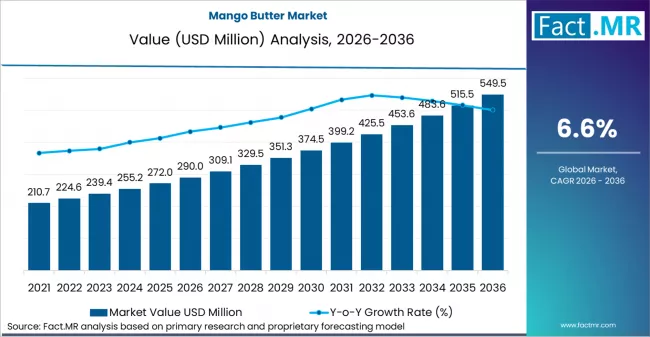
Mango Butter Market Market Value Analysis | Source: Fact.MR
Refined mango butter dominates the type segment, followed by unrefined variants. Cosmetics and personal care remain the primary application, supported by pharmaceuticals, the food industry, and soaps and toiletries, highlighting the versatility of mango butter across industries.
Market growth is driven by increasing consumer demand for natural, plant-based ingredients in skincare and personal care formulations, along with rising adoption in multifunctional products. High-growth regions such as China and India are fueling volume adoption, while mature markets including the United States, Germany, and Japan maintain demand through premium product offerings and sustainable sourcing practices. Companies focusing on high-quality, traceable, and functional mango butter are expected to capture significant market share over the forecast period.
Mango Butter Market
| Metric | Value |
|---|---|
| Market Value 2026 | USD 290 Million |
| Market Forecast Value 2036 | USD 549.5 Million |
| Forecast CAGR 2026 to 2036 | 6.6% |
Source: Fact.MR analysis. Updated Feb 2, 2026
Category
| Category | Segments |
|---|---|
| Type | Refined Mango Butter; Unrefined Mango Butter; Other |
| Application | Cosmetics and Personal Care; Pharmaceuticals; Food Industry; Soaps and Toiletries; Other |
| Form | Solid; Cream; Paste; Other |
| End User | Individual Consumers; Manufacturers; Cosmetic Brands; Other |
| Region | North America; Europe; Asia Pacific; Latin America; Middle East & Africa |
Source: Fact.MR analysis. Updated Feb 2, 2026
Segmental Analysis
Which Type Holds the Largest Share in the Mango Butter Market?
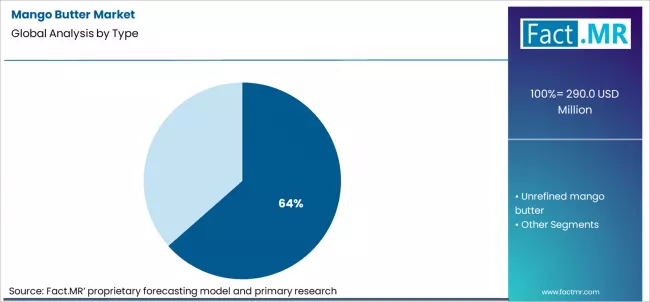
Mango Butter Market Analysis By Type | Source: Fact.MR
Refined mango butter leads the market with a 63.5% share. It is preferred for its consistent quality, smooth texture, and versatility across cosmetic and personal care formulations. Refinement removes impurities and enhances color and fragrance, making it suitable for high-performance skincare and haircare products.
- Manufacturers continue to invest in refining processes to improve purity, stability, and formulation compatibility.
- The combination of reliability, usability, and broad applicability ensures refined mango butter remains the dominant type in the market.
Which Application Drives the Highest Adoption in the Mango Butter Market?
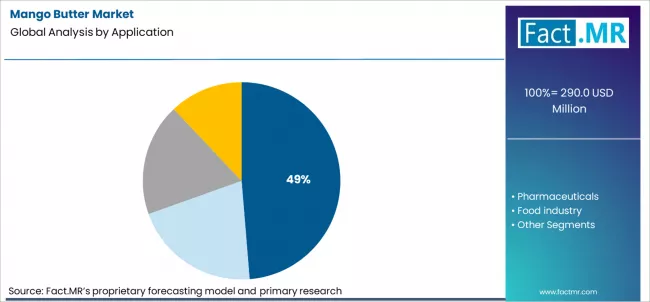
Mango Butter Market Analysis By Application | Source: Fact.MR
Cosmetics and personal care applications hold the largest share at 48.7%. Mango butter is widely incorporated into moisturizers, body butters, hair treatments, and lip care products due to its emollient properties and ability to nourish and protect the skin.
- Brands emphasize mango butter’s natural origin and functional benefits to appeal to eco-conscious and wellness-focused consumers
- Growing demand for plant-based, hydrating, and multifunctional ingredients reinforces cosmetics and personal care as the leading application segment.
What are the Drivers, Restraints, and Key Trends in the Mango Butter Market?
- Drivers: Growing demand for natural, plant-based ingredients in cosmetics, personal care, pharmaceuticals, soaps, and toiletries is driving adoption of mango butter. Refined and unrefined mango butter is increasingly used for moisturizing, emollient, and therapeutic applications. Companies such as Croda International and AAK AB are launching high-quality mango butter products to meet consumer demand for sustainable and multifunctional ingredients. Expansion of e-commerce and specialty retail channels, coupled with rising awareness of natural skin and hair care benefits, is supporting adoption across China, India, the U.S., and Europe.
- Restraints: High extraction and refining costs, seasonal availability, and variability in raw material quality limit adoption among smaller manufacturers. Maintaining consistency in texture, purity, and performance across different applications presents technical challenges that can slow product launches and restrict market penetration in emerging regions.
- Trend 1: Development of multifunctional mango butter formulations combining skin hydration, hair nourishment, and therapeutic benefits in single products.
- Trend 2: Increasing distribution through online and specialty retail channels to enhance accessibility and encourage repeat purchases globally.
Analysis of the Mango Butter Market by Key Country
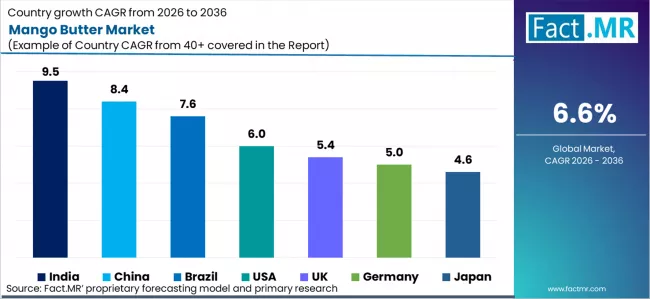
Mango Butter Market Cagr Analysis By Country | Source: Fact.MR
| Country | CAGR |
|---|---|
| China | 8.4% |
| India | 9.5% |
| Brazil | 7.6% |
| Germany | 5.0% |
| USA | 6.0% |
| UK | 5.4% |
| Japan | 4.6% |
Source: Fact.MR analysis. Updated Feb 2, 2026
How Are Personal Care and Cosmetic Trends Driving Mango Butter Demand in China?
China’s Mango Butter market is projected to grow at a CAGR of 8.4% from 2026 to 2036. Urban consumers increasingly adopt mango butter for cosmetics, moisturizers, and multifunctional skincare products. Refined formulations dominate, with premium, multifunctional, and natural ingredients supporting adoption. Retailers and e-commerce platforms enhance accessibility, while metropolitan consumers show rising interest in ingredient-focused and high-performance products.
Why Is India Emerging as a High-Growth Market for Mango Butter?
India’s market is expected to expand at a CAGR of 9.5% from 2026 to 2036. Refined mango butter is widely used in cosmetics and personal care applications. Specialty retailers and online platforms facilitate availability, while rising awareness of natural ingredients and skincare efficacy drives adoption. Urban consumers increasingly prefer multifunctional products for moisturizing, anti-aging, and skin wellness routines.
What Factors Are Influencing Mango Butter Demand in Brazil?
Brazil’s Mango Butter market is projected to grow at a CAGR of 7.6% from 2026 to 2036. Unrefined mango butter is gaining adoption in pharmaceutical and personal care applications. Retailers and specialty distributors enhance access, while interest in natural and multifunctional ingredients supports adoption. Urban consumers integrate mango butter into skincare and wellness routines, favoring premium and high-performance formulations.
How Are Food and Cosmetic Applications Supporting Mango Butter Growth in Germany?
Germany’s market is expected to expand at a CAGR of 5.0% from 2026 to 2036. Mango butter is increasingly used in food, cosmetics, and personal care products. Specialty stores and e-commerce platforms facilitate access to premium and refined formulations. Urban consumers prioritize natural, multifunctional ingredients, while product versatility supports adoption in skincare, haircare, and food applications.
Why Does the USA Remain a Key Market for Mango Butter?
The USA Mango Butter market is projected to grow at a CAGR of 6.0% from 2026 to 2036. Soaps, toiletries, and cosmetic applications are driving demand, with refined mango butter preferred for multifunctional use. E-commerce and specialty retailers enhance availability. Urban consumers increasingly seek premium, natural, and multifunctional products, supporting steady market expansion in metropolitan and suburban areas.
What Is Supporting Mango Butter Adoption in the UK?
The UK market is expected to expand at a CAGR of 5.4% from 2026 to 2036. Urban consumers are adopting mango butter in cosmetics, skincare, and personal care formulations. Retailers and online channels provide broad access, while growing awareness of natural and multifunctional ingredients encourages adoption. Premium and refined formulations are increasingly favored among metropolitan consumers.
How Is Market Maturity Affecting Mango Butter Demand in Japan?
Japan’s Mango Butter market is projected to grow at a CAGR of 4.6% from 2026 to 2036. Urban consumers prioritize high-quality refined and unrefined mango butter for cosmetics, personal care, and skincare applications. Mature retail and specialty channels support accessibility, while multifunctional and natural formulations maintain adoption. Domestic and international brands compete to provide premium and versatile offerings, sustaining steady growth in metropolitan areas.
How is Competition Structured in the Mango Butter Market?
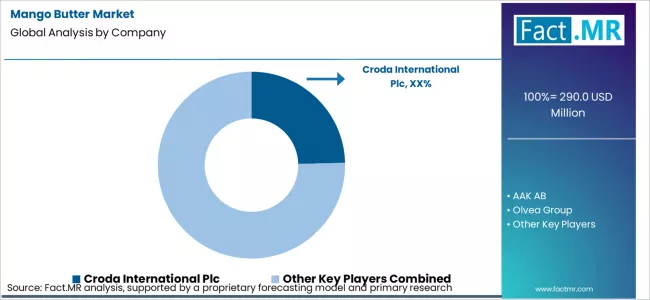
Mango Butter Market Analysis By Company | Source: Fact.MR
Competition in the Mango Butter Market is driven by type, application, and product quality. Croda International Plc leads with refined mango butter targeting cosmetics and personal care applications, emphasizing consistency, purity, and functional performance. AAK AB focuses on unrefined mango butter for pharmaceutical use, prioritizing bioactive integrity and formulation stability. Olvea Group and Bunge Limited supply mango butter for the food industry and soaps and toiletries, supporting multi-sector applications.
Akoma Cooperative, Vink Chemicals, Jarchem Industries, and All Organic Treasures differentiate through specialty sourcing, organic certification, and product versatility across cosmetic, pharmaceutical, and food applications. Competitive advantage arises from sourcing reliability, processing quality, and adaptability to diverse applications. Buyers evaluate suppliers based on consistency, functional performance, and supply chain robustness. From 2026 onward, strategies are expected to focus on high-purity, application-specific mango butter formulations, traceable sourcing, and integration with multi-functional product lines, enhancing adoption across personal care, pharmaceutical, and food sectors.
Key Players in the Mango Butter Market
- Croda International Plc
- AAK AB
- Olvea Group
- Bunge Limited
- Akoma Cooperative
- Vink Chemicals
- Jarchem Industries
- All Organic Treasures
Bibliography
- European Commission. (2024). Scientific Committee on Consumer Safety: safety assessment of plant-derived butters and oils used in cosmetic products. European Commission.
- National Institutes of Health. (2024). Mango (Mangifera indica) seed butter: composition, bioactivity, and applications in dermatology and personal care. National Library of Medicine.
- U.S. Food and Drug Administration. (2023). Cosmetic ingredient safety and labeling requirements. U.S. Food and Drug Administration.
- Organisation for Economic Co-operation and Development. (2023). Consumer trends in natural and plant-based personal care products. OECD.
- United Nations Environment Programme. (2023). Sustainable sourcing of botanical ingredients for cosmetics and personal care. United Nations Environment Programme.
Segmentation
Scope of the Report
| Items | Values |
|---|---|
| Quantitative Units (2026) | USD 290 Million |
| Type | Refined Mango Butter, Unrefined Mango Butter, Other |
| Application | Cosmetics and Personal Care, Pharmaceuticals, Food Industry, Soaps and Toiletries, Other |
| Regions Covered | Asia Pacific, North America, Europe, Latin America, and Middle East & Africa |
| Countries Covered | China, India, Brazil, Germany, USA, UK, Japan, and other countries |
| Key Companies Profiled | Croda International Plc, AAK AB, Olvea Group, Bunge Limited, Akoma Cooperative, Vink Chemicals, Jarchem Industries, All Organic Treasures, and other leading mango butter producers |
| Additional Attributes | Dollar revenue by type, application, and region; regional demand trends, competitive landscape, innovations in extraction and refinement, cosmetic and pharmaceutical formulation strategies, premium product positioning, and brand differentiation analysis |
Source: Fact.MR analysis. Updated Feb 2, 2026
Mango Butter Market by Segments
-
Type :
- Refined Mango Butter
- Unrefined Mango Butter
-
Application :
- Cosmetics and Personal Care
- Pharmaceuticals
- Food Industry
- Soaps and Toiletries
-
Region :
- North America
- U.S.
- Canada
- Mexico
- Europe
- Germany
- Italy
- UK
- France
- Spain
- Netherlands
- Switzerland
- Rest of Europe
- Asia Pacific
- Japan
- Australia
- South Korea
- China
- India
- Rest of Asia Pacific
- Latin America
- Brazil
- Argentina
- Rest of Latin America
- Middle East and Africa
- United Arab Emirates
- South Africa
- Rest of Middle East and Africa
- North America
Who worked on this report


Preview the report firsthand - request a free sample
Free SampleGet the brochure for pricing and purchase details
Download PDF