- Market Value (2025): USD 2.0 Bn
- Estimated Value (2026): USD 2.2 Bn
- Forecast Value (2036): USD 5.9 Bn
- CAGR (2026-2036): 10.3%
What is the marine propulsion control units market forecast to be worth by 2036?
USD 2.2 billion in 2026 to USD 5.9 billion by 2036 at a 10.3% CAGR.
- As per Fact.MR analysis, the marine propulsion control units market reached USD 2.0 billion in 2025.
- Demand is forecast to increase from USD 2.2 billion in 2026 to USD 5.9 billion by 2036.
- The market is forecast to record 10.3% CAGR from 2026 to 2036.
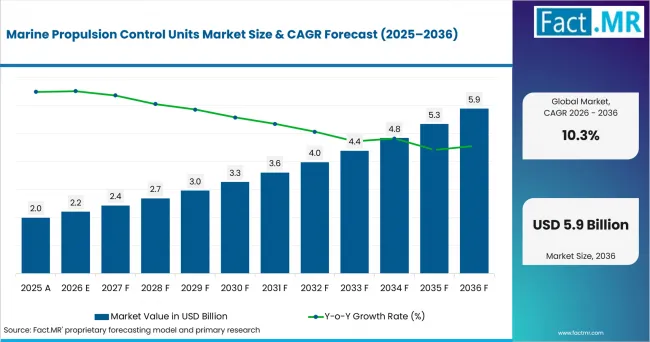
Marine Propulsion Control Units Market Value Analysis | Source: Fact.MR
What are the main market growth numbers?
An absolute growth option of USD 3.7 billion is expected between 2026 and 2036.
- Demand Drivers in the Market
- Fleet operators need reliable engine and propeller control. Small control errors can increase fuel use and affect ship handling.
- Hybrid ships need controls that manage engine and electric power together. This keeps thrust steady when batteries and engines share the load.
- Shipyards need control units that work with diesel shaft and diesel-electric systems. Clear start-up steps make ship approval easier.
- The International Maritime Organization stated in April 2025 that ships covered by its proposed net-zero framework account for 85% of international shipping CO2 emissions [3]. This increases the need to control ship power and thrust.
- Key Segments Analyzed
- By Control Scope: Engine control is expected to hold a 33.0% share in 2026 because it controls engine speed and safety.
- By Vessel: Commercial ships lead with 29.0% share in 2026 as they operate for many years and need control system replacements.
- By Propulsion: Diesel mechanical accounts for 36.0% share in 2026 since it is widely used in merchant ships and workboats.
- By Interface: Standalone ECU is expected to hold a 32.0% share in 2026 due to many vessels use separate units for propulsion and bridge control.
- Analyst Opinion at Fact.MR
- Fact.MR Principal Consultant Shambhu Nath Jha states, “Drive control now connects the engine with other ship systems. Shipyards need systems that manage propulsion and allow crews to switch control easily. Suppliers also need reliable backup, simple system connections, and service support.”
- Strategic Implications
- Control system companies should use common marine connections. This makes it easier to connect engines and gearboxes across different vessels.
- Shipyards should plan the drive control system early. Backup systems and cable routes should be set before testing.
- Fleet operators can keep working parts and replace old processors and displays. This reduces vessel changes and makes approval easier.
Japan is expected to grow at 10.3% CAGR through 2036 due to shipbuilding and container traffic. The USA follows at 10.0% as fleets upgrade control systems. Germany stands at 9.7% due to vessel design, while France records 9.4% due to port traffic. The UK is expected to grow at 8.2% as vessel upgrades continue.
How does the market break down by segment?
Diesel shaft is forecast to lead Drive at 36.0% share in 2026. Engine control leads Control Scope at 33.0% share.
Which Control Scope dominates?
Engine control is forecast to hold 33.0% share in 2026.
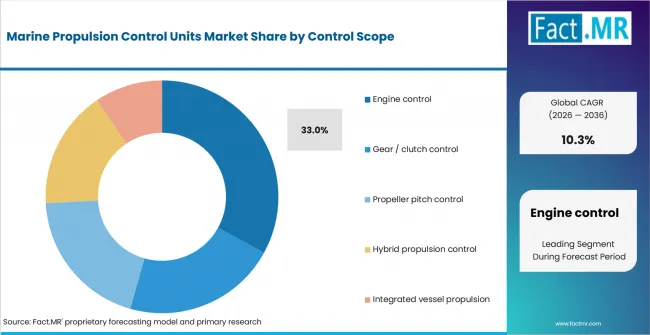
Marine Propulsion Control Units Market Analysis By Control Scope | Source: Fact.MR
Engine control manages engine speed and power from the bridge. Gear and clutch control connects the engine to the shaft at the right time. Propeller pitch control changes the propeller angle. Hybrid drive control manages batteries, electric drives, and other power sources.
What leads the Vessel segment?
Fleet ships are forecast to account for 29.0% share in 2026.
Commercial ships need control system replacements during their service life. Naval vessels need reliable backup systems. Offshore vessels need steady thrust to stay in position, while ferries need good control at low speeds. Yachts and workboats need small control units that are easy to use.
How does Propulsion shape demand?
Diesel shaft is forecast to lead with 36.0% share in 2026.
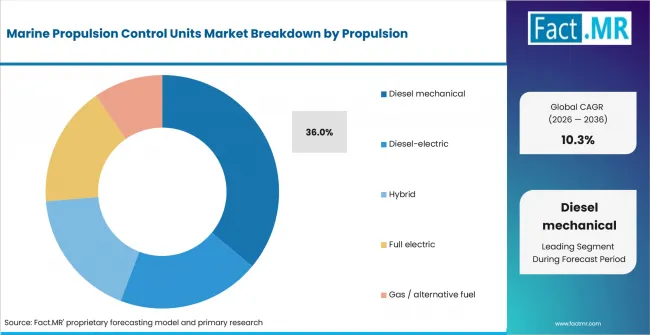
Marine Propulsion Control Units Market Analysis By Propulsion | Source: Fact.MR
Diesel shaft systems are widely used because one unit controls the engine, gearbox, and thrust. Diesel-electric systems also control generators and motors. Hybrid systems manage different power sources, while electric vessels rely on electric power controls. Gas and alternative-fuel systems need controls that keep fuel use within safe limits when power changes. Wärtsilä announced in September 2025 that two high-speed battery-electric ferries for Molslinjen would use its ProTouch propulsion control system [7].
What supports Standalone ECU within Interface?
Distinct ECU is forecast to make up 32.0% share in 2026.
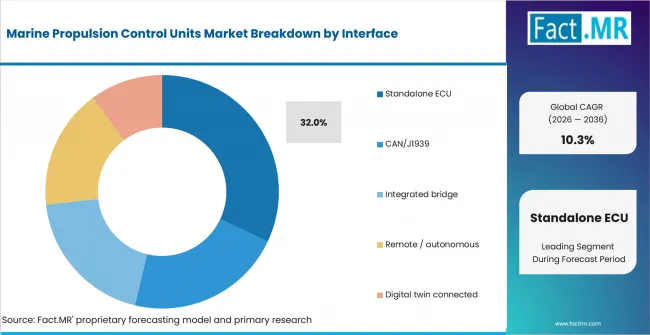
Marine Propulsion Control Units Market Analysis By Interface | Source: Fact.MR
Separate ECUs keep drive safety controls in one unit. CAN/J1939 allows engines and transmissions to share data. Bridge connections link drive controls with the main ship system. Remote control allows operation from different parts of the vessel. Digital-twin connections provide service data while safety controls stay in the main system.
What is driving market use, and what is holding it back?
Electric drives and connected ship controls increase use, while difficult upgrades and approval checks can slow growth.
Drivers Impact Analysis
| DRIVER | (~) % IMPACT ON CAGR | GEOGRAPHIC RELEVANCE | IMPACT TIMELINE |
|---|---|---|---|
| Hybrid and electric propulsion integration | +1.8% | North America, Europe, East Asia | Medium term (2-4 years) |
| Fleet retrofit of aging control electronics | +1.5% | Global | Short term (<= 2 years) |
| Integrated bridge and maneuvering control | +1.2% | Europe, East Asia | Medium term (2-4 years) |
| Alternative-fuel propulsion complexity | +0.9% | Europe, East Asia | Long term (>= 4 years) |
| Remote monitoring and lifecycle service | +0.7% | Global | Long term (>= 4 years) |
Source: Fact.MR analysis. Updated Oct 5, 2026
Opportunity Impact Analysis
| OPPORTUNITY | (~) % IMPACT ON CAGR | GEOGRAPHIC RELEVANCE | IMPACT TIMELINE |
|---|---|---|---|
| Control retrofits using existing actuators | +1.1% | Global | Short term (<= 2 years) |
| Hybrid power and propulsion coordination | +0.9% | Europe, East Asia | Medium term (2-4 years) |
| Unified bridge and propulsion interfaces | +0.7% | North America, Europe | Medium term (2-4 years) |
| Remote-support and digital-twin connectivity | +0.5% | Global | Long term (>= 4 years) |
Source: Fact.MR analysis. Updated Oct 5, 2026
Restraints Impact Analysis
| RESTRAINT | (~) % IMPACT ON CAGR | GEOGRAPHIC RELEVANCE | IMPACT TIMELINE |
|---|---|---|---|
| Legacy interface incompatibility | -0.8% | Global | Short term (<= 2 years) |
| Class approval and validation effort | -0.6% | Global | Medium term (2-4 years) |
| Vessel downtime during retrofit | -0.5% | North America, Europe | Short term (<= 2 years) |
| Cybersecurity and remote-access controls | -0.4% | Europe, North America | Long term (>= 4 years) |
Source: Fact.MR analysis. Updated Oct 5, 2026
Which countries are growing fastest through 2036?
- The country comparison spans 2.1 points across the five profiled markets during the forecast period.
- Japan remains 0.3 point above the USA as shipyard work traffic supports linked drive programs.
- The USA remains 0.3 point above Germany as fleet upgrades keeps refit demand active.
- Germany remains 0.3 point above France through niche marine design and fleet vessel traffic.
- France remains 1.2 points above the UK as port traffic supports regular use of fleet and service vessels.
- The UK closes the displayed range while fleet renewal keeps drive-control service and swap work active.
Comparable CAGRs can produce different entry conditions because vessel age and drive architecture vary by country. Full report coverage includes North America, Latin America, Western Europe, Eastern Europe, East Asia, South Asia & Pacific, Middle East & Africa.
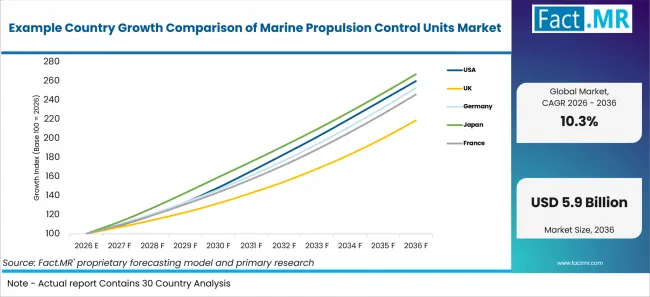
Example Country Growth Comparison Of Marine Propulsion Control Units Market | Source: Fact.MR
| Country | CAGR (2026-2036) |
|---|---|
| Japan | 10.3% |
| USA | 10.0% |
| Germany | 9.7% |
| France | 9.4% |
| UK | 8.2% |
Source: Fact.MR analysis. Updated Oct 5, 2026
How does Japan perform?
10.3% CAGR, led by shipyard work skill and container traffic.
Japan has a large shipbuilding industry and busy ports, which increases the use of control units in new and existing ships. Japan's transport ministry reported in August 2026 that Japanese ports handled 22.36 million TEU in 2025 [4]. Suppliers focus on easy system connections and service support.
What supports USA use?
10.0% CAGR, backed by fleet upgrades and shipyard traffic.
The U.S. market includes fleet upgrades, defense ships, and domestic shipping. The Maritime Administration reported in August 2026 that the U.S.-flag ocean-going merchant fleet had 190 self-propelled vessels [6]. These ships may need new control systems while using the same engines and transmissions.
What is supporting Germany’s use?
9.7% CAGR, backed by seaport traffic and niche vessel design.
Germany has an active seaports and builds specialized ships. Destatis reported in March 2026 that German seaports handled 284.4 million tonnes of goods in 2025 [2]. Regular ship traffic increases service needs. Shipyards also need easy-to-use controls for diesel-electric and hybrid ships.
What is supporting France’s use?
9.4% CAGR, backed by port traffic and fleet renewal.
France has merchant and service ships that use standard and electric drives. The Service des données et études statistiques reported in July 2026 that French ports handled 333.4 million tonnes of freight in 2025 [5]. Regular ship traffic increases the need for new and replacement control systems.
What supports the United Kingdom’s growth?
8.2% CAGR, shaped by an established running fleet and refit demand.
The UK has many ships that need control system upgrades and service support. The Department for Transport reported in February 2026 that the UK Ship Register had 1,034 vessels at the end of 2025 [1]. Suppliers can replace old controls while keeping working ship equipment.
Which companies lead the market?
Kongsberg Maritime supplies AutoChief propulsion controls and ship movement systems. Wärtsilä offers ProTouch controls for different ships and propulsion systems. Its EcoControl system adjusts propeller pitch and engine speed to improve efficiency. ABB Marine & Ports connects propulsion controls with electric power and bridge systems. Everllence supplies Alphatronic controls for Alpha propellers. Rolls-Royce Power Systems and Caterpillar Marine also supply marine propulsion controls.
ABB reported in April 2025 that MARIN verified an open-water efficiency of 0.808 at 18 knots for a 3 MW full-scale ABB Dynafin™ propulsion unit.
Kongsberg Maritime has long experience in propulsion and remote controls. Wärtsilä, ABB, Everllence, Rolls-Royce Power Systems, and Caterpillar Marine supply controls along with propulsion and power systems. Buyers can compare how these controls work with engines, propellers, electric power, and bridge systems.
Which firms are the key providers?
Key firms include Kongsberg Maritime; Wärtsilä; ABB Marine & Ports; Everllence (formerly MAN Energy Solutions); Rolls-Royce Power Systems; and Caterpillar Marine.
- Kongsberg Maritime
- Wärtsilä
- ABB Marine & Ports
- Everllence (formerly MAN Energy Solutions)
- Rolls-Royce Power Systems
- Caterpillar Marine
Bibliography
- [1] Department for Transport. (2026, February 25). Shipping fleet statistics: 2025.
- [2] Statistisches Bundesamt (Destatis). (2026, March 10). Seeverkehr 2025: Güterumschlag steigt um 3,8 % gegenüber dem Vorjahr [Maritime transport 2025: Cargo throughput increases by 3.8% compared with the previous year].
- [3] International Maritime Organization. (2025, April 11). IMO approves net-zero regulations for global shipping.
- [4] Ministry of Land, Infrastructure, Transport and Tourism, Japan. (2026, August 21). 2025[2025 domestic port container throughput: Preliminary results].
- [5] Service des données et études statistiques. (2026, July 24). Rebond du trafic maritime de fret en France en 2025 [Recovery in maritime freight traffic in France in 2025].
- [6] U.S. Maritime Administration. (2026, August). U.S.-flag fleet dashboard.
- [7] Wärtsilä. (2025, September 10). Wärtsilä to equip two high-speed fully battery-electric Danish ferries with integrated electric propulsion system and waterjets.
This Report Answers
- The report explains how propulsion control units connect bridge commands with engines and propellers across conventional and electrified vessel architectures.
- Segment analysis identifies the leading subsegments and explains why control requirements differ across vessel types and propulsion layouts.
- Country analysis compares five markets and the operating conditions that shape propulsion-control demand.
- Competitive analysis reviews active suppliers by control products and integration breadth without adding company market-share estimates.
What does the Marine Propulsion Control Units Market cover?
The Marine Propulsion Control Units Market covers hardware and software that command vessel propulsion and coordinate response with bridge inputs. Related marine steering systems influence maneuvering but remain outside the core propulsion-control boundary.
The assessment includes interfaces with marine switchboards when ship power affects propulsion operation. The switchboard itself remains a separate equipment category.
The core test for scope is whether the product sends or shapes a propulsion command. A display that only shows data stays outside the core category. A unit that checks a bridge order and sends a safe engine or propeller command stays inside. This rule keeps the market focused on command and control while still allowing links with power and ship automation systems.
What is included in the scope?
Included offerings cover propulsion-control hardware and operator interfaces that directly command engines or propellers. The scope can interact with marine gensets when generator loading affects diesel-electric propulsion response.
The analysis includes coordination with marine power battery systems where stored energy limits influence hybrid or fully electric propulsion commands.
Shaft-driven power functions are considered when they affect propulsion coordination, including interaction with marine shaft generator systems in integrated powertrains.
What is excluded from the scope?
Standalone engines and turbocharging hardware fall outside the control-unit boundary. Adjacent marine turbochargers are treated as engine components unless their actuators are directly managed by the propulsion controller.
Fuel supply remains outside the market boundary, including low-carbon ammonia propulsion as a fuel category. Control units that manage engine response to alternative-fuel operation remain within scope.
How Was the Analysis Built?
The analysis draws on 120+ sources, 35+ company portfolios, 25+ countries, and more than 20 industry interviews.
- Primary Research: Primary research includes discussions with manufacturers, service providers, technology developers, distributors, end users, and subject-matter experts. These conversations examine purchasing priorities, product adoption, operational challenges, approval requirements, competitive positioning, and the factors that influence wider market acceptance.
- Desk Research: Desk research covers government statistics, regulatory publications, company filings, trade data, technical studies, industry associations, standards, public policy, and other authoritative sources. Every source used in the analysis is documented in the bibliography.
- Market Sizing and Forecasting: Market estimates combine historical performance, demand indicators, pricing and volume trends, segment shares, company participation, country-level growth, adoption patterns, investment activity, and barriers to market expansion.
- Data Validation and Update Cycle: Findings are validated by comparing primary interviews with public data, company activity, regulatory changes, trade patterns, and industry developments. Regular updates review new product launches, capacity changes, partnerships, approvals, and shifts in commercial adoption.
Segmentation
What is the report’s scope and coverage?
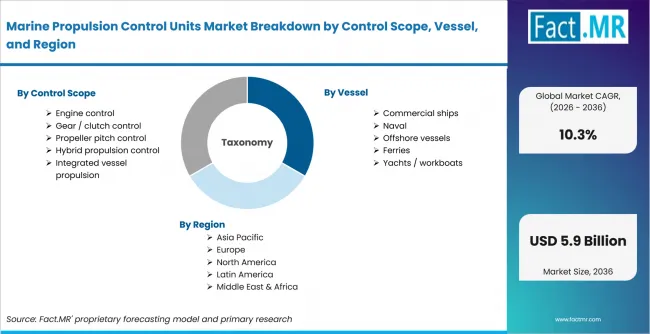
Marine Propulsion Control Units Market Breakdown By Control Scope, Vessel, And Region | Source: Fact.MR
| Attribute | Details |
|---|---|
| Quantitative Units | USD billion |
| Market Definition | Electronic and electro-mechanical control units used to command and coordinate vessel propulsion equipment. |
| Control Scope | Engine control; Gear / clutch control; Propeller pitch control; Hybrid propulsion control; Integrated vessel propulsion |
| Vessel | Commercial ships; Naval; Offshore vessels; Ferries; Yachts / workboats |
| Propulsion | Diesel mechanical; Diesel-electric; Hybrid; Full electric; Gas / alternative fuel |
| Interface | Standalone ECU; CAN/J1939; Integrated bridge; Remote / autonomous; Digital twin connected |
| Regions Covered | North America; Latin America; Western Europe; Eastern Europe; East Asia; South Asia & Pacific; Middle East & Africa |
| Countries Covered | USA; UK; Germany; Japan; France |
| Key Companies Profiled | Kongsberg Maritime; Wärtsilä; ABB Marine & Ports; Everllence; Rolls-Royce Power Systems; Caterpillar Marine |
| Forecast Period | 2026 to 2036 |
| Approach | Hybrid top-down and bottom-up approach using fleet activity, propulsion architecture, installed-base replacement, newbuild demand and provider portfolio review. |
Source: Fact.MR analysis. Updated Oct 5, 2026
How is the market segmented?
-
By Control Scope:
- Engine control
- Gear / clutch control
- Propeller pitch control
- Hybrid propulsion control
- Integrated vessel propulsion
-
By Vessel:
- Commercial ships
- Naval
- Offshore vessels
- Ferries
- Yachts / workboats
-
By Propulsion:
- Diesel mechanical
- Diesel-electric
- Hybrid
- Full electric
- Gas / alternative fuel
-
By Interface:
- Standalone ECU
- CAN/J1939
- Integrated bridge
- Remote / autonomous
- Digital twin connected
-
By Region:
- North America
- Latin America
- Western Europe
- Eastern Europe
- East Asia
- South Asia & Pacific
- Middle East & Africa
Frequently Asked Questions
How big is the marine propulsion control units market in 2026?
What is the CAGR of the marine propulsion control units market from 2026 to 2036?
Which control scope leads the marine propulsion control units market?
Which propulsion type leads the marine propulsion control units market?
Who are the leading companies in the marine propulsion control units market?
Who worked on this report


Preview the report firsthand - request a free sample
Free SampleGet the brochure for pricing and purchase details
Download PDF