- Market Value (2025): USD 207.6 Mn
- Estimated Value (2026): USD 222.0 Mn
- Forecast Value (2036): USD 435.0 Mn
- CAGR (2026-2036): 7.0%
What is the Mash Filtration System Market forecast to be worth by 2036?
USD 222.0 million in 2026 to USD 435.0 million by 2036 at a 7.0% CAGR from 2026 to 2036.
- The Mash Filtration System Market was valued at USD 207.6 million in 2025, supported by replacement demand and efficiency-led brewhouse upgrades.
- Demand is projected to increase from USD 222.0 million in 2026 to USD 435.0 million by 2036.
- The market is forecast to record a 7.0% CAGR from 2026 to 2036, driven by extract yield gains and tighter water use in brewhouses.
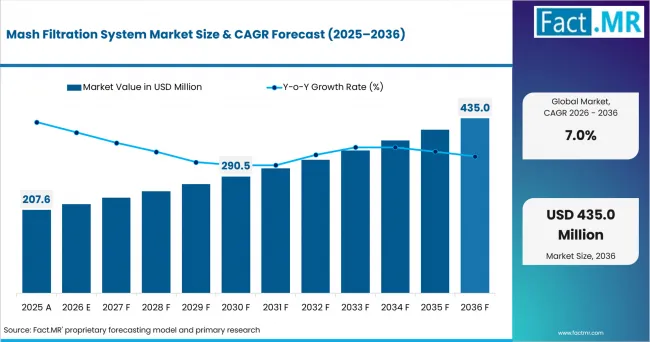
Mash Filtration System Market Value Analysis | Source: Fact.MR
What are the defining numbers behind Mash Filtration System Market growth?
USD 213.0 million absolute opportunity is expected by 2036, led by membrane mash filters and craft/microbrewery-scale systems.
- Demand Drivers in the Market
- Higher extract recovery is expected to lower malt use for a given volume of finished beer and make payback easier to prove.
- Reduced sparging water is projected to cut wastewater load where breweries face tighter discharge cost and water-use targets.
- Thin-bed filtration is anticipated to support high-adjunct recipes and non-barley grists that struggle in a conventional lauter tun.
- Shorter separation cycles are expected to raise brewhouse output without adding a second lauter vessel or extending production hours.
- Key Segments Analyzed
- By System Type: Membrane mash filters are expected to hold 34.0% share in 2026 supported by higher wort recovery and lower extract loss during membrane squeezing.
- By Capacity: Craft/microbrewery systems are projected to account for 26.0% share in 2026 owing to compact designs that fit breweries with limited production space.
- By Application: Beer brewing is anticipated to capture 36.0% share in 2026 due to the central role of wort separation in brewhouse output and recipe consistency.
- By Automation Level: Fully automated systems are estimated to represent 34.0% share in 2026 attributable to tighter control over squeezing, washing and spent-grain discharge.
- By End User: Large breweries are forecast to hold 32.0% share in 2026 supported by quicker returns when small yield improvements are repeated across high brew volumes.
- Analyst Opinion at Fact.MR
- Shambhu Nath Jha, Senior Analyst at Fact.MR, states, “Choosing mash filtration affects more than the filter itself. It also changes how the grain is milled, how much wort is recovered, how much water is used and how quickly each batch is completed. Equipment companies that help with milling setup, membrane care and control systems are likely to make the change easier for breweries.”
- Strategic Implications
- Breweries can compare added wort recovery with malt spending to judge whether the equipment delivers a practical payback.
- Equipment companies should help breweries adjust milling settings and recipes when they move away from lauter-based separation.
- Manufacturers can develop smaller automated systems for regional and craft breweries that have limited floor space.
- Service companies should keep membranes, control parts and other critical spares readily available because slow replacement may interrupt brewing schedules.
In November 2025, Krones reported that Hijos de Rivera inaugurated its new production facility in Morás, Spain, in mid-June 2025. The project includes Steinecker brewing technology and a brewhouse with a Steinecker mash filter for 12 brews per day. The development shows how large breweries are tying mash filtration to output expansion, energy recovery and automated process control in new brewhouse investments.
UAE is estimated to post a 7.7% CAGR by 2036. USA is anticipated to advance at a 7.0% CAGR from 2026 to 2036. Japan is forecast to record a 6.9% CAGR through 2036. UK is projected to post a 6.7% CAGR by 2036. Germany is estimated to record a 6.4% CAGR from 2026 to 2036.
How does the Mash Filtration System Market break down by segment?
Membrane mash filters are expected to lead System Type at 34.0% share in 2026. Craft/microbrewery is projected to lead Capacity at 26.0% share in 2026.
Why do Membrane mash filters lead System Type?
Membrane mash filters hold 34.0% share in 2026.
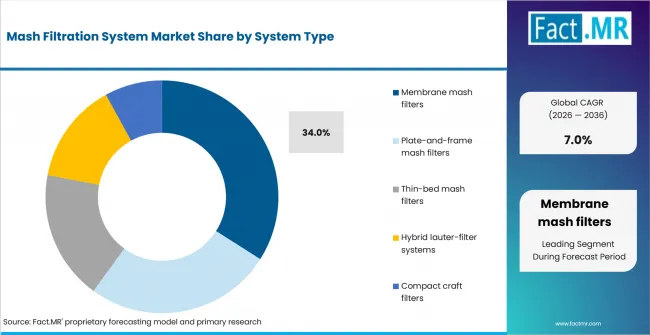
Mash Filtration System Market Analysis By System Type | Source: Fact.MR
Their position comes from the way they press a shallow grain bed after the first wort has drained. This extra step removes more liquid from the spent grain and helps breweries reduce extract left behind. The system is therefore attractive where malt efficiency has a direct effect on production cost.
Why does Craft/microbrewery lead Capacity?
Craft/microbrewery systems account for 26.0% share in 2026.
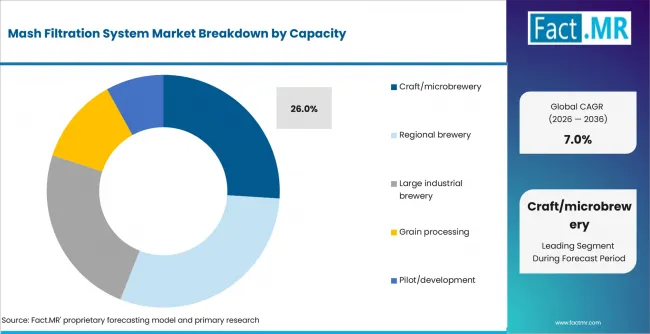
Mash Filtration System Market Analysis By Capacity | Source: Fact.MR
Smaller breweries often work with tight floor plans and limited staff. Compact mash filters give them a route to increase output without adding a large lauter tun or expanding the brewhouse. The format also suits plants where one operator manages several brewing stages during the same shift.
Why does Beer brewing lead Application?
Beer brewing leads with 36.0% share in 2026.
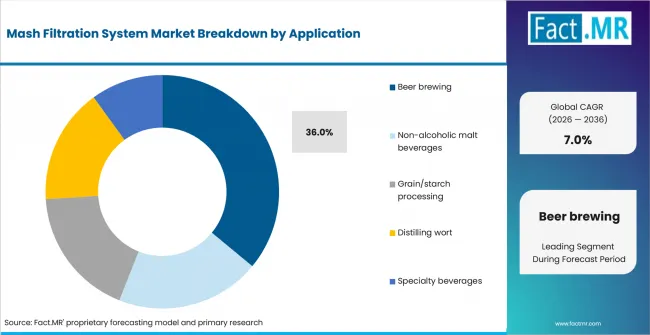
Mash Filtration System Market Analysis By Application | Source: Fact.MR
Mash filtration is used repeatedly in beer production because every brew requires wort to be separated from the grain. The equipment also gives brewers more control over wort strength and recipe consistency. Other uses remain narrower and do not create the same regular equipment demand.
Why do Fully automated systems lead Automation Level?
Fully automated systems are estimated to hold 34.0% share in 2026.
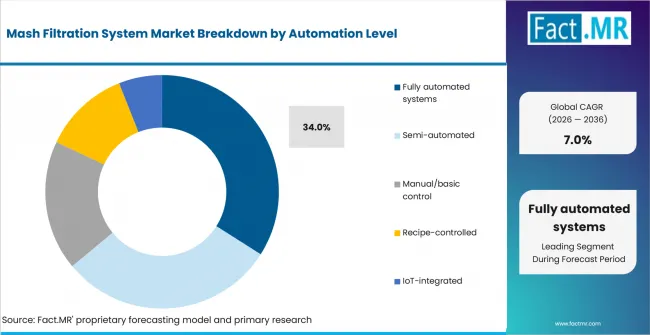
Mash Filtration System Market Analysis By Automation Level | Source: Fact.MR
Their value comes from controlling pressure changes, washing time and cake discharge in the same sequence for every batch. This reduces dependence on manual judgment during the most sensitive parts of filtration. Breweries also gain more predictable cycle times when production schedules are tightly planned.
Why do Large breweries lead End User?
Large breweries account for 32.0% share in 2026.
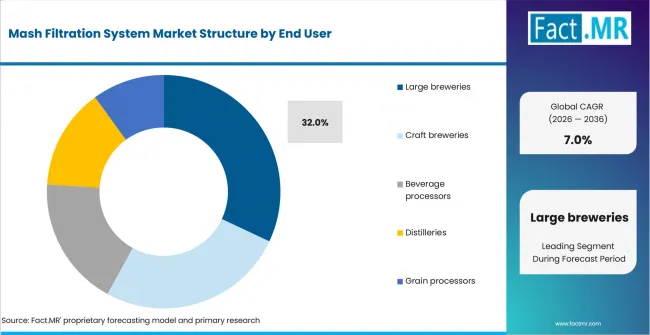
Mash Filtration System Market Analysis By End User | Source: Fact.MR
These plants process enough malt for small improvements in extract recovery to produce a meaningful annual saving. High brew frequency also shortens the payback period for advanced filtration equipment. Investment decisions are therefore tied to repeated cost gains across a large production base.
What is accelerating Mash Filtration System Market adoption, and what is holding it back?
Brewhouse efficiency is anticipated to expand Mash Filtration System Market demand, although high initial investment is expected to restrain adoption.
Drivers Impact Analysis
| DRIVER | (~) % IMPACT ON CAGR | GEOGRAPHIC RELEVANCE | IMPACT TIMELINE |
|---|---|---|---|
| Extract-yield recovery | +2.0% | China; USA; Germany | Short term (<=2 years) |
| Water and wastewater reduction | +1.5% | UAE; China; USA | Medium term (2-4 years) |
| High-adjunct recipe handling | +1.1% | China; Japan; UK | Short term (<=2 years) |
| Brewhouse debottlenecking | +0.7% | China; Germany; USA | Medium term (2-4 years) |
Source: Fact.MR analysis. Updated Jul 22, 2026
- Extract-yield recovery: Meura states that its Meura 2001 Hybrid mash filter is designed for high extract yield and more than 14 brews per day. That supports adoption where breweries measure malt loss tightly before approving capital equipment.
- Water and wastewater reduction: UAE’s Ministry of Energy and Infrastructure reported in March 2025 that the country aims to cut total water-resource demand by 21% by 2036. Breweries in water-sensitive markets are expected to value lower sparging and lower wastewater load.
- High-adjunct recipe handling: Mash filtration is anticipated to gain attention where breweries test wheat and maize blends or local cereals. A thinner bed gives engineers more control when conventional lautering slows or blinds.
- Brewhouse debottlenecking: Separation speed is expected to carry weight when a brewery cannot add another lauter vessel. Mash filtration shortens the liquid-solid separation step and gives engineers a route to higher brews per day within the same brewhouse envelope.
Opportunity Impact Analysis
| OPPORTUNITY | (~) % IMPACT ON CAGR | GEOGRAPHIC RELEVANCE | IMPACT TIMELINE |
|---|---|---|---|
| Compact craft systems | +1.2% | USA; UK; Japan | Short term (<=2 years) |
| Automated cycle data | +0.9% | Germany; Japan; China | Medium term (2-4 years) |
| Low and no-alcohol brewing | +0.7% | UK; Germany; Japan | Medium term (2-4 years) |
| Distilling and grain extract use | +0.5% | USA; China; UAE | Long term (>=4 years) |
Source: Fact.MR analysis. Updated Jul 22, 2026
- Compact craft systems: Brewers Association data show that the USA still had 9,578 craft breweries in 2025. Smaller systems are expected to address breweries that need better yield but lack space for industrial equipment.
- Automated cycle data: Fully automated systems are projected to help engineers compare pressure, flow and wash timing across batches. That data supports repeatable wort quality without constant manual adjustment.
- Low and no-alcohol brewing: Eurostat reported in August 2025 that EU production of beer below 0.5% alcohol rose 11.1% in 2024. New recipe formats are expected to favor brewhouse systems that handle varied grain bills consistently.
- Distilling and grain extract use: Mash filtration is expected to extend into grain-based spirits and extract production where clear liquid recovery follows mashing. These uses add demand without changing the core equipment logic.
Restraints Impact Analysis
| RESTRAINT | (~) % IMPACT ON CAGR | GEOGRAPHIC RELEVANCE | IMPACT TIMELINE |
|---|---|---|---|
| High initial investment | -1.6% | Global | Short term (<=2 years) |
| Milling and recipe learning curve | -1.1% | USA; UK; Japan | Medium term (2-4 years) |
| Membrane and plate maintenance | -0.8% | China; Germany; UAE | Medium term (2-4 years) |
| Conservative brewing culture | -0.5% | Germany; Japan; UK | Long term (>=4 years) |
Source: Fact.MR analysis. Updated Jul 22, 2026
- High initial investment: A mash filter press is usually tied to grist handling, controls and installation work. The upfront cost is expected to slow projects where breweries cannot prove malt savings clearly.
- Milling and recipe learning curve: Fine grist preparation changes how brewers build recipes and manage wort flow. Adoption is anticipated to move slower when production staff prefer familiar lauter tun behavior.
- Membrane and plate maintenance: Cloths, plates and membranes need careful handling during cleaning and discharge. Poor maintenance is expected to reduce yield benefits and weaken operator confidence.
- Conservative brewing culture: Traditional markets often need long internal proof before changing core brewhouse steps. This is expected to keep replacement cycles slower in heritage brewing regions.
Which countries are scaling Mash Filtration System Market fastest?
A global growth rate represents the weighted average of all countries included in the analysis. It may therefore sit above or below the rates shown for a limited set of example markets. The countries presented here do not represent the full coverage set. Their comparison with the global figure should be read as an illustration of different national demand conditions.
- The listed countries are separated less by wide CAGR differences and more by the commercial route behind each forecast. China and the UAE form a compact upper group while a clearer step separates them from the USA. The USA and Japan remain closely aligned. The United Kingdom and Germany form another measured pair.
- China’s position reflects brewhouse modernization at large beverage plants where higher extract recovery and shorter filtration cycles improve output. The UAE follows a different route through water-sensitive plant design and closer attention to sparging demand and wastewater volume.
- The USA is expected to develop through selective upgrades across craft and regional breweries. Japan is positioned nearby but places more weight on automated cycle control and repeatable brewing records. The United Kingdom depends on compact equipment and service access for mature craft breweries. Germany remains more closely tied to careful replacement decisions because many breweries protect established production methods.
- Markets with broadly similar CAGRs may therefore create different entry conditions for mash filtration companies. Equipment timing depends on brewery size and water costs alongside staff readiness to change milling and wort-separation routines.
The full report examines these differences across every country included in the study. It provides country-level CAGR analysis across North America, Latin America, Europe, East Asia, South Asia, Oceania, and the Middle East and Africa.
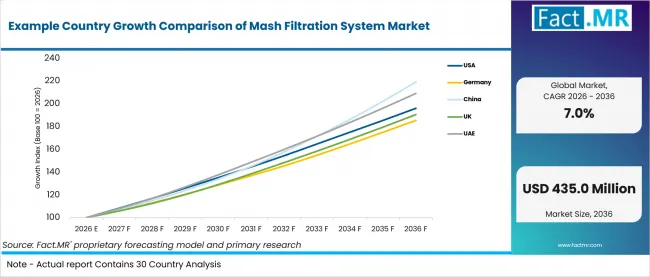
Example Country Growth Comparison Of Mash Filtration System Market | Source: Fact.MR
| COUNTRY | CAGR |
|---|---|
| UAE | 7.7% |
| USA | 7.0% |
| Japan | 6.9% |
| UK | 6.7% |
| Germany | 6.4% |
Source: Fact.MR analysis. Updated Jul 22, 2026
How is the UAE scaling demand?
7.7% CAGR, driven by water-efficiency targets and lower wastewater volumes.
Water use gives the UAE a clear business case for mash filtration. The national water strategy seeks to reduce total demand and expand treated-water reuse by 2036. Breweries are therefore expected to examine how much sparging water a system saves and how far it reduces the liquid load sent for treatment.
What supports USA adoption?
7.0% CAGR, led by selective upgrades across a large craft brewery base.
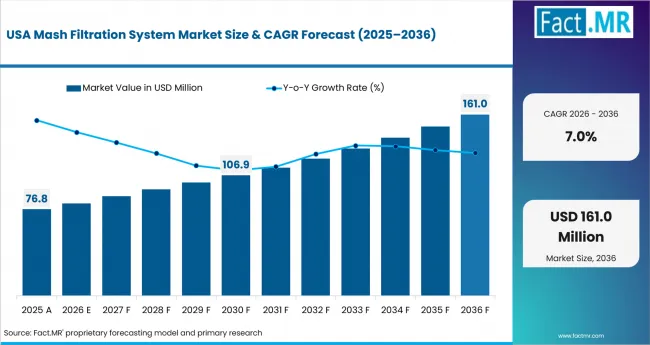
Mash Filtration System Market Country Value Analysis | Source: Fact.MR
The USA market is moving through a period of tighter capital spending among craft breweries. This makes equipment payback more important than simple capacity addition. Mash filters are expected to gain attention where operators can connect the investment with lower malt use, shorter batch cycles and more output from existing brewhouse space.
How does Japan perform?
6.9% CAGR, shaped by production control and changing alcohol-tax conditions.
Japanese breweries operate in a market where detailed production records and cost control carry growing importance. Automated mash filters give operators repeatable pressure, washing and discharge settings across each batch. This supports adoption in plants that want tighter raw-material control while adjusting to tax and pricing changes.
What shapes United Kingdom growth?
6.7% CAGR, backed by small-producer support and gradual draught-beer investment.
The United Kingdom offers a practical opening among breweries that want to expand without rebuilding the full plant. Duty relief for qualifying small producers and draught products supports a measured investment route. Compact mash filters suit this environment because they help raise output within limited floor space.
How does Germany perform?
6.4% CAGR, driven by changing beer categories within a mature brewing base.
Germany’s outlook is increasingly influenced by the rise of alcohol-free beer. Production of these products has expanded while output of traditional alcoholic beer has declined. Breweries may therefore place greater value on filtration systems that handle varied recipes and grain bills without weakening process consistency.
Who leads the Mash Filtration System Market?
Meura has the strongest direct position in mash-filter systems. Steinecker and Ziemann Holvrieka also compete through wider brewhouse equipment and different ways of separating wort from spent grain.
Meura focuses on thin-bed filtration and membrane squeezing. Its systems help breweries recover more extract and complete more brews in the same period. Steinecker offers a wider setup that links milling, mashing, filtration and process controls in one production line. Ziemann Holvrieka adds more choice through chamber, membrane and continuous systems. Ningbo Lehui International Engineering Equipment Co., Ltd. supports automated brewery projects where the mash filter is part of a larger production line. Met-Chem, Inc. and MicroPure Filtration, Inc. focus more on smaller filter-press systems for regional and small breweries.
Through 2036, project decisions are likely to depend on clear proof of operating savings. Breweries will look at how much extract remains in the spent grain and how much water is used during washing. They will also compare milling changes, cleaning time and membrane replacement costs. Equipment companies that show a clear return on investment and provide reliable technical help are likely to win more projects.
Which companies are the key providers?
Key companies include Meura; NINGBO LEHUI INTERNATIONAL ENGINEERING EQUIPMENT CO., LTD.; Steinecker GmbH; Ziemann Holvrieka; Met-Chem, Inc.; MicroPure Filtration, Inc.
- Meura
- Steinecker GmbH
- Ziemann Holvrieka
- NINGBO LEHUI INTERNATIONAL ENGINEERING EQUIPMENT CO., LTD.
- Met-Chem, Inc.
- MicroPure Filtration, Inc.
Bibliography
- Alcohol and Tobacco Tax and Trade Bureau. (2026, June 29). Beer reports. U.S. Department of the Treasury.
- German Federal Statistical Office. (2026, February). 6.0% less beer sold in 2025. Destatis.
- National Tax Agency. (2025, July). Sake no shiori. National Tax Agency, Japan.
This Report Addresses
- The report provides strategic intelligence on Mash Filtration System Market across System Type and Capacity choices that shape brewery equipment decisions.
- Segment analysis covers Membrane mash filters and Craft/microbrewery-scale systems as the leading 2026 market positions.
- Regional outlook evaluates China and UAE alongside USA and Japan, while UK and Germany complete the growth comparison.
- Competitive analysis profiles Meura and NINGBO LEHUI INTERNATIONAL ENGINEERING EQUIPMENT CO., LTD. alongside Steinecker GmbH and Ziemann Holvrieka, followed by additional active providers.
- Use-case assessment covers beer brewing and non-alcoholic malt beverages alongside grain/starch processing, distilling wort and specialty beverage applications.
What does the Mash Filtration System Market cover?
Mash filtration systems use pressure to separate sweet wort or grain extract from spent grain after the mashing stage.
The Mash Filtration System Market covers equipment that performs pressure-driven mash separation in breweries, distilleries, beverage plants and grain-processing facilities. Coverage includes membrane mash filters, plate-and-frame systems and thin-bed designs. Hybrid lauter-filter equipment and compact craft filters are also included. The market covers filter plates, membranes, hydraulic parts, wort manifolds, controls, cleaning connections and attached spent-grain discharge equipment.
The market differs from the wider brewhouse equipment sector because revenue must relate directly to pressure-driven wort or extract separation. Mash tuns and lauter tuns remain outside the boundary. Boiling, fermentation and finished-beer filtration equipment are also excluded. Complete brewery project spending is not included unless the mash filtration system is separately identified.
What is included in the scope?
Mash filtration equipment is used by large and craft breweries. Distilleries, beverage processors and grain-processing companies are included where pressure-driven separation follows mashing.
The scope includes System Type and Capacity alongside Application, Automation Level and End User. System Type covers membrane, plate-and-frame and thin-bed mash filters. Hybrid lauter-filter systems and compact craft filters complete this category. Capacity coverage extends from craft and regional breweries to large industrial plants. Beer brewing and non-alcoholic malt beverages are included. Grain or starch processing, distilling wort and specialty beverages are covered when mash filtration performs the separation step. Manual, semi-automated, recipe-controlled and fully automated systems remain within the scope.
What is excluded from the scope?
Brewing equipment that does not perform pressure-driven mash separation remains outside this market.
The scope excludes mash tuns, lauter tuns and wort kettles. Fermentation tanks and downstream beer-clarification systems are not included. Packaging lines, storage vessels and general brewery utilities also remain outside the boundary. Full brewhouse construction value is excluded when mash filtration equipment cannot be separated from the wider project.
How Was the Analysis Built?
The analysis draws on 120+ sources, 35+ company portfolios, 25+ countries, and more than 20 industry interviews.
- Primary Research: Primary research includes discussions with manufacturers, service providers, technology developers, distributors, end users, procurement teams, and subject-matter experts. These conversations examine purchasing priorities, product adoption, operational challenges, approval requirements, competitive positioning, and the factors that influence wider market acceptance.
- Desk Research: Desk research covers government statistics, regulatory publications, company filings, trade data, technical studies, industry associations, standards, public policy, and other authoritative sources. Every source used in the analysis is documented in the bibliography.
- Market Sizing and Forecasting: Market estimates combine historical performance, demand indicators, pricing and volume trends, segment shares, company participation, country-level growth, adoption patterns, investment activity, and barriers to market expansion.
- Data Validation and Update Cycle: Findings are validated by comparing primary interviews with public data, company activity, regulatory changes, trade patterns, and industry developments. Regular updates review new product launches, capacity changes, partnerships, approvals, procurement trends, and shifts in commercial adoption.
Segmentation
What is the report's scope and coverage?
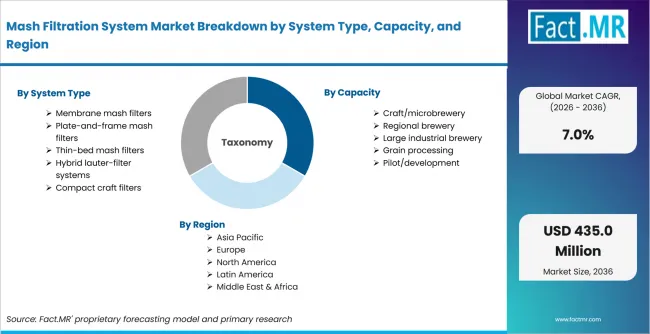
Mash Filtration System Market Breakdown By System Type, Capacity, And Region | Source: Fact.MR
| Attribute | Details |
|---|---|
| Quantitative Units | USD million in 2026 to USD million by 2036 at a CAGR. |
| Market Definition | A mash filtration system separates sweet wort from spent grain after mashing through pressure-driven filtration and a thin filter bed. |
| System Type | Membrane mash filters; Plate-and-frame mash filters; Thin-bed mash filters; Hybrid lauter-filter systems; Compact craft filters |
| Capacity | Craft/microbrewery; Regional brewery; Large industrial brewery; Grain processing; Pilot/development |
| Application | Beer brewing; Non-alcoholic malt beverages; Grain/starch processing; Distilling wort; Specialty beverages |
| Automation Level | Fully automated systems; Semi-automated; Manual/basic control; Recipe-controlled; IoT-integrated |
| End User | Large breweries; Craft breweries; Beverage processors; Distilleries; Grain processors |
| Regions Covered | North America; Latin America; Europe; East Asia; South Asia & Oceania; Middle East & Africa |
| Countries Covered | USA; Canada; Brazil; Mexico; Germany; U.K.; France; Italy; Spain; South Korea; Japan; Australia & New Zealand; GCC Countries; South Africa; UAE |
| Key Companies Profiled | Meura; NINGBO LEHUI INTERNATIONAL ENGINEERING EQUIPMENT CO., LTD.; Steinecker GmbH; Ziemann Holvrieka; Met-Chem, Inc.; MicroPure Filtration, Inc. |
| Forecast Period | 2026 to 2036 |
| Approach | Hybrid top-down and bottom-up approach using demand indicators across System Type, Capacity, Application, Automation Level, End User, country-level growth and company participation |
Source: Fact.MR analysis. Updated Jul 22, 2026
How is the market segmented?
-
By System Type:
- Membrane mash filters
- Plate-and-frame mash filters
- Thin-bed mash filters
- Hybrid lauter-filter systems
- Compact craft filters
-
By Capacity:
- Craft/microbrewery
- Regional brewery
- Large industrial brewery
- Grain processing
- Pilot/development
-
By Application:
- Beer brewing
- Non-alcoholic malt beverages
- Grain/starch processing
- Distilling wort
- Specialty beverages
-
By Automation Level:
- Fully automated systems
- Semi-automated
- Manual/basic control
- Recipe-controlled
- IoT-integrated
-
By End User:
- Large breweries
- Craft breweries
- Beverage processors
- Distilleries
- Grain processors
-
By Region:
- North America
- USA
- Canada
- Latin America
- Brazil
- Mexico
- Rest of Latin America
- Europe
- Germany
- U.K.
- France
- Italy
- Spain
- Rest of Europe
- East Asia
- South Korea
- Japan
- China
- South Asia & Oceania
- India
- Australia & New Zealand
- Rest of South Asia & Oceania
- Middle East & Africa
- GCC Countries
- South Africa
- UAE
- Rest of Middle East & Africa
- North America
Frequently Asked Questions
Which System Type leads the Mash Filtration System Market?
Which Capacity leads the Mash Filtration System Market?
Which Application leads the Mash Filtration System Market?
Which Automation Level leads the Mash Filtration System Market?
Which End User leads the Mash Filtration System Market?
How does UAE perform in the Mash Filtration System Market?
How does USA perform in the Mash Filtration System Market?
What is the primary driver in the Mash Filtration System Market?
What is the main restraint in the Mash Filtration System Market?
Who worked on this report


Preview the report firsthand - request a free sample
Free SampleGet the brochure for pricing and purchase details
Download PDF