- Base Value(2026): 7.2 Bn
- Estimated Value(2026): 7.2 Bn
- Forecast Value (2036): 17.4 Bn
- CAGR (2026 - 2036): 9.2%
Matrix LED Headlamp Modules Market Forecast and Outlook 2026 to 2036
In 2025, the matrix LED headlamp modules market was valued at approximately USD 6.6 billion. Based on Fact.MR analysis, demand is projected to reach USD 7.2 billion in 2026 and expand to USD 17.4 billion by 2036, registering a CAGR of 9.2% during the forecast period. Market expansion reflects rapid penetration of adaptive driving beam systems beyond flagship luxury models into mid-range and performance vehicle platforms.
Rolling CAGR analysis shows that growth between 2026 and 2030 is led by premium and upper mid-range vehicles adopting matrix LED high beam modules to meet safety and visibility differentiation objectives. From 2030 onward, value acceleration is driven by higher pixel count architectures, tighter software hardware coupling, and integration of driver electronics at the module level, which raises average module pricing even as adoption broadens. This shift toward digitally controlled lighting is reinforced by OEM roadmaps. As Harald Humenberger, Senior Vice President R&D of ZKW Group, stated,
“Our new digital micro-LED technology gives the Audi Q3 unique lighting technology and sets new standards in the compact class.” [1]
Fact.MR analysis views this as indicative of how lighting innovation is moving downstream from luxury flagships into volume segments.
China records the fastest growth at 10.4% CAGR, supported by rapid premium vehicle expansion and advanced lighting regulation alignment. India follows at 9.6% as feature rich mid-range vehicles gain traction. South Korea grows at 8.7% through domestic OEM technology upgrades. The United States (7.8%) and Germany (7.1%) remain innovation led but more mature, while Mexico (6.9%), France (6.5%), and Japan (5.8%) show steady adoption driven by platform refresh cycles rather than first time penetration.
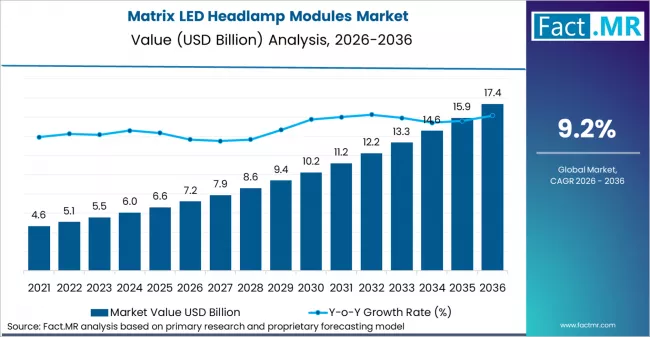
Matrix Led Headlamp Modules Market Market Value Analysis | Source: Fact.MR
Matrix LED Headlamp Modules Market Definition
The matrix LED headlamp modules market covers advanced automotive lighting units that use multiple individually controlled LED segments to adapt beam patterns in real time. These modules adjust light distribution to improve road illumination while reducing glare for oncoming traffic. Functional and installation requirements for adaptive driving beam systems are defined under UNECE Regulation No. 123 and lighting safety rules issued by the US National Highway Traffic Safety Administration. Matrix LED headlamp modules are supplied to vehicle manufacturers for passenger cars and light commercial vehicles.
Matrix LED Headlamp Modules Market Inclusions
The report covers global and regional market size estimates in volume and value terms with a forecast period from 2026 to 2036. Segmentation includes module configuration by pixel count, light source integration, application by vehicle category, and end use covering original equipment fitment and replacement demand. The scope also includes regional demand patterns, pricing benchmarks, and international trade flows for automotive lighting modules.
Matrix LED Headlamp Modules Market Exclusions
The scope excludes conventional halogen and fixed beam LED headlamps without adaptive control capability. Laser headlamp systems, rear lighting assemblies, interior lighting modules, and ambient lighting products are not included. Complete headlamp assemblies sold with housings, lenses, and electronic control units are excluded. Motorsport specific lighting systems, prototype modules, laboratory testing equipment, and software only lighting algorithms are also outside the scope.
Matrix LED Headlamp Modules Market Research Methodology
- Primary Research: Primary research involved interviews with LED module manufacturers, automotive OEM lighting suppliers, electronics integrators, and vehicle lighting engineers.
- Desk Research: Desk research used vehicle lighting regulations issued by UNECE and the US National Highway Traffic Safety Administration, vehicle production data from national transport authorities, and company annual reports and technical product disclosures filed with securities regulators.
- Market Sizing and Forecasting: Market sizing applied a hybrid top down and bottom up model using vehicle production volumes, adaptive headlamp fitment rates by vehicle class, and regional regulatory adoption timelines.
- Data Validation and Update Cycle: Outputs were cross checked against vehicle registration data, regulatory compliance records, trade statistics, and OEM supply disclosures, with updates applied when verified public data sources issue revisions.
Summary of matrix LED headlamp modules market
- Market definition
- Matrix LED headlamp modules refer to adaptive automotive lighting units using multiple individually controlled LED pixels to dynamically shape beam patterns for glare-free high beam operation and improved night-time visibility, as defined under UNECE and US federal lighting rules.
- Demand drivers
- OEM demand is driven by regulatory approval of adaptive driving beam systems, which enables automakers to deploy glare-free high beams while remaining compliant with vehicle lighting safety rules issued by UNECE and US authorities [2].
- Premium and upper mid-range vehicle platforms increasingly use matrix LED modules as a differentiation feature tied to software-controlled lighting functions and ADAS camera integration.
- Rising semiconductor integration at the module level supports adoption of higher pixel density lighting architectures, increasing average module value per vehicle.
- Key segments analyzed
- By module type, matrix LED high beam modules lead in 2026 due to their ability to deliver selective illumination without dazzling oncoming traffic.
- By vehicle segment, premium and luxury vehicles account for the largest share as early adopters of adaptive lighting systems with higher electronic content.
- By geography, China leads growth as domestic OEMs expand premium vehicle production aligned with adaptive lighting regulations.
- Analyst opinion at Fact.MR
- Shambhu Nath Jha, Principal Consultant at Fact.MR, opines, ‘CXOs will find this report useful for understanding how software-defined lighting, pixel density economics, and regulatory alignment are reshaping supplier selection and long-term platform awards in automotive lighting.’
- Strategic implications / executive takeaways
- OEM-focused suppliers should prioritise module-level integration of driver electronics to improve qualification for next-generation vehicle platforms.
- Investment in regulatory validation across multiple regions is necessary to support global OEM sourcing programs.
- Product roadmaps should align with higher pixel count designs that support software-based lighting functions.
- Methodology
- Market sizing is based on vehicle production data and adaptive headlamp fitment rates.
- Regulatory validation references UNECE and US federal lighting approvals.
- Findings are cross-checked against OEM disclosures and vehicle certification records.
Segmental Analysis
Matrix LED Headlamp Modules Market Analysis By Module Type
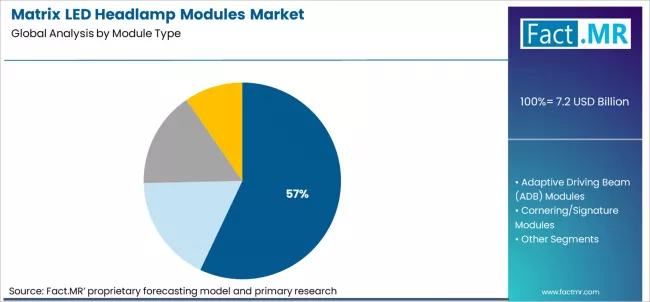
Matrix Led Headlamp Modules Market Analysis By Module Type | Source: Fact.MR
Based on Fact.MR analysis, consumption of Matrix LED high beam modules is estimated to hold 57% share of the global market in 2026. Fact.MR analysts note that these modules lead because they enable selective beam control through individually addressable LEDs, allowing high beam use without dazzling oncoming traffic. As per Fact.MR, this module type addresses OEM requirements for regulatory compliance, enhanced night-time visibility, and integration with camera-based driver assistance systems used in advanced lighting architectures.
- Regulatory alignment: Adaptive high beam functionality used in matrix modules is permitted under UNECE vehicle lighting regulations that define glare-free high beam operation requirements.[3]
- Technology deployment: Fact.MR analysts reference vehicle lighting system approvals where matrix high beam modules are specified to meet automatic beam adaptation criteria.
- Architecture shift: OEM lighting platforms continue to migrate toward segmented high beam modules to support software-controlled illumination functions.
Matrix LED Headlamp Modules Market Analysis By Vehicle Segment
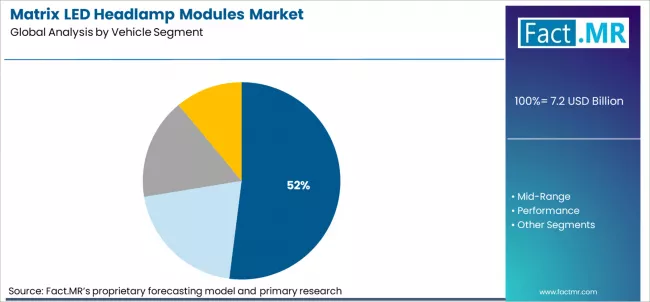
Matrix Led Headlamp Modules Market Analysis By Vehicle Segment | Source: Fact.MR
Based on Fact.MR analysis, consumption of matrix LED headlamp modules in premium and luxury vehicles is estimated to hold 52% share in 2026. Fact.MR opines that this segment leads due to higher electronic content per vehicle and faster adoption of adaptive lighting features in upper price categories. As per Fact.MR, premium vehicles require advanced illumination systems that integrate with driver assistance cameras and vehicle control units to deliver adaptive beam functionality under varying traffic conditions.
- Policy framework: The United States Department of Transportation finalized rules allowing adaptive driving beam systems on new vehicles, supporting wider deployment of matrix LED lighting in compliant vehicle segments.[4]
- Vehicle positioning: Fact.MR analysts note that premium and luxury brands introduce adaptive lighting technologies earlier in product cycles before wider market diffusion.
- Content differentiation: Matrix LED modules are increasingly used as feature differentiators in higher trim levels within premium vehicle portfolios.
Matrix LED Headlamp Modules Market Drivers, Restraints, And Opportunities
Fact.MR analysis indicates that the matrix LED headlamp modules market exists as a key safety and illumination component segment within the global automotive lighting landscape, driven by evolving vehicle design requirements and regulated safety standards. As per Fact.MR assessment, matrix LED headlamp modules use individually controlled light zones to adjust beam patterns for improved visibility and glare reduction, a performance requirement increasingly embedded in vehicle lighting regulations such as UNECE Regulation No. 123, which defines uniform provisions for adaptive front lighting systems on vehicles. Fact.MR analysts observe that demand is anchored in new vehicle OEM specifications for enhanced nighttime visibility, pedestrian detection support, and regional safety mandates that increasingly reference adaptive lighting performance criteria.
Fact.MR is of the opinion that current market dynamics reflect a transition from traditional halogen and conventional LED headlamps toward adaptive and intelligent lighting systems that offer dynamic beam control and sensor integration. Based on Fact.MR assessment, standard lighting systems maintain larger volume penetration due to lower upfront cost and established manufacturing processes, but matrix LED modules grow where vehicle segments prioritise real-time beam pattern adjustment for safety and performance. Matrix LED headlamp modules generally carry higher per-unit pricing due to semiconductor density, control software, and thermal management requirements, meaning realised market value can climb even where shipment volumes grow at a measured pace. Fact.MR analysis suggests this mix of incremental volume uptake and premium unit value shapes near-term market progress.
- Regulated adaptive lighting criteria: Fact.MR analysts note that compliance with UNECE Regulation No. 123 influences OEM specification of matrix LED headlamp modules in passenger cars and commercial vehicles that require adaptive lighting performance.
- Shift toward intelligent lighting: Based on Fact.MR assessment, adoption of adaptive and programmable LED modules that support dynamic beam control and sensor linkage supports advanced driver assistance and safety enhancement goals.
- Asia Pacific automotive adoption growth: Fact.MR opines that expanding vehicle production and rising demand for premium and safety-oriented features in China, India, and Southeast Asia sustain regional growth for matrix LED headlamp modules in both OEM and aftermarket channels.
Regional Analysis
Based on regional assessment, the matrix LED headlamp modules sector is analyzed across North America, Europe, East Asia, South Asia, and other major automotive manufacturing regions, spanning more than 40 countries. Regional performance varies according to penetration of advanced lighting technologies, adoption in premium and mid-range vehicles, and regulatory standards related to vehicle safety and visibility. The report also presents a comparative market attractiveness evaluation grounded in region-specific demand trends.
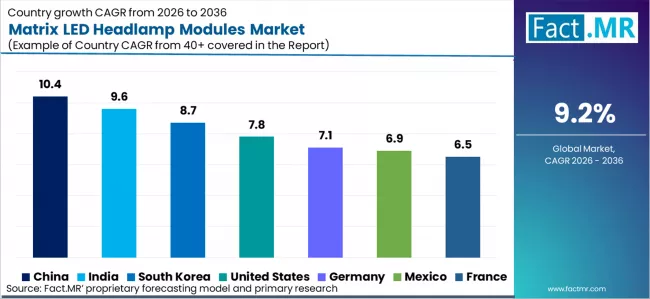
Matrix Led Headlamp Modules Market Cagr Analysis By Country | Source: Fact.MR
| Country | CAGR |
|---|---|
| China | 10.4% |
| India | 9.6% |
| South Korea | 8.7% |
| United States | 7.8% |
| Germany | 7.1% |
| Mexico | 6.9% |
| France | 6.5% |
| Japan | 5.8% |
Source: Fact.MR analysis. Updated Feb 19, 2026
Source: Fact.MR analysis, based on proprietary forecasting models and primary research.
Asia Pacific Matrix LED Headlamp Modules Market Analysis
Asia Pacific operates as a regulation- and production-driven automotive lighting region for matrix LED headlamp modules, supported by large passenger vehicle manufacturing bases and rising adoption of advanced driver assistance features. Demand is governed by vehicle lighting regulations, glare control requirements, and OEM homologation standards. Adoption is enforced through vehicle type approval systems, headlamp performance testing, and compliance with national lighting standards applied across domestic and export-oriented vehicle production.
- China: Demand for matrix LED headlamp modules in China is projected to rise at 10.4% CAGR during 2026-2036. Application follows adaptive headlamp and glare control provisions under GB vehicle lighting standards revised in 2021 and enforced through national type approval systems, as per Fact.MR.
- India: Demand for matrix LED headlamp modules in India is projected to rise at 9.6% CAGR during 2026-2036. Fitment is governed by Automotive Industry Standards aligned with CMVR lighting regulations updated during 2021 and reinforced through OEM adoption in premium passenger vehicles produced during 2022-2023, according to Fact.MR.
- South Korea: Demand for matrix LED headlamp modules in South Korea is projected to rise at 8.7% CAGR during 2026-2036. Use follows vehicle lighting certification rules enforced under national safety regulations and reinforced through domestic OEM homologation processes applied during 2021-2022, as per Fact.MR.
Fact.MR’s analysis of the Matrix LED Headlamp Modules Market in Asia Pacific consists of country-wise assessment that includes China, India, and South Korea. Readers can find lighting regulations, homologation frameworks, and production-linked demand references.
North America Matrix LED Headlamp Modules Market Analysis
North America functions as a regulation-led automotive lighting market where matrix LED headlamp module adoption is governed by federal lighting standards, OEM certification requirements, and approval pathways for adaptive driving beam technologies. Demand is shaped by regulatory amendments, vehicle certification processes, and OEM implementation across premium and high-feature passenger vehicle segments.
- United States: Demand for matrix LED headlamp modules in the United States is projected to rise at 7.8% CAGR during 2026-2036. Application follows adaptive driving beam provisions permitted under FMVSS No. 108 amendments finalized in February 2022 and reinforced through OEM vehicle certification programs, as per Fact.MR.
- Mexico: Demand for matrix LED headlamp modules in Mexico is projected to rise at 6.9% CAGR during 2026-2036. Fitment follows NOM vehicle lighting standards aligned with U.S. regulations and reinforced through export-oriented OEM production serving North American markets during 2022-2023, according to Fact.MR.
Fact.MR’s analysis of the Matrix LED Headlamp Modules Market in North America consists of country-wise assessment that includes the United States and Mexico. Readers can find federal lighting standards, certification references, and production-based compliance documentation.
Europe Matrix LED Headlamp Modules Market Analysis
Europe operates as a regulation-led automotive lighting market for matrix LED headlamp modules, with adoption governed by UNECE vehicle lighting regulations and EU type approval frameworks. Demand is driven by mandatory glare-free high-beam requirements, conformity assessments, and OEM compliance with adaptive lighting performance standards applied across member states.
- Germany: Demand for matrix LED headlamp modules in Germany is projected to rise at 7.1% CAGR during 2026-2036. Application follows UNECE Regulation No. 123 adaptive front-lighting requirements and EU type approval rules enforced through vehicle certification and inspection cycles during 2021-2022, as per Fact.MR.
- France: Demand for matrix LED headlamp modules in France is projected to rise at 6.5% CAGR during 2026-2036. Use is governed by UNECE lighting regulations and reinforced through OEM adoption in passenger vehicles certified under EU approval systems applied during 2021-2022, according to Fact.MR.
- Japan: Demand for matrix LED headlamp modules in Japan is projected to rise at 5.8% CAGR during 2026-2036. Fitment is governed by Road Transport Vehicle Act lighting provisions and enforced through national vehicle certification processes applied during 2021-2022, as per Fact.MR.
Fact.MR’s analysis of the Matrix LED Headlamp Modules Market in Europe consists of country-wise assessment that includes Germany, France, and Japan. Readers can find UNECE regulations, type approval frameworks, and adaptive lighting compliance references.
Competitive Landscape of Matrix LED Headlamp Modules Market
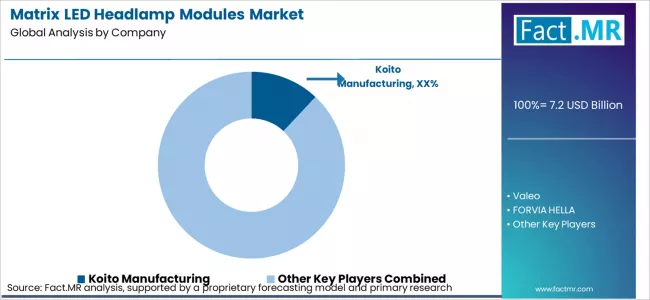
Matrix Led Headlamp Modules Market Analysis By Company | Source: Fact.MR
As per Fact.MR analysis, the 2026 matrix LED headlamp modules market is defined by validated luminous performance, system integration, and OEM compliance, which determine competitive advantage. Koito Manufacturing and Valeo lead with high-precision LED arrays and certified optical systems, which strengthens adoption in premium and mass-market vehicles. FORVIA HELLA and Marelli focus on thermal management and modular control units, which improves durability and reduces integration risks. Stanley Electric and ZKW (LG) emphasise certified illumination consistency and multi-region compliance, which enhances adoption in global OEM programs. Hyundai Mobis and SL Corporation provide scalable production and validated assembly processes, which ensure supply continuity across regions. Varroc and Ichikoh offer specialized optics and tested LED driver circuits, which support niche segments and aftermarket upgrades. Across the market, validated performance, system-level integration, and adherence to automotive safety standards form enduring competitive moats that outweigh reliance on price or isolated product features.
Recent Industry Developments
- ZKW Launches 25,600-Pixel Digital Matrix LED for Audi Q3 (January 2026)
- In early 2026, ZKW Group announced the mass production of its high-definition digital Matrix LED headlamps for the new Audi Q3. This system utilizes micro-LED technology containing 25,600 individually controllable pixels. Beyond standard glare-free high beams, these modules work with the vehicle’s ADAS to project lane-guidance markers and "slippery road" warnings onto the pavement. [5]
- Valeo Debuts AI-Driven Matrix LED to Reduce Energy Use (November 2025)
- Valeo unveiled an AI-integrated Matrix LED system designed to optimize energy consumption-a critical factor for Electric Vehicles (EVs). By using AI to fine-tune light intensity in milliseconds based on real-time sensor data, the system reduces energy use by up to 22% compared to standard LED setups. Valeo is currently scaling this technology with partners including VW and Mercedes-Benz. [6]
- Marelli Introduces "Thin Lit Line" for Aerodynamic Design (April 2025)
- At Auto Shanghai 2025, Marelli launched the Thin Lit Line Headlamp, an ultra-slim 5-millimeter profile module. This development allows automakers to maintain full Matrix LED functionality (Adaptive Driving Beam and DRLs) while drastically reducing the front-end height of the vehicle, which improves aerodynamics and battery range for the latest generation of premium EVs. [7]
Key Players in Matrix LED Headlamp Modules Market
- Koito Manufacturing
- Valeo
- FORVIA HELLA
- Marelli
- Stanley Electric
- ZKW (LG)
- Hyundai Mobis
- SL Corporation
- Varroc
- Ichikoh
Bibliography
- [1] ZKW Group GmbH. (2026). ZKW equips the new Audi Q3 with digital Matrix LED headlights. ZKW Group-Bright Minds, Bright Lights.
- [2] United Nations Economic Commission for Europe. (2023). Vehicle regulations: Lighting and light-signalling devices. UNECE; U.S. Department of Transportation, National Highway Traffic Safety Administration. (2023). Headlights and adaptive driving beam technology. NHTSA.
- [3] United Nations Economic Commission for Europe. (2019). UNECE Regulation No. 123: Uniform provisions concerning the approval of adaptive front-lighting systems (AFS) for motor vehicles. UNECE.
- [4] U.S. Department of Transportation, National Highway Traffic Safety Administration. (2022). NHTSA finalizes rule allowing adaptive driving beam headlamps. NHTSA.
- [5] ZKW Group GmbH. (2026). ZKW launches 25,600-pixel digital Matrix LED headlamps for Audi Q3. ZKW Group Newsroom.
- [6] Valeo SA. (2025). Valeo unveils AI-driven Matrix LED systems at IAA Mobility 2025. Valeo Mobility Press.
- [7] Marelli Holdings Co., Ltd. (2025). Marelli introduces Thin Lit Line headlamp technology at Auto Shanghai 2025. Autocar Professional.
Segmentation
Scope of the Report
| Metric | Value |
|---|---|
| Quantitative Units | USD 7.2 billion (2026) to USD 17.4 billion (2036), CAGR 9.2% |
| Market Definition | The matrix LED headlamp modules market covers advanced automotive lighting units with multiple individually controlled LED segments that adapt beam patterns in real time. Modules improve road illumination and reduce glare while supporting ADAS systems. Products are supplied to OEMs for passenger cars and light commercial vehicles. Functional requirements follow UNECE Regulation No. 123 and US NHTSA headlamp safety standards. |
| Module Type Segmentation | Matrix LED High Beam Modules, Adaptive Driving Beam (ADB) Modules, Cornering/Signature Modules, Other |
| Vehicle Segment | Premium/Luxury, Mid-Range, Performance, Entry-Level |
| Light Source Integration | Module + Driver Electronics, Module Only, Module + Sensor Package, Other |
| Sales Channel | OEM/Tier 1 Supply, Aftermarket Upgrades, Service Replacement, Other |
| Regions Covered | Asia Pacific, Europe, North America, Latin America, Middle East & Africa |
| Countries Covered | China, India, South Korea, United States, Germany, Mexico, France, Japan |
| Key Companies Profiled | Koito Manufacturing, Valeo, FORVIA HELLA, Marelli, Stanley Electric, ZKW (LG), Hyundai Mobis, SL Corporation, Varroc, Ichikoh |
| Forecast Period | 2026 to 2036 |
| Approach | Hybrid top-down and bottom-up modeling using vehicle production, adaptive headlamp fitment rates, and regional regulatory adoption timelines. Desk research included UNECE R123, NHTSA lighting standards, UN Comtrade trade data, and OEM production statistics. Primary interviews involved LED module manufacturers, OEM lighting suppliers, and vehicle lighting engineers. |
Source: Fact.MR analysis. Updated Feb 19, 2026
Matrix LED Headlamp Modules Market Analysis by Segments
-
By Module Type:
- Matrix LED High Beam Modules
- Adaptive Driving Beam (ADB) Modules
- Cornering/Signature Modules
- Other
-
By Vehicle Segment:
- Premium/Luxury
- Mid-Range
- Performance
- Entry-Level
-
By Light Source Integration:
- Module + Driver Electronics
- Module Only
- Module + Sensor Package
- Other
-
By Sales Channel:
- OEM/Tier 1 Supply
- Aftermarket Upgrades
- Service Replacement
- Other
-
Region
- Asia Pacific
- India
- China
- Japan
- South Korea
- Indonesia
- Australia & New Zealand
- ASEAN
- Rest of Asia Pacific
- Europe
- Germany
- Italy
- France
- United Kingdom
- Spain
- Benelux
- Nordics
- Central & Eastern Europe
- Rest of Europe
- North America
- United States
- Canada
- Mexico
- Latin America
- Brazil
- Argentina
- Chile
- Rest of Latin America
- Middle East & Africa
- Kingdom of Saudi Arabia
- United Arab Emirates
- South Africa
- Turkey
- Rest of Middle East & Africa
- Asia Pacific
Frequently Asked Questions
How large is the matrix LED headlamp modules market in 2026?
What will the market size be by 2036?
What CAGR is expected for the market during 2026–2036?
How much absolute value is expected to be added over the forecast period?
What is the primary driver behind market expansion?
Which vehicle segment currently accounts for the largest share of demand?
Which module type is expected to dominate the market?
Why are matrix LED high beam modules gaining preference among OEMs?
How important is software and electronics integration to market growth?
Which region represents the fastest-growing market?
Which country records the highest CAGR globally?
What is the growth outlook for India?
How fast is the South Korean market expected to grow?
What is the projected growth rate for the United States?
How does Germany compare in terms of growth?
What is the growth outlook for Mexico?
How is France positioned in the market?
What is the expected growth rate for Japan?
How does pixel density influence long-term market value?
What should suppliers prioritize to secure long-term OEM programs?
Who worked on this report


Preview the report firsthand - request a free sample
Free SampleGet the brochure for pricing and purchase details
Download PDF