Energy-Efficient OLED Display Systems for Electric Vehicles Market Size, Share, Growth and Forecast (2026 - 2036)

The Energy-Efficient OLED Display Systems for Electric Vehicles Market is segmented by Display Type (Instrument Cluster OLED Displays, Center Information OLED Displays, Passenger-Side OLED Displays, Pillar-to-Pillar OLED Systems, Transparent and Privacy OLED Displays, and Others), Integration Type (Standalone Display Modules, Curved Integrated Cockpit Displays, OLED Panel-and-Control Assemblies, Touch-Integrated OLED Systems, and Others), Vehicle Class (Battery Electric Passenger Cars, Premium Electric SUVs, Electric Commercial Vehicles, Electric Luxury Sedans, and Others), and Region. Forecast for 2026 to 2036.

Fact.MR analysis indicates that the energy-efficient OLED display systems for electric vehicles market is developing around cockpit power optimization, slim integration, and premium HMI performance rather than screen size alone.

Energy-Efficient OLED Display Systems for Electric Vehicles Market Forecast and Outlook By Fact.MR

  • In 2025, the energy-efficient OLED display systems for electric vehicles market was valued at USD 2.6 billion.
  • Based on Fact.MR estimates, demand is estimated to grow to USD 2.9 billion in 2026 and USD 7.2 billion by 2036.
  • Fact.MR projects a CAGR of 9.5% during the forecast period.

Energy Efficient Oled Display Systems For Electric Vehicles Market Market Value Analysis

Metric Value
Estimated Value in 2026 USD 2.9 billion
Forecast Value in 2036 USD 7.2 billion
Forecast CAGR (2026 to 2036) 9.5%

Summary of Energy-Efficient OLED Display Systems for Electric Vehicles Market

  • Market Definition
    • The market includes OLED display systems used in EV interiors to deliver lower-power visual interfaces, premium design flexibility, and integrated cockpit functionality.
  • Demand Drivers
    • OLED is increasingly positioned around lower power consumption and energy-efficient UI design, which supports its relevance in EV cockpit systems.
    • EV smart cockpits are expanding toward larger and more integrated display layouts, including P2P and wide-format automotive screens. [4]
    • OLED supports thinner, curved, and visually differentiated display architectures that fit premium EV interior design trends.
  • Key Segments Analyzed
    • By Display Type: Center information OLED displays are estimated to lead with approximately 32% share in 2026, supported by stronger use as the main EV HMI surface.
    • By Integration Type: Curved integrated cockpit displays are expected to hold approximately 29% share in 2026, driven by premium dashboard architecture trends.
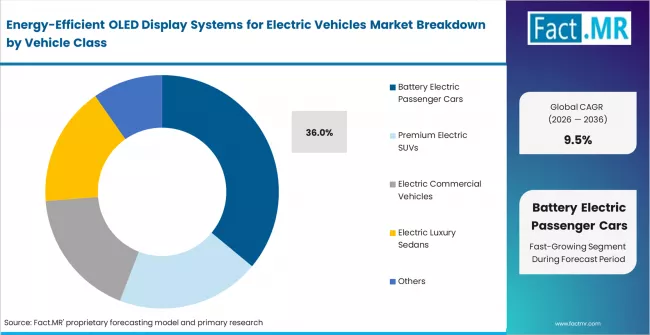
    • By Vehicle Class: Battery electric passenger cars are projected to account for approximately 36% share in 2026, supported by larger EV production volume.
    • By Geography: India leads growth at 10.8% CAGR through 2036, supported by rising EV cockpit sophistication.
    • These share values are model-based estimates rather than figures directly published in the cited sources.
  • Analyst Opinion at FACT.MR
    • Shambhu Nath Jha, Senior Analyst at Fact.MR, notes, “CXOs should read this market as an EV cockpit efficiency and interface-design category rather than a premium screen niche. Buyers are not only paying for image quality. They are paying for display systems that help shape energy use, cabin layout, and brand differentiation.”
    • This is a modeled analyst view, not a quoted external statement.
  • Strategic Implications
    • Invest in OLED systems that combine lower power draw with automotive-grade durability and larger cockpit integration.
    • Build technical sales capability around EV energy efficiency, curved integration, and cockpit software compatibility rather than display resolution alone.
    • Position OLED systems where OEMs want premium EV interiors without excessive electrical burden from cabin electronics.
    • These implications are inferred from the cited OLED efficiency and automotive display materials. [5]

The market is projected to generate USD 4.3 billion in absolute opportunity between 2026 and 2036. Growth is being supported by wider adoption of digital cockpits in EVs, stronger demand for ultra-thin and curved interior display layouts, and rising interest in reducing auxiliary electrical load in premium cabin electronics. Samsung Display states that it is collaborating to reduce OLED power consumption and has highlighted lower power consumption as a core OLED advantage in recent showcase materials. LG Display also states that it has developed lower-power OLED products and expanded automotive display activity, including automotive P2P and OLED-related products. These market values are model-based estimates built from current supplier development direction, EV cockpit adoption logic, and premium display-system integration trends rather than from a published market-size source table. [1]

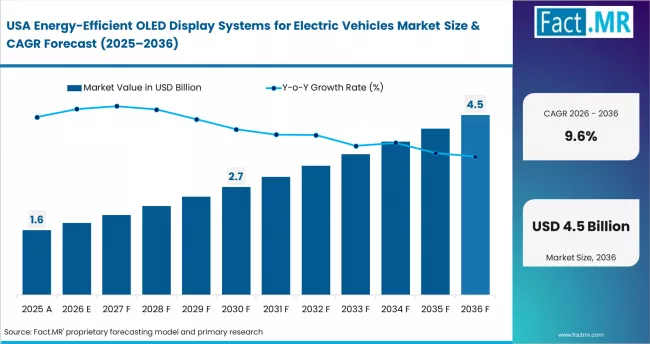
India is projected to lead with a CAGR of 10.8% through 2036, driven by EV adoption growth, premium feature migration, and stronger localization of advanced cockpit electronics. China follows at 10.2%, supported by high EV production volume and faster uptake of display-rich smart cockpit architectures. The United States is expected to grow at 9.6%, underpinned by premium EV demand and larger digital cockpit layouts. Germany records 9.1%, backed by luxury EV platforms and higher-value in-cabin electronics. South Korea grows at 8.8%, supported by domestic display leadership and advanced vehicle electronics integration.

Segmental Analysis

Energy-Efficient OLED Display Systems for Electric Vehicles Market Analysis by Display Type

Energy Efficient Oled Display Systems For Electric Vehicles Market Analysis By Integration Type

Center information OLED displays are estimated to hold 32% share in 2026, as the center display remains the main interface for navigation, infotainment, energy information, and smart-cabin interaction in EVs. Instrument-cluster OLED displays remain highly relevant where OEMs want higher-contrast visualization and integrated driver HMI, while passenger-side and P2P systems are expanding in premium programs. These share estimates are model-based. Samsung Display’s recent automotive OLED showcase and LG Display’s automotive P2P references both support the trend toward broader in-cabin OLED use.

  • Center displays lead because they serve as the primary EV infotainment and control interface.
  • Instrument-cluster OLED systems remain attractive where driver information needs strong contrast and premium layout.
  • Passenger-side and full-width systems gain traction where OEMs want differentiated smart-cabin experiences.

Energy-Efficient OLED Display Systems for Electric Vehicles Market Analysis by Integration Type

Energy Efficient Oled Display Systems For Electric Vehicles Market Analysis By Integration Type

Based on Fact.MR’s analysis, curved integrated cockpit displays are expected to hold approximately 29% share in 2026. This segment leads because OLED is well suited to thin, curved, and visually continuous cockpit layouts. Standalone display modules remain relevant in lower-cost or smaller-format EV programs, though the strongest commercial pull is moving toward integrated dashboard surfaces that combine visual continuity with premium styling. These integration shares are model-based estimates inferred from supplier product direction and OLED design capability. [6]

  • Curved integrated layouts lead because OLED supports thin and design-flexible cockpit architecture.
  • Standalone modules remain relevant where cost and simpler packaging still matter.
  • Touch-integrated systems gain importance where EV interiors rely more on software-defined controls and fewer physical switches.

Energy-Efficient OLED Display Systems for Electric Vehicles Market Analysis by Vehicle Class
Energy Efficient Oled Display Systems For Electric Vehicles Market Analysis By Vehicle Class

Battery electric passenger cars are projected to account for approximately 36% share in 2026. They lead because this class carries the largest EV production base and the widest range of digital cockpit deployments. Premium electric SUVs and luxury EV sedans remain highly relevant where larger displays and advanced HMI systems are more easily justified. These vehicle-class shares are model-based estimates built from EV production logic and premium display adoption direction. LG Display has explicitly linked its large-sized OLED automotive display focus to EV market growth.

  • Passenger BEVs lead because they combine the largest volume opportunity with rising cockpit digitization.
  • Premium electric SUVs remain attractive where larger dashboards support wider display integration.
  • Luxury EV sedans create strong value where OLED differentiation aligns with premium cabin positioning.

Drivers, Restraints, and Opportunities

Energy Efficient Oled Display Systems For Electric Vehicles Market Opportunity Matrix Growth Vs Value

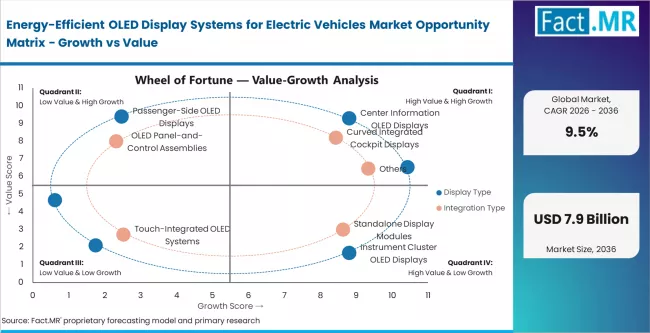
The market is being shaped by the need to make EV cockpits more premium without adding excessive energy burden from cabin electronics. Structural demand is anchored in the fact that suppliers increasingly present OLED as a lower-power and energy-efficient display technology, while EVs are simultaneously moving toward larger and more software-driven cabin interfaces. This creates a favorable environment for OLED systems that improve visual quality and energy efficiency together.

The main restraint is automotive-grade reliability and cost discipline. Automotive OLED adoption depends on durability, lifetime, burn-in management, and integration cost being acceptable at the OEM level. Supplier materials continue to emphasize reliability and advanced product development in automotive displays, which suggests that commercialization depends on meeting tougher vehicle standards than consumer display markets. Another challenge is that many EV programs still rely on advanced LCD solutions where cost and maturity remain favorable. This means suppliers must prove that OLED systems justify their premium through power, design, and HMI gains.

  • Lower-power cockpit displays remain the clearest opportunity where EVs want larger interfaces without unnecessary auxiliary load.
  • Curved and P2P OLED systems create stronger value where OEMs want differentiated premium cockpit architecture.
  • Integrated software-defined cockpit systems offer higher-value opportunity where OLED supports design freedom and premium user experience together.

Regional Analysis

The market is assessed across North America, Europe, Asia Pacific, Latin America, and Middle East and Africa, covering 40+ countries with demand profiles shaped by EV production, premium vehicle mix, cockpit digitization, and supplier ecosystem maturity. The country growth rates below are model-based estimates.

Top Country Growth Comparison Energy Efficient Oled Display Systems For Electric Vehicles Market Cagr (2026 2036)

Country CAGR (2026 to 2036)
India 10.8%
China 10.2%
United States 9.6%
Germany 9.1%
South Korea 8.8%

North America Energy-Efficient OLED Display Systems for Electric Vehicles Market Analysis

Energy Efficient Oled Display Systems For Electric Vehicles Market Country Value Analysis

North America remains an important commercial region because it combines premium EV demand, software-defined cockpit interest, and stronger willingness to adopt large integrated display layouts. Demand is strongest where OEMs and buyers treat the cockpit as a core differentiation area rather than a simple instrumentation surface. This regional view is supported by the wider move toward integrated OLED cockpit systems shown by suppliers.

  • United States: Premium EV demand and strong digital cockpit adoption continue to support growth. The market is projected to expand at a CAGR of 9.6% through 2036, driven by increasing integration of large-format displays, infotainment systems, and connected vehicle interfaces.

Europe Energy-Efficient OLED Display Systems for Electric Vehicles Market Analysis

Energy Efficient Oled Display Systems For Electric Vehicles Market Europe Country Market Share Analysis, 2026 & 2036

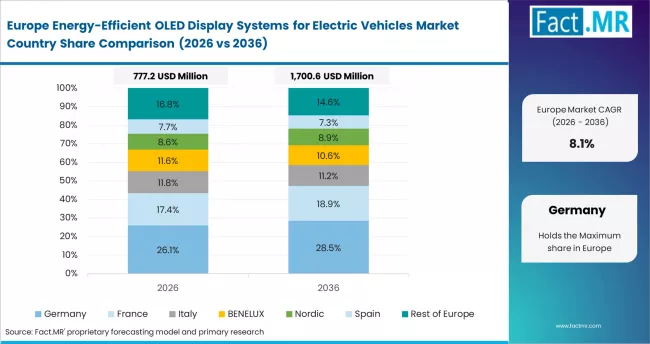
Europe remains a premium, engineering-driven market where cockpit design, display integration, and energy efficiency are closely linked to vehicle differentiation. OEMs emphasize high-quality display systems that enhance user experience while maintaining efficiency standards.

  • Germany: Strong automotive engineering capability and premium vehicle production support demand. The market is projected to grow at a CAGR of 9.1% through 2036, driven by increasing adoption of OLED-based digital cockpits, curved displays, and integrated user interfaces across high-end EV platforms.

Asia Pacific and Latin America Energy-Efficient OLED Display Systems for Electric Vehicles Market Analysis

Asia Pacific offers the strongest long-term expansion potential because it combines high EV production, deep display-manufacturing capability, and faster adoption of smart cockpit architectures. Demand is likely to strengthen where OEMs move beyond basic digital clusters toward larger integrated interfaces with lower-power premium displays. These regional growth views are model-based estimates built from current supplier activity, EV production direction, and cockpit digitization logic.

  • India: EV adoption growth and premium feature migration support demand. The market is projected to grow at a CAGR of 10.8% through 2036, driven by increasing interest in connected and feature-rich vehicle interiors.
  • China: High EV production and rapid adoption of display-rich smart cockpits continue to support growth. The market is projected to expand at a CAGR of 10.2% through 2036, with strong integration of advanced display technologies across domestic EV platforms.
  • South Korea: Domestic display leadership and advanced cockpit electronics support steady growth. The market is projected to grow at a CAGR of 8.8% through 2036, backed by strong supplier ecosystems and innovation in OLED display technologies.

Competitive Aligners for Market Players

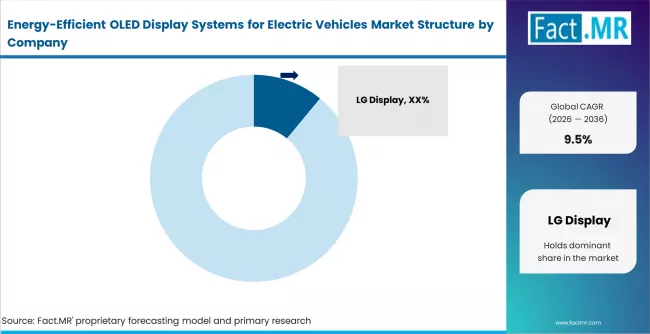
Energy Efficient Oled Display Systems For Electric Vehicles Market Analysis By Company

The market is moderately concentrated at the display-panel and cockpit-integration level, while broader vehicle deployment remains OEM-controlled. Competitive strength comes from the ability to combine lower-power OLED performance with automotive reliability, curvature, and software-ready cockpit integration. Suppliers need more than a premium image-quality claim. They need a clear explanation of how the display system reduces energy draw, supports advanced HMI, and survives automotive operating conditions.

Competitive advantage is defined by power efficiency, durability, display shape flexibility, and ability to support integrated cockpit architectures. OLED suppliers that can pair panel technology with automotive-grade performance and premium wide-format integration have a stronger position. This competitive framing is an analytical view derived from current supplier disclosures rather than a published market-share table.

Representative Players

  • LG Display
  • Samsung Display
  • Continental
  • Visteon
  • Tianma
  • BOE
  • FORVIA
  • AUO
  • Japan Display Inc.
  • Panasonic Automotive Systems

Bibliography

  • [1] LG Display annual and corporate disclosures referencing focus on large-sized OLED automotive display panels amid rapid EV market growth.
  • [2] Samsung Display sustainability and product materials referencing OLED optimized to maximize energy efficiency and lower power consumption.
  • [3] Samsung Display announcements on SmartPower HDR and lower OLED power consumption.
  • [4] LG Display materials on mass production capability for automotive P2P displays including OLED.
  • [5] Samsung Display automotive OLED showcase materials featuring a 34-inch 6K automotive OLED display for cockpit integration.
  • [6] Continental materials referencing integrated OLED automotive display concepts.

This Report Addresses

  • Strategic intelligence on energy-efficient OLED display system demand across EV cockpits, premium digital interiors, and software-defined cabin architectures.
  • Market forecast from USD 2.9 billion in 2026 to USD 7.2 billion by 2036 at a CAGR of 9.5%.
  • Growth opportunity mapping across center information OLED displays, curved cockpit systems, P2P OLED layouts, and integrated EV display modules.
  • Segment analysis by display type, integration type, vehicle class, and end use.
  • Regional outlook covering North America, Europe, Asia Pacific, Latin America, and Middle East and Africa.
  • Competitive analysis of major suppliers serving automotive OLED panels, cockpit electronics, and EV HMI systems.

Energy-Efficient OLED Display Systems for Electric Vehicles Market Definition

The market covers OLED-based automotive display systems designed for use in electric vehicles where lower power consumption, thin form factor, curved integration, and premium visual performance are central product attributes. It includes OLED instrument clusters, infotainment displays, passenger-side displays, full-width cockpit displays, and related integrated display systems used in EV interiors. [2]

Energy-Efficient OLED Display Systems for Electric Vehicles Market Inclusions

Covers global and regional forecasts from 2026 to 2036. Includes automotive OLED display modules, integrated OLED cockpit systems, P2P OLED layouts, curved OLED displays, and other EV-oriented display systems positioned around lower power consumption, high contrast, thin integration, and differentiated smart cockpit design.

Energy-Efficient OLED Display Systems for Electric Vehicles Market Exclusions

Excludes conventional automotive LCD-only display systems, aftermarket infotainment screens without OEM integration logic, head-up displays without OLED panel systems, and general consumer OLED products not designed for vehicle use. It also excludes non-display cockpit electronics unless the OLED display remains the core product role. This exclusion logic is an analytical market boundary rather than a quoted source definition.

Energy-Efficient OLED Display Systems for Electric Vehicles Market Research Methodology

  • Primary Research:Interviews with cockpit electronics specialists, automotive display engineers, EV interior system suppliers, OEM sourcing teams, and premium vehicle HMI advisors.
  • Desk Research:Uses current supplier materials from OLED and automotive display companies, sustainability and annual reports, and automotive display product announcements tied to EV cockpit design, OLED efficiency, and automotive integration. [3]
  • Market-Sizing and Forecasting:Hybrid model using EV cockpit digitization, OLED efficiency relevance, premium display adoption, display-area expansion, and OEM integration potential.
  • Data Validation and Update Cycle:Validated using current OLED supplier disclosures, automotive display product references, and recurring checks on EV display-system direction, power-efficiency positioning, and cockpit integration logic.

Scope of Report

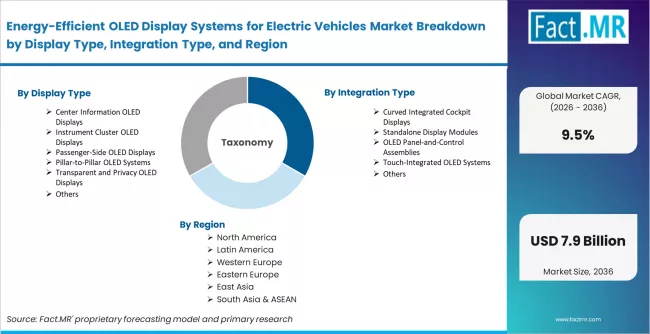
Energy Efficient Oled Display Systems For Electric Vehicles Market Breakdown By Display Type, Integration Type, And Region

Attribute Details
Quantitative Units USD 2.9 billion (2026) to USD 7.2 billion (2036), at a CAGR of 9.5%
Market Definition OLED-based automotive display systems designed for EV interiors where lower power consumption, thin form factor, curved integration, and premium visual performance are central attributes
Display Type Segmentation Instrument Cluster OLED Displays, Center Information OLED Displays, Passenger-Side OLED Displays, Pillar-to-Pillar OLED Systems, Transparent and Privacy OLED Displays, Others
Integration Type Segmentation Standalone Display Modules, Curved Integrated Cockpit Displays, OLED Panel-and-Control Assemblies, Touch-Integrated OLED Systems, Others
Vehicle Class Segmentation Battery Electric Passenger Cars, Premium Electric SUVs, Electric Commercial Vehicles, Electric Luxury Sedans, Others
Regions Covered North America, Europe, Asia Pacific, Latin America, Middle East and Africa
Countries Covered United States, Germany, China, India, South Korea, Japan, and 40+ countries
Forecast Period 2026 to 2036
Approach Hybrid top-down and bottom-up model using EV cockpit digitization, OLED efficiency relevance, premium display adoption, and primary interviews with OEM, supplier, and HMI specialists

Energy-Efficient OLED Display Systems for Electric Vehicles Market by Segments

  • By Display Type:

    • Instrument Cluster OLED Displays
    • Center Information OLED Displays
    • Passenger-Side OLED Displays
    • Pillar-to-Pillar OLED Systems
    • Transparent and Privacy OLED Displays
    • Others
  • By Integration Type:

    • Standalone Display Modules
    • Curved Integrated Cockpit Displays
    • OLED Panel-and-Control Assemblies
    • Touch-Integrated OLED Systems
    • Others
  • By Vehicle Class:

    • Battery Electric Passenger Cars
    • Premium Electric SUVs
    • Electric Commercial Vehicles
    • Electric Luxury Sedans
    • Others
  • By Region:

    • North America
      • United States
      • Canada
      • Mexico
    • Latin America
      • Brazil
      • Argentina
      • Chile
      • Rest of Latin America
      • Western Europe
    • Germany
      • France
      • United Kingdom
      • Italy
      • Spain
      • Nordic Countries
      • BENELUX
      • Rest of Western Europe
    • Eastern Europe
      • Russia
      • Poland
      • Hungary
      • Balkan and Baltic
      • Rest of Eastern Europe
    • East Asia
      • China
      • Japan
      • South Korea
    • South Asia and Pacific
      • India
      • ASEAN
      • Australia and New Zealand
      • Rest of South Asia and Pacific
    • Middle East and Africa
      • Kingdom of Saudi Arabia
      • Other GCC Countries
      • Turkey
      • South Africa
      • Rest of Middle East and Africa

- Frequently Asked Questions -

How large is the global energy-efficient OLED display systems for electric vehicles market in 2025?

The global market was valued at USD 2.6 billion in 2025.

What will the market size be in 2026?

Demand is estimated to reach USD 2.9 billion in 2026.

What is the projected market size by 2036?

The market is projected to reach USD 7.2 billion by 2036, generating USD 4.3 billion in absolute opportunity over the forecast period.

What is the expected CAGR from 2026 to 2036?

Fact.MR projects a CAGR of 9.5% during the 2026 to 2036 period.

Which display type is poised to lead the market?

Center information OLED displays are estimated to lead with approximately 32% share in 2026.

Which integration type holds the largest share?

Curved integrated cockpit displays are estimated to lead with approximately 29% share in 2026

Which vehicle class is expected to remain strongest?

Battery electric passenger cars are projected to account for approximately 36% share in 2026.

Which country shows the fastest growth?

India is projected to lead growth at 10.8% CAGR through 2036.

What is driving demand for energy-efficient OLED display systems in EVs?

Demand is being driven by the need for lower-power cockpit electronics, larger integrated displays, and premium EV interior differentiation.

What is the key challenge in this market?

The main challenge is balancing OLED power and design advantages with automotive-grade durability, lifetime, and OEM cost discipline.
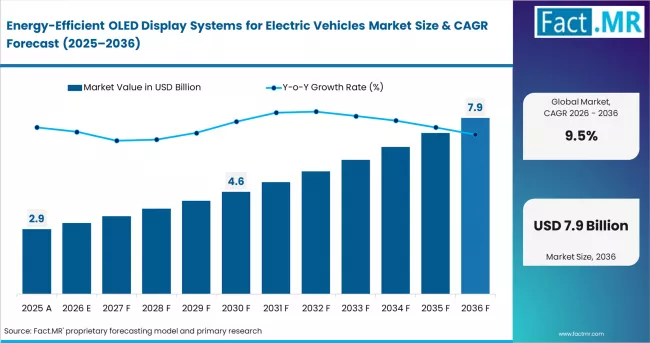
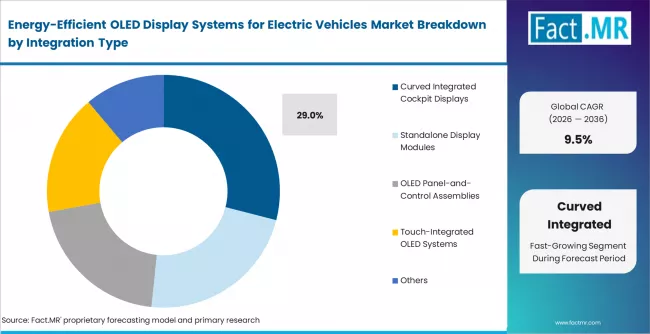
Table of Content

  1. Executive Summary
    • Global Market Outlook
    • Demand to side Trends
    • Supply to side Trends
    • Technology Roadmap Analysis
    • Analysis and Recommendations
  2. Market Overview
    • Market Coverage / Taxonomy
    • Market Definition / Scope / Limitations
  3. Research Methodology
    • Chapter Orientation
    • Analytical Lens and Working Hypotheses
      • Market Structure, Signals, and Trend Drivers
      • Benchmarking and Cross-market Comparability
      • Market Sizing, Forecasting, and Opportunity Mapping
    • Research Design and Evidence Framework
      • Desk Research Programme (Secondary Evidence)
        • Company Annual and Sustainability Reports
        • Peer-reviewed Journals and Academic Literature
        • Corporate Websites, Product Literature, and Technical Notes
        • Earnings Decks and Investor Briefings
        • Statutory Filings and Regulatory Disclosures
        • Technical White Papers and Standards Notes
        • Trade Journals, Industry Magazines, and Analyst Briefs
        • Conference Proceedings, Webinars, and Seminar Materials
        • Government Statistics Portals and Public Data Releases
        • Press Releases and Reputable Media Coverage
        • Specialist Newsletters and Curated Briefings
        • Sector Databases and Reference Repositories
        • Fact.MR Internal Proprietary Databases and Historical Market Datasets
        • Subscription Datasets and Paid Sources
        • Social Channels, Communities, and Digital Listening Inputs
        • Additional Desk Sources
      • Expert Input and Fieldwork (Primary Evidence)
        • Primary Modes
          • Qualitative Interviews and Expert Elicitation
          • Quantitative Surveys and Structured Data Capture
          • Blended Approach
        • Why Primary Evidence is Used
        • Field Techniques
          • Interviews
          • Surveys
          • Focus Groups
          • Observational and In-context Research
          • Social and Community Interactions
        • Stakeholder Universe Engaged
          • C-suite Leaders
          • Board Members
          • Presidents and Vice Presidents
          • R&D and Innovation Heads
          • Technical Specialists
          • Domain Subject-matter Experts
          • Scientists
          • Physicians and Other Healthcare Professionals
        • Governance, Ethics, and Data Stewardship
          • Research Ethics
          • Data Integrity and Handling
      • Tooling, Models, and Reference Databases
    • Data Engineering and Model Build
      • Data Acquisition and Ingestion
      • Cleaning, Normalisation, and Verification
      • Synthesis, Triangulation, and Analysis
    • Quality Assurance and Audit Trail
  4. Market Background
    • Market Dynamics
      • Drivers
      • Restraints
      • Opportunity
      • Trends
    • Scenario Forecast
      • Demand in Optimistic Scenario
      • Demand in Likely Scenario
      • Demand in Conservative Scenario
    • Opportunity Map Analysis
    • Product Life Cycle Analysis
    • Supply Chain Analysis
    • Investment Feasibility Matrix
    • Value Chain Analysis
    • PESTLE and Porter’s Analysis
    • Regulatory Landscape
    • Regional Parent Market Outlook
    • Production and Consumption Statistics
    • Import and Export Statistics
  5. Global Market Analysis 2021 to 2025 and Forecast, 2026 to 2036
    • Historical Market Size Value (USD Million) Analysis, 2021 to 2025
    • Current and Future Market Size Value (USD Million) Projections, 2026 to 2036
      • Y to o to Y Growth Trend Analysis
      • Absolute $ Opportunity Analysis
  6. Global Market Pricing Analysis 2021 to 2025 and Forecast 2026 to 2036
  7. Global Market Analysis 2021 to 2025 and Forecast 2026 to 2036, By Radar Type
    • Introduction / Key Findings
    • Historical Market Size Value (USD Million) Analysis By Radar Type , 2021 to 2025
    • Current and Future Market Size Value (USD Million) Analysis and Forecast By Radar Type , 2026 to 2036
      • Rear Corner Radar Modules
      • Integrated Short-Range Radar Sensor Value (USD Million)s
      • Wide-Coverage Blind Spot Radar Systems
    • Y to o to Y Growth Trend Analysis By Radar Type , 2021 to 2025
    • Absolute $ Opportunity Analysis By Radar Type , 2026 to 2036
  8. Global Market Analysis 2021 to 2025 and Forecast 2026 to 2036, By Function Type
    • Introduction / Key Findings
    • Historical Market Size Value (USD Million) Analysis By Function Type, 2021 to 2025
    • Current and Future Market Size Value (USD Million) Analysis and Forecast By Function Type, 2026 to 2036
      • Blind Spot Warning
      • Lane Change Assist
      • Rear Cross Traffic Alert Support
    • Y to o to Y Growth Trend Analysis By Function Type, 2021 to 2025
    • Absolute $ Opportunity Analysis By Function Type, 2026 to 2036
  9. Global Market Analysis 2021 to 2025 and Forecast 2026 to 2036, By Vehicle Class
    • Introduction / Key Findings
    • Historical Market Size Value (USD Million) Analysis By Vehicle Class, 2021 to 2025
    • Current and Future Market Size Value (USD Million) Analysis and Forecast By Vehicle Class, 2026 to 2036
      • Passenger Cars
      • SUVs
      • Light Commercial Vehicles
    • Y to o to Y Growth Trend Analysis By Vehicle Class, 2021 to 2025
    • Absolute $ Opportunity Analysis By Vehicle Class, 2026 to 2036
  10. Global Market Analysis 2021 to 2025 and Forecast 2026 to 2036, By Region
    • Introduction
    • Historical Market Size Value (USD Million) Analysis By Region, 2021 to 2025
    • Current Market Size Value (USD Million) Analysis and Forecast By Region, 2026 to 2036
      • North America
      • Latin America
      • Western Europe
      • Eastern Europe
      • East Asia
      • South Asia and Pacific
      • Middle East & Africa
    • Market Attractiveness Analysis By Region
  11. North America Market Analysis 2021 to 2025 and Forecast 2026 to 2036, By Country
    • Historical Market Size Value (USD Million) Trend Analysis By Market Taxonomy, 2021 to 2025
    • Market Size Value (USD Million) Forecast By Market Taxonomy, 2026 to 2036
      • By Country
        • USA
        • Canada
        • Mexico
      • By Radar Type
      • By Function Type
      • By Vehicle Class
    • Market Attractiveness Analysis
      • By Country
      • By Radar Type
      • By Function Type
      • By Vehicle Class
    • Key Takeaways
  12. Latin America Market Analysis 2021 to 2025 and Forecast 2026 to 2036, By Country
    • Historical Market Size Value (USD Million) Trend Analysis By Market Taxonomy, 2021 to 2025
    • Market Size Value (USD Million) Forecast By Market Taxonomy, 2026 to 2036
      • By Country
        • Brazil
        • Chile
        • Rest of Latin America
      • By Radar Type
      • By Function Type
      • By Vehicle Class
    • Market Attractiveness Analysis
      • By Country
      • By Radar Type
      • By Function Type
      • By Vehicle Class
    • Key Takeaways
  13. Western Europe Market Analysis 2021 to 2025 and Forecast 2026 to 2036, By Country
    • Historical Market Size Value (USD Million) Trend Analysis By Market Taxonomy, 2021 to 2025
    • Market Size Value (USD Million) Forecast By Market Taxonomy, 2026 to 2036
      • By Country
        • Germany
        • UK
        • Italy
        • Spain
        • France
        • Nordic
        • BENELUX
        • Rest of Western Europe
      • By Radar Type
      • By Function Type
      • By Vehicle Class
    • Market Attractiveness Analysis
      • By Country
      • By Radar Type
      • By Function Type
      • By Vehicle Class
    • Key Takeaways
  14. Eastern Europe Market Analysis 2021 to 2025 and Forecast 2026 to 2036, By Country
    • Historical Market Size Value (USD Million) Trend Analysis By Market Taxonomy, 2021 to 2025
    • Market Size Value (USD Million) Forecast By Market Taxonomy, 2026 to 2036
      • By Country
        • Russia
        • Poland
        • Hungary
        • Balkan & Baltic
        • Rest of Eastern Europe
      • By Radar Type
      • By Function Type
      • By Vehicle Class
    • Market Attractiveness Analysis
      • By Country
      • By Radar Type
      • By Function Type
      • By Vehicle Class
    • Key Takeaways
  15. East Asia Market Analysis 2021 to 2025 and Forecast 2026 to 2036, By Country
    • Historical Market Size Value (USD Million) Trend Analysis By Market Taxonomy, 2021 to 2025
    • Market Size Value (USD Million) Forecast By Market Taxonomy, 2026 to 2036
      • By Country
        • China
        • Japan
        • South Korea
      • By Radar Type
      • By Function Type
      • By Vehicle Class
    • Market Attractiveness Analysis
      • By Country
      • By Radar Type
      • By Function Type
      • By Vehicle Class
    • Key Takeaways
  16. South Asia and Pacific Market Analysis 2021 to 2025 and Forecast 2026 to 2036, By Country
    • Historical Market Size Value (USD Million) Trend Analysis By Market Taxonomy, 2021 to 2025
    • Market Size Value (USD Million) Forecast By Market Taxonomy, 2026 to 2036
      • By Country
        • India
        • ASEAN
        • Australia & New Zealand
        • Rest of South Asia and Pacific
      • By Radar Type
      • By Function Type
      • By Vehicle Class
    • Market Attractiveness Analysis
      • By Country
      • By Radar Type
      • By Function Type
      • By Vehicle Class
    • Key Takeaways
  17. Middle East & Africa Market Analysis 2021 to 2025 and Forecast 2026 to 2036, By Country
    • Historical Market Size Value (USD Million) Trend Analysis By Market Taxonomy, 2021 to 2025
    • Market Size Value (USD Million) Forecast By Market Taxonomy, 2026 to 2036
      • By Country
        • Kingdom of Saudi Arabia
        • Other GCC Countries
        • Turkiye
        • South Africa
        • Other African Union
        • Rest of Middle East & Africa
      • By Radar Type
      • By Function Type
      • By Vehicle Class
    • Market Attractiveness Analysis
      • By Country
      • By Radar Type
      • By Function Type
      • By Vehicle Class
    • Key Takeaways
  18. Key Countries Market Analysis
    • USA
      • Pricing Analysis
      • Market Share Analysis, 2025
        • By Radar Type
        • By Function Type
        • By Vehicle Class
    • Canada
      • Pricing Analysis
      • Market Share Analysis, 2025
        • By Radar Type
        • By Function Type
        • By Vehicle Class
    • Mexico
      • Pricing Analysis
      • Market Share Analysis, 2025
        • By Radar Type
        • By Function Type
        • By Vehicle Class
    • Brazil
      • Pricing Analysis
      • Market Share Analysis, 2025
        • By Radar Type
        • By Function Type
        • By Vehicle Class
    • Chile
      • Pricing Analysis
      • Market Share Analysis, 2025
        • By Radar Type
        • By Function Type
        • By Vehicle Class
    • Germany
      • Pricing Analysis
      • Market Share Analysis, 2025
        • By Radar Type
        • By Function Type
        • By Vehicle Class
    • UK
      • Pricing Analysis
      • Market Share Analysis, 2025
        • By Radar Type
        • By Function Type
        • By Vehicle Class
    • Italy
      • Pricing Analysis
      • Market Share Analysis, 2025
        • By Radar Type
        • By Function Type
        • By Vehicle Class
    • Spain
      • Pricing Analysis
      • Market Share Analysis, 2025
        • By Radar Type
        • By Function Type
        • By Vehicle Class
    • France
      • Pricing Analysis
      • Market Share Analysis, 2025
        • By Radar Type
        • By Function Type
        • By Vehicle Class
    • India
      • Pricing Analysis
      • Market Share Analysis, 2025
        • By Radar Type
        • By Function Type
        • By Vehicle Class
    • ASEAN
      • Pricing Analysis
      • Market Share Analysis, 2025
        • By Radar Type
        • By Function Type
        • By Vehicle Class
    • Australia & New Zealand
      • Pricing Analysis
      • Market Share Analysis, 2025
        • By Radar Type
        • By Function Type
        • By Vehicle Class
    • China
      • Pricing Analysis
      • Market Share Analysis, 2025
        • By Radar Type
        • By Function Type
        • By Vehicle Class
    • Japan
      • Pricing Analysis
      • Market Share Analysis, 2025
        • By Radar Type
        • By Function Type
        • By Vehicle Class
    • South Korea
      • Pricing Analysis
      • Market Share Analysis, 2025
        • By Radar Type
        • By Function Type
        • By Vehicle Class
    • Russia
      • Pricing Analysis
      • Market Share Analysis, 2025
        • By Radar Type
        • By Function Type
        • By Vehicle Class
    • Poland
      • Pricing Analysis
      • Market Share Analysis, 2025
        • By Radar Type
        • By Function Type
        • By Vehicle Class
    • Hungary
      • Pricing Analysis
      • Market Share Analysis, 2025
        • By Radar Type
        • By Function Type
        • By Vehicle Class
    • Kingdom of Saudi Arabia
      • Pricing Analysis
      • Market Share Analysis, 2025
        • By Radar Type
        • By Function Type
        • By Vehicle Class
    • Turkiye
      • Pricing Analysis
      • Market Share Analysis, 2025
        • By Radar Type
        • By Function Type
        • By Vehicle Class
    • South Africa
      • Pricing Analysis
      • Market Share Analysis, 2025
        • By Radar Type
        • By Function Type
        • By Vehicle Class
  19. Market Structure Analysis
    • Competition Dashboard
    • Competition Benchmarking
    • Market Share Analysis of Top Players
      • By Regional
      • By Radar Type
      • By Function Type
      • By Vehicle Class
  20. Competition Analysis
    • Competition Deep Dive
      • Bosch
        • Overview
        • Product Portfolio
        • Profitability by Market Segments (Product/Age /Sales Channel/Region)
        • Sales Footprint
        • Strategy Overview
          • Marketing Strategy
          • Product Strategy
          • Channel Strategy
      • Continental
      • Aptiv
      • Valeo
      • ZF
      • Magna
      • Veoneer
      • FORVIA
  21. Assumptions & Acronyms Used

List Of Table

  • Table 1: Global Market Value (USD Million) Forecast by Region, 2021 to 2036
  • Table 2: Global Market Value (USD Million) Forecast by Radar Type, 2021 to 2036
  • Table 3: Global Market Value (USD Million) Forecast by Function Type, 2021 to 2036
  • Table 4: Global Market Value (USD Million) Forecast by Vehicle Class, 2021 to 2036
  • Table 5: North America Market Value (USD Million) Forecast by Country, 2021 to 2036
  • Table 6: North America Market Value (USD Million) Forecast by Radar Type, 2021 to 2036
  • Table 7: North America Market Value (USD Million) Forecast by Function Type, 2021 to 2036
  • Table 8: North America Market Value (USD Million) Forecast by Vehicle Class, 2021 to 2036
  • Table 9: Latin America Market Value (USD Million) Forecast by Country, 2021 to 2036
  • Table 10: Latin America Market Value (USD Million) Forecast by Radar Type, 2021 to 2036
  • Table 11: Latin America Market Value (USD Million) Forecast by Function Type, 2021 to 2036
  • Table 12: Latin America Market Value (USD Million) Forecast by Vehicle Class, 2021 to 2036
  • Table 13: Western Europe Market Value (USD Million) Forecast by Country, 2021 to 2036
  • Table 14: Western Europe Market Value (USD Million) Forecast by Radar Type, 2021 to 2036
  • Table 15: Western Europe Market Value (USD Million) Forecast by Function Type, 2021 to 2036
  • Table 16: Western Europe Market Value (USD Million) Forecast by Vehicle Class, 2021 to 2036
  • Table 17: Eastern Europe Market Value (USD Million) Forecast by Country, 2021 to 2036
  • Table 18: Eastern Europe Market Value (USD Million) Forecast by Radar Type, 2021 to 2036
  • Table 19: Eastern Europe Market Value (USD Million) Forecast by Function Type, 2021 to 2036
  • Table 20: Eastern Europe Market Value (USD Million) Forecast by Vehicle Class, 2021 to 2036
  • Table 21: East Asia Market Value (USD Million) Forecast by Country, 2021 to 2036
  • Table 22: East Asia Market Value (USD Million) Forecast by Radar Type, 2021 to 2036
  • Table 23: East Asia Market Value (USD Million) Forecast by Function Type, 2021 to 2036
  • Table 24: East Asia Market Value (USD Million) Forecast by Vehicle Class, 2021 to 2036
  • Table 25: South Asia and Pacific Market Value (USD Million) Forecast by Country, 2021 to 2036
  • Table 26: South Asia and Pacific Market Value (USD Million) Forecast by Radar Type, 2021 to 2036
  • Table 27: South Asia and Pacific Market Value (USD Million) Forecast by Function Type, 2021 to 2036
  • Table 28: South Asia and Pacific Market Value (USD Million) Forecast by Vehicle Class, 2021 to 2036
  • Table 29: Middle East & Africa Market Value (USD Million) Forecast by Country, 2021 to 2036
  • Table 30: Middle East & Africa Market Value (USD Million) Forecast by Radar Type, 2021 to 2036
  • Table 31: Middle East & Africa Market Value (USD Million) Forecast by Function Type, 2021 to 2036
  • Table 32: Middle East & Africa Market Value (USD Million) Forecast by Vehicle Class, 2021 to 2036

List Of Figures

  • Figure 1: Global Market Pricing Analysis
  • Figure 2: Global Market Value (USD Million) Forecast 2021-2036
  • Figure 3: Global Market Value Share and BPS Analysis by Radar Type, 2026 and 2036
  • Figure 4: Global Market Y-o-Y Growth Comparison by Radar Type, 2026 to 2036
  • Figure 5: Global Market Attractiveness Analysis by Radar Type
  • Figure 6: Global Market Value Share and BPS Analysis by Function Type, 2026 and 2036
  • Figure 7: Global Market Y-o-Y Growth Comparison by Function Type, 2026 to 2036
  • Figure 8: Global Market Attractiveness Analysis by Function Type
  • Figure 9: Global Market Value Share and BPS Analysis by Vehicle Class, 2026 and 2036
  • Figure 10: Global Market Y-o-Y Growth Comparison by Vehicle Class, 2026 to 2036
  • Figure 11: Global Market Attractiveness Analysis by Vehicle Class
  • Figure 12: Global Market Value (USD Million) Share and BPS Analysis by Region, 2026 and 2036
  • Figure 13: Global Market Y-o-Y Growth Comparison by Region, 2026 to 2036
  • Figure 14: Global Market Attractiveness Analysis by Region
  • Figure 15: North America Market Incremental Dollar Opportunity, 2026 to 2036
  • Figure 16: Latin America Market Incremental Dollar Opportunity, 2026 to 2036
  • Figure 17: Western Europe Market Incremental Dollar Opportunity, 2026 to 2036
  • Figure 18: Eastern Europe Market Incremental Dollar Opportunity, 2026 to 2036
  • Figure 19: East Asia Market Incremental Dollar Opportunity, 2026 to 2036
  • Figure 20: South Asia and Pacific Market Incremental Dollar Opportunity, 2026 to 2036
  • Figure 21: Middle East & Africa Market Incremental Dollar Opportunity, 2026 to 2036
  • Figure 22: North America Market Value Share and BPS Analysis by Country, 2026 and 2036
  • Figure 23: North America Market Value Share and BPS Analysis by Radar Type, 2026 and 2036
  • Figure 24: North America Market Y-o-Y Growth Comparison by Radar Type, 2026 to 2036
  • Figure 25: North America Market Attractiveness Analysis by Radar Type
  • Figure 26: North America Market Value Share and BPS Analysis by Function Type, 2026 and 2036
  • Figure 27: North America Market Y-o-Y Growth Comparison by Function Type, 2026 to 2036
  • Figure 28: North America Market Attractiveness Analysis by Function Type
  • Figure 29: North America Market Value Share and BPS Analysis by Vehicle Class, 2026 and 2036
  • Figure 30: North America Market Y-o-Y Growth Comparison by Vehicle Class, 2026 to 2036
  • Figure 31: North America Market Attractiveness Analysis by Vehicle Class
  • Figure 32: Latin America Market Value Share and BPS Analysis by Country, 2026 and 2036
  • Figure 33: Latin America Market Value Share and BPS Analysis by Radar Type, 2026 and 2036
  • Figure 34: Latin America Market Y-o-Y Growth Comparison by Radar Type, 2026 to 2036
  • Figure 35: Latin America Market Attractiveness Analysis by Radar Type
  • Figure 36: Latin America Market Value Share and BPS Analysis by Function Type, 2026 and 2036
  • Figure 37: Latin America Market Y-o-Y Growth Comparison by Function Type, 2026 to 2036
  • Figure 38: Latin America Market Attractiveness Analysis by Function Type
  • Figure 39: Latin America Market Value Share and BPS Analysis by Vehicle Class, 2026 and 2036
  • Figure 40: Latin America Market Y-o-Y Growth Comparison by Vehicle Class, 2026 to 2036
  • Figure 41: Latin America Market Attractiveness Analysis by Vehicle Class
  • Figure 42: Western Europe Market Value Share and BPS Analysis by Country, 2026 and 2036
  • Figure 43: Western Europe Market Value Share and BPS Analysis by Radar Type, 2026 and 2036
  • Figure 44: Western Europe Market Y-o-Y Growth Comparison by Radar Type, 2026 to 2036
  • Figure 45: Western Europe Market Attractiveness Analysis by Radar Type
  • Figure 46: Western Europe Market Value Share and BPS Analysis by Function Type, 2026 and 2036
  • Figure 47: Western Europe Market Y-o-Y Growth Comparison by Function Type, 2026 to 2036
  • Figure 48: Western Europe Market Attractiveness Analysis by Function Type
  • Figure 49: Western Europe Market Value Share and BPS Analysis by Vehicle Class, 2026 and 2036
  • Figure 50: Western Europe Market Y-o-Y Growth Comparison by Vehicle Class, 2026 to 2036
  • Figure 51: Western Europe Market Attractiveness Analysis by Vehicle Class
  • Figure 52: Eastern Europe Market Value Share and BPS Analysis by Country, 2026 and 2036
  • Figure 53: Eastern Europe Market Value Share and BPS Analysis by Radar Type, 2026 and 2036
  • Figure 54: Eastern Europe Market Y-o-Y Growth Comparison by Radar Type, 2026 to 2036
  • Figure 55: Eastern Europe Market Attractiveness Analysis by Radar Type
  • Figure 56: Eastern Europe Market Value Share and BPS Analysis by Function Type, 2026 and 2036
  • Figure 57: Eastern Europe Market Y-o-Y Growth Comparison by Function Type, 2026 to 2036
  • Figure 58: Eastern Europe Market Attractiveness Analysis by Function Type
  • Figure 59: Eastern Europe Market Value Share and BPS Analysis by Vehicle Class, 2026 and 2036
  • Figure 60: Eastern Europe Market Y-o-Y Growth Comparison by Vehicle Class, 2026 to 2036
  • Figure 61: Eastern Europe Market Attractiveness Analysis by Vehicle Class
  • Figure 62: East Asia Market Value Share and BPS Analysis by Country, 2026 and 2036
  • Figure 63: East Asia Market Value Share and BPS Analysis by Radar Type, 2026 and 2036
  • Figure 64: East Asia Market Y-o-Y Growth Comparison by Radar Type, 2026 to 2036
  • Figure 65: East Asia Market Attractiveness Analysis by Radar Type
  • Figure 66: East Asia Market Value Share and BPS Analysis by Function Type, 2026 and 2036
  • Figure 67: East Asia Market Y-o-Y Growth Comparison by Function Type, 2026 to 2036
  • Figure 68: East Asia Market Attractiveness Analysis by Function Type
  • Figure 69: East Asia Market Value Share and BPS Analysis by Vehicle Class, 2026 and 2036
  • Figure 70: East Asia Market Y-o-Y Growth Comparison by Vehicle Class, 2026 to 2036
  • Figure 71: East Asia Market Attractiveness Analysis by Vehicle Class
  • Figure 72: South Asia and Pacific Market Value Share and BPS Analysis by Country, 2026 and 2036
  • Figure 73: South Asia and Pacific Market Value Share and BPS Analysis by Radar Type, 2026 and 2036
  • Figure 74: South Asia and Pacific Market Y-o-Y Growth Comparison by Radar Type, 2026 to 2036
  • Figure 75: South Asia and Pacific Market Attractiveness Analysis by Radar Type
  • Figure 76: South Asia and Pacific Market Value Share and BPS Analysis by Function Type, 2026 and 2036
  • Figure 77: South Asia and Pacific Market Y-o-Y Growth Comparison by Function Type, 2026 to 2036
  • Figure 78: South Asia and Pacific Market Attractiveness Analysis by Function Type
  • Figure 79: South Asia and Pacific Market Value Share and BPS Analysis by Vehicle Class, 2026 and 2036
  • Figure 80: South Asia and Pacific Market Y-o-Y Growth Comparison by Vehicle Class, 2026 to 2036
  • Figure 81: South Asia and Pacific Market Attractiveness Analysis by Vehicle Class
  • Figure 82: Middle East & Africa Market Value Share and BPS Analysis by Country, 2026 and 2036
  • Figure 83: Middle East & Africa Market Value Share and BPS Analysis by Radar Type, 2026 and 2036
  • Figure 84: Middle East & Africa Market Y-o-Y Growth Comparison by Radar Type, 2026 to 2036
  • Figure 85: Middle East & Africa Market Attractiveness Analysis by Radar Type
  • Figure 86: Middle East & Africa Market Value Share and BPS Analysis by Function Type, 2026 and 2036
  • Figure 87: Middle East & Africa Market Y-o-Y Growth Comparison by Function Type, 2026 to 2036
  • Figure 88: Middle East & Africa Market Attractiveness Analysis by Function Type
  • Figure 89: Middle East & Africa Market Value Share and BPS Analysis by Vehicle Class, 2026 and 2036
  • Figure 90: Middle East & Africa Market Y-o-Y Growth Comparison by Vehicle Class, 2026 to 2036
  • Figure 91: Middle East & Africa Market Attractiveness Analysis by Vehicle Class
  • Figure 92: Global Market - Tier Structure Analysis
  • Figure 93: Global Market - Company Share Analysis

Energy-Efficient OLED Display Systems for Electric Vehicles Market