Mechanically Separated Meat Market Size, Share, Growth and Forecast (2026 - 2036)

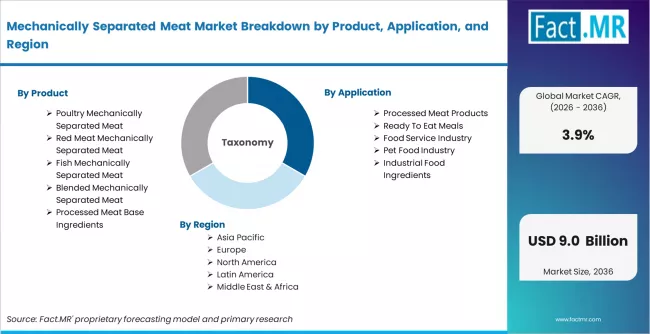
Mechanically Separated Meat Market is segmented by Product (Poultry Mechanically Separated Meat, Red Meat Mechanically Separated Meat, Fish Mechanically Separated Meat, Blended Mechanically Separated Meat, Processed Meat Base Ingredients), Application (Processed Meat Products, Ready To Eat Meals, Food Service Industry, Pet Food Industry, Industrial Food Ingredients), Source (Poultry Based, Red Meat Based, Fish Based), and Region, with forecasts covering the period from 2026 to 2036.

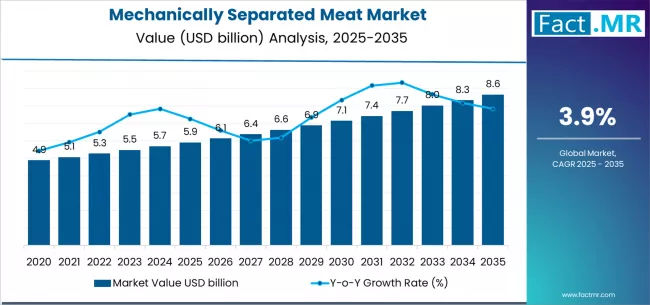
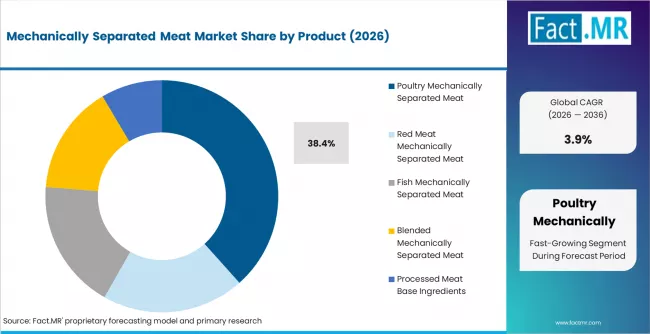
According to Fact.MR estimates, the global mechanically separated meat market market was valued at USD 5.9 billion in 2025. The market is projected to reach USD 6.1 billion in 2026 and is expected to grow to USD 9.0 billion by 2036, expanding at a CAGR of 3.9%. Poultry Mechanically Separated Meat is anticipated to account for 38.4% of the product segment in 2026, while Processed Meat Products is expected to remain the leading application with around 41.7% share.

Mechanically Separated Meat Market Analysis and Forecast by Fact.MR

The mechanically separated meat market, valued at USD 5.9 billion in 2025, is expanding at a 3.9% CAGR to reach USD 8.987 billion by 2036. Mechanically separated meat (MSM) is a paste-like product obtained by forcing animal carcass bones with attached edible tissue through a sieve or similar device to separate bone from edible tissue. MSM from poultry, red meat, and fish serves as a cost-effective protein ingredient in processed meat products, ready meals, pet food, and industrial food applications. Growth is shaped by processed meat production expansion in emerging markets, protein ingredient cost optimisation by food manufacturers, and pet food industry demand for affordable animal protein.
Mechanically Separated Meat Market Market Value Analysis

Summary of Mechanically Separated Meat Market

  • Market Snapshot
    • The mechanically separated meat market is valued at USD 5.9 billion in 2025.
    • Estimated market value for 2026 is USD 6.13 billion, projected to reach USD 8.987 billion by 2036.
    • A CAGR of 3.9% is forecast for the 2026 to 2036 assessment period.
    • Incremental opportunity of USD 2.857 billion between 2026 and 2036.
    • Poultry MSM holds 38.4% of the product segment, with poultry-based sources at 52.6% of source demand.
    • India and China are the fastest-growing markets for MSM consumption.
  • Demand and Growth Drivers
    • Global processed meat production exceeds 40 million tonnes annually, with MSM serving as a cost-effective protein filler and binder in sausages, frankfurters, nuggets, patties, and canned meat products, reducing per-unit protein ingredient costs by 30 to 50% versus whole muscle meat.
    • Pet food industry growth at 6 to 8% annually is creating secondary demand for MSM as an affordable animal protein ingredient in wet pet food, treats, and semi-moist pet food formulations where protein content and palatability are production requirements.
    • Poultry processing intensification in Asia and Latin America is expanding MSM supply as integrated poultry companies invest in mechanical separation equipment to maximise carcass utilisation and extract value from frames, necks, and backs that previously generated minimal revenue.
    • Quick-service restaurant chain expansion in emerging markets is creating demand for processed meat products (nuggets, patties, hot dogs) that rely on MSM as a primary or supplementary protein ingredient.
  • Product and Segment View
    • Poultry MSM holds 38.4% of the product segment, reflecting the dominance of chicken and turkey mechanical separation in processed meat manufacturing.
    • Processed meat products capture 41.7% of application demand, driven by sausage, frankfurter, nugget, and patty manufacturing.
    • Frozen MSM accounts for 47.3% of form demand, reflecting the frozen storage and transport requirements for maintaining product safety and shelf life.
    • Key segmentation includes:
      • Product: Poultry Mechanically Separated Meat, Red Meat Mechanically Separated Meat, Fish Mechanically Separated Meat, Blended Mechanically Separated Meat, Processed Meat Base Ingredients
      • Application: Processed Meat Products, Ready To Eat Meals, Food Service Industry, Pet Food Industry, Industrial Food Ingredients
      • Source: Poultry Based, Red Meat Based, Fish Based
      • Form: Frozen Mechanically Separated Meat, Fresh Mechanically Separated Meat, Paste Form, Dry Form
      • Processing Technology: Mechanical Separation, Grinding Technology, Separation Enhancement, Stabilization Technology
  • Geography and Competitive Outlook
    • North America accounts for the largest share, with the USA generating USD 2.264 billion in 2025.
    • East Asia is expanding, with Japan contributing USD 0.305 billion and South Korea contributing USD 0.202 billion.
    • Tyson Foods holds approximately 12.0% of global market share through integrated poultry processing and MSM production at scale.
    • JBS, Cargill, and BRF compete on multi-species processing scale, geographic diversification, and integrated supply chain positioning.
  • Analyst Opinion
    • The mechanically separated meat market is a cost-driven ingredient sector where growth depends on processed meat production volumes and protein cost arbitrage between MSM and whole muscle meat. The commercial opportunity is in improving MSM quality perception through advanced separation technology that produces cleaner, lower-fat, higher-protein products. Companies investing in high-pressure separation and advanced deboning technology will produce MSM that meets tightening regulatory and customer quality specifications.

Key Growth Drivers, Constraints, and Opportunities
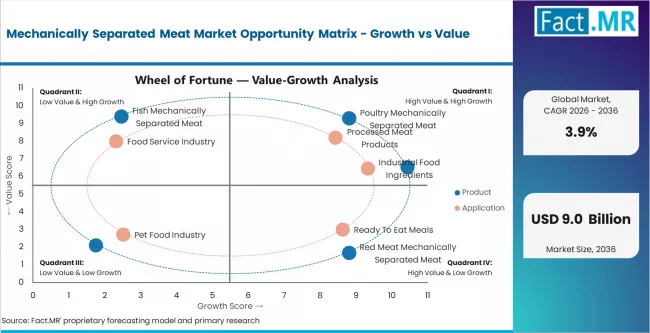
Mechanically Separated Meat Market Opportunity Matrix Growth Vs Value

Key Factors Driving Growth

  • Poultry processing generates 25 to 35% of carcass weight as frames, necks, and backs suitable for mechanical separation. With global chicken production exceeding 130 million tonnes annually, per FAO data, the raw material base for poultry MSM is expanding in direct proportion to poultry production growth, creating a structural supply increase that supports market expansion.
  • Protein cost management in processed meat manufacturing is a continuous commercial pressure. MSM delivers functional protein at USD 0.80 to USD 1.50 per kilogram versus USD 3 to USD 6 per kilogram for whole muscle poultry meat, making MSM an essential cost management tool for manufacturers of value-tier processed meat products.
  • Regulatory frameworks in the EU, USA, and other major markets permit MSM use in defined product categories with labelling requirements, providing a clear legal basis for MSM utilisation. EU Regulation 853/2004 and USDA FSIS regulations define MSM production standards, species restrictions, and labelling obligations that enable compliant commercial use.

Key Market Constraints

  • Consumer perception of MSM is negative in markets with high food quality awareness. Media coverage characterising MSM as 'pink slime' has created reputational risks for products containing MSM, leading some food manufacturers to voluntarily exclude MSM from premium product lines and some retailers to specify MSM-free requirements for private label products.
  • Regulatory restrictions on MSM usage vary by species and jurisdiction. EU regulations prohibit MSM from ruminant (bovine) bones due to BSE transmission risk, limiting red meat MSM to pork in European markets. USDA regulations restrict MSM labelling, requiring distinct identification on product labels that can deter consumer purchase.
  • Microbiological safety management is critical for MSM, as the mechanical separation process creates a high surface-area product with elevated pathogen risk. Salmonella, Listeria, and E. coli management require strict temperature control, rapid processing, and validated HACCP programmes that increase operational costs.

Key Opportunity Areas

  • Advanced mechanical separation technology (high-pressure deboning, Baader-type separation) is producing higher-quality MSM with lower bone particle content, higher protein concentration, and improved texture that meets tighter customer specifications and enables use in higher-value product applications.
  • Pet food premiumisation is creating demand for species-specific, traceable MSM products. Premium pet food manufacturers specify poultry MSM from named species (chicken breast frames only) with batch traceability documentation, commanding prices 20 to 40% above commodity MSM.
  • Emerging market processed meat production expansion in India, China, Vietnam, and Indonesia is the primary volume growth driver. As these markets scale processed meat manufacturing for domestic consumption and export, MSM adoption follows as an essential cost management ingredient.

Segment-wise Analysis of the Mechanically Separated Meat Market

  • Poultry MSM holds 38.4% of the product segment, reflecting poultry processing dominance.
  • Processed meat products capture 41.7% of application demand, driven by sausage and nugget manufacturing.
  • High volume use accounts for 49.1% of application intensity, reflecting MSM's role in mass-market processed meat production.

Which product type dominates the Mechanically Separated Meat Market?
Mechanically Separated Meat Market Analysis By Product

Poultry MSM controls 38.4% of the product segment. Chicken MSM is the highest-volume product, produced from broiler carcass frames after breast and leg deboning. Turkey MSM serves similar applications with slightly different functional properties. Poultry MSM dominance reflects the scale of global poultry processing and the regulatory permissiveness for poultry MSM across all major markets.

Red meat MSM holds the second-largest share, led by pork MSM in European and Asian markets. Fish MSM serves surimi-adjacent applications and pet food manufacturing. Blended MSM products combine species for optimised functionality in specific processed meat formulations.

Which application drives demand in the Mechanically Separated Meat Market?
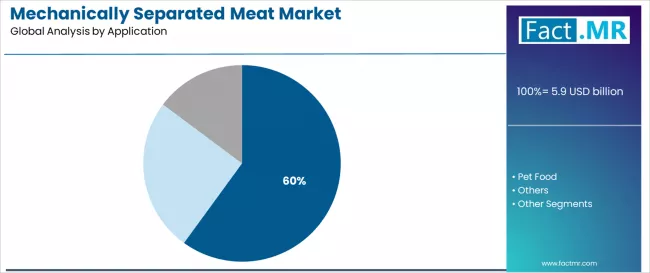
Mechanically Separated Meat Market Analysis By Application

Processed meat products account for 41.7% of application demand. Sausages, frankfurters, bologna, chicken nuggets, and meat patties are the primary processed meat applications for MSM. The ingredient provides protein content, binding functionality, and cost efficiency that enable manufacturers to produce affordable processed meat products at price points accessible to mass-market consumers.

Pet food industry holds the second-largest application share, with MSM used in wet pet food, semi-moist products, and pet treat manufacturing. Ready-to-eat meals and food service applications serve additional demand channels.

Which source captures the largest share in the Mechanically Separated Meat Market?
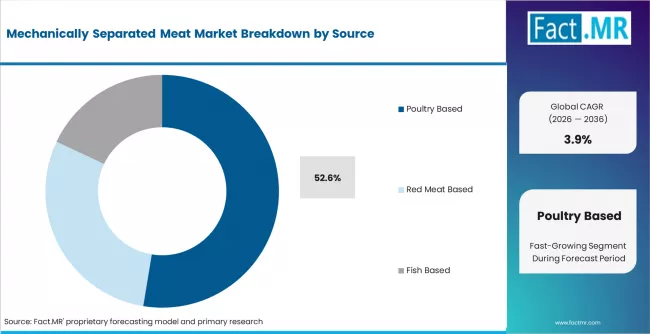
Mechanically Separated Meat Market Analysis By Source

Poultry-based sources account for 52.6% of source demand. Chicken frames from broiler processing are the dominant MSM raw material, supplemented by turkey frames and spent hen carcasses. Poultry sources are favoured for their lower cost, regulatory acceptance across all markets, and neutral flavour profile that is compatible with diverse processed meat applications.

Red meat-based sources hold the second-largest share, with pork as the primary species. Fish-based sources serve niche applications in surimi production and pet food.

Which Product Trend is Shaping the Next Phase of Growth in the Mechanically Separated Meat Market?

The fastest-growing product trend in the mechanically separated meat market is the development of advanced separation technology that produces higher-quality MSM meeting tighter regulatory and customer specifications. Traditional mechanical separation using auger-type separators produces MSM with 0.5 to 1.0% bone particle content and variable fat levels. Advanced high-pressure separation systems (Baader, Lima, Bibun) produce MSM with bone particle content below 0.3%, lower fat content, and improved texture that enables use in higher-value product applications.

The commercial significance is that advanced-technology MSM commands prices 15 to 30% above standard MSM while enabling use in product categories that previously excluded mechanically separated ingredients. Chicken nuggets, premium sausages, and export-grade processed meat products increasingly specify advanced-separation MSM that meets stringent bone particle and microbiological specifications. Processors investing in next-generation separation equipment are capturing both price premiums and expanded customer access.

Regional Outlook Across Key Markets

Top Country Growth Comparison Mechanically Separated Meat Market Cagr (2026 2036)

  • North America is the largest market, with the USA contributing USD 2.264 billion in 2025.
  • East Asia is expanding, with Japan at USD 0.305 billion and South Korea at USD 0.202 billion.
  • South Asia and Pacific is the fastest-growing region, driven by India's processed meat sector expansion.
  • Latin America is a major production region, with Brazil as a leading MSM producer and exporter.

CAGR Table

Country CAGR (%)
India 5.5%
China 4.6%
Mexico 3.5%
USA 3.4%
Germany 3.3%
South Korea 3.0%
Japan 2.7%

Source: Fact.MR analysis, based on proprietary forecasting model and primary research.
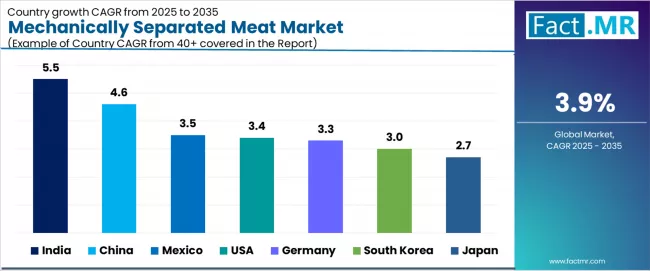
Mechanically Separated Meat Market Cagr Analysis By Country

India: Poultry processing expansion and processed food manufacturing drive growth

India leads country-level growth. India's poultry processing industry is scaling rapidly, with organised poultry processing capacity growing at 15 to 20% annually. As Indian processors install mechanical separation equipment, MSM production is expanding to serve the growing domestic processed meat and ready-meal manufacturing sectors.

  • India's poultry production exceeded 5 billion birds in 2024, per CLFMA data, with organised processing capturing an increasing share of total slaughter volume.

China: Processed meat industry scale and pet food growth drive demand

China records the second-highest growth rate. China's processed meat industry is the world's largest by volume, and MSM serves as a cost-effective protein ingredient in sausage, ham, and canned meat production. Chinese pet food market growth at 15 to 20% annually is creating additional MSM demand.

  • China's processed meat production exceeded 20 million tonnes in 2024, per National Bureau of Statistics data.

Mexico: Processed meat consumption and export production sustain demand

Mexico's growth reflects expanding domestic processed meat consumption and export-oriented production. Mexican meat processors use MSM in hot dog, bologna, and canned meat production for both domestic and Central American export markets.

  • Mexico's processed meat market grew 5% in 2024, per CANAINCA data, with MSM-containing products maintaining stable category share.

USA: Processed meat heritage and pet food demand sustain the market
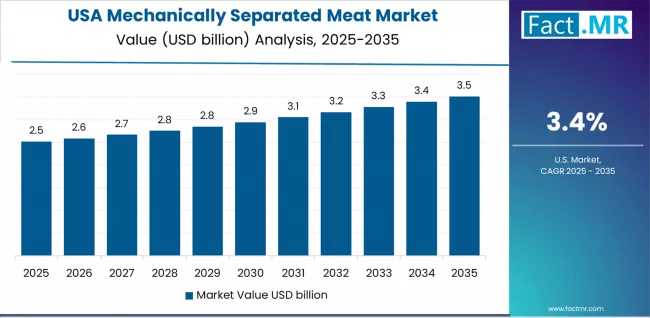
Mechanically Separated Meat Market Country Value Analysis

The USA generates USD 2.264 billion in 2025. The US is the world's largest MSM market, with poultry MSM used extensively in chicken nugget, sausage, hot dog, and pet food manufacturing. USDA FSIS regulations provide a clear framework for MSM production and labelling.

  • US poultry MSM production exceeded 1.5 million tonnes in 2024, per USDA FSIS inspection data.

Germany: Processed meat tradition and quality specifications define the market

Germany's growth reflects the country's deep processed meat (Wurst) tradition. German meat processors apply stringent quality specifications for MSM, and the EU regulatory framework for MSM production provides clear compliance standards.

  • Germany's processed meat market exceeded EUR 20 billion in 2024, per BVE data, with MSM serving as a standard ingredient in mass-market sausage production.

South Korea: Processed meat growth and pet food expansion drive adoption
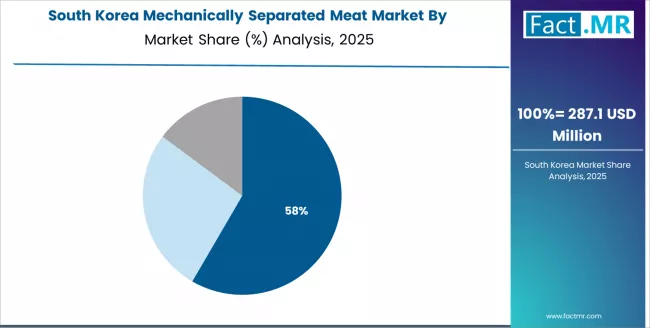
Mechanically Separated Meat Market South Korea Market Share Analysis By Application

South Korea's growth is driven by processed meat consumption growth and the expanding pet food market. Korean food manufacturers use MSM in processed meat products for both domestic consumption and export.

  • South Korea's pet food market grew 12% in 2024, per KAPA data, creating additional MSM ingredient demand.

Japan: Processed food manufacturing and pet food premium demand sustain consumption
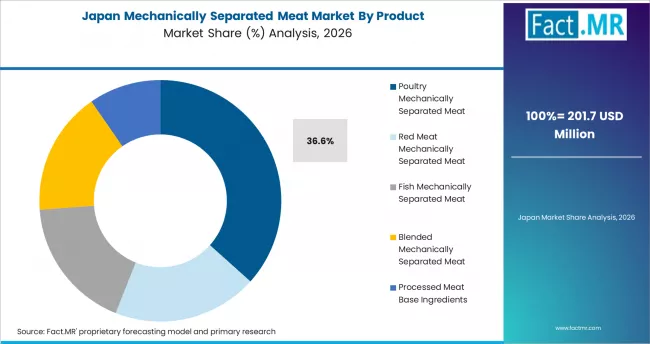
Mechanically Separated Meat Market Japan Market Share Analysis By Product

Japan contributes USD 0.305 billion in 2025. Japanese MSM demand is driven by processed food manufacturing quality standards and the premium pet food market. Japanese processors apply stringent microbiological and bone particle specifications for MSM.

  • Japan's processed meat market maintained stable volumes in 2024, per Japan Meat Processors Association data.

Competitive Benchmarking and Company Positioning
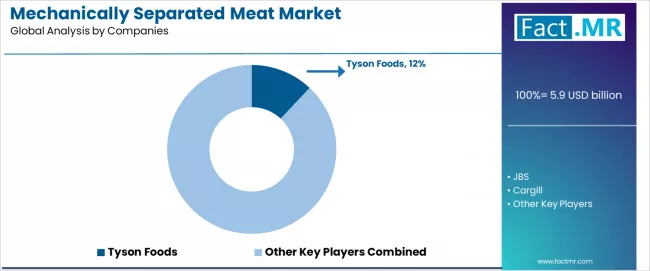
Mechanically Separated Meat Market Analysis By Company

Mechanically Separated Meat Market Analysis By Company

  • Tyson Foods holds approximately 12.0% of global revenue through integrated poultry processing and MSM production at its US and international processing facilities.
  • JBS and Cargill compete on multi-species processing scale, with MSM production integrated into beef, pork, and poultry processing operations across multiple countries.
  • BRF and Pilgrim's Pride serve specific regional and species markets within the MSM competitive field.

The competitive structure is moderately concentrated, with Tyson Foods holding the largest share at 12.0%. Tyson's position is built on its scale as the world's largest poultry processor, with MSM production integrated into its chicken processing operations across the USA and international facilities.

Competition is driven by processing scale and species diversification. JBS competes across beef, pork, and poultry MSM globally. Cargill brings multi-species processing capability and B2B ingredient distribution. The competitive dynamic favours vertically integrated processors that can optimise carcass utilisation across product grades.

Key Companies in the Mechanically Separated Meat Market

The mechanically separated meat competitive field includes Tyson Foods, JBS, Cargill, BRF, Smithfield, Hormel, Perdue, Sanderson Farms, OSI Group, Maple Leaf Foods, Pilgrim's Pride, CP Group, Vion, Marfrig, and Foster Farms.

Recent Industry Developments

  • Tyson Foods: advanced separation technology investment (2025)
    • Tyson invested in next-generation high-pressure mechanical separation equipment at three US poultry processing facilities, producing lower-fat, lower-bone-particle MSM for premium processed meat and pet food applications.
  • JBS: MSM quality improvement programme (2025)
    • JBS implemented a global MSM quality improvement programme across its poultry processing facilities in Brazil, USA, and Europe, standardising bone particle specifications and microbiological controls.
  • BRF: halal MSM export expansion (2026)
    • BRF expanded halal-certified poultry MSM production and export to Middle East and Southeast Asian markets, targeting growing demand for affordable halal protein ingredients in processed food manufacturing.
  • CP Group: Asian MSM production capacity expansion (2025)
    • CP Group expanded poultry MSM production capacity at its Thai and Vietnamese processing facilities, supporting growing domestic and regional demand for processed meat ingredients.

Leading Companies Shaping the Mechanically Separated Meat Market

  • Global Players

    • Tyson Foods
    • JBS
    • Cargill
    • BRF
    • Smithfield
  • Regional Players

    • Hormel
    • Perdue
    • OSI Group
    • Maple Leaf Foods
    • CP Group
  • Emerging / Start-up Players

    • Sanderson Farms
    • Pilgrim's Pride
    • Vion
    • Marfrig
    • Foster Farms

Sources and Research References

  • Company annual reports from Tyson Foods, JBS, and Cargill.
  • FAO global meat production and trade statistics.
  • USDA FSIS MSM production inspection data and regulatory documentation.
  • EU Regulation 853/2004 on food hygiene rules for mechanically separated meat.
  • CLFMA of India poultry production data.
  • Japan Meat Processors Association industry statistics.

All cited sources are first-party company filings, government agencies, regulatory bodies, or industry associations. No syndicated market research reports were used.

Key Questions This Report Addresses

  • What is the projected market value for MSM by 2036?
  • Which product type holds the largest share?
  • What CAGR is forecast from 2026 to 2036?
  • How is advanced separation technology improving MSM quality?
  • Which countries are growing fastest?
  • What is the competitive structure?
  • How do regulatory frameworks affect MSM usage across markets?
  • What role does pet food demand play in MSM market growth?
  • How does consumer perception affect MSM product positioning?

Mechanically Separated Meat Market Definition

The mechanically separated meat market encompasses the production and sale of paste-like meat products obtained through mechanical bone-meat separation processes from poultry, red meat, and fish carcasses. Products serve as protein ingredients in processed meat, ready meals, pet food, and industrial food applications.

Mechanically Separated Meat Market Inclusions

  • Poultry MSM from chicken and turkey frames, necks, and backs.
  • Red meat MSM from beef, pork, and lamb carcass bones.
  • Fish MSM (surimi-grade and lower-grade) from fish frames and trimmings.
  • Blended MSM products combining multiple species for specific formulation requirements.

Mechanically Separated Meat Market Exclusions

  • Whole muscle meat, ground meat, and deboned meat produced without mechanical separation.
  • Surimi (fish paste) produced through washing and refining processes distinct from mechanical separation.
  • Rendered meat meal and bone meal produced through thermal rendering rather than mechanical separation.
  • Collagen and gelatin extracted from bones through chemical or enzymatic processes.

Mechanically Separated Meat Market Research Methodology

  • Primary research with meat processors, poultry integrators, pet food manufacturers, and processed meat companies across 12 countries.
  • Revenue modelling based on MSM production volumes, carcass utilisation data, and processor-reported sales.
  • Pricing analysis using B2B meat ingredient trading data, processor contract records, and pet food ingredient procurement data.
  • Competitive share estimation through company annual reports, meat processing industry data, and production capacity registries.
  • Demand validation through processed meat production statistics, pet food industry consumption data, and food safety regulatory records.

Scope of Analysis

Mechanically Separated Meat Market Breakdown By Product, Application, And Region

Parameter Details
Report Currency USD Billion
Market Value (2025) USD 5.9 Billion
Forecast Value (2036) USD 8.987 Billion
CAGR (2026 to 2036) 3.9%
Product Poultry MSM, Red Meat MSM, Fish MSM, Blended MSM, Processed Meat Base Ingredients
Application Processed Meat Products, Ready To Eat Meals, Food Service Industry, Pet Food Industry, Industrial Food Ingredients
Source Poultry Based, Red Meat Based, Fish Based
Form Frozen MSM, Fresh MSM, Paste Form, Dry Form
Processing Technology Mechanical Separation, Grinding Technology, Separation Enhancement, Stabilization Technology
Regions North America, Latin America, Europe, East Asia, South Asia and Pacific, Middle East and Africa
Countries India, China, Mexico, USA, Germany, South Korea, Japan, and 40+ countries
Companies Tyson Foods, JBS, Cargill, BRF, Smithfield, Hormel, Perdue, Sanderson Farms, OSI Group, Maple Leaf Foods, Pilgrim's Pride, CP Group, Vion, Marfrig, Foster Farms
Forecast Period 2026 to 2036
Approach Top-down and bottom-up with primary and secondary research

Market Segmentation Analysis

  • Mechanically Separated Meat Market Market Segmented by Product:

    • Poultry Mechanically Separated Meat
      • Chicken Mechanically Separated Meat
      • Turkey Mechanically Separated Meat
    • Red Meat Mechanically Separated Meat
      • Beef Mechanically Separated Meat
      • Pork Mechanically Separated Meat
    • Fish Mechanically Separated Meat
      • White Fish MSM
      • Surimi Grade Fish Meat
    • Blended Mechanically Separated Meat
      • Poultry Red Meat Blends
      • Multi Species Blends
    • Processed Meat Base Ingredients
      • Sausage Meat Base
      • Nugget Meat Base
      • Burger Patty Meat Base
  • Mechanically Separated Meat Market Market Segmented by Application:

    • Processed Meat Products
      • Sausages
      • Hot Dogs
      • Nuggets
      • Burgers
    • Ready To Eat Meals
      • Frozen Meals
      • Canned Meat Products
    • Food Service Industry
      • Fast Food Chains
      • QSR Applications
      • Horeca Sector
    • Pet Food Industry
      • Dry Pet Food
      • Wet Pet Food
      • Aquatic Feed Products
    • Industrial Food Ingredients
      • Flavored Meat Systems
      • Protein Texturization Systems
  • Mechanically Separated Meat Market Market Segmented by Source:

    • Poultry Based
      • Chicken Processing Plants
      • Turkey Processing Plants
    • Red Meat Based
      • Beef Processing Facilities
      • Pork Processing Facilities
    • Fish Based
      • Marine Processing Units
      • Fish Filleting Plants
  • Mechanically Separated Meat Market Market Segmented by Form:

    • Frozen Mechanically Separated Meat
      • Block Frozen MSM
      • Individually Frozen Packs
    • Fresh Mechanically Separated Meat
      • Chilled Paste Form
    • Paste Form
      • Emulsified Meat Paste
      • Homogenized Meat Base
    • Dry Form
      • Dehydrated Meat Protein
      • Meat Protein Powder
  • Mechanically Separated Meat Market Market Segmented by Processing Technology:

    • Mechanical Separation
      • High Pressure Separation Systems
      • Low Pressure Deboning Systems
    • Grinding Technology
      • Fine Grinding Systems
      • Emulsification Technology
    • Separation Enhancement
      • Centrifugal Separation
      • Hydraulic Press Systems
    • Stabilization Technology
      • Thermal Stabilization
      • Preservative Integration Systems
  • Mechanically Separated Meat Market Market Segmented by Application Intensity:

    • High Volume Use
      • Sausage Industry
      • Nugget Production
    • Medium Volume Use
      • Food Service Applications
      • RTE Meals
    • Low Volume Use
      • Premium Processed Foods
      • Specialty Meat Products
  • Mechanically Separated Meat Market Market by Region:

    • North America
      • USA
      • Canada
      • Mexico
    • Latin America
      • Brazil
      • Chile
      • Rest of Latin America
    • Western Europe
      • Germany
      • UK
      • Italy
      • Spain
      • France
      • Nordic
      • BENELUX
      • Rest of Western Europe
    • Eastern Europe
      • Russia
      • Poland
      • Hungary
      • Balkan & Baltic
      • Rest of Eastern Europe
    • East Asia
      • China
      • Japan
      • South Korea
    • South Asia and Pacific
      • India
      • ASEAN
      • Australia & New Zealand
      • Rest of South Asia and Pacific
    • Middle East & Africa
      • Kingdom of Saudi Arabia
      • Other GCC Countries
      • Turkiye
      • South Africa
      • Other African Union
      • Rest of Middle East & Africa

- Frequently Asked Questions -

What is the current market size?

The market is valued at USD 5.9 billion in 2025.

What growth rate is expected?

A 3.9% CAGR from 2026 to 2036.

Which product type leads?

Poultry MSM holds 38.4% of the product segment.

Which application is largest?

Processed meat products capture 41.7% of application demand.

Which country is growing fastest?

India leads at 5.5% CAGR.

What is the incremental opportunity?

USD 2.857 billion between 2026 and 2036.

Which company holds the largest share?

Tyson Foods holds approximately 12.0%.

Table of Content

  1. Executive Summary
    • Global Market Outlook
    • Demand to side Trends
    • Supply to side Trends
    • Technology Roadmap Analysis
    • Analysis and Recommendations
  2. Market Overview
    • Market Coverage / Taxonomy
    • Market Definition / Scope / Limitations
  3. Research Methodology
    • Chapter Orientation
    • Analytical Lens and Working Hypotheses
      • Market Structure, Signals, and Trend Drivers
      • Benchmarking and Cross-market Comparability
      • Market Sizing, Forecasting, and Opportunity Mapping
    • Research Design and Evidence Framework
      • Desk Research Programme (Secondary Evidence)
        • Company Annual and Sustainability Reports
        • Peer-reviewed Journals and Academic Literature
        • Corporate Websites, Product Literature, and Technical Notes
        • Earnings Decks and Investor Briefings
        • Statutory Filings and Regulatory Disclosures
        • Technical White Papers and Standards Notes
        • Trade Journals, Industry Magazines, and Analyst Briefs
        • Conference Proceedings, Webinars, and Seminar Materials
        • Government Statistics Portals and Public Data Releases
        • Press Releases and Reputable Media Coverage
        • Specialist Newsletters and Curated Briefings
        • Sector Databases and Reference Repositories
        • Fact.MR Internal Proprietary Databases and Historical Market Datasets
        • Subscription Datasets and Paid Sources
        • Social Channels, Communities, and Digital Listening Inputs
        • Additional Desk Sources
      • Expert Input and Fieldwork (Primary Evidence)
        • Primary Modes
          • Qualitative Interviews and Expert Elicitation
          • Quantitative Surveys and Structured Data Capture
          • Blended Approach
        • Why Primary Evidence is Used
        • Field Techniques
          • Interviews
          • Surveys
          • Focus Groups
          • Observational and In-context Research
          • Social and Community Interactions
        • Stakeholder Universe Engaged
          • C-suite Leaders
          • Board Members
          • Presidents and Vice Presidents
          • R&D and Innovation Heads
          • Technical Specialists
          • Domain Subject-matter Experts
          • Scientists
          • Physicians and Other Healthcare Professionals
        • Governance, Ethics, and Data Stewardship
          • Research Ethics
          • Data Integrity and Handling
      • Tooling, Models, and Reference Databases
    • Data Engineering and Model Build
      • Data Acquisition and Ingestion
      • Cleaning, Normalisation, and Verification
      • Synthesis, Triangulation, and Analysis
    • Quality Assurance and Audit Trail
  4. Market Background
    • Market Dynamics
      • Drivers
      • Restraints
      • Opportunity
      • Trends
    • Scenario Forecast
      • Demand in Optimistic Scenario
      • Demand in Likely Scenario
      • Demand in Conservative Scenario
    • Opportunity Map Analysis
    • Product Life Cycle Analysis
    • Supply Chain Analysis
    • Investment Feasibility Matrix
    • Value Chain Analysis
    • PESTLE and Porter’s Analysis
    • Regulatory Landscape
    • Regional Parent Market Outlook
    • Production and Consumption Statistics
    • Import and Export Statistics
  5. Global Market Analysis 2021 to 2025 and Forecast, 2026 to 2036
    • Historical Market Size Value (USD Million) Analysis, 2021 to 2025
    • Current and Future Market Size Value (USD Million) Projections, 2026 to 2036
      • Y to o to Y Growth Trend Analysis
      • Absolute $ Opportunity Analysis
  6. Global Market Pricing Analysis 2021 to 2025 and Forecast 2026 to 2036
  7. Global Market Analysis 2021 to 2025 and Forecast 2026 to 2036, By Product
    • Introduction / Key Findings
    • Historical Market Size Value (USD Million) Analysis By Product , 2021 to 2025
    • Current and Future Market Size Value (USD Million) Analysis and Forecast By Product , 2026 to 2036
      • Poultry Mechanically Separated Meat
        • Chicken Mechanically Separated Meat
        • Turkey Mechanically Separated Meat
      • Red Meat Mechanically Separated Meat
        • Beef Mechanically Separated Meat
        • Pork Mechanically Separated Meat
      • Fish Mechanically Separated Meat
        • White Fish MSM
        • Surimi Grade Fish Meat
      • Blended Mechanically Separated Meat
        • Poultry Red Meat Blends
        • Multi Species Blends
      • Processed Meat Base Ingredients
        • Sausage Meat Base
        • Nugget Meat Base
        • Burger Patty Meat Base
      • Y to o to Y Growth Trend Analysis By Product , 2021 to 2025
      • Absolute $ Opportunity Analysis By Product , 2026 to 2036
    • Global Market Analysis 2021 to 2025 and Forecast 2026 to 2036, By Application
      • Introduction / Key Findings
      • Historical Market Size Value (USD Million) Analysis By Application, 2021 to 2025
      • Current and Future Market Size Value (USD Million) Analysis and Forecast By Application, 2026 to 2036
        • Processed Meat Products
          • Sausages
          • Hot Dogs
          • Nuggets
          • Burgers
        • Ready To Eat Meals
          • Frozen Meals
          • Canned Meat Products
        • Food Service Industry
          • Fast Food Chains
          • QSR Applications
          • Horeca Sector
        • Pet Food Industry
          • Dry Pet Food
          • Wet Pet Food
          • Aquatic Feed Products
        • Industrial Food Ingredients
          • Flavored Meat Systems
          • Protein Texturization Systems
      • Y to o to Y Growth Trend Analysis By Application, 2021 to 2025
      • Absolute $ Opportunity Analysis By Application, 2026 to 2036
    • Global Market Analysis 2021 to 2025 and Forecast 2026 to 2036, By Source
      • Introduction / Key Findings
      • Historical Market Size Value (USD Million) Analysis By Source, 2021 to 2025
      • Current and Future Market Size Value (USD Million) Analysis and Forecast By Source, 2026 to 2036
        • Poultry Based
          • Chicken Processing Plants
          • Turkey Processing Plants
        • Red Meat Based
          • Beef Processing Facilities
          • Pork Processing Facilities
        • Fish Based
          • Marine Processing Value (USD Million)s
          • Fish Filleting Plants
      • Y to o to Y Growth Trend Analysis By Source, 2021 to 2025
      • Absolute $ Opportunity Analysis By Source, 2026 to 2036
    • Global Market Analysis 2021 to 2025 and Forecast 2026 to 2036, By Form
      • Introduction / Key Findings
      • Historical Market Size Value (USD Million) Analysis By Form, 2021 to 2025
      • Current and Future Market Size Value (USD Million) Analysis and Forecast By Form, 2026 to 2036
        • Frozen Mechanically Separated Meat
          • Block Frozen MSM
          • Individually Frozen Packs
        • Fresh Mechanically Separated Meat
          • Chilled Paste Form
        • Paste Form
          • Emulsified Meat Paste
          • Homogenized Meat Base
        • Dry Form
          • Dehydrated Meat Protein
          • Meat Protein Powder
      • Y to o to Y Growth Trend Analysis By Form, 2021 to 2025
      • Absolute $ Opportunity Analysis By Form, 2026 to 2036
    • Global Market Analysis 2021 to 2025 and Forecast 2026 to 2036, By Processing Technology
      • Introduction / Key Findings
      • Historical Market Size Value (USD Million) Analysis By Processing Technology, 2021 to 2025
      • Current and Future Market Size Value (USD Million) Analysis and Forecast By Processing Technology, 2026 to 2036
        • Mechanical Separation
          • High Pressure Separation Systems
          • Low Pressure Deboning Systems
        • Grinding Technology
          • Fine Grinding Systems
          • Emulsification Technology
        • Separation Enhancement
          • Centrifugal Separation
          • Hydraulic Press Systems
        • Stabilization Technology
          • Thermal Stabilization
          • Preservative Integration Systems
      • Y to o to Y Growth Trend Analysis By Processing Technology, 2021 to 2025
      • Absolute $ Opportunity Analysis By Processing Technology, 2026 to 2036
    • Global Market Analysis 2021 to 2025 and Forecast 2026 to 2036, By Application Intensity
      • Introduction / Key Findings
      • Historical Market Size Value (USD Million) Analysis By Application Intensity, 2021 to 2025
      • Current and Future Market Size Value (USD Million) Analysis and Forecast By Application Intensity, 2026 to 2036
        • High Volume Use
          • Sausage Industry
          • Nugget Production
        • Medium Volume Use
          • Food Service Applications
          • RTE Meals
        • Low Volume Use
          • Premium Processed Foods
          • Specialty Meat Products
      • Y to o to Y Growth Trend Analysis By Application Intensity, 2021 to 2025
      • Absolute $ Opportunity Analysis By Application Intensity, 2026 to 2036
    • Global Market Analysis 2021 to 2025 and Forecast 2026 to 2036, By Region
      • Introduction
      • Historical Market Size Value (USD Million) Analysis By Region, 2021 to 2025
      • Current Market Size Value (USD Million) Analysis and Forecast By Region, 2026 to 2036
        • North America
        • Latin America
        • Western Europe
        • Eastern Europe
        • East Asia
        • South Asia and Pacific
        • Middle East & Africa
      • Market Attractiveness Analysis By Region
    • North America Market Analysis 2021 to 2025 and Forecast 2026 to 2036, By Country
      • Historical Market Size Value (USD Million) Trend Analysis By Market Taxonomy, 2021 to 2025
      • Market Size Value (USD Million) Forecast By Market Taxonomy, 2026 to 2036
        • By Country
          • USA
          • Canada
          • Mexico
        • By Product
        • By Application
        • By Source
        • By Form
        • By Processing Technology
        • By Application Intensity
      • Market Attractiveness Analysis
        • By Country
        • By Product
        • By Application
        • By Source
        • By Form
        • By Processing Technology
        • By Application Intensity
      • Key Takeaways
    • Latin America Market Analysis 2021 to 2025 and Forecast 2026 to 2036, By Country
      • Historical Market Size Value (USD Million) Trend Analysis By Market Taxonomy, 2021 to 2025
      • Market Size Value (USD Million) Forecast By Market Taxonomy, 2026 to 2036
        • By Country
          • Brazil
          • Chile
          • Rest of Latin America
        • By Product
        • By Application
        • By Source
        • By Form
        • By Processing Technology
        • By Application Intensity
      • Market Attractiveness Analysis
        • By Country
        • By Product
        • By Application
        • By Source
        • By Form
        • By Processing Technology
        • By Application Intensity
      • Key Takeaways
    • Western Europe Market Analysis 2021 to 2025 and Forecast 2026 to 2036, By Country
      • Historical Market Size Value (USD Million) Trend Analysis By Market Taxonomy, 2021 to 2025
      • Market Size Value (USD Million) Forecast By Market Taxonomy, 2026 to 2036
        • By Country
          • Germany
          • UK
          • Italy
          • Spain
          • France
          • Nordic
          • BENELUX
          • Rest of Western Europe
        • By Product
        • By Application
        • By Source
        • By Form
        • By Processing Technology
        • By Application Intensity
      • Market Attractiveness Analysis
        • By Country
        • By Product
        • By Application
        • By Source
        • By Form
        • By Processing Technology
        • By Application Intensity
      • Key Takeaways
    • Eastern Europe Market Analysis 2021 to 2025 and Forecast 2026 to 2036, By Country
      • Historical Market Size Value (USD Million) Trend Analysis By Market Taxonomy, 2021 to 2025
      • Market Size Value (USD Million) Forecast By Market Taxonomy, 2026 to 2036
        • By Country
          • Russia
          • Poland
          • Hungary
          • Balkan & Baltic
          • Rest of Eastern Europe
        • By Product
        • By Application
        • By Source
        • By Form
        • By Processing Technology
        • By Application Intensity
      • Market Attractiveness Analysis
        • By Country
        • By Product
        • By Application
        • By Source
        • By Form
        • By Processing Technology
        • By Application Intensity
      • Key Takeaways
    • East Asia Market Analysis 2021 to 2025 and Forecast 2026 to 2036, By Country
      • Historical Market Size Value (USD Million) Trend Analysis By Market Taxonomy, 2021 to 2025
      • Market Size Value (USD Million) Forecast By Market Taxonomy, 2026 to 2036
        • By Country
          • China
          • Japan
          • South Korea
        • By Product
        • By Application
        • By Source
        • By Form
        • By Processing Technology
        • By Application Intensity
      • Market Attractiveness Analysis
        • By Country
        • By Product
        • By Application
        • By Source
        • By Form
        • By Processing Technology
        • By Application Intensity
      • Key Takeaways
    • South Asia and Pacific Market Analysis 2021 to 2025 and Forecast 2026 to 2036, By Country
      • Historical Market Size Value (USD Million) Trend Analysis By Market Taxonomy, 2021 to 2025
      • Market Size Value (USD Million) Forecast By Market Taxonomy, 2026 to 2036
        • By Country
          • India
          • ASEAN
          • Australia & New Zealand
          • Rest of South Asia and Pacific
        • By Product
        • By Application
        • By Source
        • By Form
        • By Processing Technology
        • By Application Intensity
      • Market Attractiveness Analysis
        • By Country
        • By Product
        • By Application
        • By Source
        • By Form
        • By Processing Technology
        • By Application Intensity
      • Key Takeaways
    • Middle East & Africa Market Analysis 2021 to 2025 and Forecast 2026 to 2036, By Country
      • Historical Market Size Value (USD Million) Trend Analysis By Market Taxonomy, 2021 to 2025
      • Market Size Value (USD Million) Forecast By Market Taxonomy, 2026 to 2036
        • By Country
          • Kingdom of Saudi Arabia
          • Other GCC Countries
          • Turkiye
          • South Africa
          • Other African Union
          • Rest of Middle East & Africa
        • By Product
        • By Application
        • By Source
        • By Form
        • By Processing Technology
        • By Application Intensity
      • Market Attractiveness Analysis
        • By Country
        • By Product
        • By Application
        • By Source
        • By Form
        • By Processing Technology
        • By Application Intensity
      • Key Takeaways
    • Key Countries Market Analysis
      • USA
        • Pricing Analysis
        • Market Share Analysis, 2025
          • By Product
          • By Application
          • By Source
          • By Form
          • By Processing Technology
          • By Application Intensity
      • Canada
        • Pricing Analysis
        • Market Share Analysis, 2025
          • By Product
          • By Application
          • By Source
          • By Form
          • By Processing Technology
          • By Application Intensity
      • Mexico
        • Pricing Analysis
        • Market Share Analysis, 2025
          • By Product
          • By Application
          • By Source
          • By Form
          • By Processing Technology
          • By Application Intensity
      • Brazil
        • Pricing Analysis
        • Market Share Analysis, 2025
          • By Product
          • By Application
          • By Source
          • By Form
          • By Processing Technology
          • By Application Intensity
      • Chile
        • Pricing Analysis
        • Market Share Analysis, 2025
          • By Product
          • By Application
          • By Source
          • By Form
          • By Processing Technology
          • By Application Intensity
      • Germany
        • Pricing Analysis
        • Market Share Analysis, 2025
          • By Product
          • By Application
          • By Source
          • By Form
          • By Processing Technology
          • By Application Intensity
      • UK
        • Pricing Analysis
        • Market Share Analysis, 2025
          • By Product
          • By Application
          • By Source
          • By Form
          • By Processing Technology
          • By Application Intensity
      • Italy
        • Pricing Analysis
        • Market Share Analysis, 2025
          • By Product
          • By Application
          • By Source
          • By Form
          • By Processing Technology
          • By Application Intensity
      • Spain
        • Pricing Analysis
        • Market Share Analysis, 2025
          • By Product
          • By Application
          • By Source
          • By Form
          • By Processing Technology
          • By Application Intensity
      • France
        • Pricing Analysis
        • Market Share Analysis, 2025
          • By Product
          • By Application
          • By Source
          • By Form
          • By Processing Technology
          • By Application Intensity
      • India
        • Pricing Analysis
        • Market Share Analysis, 2025
          • By Product
          • By Application
          • By Source
          • By Form
          • By Processing Technology
          • By Application Intensity
      • ASEAN
        • Pricing Analysis
        • Market Share Analysis, 2025
          • By Product
          • By Application
          • By Source
          • By Form
          • By Processing Technology
          • By Application Intensity
      • Australia & New Zealand
        • Pricing Analysis
        • Market Share Analysis, 2025
          • By Product
          • By Application
          • By Source
          • By Form
          • By Processing Technology
          • By Application Intensity
      • China
        • Pricing Analysis
        • Market Share Analysis, 2025
          • By Product
          • By Application
          • By Source
          • By Form
          • By Processing Technology
          • By Application Intensity
      • Japan
        • Pricing Analysis
        • Market Share Analysis, 2025
          • By Product
          • By Application
          • By Source
          • By Form
          • By Processing Technology
          • By Application Intensity
      • South Korea
        • Pricing Analysis
        • Market Share Analysis, 2025
          • By Product
          • By Application
          • By Source
          • By Form
          • By Processing Technology
          • By Application Intensity
      • Russia
        • Pricing Analysis
        • Market Share Analysis, 2025
          • By Product
          • By Application
          • By Source
          • By Form
          • By Processing Technology
          • By Application Intensity
      • Poland
        • Pricing Analysis
        • Market Share Analysis, 2025
          • By Product
          • By Application
          • By Source
          • By Form
          • By Processing Technology
          • By Application Intensity
      • Hungary
        • Pricing Analysis
        • Market Share Analysis, 2025
          • By Product
          • By Application
          • By Source
          • By Form
          • By Processing Technology
          • By Application Intensity
      • Kingdom of Saudi Arabia
        • Pricing Analysis
        • Market Share Analysis, 2025
          • By Product
          • By Application
          • By Source
          • By Form
          • By Processing Technology
          • By Application Intensity
      • Turkiye
        • Pricing Analysis
        • Market Share Analysis, 2025
          • By Product
          • By Application
          • By Source
          • By Form
          • By Processing Technology
          • By Application Intensity
      • South Africa
        • Pricing Analysis
        • Market Share Analysis, 2025
          • By Product
          • By Application
          • By Source
          • By Form
          • By Processing Technology
          • By Application Intensity
    • Market Structure Analysis
      • Competition Dashboard
      • Competition Benchmarking
      • Market Share Analysis of Top Players
        • By Regional
        • By Product
        • By Application
        • By Source
        • By Form
        • By Processing Technology
        • By Application Intensity
    • Competition Analysis
      • Competition Deep Dive
        • Tyson Foods
          • Overview
          • Product Portfolio
          • Profitability by Market Segments (Product/Age /Sales Channel/Region)
          • Sales Footprint
          • Strategy Overview
            • Marketing Strategy
            • Product Strategy
            • Channel Strategy
        • JBS
        • Cargill
        • BRF
        • Smithfield
        • Hormel
        • Perdue
        • Sanderson Farms
        • OSI Group
        • Maple Leaf Foods
        • Pilgrim's Pride
        • CP Group
        • Vion
        • Marfrig
        • Foster Farms
  8. Assumptions & Acronyms Used

List Of Table

  • Table 1: Global Market Value (USD Million) Forecast by Region, 2021 to 2036
  • Table 2: Global Market Value (USD Million) Forecast by Product , 2021 to 2036
  • Table 3: Global Market Value (USD Million) Forecast by Application, 2021 to 2036
  • Table 4: Global Market Value (USD Million) Forecast by Source, 2021 to 2036
  • Table 5: Global Market Value (USD Million) Forecast by Form, 2021 to 2036
  • Table 6: Global Market Value (USD Million) Forecast by Processing Technology, 2021 to 2036
  • Table 7: Global Market Value (USD Million) Forecast by Application Intensity, 2021 to 2036
  • Table 8: North America Market Value (USD Million) Forecast by Country, 2021 to 2036
  • Table 9: North America Market Value (USD Million) Forecast by Product , 2021 to 2036
  • Table 10: North America Market Value (USD Million) Forecast by Application, 2021 to 2036
  • Table 11: North America Market Value (USD Million) Forecast by Source, 2021 to 2036
  • Table 12: North America Market Value (USD Million) Forecast by Form, 2021 to 2036
  • Table 13: North America Market Value (USD Million) Forecast by Processing Technology, 2021 to 2036
  • Table 14: North America Market Value (USD Million) Forecast by Application Intensity, 2021 to 2036
  • Table 15: Latin America Market Value (USD Million) Forecast by Country, 2021 to 2036
  • Table 16: Latin America Market Value (USD Million) Forecast by Product , 2021 to 2036
  • Table 17: Latin America Market Value (USD Million) Forecast by Application, 2021 to 2036
  • Table 18: Latin America Market Value (USD Million) Forecast by Source, 2021 to 2036
  • Table 19: Latin America Market Value (USD Million) Forecast by Form, 2021 to 2036
  • Table 20: Latin America Market Value (USD Million) Forecast by Processing Technology, 2021 to 2036
  • Table 21: Latin America Market Value (USD Million) Forecast by Application Intensity, 2021 to 2036
  • Table 22: Western Europe Market Value (USD Million) Forecast by Country, 2021 to 2036
  • Table 23: Western Europe Market Value (USD Million) Forecast by Product , 2021 to 2036
  • Table 24: Western Europe Market Value (USD Million) Forecast by Application, 2021 to 2036
  • Table 25: Western Europe Market Value (USD Million) Forecast by Source, 2021 to 2036
  • Table 26: Western Europe Market Value (USD Million) Forecast by Form, 2021 to 2036
  • Table 27: Western Europe Market Value (USD Million) Forecast by Processing Technology, 2021 to 2036
  • Table 28: Western Europe Market Value (USD Million) Forecast by Application Intensity, 2021 to 2036
  • Table 29: Eastern Europe Market Value (USD Million) Forecast by Country, 2021 to 2036
  • Table 30: Eastern Europe Market Value (USD Million) Forecast by Product , 2021 to 2036
  • Table 31: Eastern Europe Market Value (USD Million) Forecast by Application, 2021 to 2036
  • Table 32: Eastern Europe Market Value (USD Million) Forecast by Source, 2021 to 2036
  • Table 33: Eastern Europe Market Value (USD Million) Forecast by Form, 2021 to 2036
  • Table 34: Eastern Europe Market Value (USD Million) Forecast by Processing Technology, 2021 to 2036
  • Table 35: Eastern Europe Market Value (USD Million) Forecast by Application Intensity, 2021 to 2036
  • Table 36: East Asia Market Value (USD Million) Forecast by Country, 2021 to 2036
  • Table 37: East Asia Market Value (USD Million) Forecast by Product , 2021 to 2036
  • Table 38: East Asia Market Value (USD Million) Forecast by Application, 2021 to 2036
  • Table 39: East Asia Market Value (USD Million) Forecast by Source, 2021 to 2036
  • Table 40: East Asia Market Value (USD Million) Forecast by Form, 2021 to 2036
  • Table 41: East Asia Market Value (USD Million) Forecast by Processing Technology, 2021 to 2036
  • Table 42: East Asia Market Value (USD Million) Forecast by Application Intensity, 2021 to 2036
  • Table 43: South Asia and Pacific Market Value (USD Million) Forecast by Country, 2021 to 2036
  • Table 44: South Asia and Pacific Market Value (USD Million) Forecast by Product , 2021 to 2036
  • Table 45: South Asia and Pacific Market Value (USD Million) Forecast by Application, 2021 to 2036
  • Table 46: South Asia and Pacific Market Value (USD Million) Forecast by Source, 2021 to 2036
  • Table 47: South Asia and Pacific Market Value (USD Million) Forecast by Form, 2021 to 2036
  • Table 48: South Asia and Pacific Market Value (USD Million) Forecast by Processing Technology, 2021 to 2036
  • Table 49: South Asia and Pacific Market Value (USD Million) Forecast by Application Intensity, 2021 to 2036
  • Table 50: Middle East & Africa Market Value (USD Million) Forecast by Country, 2021 to 2036
  • Table 51: Middle East & Africa Market Value (USD Million) Forecast by Product , 2021 to 2036
  • Table 52: Middle East & Africa Market Value (USD Million) Forecast by Application, 2021 to 2036
  • Table 53: Middle East & Africa Market Value (USD Million) Forecast by Source, 2021 to 2036
  • Table 54: Middle East & Africa Market Value (USD Million) Forecast by Form, 2021 to 2036
  • Table 55: Middle East & Africa Market Value (USD Million) Forecast by Processing Technology, 2021 to 2036
  • Table 56: Middle East & Africa Market Value (USD Million) Forecast by Application Intensity, 2021 to 2036

List Of Figures

  • Figure 1: Global Market Pricing Analysis
  • Figure 2: Global Market Value (USD Million) Forecast 2021-2036
  • Figure 3: Global Market Value Share and BPS Analysis by Product, 2026 and 2036
  • Figure 4: Global Market Y-o-Y Growth Comparison by Product,2026 to 2036
  • Figure 5: Global Market Attractiveness Analysis by Product
  • Figure 6: Global Market Value Share and BPS Analysis by Application, 2026 and 2036
  • Figure 7: Global Market Y-o-Y Growth Comparison by Application,2026 to 2036
  • Figure 8: Global Market Attractiveness Analysis by Application
  • Figure 9: Global Market Value Share and BPS Analysis by Source, 2026 and 2036
  • Figure 10: Global Market Y-o-Y Growth Comparison by Source,2026 to 2036
  • Figure 11: Global Market Attractiveness Analysis by Source
  • Figure 12: Global Market Value Share and BPS Analysis by Form, 2026 and 2036
  • Figure 13: Global Market Y-o-Y Growth Comparison by Form,2026 to 2036
  • Figure 14: Global Market Attractiveness Analysis by Form
  • Figure 15: Global Market Value Share and BPS Analysis by Processing Technology, 2026 and 2036
  • Figure 16: Global Market Y-o-Y Growth Comparison by Processing Technology,2026 to 2036
  • Figure 17: Global Market Attractiveness Analysis by Processing Technology
  • Figure 18: Global Market Value Share and BPS Analysis by Application Intensity, 2026 and 2036
  • Figure 19: Global Market Y-o-Y Growth Comparison by Application Intensity,2026 to 2036
  • Figure 20: Global Market Attractiveness Analysis by Application Intensity
  • Figure 21: Global Market Value (USD Million) Share and BPS Analysis by Region, 2026 and 2036
  • Figure 22: Global Market Y-o-Y Growth Comparison by Region,2026 to 2036
  • Figure 23: Global Market Attractiveness Analysis by Region
  • Figure 24: North America Market Incremental Dollar Opportunity,2026 to 2036
  • Figure 25: Latin America Market Incremental Dollar Opportunity,2026 to 2036
  • Figure 26: Western Europe Market Incremental Dollar Opportunity,2026 to 2036
  • Figure 27: Eastern Europe Market Incremental Dollar Opportunity,2026 to 2036
  • Figure 28: East Asia Market Incremental Dollar Opportunity,2026 to 2036
  • Figure 29: South Asia and Pacific Market Incremental Dollar Opportunity,2026 to 2036
  • Figure 30: Middle East & Africa Market Incremental Dollar Opportunity,2026 to 2036
  • Figure 31: North America Market Value Share and BPS Analysis by Country, 2026 and 2036
  • Figure 32: North America Market Value Share and BPS Analysis by Product, 2026 and 2036
  • Figure 33: North America Market Y-o-Y Growth Comparison by Product,2026 to 2036
  • Figure 34: North America Market Attractiveness Analysis by Product
  • Figure 35: North America Market Value Share and BPS Analysis by Application, 2026 and 2036
  • Figure 36: North America Market Y-o-Y Growth Comparison by Application,2026 to 2036
  • Figure 37: North America Market Attractiveness Analysis by Application
  • Figure 38: North America Market Value Share and BPS Analysis by Source, 2026 and 2036
  • Figure 39: North America Market Y-o-Y Growth Comparison by Source,2026 to 2036
  • Figure 40: North America Market Attractiveness Analysis by Source
  • Figure 41: North America Market Value Share and BPS Analysis by Form, 2026 and 2036
  • Figure 42: North America Market Y-o-Y Growth Comparison by Form,2026 to 2036
  • Figure 43: North America Market Attractiveness Analysis by Form
  • Figure 44: North America Market Value Share and BPS Analysis by Processing Technology, 2026 and 2036
  • Figure 45: North America Market Y-o-Y Growth Comparison by Processing Technology,2026 to 2036
  • Figure 46: North America Market Attractiveness Analysis by Processing Technology
  • Figure 47: North America Market Value Share and BPS Analysis by Application Intensity, 2026 and 2036
  • Figure 48: North America Market Y-o-Y Growth Comparison by Application Intensity,2026 to 2036
  • Figure 49: North America Market Attractiveness Analysis by Application Intensity
  • Figure 50: Latin America Market Value Share and BPS Analysis by Country, 2026 and 2036
  • Figure 51: Latin America Market Value Share and BPS Analysis by Product, 2026 and 2036
  • Figure 52: Latin America Market Y-o-Y Growth Comparison by Product,2026 to 2036
  • Figure 53: Latin America Market Attractiveness Analysis by Product
  • Figure 54: Latin America Market Value Share and BPS Analysis by Application, 2026 and 2036
  • Figure 55: Latin America Market Y-o-Y Growth Comparison by Application,2026 to 2036
  • Figure 56: Latin America Market Attractiveness Analysis by Application
  • Figure 57: Latin America Market Value Share and BPS Analysis by Source, 2026 and 2036
  • Figure 58: Latin America Market Y-o-Y Growth Comparison by Source,2026 to 2036
  • Figure 59: Latin America Market Attractiveness Analysis by Source
  • Figure 60: Latin America Market Value Share and BPS Analysis by Form, 2026 and 2036
  • Figure 61: Latin America Market Y-o-Y Growth Comparison by Form,2026 to 2036
  • Figure 62: Latin America Market Attractiveness Analysis by Form
  • Figure 63: Latin America Market Value Share and BPS Analysis by Processing Technology, 2026 and 2036
  • Figure 64: Latin America Market Y-o-Y Growth Comparison by Processing Technology,2026 to 2036
  • Figure 65: Latin America Market Attractiveness Analysis by Processing Technology
  • Figure 66: Latin America Market Value Share and BPS Analysis by Application Intensity, 2026 and 2036
  • Figure 67: Latin America Market Y-o-Y Growth Comparison by Application Intensity,2026 to 2036
  • Figure 68: Latin America Market Attractiveness Analysis by Application Intensity
  • Figure 69: Western Europe Market Value Share and BPS Analysis by Country, 2026 and 2036
  • Figure 70: Western Europe Market Value Share and BPS Analysis by Product, 2026 and 2036
  • Figure 71: Western Europe Market Y-o-Y Growth Comparison by Product,2026 to 2036
  • Figure 72: Western Europe Market Attractiveness Analysis by Product
  • Figure 73: Western Europe Market Value Share and BPS Analysis by Application, 2026 and 2036
  • Figure 74: Western Europe Market Y-o-Y Growth Comparison by Application,2026 to 2036
  • Figure 75: Western Europe Market Attractiveness Analysis by Application
  • Figure 76: Western Europe Market Value Share and BPS Analysis by Source, 2026 and 2036
  • Figure 77: Western Europe Market Y-o-Y Growth Comparison by Source,2026 to 2036
  • Figure 78: Western Europe Market Attractiveness Analysis by Source
  • Figure 79: Western Europe Market Value Share and BPS Analysis by Form, 2026 and 2036
  • Figure 80: Western Europe Market Y-o-Y Growth Comparison by Form,2026 to 2036
  • Figure 81: Western Europe Market Attractiveness Analysis by Form
  • Figure 82: Western Europe Market Value Share and BPS Analysis by Processing Technology, 2026 and 2036
  • Figure 83: Western Europe Market Y-o-Y Growth Comparison by Processing Technology,2026 to 2036
  • Figure 84: Western Europe Market Attractiveness Analysis by Processing Technology
  • Figure 85: Western Europe Market Value Share and BPS Analysis by Application Intensity, 2026 and 2036
  • Figure 86: Western Europe Market Y-o-Y Growth Comparison by Application Intensity,2026 to 2036
  • Figure 87: Western Europe Market Attractiveness Analysis by Application Intensity
  • Figure 88: Eastern Europe Market Value Share and BPS Analysis by Country, 2026 and 2036
  • Figure 89: Eastern Europe Market Value Share and BPS Analysis by Product, 2026 and 2036
  • Figure 90: Eastern Europe Market Y-o-Y Growth Comparison by Product,2026 to 2036
  • Figure 91: Eastern Europe Market Attractiveness Analysis by Product
  • Figure 92: Eastern Europe Market Value Share and BPS Analysis by Application, 2026 and 2036
  • Figure 93: Eastern Europe Market Y-o-Y Growth Comparison by Application,2026 to 2036
  • Figure 94: Eastern Europe Market Attractiveness Analysis by Application
  • Figure 95: Eastern Europe Market Value Share and BPS Analysis by Source, 2026 and 2036
  • Figure 96: Eastern Europe Market Y-o-Y Growth Comparison by Source,2026 to 2036
  • Figure 97: Eastern Europe Market Attractiveness Analysis by Source
  • Figure 98: Eastern Europe Market Value Share and BPS Analysis by Form, 2026 and 2036
  • Figure 99: Eastern Europe Market Y-o-Y Growth Comparison by Form,2026 to 2036
  • Figure 100: Eastern Europe Market Attractiveness Analysis by Form
  • Figure 101: Eastern Europe Market Value Share and BPS Analysis by Processing Technology, 2026 and 2036
  • Figure 102: Eastern Europe Market Y-o-Y Growth Comparison by Processing Technology,2026 to 2036
  • Figure 103: Eastern Europe Market Attractiveness Analysis by Processing Technology
  • Figure 104: Eastern Europe Market Value Share and BPS Analysis by Application Intensity, 2026 and 2036
  • Figure 105: Eastern Europe Market Y-o-Y Growth Comparison by Application Intensity,2026 to 2036
  • Figure 106: Eastern Europe Market Attractiveness Analysis by Application Intensity
  • Figure 107: East Asia Market Value Share and BPS Analysis by Country, 2026 and 2036
  • Figure 108: East Asia Market Value Share and BPS Analysis by Product, 2026 and 2036
  • Figure 109: East Asia Market Y-o-Y Growth Comparison by Product,2026 to 2036
  • Figure 110: East Asia Market Attractiveness Analysis by Product
  • Figure 111: East Asia Market Value Share and BPS Analysis by Application, 2026 and 2036
  • Figure 112: East Asia Market Y-o-Y Growth Comparison by Application,2026 to 2036
  • Figure 113: East Asia Market Attractiveness Analysis by Application
  • Figure 114: East Asia Market Value Share and BPS Analysis by Source, 2026 and 2036
  • Figure 115: East Asia Market Y-o-Y Growth Comparison by Source,2026 to 2036
  • Figure 116: East Asia Market Attractiveness Analysis by Source
  • Figure 117: East Asia Market Value Share and BPS Analysis by Form, 2026 and 2036
  • Figure 118: East Asia Market Y-o-Y Growth Comparison by Form,2026 to 2036
  • Figure 119: East Asia Market Attractiveness Analysis by Form
  • Figure 120: East Asia Market Value Share and BPS Analysis by Processing Technology, 2026 and 2036
  • Figure 121: East Asia Market Y-o-Y Growth Comparison by Processing Technology,2026 to 2036
  • Figure 122: East Asia Market Attractiveness Analysis by Processing Technology
  • Figure 123: East Asia Market Value Share and BPS Analysis by Application Intensity, 2026 and 2036
  • Figure 124: East Asia Market Y-o-Y Growth Comparison by Application Intensity,2026 to 2036
  • Figure 125: East Asia Market Attractiveness Analysis by Application Intensity
  • Figure 126: South Asia and Pacific Market Value Share and BPS Analysis by Country, 2026 and 2036
  • Figure 127: South Asia and Pacific Market Value Share and BPS Analysis by Product, 2026 and 2036
  • Figure 128: South Asia and Pacific Market Y-o-Y Growth Comparison by Product,2026 to 2036
  • Figure 129: South Asia and Pacific Market Attractiveness Analysis by Product
  • Figure 130: South Asia and Pacific Market Value Share and BPS Analysis by Application, 2026 and 2036
  • Figure 131: South Asia and Pacific Market Y-o-Y Growth Comparison by Application,2026 to 2036
  • Figure 132: South Asia and Pacific Market Attractiveness Analysis by Application
  • Figure 133: South Asia and Pacific Market Value Share and BPS Analysis by Source, 2026 and 2036
  • Figure 134: South Asia and Pacific Market Y-o-Y Growth Comparison by Source,2026 to 2036
  • Figure 135: South Asia and Pacific Market Attractiveness Analysis by Source
  • Figure 136: South Asia and Pacific Market Value Share and BPS Analysis by Form, 2026 and 2036
  • Figure 137: South Asia and Pacific Market Y-o-Y Growth Comparison by Form,2026 to 2036
  • Figure 138: South Asia and Pacific Market Attractiveness Analysis by Form
  • Figure 139: South Asia and Pacific Market Value Share and BPS Analysis by Processing Technology, 2026 and 2036
  • Figure 140: South Asia and Pacific Market Y-o-Y Growth Comparison by Processing Technology,2026 to 2036
  • Figure 141: South Asia and Pacific Market Attractiveness Analysis by Processing Technology
  • Figure 142: South Asia and Pacific Market Value Share and BPS Analysis by Application Intensity, 2026 and 2036
  • Figure 143: South Asia and Pacific Market Y-o-Y Growth Comparison by Application Intensity,2026 to 2036
  • Figure 144: South Asia and Pacific Market Attractiveness Analysis by Application Intensity
  • Figure 145: Middle East & Africa Market Value Share and BPS Analysis by Country, 2026 and 2036
  • Figure 146: Middle East & Africa Market Value Share and BPS Analysis by Product, 2026 and 2036
  • Figure 147: Middle East & Africa Market Y-o-Y Growth Comparison by Product,2026 to 2036
  • Figure 148: Middle East & Africa Market Attractiveness Analysis by Product
  • Figure 149: Middle East & Africa Market Value Share and BPS Analysis by Application, 2026 and 2036
  • Figure 150: Middle East & Africa Market Y-o-Y Growth Comparison by Application,2026 to 2036
  • Figure 151: Middle East & Africa Market Attractiveness Analysis by Application
  • Figure 152: Middle East & Africa Market Value Share and BPS Analysis by Source, 2026 and 2036
  • Figure 153: Middle East & Africa Market Y-o-Y Growth Comparison by Source,2026 to 2036
  • Figure 154: Middle East & Africa Market Attractiveness Analysis by Source
  • Figure 155: Middle East & Africa Market Value Share and BPS Analysis by Form, 2026 and 2036
  • Figure 156: Middle East & Africa Market Y-o-Y Growth Comparison by Form,2026 to 2036
  • Figure 157: Middle East & Africa Market Attractiveness Analysis by Form
  • Figure 158: Middle East & Africa Market Value Share and BPS Analysis by Processing Technology, 2026 and 2036
  • Figure 159: Middle East & Africa Market Y-o-Y Growth Comparison by Processing Technology,2026 to 2036
  • Figure 160: Middle East & Africa Market Attractiveness Analysis by Processing Technology
  • Figure 161: Middle East & Africa Market Value Share and BPS Analysis by Application Intensity, 2026 and 2036
  • Figure 162: Middle East & Africa Market Y-o-Y Growth Comparison by Application Intensity,2026 to 2036
  • Figure 163: Middle East & Africa Market Attractiveness Analysis by Application Intensity
  • Figure 164: Global Market - Tier Structure Analysis
  • Figure 165: Global Market - Company Share Analysis

Mechanically Separated Meat Market