- Market Value (2025): USD 4.9 Bn
- Estimated Value (2026): USD 5.3 Bn
- Forecast Value (2036): USD 10.8 Bn
- CAGR (2026-2036): 7.4%
What is the Medical and Pharmaceutical Dynamic Sealing Solutions Market forecast to be worth by 2036?
USD 5.3 billion in 2026 to USD 10.8 billion by 2036 at a 7.4% CAGR.
- The Medical and Pharmaceutical Dynamic Sealing Solutions Market reached USD 4.9 billion in 2025.
- Demand is projected to increase from USD 5.3 billion in 2026 to USD 10.8 billion by 2036.
- The market is valued at USD 5.3 billion in 2026 across medical device, pharmaceutical equipment and drug delivery sealing programs.
- Demand is projected to increase to USD 10.8 billion by 2036 as more moving fluid-control and actuation interfaces require qualified sealing systems.
- The market is forecast to record a 7.4% CAGR from 2026 to 2036 and create an absolute opportunity of USD 5.5 billion.
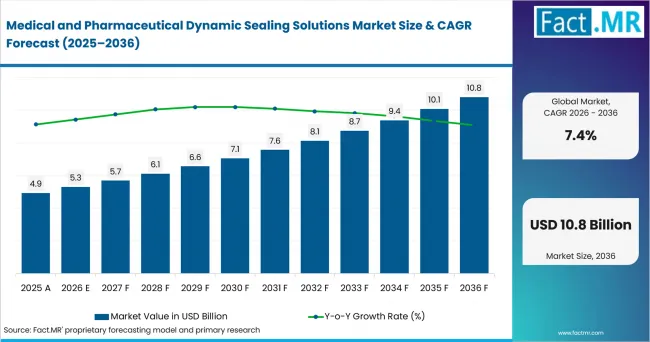
Medical And Pharmaceutical Dynamic Sealing Solutions Market Value Analysis | Source: Fact.MR
What are the defining numbers behind Medical and Pharmaceutical Dynamic Sealing Solutions Market growth?
An absolute opportunity of USD 5.5 billion is expected between 2026 and 2036, led by Rotary Seals and Silicone across Medical Devices and direct OEM relationships.
- What demand drivers are shaping the market?
- Medical device engineers need low-friction seals that preserve dosing accuracy, pressure stability and service life in infusion pumps, respiratory equipment and compact electromechanical assemblies.
- Pharmaceutical equipment owners need dynamic seals that tolerate repeated cleaning, sanitization and sterilization without creating leakage, particle or material-transfer risks at filling, mixing and bioreactor interfaces.
- Quality systems place more weight on lot traceability, supplier controls, material declarations and documented change management because an elastomer or compound change can trigger device or process requalification.
- OEM supply agreements remain central because geometry, surface finish, lubrication, assembly and operating cycles must be validated together instead of purchasing a nominal seal size as an interchangeable commodity.
- Why do Rotary Seals lead Product Type?
- By Product Type: Rotary Seals are projected to account for 33% share in 2026 owing to recurring shaft-motion requirements in pumps, drives and processing equipment.
- By Material: Silicone is expected to hold 36% share in 2026 supported by medical-grade molding, flexibility and established use in sterilized fluid-handling systems.
- By Application: Medical Devices are anticipated to capture 39% share in 2026 as infusion, respiratory and diagnostic equipment use multiple moving sealing interfaces.
- By End User: Medical Device Manufacturers are forecast to represent 43% share in 2026 because sealing components are qualified during device design and remain tied to controlled bills of material.
- By Distribution Channel: Direct Sales are estimated to hold 48% share in 2026 driven by OEM supply agreements, application engineering and long-term quality documentation.
- What is Fact.MR's analyst opinion?
- Shambhu Nath Jha, Sr. Consultant at Fact.MR, states, “Dynamic seals are small components with system-level consequences. Buyers do not approve a seal on material name alone; they evaluate geometry, friction, wear, sterilization exposure, extractables, assembly controls and supplier change discipline as one risk package. Suppliers that shorten qualification without weakening evidence will convert more design-in work into durable OEM revenue.” Fact.MR opines that suppliers will be assessed on material compatibility, motion durability, and documented qualification.
- What are the strategic implications?
- Seal manufacturers should organize portfolios around named motion profiles, media, pressure, temperature and sterilization conditions instead of presenting broad medical-grade material claims without application limits.
- Medical device OEMs should freeze compound, tooling and surface-finish requirements early because late seal changes can alter dose delivery, motor load, leakage behavior and regulatory documentation.
- Pharmaceutical equipment suppliers should validate seal wear and cleanability across actual cleaning-in-place and sterilization-in-place cycles, including startup, dry-running and maintenance conditions.
- Distributors should distinguish emergency maintenance supply from qualified production supply because documentation, lot control and change notification requirements are materially different.
South Korea records the highest listed country CAGR at 8.18%. The USA follows at 7.83%, while Canada is projected at 7.47%. The UK advances at 7.22%, Australia at 7.16%, Germany at 7.02% and Japan at 6.66% through 2036.
How does the Medical and Pharmaceutical Dynamic Sealing Solutions Market break down by segment?
Why does Silicone lead Material?
Rotary Seals lead Product Type with 33% share in 2026. Silicone leads Material with 36% share. Medical Devices lead Application with 39% share. Medical Device Manufacturers lead End User with 43% share, while Direct Sales lead Distribution Channel with 48% share.
Why do Medical Devices lead Application?
Rotary Seals are projected to account for 33% share in 2026.
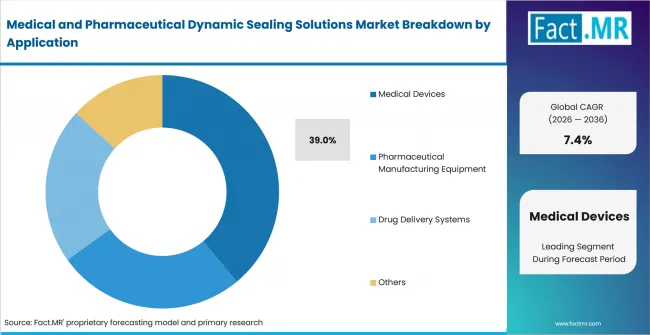
Medical And Pharmaceutical Dynamic Sealing Solutions Market Analysis By Application | Source: Fact.MR
Rotary seals lead because many medical and pharmaceutical systems transmit motion through a shaft while containing air, liquid, vapor or process media. Shaft seals and radial lip seals are used around pumps, compressors, centrifuges, surgical drives and filling equipment where leakage and friction must remain controlled over repeated cycles. Reciprocating seals address pistons and rods in dosing, pumping and actuation systems.
O-Rings & Elastomeric Seals serve oscillating or limited-motion interfaces, while diaphragms, bellows and custom dynamic seals are selected where the moving boundary must separate media or avoid a sliding contact. Trelleborg and Bal Seal both document rotary and reciprocating sealing capabilities for demanding medical and life-science applications.
Why do Medical Device Manufacturers lead End User?
Silicone is expected to hold 36% share in 2026.
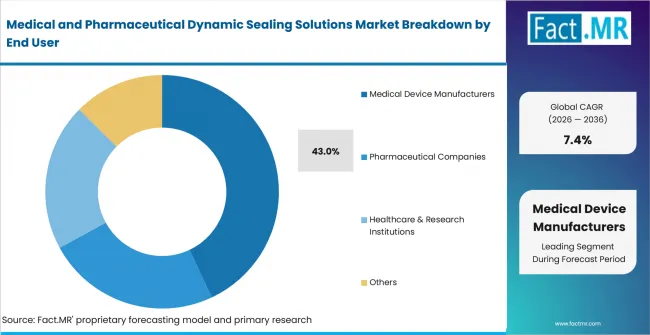
Medical And Pharmaceutical Dynamic Sealing Solutions Market Analysis By End User | Source: Fact.MR
Silicone leads because medical-grade formulations can be molded into complex geometries, remain flexible over a broad operating range and support many sterilized fluid-handling applications. Medical Grade Silicone is selected where biological safety, traceability and controlled compounding matter, while Liquid Silicone Rubber supports high-volume precision molding for small seals and integrated components.
PTFE is favored where low friction and chemical resistance dominate, with modified and filled grades used to tune wear and deformation. EPDM and FKM address distinct steam, cleaning-agent and chemical exposures. PEEK and thermoplastic elastomers serve narrower programs where stiffness, dimensional stability or processing economics justify a different material system.
Why do Direct Sales lead Distribution Channel?
Medical Devices are anticipated to capture 39% share in 2026.
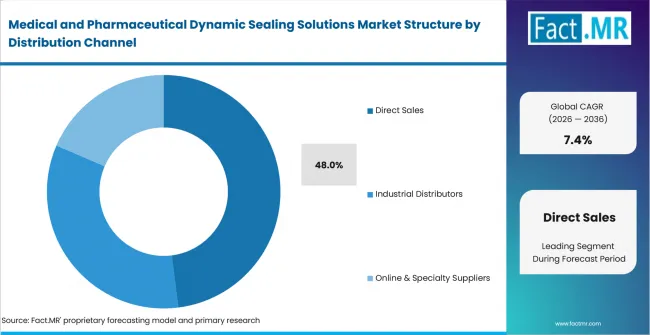
Medical And Pharmaceutical Dynamic Sealing Solutions Market Analysis By Distribution Channel | Source: Fact.MR
Medical Devices lead because infusion pumps and respiratory equipment depend on controlled movement of air or liquid through compact assemblies with strict leakage and dosing requirements. Dynamic seals appear at pistons, valves, shafts, actuators and motor-driven interfaces, and a failure can affect flow accuracy, alarm behavior or usable life. Pharmaceutical Manufacturing Equipment follows through filling systems and bioreactors that require hygienic motion control under cleaning and sterilization cycles.
Drug Delivery Systems create demand in inhalers and auto-injectors where friction and break-loose force influence user experience. Diagnostic instruments and laboratory equipment add smaller but diverse programs that often need customized geometry and low production volumes.
What is accelerating Medical and Pharmaceutical Dynamic Sealing Solutions Market adoption, and what is holding it back?
Medical device motion control, sterile process equipment upgrades and stronger supplier-quality requirements support demand. Qualification time, material evidence, wear control and custom-program economics constrain substitution and slow the conversion of prototypes into recurring production.
Which drivers have the greatest commercial effect?
| DRIVER | (~) % IMPACT ON CAGR | GEOGRAPHIC RELEVANCE | IMPACT TIMELINE |
|---|---|---|---|
| Medical device fluid-control and actuation growth | Qualitative | USA; Japan; South Korea | Short term (<= 2 years) |
| Sterile and hygienic equipment upgrades | Qualitative | Germany; UK; Australia | Medium term (2-4 years) |
| Supplier quality, traceability and change control | Qualitative | USA; Canada; Australia | Short term (<= 2 years) |
| Automated filling and bioprocess equipment investment | Qualitative | Germany; USA; South Korea | Medium term (2-4 years) |
| Compact drug-delivery mechanisms | Qualitative | Japan; UK; USA | Long term (>= 4 years) |
Source: Fact.MR analysis. Updated Aug 5, 2026
- Medical device fluid-control and actuation growth: Pumps, respiratory systems and automated diagnostic platforms use more compact moving interfaces. Seal suppliers gain when they can control friction and leakage without increasing motor load or assembly complexity.
- Sterile and hygienic equipment upgrades: Filling, mixing and bioprocess systems require seals that remain functional through cleaning and sterilization. The commercial value lies in documented cycle life and cleanability rather than nominal material resistance alone.
- Supplier quality and traceability: FDA QMSR, ISO 13485 and national conformity-assessment systems increase attention to supplier controls and records. A stable compound, controlled process and formal change-notification route become part of the purchasing decision.
Where are the clearest market opportunities?
| OPPORTUNITY | (~) % IMPACT ON CAGR | GEOGRAPHIC RELEVANCE | IMPACT TIMELINE |
|---|---|---|---|
| Low-friction PTFE and PEEK seals for compact mechanisms | Qualitative | USA; Japan; Germany | Medium term (2-4 years) |
| Medical-grade silicone molding for pumps and respiratory devices | Qualitative | South Korea; USA; Canada | Short term (<= 2 years) |
| Validated seal kits for CIP/SIP equipment | Qualitative | Germany; UK; Australia | Medium term (2-4 years) |
| Local cleanroom customization and rapid qualification | Qualitative | Canada; Australia; South Korea | Long term (>= 4 years) |
Source: Fact.MR analysis. Updated Aug 5, 2026
- Low-friction engineered polymers: Modified PTFE, filled PTFE and PEEK-based designs can reduce stick-slip and wear where compact pumps, valves or instrument drives cannot tolerate high breakaway force. Suppliers must prove dimensional stability and debris control under the intended motion cycle.
- Medical-grade silicone molding: Precision Liquid Silicone Rubber and medical-grade silicone programs create room for integrated lips, diaphragms and miniature seals. The opportunity improves when the molder supplies tool control, lot traceability and biological-safety support with the part.
- Validated CIP/SIP seal kits: Pharmaceutical equipment owners benefit from seal sets matched to specific pumps, filling heads, valves and maintenance intervals. A documented kit can reduce wrong-material installation and simplify planned maintenance across regulated facilities.
Which restraints limit wider use?
| RESTRAINT | (~) % IMPACT ON CAGR | GEOGRAPHIC RELEVANCE | IMPACT TIMELINE |
|---|---|---|---|
| Long qualification and material-change cycles | Qualitative | Global regulated manufacturers | Short term (<= 2 years) |
| Extractables, leachables and biological evaluation burden | Qualitative | Medical devices; drug delivery | Medium term (2-4 years) |
| Wear debris, friction and leakage at moving interfaces | Qualitative | All operating regions | Short term (<= 2 years) |
| Chemical, temperature and sterilization trade-offs | Qualitative | Pharmaceutical manufacturing | Medium term (2-4 years) |
| Low-volume customization and tooling economics | Qualitative | Canada; Australia; research users | Long term (>= 4 years) |
Source: Fact.MR analysis. Updated Aug 5, 2026
- Long qualification cycles: A seal change can affect device verification, process validation, supplier records and field performance. Buyers therefore resist switching after approval unless the existing component creates a clear cost, supply or reliability problem.
- Material evidence burden: ISO 10993 biological evaluation, chemical characterization and customer-specific extractables or leachables work can extend timelines. A general medical-grade statement does not establish suitability for every contact route, fluid or exposure duration.
- Wear and sterilization trade-offs: Low friction, elasticity, chemical resistance, steam tolerance and low particle generation do not always peak in one material. Design teams must balance seal geometry, surface finish, lubrication and compound choice under the full operating cycle.
Which countries are scaling the Medical and Pharmaceutical Dynamic Sealing Solutions Market fastest?
The listed country outlook reflects different purchasing systems. South Korea and the USA combine expanding medical-device production with strong design and quality requirements. Canada and Australia rely more heavily on audited quality systems, imported equipment and specialist distribution. The UK and Germany connect sealing demand to life-science manufacturing and equipment engineering, while Japan brings a large, mature pharmaceutical and medical-device base with conservative supplier qualification.
Across all seven countries, demand converts into revenue only after the seal is matched to motion, media, cleaning, sterilization and documentation requirements. Suppliers with local application engineering and controlled production records are positioned to win recurring programs, while purely transactional vendors remain concentrated in standard replacement parts. Full report coverage includes North America, Latin America, Europe, East Asia, South Asia and Pacific, and the Middle East and Africa.
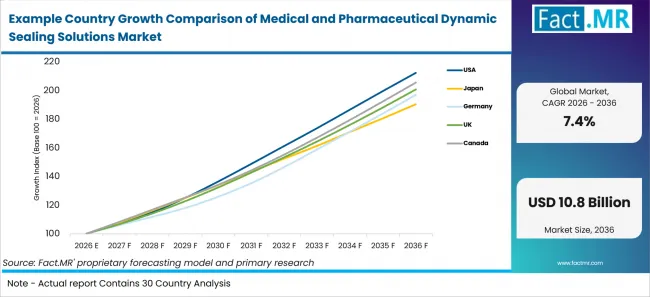
Example Country Growth Comparison Of Medical And Pharmaceutical Dynamic Sealing Solutions Market | Source: Fact.MR
| COUNTRY | CAGR (2026-2036) |
|---|---|
| South Korea | 8.18% |
| USA | 7.8% |
| Canada | 7.47% |
| UK | 7.22% |
| Australia | 7.16% |
| Germany | 7.02% |
| Japan | 6.66% |
Source: Fact.MR analysis. Updated Aug 5, 2026
What is driving South Korea's growth through 2036?
8.18% CAGR, supported by expanding medical-device production, export activity and application-focused manufacturing capability.
South Korea combines electronics, precision molding, medical-device manufacturing and biopharmaceutical investment in a supply base that can adopt miniature rotary, reciprocating and elastomeric sealing systems. In May 2026, the Ministry of Food and Drug Safety reported that 2025 medical-device production and exports increased 8.1% and 2.2% year over year, respectively. The market is projected to record an 8.18% CAGR through 2036.
How does the USA scale demand?
7.8% CAGR, driven by medical-device design activity, pharmaceutical equipment demand and tighter alignment of supplier quality systems.
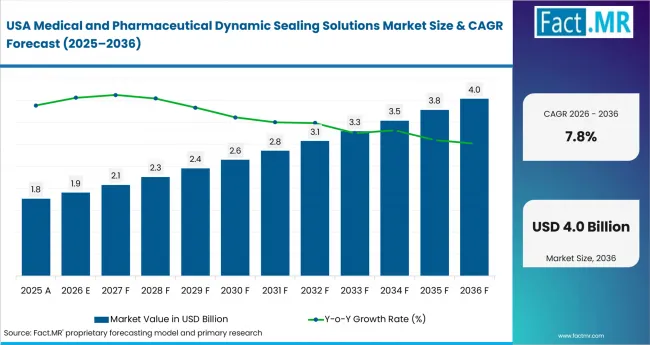
Medical And Pharmaceutical Dynamic Sealing Solutions Market Country Value Analysis | Source: Fact.MR
The USA has a broad base of device OEMs, contract manufacturers, drug-delivery developers and pharmaceutical plants that purchase dynamic seals through both design-in and maintenance channels. FDA's Quality Management System Regulation became effective on February 2, 2026 and incorporates ISO 13485:2016 into the device current good manufacturing practice framework. Pharmaceutical equipment also operates under 21 CFR Part 211 requirements for nonreactive product-contact surfaces and controlled cleaning and maintenance. Demand is forecast to rise at a 7.8% CAGR through 2036, favoring suppliers that combine rotary and reciprocating design expertise with traceability, change control and documented material performance.
What supports Canada's growth?
7.47% CAGR, supported by MDSAP-linked quality oversight, contract manufacturing and specialist supply channels.
Canada's device market places supplier evidence inside an established audit framework. Health Canada states that all manufacturers holding medical-device licences participate in the Medical Device Single Audit Program, and Class II, III and IV manufacturers must maintain ISO 13485 certification issued through an MDSAP auditing organization. This increases the value of controlled specifications and supplier agreements for seals used in pumps, respiratory systems and diagnostic equipment. The market is expected to post a 7.47% CAGR through 2036.
What is driving the UK's growth?
7.22% CAGR, led by life-science manufacturing policy, medical-device innovation and specification-driven procurement.
The UK combines pharmaceutical production, diagnostics, medical technology development and a network of specialist engineering suppliers. The Life Sciences Sector Plan, published in July 2025 and updated in July 2026, identifies manufacturing investment as a national priority. Medical-device and pharmaceutical buyers therefore have continuing reasons to qualify seals for compact devices, filling systems and laboratory equipment. Demand is projected to advance at a 7.22% CAGR through 2036. Conversion depends on technical documentation and supply resilience because UK OEMs often use contract manufacturers and cross-border component supply chains that make uncontrolled material changes commercially unacceptable.
What supports Australia's growth?
7.16% CAGR, shaped by audited medical-device quality systems, updated medicine GMP requirements and reliance on specialist distribution.
Australia's market combines domestic device manufacturing with imported medical and pharmaceutical equipment, making supplier documentation and local availability central to purchasing. A TGA review of 2021 to 2023 device-manufacturer audits identified recurring nonconformities in supplier management, document and record control, and production controls. From September 1, 2025, the TGA also adopted PIC/S Guide PE009-17 for medicines, including updated expectations relevant to sterile manufacturing. The market is forecast to record a 7.16% CAGR through 2036.
How does Germany perform?
7.02% CAGR, supported by pharmaceutical manufacturing, medical-technology scale and demanding equipment-engineering standards.
Germany offers a dense base of pharmaceutical producers, medical-device companies, process-equipment builders and precision component suppliers. Germany Trade & Invest reports pharmaceutical industry turnover of EUR 59.8 billion and a medical-technology market of EUR 43 billion in 2023. This industrial depth creates recurring demand for rotary seals, reciprocating seals, high-purity O-rings and custom diaphragms used in filling, pumping, bioreactor and diagnostic systems. The market is estimated to grow at a 7.02% CAGR through 2036. German buyers reward measurable performance and documentation, but long validation and conservative change control can delay replacement of an established seal.
What is shaping Japan's growth?
6.66% CAGR, supported by a large mature pharmaceutical and medical-device production base with rigorous manufacturing controls.
Japan combines precision device engineering with established pharmaceutical production and supplier relationships that favor long service life and disciplined qualification. The Ministry of Health, Labour and Welfare reported 2024 domestic production of JPY 10.2485 trillion for pharmaceuticals and JPY 2.6642 trillion for medical devices. PMDA conducts on-site and document-based QMS inspections for medical-device manufacturing sites and GMP inspections for drug facilities. Demand is anticipated to record a 6.66% CAGR through 2036.
Who leads the Medical and Pharmaceutical Dynamic Sealing Solutions Market?
Trelleborg AB is an active provider. Freudenberg Sealing Technologies, Parker Hannifin Corporation and Saint-Gobain S.A. compete through broad material, engineering and life-science component capabilities.
Trelleborg AB combines rotary seals, O-rings, engineered polymers and custom medical or pharmaceutical components with application engineering across moving and hygienic interfaces. Freudenberg Sealing Technologies brings sealing design and materials capability, while Freudenberg Medical adds medical-device manufacturing and component expertise. Parker Hannifin Corporation competes through elastomer, PTFE, rotary and reciprocating sealing systems supported by life-science material guidance.
Saint-Gobain S.A. participates through high-purity silicone, custom molded components and medical OEM support. These companies are positioned where buyers need a documented component and an engineering relationship rather than a catalog part alone.
Datwyler Holding Inc. contributes healthcare elastomer and drug-delivery component expertise. Bal Seal Engineering, Inc. is differentiated by spring-energized rotary and reciprocating seals for compact medical mechanisms. Garlock Sealing Technologies addresses demanding fluid-handling and sanitary sealing needs, while Precision Associates, Inc. provides custom rubber seals and cleanroom production.
James Walker Group Ltd. supports biopharmaceutical users with high-purity elastomer sealing, and ERIKS N.V. connects engineered sealing products with distribution and application support. Fact.MR opines that competition through 2036 will be shaped by design-in speed, compound control, clean manufacturing, local engineering and credible change-notification systems.
Which companies are the key providers?
Key companies include Trelleborg AB; Freudenberg Sealing Technologies; Parker Hannifin Corporation; Saint-Gobain S.A.; Datwyler Holding Inc.; Bal Seal Engineering, Inc.; Garlock Sealing Technologies; Precision Associates, Inc.; James Walker Group Ltd.; and ERIKS N.V.
- Trelleborg AB
- Freudenberg Sealing Technologies
- Parker Hannifin Corporation
- Saint-Gobain S.A.
- Datwyler Holding Inc.
- Bal Seal Engineering, Inc.
- Garlock Sealing Technologies
- Precision Associates, Inc.
- James Walker Group Ltd.
- ERIKS N.V.
Bibliography
- U.S. Food and Drug Administration. (2026, February 2). Quality Management System Regulation (QMSR).
- U.S. Food and Drug Administration. (2026, February 2). Quality Management System Regulation: Frequently Asked Questions.
- Electronic Code of Federal Regulations. (n.d.). 21 CFR 211.65: Equipment construction. Accessed August 4, 2026.
- Electronic Code of Federal Regulations. (n.d.). 21 CFR 211.67: Equipment cleaning and maintenance. Accessed August 4, 2026.
- European Commission. (2022, August 25). EudraLex Volume 4, Annex 1: Manufacture of Sterile Medicinal Products.
- International Organization for Standardization. (2016). ISO 13485:2016, Medical devices, Quality management systems, Requirements for regulatory purposes.
- International Organization for Standardization. (2025). ISO 10993-1:2025, Biological evaluation of medical devices, Part 1.
- Ministry of Food and Drug Safety, Republic of Korea. (2026, May 29). 2025 medical device trade balance achieves surplus for sixth consecutive year.
- Ministry of Health, Labour and Welfare, Japan. (2025, December 24). Publication of the 2024 Annual Report on Statistics of Pharmaceutical Production.
- Pharmaceuticals and Medical Devices Agency. (n.d.). GMP, QMS and GCTP inspections. Accessed August 4, 2026.
- Germany Trade & Invest. (n.d.). The Healthcare Market in Germany. Accessed August 4, 2026.
- Department for Business and Trade, Department of Health and Social Care, Department for Science, Innovation and Technology and Office for Life Sciences. (2025, July 16; updated 2026, July 9). Life Sciences Sector Plan.
- Health Canada. (n.d.). Medical Device Single Audit Program (MDSAP). Accessed August 4, 2026.
- Therapeutic Goods Administration. (2024, September 24). Quality Management System audits and nonconformities.
- Therapeutic Goods Administration. (2025, August 27). Good manufacturing practice requirements for medicinal products: PIC/S Guide to GMP PE009-17.
- Trelleborg Sealing Solutions. (n.d.). Medical seals and life-science sealing solutions. Accessed August 4, 2026.
- Freudenberg Group. (n.d.). Freudenberg Sealing Technologies and Freudenberg Medical portfolios. Accessed August 4, 2026.
- Parker Hannifin Corporation. (n.d.). Life sciences sealing solutions and medical-grade materials. Accessed August 4, 2026.
- Saint-Gobain Life Sciences. (n.d.). Custom medical components, silicone molding and sealing solutions. Accessed August 4, 2026.
- Datwyler Holding Inc. (n.d.). Healthcare elastomer components and drug-delivery solutions. Accessed August 4, 2026.
- Bal Seal Engineering, Inc. (n.d.). Rotary and reciprocating sealing solutions for medical devices. Accessed August 4, 2026.
- Garlock Sealing Technologies. (n.d.). High-performance sealing solutions and sanitary PTFE gaskets. Accessed August 4, 2026.
- Precision Associates, Inc. (n.d.). Custom medical rubber seals and cleanroom manufacturing. Accessed August 4, 2026.
- James Walker Group Ltd. (n.d.). High-purity elastomer sealing for biopharmaceutical applications. Accessed August 4, 2026.
- ERIKS N.V. (n.d.). Sealing and polymer engineering solutions. Accessed August 4, 2026.
This Report Answers
- The report provides strategic intelligence on the Medical and Pharmaceutical Dynamic Sealing Solutions Market across Product Type, Material, Application, End User and Distribution Channel choices that shape component qualification and sourcing.
- Segment analysis covers Rotary Seals, Silicone, Medical Devices, Medical Device Manufacturers and Direct Sales as the share leaders within the 2026 market structure.
- Country outlook compares South Korea and the USA with Canada, the UK, Australia, Germany and Japan across the 2026 to 2036 forecast period.
- Competitive analysis profiles Trelleborg AB as the active provider alongside nine additional sealing, medical-component and distribution providers.
- Application assessment covers infusion pumps, respiratory equipment, filling systems, bioreactors, inhalers, auto-injectors, diagnostic instruments and laboratory equipment.
- Commercial assessment distinguishes design-in OEM supply from maintenance distribution and specialty online purchasing because the documentation and substitution rules differ by channel.
What does the Medical and Pharmaceutical Dynamic Sealing Solutions Market cover?
The market covers rotary, reciprocating and elastomeric sealing components used where a moving or pressure-cycling interface must contain fluid or gas in a medical or pharmaceutical system.
Coverage includes shaft seals, radial lip seals, piston seals, rod seals, dynamically applied O-rings, diaphragms, bellows and custom seals. It includes silicone, PTFE, EPDM, FKM, PEEK and thermoplastic elastomer solutions when revenue is tied to the defined moving-interface function. Applications span medical devices, pharmaceutical manufacturing equipment, drug delivery systems, diagnostics and laboratory equipment. Revenue from direct OEM supply, industrial distribution and specialty suppliers is included when the purchased component falls within this boundary.
What is included in the scope?
The scope includes qualified dynamic sealing components, engineered material variants and associated component-level application support across the approved segmentation.
Product coverage spans Rotary Seals, Reciprocating Seals, O-Rings & Elastomeric Seals, Diaphragms, Bellows and Custom Dynamic Seals. Material coverage includes Medical Grade Silicone, Liquid Silicone Rubber, Modified PTFE, Filled PTFE, EPDM, FKM, PEEK and Thermoplastic Elastomers. End-user coverage includes OEMs, Contract Manufacturers, Drug Manufacturers, Biopharmaceutical Companies, Hospitals, Research Laboratories, CDMOs and Diagnostic Equipment Manufacturers. Company coverage is limited to the named providers in the competitive section.
What is excluded from the scope?
Static sealing products and complete medical or pharmaceutical equipment are outside the market unless revenue is specifically attributable to a defined dynamic sealing component.
The scope excludes static gaskets, vial stoppers, syringe plungers sold only as primary packaging, ordinary static O-rings, tubing, hoses, pumps, valves, inhalers, auto-injectors and processing equipment as finished systems. General industrial mechanical seals are excluded when sold for unrelated chemical, energy, automotive or water applications. Raw polymers and compounds are outside the market unless they are converted and sold as qualified dynamic seals. Lubricants, surface coatings, test equipment and validation services are excluded when billed independently from the sealing component.
How Was the Analysis Built?
The analysis combines primary interviews, public regulatory and technical records, company portfolios, country-level manufacturing evidence and structured market modeling. Quantitative estimates are validated across product, material and channel revenue pools, application adoption, design-in activity, replacement demand and forecast assumptions.
- Primary Research: Primary research includes discussions with seal manufacturers, elastomer and engineered-polymer specialists, medical-device OEMs, contract manufacturers, pharmaceutical equipment suppliers, distributors, quality teams, maintenance engineers and procurement professionals. These discussions examine application fit, qualification time, operating cycles, failure modes, supplier controls and purchasing routes.
- Desk Research: Desk research reviews medical-device quality-system requirements, pharmaceutical GMP rules, biological-evaluation standards, regulator audit findings, country manufacturing statistics, company technical literature and provider portfolios. The bibliography documents the external sources used for qualitative context.
- Market Sizing and Forecasting: Market sizing combines Product Type, Material, Application, End User and Distribution Channel demand with design-in revenue, replacement cycles, average component economics and the degree of customization. Country growth is assessed against local device and pharmaceutical manufacturing, quality-system requirements, supplier access and qualification constraints.
- Data Validation and Update Cycle: The analysis combines primary interviews with structured review of public company disclosures, official statistics, regulatory material, and sector publications. Forecast interpretation considers market conditions, adoption requirements, competitive positioning, and regional operating context.
Segmentation
What is the report's scope and coverage?
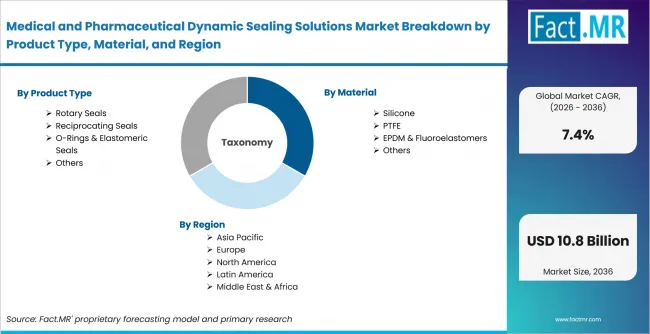
Medical And Pharmaceutical Dynamic Sealing Solutions Market Breakdown By Product Type, Material, And Region | Source: Fact.MR
| Attribute | Details |
|---|---|
| Quantitative Units | USD Bllion |
| Market Definition | Dynamic sealing components engineered to contain fluids or gases across moving shafts, rods, pistons, oscillating interfaces and pressure-cycling boundaries in medical and pharmaceutical systems |
| Product Type | Rotary Seals; Reciprocating Seals; O-Rings & Elastomeric Seals; Others |
| Material | Silicone; PTFE; EPDM & Fluoroelastomers; Others |
| Application | Medical Devices; Pharmaceutical Manufacturing Equipment; Drug Delivery Systems; Others |
| End User | Medical Device Manufacturers; Pharmaceutical Companies; Healthcare & Research Institutions; Others |
| Distribution Channel | Direct Sales; Industrial Distributors; Online & Specialty Suppliers |
| Regions Covered | North America; Latin America; Europe; East Asia; South Asia and Pacific; Middle East and Africa |
| Countries Covered | USA; Japan; Germany; UK; Canada; Australia; South Korea |
| Key Companies Profiled | Trelleborg AB; Freudenberg Sealing Technologies; Parker Hannifin Corporation; Saint-Gobain S.A.; Datwyler Holding Inc.; Bal Seal Engineering, Inc.; Garlock Sealing Technologies; Precision Associates, Inc.; James Walker Group Ltd.; ERIKS N.V. |
| Forecast Period | 2026 to 2036 |
| Approach | Hybrid top-down and bottom-up assessment using product and material demand, application design-ins, equipment maintenance, segment shares, country growth, distribution routes, qualification requirements and company portfolio review |
Source: Fact.MR analysis. Updated Aug 5, 2026
How is the market segmented?
-
By Product Type:
- Rotary Seals
- Shaft Seals
- Radial Lip Seals
- Reciprocating Seals
- Piston Seals
- Rod Seals
- O-Rings & Elastomeric Seals
- Silicone O-Rings
- EPDM O-Rings
- Others
- Diaphragms
- Bellows
- Custom Dynamic Seals
- Rotary Seals
-
By Material:
- Silicone
- Medical Grade Silicone
- Liquid Silicone Rubber
- PTFE
- Modified PTFE
- Filled PTFE
- EPDM & Fluoroelastomers
- EPDM
- FKM
- Others
- PEEK
- Thermoplastic Elastomers
- Silicone
-
By Application:
- Medical Devices
- Infusion Pumps
- Respiratory Equipment
- Pharmaceutical Manufacturing Equipment
- Filling Systems
- Bioreactors
- Drug Delivery Systems
- Inhalers
- Auto-Injectors
- Others
- Diagnostic Instruments
- Laboratory Equipment
- Medical Devices
-
By End User:
- Medical Device Manufacturers
- OEMs
- Contract Manufacturers
- Pharmaceutical Companies
- Drug Manufacturers
- Biopharmaceutical Companies
- Healthcare & Research Institutions
- Hospitals
- Research Laboratories
- Others
- CDMOs
- Diagnostic Equipment Manufacturers
- Medical Device Manufacturers
-
By Distribution Channel:
- Direct Sales
- OEM Supply Agreements
- Long-Term Contracts
- Industrial Distributors
- Authorized Distributors
- Value-Added Resellers
- Online & Specialty Suppliers
- E-Commerce Platforms
- Specialty Medical Component Suppliers
- Direct Sales
-
By Region:
- North America
- Latin America
- Western Europe
- Eastern Europe
- East Asia
- South Asia and Pacific
- Middle East & Africa
Frequently Asked Questions
Which Product Type leads the market?
Which Material leads the market?
Which Application leads the market?
Which End User leads the market?
Which Distribution Channel leads the market?
Which country records the highest listed CAGR?
How does the USA perform?
How does Canada perform?
How does the UK perform?
How does Australia perform?
How does Germany perform?
How does Japan perform?
What is the primary driver in this market?
What is the main restraint?
Why is Silicone important?
Why do Direct Sales dominate?
Which companies are active in the market?
Who worked on this report


Preview the report firsthand - request a free sample
Free SampleGet the brochure for pricing and purchase details
Download PDF