- Market Value (2025): USD 603.0 Mn
- Estimated Value (2026): USD 636.4 Mn
- Forecast Value (2036): USD 1090.1 Mn
- CAGR (2026-2036): 5.5%
What is the Medical Instrument Cabinets Market forecast to be worth by 2036?
USD 636.4 million in 2026 to USD 1,090.1 million by 2036 at a 5.5% CAGR.
- The medical instrument cabinets market was valued at USD 603.0 million in 2025, with hospital sterile storage forming the core of demand.
- By 2036 the market will reach USD 1090.1 million, up from USD 636.4 million in 2026, as hospitals and clinics replace and expand their storage.
- Revenue will compound at 5.5% CAGR from 2026 to 2036, since higher procedure volumes and tighter hygiene rules favor closed, cleanable cabinets.
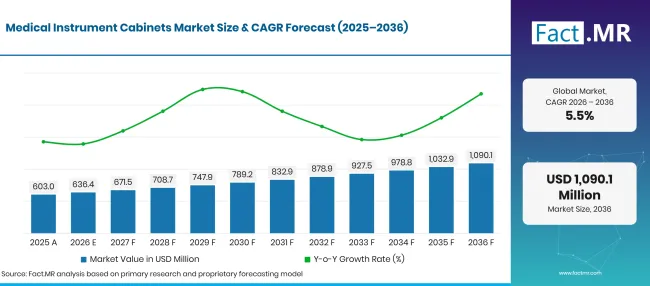
Factmr Medical Instrument Cabinets Market Forecast Global | Source: Fact.MR
medical-instrument-cabinets-market
| Year | Basis | Market Value (USD million) |
|---|---|---|
| 2025 | Actual | 603.0 |
| 2026 | Estimate | 636.4 |
| 2036 | Forecast | 1090.1 |
| CAGR 2026 to 2036 | Forecast period | 5.5% |
Source: Fact.MR analysis. Updated Oct 22, 2026
What are the defining numbers behind Medical Instrument Cabinets Market growth?
The 2026 to 2036 period will add USD 453.7 million in new value, led by hospital refits and outpatient surgery growth.
- Demand Drivers in the Market
- Infection prevention has moved up hospital budgets. In March 2025, the World Health Organization published an investment case that set out the expected return from stronger infection prevention and control in health facilities [1]. Closed cabinets with sealed seams and wipeable finishes help sterile departments keep processed instruments protected until use.
- Health-care-associated infections still affect a large patient pool. The Centers for Disease Control and Prevention reported in July 2026 that about 1 in 38 hospitalized patients had at least one such infection on any given day in 2023, against 1 in 31 in 2015 [2]. Hospitals working to hold these gains specify storage that limits dust, moisture and handling.
- Outbreak readiness plans now reach down to room-level storage. WHO released a framework and toolkit for infection prevention and control outbreak preparedness in December 2025 [3]. Facilities that follow such guidance review where clean and sterile items are kept, and older open shelving often fails that review.
- Hospital construction and refurbishment create fresh cabinet orders in theaters, examination rooms and sterilization units. Each refitted wing needs storage sized to its rooms, which favors suppliers able to deliver standard units alongside custom casework.
- Space limits shape demand in smaller sites. Clinics and ambulatory care centers lack the floor area of hospital sterile cores, so wall-mounted and mobile cabinets that hold instruments close to the point of care are gaining ground.
- Key Segments Analyzed
- By Product Type: Floor-Standing Cabinets will hold 42.3% share in 2026, since hospitals want tall, stable units that keep complete instrument sets in one place.
- By Material: Metal will account for 48.2% share in 2026, as stainless and coated steel withstand repeated chemical disinfection without warping.
- By End-User: Hospitals will capture 38.7% share in 2026 on the strength of large sterile departments and multiple operating theaters.
- By Distribution Channel: Direct Sales will take 54.2% share in 2026, given that hospital projects buy against tendered specifications and need site surveys.
- Analyst Opinion at Fact.MR
- Shambhu Nath Jha, Principal Consultant at Fact.MR, states, “Hospitals now treat instrument storage as part of their infection-control plan, so cleanability and seal quality weigh as heavily as price in tenders. Metal will stay the hospital standard because it survives years of disinfection, while clinics and surgical centers widen demand for compact and mobile units. Suppliers that combine catalog ranges with custom casework and on-site project support will hold the stronger position with hospital buyers.”
- Strategic Implications
- Cabinet manufacturers should widen their wall-mounted and mobile ranges, since clinics and ambulatory centers compare storage on footprint and flexibility.
- Product managers should publish cleanability, surface finish and disinfectant compatibility data for every model, so infection-control teams can approve units faster.
- Hospital planners should specify modular casework early in refit projects, given that cabinets sized to a room cut wasted space and later rework.
- Distributors should build stock programs for clinics and laboratories that need quick delivery of standard units without a full tender.
Germany will lead the group at 6.9% CAGR as federal transformation funding pays for hospital site mergers and refits. A 6.4% pace in the United Kingdom will come from new hospital schemes and theater capacity aimed at elective backlogs. Brazil will match the global rate at 5.5%, with private hospital groups and outpatient clinics adding sites. In the United States, growth of 4.4% reflects a large installed base where replacement orders carry most volume. Japan, at 4.0%, has a well-equipped hospital network and buys mainly for refurbishment.
How does the Medical Instrument Cabinets Market break down by segment?
Floor-Standing Cabinets will lead Product Type at 42.3%; Metal will head Material at 48.2%; Hospitals will top End-User at 38.7%; Direct Sales will take first place in Distribution Channel at 54.2%.
Which Product Type leads?
Floor-Standing Cabinets take 42.3% of 2026 sales.
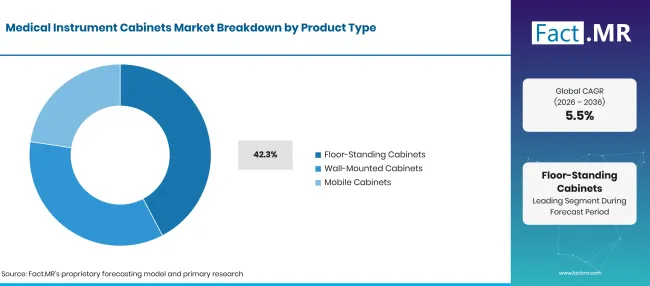
Factmr Medical Instrument Cabinets Market Breakdown Product Type | Source: Fact.MR
| Product Type | Share (2026) |
|---|---|
| Floor-Standing Cabinets (Leading segment) | 42.3% |
| Other segments combined | 57.7%* |
| Total | 100.0% |
Source: Fact.MR analysis. Updated Oct 22, 2026
Sterile cores and theater preparation rooms must store full instrument trays in a unit that stays stable under load and survives heavy daily use. Tall floor units answer this with deep shelving, lockable doors and cleanable surfaces. Many are specified alongside operating room equipment during theater fit-outs, so one supplier often delivers the whole room. Wall-mounted models keep their place in small treatment rooms and dental operatories with little free floor. Mobile cabinets serve teams that move instruments between rooms, and demand is rising in ambulatory surgical centers. In the United States, 248 new Medicare-certified ambulatory surgical centers opened in 2024, according to the Medicare Payment Advisory Commission [4].
What supports Metal within Material?
Metal represents 48.2% of 2026 revenue.
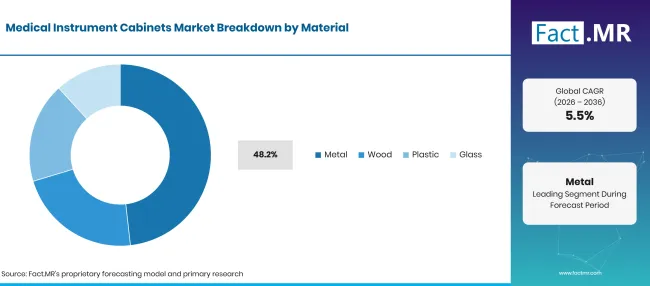
Factmr Medical Instrument Cabinets Market Breakdown Material | Source: Fact.MR
| Material | Share (2026) |
|---|---|
| Metal (Leading segment) | 48.2% |
| Other segments combined | 51.8%* |
| Total | 100.0% |
Source: Fact.MR analysis. Updated Oct 22, 2026
Infection-control teams want surfaces that resist corrosion, tolerate harsh disinfectants and keep their shape for a decade or more. Stainless and powder-coated steel meet these demands, and a long service life lowers replacement spending. Fabricators draw on stainless steel panels for doors, sides and work tops in theaters and sterile stores. Wood keeps a share in clinics and dental offices, where buyers want a warmer look and custom casework. Plastic suits light-duty and mobile units because it is light and easy to wipe down. Glass appears mainly in doors and display fronts, letting staff see stored items without opening the cabinet. Dental practices often pair glass-fronted units with dental infection control products in the same operatory.
What leads the End-User segment?
Hospitals command 38.7% of 2026 demand.
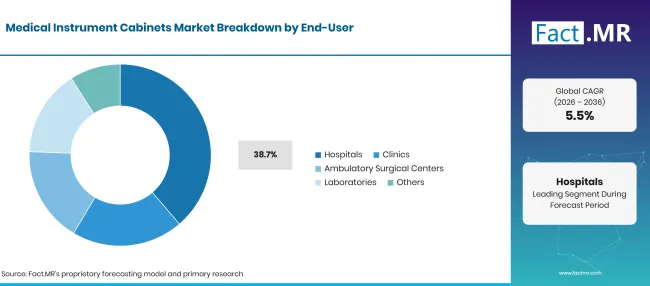
Factmr Medical Instrument Cabinets Market Breakdown End User | Source: Fact.MR
| End-User | Share (2026) |
|---|---|
| Hospitals (Leading segment) | 38.7% |
| Other segments combined | 61.3%* |
| Total | 100.0% |
Source: Fact.MR analysis. Updated Oct 22, 2026
Multiple theaters, wards and sterile departments give hospitals the biggest instrument inventories and the biggest orders. Storage is renewed and expanded whenever a wing is built or refitted, and sterile services managers often set a single cabinet standard across the site. Clinics form a wide second base. Japan alone counted 105,657 general clinics at the end of October 2025, according to the Ministry of Health, Labour and Welfare [5]. Ambulatory surgical centers buy for fast-turnover procedure rooms. Laboratories need orderly, lockable storage and often source cabinets together with laboratory furniture during fit-outs.
How does Distribution Channel shape demand?
Direct Sales make up 54.2% of 2026 sales.
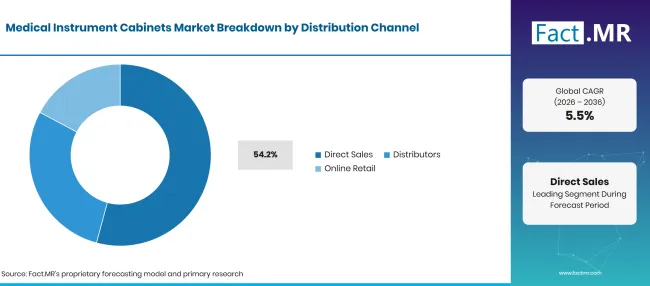
Factmr Medical Instrument Cabinets Market Breakdown Distribution Channel | Source: Fact.MR
| Distribution Channel | Share (2026) |
|---|---|
| Direct Sales (Leading segment) | 54.2% |
| Other segments combined | 45.8%* |
| Total | 100.0% |
Source: Fact.MR analysis. Updated Oct 22, 2026
Hospital and health-system projects run through tenders with drawings, room data sheets and installation dates. Manufacturers sell direct to win these jobs because buyers expect site surveys, custom sizing and fitting by trained crews. Group purchasing contracts and national frameworks also favor makers that can quote, deliver and install under one agreement. Distributors serve clinics, dental practices and smaller laboratories that order a few standard units at a time and value quick delivery from stock. Many bundle cabinets with carts and consumables on one account. Online retail is the smallest route, used mainly for catalog models, replacement shelving and low-cost wall units that need no installation.
What is accelerating Medical Instrument Cabinets Market adoption, and what is holding it back?
Procedure growth, tighter infection-control practice and hospital building programs steer buyers toward purpose-built instrument cabinets. Adoption slows in cost-sensitive settings because metal prices swing, medical-grade units cost more than general furniture and hospital approvals take time.
Drivers Impact Analysis
| DRIVER | (~) % IMPACT ON CAGR | GEOGRAPHIC RELEVANCE | IMPACT TIMELINE |
|---|---|---|---|
| Higher surgical and procedure volumes increasing demand for instrument storage in operating theaters and sterile departments | +1.8% | Global | Short term (<= 2 years) |
| Stricter infection-control protocols requiring cleanable, corrosion-resistant and lockable storage | +1.2% | North America, Western Europe, East Asia | Medium term (2-4 years) |
| Hospital construction, modernization and refit programs creating fresh storage requirements | +0.8% | Western Europe, Latin America, East Asia | Medium term (2-4 years) |
| Replacement of ageing cabinets in mature hospital networks | +0.4% | North America, East Asia | Short term (<= 2 years) |
Source: Fact.MR analysis. Updated Oct 22, 2026
Opportunity Impact Analysis
| OPPORTUNITY | (~) % IMPACT ON CAGR | GEOGRAPHIC RELEVANCE | IMPACT TIMELINE |
|---|---|---|---|
| Compact wall-mounted and mobile cabinets for clinics and ambulatory surgical centers | +0.7% | North America, Western Europe, East Asia | Medium term (2-4 years) |
| Modular and custom casework sized to specific rooms in hospital projects | +0.5% | Western Europe, North America | Medium term (2-4 years) |
| Growth of private hospital and clinic networks in emerging markets | +0.4% | Latin America, South Asia & Pacific | Long term (>= 4 years) |
| Direct project support, installation services and documented product specifications for large accounts | +0.3% | North America, Western Europe | Short term (<= 2 years) |
Source: Fact.MR analysis. Updated Oct 22, 2026
Restraints Impact Analysis
| RESTRAINT | (~) % IMPACT ON CAGR | GEOGRAPHIC RELEVANCE | IMPACT TIMELINE |
|---|---|---|---|
| Fluctuating metal prices affecting manufacturing costs and quoted prices | -0.3% | Global | Short term (<= 2 years) |
| Price premium of medical-grade cabinets over general furniture in cost-sensitive settings | -0.2% | Global | Medium term (2-4 years) |
| Lengthy hospital procurement and approval cycles delaying purchase decisions | -0.1% | Global | Long term (>= 4 years) |
Source: Fact.MR analysis. Updated Oct 22, 2026
Which countries are scaling the Medical Instrument Cabinets Market through 2036?
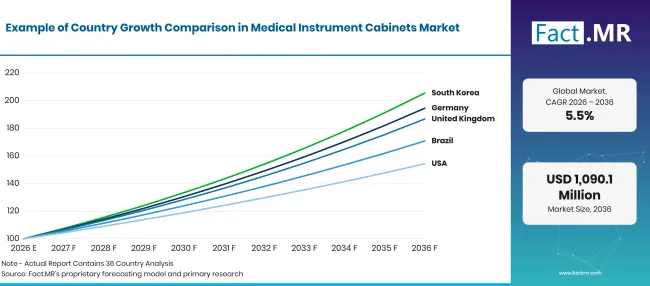
Factmr Medical Instrument Cabinets Market Growth Index | Source: Fact.MR
| Country | CAGR (2026 to 2036) |
|---|---|
| Germany | 6.9% |
| United Kingdom | 6.4% |
| Brazil | 5.5% |
| United States | 4.4% |
| Japan | 4.0% |
Source: Fact.MR analysis. Updated Oct 22, 2026
What supports adoption in Germany?
6.9% CAGR, driven by federal transformation funding for hospital mergers and refits.
Germany is reshaping its hospital map, and new or merged sites need fresh storage in theaters and sterile departments. The Federal Ministry of Health reported that the Transformation Fund will offer up to EUR 50 billion from 2026 to 2035 [6]. On 17 April 2026, the Federal Office for Social Security approved its first grant of about EUR 45.4 million for merging two hospital sites in North Rhine-Westphalia [6]. Strict hygiene rules then favor durable metal cabinets in the rebuilt rooms.
How is the United Kingdom developing demand?
6.4% CAGR, helped by new hospital schemes and added theater capacity.
NHS trusts are adding theaters and day-surgery units to cut elective waiting lists, and every new room needs organized instrument storage. The Department of Health and Social Care reported in July 2026 that the New Hospital Programme covers 46 schemes, with 7 open to patients and 9 under construction [7]. Fit-out packages for these sites include cabinets and casework, and trusts often buy through national frameworks with direct supplier contracts.
What supports adoption in Brazil?
5.5% CAGR, on the back of a growing private hospital and clinic base.
Brazil’s health regulator requires closed, clean storage for processed health products in sterile processing units, which supports demand for cleanable cabinets. A large population keeps procedure demand high, with IBGE estimating 213.4 million residents in July 2025 [8]. Private hospital groups and outpatient clinics keep opening sites and buy standard metal cabinets in growing numbers. Public buyers on tight budgets still choose simpler models, holding growth at the global pace.
How does the United States perform?
4.4% CAGR, reflecting a mature base where replacement leads demand.
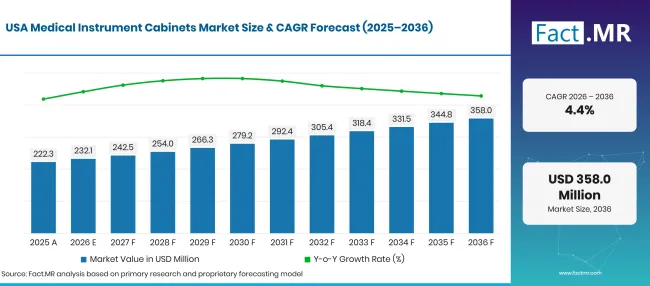
Factmr Medical Instrument Cabinets Market Forecast Usa | Source: Fact.MR
The Medicare Payment Advisory Commission counted 6,436 Medicare-certified ambulatory surgical centers in 2024, up 2.2% from 2023 [4]. Each center needs compact storage for fast room turnover. Hospitals carry a heavy infection burden too, with about 518,000 health-care-associated infections in 2023, according to CDC [2]. A base this large is already well equipped, so replacement cycles and modular upgrades carry most orders.
How is Japan developing demand?
4.0% CAGR, as refurbishment of a well-equipped hospital network sets the pace.
Japan’s Statistics Bureau reported that people aged 65 and over made up 29.6% of the population in September 2026 [9]. Older patients keep clinic and procedure visits high, yet the country already had 7,998 hospitals at the end of October 2025 [5]. Few new hospitals are being added, which keeps growth modest. Buyers focus on compact, space-saving units and secure storage for busy clinical rooms during refurbishment.
Who leads the Medical Instrument Cabinets Market?
The market splits into stainless steel fabricators, clinical cabinetry makers and storage specialists.
Skytron, Blickman and STERIS supply stainless supply cabinets, warming cabinets and modular casework for theaters and sterile cores, and they compete on build quality and room-level project work. Skytron introduced its FreedomAire modular clean-air ceiling system for operating rooms in March 2025, which widens its role in full theater fit-outs [10]. Capsa Healthcare (Harloff) serves point-of-care storage with supply cabinets, scope cabinets and procedure carts. In March 2025, Capsa opened an innovation center at its Ohio headquarters to show procedure carts and supply organization to hospital teams [11]. Midmark targets clinics and outpatient sites with its Synthesis cabinetry and added a nine-finish color palette in June 2026 [12]. Bristol Maid supplies bedside cabinets and sterile services equipment to hospitals. Proven cleanability, dependable lead times and installation support will separate the stronger suppliers.
Which companies supply the market?
Leading companies include STERIS plc; Skytron, LLC; Blickman; Capsa Healthcare (Harloff); Midmark Corporation; and Bristol Maid.
- STERIS plc
- Skytron, LLC
- Blickman
- Capsa Healthcare (Harloff)
- Midmark Corporation
- Bristol Maid
Bibliography
- [1] World Health Organization. (2025, March 5). The case for investment and action in infection prevention and control.
- [2] Centers for Disease Control and Prevention. (2026, July 15). New CDC Data Shows Decline in Healthcare-Associated Infections.
- [3] World Health Organization. (2025, December 2). Framework and toolkit for infection prevention and control outbreak preparedness, readiness and response.
- [4] Medicare Payment Advisory Commission. (2026, March). Ambulatory surgical center services: Status report (Report to the Congress: Medicare Payment Policy, Chapter 11).
- [5] Ministry of Health, Labour and Welfare, Japan. (2025, December 24). 医療施設動態調査(令和7(2025)年10月末概数) [Survey of Medical Institutions Dynamics: Provisional figures as of the end of October 2025].
- [6] Bundesministerium für Gesundheit. (2026, April 17). Transformationsfonds: Bundesamt für Soziale Sicherung bewilligt bereits erste Fördermittel [Transformation Fund: Federal Office for Social Security already approves first grants].
- [7] Department of Health and Social Care. (2026, July 8). New Hospital Programme annual report: 2025 to 2026.
- [8] Instituto Brasileiro de Geografia e Estatística. (2025, August 28). População estimada do país chega a 213,4 milhões de habitantes em 2025 [Estimated population of the country reaches 213.4 million inhabitants in 2025].
- [9] Statistics Bureau of Japan. (2026, September 20). 統計からみた我が国の高齢者: 「敬老の日」にちなんで [Japan’s older population in statistics: For Respect for the Aged Day].
- [10] Skytron. (2025, March 31). Skytron Introduces FreedomAire: A Modular Clean Air Ceiling System for Operating Rooms.
- [11] Capsa Healthcare. (2025, March 19). Capsa Healthcare Unveils Cutting-Edge Innovation Center, Elevating Collaborative Healthcare Solutions.
- [12] Midmark Corporation. (2026, June 30). Midmark enhances Synthesis Cabinetry Collection with new color palette.
This Report Answers
- Cabinet sales are split by product type, material, end-user and distribution channel.
- Each segment shows its leading subsegment and the buyer needs behind its 2026 share.
- Hospital funding, sterile storage practice and care capacity frame the comparison of the five listed countries.
- Stainless fabricators, cabinetry makers and storage specialists are compared on how they win hospital and clinic orders.
Infection-control guidance is traced to the cabinet features that infection teams now ask for.
What does the Medical Instrument Cabinets Market cover?
Cabinets built to store and protect surgical, dental and clinical instruments in healthcare settings form this market. Floor-standing, wall-mounted and mobile cabinets are tracked in metal, wood, plastic and glass.
Demand is measured across hospitals, clinics, ambulatory surgical centers and laboratories. Buyers reach these products through direct sales, distributors and online retail.
What is included in the scope?
Complete cabinet units sold for healthcare use count in every product type and material, including lockable, glass-fronted, modular and custom-built models. Cabinets with built-in shelving, drawers or trays are counted when their main purpose is instrument storage.
Where a cabinet ships inside a larger casework or room fit-out package, only the cabinet value is recorded. Storage linked to surgical instrument tracking systems counts at the value of the cabinet alone.
What is excluded from the scope?
Automated medication dispensing cabinets, pharmacy automation systems and sterilizers are left out, along with instrument trays, containers and sterilization wraps. General office and household furniture adds nothing to market revenue.
Laboratory chemical storage cabinets, hospital beds, patient lifts and fixed theater equipment are not counted. Wider infection control products such as disinfectants and barrier supplies also fall outside this assessment.
How Was the Analysis Built?
The analysis draws on 120+ sources, 35+ company portfolios, 25+ countries, and more than 20 industry interviews.
- Primary Research: Primary research includes discussions with manufacturers, service providers, technology developers, distributors, end users, and subject-matter experts. These conversations examine purchasing priorities, product adoption, operational challenges, approval requirements, competitive positioning, and the factors that influence wider market acceptance.
- Desk Research: Desk research covers government statistics, regulatory publications, company filings, trade data, technical studies, industry associations, standards, public policy, and other authoritative sources. Every source used in the analysis is documented in the bibliography.
- Market Sizing and Forecasting: Market estimates combine historical performance, demand indicators, pricing and volume trends, segment shares, company participation, country-level growth, adoption patterns, investment activity, and barriers to market expansion.
- Data Validation and Update Cycle: Findings are validated by comparing primary interviews with public data, company activity, regulatory changes, trade patterns, and industry developments. Regular updates review new product launches, capacity changes, partnerships, approvals, and shifts in commercial adoption.
Segmentation
What is the report’s scope and coverage?
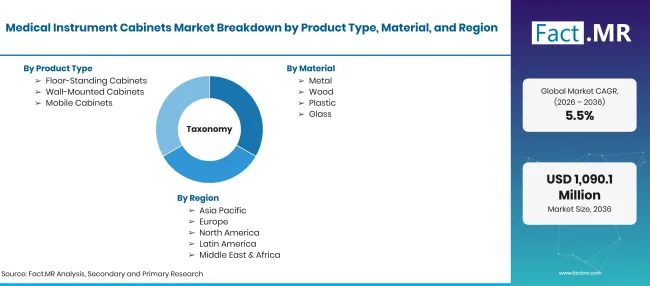
Factmr Medical Instrument Cabinets Market Taxonomy | Source: Fact.MR
| Attribute | Details |
|---|---|
| Quantitative Units | USD million in 2026 to USD million by 2036 at CAGR |
| Market Definition | Cabinets designed to store, organize and protect surgical, dental and clinical instruments in healthcare settings. They are made from metal, wood, plastic or glass and sold as floor-standing, wall-mounted or mobile units. |
| Product Type | Floor-Standing Cabinets; Wall-Mounted Cabinets; Mobile Cabinets |
| Material | Metal; Wood; Plastic; Glass |
| End-User | Hospitals; Clinics; Ambulatory Surgical Centers; Laboratories |
| Distribution Channel | Direct Sales; Distributors; Online Retail |
| Regions Covered | North America; Latin America; Western Europe; Eastern Europe; East Asia; South Asia & Pacific; Middle East & Africa |
| Countries Covered | Germany; United Kingdom; Brazil; United States; Japan |
| Companies Profiled | STERIS plc; Skytron, LLC; Blickman; Capsa Healthcare (Harloff); Midmark Corporation; Bristol Maid |
| Forecast Period | 2026 to 2036 |
| Approach | Hybrid top-down and bottom-up approach using hospital, clinic and surgical center counts by country; product type and material mix; end-user demand; channel split; and supplier portfolio review. |
Source: Fact.MR analysis. Updated Oct 22, 2026
How is the market segmented?
-
By Product Type
- Floor-Standing Cabinets
- Wall-Mounted Cabinets
- Mobile Cabinets
-
By Material
- Metal
- Wood
- Plastic
- Glass
-
By End-User
- Hospitals
- Clinics
- Ambulatory Surgical Centers
- Laboratories
-
By Distribution Channel
- Direct Sales
- Distributors
- Online Retail
-
By Region
- North America
- Latin America
- Western Europe
- Eastern Europe
- East Asia
- South Asia & Pacific
- Middle East & Africa
Frequently Asked Questions
How large is the medical instrument cabinets market in 2026?
What growth rate will the medical instrument cabinets market record from 2026 to 2036?
Which product type leads the medical instrument cabinets market?
Which material holds the greatest share of the medical instrument cabinets market?
Which end-user contributes the most to the medical instrument cabinets market?
Which distribution channel leads the medical instrument cabinets market?
Which country will record the strongest growth in the medical instrument cabinets market?
Who are the main companies in the medical instrument cabinets market?
Who worked on this report


Preview the report firsthand - request a free sample
Free SampleGet the brochure for pricing and purchase details
Download PDF