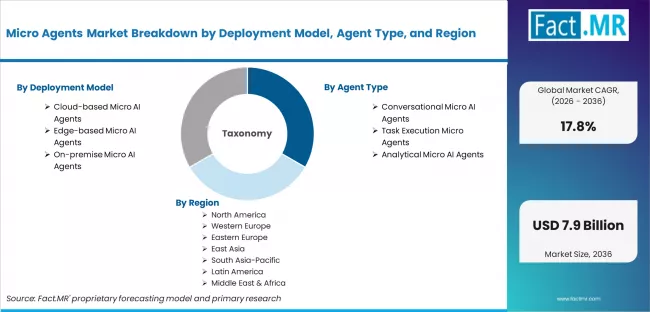
Micro Agents Market Size, Share, Growth and Forecast (2026 - 2036)

The Global Micro Agents Market is segmented by Deployment Model, Agent Type, Architecture Type, Technology Type, and Functional Application and Region. Forecasts from 2026 to 2036.

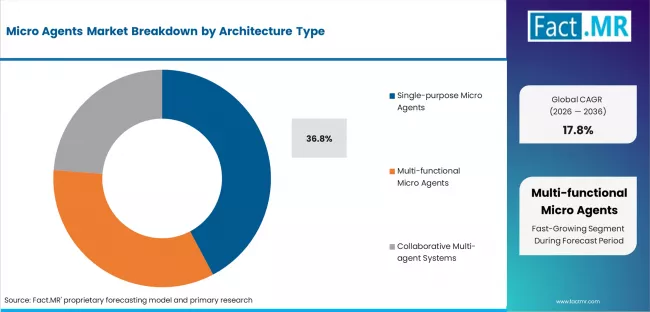
According to market estimates, the global micro agents market stood at approximately USD 1.3 billion in 2025. The market is projected to reach around USD 1.5 billion in 2026 and is expected to grow significantly to approximately USD 7.9 billion by 2036, progressing at a CAGR of around 17.8% during the forecast period. Among key segments in 2026, Cloud-based deployment is anticipated to account for nearly 58.7% share, driven by the scalability, lower upfront costs, and ease of integration with existing enterprise cloud infrastructure. Meanwhile, Single-purpose Micro Agents are expected to remain the leading architecture type with around 36.8% share by 2026.
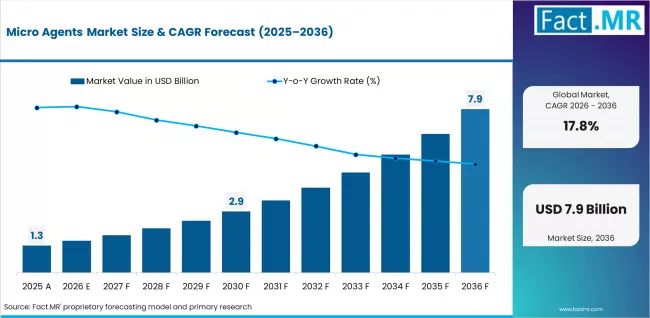
Micro Agents Market Overview, Growth Outlook, and Forecast by Fact.MR

  • In 2025, the global micro agent market was valued at approximately USD 1.3 billion.
  • Based on Fact.MR analysis, demand for micro agents is estimated to grow to around USD 1.5 billion in 2026 and USD 7.9 billion by 2036.
  • The market is projected to expand at a CAGR of around 17.8% during the forecast period.

Micro Agents Market  Value Analysis

Summary of the Micro Agents Market

  • Market Snapshot
    • In 2025, the global micro agent market was valued at approximately USD 1.3 billion.
    • The market is estimated to reach around USD 1.5 billion in 2026 and is projected to attain nearly USD 7.9 billion by 2036.
    • The Micro Agents market is expected to expand at a CAGR of approximately 17.8% during the forecast period.
    • The market is anticipated to create an absolute dollar opportunity of approximately USD 6.4 billion between 2026 and 2036.
    • In terms of deployment model, Cloud-based dominates with a share of approximately 58.7% in 2026, driven by their scalability, lower upfront costs, and ease of integration with existing enterprise cloud infrastructure.
    • Based on architecture type, Single-purpose Micro Agents account for approximately 36.8% share in 2026, driven by rising demand for specialized, efficient, and cost-effective micro agents in workflow automation, IT operations, and cybersecurity applications.
  • Demand and Growth Drivers
    • Development of large language model (LLM) advances combined with tool capabilities allows for micro-AIs to perform very efficiently on specific tasks with greater accuracy and less expense.
    • The increasing requirement for workflow automation drives organizations to utilize micro-AIs due to their ability to perform repetitive and strictly rule-based tasks.
    • Emergence of no-code and low-code platforms is facilitating the creation and implementation of micro-AIs.
  • Product and Segment View
    • Increasing demand for Cloud-based Micro Agents with 58.7% share is driven by their dominant role in enterprise deployment models, particularly scalable, cost-effective, and remotely accessible micro agent solutions.
    • Growing demand for Single-purpose Micro Agents with 36.8% share is driven by the rapid adoption of specialized, task-specific automation in workflow, IT operations, and cybersecurity applications.
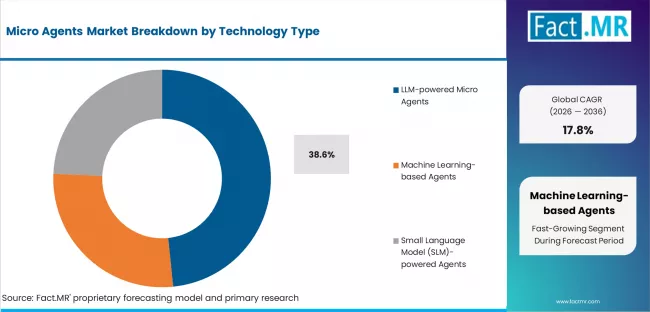
    • Rising demand for LLM-powered Micro Agents with 38.6% share is driven by the need for advanced natural language understanding, contextual reasoning, and dynamic task execution across various functional applications.
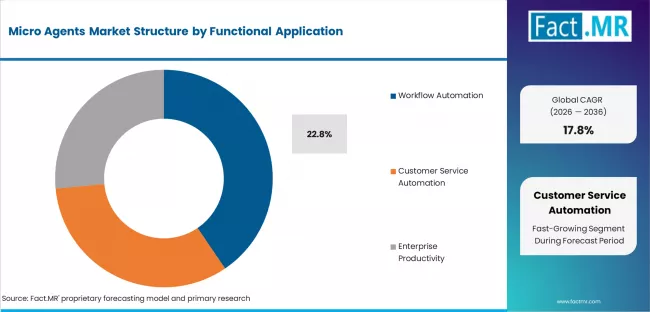
    • Increasing demand for Workflow Automation with 22.8% share is driven by the widespread use of micro agents in streamlining business processes, reducing manual intervention, and improving operational efficiency.
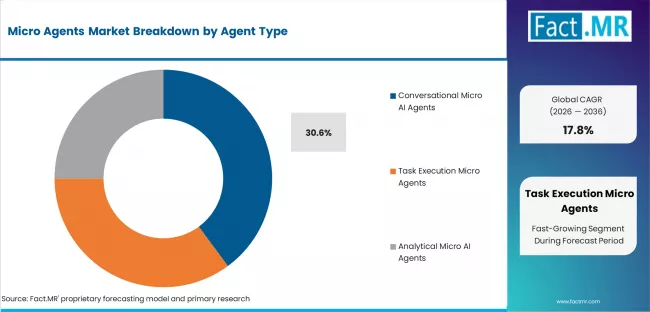
    • Growing demand for Conversational Micro Agents with 30.6% share is driven by their excellent user interaction capabilities, and compatibility with customer service automation, enterprise productivity tools, and seamless human-agent collaboration.
  • Geography and Competitive Outlook
    • The proliferation of micro-AI agents is being witnessed in developing regions like China, India is due to the growing digital ecosystems, escalating enterprise automation requirements, and increasing investments in AI startups and cloud infrastructure.
    • North America and Europe are predicted to be the major adopters of micro-AI agents, owing to the presence of a well-developed technology infrastructure, high availability of venture funding and leading AI companies and innovation centers.
    • The Asia-Pacific region, on the other hand, is anticipated to grow at a commendable rate in the micro-AI agent market, owing to accelerating digital transformation, increasing requirement for cost-effective automation, and development of technology-driven sectors.
    • The global Micro Agents market includes key players such as OpenAI, Anthropic, Fixie, Builder.IO, and Wild Moose.
  • Analyst Opinion
    • Shambhu Nath Jha, Principal Consultant at Fact.MR, says, “Micro AI agents are gaining momentum very quickly because they provide extremely efficient task-oriented automation for business and consumer applications. The combination of micro agents, advanced natural language processing models, workflow systems, and APIs, as well as advances in AI technology, will create many new use cases for micro agents and will help accelerate market adoption over time.

Micro Agents Market — At a Glance

Metric Value
Market Value 2025 USD 1.3 Billion
Market Value 2026 USD 1.5 Billion
Market Value 2036 USD 7.9 Billion
Absolute Dollar Opportunity USD 6.4 Billion
CAGR 17.80%
Growth Multiple 5.3x
Key Demand Theme Rising demand for specialized, efficient, and cost-effective micro agents enabling workflow automation, cybersecurity, IT operations, and enterprise productivity, driven by increasing adoption of composable AI architectures, edge computing, and small language models across industries
Leading Deployment Model Cloud-based
Deployment Model Share 58.70%
Leading Agent Type Conversational
Agent Type Share 30.60%
Leading Architecture Type Single-purpose
Architecture Type Share 36.80%
Leading Technology Type LLM-powered
Technology Type Share 38.60%
Leading Functional Application Workflow Automation
Functional Application Share 22.80%
Key Growth Regions North America, Asia-Pacific, Europe
Fastest Growing Countries China (18.8% CAGR), U.K. (18.6% CAGR), Germany (17.7% CAGR), Japan (17.6% CAGR), U.S. (17.1% CAGR)
Key Companies OpenAI, Anthropic, Fixie, Builder.IO, Wild Moose, Vectorize, Inc.
Deployment Model Segmentation Cloud-based, Edge-based, On-premise
Agent Type Segmentation Conversational, Task Execution, Analytical, Coding & Development, Monitoring & Security, Industrial & IoT
Architecture Type Segmentation Single-purpose, Multi-functional, Collaborative Multi-agent Systems, Hierarchical Agent Networks, Swarm-based
Technology Type Segmentation LLM-powered, Machine Learning-based, Small Language Model (SLM)-powered, Hybrid, Rule-based
Functional Application Segmentation Workflow Automation, Customer Service Automation, Enterprise Productivity, IT Operations Automation, Data Intelligence & Analytics, Software Development Automation, Cybersecurity Automation, Supply Chain Automation, Others
Region North America, Europe, Asia-Pacific, Middle East & Africa, Latin America

Key Growth Drivers, Constraints, and Opportunities
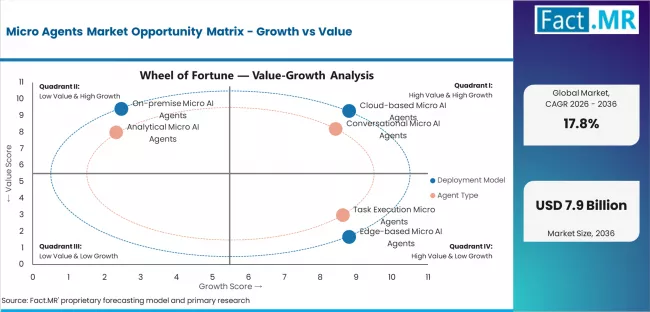
Micro Agents Market Opportunity Matrix Growth Vs Value

Key Factors Driving Growth

  • Increased interest in the efficiency of business operations and automation has led to increasing demand for micro agents that can automate any type of repetitive or tedious activity that is part of the workflow in a business or digital environment.
  • Advances in artificial intelligence continue to create opportunities for newer and more powerful micro agents to be developed, mostly due to the rapid evolution of AI applications such as large language models and APIs.
  • The increased amount of money being invested into AI research and development, combined with increasing collaboration and partnership agreements between enterprise and technology providers, is leading to greater innovation and proliferation of AI-based micro agents in a variety of end-user industries.
Growth Driver Demand Impact Time Horizon Key Impact Area Fact.MR Insight
Increasing demand for workflow automation and operational efficiency High Short–Mid Term Adoption acceleration Rising need to automate repetitive business processes across industries is significantly driving the adoption of micro agents due to their ability to execute task-specific functions with speed and accuracy
Growing adoption of AI-powered enterprise solutions High Mid Term Market expansion The increasing integration of AI into enterprise software and digital ecosystems is boosting demand for micro agents that enhance productivity, decision-making, and customer engagement
Advancements in language models and API ecosystems High Mid–Long Term Technology advancement Continuous improvements in AI models, tool-use capabilities, and API integrations are enhancing the scalability, efficiency, and real-world applicability of micro agents across industries
Rising focus on modular and multi-agent architectures Medium-High Short–Mid Term Technology deployment & scaling The shift from monolithic systems to modular AI frameworks is accelerating the deployment of micro agents that can operate independently or collaboratively within workflows

Key Market Constraints

  • High implementation complexity and the associated integration costs can restrict the uptake of micro agents, especially by small and medium businesses. This is particularly difficult in environments characterized by legacy systems and budget limitations, where it is challenging to deploy and scale sophisticated AI-based solutions.
  • Lack of standardization and interoperability across platforms has created barriers to seamless deployment of micro agents within workflows. Many organizations are experiencing technical challenges that stem from fragmented ecosystems and the lack of a common framework for implementation or protocols.
  • Regulatory issues, data privacy and governance policies will impact on the deployment of micro agents in some industries. Additionally, the need to comply with regulatory, security, and ethical requirements will extend the time required for large-scale deployment and the commercialization of micro agents.

Key Opportunity Areas

  • A rise in demand for intelligent workflow automation from various sectors is leading to major opportunities for micro-agents since companies are looking for scalable and effective ways to better their businesses.
  • There is significant growth potential from emerging markets due to rapid digitization, coupled with an increased interest in cloud computing and low-cost automation solutions.
  • Customers are looking for personalized experience and immediate gratification in digital interactions; therefore, the increasing focus on those types of experiences has created a spike in customers' desire for micro-agents to help enhance their customer-engagement efforts.

Segment-wise Analysis of the Micro Agents Market

  • Workflow Automation holds 22.80% share in the functional application segment, driven by increasing demand for streamlined business processes, and improved operational efficiency across enterprises adopting micro agents for end-to-end task orchestration.
  • Cloud-based holds 58.70% share in the deployment model segment, supported by their dominant role in scalable, and remotely accessible micro agent solutions where cloud infrastructure enables rapid deployment, integration, and updates across distributed teams.
  • Single-purpose Micro Agents account for 36.80% share in the architecture type segment, driven by the critical need for specialized, and higher accuracy in workflow automation, IT operations, and cybersecurity applications compared to multi-functional alternatives.

The Micro Agents Market is segmented by deployment model, agent type, architecture type, technology type, functional application, and region.

Which Deployment Model Segment Dominates the Market?
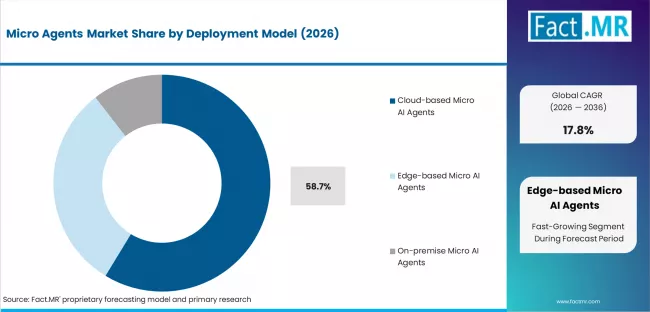
Micro Agents Market Analysis By Deployment Model

At 58.70% market share, the Cloud-based category is predicted to continue its reign as the leading player. This leadership position is reinforced by the inherent traits of cloud-based micro agents, including scalability, low-cost subscription models, and easy integration with legacy systems, utilized for automating workflows, delivering customer service, performing IT functions, and managing other enterprise applications requiring fast implementation, remote access, and frequent upgrades.

Which Architecture Type Dominates the Micro Agents Market?
Micro Agents Market Analysis By Architecture Type

Market leaders in this segment are the Single-purpose micro agents, with a market share of 36.8%. The difference between these agents and others is that while the latter seek versatility, single-purpose micro agents have their strengths and capabilities concentrated on one particular task, such as workflow initiation, threat detection in log files.

Which Technology Type Leads the Micro Agents Market?
Micro Agents Market Analysis By Technology Type

The biggest market share belongs to LLM-Powered micro agents, which account for 38.6% of the market share. SLMs are slowly taking precedence in edge-based use cases however, LLMs are still the preferred engine for advanced reasoning, understanding of natural language, and planning dynamic tasks.

Which Functional Application is Largest in the Micro Agents Market?
Micro Agents Market Analysis By Functional Application

Workflow automation accounts for 22.8% of applications, making it the single biggest use case. Companies are deploying micro agents to replace brittle, script‑based automation with intelligent, event‑driven execution.

Which Agent Type Dominates the Micro Agents Market?
Micro Agents Market Analysis By Agent Type

Conversational micro agents enjoy 30.6% market share and are leading in the agent type category. These agents function as the first point of contact for enterprise automation processes in answering customer queries, support desk tickets, data searches, and voice command processing. The reason behind their popularity is that communication is the most natural way of interaction between humans and computers.

Regional Outlook Across Key Markets

The market analysis covers key global regions, including South Asia and Pacific, Middle East & Africa, North America, Latin America, Western Europe, and Eastern Europe. It is segmented geographically, with specific market dynamics for each region. The full report provides a detailed market attractiveness analysis.

Top Country Growth Comparison Micro Agents Market Cagr (2026 2036)

CAGR Table

Country CAGR (%)
U.S.A. 17.1%
China 18.8%
U.K. 18.6%
Germany 17.7%
Japan 17.6%
India 18.6%
South Korea 18.7%

Source: Fact.MR (FMR) analysis, based on proprietary forecasting model and primary research.
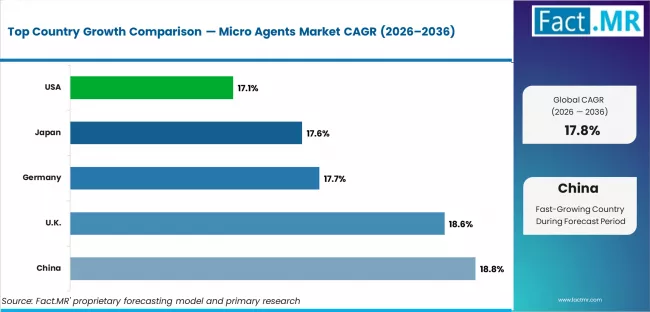
Micro Agents Market Cagr Analysis By Country

North America – The Micro Agents & Enterprise Automation Hub
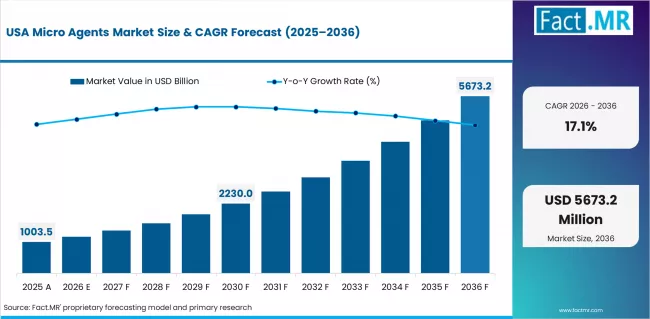
Micro Agents Market Country Value Analysis

There have been tremendous advances in the micro agent market in North America, owing to the quick adoption of composable AI architecture by businesses and increasing awareness about the benefits that can be derived by leveraging single-purpose micro agents in process automation, information technology management, and cybersecurity.

  • U.S.: Demand for micro agents in the U.S. is projected to grow at around 17.1% CAGR, supported by strong penetration of cloud-based automation platforms, and increasing integration of LLM-powered and SLM‑powered micro agents in next‑generation enterprise productivity and customer service systems.

Western Europe – The Micro Agents & Enterprise Automation Innovation Hub
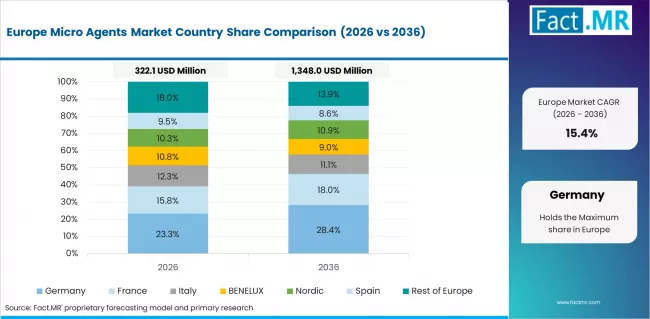
Micro Agents Market Europe Country Market Share Analysis, 2026 & 2036

The Western European market for micro agents is expected to see further growth due to the need for intelligent process automation among businesses, along with the backing provided by European regulations that are designed to promote digital transformation and data ownership, thus ensuring a burgeoning market for advanced micro agents and LLM-driven automation solutions in this part of the world.

  • Germany: Demand for micro agents in Germany is projected to grow at a 17.7% CAGR through 2036, supported by its strong industrial manufacturing and automotive engineering base, and increasing integration of cloud-based and edge-based micro agents into Industry 4.0 workflows, IT operations automation, and next‑generation enterprise productivity systems.

East Asia – The High-Growth Micro Agents & Enterprise Automation Hub

The East Asia micro agent market is experiencing high growth, mainly due to the increased use of intelligent automation and composable AI, coupled with increasing adoption of cloud-edge based micro agents in enterprise productivity and next-generation automation based on single-purpose micro agent technology.

  • China: Demand for micro agents in China is projected to grow at 18.8% CAGR through 2036, supported by rapid expansion of digital enterprise ecosystems, increasing investments in LLM‑powered and SLM‑powered micro agents for scalable automation.

South Asia & Pacific – The Rapidly Growing Micro Agents & Emerging Enterprise Automation Region

There is substantial growth in the South Asia & Pacific micro agent market primarily because of increased penetration of intelligent automation tools, greater adoption of cloud and edge computing, and better awareness of workflow automation and IT automation needs.

  • India: Demand for micro agents in India is projected to grow at 18.6% CAGR through 2036, driven by rapid expansion of digital enterprise ecosystems, increasing SaaS and cloud platform adoption, and growing deployment of LLM‑powered micro agents utilizing cloud‑based and edge‑based deployment models for workflow automation and customer service.

Latin America – The Emerging Micro Agents & Enterprise Automation Market

The Latin American market for micro agents is anticipated to grow moderately owing to an ongoing increase in cloud-based automation and digital transformation within businesses, as well as investment in IT infrastructure for industrial and commercial applications in Latin America.

  • Brazil: Demand for micro agents in Brazil is projected to grow at around 19.2% CAGR through 2036, supported by expanding cloud infrastructure, increasing enterprise interest in workflow automation and customer service automation, and gradual adoption of single-purpose micro agents and LLM‑powered agents for IT operations and productivity applications.

Middle East & Africa – The Emerging Micro Agents & Enterprise Automation Expansion Zone

It is estimated that the micro agents market in the Middle East and Africa will have a moderate CAGR during the forecast period owing to the increase in investments towards the digitization of IT infrastructure, adoption of cloud and edge computing automation solutions, and increased awareness regarding agentic AI and composable architectures in the region.

  • KSA: Demand for micro agents in Saudi Arabia is projected to grow steadily at 19.3% CAGR through 2036, supported by Vision 2030 digital transformation initiatives, and increasing adoption of cloud-based and single-purpose micro agents in workflow automation, IT operations, and enterprise productivity systems.

Fact.MR’s analysis of the Micro Agents market provides a comprehensive regional outlook covering North America, Western Europe, East Asia, South Asia & Pacific, Latin America, and Middle East & Africa. Readers can access country-wise insights, growth trends, cloud and edge automation adoption patterns, and enterprise & consumer behavior dynamics shaping both mature and emerging markets, driven by increasing demand for intelligent workflow automation, and real-time, single-purpose micro agent applications across global industries, IT operations, and customer service ecosystems.

Competitive Benchmarking and Company Positioning

Leading Companies Shaping the Micro Agents Market
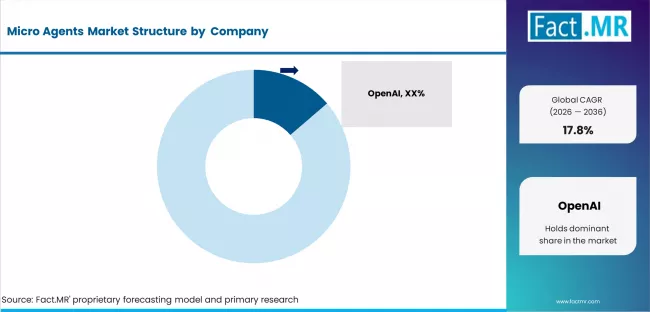
Micro Agents Market Analysis By Company

Market conditions are described as moderately fragmented, with some major vendors such as OpenAI, Anthropic, Fixie, Builder.IO, and Wild Moose. The companies specialize in the development of conversational and task execution microagents using either large language models and small language models to provide purpose-built automation solutions. Collectively, the companies will capture 40-45% of the global market share. Through their extensive experience in building agentic AI systems, and composable workflow orchestration, the vendors can drive adoption in enterprise productivity and customer service automation use cases.

Key Players of the Micro Agents Market

  • OpenAI
  • Anthropic
  • Microsoft
  • Fixie
  • Amazon Web Services
  • Builder.IO
  • Salesforce
  • Wild Moose
  • Vectorize, Inc.
  • ServiceNow
  • Cognition AI

Recent Industry Developments

  • Baidu unveils AI agent products, proposes new metric (2026), Baidu Inc. introduced a series of AI agent products at its annual developer conference. (Baidu) [1]
  • Ingram Micro Announces Agentic AI Capabilities, Adds Models to Xvantage AI Factory (2025): Announced the first enterprise-grade AI Agent built within its patented Ingram Micro Xvantage AI Factory, using Gemini large language models. (IngramMicro) [2]
  • Mira launches micro-agent Aven built on the x402 standard (2025): Mira has announced the launch of the micro-agent Aven. Aven can automatically purchase items on-chain with a single reply, and is built on the x402 open standard. (Mira) [3]
  • BlinkOp’s Micro-Agents Builder enables teams to generate unlimited security micro-agents for specific tasks (2025): BlinkOps today announced the completion of a $50 million Series B financing round led by O.G. Venture Partners. (BlinkOps) [4]
  • Nvidia Targets $1 Trillion Market with New AI Agent Software (2025): Nvidia is deepening its push into enterprise AI by launching NeMo microservices, a new software platform. (Nvidia) [5]

Sources and Research References

  • [1] “Baidu unveils AI agent products, proposes new metric”, 2026
  • [2] “Ingram Micro Announces Agentic AI Capabilities, Adds Models to Xvantage™ AI Factory”, 2025
  • [3] “Mira launches micro-agent Aven built on the x402 standard”, 2025
  • [4] “Micro-agents security co BlinkOps raises $50m”, 2025
  • [5] “Nvidia Targets $1 Trillion Market with New AI Agent Software”, 2025

Micro Agents Market Definition

Micro agents market offers an overview of the world economy encompassing micro-agents created/deployed via software applications, platforms, and technology for automating specific tasks in the digital space by automated processes using micro-agents. Micro-agents can use AI-based language models, APIs, and workflow integrations as a basis for performing discrete activities like data processing, decision support, or user-to-user communications.

Micro Agents Market Inclusions

Market overview aims to give a complete picture of markets dynamics and the market share and growth opportunities of global micro agent market. Micro agents are used for everything from workflow automation, customer and technical support, and data analysis to software development and digital assistants.

Micro Agents Market Exclusions

This report on the market does not include general AI systems or platforms that are not designed as micro agents for task specific automation, nor does it cover massive AI models or standalone software products that do not function as discrete, modular micro agents in workflows.

Micro Agents Market Research Methodology

  • Primary Research
    • The identification of the market is based on the trends present in the industry, which are recognized by the contribution that the players make to the value chain. This includes players such as micro agents platform providers, AI models, API and Infrastructure providers, workflow automation platform providers, enterprise software firms, and users of micro agents.
  • Desk Research
    • Secondary research was conducted on the market study of the market where the process of gathering relevant data and collecting information about the topic included micro agents, artificial intelligence technology, workflow automation software, and modular agent architecture.
  • Market-Sizing and Forecasting
    • Market value of micro agents was calculated by adding up the values of the following segments: Micro agents for workflow automation, micro agents for customer interactions, micro agents for data processing & analysis, and other application-specific micro agents.
  • Data Validation and Update Cycle
    • The data validation process is conducted using several sources such as industry information and corporate reporting data. The market is always changing due to innovations that continue to be made in the field of micro agents.

Scope of Analysis

Micro Agents Market Breakdown By Deployment Model, Agent Type, And Region

Parameter Details
Quantitative Units USD 1.3 billion in 2025 to USD 7.9 billion in 2036, at a CAGR of 17.8%
Market Definition The Micro Agents market comprises lightweight, purpose‑built AI agents designed to execute specific tasks with high accuracy and low latency. These agents are deployed via cloud, edge, or on‑premise models and are integrated into workflow automation, customer service, IT operations, and cybersecurity systems to enable intelligent orchestration, real‑time decision‑making, and scalable enterprise productivity across industries.
Regions Covered North America, Latin America, Europe, East Asia, South Asia & Pacific, Middle East & Africa
Countries Covered USA, Canada, UK, Germany, China, India, 30 plus countries
Key Companies OpenAI, Anthropic, Fixie, Builder.IO, Wild Moose, and others
Forecast Period 2026 to 2036
Approach Hybrid demand‑side and top‑down methodology based on rising adoption of agentic AI and composable automation architectures, increasing penetration of cloud‑based and edge‑based deployment models, advancements in SLM technologies for single‑purpose micro agents, and growing enterprise shift toward workflow automation, and real‑time customer service solutions across global markets.

Analysis by Agent Type, by Architecture Type, by Technology Type, by Deployment Model, by Functional Application, and by Region

  • Micro Agents Market By Agent Type

    • Task Execution Micro Agents
      • Workflow Automation Agents
      • Scheduling Agents
      • Transaction Processing Agents
    • Conversational Micro AI Agents
      • Chat-based Agents
      • Voice-based Agents
      • Customer Support Agents
    • Analytical Micro AI Agents
      • Predictive Analytics Agents
      • Decision-support Agents
    • Coding & Development Micro Agents
      • Code Generation Agents
      • Code Review Agents
    • Testing & Debugging Agents
      • Monitoring & Security Micro Agents
      • Cybersecurity Monitoring Agents
      • Threat Detection Agents
    • Industrial & IoT Micro Agents
      • Predictive Maintenance Agents
      • Industrial Monitoring Agents
    • Edge Automation Agents
  • Micro Agents Market By Architecture Type

    • Single-purpose Micro Agents
    • Multi-functional Micro Agents
    • Collaborative Multi-agent Systems
    • Hierarchical Agent Networks
    • Swarm-based Agent Architectures
  • Micro Agents Market By Technology Type

    • LLM-powered Micro Agents
      • GPT-based Agents
      • Open-source LLM Agents
      • Domain-specific LLM Agents
    • Small Language Model (SLM)-powered Agents
      • Edge-optimized AI Agents
      • Lightweight Embedded Agents
      • Low-latency AI Agents
    • Machine Learning-based Agents
      • Reinforcement Learning Agents
      • Predictive ML Agents
      • Adaptive Learning Agents
    • Rule-based AI Agents
      • Deterministic Automation Agents
      • Logic-driven Agents
      • Expert-system Agents
    • Hybrid AI Agents
      • Neuro-symbolic Agents
      • Retrieval-Augmented Agents
      • Memory-enabled Agents
  • Micro Agents Market By Deployment Model

    • Cloud-based Micro AI Agents
      • Public Cloud
      • Private Cloud
      • Hybrid Cloud
    • Edge-based Micro AI Agents
      • On-device Agents
      • Industrial Edge Agents
      • IoT-integrated Agents
    • On-premise Micro AI Agents
      • Enterprise Datacenter Deployment
      • Secure Infrastructure Deployment
      • Air-gapped Deployment
  • Micro Agents Market By Functional Application

    • Workflow Automation
    • Customer Service Automation
    • Enterprise Productivity
    • IT Operations Automation
    • Software Development Automation
    • Data Intelligence & Analytics
    • Cybersecurity Automation
    • Supply Chain Automation
    • Others
  • Micro Agents Market By Region

    • North America
      • USA
      • Canada
      • Mexico
    • Latin America
      • Brazil
      • Chile
      • Rest of LATAM
    • East Asia
      • China
      • Japan
      • South Korea
    • Western Europe
      • Germany
      • Italy
      • France
      • U.K.
      • Spain
      • BENELUX
      • Nordic
      • Rest of W. Europe
    • Eastern Europe
      • Russia
      • Hungary
      • Poland
      • Balkan & Baltics
      • Rest of E. Europe
    • Middle East and Africa
      • Kingdom of Saudi Arabia
      • United Arab Emirates
      • South Africa
      • Rest of Middle East and Africa

- Frequently Asked Questions -

How large is the demand for Micro Agents in the global market in 2025?

Demand for Micro Agents in the global market is estimated to be valued at USD 1.3 billion in 2025.

What will be the market size of Micro Agents in the global market by 2036?

The market size for Micro Agents is projected to reach USD 7.9 billion by 2036.

What is the expected demand growth for Micro Agents in the global market between 2026 and 2036?

Demand for Micro Agents in the global market is expected to grow at a CAGR of 17.8% between 2026 and 2036.

Which deployment model segment is expected to dominate the Micro Agents market?

Cloud-based is expected to dominate the market, accounting for 58.7% share in 2026, driven by their extensive use in workflow automation, customer service, and IT operations requiring scalable, cost-effective, and remotely accessible micro agents for superior deployment flexibility, integration ease, and operational efficiency.

How significant is the growth outlook for China in this market?

China is expected to grow at a CAGR of 18.8% through 2036, supported by rapid expansion of digital enterprise ecosystems, increasing investments in LLM-powered and SLM-powered micro agents, and growing adoption of cloud-based and single-purpose micro agents in workflow automation, enterprise productivity, and customer service applications.

Which company is identified as a leading player in the Micro Agents market?

OpenAI is identified as a leading player in the market, supported by its strong expertise in large language model development, conversational and task-execution micro agent solutions, and expanding global presence in enterprise automation, IT operations, and productivity applications.

Table of Content

  1. Micro Agents Market – Executive Summary
  2. Market Overview
    • Market Definition & Introduction
    • Market Taxonomy & Research Scope
  3. Global Micro Agents Market Demand (in Value or Size in US$ Mn) Analysis 2021-2025 and Forecast, 2026–2036
    • Historical Market Value (US$ Mn) Analysis, 2021-2025
    • Current and Future Market Value (US$ Mn) Projections, 2026–2036
      • Y-o-Y Growth Trend Analysis
      • Absolute $ Opportunity Analysis
  4. Market Background and Foundational Data Points
    • Micro Agents Development Cost Sensitivity Across Enterprise Deployment Models
    • Task Automation Efficiency vs Implementation Complexity Trade-off Ratio
    • Micro Agents Performance Optimization Through LLM Fine-Tuning and Tool Integration
    • Workflow Automation Accuracy Improvement Rate (Micro Agents Deployment Impact)
    • Response Latency Reduction Index in Task-Specific Micro Agents
    • Multi-Agent Collaboration Efficiency Growth Rate
    • Enterprise AI Adoption Impact Factor (Micro Agents Integration in Business Processes)
    • API Ecosystem Integration Depth for Micro Agents
    • Micro Agents vs Traditional Automation Tools Penetration Rate
    • Scalability and Orchestration Capability Index for Micro Agents Frameworks
    • Cloud Infrastructure Maturity Supporting Micro Agents Deployment
    • R&D Investment Intensity in Agentic AI and Autonomous Systems
    • No-Code / Low-Code Micro Agents Adoption Rate
    • Enterprise Workflow Replacement Rate (Manual Processes to Micro Agents)
    • Reliability and Error Reduction Metrics in Micro Agents Systems
    • Data Privacy, Security, and Compliance Maturity Index for Agentic Systems
    • Strategic Partnerships Between AI Platforms, SaaS Providers, and Enterprises
    • Industry-Wise Micro Agents Adoption Diversification Rate (BFSI, Healthcare, Retail, IT, etc.)
    • Micro Agents Market Opportunity Assessment
      • Total Available Market (US$ Mn)
      • Serviceable Addressable Market (US$ Mn)
      • Serviceable Obtainable Market (US$ Mn)
    • Porter’s Five Forces and PESTEL Analysis
    • Investment Feasibility Analysis
    • Macro-Economic Factors & Forecast Factors - Relevance & Impact
    • Market Dynamics
      • Drivers
      • Restraints
      • Opportunity Analysis
    • Key Regulations & Certifications
  5. Micro Agents Market Analysis 2021-2025 and Forecast 2026–2036, By Agent Type
    • Introduction / Key Findings
    • Historical Market Size (US$ Mn) & Trend Analysis By Agent Type, 2021-2025
    • Current and Future Market Size (US$ Mn) Analysis and Forecast By Agent Type, 2026-2036
      • Task Execution Micro Agents
        • Workflow Automation Agents
        • Scheduling Agents
        • Transaction Processing Agents
      • Conversational Micro AI Agents
        • Chat-based Agents
        • Voice-based Agents
        • Customer Support Agents
      • Analytical Micro AI Agents
        • Predictive Analytics Agents
        • Decision-support Agents
      • Coding & Development Micro Agents
        • Code Generation Agents
        • Code Review Agents
        • Testing & Debugging Agents
      • Monitoring & Security Micro Agents
        • Cybersecurity Monitoring Agents
        • Threat Detection Agents
      • Industrial & IoT Micro Agents
        • Predictive Maintenance Agents
        • Industrial Monitoring Agents
        • Edge Automation Agents
    • Market Attractiveness Analysis By Agent Type
  6. Micro Agents Market Analysis 2021-2025 and Forecast 2026–2036, By Architecture Type
    • Introduction / Key Findings
    • Historical Market Size (US$ Mn) Trend Analysis By Architecture Type, 2021-2025
    • Current and Future Market Size (US$ Mn) Analysis and Forecast By Architecture Type, 2026-2036
      • Single-purpose Micro Agents
      • Multi-functional Micro Agents
      • Collaborative Multi-agent Systems
      • Hierarchical Agent Networks
      • Swarm-based Agent Architectures
    • Market Attractiveness Analysis By Architecture Type
  7. Micro Agents Market Analysis 2021-2025 and Forecast 2026–2036, By Technology Type
    • Introduction / Key Findings
    • Historical Market Size (US$ Mn) Trend Analysis By Technology Type, 2021-2025
    • Current and Future Market Size (US$ Mn) Analysis and Forecast By Technology Type, 2026-2036
      • LLM-powered Micro Agents
        • GPT-based Agents
        • Open-source LLM Agents
        • Domain-specific LLM Agents
      • Small Language Model (SLM)-powered Agents
        • Edge-optimized AI Agents
        • Lightweight Embedded Agents
        • Low-latency AI Agents
      • Machine Learning-based Agents
        • Reinforcement Learning Agents
        • Predictive ML Agents
        • Adaptive Learning Agents
      • Rule-based AI Agents
        • Deterministic Automation Agents
        • Logic-driven Agents
        • Expert-system Agents
      • Hybrid AI Agents
        • Neuro-symbolic Agents
        • Retrieval-Augmented Agents
        • Memory-enabled Agents
    • Market Attractiveness Analysis By Technology Type
  8. Micro Agents Market Analysis 2021-2025 and Forecast 2026–2036, By Deployment Model
    • Introduction / Key Findings
    • Historical Market Size (US$ Mn) Trend Analysis By Deployment Model, 2021-2025
    • Current and Future Market Size (US$ Mn) Analysis and Forecast By Deployment Model, 2026-2036
      • Cloud-based Micro AI Agents
        • Public Cloud
        • Private Cloud
        • Hybrid Cloud
      • Edge-based Micro AI Agents
        • On-device Agents
        • Industrial Edge Agents
        • IoT-integrated Agents
      • On-premise Micro AI Agents
        • Enterprise Datacenter Deployment
        • Secure Infrastructure Deployment
        • Air-gapped Deployment
    • Market Attractiveness Analysis By Deployment Model
  9. Micro Agents Market Analysis 2021-2025 and Forecast 2026–2036, By Functional Application
    • Introduction / Key Findings
    • Historical Market Size (US$ Mn) Trend Analysis By Functional Application, 2021-2025
    • Current and Future Market Size (US$ Mn) Analysis and Forecast By Functional Application, 2026-2036
      • Workflow Automation
      • Customer Service Automation
      • Enterprise Productivity
      • IT Operations Automation
      • Software Development Automation
      • Data Intelligence & Analytics
      • Cybersecurity Automation
      • Supply Chain Automation
      • Others
    • Market Attractiveness Analysis By Functional Application
  10. Global Micro Agents Market Analysis and Forecast, by Region
    • Introduction / Key Findings
    • Historical Market Size (US$ Mn) Trend Analysis by Region, 2021-2025
    • Current and Future Market Size (US$ Mn) Analysis and Forecast by Region, 2026-2036
      • North America
      • Latin America
      • Western Europe
      • Eastern Europe
      • East Asia
      • South Asia & Pacific
      • Middle East & Africa
    • Market Attractiveness Analysis by Region
  11. North America Micro Agents Market Analysis and Forecast
    • Introduction / Key Findings
    • Historical Market Size (US$ Mn) Trend Analysis by Market Taxonomy, 2021-2025
    • Current and Future Market Size (US$ Mn) Analysis & Forecast by Market Taxonomy, 2026-2036
    • By Country
      • United States
      • Canada
      • Mexico
    • By Taxonomy
    • Market Attractiveness Analysis By Country & Taxonomy
    • Market Trends
    • Key Market Participants – Intensity Mapping
    • Drivers and Restraints - Impact Analysis
  12. Latin America Micro Agents Market Analysis and Forecast
    • Introduction / Key Findings
    • Historical Market Size (US$ Mn) Trend Analysis by Market Taxonomy, 2021-2025
    • Current and Future Market Size (US$ Mn) Analysis & Forecast by Market Taxonomy, 2026-2036
    • By Country
      • Brazil
      • Chile
      • Rest of LATAM
    • By Taxonomy
    • Market Attractiveness Analysis By Country & Taxonomy
    • Market Trends
    • Key Market Participants – Intensity Mapping
    • Drivers and Restraints - Impact Analysis
  13. Western Europe Micro Agents Market Analysis and Forecast
    • Introduction / Key Findings
    • Historical Market Size (US$ Mn) Trend Analysis by Market Taxonomy, 2021-2025
    • Current and Future Market Size (US$ Mn) Analysis & Forecast by Market Taxonomy, 2026-2036
    • By Country
      • Germany
      • Italy
      • France
      • United Kingdom
      • Spain
      • BENELUX
      • Nordics
      • Rest of Western Europe
    • By Taxonomy
    • Market Attractiveness Analysis By Country & Taxonomy
    • Market Trends
    • Key Market Participants – Intensity Mapping
    • Drivers and Restraints - Impact Analysis
  14. Eastern Europe Micro Agents Market Analysis and Forecast
    • Introduction / Key Findings
    • Historical Market Size (US$ Mn) Trend Analysis by Market Taxonomy, 2021-2025
    • Current and Future Market Size (US$ Mn) Analysis & Forecast by Market Taxonomy, 2026-2036
    • By Country
      • Russia
      • Hungary
      • Poland
      • Balkan & Baltics
      • Rest of Eastern Europe
    • By Taxonomy
    • Market Attractiveness Analysis By Country & Taxonomy
    • Market Trends
    • Key Market Participants – Intensity Mapping
    • Drivers and Restraints - Impact Analysis
  15. East Asia Micro Agents Market Analysis and Forecast
    • Introduction / Key Findings
    • Historical Market Size (US$ Mn) Trend Analysis by Market Taxonomy, 2021-2025
    • Current and Future Market Size (US$ Mn) Analysis & Forecast by Market Taxonomy, 2026-2036
    • By Country
      • China
      • Japan
      • South Korea
    • By Taxonomy
    • Market Attractiveness Analysis By Country & Taxonomy
    • Market Trends
    • Key Market Participants – Intensity Mapping
    • Drivers and Restraints - Impact Analysis
  16. South Asia & Pacific Micro Agents Market Analysis and Forecast
    • Introduction / Key Findings
    • Historical Market Size (US$ Mn) Trend Analysis by Market Taxonomy, 2021-2025
    • Current and Future Market Size (US$ Mn) Analysis & Forecast by Market Taxonomy, 2026-2036
    • By Country
      • India
      • ASEAN
      • Australia & New Zealand
      • Rest of South Asia & Pacific
    • By Taxonomy
    • Market Attractiveness Analysis By Country & Taxonomy
    • Market Trends
    • Key Market Participants – Intensity Mapping
    • Drivers and Restraints - Impact Analysis
  17. Middle East & Africa Micro Agents Market Analysis and Forecast
    • Introduction / Key Findings
    • Historical Market Size (US$ Mn) Trend Analysis by Market Taxonomy, 2021-2025
    • Current and Future Market Size (US$ Mn) Analysis & Forecast by Market Taxonomy, 2026-2036
    • By Country
      • Kingdom of Saudi Arabia
      • Other GCC Countries
      • Turkiye
      • South Africa
      • Other African Union
    • By Taxonomy
    • Market Attractiveness Analysis By Country & Taxonomy
    • Market Trends
    • Key Market Participants – Intensity Mapping
    • Drivers and Restraints - Impact Analysis
  18. Country-level Micro Agents Market Analysis and Forecast
    • Introduction
    • Market Value Proportion Analysis, By Key Countries
    • Global Vs. Country Growth Comparison
      • United States Micro Agents Market Analysis
        • Market Size (US$ Mn) Analysis by Market Taxonomy, 2021–2036
        • By Agent Type
        • By Architecture Type
        • By Technology Type
        • By Deployment Model
        • By Functional Application
        • Canada Micro Agents Market Analysis
        • Mexico Micro Agents Market Analysis
        • Brazil Micro Agents Market Analysis
        • Chile Micro Agents Market Analysis
        • Germany Micro Agents Market Analysis
        • France Micro Agents Market Analysis
        • Italy Micro Agents Market Analysis
        • Spain Micro Agents Market Analysis
        • United Kingdom Micro Agents Market Analysis
        • BENELUX Micro Agents Market Analysis
        • Nordics Micro Agents Market Analysis
        • Poland Micro Agents Market Analysis
        • Russia Micro Agents Market Analysis
        • Hungary Micro Agents Market Analysis
        • Balkan & Baltics Micro Agents Market Analysis
        • China Micro Agents Market Analysis
        • Japan Micro Agents Market Analysis
        • South Korea Micro Agents Market Analysis
        • India Micro Agents Market Analysis
        • ASEAN Micro Agents Market Analysis
        • ANZ Micro Agents Market Analysis
        • KSA Micro Agents Market Analysis
        • Other GCC Countries Micro Agents Market Analysis
        • South Africa Micro Agents Market Analysis
        • Turkiye Micro Agents Market Analysis
    • Micro Agents Market Structure Analysis
      • Market Analysis by Tier of Companies
      • Market Concentration
      • Market Share Analysis of Top Players
      • Market Space for New Brands and Dollar Opportunity
      • Market Presence Analysis
        • Regional Footprint of Players
        • Product Footprint by Players
    • Micro Agents Market Competition Analysis
      • Competition Dashboard
      • Pricing Analysis by Competition
      • Competition Benchmarking
      • Competition Deep Dive
        • OpenAI
          • Overview
          • Product Portfolio
          • Sales Footprint
          • Key Developments
          • SWOT Analysis
          • Strategy Overview
          • Key Financials
        • Anthropic
        • Microsoft
        • Fixie
        • Amazon Web Services
        • Builder.IO
        • Salesforce
        • Wild Moose
        • Vectorize, Inc.
        • ServiceNow
        • Cognition AI
        • Other Prominent Players
    • Primary insights
    • Assumptions & Acronyms Used
    • Research Methodology & Data Sources

List Of Table

  • Table 1: Global Market Value (USD Mn) Forecast by Region, 2021 to 2036
  • Table 2: Global Market Value (USD Mn) Forecast by Agent Type, 2021 to 2036
  • Table 3: Global Market Value (USD Mn) Forecast by Architecture Type, 2021 to 2036
  • Table 4: Global Market Value (USD Mn) Forecast by Deployment Model, 2021 to 2036
  • Table 5: Global Market Value (USD Mn) Forecast by Technology Type, 2021 to 2036
  • Table 6: Global Market Value (USD Mn) Forecast by Functional Application, 2021 to 2036
  • Table 7: North America Market Value (USD Mn) Forecast by Country, 2021 to 2036
  • Table 8: North America Market Value (USD Mn) Forecast by Agent Type, 2021 to 2036
  • Table 9: North America Market Value (USD Mn) Forecast by Architecture Type, 2021 to 2036
  • Table 10: North America Market Value (USD Mn) Forecast by Deployment Model, 2021 to 2036
  • Table 11: North America Market Value (USD Mn) Forecast by Technology Type, 2021 to 2036
  • Table 12: North America Market Value (USD Mn) Forecast by Functional Application, 2021 to 2036
  • Table 13: Latin America Market Value (USD Mn) Forecast by Country, 2021 to 2036
  • Table 14: Latin America Market Value (USD Mn) Forecast by Agent Type, 2021 to 2036
  • Table 15: Latin America Market Value (USD Mn) Forecast by Architecture Type, 2021 to 2036
  • Table 16: Latin America Market Value (USD Mn) Forecast by Deployment Model, 2021 to 2036
  • Table 17: Latin America Market Value (USD Mn) Forecast by Technology Type, 2021 to 2036
  • Table 18: Latin America Market Value (USD Mn) Forecast by Functional Application, 2021 to 2036
  • Table 19: Western Europe Market Value (USD Mn) Forecast by Country, 2021 to 2036
  • Table 20: Western Europe Market Value (USD Mn) Forecast by Agent Type, 2021 to 2036
  • Table 21: Western Europe Market Value (USD Mn) Forecast by Architecture Type, 2021 to 2036
  • Table 22: Western Europe Market Value (USD Mn) Forecast by Deployment Model, 2021 to 2036
  • Table 23: Western Europe Market Value (USD Mn) Forecast by Technology Type, 2021 to 2036
  • Table 24: Western Europe Market Value (USD Mn) Forecast by Functional Application, 2021 to 2036
  • Table 25: Eastern Europe Market Value (USD Mn) Forecast by Country, 2021 to 2036
  • Table 26: Eastern Europe Market Value (USD Mn) Forecast by Agent Type, 2021 to 2036
  • Table 27: Eastern Europe Market Value (USD Mn) Forecast by Architecture Type, 2021 to 2036
  • Table 28: Eastern Europe Market Value (USD Mn) Forecast by Deployment Model, 2021 to 2036
  • Table 29: Eastern Europe Market Value (USD Mn) Forecast by Technology Type, 2021 to 2036
  • Table 30: Eastern Europe Market Value (USD Mn) Forecast by Functional Application, 2021 to 2036
  • Table 31: East Asia Market Value (USD Mn) Forecast by Country, 2021 to 2036
  • Table 32: East Asia Market Value (USD Mn) Forecast by Agent Type, 2021 to 2036
  • Table 33: East Asia Market Value (USD Mn) Forecast by Architecture Type, 2021 to 2036
  • Table 34: East Asia Market Value (USD Mn) Forecast by Deployment Model, 2021 to 2036
  • Table 35: East Asia Market Value (USD Mn) Forecast by Technology Type, 2021 to 2036
  • Table 36: East Asia Market Value (USD Mn) Forecast by Functional Application, 2021 to 2036
  • Table 37: South Asia and Pacific Market Value (USD Mn) Forecast by Country, 2021 to 2036
  • Table 38: South Asia and Pacific Market Value (USD Mn) Forecast by Agent Type, 2021 to 2036
  • Table 39: South Asia and Pacific Market Value (USD Mn) Forecast by Architecture Type, 2021 to 2036
  • Table 40: South Asia and Pacific Market Value (USD Mn) Forecast by Deployment Model, 2021 to 2036
  • Table 41: South Asia and Pacific Market Value (USD Mn) Forecast by Technology Type, 2021 to 2036
  • Table 42: South Asia and Pacific Market Value (USD Mn) Forecast by Functional Application, 2021 to 2036
  • Table 43: Middle East & Africa Market Value (USD Mn) Forecast by Country, 2021 to 2036
  • Table 44: Middle East & Africa Market Value (USD Mn) Forecast by Agent Type, 2021 to 2036
  • Table 45: Middle East & Africa Market Value (USD Mn) Forecast by Architecture Type, 2021 to 2036
  • Table 46: Middle East & Africa Market Value (USD Mn) Forecast by Deployment Model, 2021 to 2036
  • Table 47: Middle East & Africa Market Value (USD Mn) Forecast by Technology Type, 2021 to 2036
  • Table 48: Middle East & Africa Market Value (USD Mn) Forecast by Functional Application, 2021 to 2036

List Of Figures

  • Figure 1: Global Market Pricing Analysis
  • Figure 2: Global Market Value (USD Mn) Forecast 2021 to 2036
  • Figure 3: Global Market Value Share and BPS Analysis by Agent Type, 2026 and 2036
  • Figure 4: Global Market Y-o-Y Growth Comparison by Agent Type, 2026 to 2036
  • Figure 5: Global Market Attractiveness Analysis by Agent Type
  • Figure 6: Global Market Value Share and BPS Analysis by Architecture Type, 2026 and 2036
  • Figure 7: Global Market Y-o-Y Growth Comparison by Architecture Type, 2026 to 2036
  • Figure 8: Global Market Attractiveness Analysis by Architecture Type
  • Figure 9: Global Market Value Share and BPS Analysis by Deployment Model, 2026 and 2036
  • Figure 10: Global Market Y-o-Y Growth Comparison by Deployment Model, 2026 to 2036
  • Figure 11: Global Market Attractiveness Analysis by Deployment Model
  • Figure 12: Global Market Value Share and BPS Analysis by Technology Type, 2026 and 2036
  • Figure 13: Global Market Y-o-Y Growth Comparison by Technology Type, 2026 to 2036
  • Figure 14: Global Market Attractiveness Analysis by Technology Type
  • Figure 15: Global Market Value Share and BPS Analysis by Functional Application, 2026 and 2036
  • Figure 16: Global Market Y-o-Y Growth Comparison by Functional Application, 2026 to 2036
  • Figure 17: Global Market Attractiveness Analysis by Functional Application
  • Figure 18: Global Market Value (USD Mn) Share and BPS Analysis by Region, 2026 and 2036
  • Figure 19: Global Market Y-o-Y Growth Comparison by Region, 2026 to 2036
  • Figure 20: Global Market Attractiveness Analysis by Region
  • Figure 21: North America Market Incremental $ Opportunity, 2026 to 2036
  • Figure 22: Latin America Market Incremental $ Opportunity, 2026 to 2036
  • Figure 23: Western Europe Market Incremental $ Opportunity, 2026 to 2036
  • Figure 24: Eastern Europe Market Incremental $ Opportunity, 2026 to 2036
  • Figure 25: East Asia Market Incremental $ Opportunity, 2026 to 2036
  • Figure 26: South Asia and Pacific Market Incremental $ Opportunity, 2026 to 2036
  • Figure 27: Middle East & Africa Market Incremental $ Opportunity, 2026 to 2036
  • Figure 28: North America Market Value Share and BPS Analysis by Country, 2026 and 2036
  • Figure 29: North America Market Value Share and BPS Analysis by Agent Type, 2026 and 2036
  • Figure 30: North America Market Y-o-Y Growth Comparison by Agent Type, 2026 to 2036
  • Figure 31: North America Market Attractiveness Analysis by Agent Type
  • Figure 32: North America Market Value Share and BPS Analysis by Architecture Type, 2026 and 2036
  • Figure 33: North America Market Y-o-Y Growth Comparison by Architecture Type, 2026 to 2036
  • Figure 34: North America Market Attractiveness Analysis by Architecture Type
  • Figure 35: North America Market Value Share and BPS Analysis by Deployment Model, 2026 and 2036
  • Figure 36: North America Market Y-o-Y Growth Comparison by Deployment Model, 2026 to 2036
  • Figure 37: North America Market Attractiveness Analysis by Deployment Model
  • Figure 38: North America Market Value Share and BPS Analysis by Technology Type, 2026 and 2036
  • Figure 39: North America Market Y-o-Y Growth Comparison by Technology Type, 2026 to 2036
  • Figure 40: North America Market Attractiveness Analysis by Technology Type
  • Figure 41: North America Market Value Share and BPS Analysis by Functional Application, 2026 and 2036
  • Figure 42: North America Market Y-o-Y Growth Comparison by Functional Application, 2026 to 2036
  • Figure 43: North America Market Attractiveness Analysis by Functional Application
  • Figure 44: Latin America Market Value Share and BPS Analysis by Country, 2026 and 2036
  • Figure 45: Latin America Market Value Share and BPS Analysis by Agent Type, 2026 and 2036
  • Figure 46: Latin America Market Y-o-Y Growth Comparison by Agent Type, 2026 to 2036
  • Figure 47: Latin America Market Attractiveness Analysis by Agent Type
  • Figure 48: Latin America Market Value Share and BPS Analysis by Architecture Type, 2026 and 2036
  • Figure 49: Latin America Market Y-o-Y Growth Comparison by Architecture Type, 2026 to 2036
  • Figure 50: Latin America Market Attractiveness Analysis by Architecture Type
  • Figure 51: Latin America Market Value Share and BPS Analysis by Deployment Model, 2026 and 2036
  • Figure 52: Latin America Market Y-o-Y Growth Comparison by Deployment Model, 2026 to 2036
  • Figure 53: Latin America Market Attractiveness Analysis by Deployment Model
  • Figure 54: Latin America Market Value Share and BPS Analysis by Technology Type, 2026 and 2036
  • Figure 55: Latin America Market Y-o-Y Growth Comparison by Technology Type, 2026 to 2036
  • Figure 56: Latin America Market Attractiveness Analysis by Technology Type
  • Figure 57: Latin America Market Value Share and BPS Analysis by Functional Application, 2026 and 2036
  • Figure 58: Latin America Market Y-o-Y Growth Comparison by Functional Application, 2026 to 2036
  • Figure 59: Latin America Market Attractiveness Analysis by Functional Application
  • Figure 60: Western Europe Market Value Share and BPS Analysis by Country, 2026 and 2036
  • Figure 61: Western Europe Market Value Share and BPS Analysis by Agent Type, 2026 and 2036
  • Figure 62: Western Europe Market Y-o-Y Growth Comparison by Agent Type, 2026 to 2036
  • Figure 63: Western Europe Market Attractiveness Analysis by Agent Type
  • Figure 64: Western Europe Market Value Share and BPS Analysis by Architecture Type, 2026 and 2036
  • Figure 65: Western Europe Market Y-o-Y Growth Comparison by Architecture Type, 2026 to 2036
  • Figure 66: Western Europe Market Attractiveness Analysis by Architecture Type
  • Figure 67: Western Europe Market Value Share and BPS Analysis by Deployment Model, 2026 and 2036
  • Figure 68: Western Europe Market Y-o-Y Growth Comparison by Deployment Model, 2026 to 2036
  • Figure 69: Western Europe Market Attractiveness Analysis by Deployment Model
  • Figure 70: Western Europe Market Value Share and BPS Analysis by Technology Type, 2026 and 2036
  • Figure 71: Western Europe Market Y-o-Y Growth Comparison by Technology Type, 2026 to 2036
  • Figure 72: Western Europe Market Attractiveness Analysis by Technology Type
  • Figure 73: Western Europe Market Value Share and BPS Analysis by Functional Application, 2026 and 2036
  • Figure 74: Western Europe Market Y-o-Y Growth Comparison by Functional Application, 2026 to 2036
  • Figure 75: Western Europe Market Attractiveness Analysis by Functional Application
  • Figure 76: Eastern Europe Market Value Share and BPS Analysis by Country, 2026 and 2036
  • Figure 77: Eastern Europe Market Value Share and BPS Analysis by Agent Type, 2026 and 2036
  • Figure 78: Eastern Europe Market Y-o-Y Growth Comparison by Agent Type, 2026 to 2036
  • Figure 79: Eastern Europe Market Attractiveness Analysis by Agent Type
  • Figure 80: Eastern Europe Market Value Share and BPS Analysis by Architecture Type, 2026 and 2036
  • Figure 81: Eastern Europe Market Y-o-Y Growth Comparison by Architecture Type, 2026 to 2036
  • Figure 82: Eastern Europe Market Attractiveness Analysis by Architecture Type
  • Figure 83: Eastern Europe Market Value Share and BPS Analysis by Deployment Model, 2026 and 2036
  • Figure 84: Eastern Europe Market Y-o-Y Growth Comparison by Deployment Model, 2026 to 2036
  • Figure 85: Eastern Europe Market Attractiveness Analysis by Deployment Model
  • Figure 86: Eastern Europe Market Value Share and BPS Analysis by Technology Type, 2026 and 2036
  • Figure 87: Eastern Europe Market Y-o-Y Growth Comparison by Technology Type, 2026 to 2036
  • Figure 88: Eastern Europe Market Attractiveness Analysis by Technology Type
  • Figure 89: Eastern Europe Market Value Share and BPS Analysis by Functional Application, 2026 and 2036
  • Figure 90: Eastern Europe Market Y-o-Y Growth Comparison by Functional Application, 2026 to 2036
  • Figure 91: Eastern Europe Market Attractiveness Analysis by Functional Application
  • Figure 92: East Asia Market Value Share and BPS Analysis by Country, 2026 and 2036
  • Figure 93: East Asia Market Value Share and BPS Analysis by Agent Type, 2026 and 2036
  • Figure 94: East Asia Market Y-o-Y Growth Comparison by Agent Type, 2026 to 2036
  • Figure 95: East Asia Market Attractiveness Analysis by Agent Type
  • Figure 96: East Asia Market Value Share and BPS Analysis by Architecture Type, 2026 and 2036
  • Figure 97: East Asia Market Y-o-Y Growth Comparison by Architecture Type, 2026 to 2036
  • Figure 98: East Asia Market Attractiveness Analysis by Architecture Type
  • Figure 99: East Asia Market Value Share and BPS Analysis by Deployment Model, 2026 and 2036
  • Figure 100: East Asia Market Y-o-Y Growth Comparison by Deployment Model, 2026 to 2036
  • Figure 101: East Asia Market Attractiveness Analysis by Deployment Model
  • Figure 102: East Asia Market Value Share and BPS Analysis by Technology Type, 2026 and 2036
  • Figure 103: East Asia Market Y-o-Y Growth Comparison by Technology Type, 2026 to 2036
  • Figure 104: East Asia Market Attractiveness Analysis by Technology Type
  • Figure 105: East Asia Market Value Share and BPS Analysis by Functional Application, 2026 and 2036
  • Figure 106: East Asia Market Y-o-Y Growth Comparison by Functional Application, 2026 to 2036
  • Figure 107: East Asia Market Attractiveness Analysis by Functional Application
  • Figure 108: South Asia and Pacific Market Value Share and BPS Analysis by Country, 2026 and 2036
  • Figure 109: South Asia and Pacific Market Value Share and BPS Analysis by Agent Type, 2026 and 2036
  • Figure 110: South Asia and Pacific Market Y-o-Y Growth Comparison by Agent Type, 2026 to 2036
  • Figure 111: South Asia and Pacific Market Attractiveness Analysis by Agent Type
  • Figure 112: South Asia and Pacific Market Value Share and BPS Analysis by Architecture Type, 2026 and 2036
  • Figure 113: South Asia and Pacific Market Y-o-Y Growth Comparison by Architecture Type, 2026 to 2036
  • Figure 114: South Asia and Pacific Market Attractiveness Analysis by Architecture Type
  • Figure 115: South Asia and Pacific Market Value Share and BPS Analysis by Deployment Model, 2026 and 2036
  • Figure 116: South Asia and Pacific Market Y-o-Y Growth Comparison by Deployment Model, 2026 to 2036
  • Figure 117: South Asia and Pacific Market Attractiveness Analysis by Deployment Model
  • Figure 118: South Asia and Pacific Market Value Share and BPS Analysis by Technology Type, 2026 and 2036
  • Figure 119: South Asia and Pacific Market Y-o-Y Growth Comparison by Technology Type, 2026 to 2036
  • Figure 120: South Asia and Pacific Market Attractiveness Analysis by Technology Type
  • Figure 121: South Asia and Pacific Market Value Share and BPS Analysis by Functional Application, 2026 and 2036
  • Figure 122: South Asia and Pacific Market Y-o-Y Growth Comparison by Functional Application, 2026 to 2036
  • Figure 123: South Asia and Pacific Market Attractiveness Analysis by Functional Application
  • Figure 124: Middle East & Africa Market Value Share and BPS Analysis by Country, 2026 and 2036
  • Figure 125: Middle East & Africa Market Value Share and BPS Analysis by Agent Type, 2026 and 2036
  • Figure 126: Middle East & Africa Market Y-o-Y Growth Comparison by Agent Type, 2026 to 2036
  • Figure 127: Middle East & Africa Market Attractiveness Analysis by Agent Type
  • Figure 128: Middle East & Africa Market Value Share and BPS Analysis by Architecture Type, 2026 and 2036
  • Figure 129: Middle East & Africa Market Y-o-Y Growth Comparison by Architecture Type, 2026 to 2036
  • Figure 130: Middle East & Africa Market Attractiveness Analysis by Architecture Type
  • Figure 131: Middle East & Africa Market Value Share and BPS Analysis by Deployment Model, 2026 and 2036
  • Figure 132: Middle East & Africa Market Y-o-Y Growth Comparison by Deployment Model, 2026 to 2036
  • Figure 133: Middle East & Africa Market Attractiveness Analysis by Deployment Model
  • Figure 134: Middle East & Africa Market Value Share and BPS Analysis by Technology Type, 2026 and 2036
  • Figure 135: Middle East & Africa Market Y-o-Y Growth Comparison by Technology Type, 2026 to 2036
  • Figure 136: Middle East & Africa Market Attractiveness Analysis by Technology Type
  • Figure 137: Middle East & Africa Market Value Share and BPS Analysis by Functional Application, 2026 and 2036
  • Figure 138: Middle East & Africa Market Y-o-Y Growth Comparison by Functional Application, 2026 to 2036
  • Figure 139: Middle East & Africa Market Attractiveness Analysis by Functional Application
  • Figure 140: Global Market – Tier Structure Analysis
  • Figure 141: Global Market – Company Share Analysis

Micro Agents Market