- Market Value (2025): USD 22.6 Bn
- Estimated Value (2026): USD 24.1 Bn
- Forecast Value (2036): USD 45.0 Bn
- CAGR (2026-2036): 6.5%
What is the Micro-Compact Cars Market forecast to be worth by 2036?
USD 24.1 billion in 2026 to USD 45.0 billion by 2036 at a 6.5% CAGR.
- The micro-compact cars market crossed a valuation of USD 22.6 billion in 2025.
- Sales value is projected to reach from USD 24.1 billion in 2026 to USD 45.0 billion by 2036 as compact urban models add more propulsion choices.
- A 6.5% CAGR applies from 2026 to 2036, reflecting purchases by individual owners and smaller commercial fleets.
| Year | Basis | Market Value (USD billion) |
|---|---|---|
| 2025 | Actual | 22.6 |
| 2026 | Estimate | 24.1 |
| 2036 | Forecast | 45.0 |
| CAGR 2026 to 2036 | Forecast period | 6.5% |
Source: Fact.MR analysis. Updated Nov 11, 2026
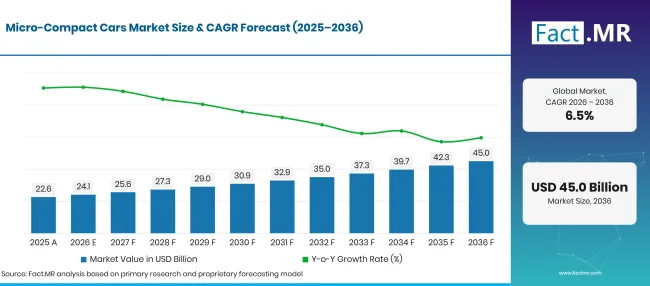
Micro Compact Cars Market Forecast Global | Source: Fact.MR
What are the defining numbers behind Micro-Compact Cars Market growth?
USD 20.9 billion in additional market value by 2036, with electric models and personal use shaping the mix.
- Demand Drivers in the Market
- Urban drivers need vehicles that fit narrow parking bays and handle repeated short trips. A small footprint suits limited parking, while easy access shapes the purchase. Automakers must balance external dimensions against practical seating and luggage space.
- Electric propulsion offers an alternative to gasoline for daily city travel. The International Energy Agency reported in 2026 that global electric-car sales exceeded 20 million units in 2025.
- Households often choose a micro-compact car as a second vehicle for errands or commuting. The value of this purchase depends on how often the car is used and the cost of owning another vehicle.
- Fleet operators assess compact cars against the real needs of their routes. Short local journeys can suit a smaller vehicle, particularly where parking time and vehicle access affect daily work.
- Key Segments Analyzed
- By Propulsion Type: Electric is projected to account for 42.3% of 2026 market value, supported by interest in small vehicles for repeatable urban journeys.
- By Application: Personal use is projected to represent 68.4% in 2026 because household mobility creates more varied daily trips than a single fleet route.
- By End-User: Individual customers are expected to represent 59.3% of 2026 value as parking convenience and recurring ownership expenses influence purchases.
- By Distribution Channel: Offline sales are forecast to account for 71.2% in 2026 since purchasers often want a test drive and local aftersales contact.
- Analyst Opinion at Fact.MR
- Shambhu Nath Jha, Principal Consultant at Fact.MR, states, “Micro-compact cars succeed when small exterior dimensions still provide practical seating, luggage access and manageable ownership costs. Buyers compare propulsion type, daily range, parking convenience and local service support before choosing a model. Manufacturers that match vehicle size and powertrain to real urban travel patterns are better positioned to attract repeat demand.”
- Strategic Implications
- Vehicle makers can design electric variants around actual travel patterns while keeping battery size and vehicle weight appropriate for short urban journeys.
- Retailers benefit from using test drives to demonstrate passenger access, parking ease and luggage practicality rather than focusing only on compact exterior dimensions.
- Fleet managers need to compare route length, daily mileage and service requirements before selecting micro-compact cars for commercial use.
- Component manufacturers can focus on compact powertrains and thermal systems that fit limited packaging space without compromising reliability or service access.
Japan is forecast to achieve a 7.5% CAGR through 2036 as kei-car experience supports small-vehicle design. Brazil follows at 6.9% amid price-conscious urban transport demand. The USA is forecast at 6.5% from a smaller small-car base. The UK follows at 5.9% as city-car buyers compare electric and hybrid alternatives. Germany is projected at 5.1% against a wider choice of conventional passenger cars.
How does the Micro-Compact Cars Market break down by segment?
Electric holds 42.3%; Personal accounts for 68.4%; Individual represents 59.3%; Offline captures 71.2% in 2026.
Which Propulsion Type dominates?
Electric represents 42.3% of 2026 market value.
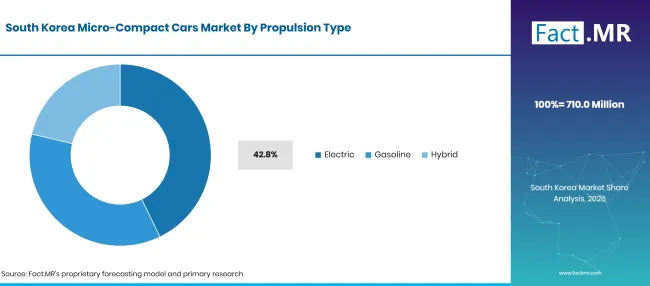
Factmr Micro Compact Cars Market South Korea By Propulsion Type | Source: Fact.MR
| Propulsion Type | Share (2026) |
|---|---|
| Electric (Leading segment) | 42.3% |
| Other segments combined | 57.7% |
| Total | 100.0% |
Source: Fact.MR analysis. Updated Nov 11, 2026
Electric micro-compact cars are suited to owners who complete predictable daily journeys and have convenient charging access. Battery packaging must protect the useful cabin space. Gasoline versions remain relevant where drivers rely on long-distance flexibility or have limited charging options. Hybrid models serve a middle position by reducing fuel use without requiring a charging routine.
How does Application shape demand?
Personal application captures 68.4% of 2026 value.
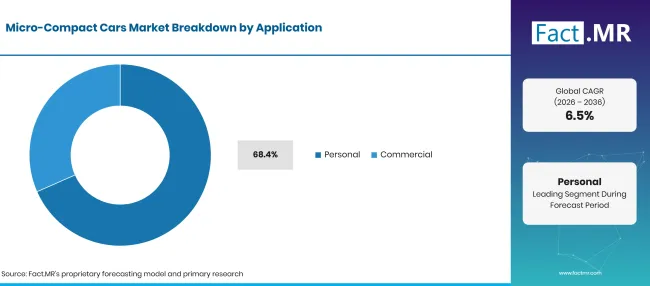
Micro Compact Cars Market Breakdown Application | Source: Fact.MR
| Application | Share (2026) |
|---|---|
| Personal (Leading segment) | 68.4% |
| Other segments combined | 31.6% |
| Total | 100.0% |
Source: Fact.MR analysis. Updated Nov 11, 2026
Personal buyers use micro-compact cars for commuting and local trips that do not require a large vehicle. Easy parking can save time in crowded districts, while low running expenses make ownership more manageable. Commercial applications include short-distance service trips and local fleet duties, but operators measure whether smaller cars can carry the necessary equipment. Commercial operators value dependable maintenance. Application differences also affect propulsion choices.
Who makes up the End-User segment?
Individual buyers account for 59.3% in 2026.
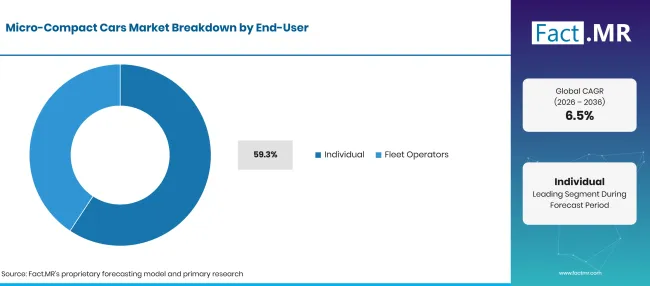
Micro Compact Cars Market Breakdown End User | Source: Fact.MR
| End-User | Share (2026) |
|---|---|
| Individual (Leading segment) | 59.3% |
| Other segments combined | 40.7% |
| Total | 100.0% |
Source: Fact.MR analysis. Updated Nov 11, 2026
Individual owners buy small cars to fit household budgets and daily movement patterns. They compare payments and energy costs alongside parking access. Fleet operators consider different questions. A smaller body can simplify parking for local staff, but downtime and service coverage affect the cost of keeping a car on the road. Japanese mini-car makers focus on easy access.
What leads the Distribution Channel segment?
Offline sales lead with 71.2% in 2026.
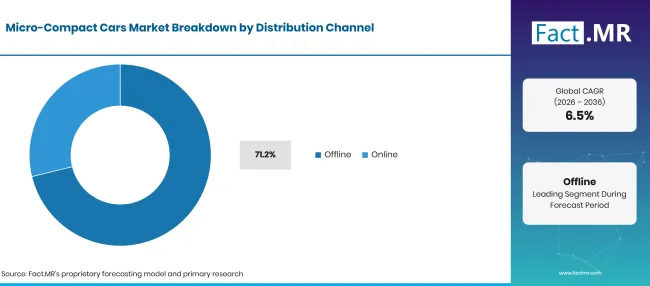
Micro Compact Cars Market Breakdown Distribution Channel | Source: Fact.MR
| Distribution Channel | Share (2026) |
|---|---|
| Offline (Leading segment) | 71.2% |
| Other segments combined | 28.8% |
| Total | 100.0% |
Source: Fact.MR analysis. Updated Nov 11, 2026
Offline dealerships remain important because shoppers can judge whether a small car offers enough headroom, luggage access and seating comfort for everyday use. A test drive also helps them assess visibility and maneuverability in narrow streets, which are difficult to evaluate from a specification sheet alone. Customers may compare prices and models online first, then visit a dealer to confirm the vehicle fits their needs and to discuss service and warranty support.
What is accelerating Micro-Compact Cars Market adoption, and what is holding it back?
Parking convenience and lower running costs support sales; price pressure and limited model availability can restrain purchases.
Drivers Impact Analysis
| Driver | (~) % Impact on CAGR | Geographic Relevance | Impact Timeline |
|---|---|---|---|
| Urban parking needs | +1.2% | Major cities worldwide | Short term |
| Electric city-car availability | +1.0% | Europe, Japan | Medium term |
| Household operating-cost focus | +0.8% | Global | Short term |
| Compact fleet use | +0.5% | Urban commercial centres | Medium term |
| Small-car design improvements | +0.4% | Japan, Europe | Long term |
Source: Fact.MR analysis. Updated Nov 11, 2026
Opportunity Impact Analysis
| Opportunity | (~) % Impact on CAGR | Geographic Relevance | Impact Timeline |
|---|---|---|---|
| Entry-level hybrids | +0.7% | Europe | Medium term |
| Mini electric cars | +0.6% | Japan, Europe | Medium term |
| Local fleet supply | +0.4% | Urban markets | Short term |
| Digital comparison tools | +0.2% | Global | Medium term |
Source: Fact.MR analysis. Updated Nov 11, 2026
Restraints Impact Analysis
| Restraint | (~) % Impact on CAGR | Geographic Relevance | Impact Timeline |
|---|---|---|---|
| Higher upfront EV cost | -0.8% | Price-sensitive markets | Short term |
| Limited parking or charging access | -0.6% | Dense residential areas | Medium term |
| Competition from larger used cars | -0.5% | Global | Short term |
| Thin model availability | -0.4% | Selected national markets | Long term |
Source: Fact.MR analysis. Updated Nov 11, 2026
Which countries are scaling the Micro-Compact Cars Market through 2036?
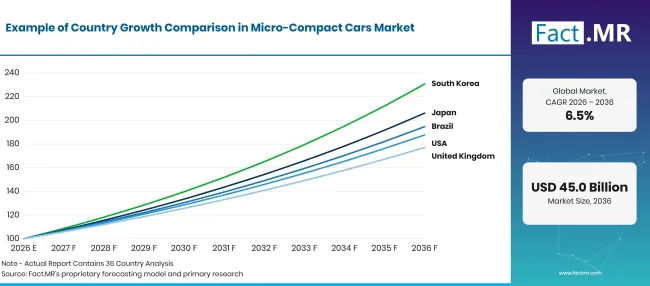
Micro Compact Cars Market Growth Index | Source: Fact.MR
| Country | CAGR (2026 to 2036) |
|---|---|
| Japan | 7.5% |
| Brazil | 6.9% |
| USA | 6.5% |
| UK | 5.9% |
| Germany | 5.1% |
Source: Fact.MR analysis. Updated Nov 11, 2026
What supports Japan’s micro-compact car market?
7.5% CAGR, linked to everyday use of kei vehicles.
Japan’s kei-car format gives automakers a clear size category and offers families a familiar choice for local travel. Honda began selling the N-ONE e: in September 2025, adding electric propulsion to its small-car range. The product places daily driving range and usable passenger space at the center of the purchase decision.
How is Brazil developing micro-compact car demand?
6.9% CAGR, with fuel spending and city driving shaping purchases.
Brazilian households comparing small passenger cars tend to weigh vehicle price against the cost of regular city travel. In January 2026, the national metrology institute Inmetro said its PBE Veicular efficiency table covered more than 760 models. A micro-compact model is more convincing when a dealership explains the cost of everyday driving alongside its parking benefits.
What shapes the USA micro-compact car market?
6.5% CAGR, reflecting selective demand for urban-sized vehicles.
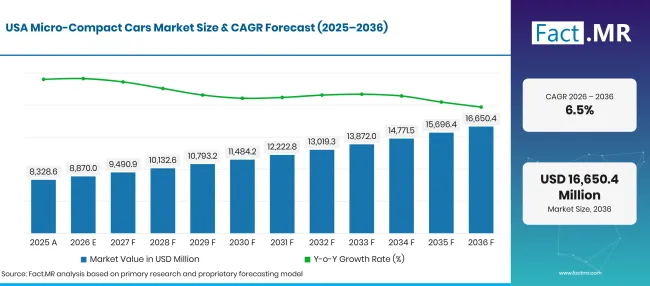
Micro Compact Cars Market Forecast Usa | Source: Fact.MR
American small-car customers compare easy parking with the interior room offered by larger passenger vehicles. The U.S. Environmental Protection Agency reported in its 2026 Automotive Trends publication that model-year 2024 new vehicles averaged 27.2 miles per gallon in real-world fuel economy. Micro-compact models have a clearer role for short urban journeys and households that value a smaller exterior footprint.
How is the UK micro-compact car market changing?
5.9% CAGR, linked to urban travel and propulsion choice.
UK city-car demand reflects how people balance parking convenience with the cost of running a new vehicle. The UK Department for Transport reported 528,000 first registrations of zero-emission vehicles in 2025, including approximately 473,000 zero-emission cars. Toyota began production of the Aygo X Hybrid in November 2025, giving European shoppers another way to compare fuel use without a charging routine.
What influences Germany’s micro-compact car market?
5.1% CAGR, with small-car value tested against other passenger vehicles.
Germany offers city-car customers a wide range of passenger vehicles and a growing choice of electrified powertrains. The European Automobile Manufacturers’ Association reported in January 2026 that German battery-electric registrations rose by 43.2% during 2025. Micro-compact cars need to offer simple parking and practical daily seating at a price that households can justify.
Who leads the Micro-Compact Cars Market?
Competition in micro-compact cars varies by national vehicle category and the needs of local drivers. Japan’s kei cars have their own size rules, while European city cars are designed for a different market.
Manufacturers compete on the usefulness of a compact cabin and the cost of everyday ownership. Toyota, Honda, Suzuki, Nissan and Daihatsu offer different small-car designs. Their sales prospects depend on whether a small vehicle meets the expectations of drivers in each market.
Daihatsu has concentrated on easy access and usable interior space in its small passenger vehicles. The company launched a redesigned Move with sliding doors in June 2025. In July 2025, it reported approximately 30,000 orders during the model’s first month. The orders reflect early interest in the redesigned model. Features that simplify daily entry and loading can help a small car stand apart. Customers also consider the showroom price and the ease of finding local maintenance support.
Which companies are the key providers?
The companies profiled in the micro-compact cars market are Toyota Motor Corporation, Honda Motor Co., Ltd., Suzuki Motor Corporation, Nissan Motor Co., Ltd., and Daihatsu Motor Co., Ltd.
- Toyota Motor Corporation
- Honda Motor Co., Ltd.
- Suzuki Motor Corporation
- Nissan Motor Co., Ltd.
- Daihatsu Motor Co., Ltd.
Bibliography
- Daihatsu Motor Co., Ltd. (2025, June 5). Daihatsu fully remodeled Move, which has met customer needs for 30 years.
- Daihatsu Motor Co., Ltd. (2025, July 8). New “Move” receives approximately 30,000 orders in the first month after launch.
- Department for Transport. (2026, April 29). Vehicle licensing statistics, United Kingdom: 2025. GOV.UK.
- Eurostat. (2026, July 31). New battery-only electric cars up 30% in 2025.
- Honda Motor Co., Ltd. (2025, September 11). Honda begins sales of all-new N-ONE e: mini-EV.
- Instituto Nacional de Metrologia, Qualidade e Tecnologia. (2026, January 20). Tabela PBE Veicular 2026 reúne mais de 760 modelos e mostra avanço na eficiência energética.
- International Energy Agency. (2026, May 20). Global EV Outlook 2026: Trends in electric cars.
- Toyota Motor Europe. (2025, November 13). Toyota Motor Europe starts production of Toyota’s new Aygo X Hybrid.
- U.S. Environmental Protection Agency. (2026, February 19). Highlights of the Automotive Trends Report.
This Report Answers
- The report reviews how electric, gasoline and hybrid powertrains fit compact passenger-car designs and customer travel routines.
- Application analysis separates private household trips from commercial journeys where vehicle size must suit the work.
- End-user analysis examines the different purchase needs of individual motorists and fleet operators.
- Distribution analysis compares local dealership support with online vehicle comparison and ordering.
- Country analysis assesses Japan, Brazil, the USA, the UK and Germany against their distinct passenger-car conditions.
What does the Micro-Compact Cars Market cover?
The market covers electric, gasoline and hybrid small cars for individuals and fleets. Japanese kei vehicles and European city cars follow different size classifications. These formats provide distinct examples for the global analysis.
What is included in the scope?
Sales of new micro-compact passenger vehicles are included across personal and commercial applications.
The product scope covers gasoline, electric and hybrid propulsion. Offline dealer channels and online vehicle-ordering routes are considered where they lead to a new car sale.
What is excluded from the scope?
Motorcycles, mopeds and three-wheelers fall outside the market boundary.
Vehicles built primarily as commercial vans are excluded even when they use compact platforms. Larger passenger SUVs and conventional midsize cars are also outside the definition.
How Was the Analysis Built?
The analysis draws on 120+ sources, 35+ company portfolios, 25+ countries, and more than 20 industry interviews.
- Primary Research: Primary research includes discussions with manufacturers, service providers, technology developers, distributors, end users, and subject-matter experts. These conversations examine purchasing priorities, product adoption, operational challenges, approval requirements, competitive positioning, and the factors that influence wider market acceptance.
- Desk Research: Desk research covers government statistics, regulatory publications, company filings, trade data, technical studies, industry associations, standards, public policy, and other authoritative sources. Every source used in the analysis is documented in the bibliography.
- Market Sizing and Forecasting: Market estimates combine historical performance, demand indicators, pricing and volume trends, segment shares, company participation, country-level growth, adoption patterns, investment activity, and barriers to market expansion.
- Data Validation and Update Cycle: Findings are validated by comparing primary interviews with public data, company activity, regulatory changes, trade patterns, and industry developments. Regular updates review new product launches, capacity changes, partnerships, approvals, and shifts in commercial adoption.
Segmentation
What is the report’s scope and coverage?
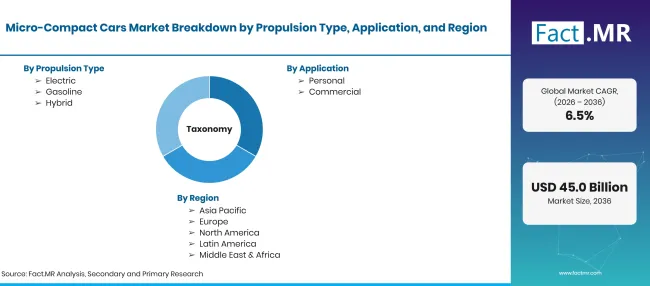
Micro Compact Cars Market Taxonomy | Source: Fact.MR
| Attribute | Details |
|---|---|
| Quantitative Units | USD billion |
| Market Definition | Small passenger cars intended mainly for short-distance personal use or selected commercial travel, including relevant Japanese kei and European city-car formats. |
| Propulsion Type | Electric; Gasoline; Hybrid |
| Application | Personal; Commercial |
| End-User | Individual; Fleet Operators |
| Distribution Channel | Offline; Online |
| Regions Covered | North America; Latin America; Western Europe; Eastern Europe; East Asia; South Asia & Pacific; Middle East & Africa |
| Countries Covered | Japan; Brazil; USA; UK; Germany |
| Companies Profiled | Toyota Motor Corporation, Honda Motor Co., Ltd., Suzuki Motor Corporation, Nissan Motor Co., Ltd., and Daihatsu Motor Co., Ltd. |
| Forecast Period | 2026 to 2036 |
| Approach | Forecast based on the defined segments and official vehicle and company evidence. Impact-table percentages represent indicative scenario estimates. |
Source: Fact.MR analysis. Updated Nov 11, 2026
How is the market segmented?
-
By Propulsion Type
- Electric
- Gasoline
- Hybrid
-
By Application
- Personal
- Commercial
-
By End-User
- Individual
- Fleet Operators
-
By Distribution Channel
- Offline
- Online
-
By Region
- North America
- Latin America
- Western Europe
- Eastern Europe
- East Asia
- South Asia & Pacific
- Middle East & Africa
Frequently Asked Questions
How big is the micro-compact cars market in 2026?
What is the CAGR of the micro-compact cars market from 2026 to 2036?
Which propulsion type leads the micro-compact cars market?
Which application leads the micro-compact cars market?
Which end-user group leads the micro-compact cars market?
Which distribution channel leads the micro-compact cars market?
Which country has the highest listed micro-compact cars CAGR?
Toyota, Honda, Suzuki, Nissan and Daihatsu are profiled for their relevant small passenger-car activity.
Who worked on this report


Preview the report firsthand - request a free sample
Free SampleGet the brochure for pricing and purchase details
Download PDF