- Base Value(2025): 210 Mn
- Estimated Value(2026): 235 Mn
- Forecast Value (2036): 720 Mn
- CAGR (2026 - 2036): 11.9%
Microbiome-Stable Fruit Fillings Market Size, Share and Forecast and Outlook By FACT.MR
In 2025, the microbiome-stable fruit fillings market was valued at USD 210 million. Fact MR analysis indicates demand for microbiome-stable fruit fillings is expected to reach USD 235 million in 2026 and USD 720 million by 2036. FMR estimates the market will expand at a CAGR of 11.9% across the forecast period.
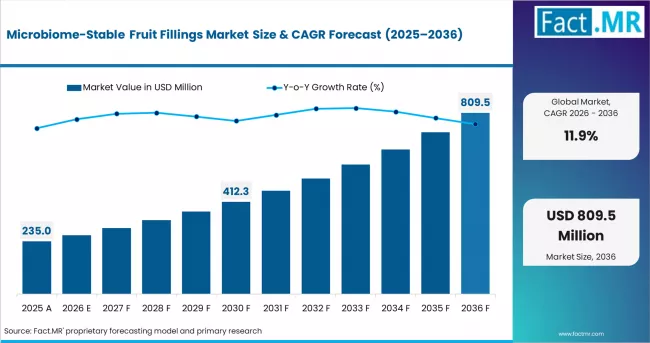
Microbiome Stable Fruit Fillings Market Market Value Analysis | Source: Fact.MR
Microbiome-Stable Fruit Fillings Market
| Metric | Details |
|---|---|
| Industry Size (2026E) | USD 235 million |
| Industry Value (2036F) | USD 720 million |
| CAGR (2026 to 2036) | 11.9% |
Source: Fact.MR analysis. Updated Apr 24, 2026
Summary of Microbiome-Stable Fruit Fillings Market
- Market Definition
- The microbiome-stable fruit fillings market comprises fruit-based ingredient systems formulated to maintain compatibility with beneficial microbiota while preserving texture stability, shelf life performance, and sensory attributes in processed foods. These fillings integrate controlled water activity, fiber enrichment, and fermentation-compatible stabilization methods enabling use in functional bakery, probiotic dairy, snack, and clinical nutrition applications.
- Demand Drivers
- Increasing demand for functional food ingredients supporting digestive health positioning across bakery, dairy, and snack product categories.
- Expansion of reduced-sugar formulation technologies requiring alternative preservation systems compatible with microbiome stability requirements.
- Rising incorporation of prebiotic fibers and fermentation-derived stabilizers in fruit preparations supporting gut health product development.
- Growth in probiotic dairy and functional snack categories requiring ingredient systems maintaining microbial compatibility during storage.
- Increasing R&D investment in bio-preservation technologies replacing synthetic preservatives in fruit-based fillings.
- Expansion of clinical nutrition and meal replacement product development incorporating microbiome-support ingredient positioning.
- Key Segments Analyzed
- Fruit Type: Berry fillings lead with 34% share due to formulation compatibility with fiber enrichment and controlled acidity systems supporting microbiome stability.
- Application: Functional bakery dominates with 33% share reflecting incorporation of microbiome-compatible fillings in breads, snack bars, and fortified baked goods.
- Processing Technology: Reduced water activity systems and fermentation stabilization technologies represent key technical approaches supporting microbial balance.
- Geography: China and India demonstrate strongest growth supported by expansion of functional food manufacturing, while the United States, Germany, and the United Kingdom reflect scaling adoption across established digestive health product categories.
- Analyst Opinion at Fact MR
- Shambhu Nath Jha, Principal Consultant, Fact MR, opines, 'In this updated edition of the Microbiome-Stable Fruit Fillings Market report, industry participants observe emergence of a specialized formulation segment positioned between functional fruit preparations and microbiome-support ingredient systems. Market participants are aligning processing technologies with stability validation requirements supporting compatibility with probiotic and prebiotic components across diverse food matrices. Demand expansion reflects increasing integration of controlled fermentation and fiber-enriched fruit bases capable of supporting digestive health positioning without compromising texture stability or shelf performance. Competitive positioning is influenced by formulation reproducibility, regulatory compliance capability, and compatibility with industrial food processing systems through 2036.'
- Strategic Implications/Executive Takeaways
- Invest in formulation technologies supporting controlled water activity and pH balance required for microbiome-compatible fruit preparations.
- Strengthen development of fiber-enriched fruit matrices supporting prebiotic functionality across functional food product applications.
- Expand collaboration with probiotic dairy and functional bakery manufacturers integrating digestive health ingredient positioning.
- Improve validation protocols ensuring microbial compatibility and shelf stability across diverse storage conditions.
- Develop reduced-sugar fruit filling systems aligned with clean-label formulation requirements.
- Enhance encapsulation and stabilization technologies supporting protection of bioactive components during processing and storage.
- Methodology
- Built on primary interviews with functional ingredient developers, fruit processing companies, dairy formulation specialists, and food technology researchers.
- Benchmarked against functional food demand trends, microbiome research developments, and adoption of prebiotic-compatible ingredient systems.
- Applied hybrid market sizing approach combining supplier revenue analysis with top down evaluation of functional ingredient consumption across processed foods.
- Validated through triangulation using scientific literature, patent filings, supplier product documentation, and expert consultation.
- Periodically updated to reflect advancements in fermentation stabilization technologies, clean-label formulation developments, and microbiome-focused ingredient innovation.
A CAGR of 11.9%, with market value increasing from USD 235 million to USD 720 million, indicates a high growth contribution index driven by functional food reformulation aligned with gut health positioning and reduced sugar preservation systems. Expansion is supported by demand for microbiome-compatible ingredients in dairy alternatives and nutritional snacks, while structural constraints include stability validation costs, regulatory scrutiny around health claims, and formulation complexity affecting large-scale manufacturing consistency.
China records the fastest growth at 13.2%, supported by increased incorporation of functional fruit preparations in digestive health-oriented food products. India follows at 12.9%, driven by rising demand for prebiotic-compatible fillings used in dairy alternatives and fortified snacks. The United Kingdom shows 12.6% growth, linked to formulation of gut-friendly bakery and yogurt inclusions. Germany at 12.3% and the United States at 11.9% represent mature markets where demand is largely replacement-driven due to established functional ingredient portfolios in packaged foods. A structural constraint across mature markets is regulatory scrutiny around health claims, which limits rapid commercialization of new microbiome-positioned formulations.
Segmental Analysis
Microbiome-Stable Fruit Fillings Market Analysis by Fruit Type
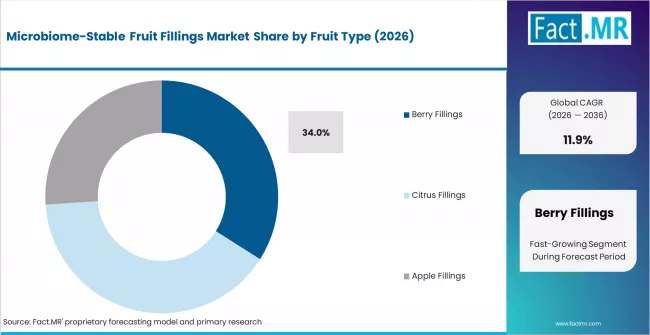
Microbiome Stable Fruit Fillings Market Analysis By Fruit Type | Source: Fact.MR
- Market Overview: Berry fillings are projected to hold 34% share of the microbiome-stable fruit fillings market in 2026. Demand concentration reflects compatibility of berry matrices with controlled sugar reduction and fiber enrichment strategies designed to support microbiome stability without compromising texture integrity or product shelf performance. Processing characteristics of berries enable stable dispersion of prebiotic components across standardized filling formulations.
- Demand Drivers:
- Prebiotic Compatibility: Berry compositions support incorporation of resistant starches and soluble fibers used to maintain microbiome-supportive formulation profiles in processed fruit fillings.
- Processing Stability: Berry-derived fillings demonstrate stable viscosity and color retention under thermal processing conditions used in industrial baking and dessert manufacturing environments.
- Formulation Flexibility: Manufacturers utilize berry matrices to balance acidity, sweetness, and fiber inclusion targets required for functional ingredient positioning across health-oriented food product categories.
Microbiome-Stable Fruit Fillings Market Analysis by Application
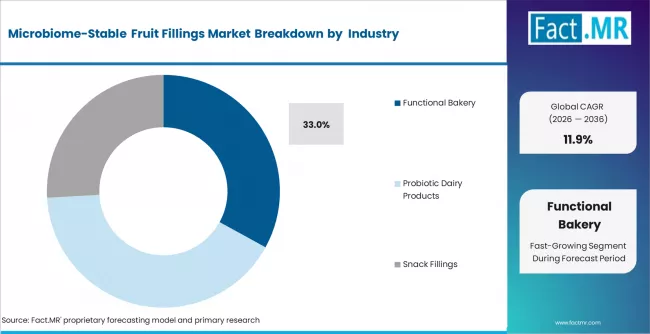
Microbiome Stable Fruit Fillings Market Analysis By Application | Source: Fact.MR
- Market Overview: Functional bakery applications are estimated to account for 33% share in 2026, supported by increasing use of microbiome-supportive fruit fillings in breads, pastries, snack bars, and fortified baked goods designed to incorporate digestive health-oriented ingredients. Product formulation strategies prioritize ingredient stability under baking temperature exposure and controlled moisture migration characteristics.
- Demand Drivers:
- Functional Ingredient Integration: Bakery manufacturers incorporate microbiome-supportive fruit fillings containing prebiotic fibers to support digestive health positioning in packaged baked products.
- Thermal Stability Requirements: Filling formulations are designed to maintain structural consistency and active ingredient stability across high-temperature baking environments.
- Product Differentiation Strategies: Food producers utilize microbiome-stable fillings to develop functional bakery products aligned with consumer demand for digestive wellness-oriented packaged foods.
Key Dynamics
Microbiome-Stable Fruit Fillings Market Drivers, Restraints, and Opportunities
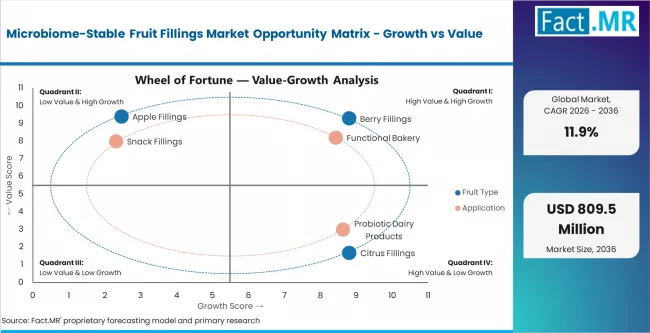
Microbiome Stable Fruit Fillings Market Opportunity Matrix Growth Vs Value | Source: Fact.MR
Fact MR analysis indicates the market reflects an emerging formulation niche positioned between functional food ingredients and advanced fruit preparation technologies. Market size exists because conventional fruit fillings rely on preservatives, thermal processing, and sugar concentration to control microbial growth, while microbiome-stable systems attempt to maintain beneficial microbial balance or compatibility with gut microbiota. The current valuation reflects structural demand from clean-label bakery, dairy, and snack manufacturers seeking fruit inclusions that align with digestive health positioning and reduced synthetic preservative use. Fruit fillings typically combine purees, stabilizers, and texture agents to maintain consistency during storage and processing, creating a baseline technical framework for microbiome-compatible reformulation.
Current dynamics show declining reliance on high-sugar preservation systems as food producers shift toward controlled fermentation, protective cultures, and low-thermal processing techniques that maintain microbial integrity. Microbiome-compatible formulations command higher per-unit pricing due to controlled processing environments, encapsulation technologies, and stability testing requirements, while total volume expansion remains gradual as manufacturers validate shelf stability and regulatory compliance. Beneficial microbial systems can inhibit spoilage organisms and extend product shelf life, supporting transition toward biologically stabilized fruit preparations.
- Clean Label Reformulation: EFSA novel food guidance and global clean-label policies encourage replacement of synthetic preservatives with microbial stabilization systems compatible with gut microbiome positioning.
- Functional Nutrition Demand: North America and Western Europe functional food manufacturers integrate microbiome-positioned fruit preparations into yogurt, snack bars, and digestive health products.
- Bio-Preservation Shift: Protective cultures and fermentation-derived stabilizers replace high-sugar osmotic preservation, increasing formulation costs while improving nutritional positioning and label transparency.
Regional Analysis
The microbiome-stable fruit fillings market is assessed across Asia Pacific, Europe, and North America, segmented by country-level demand for gut-friendly bakery inclusions, reduced-sugar fruit preparations, prebiotic-compatible fillings, and shelf-stable functional ingredients. Geographic variation reflects functional food adoption, digestive health positioning, and reformulation of processed fruit ingredients. The full report offers market attractiveness analysis.
.webp "Top Country Growth Comparison Microbiome Stable Fruit Fillings Market Cagr (2026 2036)")
Top Country Growth Comparison Microbiome Stable Fruit Fillings Market Cagr (2026 2036) | Source: Fact.MR
CAGR Table
| Country | CAGR (2026–2036) |
|---|---|
| China | 13.2% |
| India | 12.9% |
| United Kingdom | 12.6% |
| Germany | 12.3% |
| United States | 11.9% |
Source: Fact.MR analysis. Updated Apr 24, 2026
Source: Fact MR analysis, based on proprietary forecasting model and primary research
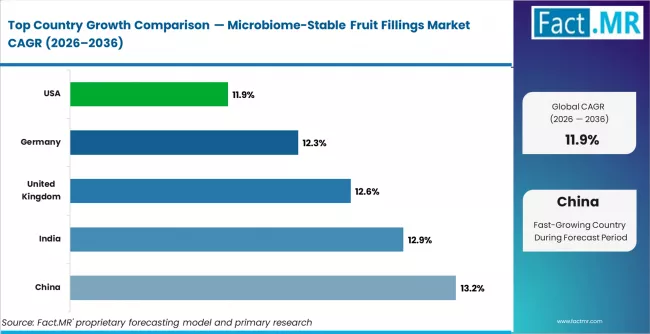
Microbiome Stable Fruit Fillings Market Cagr Analysis By Country | Source: Fact.MR
Asia Pacific
Asia Pacific functions as the functional fruit ingredient innovation hub supported by increasing demand for digestive health products and reformulated bakery fillings with microbiome compatibility. Döhler GmbH strengthens functional fruit preparation development capability. Ingredion Incorporated expands prebiotic ingredient formulation expertise. Tate & Lyle supports fiber-based stabilization technology innovation.
- China: China is projected to record 13.2% CAGR in microbiome-stable fruit fillings through 2036. National Nutrition Plan revision (National Health Commission, January 2023) supports gut health ingredient innovation. Döhler GmbH expanded functional fruit ingredient application development (June 2023).
- India: India is expected to observe 12.9% CAGR in microbiome-stable fruit fillings through 2036. Eat Right India initiative expansion (FSSAI, April 2023) encourages functional ingredient reformulation in processed foods. Ingredion Incorporated strengthened prebiotic ingredient development capability (May 2023).
Europe
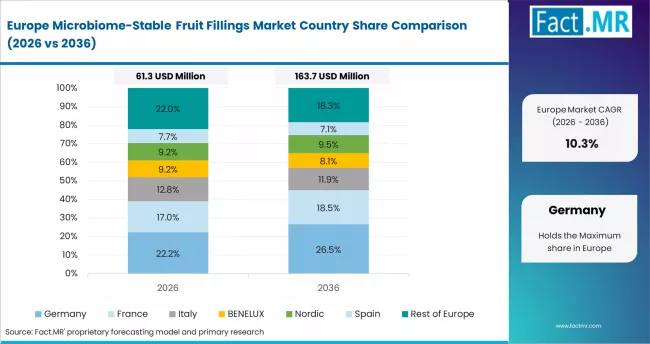
Microbiome Stable Fruit Fillings Market Europe Country Market Share Analysis, 2026 & 2036 | Source: Fact.MR
Europe operates as the regulatory and formulation laboratory for functional fruit ingredients supported by structured food labeling standards and demand for digestive health positioned products. Döhler GmbH strengthens fruit preparation innovation expertise. Tate & Lyle expands fiber-based ingredient portfolio capability. Agrana Beteiligungs AG supports fruit ingredient processing specialization.
- United Kingdom: The United Kingdom is anticipated to expand at 12.6% CAGR in microbiome-stable fruit fillings through 2036. UK National Food Strategy update (Department for Environment, Food and Rural Affairs, February 2023) supports reformulated functional ingredient adoption. Tate & Lyle expanded fiber-based ingredient application capability (July 2023).
- Germany: Germany is forecast to grow at 12.3% CAGR in microbiome-stable fruit fillings through 2036. Federal nutrition strategy update (Federal Ministry of Food and Agriculture, March 2023) supports digestive health product development. Döhler GmbH expanded fruit preparation innovation infrastructure (April 2023).
North America
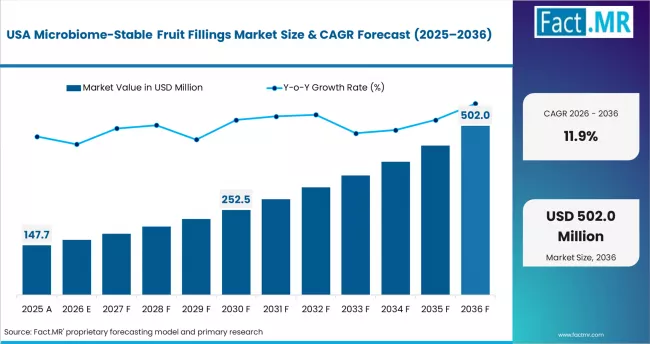
Microbiome Stable Fruit Fillings Market Country Value Analysis | Source: Fact.MR
North America functions as the commercial functional food formulation center supported by strong adoption of digestive health positioned ingredients and reformulated reduced-sugar fruit fillings. Ingredion Incorporated strengthens prebiotic stabilization technology expertise. Tate & Lyle expands soluble fiber ingredient portfolio depth. Sensient Technologies supports functional ingredient application development.
- United States: The United States is projected to register 11.9% CAGR in microbiome-stable fruit fillings through 2036. FDA guidance update on dietary fiber labeling (June 2023) supports digestive health ingredient positioning. Ingredion Incorporated expanded functional ingredient formulation program (August 2023).
Fact MR's analysis of microbiome-stable fruit fillings market in global regions consists of country-wise assessment that includes China, India, United Kingdom, Germany, and United States. Readers can find functional ingredient reformulation trends, digestive health product developments, regulatory positioning frameworks, and competitive ingredient innovation indicators.
Competitive Landscape
What is the Competitive Structure of the Microbiome-Stable Fruit Fillings Market?
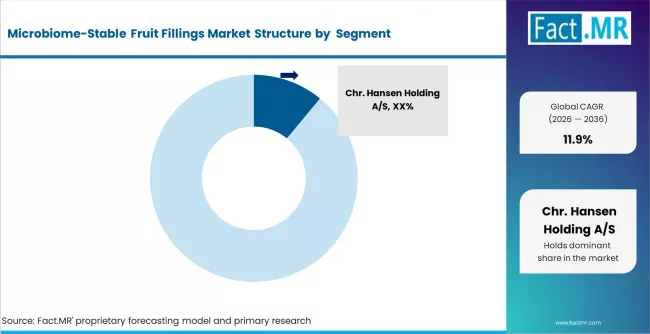
Microbiome Stable Fruit Fillings Market Analysis By Company | Source: Fact.MR
The Microbiome-Stable Fruit Fillings Market demonstrates a moderately concentrated competitive structure, supported by participation from global ingredient companies specializing in food cultures, hydrocolloids, and functional formulation systems. Key companies including Chr. Hansen Holding A/S, DSM Firmenich AG, IFF Nutrition and Biosciences, Kerry Group plc, Cargill Incorporated, Tate and Lyle plc, Symrise AG, and Givaudan SA collectively account for approximately 60–70% of total market share, particularly in stabilized fruit preparations designed to support probiotic compatibility and controlled microbial activity. Competitive differentiation is primarily determined by stability of bioactive compounds, pH tolerance performance, sugar reduction compatibility, and shelf-life consistency under varying storage conditions. Technical expertise in stabilizer systems and microbial interaction control creates moderate entry barriers, limiting rapid expansion of smaller ingredient suppliers.
Structural advantages are observed among companies possessing integrated portfolios of cultures, texturizers, and formulation technologies enabling controlled microbial stability in fruit-based applications. Chr. Hansen Holding A/S and DSM Firmenich AG benefit from established capabilities in probiotic stabilization and fermentation-compatible ingredient development. Buyers including dairy processors and functional food manufacturers typically manage supplier dependency through multi-supplier validation of texture stability and microbiome compatibility across different product matrices. Procurement decisions often consider formulation adaptability, regulatory compliance, and consistency of microbial viability during storage. Pricing power remains relatively balanced, though suppliers retain moderate leverage where proprietary stabilization systems and validated formulation performance create switching constraints for manufacturers producing microbiome-supportive food products.
Key Players of the Microbiome-Stable Fruit Fillings Market
- Chr. Hansen Holding A/S
- DSM Firmenich AG
- IFF Nutrition and Biosciences
- Kerry Group plc
- CP Kelco U.S. Inc.
- DuPont Nutrition and Biosciences
- Givaudan SA
- Cargill Incorporated
- Symrise AG
- Tate and Lyle plc
Bibliographies
- [1] National Health Commission (China). (2023, January). National Nutrition Plan revision.
- [2] Food Safety and Standards Authority of India. (2023, April). Eat Right India initiative expansion.
- [3] Department for Environment, Food and Rural Affairs (United Kingdom). (2023, February). UK National Food Strategy update.
- [4] Federal Ministry of Food and Agriculture (Germany). (2023, March). Federal nutrition strategy update.
- [5] U.S. Food and Drug Administration. (2023, June). FDA guidance update on dietary fiber labeling.
- [6] Döhler GmbH. (2023, June). Functional fruit ingredient application development expansion.
- [7] Ingredion Incorporated. (2023, May). Prebiotic ingredient development capability strengthening.
- [8] Tate & Lyle. (2023, July). Fiber-based ingredient application capability expansion.
- [9] Agrana Beteiligungs AG. (2023, April). Fruit preparation innovation infrastructure expansion.
- [10] Sensient Technologies. (2023, August). Functional ingredient formulation program expansion.
This Report Addresses
- Market size estimation and revenue forecasts from 2026 to 2036, supported by validated functional ingredient capacity benchmarks and adoption trends across microbiome-compatible food formulation systems.
- Growth opportunity mapping across berry, citrus, apple, tropical, and mixed fruit matrices aligned with prebiotic-compatible formulation requirements and reduced sugar preservation systems.
- Segment and regional revenue forecasts covering aseptic processing, fermentation stabilization, reduced water activity systems, and thermal pasteurization technologies across functional bakery, probiotic dairy, clinical nutrition, and snack filling applications.
- Competition strategy assessment including benchmarking of bio-preservation technologies, microbial stability performance capability, and formulation consistency across functional fruit preparation systems.
- Regulatory impact analysis covering digestive health positioning frameworks, clean-label ingredient standards, and permissible health claim structures influencing microbiome-compatible formulation adoption.
- Market report delivery in PDF, Excel, PPT, and structured data formats designed for functional food formulators, ingredient R&D teams, and product innovation strategists.
- Supply chain vulnerability assessments identifying concentration risks in fruit puree processing infrastructure, encapsulated fiber ingredient production capacity, and fermentation-enabled stabilization technology networks.
Microbiome-Stable Fruit Fillings Market Definition
The microbiome-stable fruit fillings market refers to fruit-based processed fillings formulated to maintain microbial stability and support beneficial microbiota during storage and consumption. These fillings contain fruit preparations combined with stabilizers, fibers, or functional ingredients that help preserve texture, shelf life, and gut-health benefits in bakery, dairy, and confectionery products.
Microbiome-Stable Fruit Fillings Market Inclusions
The report covers global and regional market size assessment and forecast outlook across the defined period. It includes segmentation by formulation type such as probiotic-compatible fillings, prebiotic-enriched fruit bases, and reduced-sugar variants. Applications include bakery, yogurt, desserts, and functional foods. Pricing trends, ingredient sourcing structure, and trade flow patterns are evaluated.
Microbiome-Stable Fruit Fillings Market Exclusions
The scope excludes conventional fruit jams, preserves, and fillings that do not maintain microbiome stability. It does not include probiotic supplements, standalone dietary fibers, or finished packaged foods. The analysis focuses strictly on fruit-based functional fillings designed to maintain microbial balance, shelf stability, and formulation compatibility in processed foods.
Microbiome-Stable Fruit Fillings Market Research Methodology
- Primary Research: Interviews were conducted with functional ingredient manufacturers, fruit processing companies, dairy formulators, and R&D specialists working on microbiome-supportive food applications.
- Desk Research: Scientific journals, patent publications, ingredient supplier technical literature, and food science databases were reviewed to identify formulation technologies supporting microbial stability and shelf life extension.
- Market-Sizing and Forecasting: A hybrid estimation model combining bottom-up supplier revenue analysis and top-down evaluation of functional food demand was applied to determine market size and future growth trajectory.
- Data Validation and Update Cycle: Outputs were verified through triangulation of technical studies, supplier product data, and expert consultation. Periodic updates reflect developments in microbiome research, clean-label formulation requirements, and functional food adoption trends.
Segmentation
Report Scope
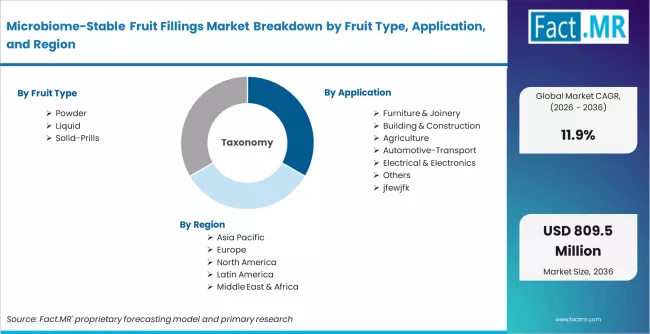
Microbiome Stable Fruit Fillings Market Breakdown By Fruit Type, Application, And Region | Source: Fact.MR
| Metric | Value |
|---|---|
| Quantitative Units | USD 235 million (2026) to USD 720 million (2036), at a CAGR of 11.9% |
| Market Definition | The microbiome-stable fruit fillings market includes fruit-based ingredient systems engineered to maintain compatibility with probiotic and microbiome-support formulations. These fillings are processed to ensure controlled water activity, pH balance, and microbial stability, enabling use in functional foods where live cultures or microbiome-support components must remain viable throughout shelf life and consumption. |
| Fruit Type Segmentation | Berry fillings, Citrus fillings, Apple fillings, Tropical fruit fillings, Mixed fruit fillings |
| Processing Technology Segmentation | Aseptic processing, Fermentation stabilization, Reduced water activity systems, Thermal pasteurization |
| Application Segmentation | Functional bakery, Probiotic dairy products, Clinical nutrition foods, Snack fillings, Meal replacement products |
| Regions Covered | North America, Latin America, Europe, East Asia, South Asia, Oceania, Middle East and Africa |
| Countries Covered | United States, Canada, Mexico, Brazil, Argentina, Germany, France, United Kingdom, Italy, Spain, China, India, Japan, South Korea, Indonesia, Australia, and 40+ countries |
| Key Companies Profiled | Chr. Hansen Holding A/S, DSM Firmenich AG, IFF Nutrition and Biosciences, Kerry Group plc, CP Kelco U.S. Inc., DuPont Nutrition and Biosciences, Givaudan SA, Cargill Incorporated, Symrise AG, Tate and Lyle plc |
| Forecast Period | 2026 to 2036 |
| Approach | Hybrid top-down and bottom-up market estimation validated through primary interviews with functional ingredient manufacturers, fruit preparation suppliers, probiotic formulation developers, and food technology specialists, supported by benchmarking of processing technologies, regulatory compliance evaluation, and assessment of adoption trends across microbiome-support food product development |
Source: Fact.MR analysis. Updated Apr 24, 2026
Microbiome Stable Fruit Fillings Market Key Segments
-
Fruit Type:
- Berry Fillings
- Citrus Fillings
- Apple Fillings
- Tropical Fruit Fillings
- Mixed Fruit Fillings
-
Processing Technology:
- Aseptic Processing
- Fermentation Stabilization
- Reduced Water Activity Systems
- Thermal Pasteurization
-
Application:
- Functional Bakery
- Probiotic Dairy Products
- Clinical Nutrition Foods
- Snack Fillings
- Meal Replacement Products
-
Region:
- North America
- USA
- Canada
- Mexico
- Europe
- Germany
- UK
- France
- Italy
- Spain
- Nordic Countries
- BENELUX
- Rest of Europe
- Asia Pacific
- China
- Japan
- South Korea
- India
- Australia
- Rest of Asia Pacific
- Latin America
- Brazil
- Argentina
- Rest of Latin America
- Middle East and Africa
- Kingdom of Saudi Arabia
- United Arab Emirates
- South Africa
- Rest of Middle East and Africa
- Other Regions
- Oceania
- Central Asia
- Other Markets
- North America
Frequently Asked Questions
How large is the demand for Microbiome Stable Fruit Fillings in the global market in 2026?
What will be the market size of Microbiome Stable Fruit Fillings in the global market by 2036?
What is the expected demand growth for Microbiome Stable Fruit Fillings in the global market between 2026 and 2036?
Which Fruit Type is poised to lead global demand by 2026?
What is Driving Microbiome Stable Fruit Filling Demand in China?
What is the China Growth Outlook in this Report?
What is Driving Microbiome Stable Fruit Filling Demand in India?
What is the India Growth Outlook in this Report?
What is Driving Microbiome Stable Fruit Filling Demand in the United Kingdom?
What is the United Kingdom Growth Outlook in this Report?
What is Driving Microbiome Stable Fruit Filling Demand in Germany?
What is the Germany Growth Outlook in this Report?
What is Driving Microbiome Stable Fruit Filling Demand in the United States?
What is the United States Growth Outlook in this Report?
Which Companies are Identified as Leading Participants in the Microbiome Stable Fruit Fillings Market?
What are Microbiome Stable Fruit Fillings and What are They Mainly Used For?
What does Microbiome Stable Fruit Fillings Market Mean in this Report?
What is Included in the Scope of this Microbiome Stable Fruit Fillings Market Report?
What is Excluded from the Scope of this Report?
What does Market Forecast Mean on this Page?
How is the Microbiome Stable Fruit Fillings Market Forecast Developed in this Report?
What does Data Validation Approach Mean in this Report?
Who worked on this report


Preview the report firsthand - request a free sample
Free SampleGet the brochure for pricing and purchase details
Download PDF