- Market Value (2025): USD 1.73 Bn
- Estimated Value (2026): USD 4.38 Bn
- Forecast Value (2036): USD 1.88 Bn
- CAGR (2026-2036): 8.8%
What is the Military GNSS Anti-Jamming and Anti-Spoof Solutions Market forecast to be worth by 2036?
USD 1.88 billion in 2026 to USD 4.38 billion by 2036 at an 8.8% CAGR.
- The military GNSS anti-jamming and anti-spoof solutions market reached a value of USD 1.73 billion in 2025, with most spending going to antenna electronics fitted on combat aircraft and armoured vehicles.
- By 2036 the market will reach USD 4.38 billion, up from USD 1.88 billion in 2026, as protection spreads from high-value aircraft to drones, munitions and support vehicles.
- An 8.8% CAGR through 2036 reflects armed forces treating jamming and spoofing as everyday threats that every navigating platform must survive.
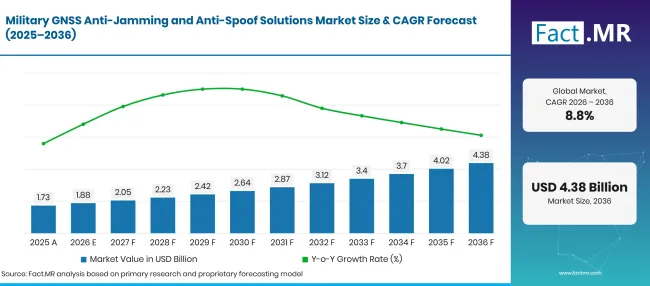
Military Gnss Anti Jamming And Anti Spoof Solutions Market Forecast Global | Source: Fact.MR
| Year | Basis | Market Value (USD billion) |
|---|---|---|
| 2025 | Actual | 1.73 |
| 2026 | Estimate | 1.88 |
| 2036 | Forecast | 4.38 |
| CAGR 2026 to 2036 | Forecast period | 8.8% |
Source: Fact.MR analysis. Updated Nov 6, 2026
What are the defining numbers behind Military GNSS Anti-Jamming and Anti-Spoof Solutions Market growth?
The 2026 to 2036 period adds USD 2.5 billion in new value, with anti-jam hardware and unmanned platforms accounting for most of it.
- Demand Drivers in the Market
- Interference is now a shared civil and military problem. In March 2025, the ITU, ICAO and IMO jointly warned that jamming and spoofing of satellite navigation are increasingly frequent and threaten ships and aircraft [1]. Defence buyers read that warning as proof that hostile signals now reach well beyond front lines.
- Spoofing has grown more sophisticated, so position integrity is checked, not assumed. EASA issued the fourth revision of its GNSS outages and alterations bulletin in July 2026, describing incidents growing in severity and sophistication [2]. Receivers that flag false signals are becoming a stated requirement in military tenders.
- Delays in signal modernization keep older receivers in service for longer. GAO reported in October 2026 that the US Department of Defense is still years away from fielding M-code after more than two decades and billions of dollars of effort [3]. Add-on anti-jam antennas give those legacy fleets protection in the meantime.
- Drone fleets need navigation protection small enough for their payload limits. Programme offices now ask for jam-resistant positioning in lightweight form factors that draw little power, which opens the door for compact antennas and chip-scale receivers.
- Key Segments Analyzed
- By Type: Anti-Jam will hold 58.2% share in 2026, since controlled reception pattern antennas can null several jammers at once and fit existing receivers without rewiring the platform.
- By Application: Unmanned Platform will account for 35.2% of 2026 value, given that drones lack a pilot who can fall back on visual navigation when satellite signals fail.
- Analyst Opinion at Fact.MR
- Shambhu Nath Jha, Principal Consultant at Fact.MR, states, “Navigation warfare has moved from a planning scenario to a daily operating condition, and procurement offices are responding by writing anti-jam and anti-spoof performance into baseline platform specifications. Suppliers that shrink a multi-element antenna into a drone-sized package will capture most of the new volume. Over time, buyers will reward vendors who combine protected GNSS with inertial and timing backups in one qualified box.”
- Strategic Implications
- Manufacturers should cut the size, weight and power of their antenna electronics so that one product family can serve both a fighter jet and a small quadcopter.
- Receiver developers should build spoofing detection and signal authentication into firmware, since tender language increasingly asks for integrity alerts alongside jam resistance.
- System integrators should offer retrofit kits that replace existing GNSS antennas through standard RF interfaces, giving air forces and armies a fast route to protect older fleets.
- Defence ministries should budget for multi-source navigation that pairs protected satellite receivers with inertial units and atomic clocks, reducing single-point failure in contested airspace.
The United States heads the country set at 11.4%, because M-code delays force parallel spending on add-on antennas and alternative navigation. Germany follows at 10.1%, with its sharply higher defence budget funding vehicle and drone upgrades across the Bundeswehr. The United Kingdom, at 8.8%, gains from a large drone programme and a national policy push on resilient positioning. Japan registers 8.1%, tied closely to unmanned coastal defence spending. Brazil closes at 7.2%, where a broad but slower-moving defence budget limits the pace of upgrades.
How does the Military GNSS Anti-Jamming and Anti-Spoof Solutions Market break down by segment?
Anti-Jam will lead Type at 58.2%; Unmanned Platform will head Application at 35.2% in 2026.
Which Type leads?
Anti-Jam takes 58.2% of 2026 sales.
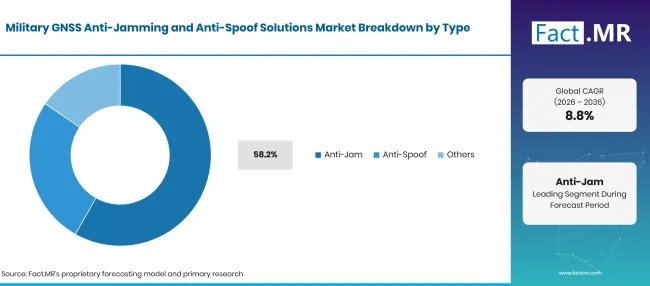
Military Gnss Anti Jamming And Anti Spoof Solutions Market Breakdown Type | Source: Fact.MR
| Type | Share (2026) |
|---|---|
| Anti-Jam (Leading segment) | 58.2% |
| Other segments combined | 41.8%* |
| Total | 100.0% |
Source: Fact.MR analysis. Updated Nov 6, 2026
Jamming is cheap to produce and easy to aim, so suppressing it is the first protection any force buys. Controlled reception pattern antennas and adaptive nulling electronics steer receive gain toward satellites and away from hostile emitters, which keeps a weapon or vehicle on course in heavy interference. Many of these units mount on combat aircraft weapons, where the antenna must also survive launch shock and airflow. Anti-Spoof is the newer of the two technology groups and is growing as adversaries field deceptive signals. India’s Ministry of Defence signed a contract in June 2026 for 20 enhanced capability GNSS jammers for its navy, systems able to perform spoofing and deceptive jamming as well as denial [4]. Militaries that see such capability spreading among navies are adding signal authentication and integrity monitoring to their own receivers. Others covers timing protection and interference detection sensors.
What supports Unmanned Platform within Application?
Unmanned Platform captures 35.2% of 2026 revenue.
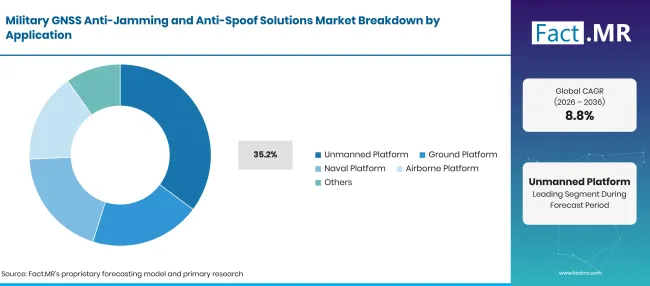
Military Gnss Anti Jamming And Anti Spoof Solutions Market Breakdown Application | Source: Fact.MR
| Application | Share (2026) |
|---|---|
| Unmanned Platform (Leading segment) | 35.2% |
| Other segments combined | 64.8%* |
| Total | 100.0% |
Source: Fact.MR analysis. Updated Nov 6, 2026
Drones depend on satellite positioning for waypoint flight, target hand-off and return to base, and a jammed drone is often a lost drone. Buyers of surveillance drones and strike aircraft now specify compact anti-jam antennas at the design stage. Japan’s FY2026 defence budget sets aside JPY 100.1 billion for the SHIELD layered coastal defence built around unmanned assets [5]. Ground Platform demand comes from armoured vehicles and command posts, where protection is often bundled with military vetronics upgrades. Naval Platform buyers face interference near contested straits and ports. Airborne Platform programmes cover crewed fighters, tankers and helicopters, while Others includes munitions and timing nodes.
What is accelerating Military GNSS Anti-Jamming and Anti-Spoof Solutions Market adoption, and what is holding it back?
Daily interference across conflict zones and busy trade routes keeps protected navigation high on procurement lists, and the steady rise in drone fleets multiplies the number of platforms needing it. Cost restrains wider uptake. Multi-element antennas and certified military receivers remain expensive, integration with older avionics takes engineering time, and qualification cycles can stretch beyond a single budget year, delaying contract awards.
Drivers Impact Analysis
| DRIVER | (~) % IMPACT ON CAGR | GEOGRAPHIC RELEVANCE | IMPACT TIMELINE |
|---|---|---|---|
| DRIVER | (~) % IMPACT ON CAGR | GEOGRAPHIC RELEVANCE | IMPACT TIMELINE |
| Routine GNSS jamming in modern electronic warfare | +1.3% | Global | Short term (<=2 years) |
| Growth in unmanned military fleets that must keep navigating | +1.0% | Global | Medium term (2-4 years) |
| Spoofing detection written into receiver tenders | +0.8% | North America, Western Europe, East Asia | Medium term (2-4 years) |
| Interim protection for legacy fleets during M-code delays | +0.6% | North America | Long term (>=4 years) |
Source: Fact.MR analysis. Updated Nov 6, 2026
Opportunity Impact Analysis
| OPPORTUNITY | (~) % IMPACT ON CAGR | GEOGRAPHIC RELEVANCE | IMPACT TIMELINE |
|---|---|---|---|
| OPPORTUNITY | (~) % IMPACT ON CAGR | GEOGRAPHIC RELEVANCE | IMPACT TIMELINE |
| Low-SWaP anti-jam antennas for small drones | +0.7% | Global | Medium term (2-4 years) |
| Tightly coupled GNSS and inertial navigation units | +0.6% | North America, Western Europe, East Asia | Medium term (2-4 years) |
| Retrofit kits for older aircraft and armoured vehicles | +0.5% | Global | Long term (>=4 years) |
| Multi-constellation, multi-frequency protection | +0.4% | Western Europe, East Asia | Long term (>=4 years) |
Source: Fact.MR analysis. Updated Nov 6, 2026
Restraints Impact Analysis
| RESTRAINT | (~) % IMPACT ON CAGR | GEOGRAPHIC RELEVANCE | IMPACT TIMELINE |
|---|---|---|---|
| RESTRAINT | (~) % IMPACT ON CAGR | GEOGRAPHIC RELEVANCE | IMPACT TIMELINE |
| High cost of multi-element antennas and certified receivers | -0.6% | Global | Short term (<=2 years) |
| Long defence qualification and procurement cycles | -0.4% | North America, Western Europe | Medium term (2-4 years) |
| Integration effort with older avionics and vehicle systems | -0.3% | Global | Medium term (2-4 years) |
| Export controls on military-grade receivers | -0.2% | Emerging markets | Long term (>=4 years) |
Source: Fact.MR analysis. Updated Nov 6, 2026
Which countries are scaling the Military GNSS Anti-Jamming and Anti-Spoof Solutions Market through 2036?
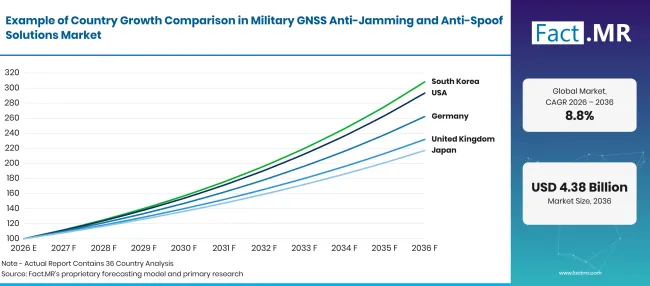
Military Gnss Anti Jamming And Anti Spoof Solutions Market Growth Index | Source: Fact.MR
| Country | CAGR (2026 to 2036) |
|---|---|
| United States | 11.4% |
| Germany | 10.1% |
| United Kingdom | 8.8% |
| Japan | 8.1% |
| Brazil | 7.2% |
Source: Fact.MR analysis. Updated Nov 6, 2026
What supports United States adoption?
11.4% CAGR, driven by delayed M-code fielding and parallel funding for alternative navigation.
American forces must protect a very large legacy fleet while the new signal matures. GAO notes that the Army’s ALTNAV low Earth orbit system reached initial operational capability in late 2024, and the Air Force launched its NTS-3 navigation test satellite in August 2025 [3]. Each new navigation layer still needs protected antennas and receivers on the platform side, which keeps US orders for anti-jam hardware well ahead of other countries.
How is Germany developing demand?
10.1% CAGR, backed by a steep step-up in federal defence spending.
The 2026 federal budget lifts the defence allocation to EUR 82.7 billion from EUR 62.4 billion, with a further EUR 25.5 billion drawn from the Bundeswehr special fund [6]. Much of that money goes to armoured vehicles, helicopters and drones that operate close to NATO’s eastern flank, where interference with satellite navigation has become common. German integrators are fitting protected antennas as standard on new vehicle batches.
What is shaping the United Kingdom’s adoption?
8.8% CAGR, helped by a large drone programme and a national resilience agenda.
The Ministry of Defence announced in June 2026 that more than GBP 5 billion over four years will go to drones under the Defence Investment Plan [7]. Government guidance updated in February 2026 puts the cost of a 24-hour GNSS outage at GBP 1.42 billion to the UK economy, which keeps resilient positioning on the policy agenda [8]. Both signals favour compact anti-jam units for British unmanned systems.
What supports Japan’s adoption?
8.1% CAGR, reflecting record defence budgets and a shift to unmanned coastal defence.
Japan’s FY2026 defence-related expenditure comes to about JPY 8.8 trillion, up 3.9% on the prior year, and unmanned defence capabilities receive about JPY 277.3 billion [5]. Island defence relies on drones, patrol vessels and missiles that must hold position over open sea. The Japanese procurement pipeline favours domestically integrated systems, giving local electronics houses a role alongside foreign antenna suppliers.
How does Brazil perform?
7.2% CAGR, as gradual modernization spreads protection across a wide territory.
The Ministry of Defence’s budget execution series records an updated 2026 allocation of BRL 140.29 billion for the ministry [9]. A large share of that funding pays personnel, so equipment budgets move slowly. Even so, border surveillance over the Amazon and patrols of offshore oil fields require dependable positioning, and Brazil is adding protected receivers mainly during planned aircraft and naval refits.
Who leads the Military GNSS Anti-Jamming and Anti-Spoof Solutions Market?
Competition splits into three tiers. Large US and European primes, BAE Systems, L3Harris, Collins Aerospace and Thales, hold the certified military receiver and antenna programmes, where security accreditation and decades of platform integration keep new entrants out. BAE Systems unveiled an M-code version of every GPS receiver it makes in June 2025, spanning low-power units to receivers with integrated anti-jam antenna electronics [10]. L3Harris reported in March 2026 that its deliveries of M-code receivers under the MGUE Increment 1 programme had passed 100,000 units [11].
A second tier of navigation specialists, Safran and Hexagon through NovAtel, wins on fused navigation and exportable antennas. Safran launched its BlackNaute resilient navigation system at the 2025 Paris Air Show, combining inertial sensing, a multi-constellation receiver and an atomic clock [12]. A third group, including Chemring through Roke, targets low-cost sovereign antennas. Winning bids through 2036 will hinge on shrinking protection for drones while keeping accreditation.
Which companies are the key providers?
Key companies in the Military GNSS Anti-Jamming and Anti-Spoof Solutions Market include BAE Systems, L3Harris, Collins Aerospace, Thales, Safran, Hexagon (NovAtel) and Chemring.
- BAE Systems
- L3Harris
- Collins Aerospace
- Thales
- Safran
- Hexagon (NovAtel)
- Chemring
Bibliography
- [1] International Telecommunication Union. (2025, March 26). UN agencies warn of satellite navigation jamming and spoofing.
- [2] European Union Aviation Safety Agency. (2026, July 3). Global Navigation Satellite System (GNSS) outages and alterations.
- [3] U.S. Government Accountability Office. (2026, October 7). Precision Navigation Systems: Challenges Remain with Fielding New Capabilities (GAO-27-107676).
- [4] Press Information Bureau, Ministry of Defence, Government of India. (2026, June 10). Aatmanirbhar Bharat: MoD inks Rs 449 crore contract for 20 Enhanced Capability Global Navigation Satellite System Jammers for Indian Navy.
- [5] Ministry of Defense of Japan. (2025, December 26). Progress and Budget in Fundamental Reinforcement of Defense Capabilities: Overview of FY2026 Budget.
- [6] Federal Government of Germany. (2025, December 19). Bundeshaushalt 2026: Investitionen für die Zukunft.
- [7] UK Ministry of Defence. (2026, June 29). UK drone transformation to strengthen Armed Forces backed by more than £5 billion.
- [8] Department for Science, Innovation and Technology. (2026, February 2). Positioning, Navigation and Timing: Overview.
- [9] Ministério da Defesa. (2026, May 14). 10_Serie_Historica_Global_da_Execucao Orçamentaria do MD ate abril 2026.
- [10] BAE Systems. (2025, June 3). Comprehensive line of M-Code GPS receivers unveiled at Joint Navigation Conference.
- [11] L3Harris. (2026, March 16). L3Harris Military GPS Receiver Deliveries Surpass 100,000 Units.
- [12] Safran. (2025, June 16). BlackNaute: the resilient PNT revolution against threats to Global Navigation Satellite Systems (GNSS).
This Report Answers
- How much value will military GNSS protection add between 2026 and 2036, and where will it concentrate?
- Why do anti-jam antennas take the bigger portion of spending, and how fast is anti-spoof technology catching up?
- Which unmanned, ground, naval and airborne platforms create the most demand for protected navigation?
- How do defence budgets in the United States, Germany, the United Kingdom, Japan and Brazil shape national growth rates?
- Which suppliers hold certified receiver programmes, and where can newer antenna makers compete?
- What cost, qualification and export barriers slow adoption across defence programmes?
What does the Military GNSS Anti-Jamming and Anti-Spoof Solutions Market cover?
This study tracks equipment that keeps military satellite navigation working when an adversary tries to block or falsify the signal. Controlled reception pattern antennas, nulling and beamforming electronics, protected receivers and spoofing detection modules form the core product set.
Value is measured at manufacturer selling price for new installations and retrofits. Revenue is split by protection type and by the class of platform that carries the equipment, from unmanned combat aerial vehicles to frigates and armoured vehicles.
What is included in the scope?
Multi-element anti-jam antennas, antenna electronics units and digital beamforming boards built for defence users are counted.
Military receivers with integrated spoofing detection, signal authentication or M-code processing are counted when sold for protected navigation.Protection fitted to air-launched effects, guided munitions and loitering weapons is counted.
Embedded GNSS and inertial units are counted where anti-jam or anti-spoof capability forms part of the delivered system.
What is excluded from the scope?
Civilian and consumer navigation receivers, including car and smartphone units, are excluded.
Commercial navigation used in autonomous delivery drones without military protection features is excluded.Satellite construction, launch services and ground control segments are excluded.Offensive jammers and stand-alone inertial systems without a GNSS protection function are excluded.
How Was the Analysis Built?
The analysis draws on 120+ sources, 35+ company portfolios, 25+ countries, and more than 20 industry interviews.
- Primary Research: Primary research includes discussions with manufacturers, service providers, technology developers, distributors, end users, and subject-matter experts. These conversations examine purchasing priorities, product adoption, operational challenges, approval requirements, competitive positioning, and the factors that influence wider market acceptance.
- Desk Research: Desk research covers government statistics, regulatory publications, company filings, trade data, technical studies, industry associations, standards, public policy, and other authoritative sources. Every source used in the analysis is documented in the bibliography.
- Market Sizing and Forecasting: Market estimates combine historical performance, demand indicators, pricing and volume trends, segment shares, company participation, country-level growth, adoption patterns, investment activity, and barriers to market expansion.
- Data Validation and Update Cycle: Findings are validated by comparing primary interviews with public data, company activity, regulatory changes, trade patterns, and industry developments. Regular updates review new product launches, capacity changes, partnerships, approvals, and shifts in commercial adoption.
Segmentation
What is the report’s scope and coverage?
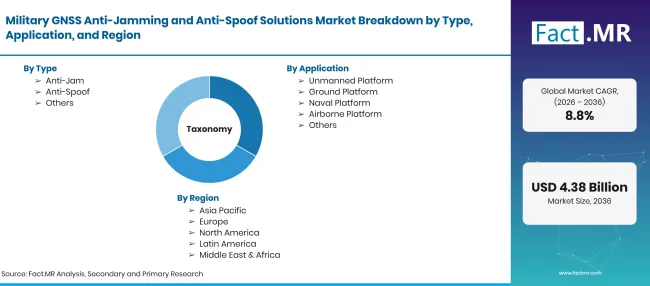
Military Gnss Anti Jamming And Anti Spoof Solutions Market Taxonomy | Source: Fact.MR
| Attribute | Details |
|---|---|
| Quantitative Units | USD billion |
| Market Definition | Hardware and embedded software that protect military satellite navigation receivers against deliberate jamming and deceptive spoofing signals. |
| Type | Anti-Jam; Anti-Spoof; Others |
| Application | Unmanned Platform; Ground Platform; Naval Platform; Airborne Platform; Others |
| Regions Covered | North America; Latin America; Western Europe; Eastern Europe; East Asia; South Asia & Pacific; Middle East & Africa |
| Countries Covered | United States; Germany; United Kingdom; Japan; Brazil |
| Companies Profiled | BAE Systems; L3Harris; Collins Aerospace; Thales; Safran; Hexagon (NovAtel); Chemring |
| Forecast Period | 2026 to 2036 |
| Approach | Platform fleet counts by country multiplied by protection fit rates and unit prices, cross-checked against defence budgets and supplier portfolios. |
Source: Fact.MR analysis. Updated Nov 6, 2026
How is the market segmented?
-
By Type
- Anti-Jam
- Anti-Spoof
- Others
-
By Application
- Unmanned Platform
- Ground Platform
- Naval Platform
- Airborne Platform
- Others
-
By Region
- North America
- Latin America
- Western Europe
- Eastern Europe
- East Asia
- South Asia & Pacific
- Middle East & Africa
Frequently Asked Questions
How large is the military GNSS anti-jamming and anti-spoof solutions market in 2026?
What growth rate will the market record from 2026 to 2036?
Which type leads?
Which application leads?
Which country will grow quickest?
Who are the main suppliers?
What holds the market back?
How much new value will the decade add?
Who worked on this report


Preview the report firsthand - request a free sample
Free SampleGet the brochure for pricing and purchase details
Download PDF