- Market Value (2025): USD 491.6 Mn
- Estimated Value (2026): USD 536.0 Mn
- Forecast Value (2036): USD 1272.3 Mn
- CAGR (2026-2036): 9.0%
What is the Open Source Video Editing Software Market forecast to be worth by 2036?
USD 536.0 million in 2026 to USD 1,272.3 million by 2036 at a 9.0% CAGR.
- Open source video editing software revenue came to USD 491.6 million in 2025, as independent creators, schools and small studios widened their use of freely licensed editors.
- Revenue will grow from USD 536.0 million in 2026 to USD 1,272.3 million by 2036, as professional features such as HDR export and color scopes arrive in community releases.
- A 9.0% CAGR will follow from steady growth in video publishing and from public procurement rules that now favor open code.
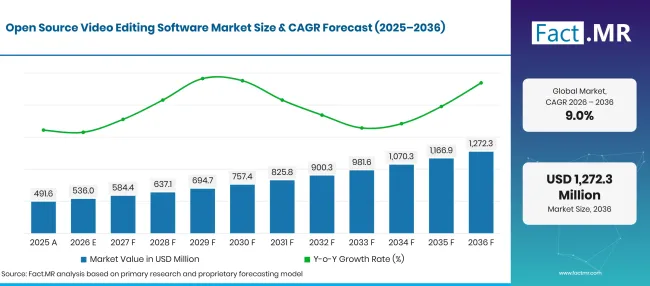
Open Source Video Editing Software Market Forecast Global | Source: Fact.MR
| Year | Basis | Market Value (USD million) |
|---|---|---|
| 2025 | Actual | 491.6 |
| 2026 | Estimate | 536.0 |
| 2036 | Forecast | 1,272.3 |
| CAGR 2026 to 2036 | Forecast period | 9.0% |
Source: Fact.MR analysis. Updated Nov 6, 2026
What are the defining numbers behind Open Source Video Editing Software Market growth?
The 2026 to 2036 period will add USD 736.4 million in new value, with non-linear editors, professional users, Windows desktops and media and entertainment buyers carrying most of the gain.
- Demand Drivers in the Market
- Online video now reaches a far wider audience than a decade ago. About 6 billion people were online in 2025, close to three quarters of the world population, according to the International Telecommunication Union [1].
- Open code already carries much of the digital economy. The European Commission notes that open source software underpins 70 to 90% of all code in the digital economy, and its January 2026 call for evidence sought ways to cut dependence on non-EU technologies [2].
- Classrooms and training programs lean on free tools. Eurostat reported that 17.3% of EU internet users took an online course in 2025 [3], and lesson videos, recorded lectures and student projects all need an editor that every learner can install at no cost.
- Community releases keep closing the feature gap with paid suites, and source access lets studios patch and script an editor for their own pipeline.
- Key Segments Analyzed
- By Software Type: Non-Linear Editing will hold 42.5% in 2026, since editors want to move, trim and layer clips freely across video and audio tracks.
- By Application: Professional will account for 45.0% of 2026 value, as freelance editors and small studios trade license fees for tools they can tailor.
- By Platform: Windows will capture 49.0% in 2026, given its broad installed base across home PCs and business workstations.
- By End-User: Media and Entertainment will command 48.0% of 2026 revenue, driven by constant output for streaming, broadcast and online channels.
- Analyst Opinion at Fact.MR
- Shambhu Nath Jha, Principal Consultant at Fact.MR, states, “Open source editors will win more professional work as HDR, color grading and plugin support reach the same timelines that hobbyists already use. Public procurement in Germany, the United States and Brazil will add a second source of demand that does not depend on creator budgets. Projects that pair steady release cycles with reliable funding will hold the strongest position through 2036.”
- Strategic Implications
- Developers should put rendering speed, GPU acceleration and HDR export at the top of the roadmap, since these are the gaps professional editors cite first when they compare open tools with paid suites.
- Training providers and schools should build course material around one or two open editors, so students learn skills they can keep using after graduation without a license.
- Media companies should test open editors on secondary workflows such as social cuts and archive clips before moving primary post-production.
- Funders and foundations should back maintainers through multi-year grants, because release continuity decides whether institutions trust an editor for long projects.
Germany leads the five-country view at 11.3%, where digital sovereignty policy and new procurement templates push public bodies toward open code. Brazil follows a full point lower at 10.3%, carried by near-universal online video viewing and a revised digital government strategy. The United States trails Brazil by the same margin at 9.3%, as a large editing workforce meets an open-first federal code policy. At 8.3%, the United Kingdom gains from heavy YouTube viewing but lacks a binding open source mandate. Japan closes the range at 7.4%, only 0.9 points behind, where a mature video distribution market adopts open tools at a slower pace.
How does the Open Source Video Editing Software Market break down by segment?
Non-Linear Editing will lead Software Type at 42.5%; Professional will head Application at 45.0%; Windows will top Platform at 49.0%; Media and Entertainment will hold End-User at 48.0% in 2026.
Which Software Type leads?
Non-Linear Editing holds 42.5% of 2026 sales.
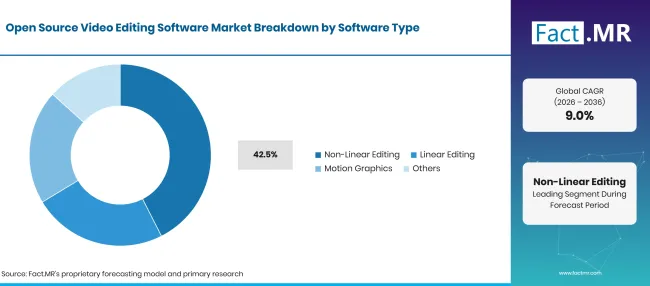
Open Source Video Editing Software Market Breakdown Software Type | Source: Fact.MR
| Software Type | Share (2026) |
|---|---|
| Non-Linear Editing (Leading segment) | 42.5% |
| Other segments combined | 57.5%* |
| Total | 100.0% |
Source: Fact.MR analysis. Updated Nov 6, 2026
Editors cut, reorder and layer footage in any sequence, and that freedom is why non-linear tools form the core of nearly every open project. Blender’s November 2025 release moved strip settings into a dedicated Properties tab, added a Compositor Modifier inside the Video Sequencer and brought HDR and wide-gamut video read and write support [4]. Such changes pull the sequencer closer to work done in real-time video rendering pipelines. Linear editing survives in capture-to-tape and broadcast logging tasks, where footage runs in a fixed order. Motion graphics tools with qualifying editing features form a third group, often paired with 3D animation software for titles and effects.
What supports Professional within Application?
Professional takes 45.0% of 2026 revenue.
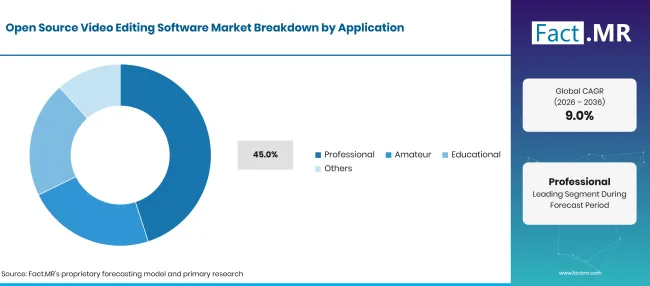
Open Source Video Editing Software Market Breakdown Application | Source: Fact.MR
| Application | Share (2026) |
|---|---|
| Professional (Leading segment) | 45.0% |
| Other segments combined | 55.0%* |
| Total | 100.0% |
Source: Fact.MR analysis. Updated Nov 6, 2026
Freelancers and boutique studios bill by the project, so a tool with no seat fee protects margins on every job. Shotcut’s June 2026 release added HDR preview and export along with limited OpenFX, VST2 and LV2 plugin support [5], features that count for more with paid editors than with hobbyists working to a client brief. Amateur users edit travel clips, gaming captures and family videos, and they value simple timelines over deep controls. Educational use covers lesson recordings and student coursework.
What leads the Platform segment?
Windows accounts for 49.0% of 2026 demand.
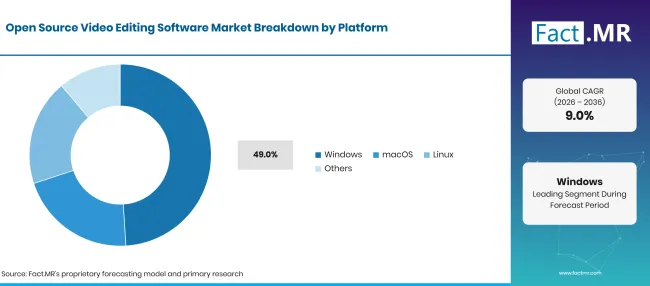
Open Source Video Editing Software Market Breakdown Platform | Source: Fact.MR
| Platform | Share (2026) |
|---|---|
| Windows (Leading segment) | 49.0% |
| Other segments combined | 51.0%* |
| Total | 100.0% |
Source: Fact.MR analysis. Updated Nov 6, 2026
Most creators already own a Windows PC, and every major open editor ships a Windows build. Kdenlive’s April 2026 release added an AMF encoding profile for Windows along with monitor mirroring and multi-clip speed changes [6], which shows how projects tune hardware encoding for that platform. macOS keeps a loyal base in design and music studios. Linux draws developers and technically minded editors who prefer full control of their system.
How does End-User shape demand?
Media and Entertainment represents 48.0% of 2026 value.
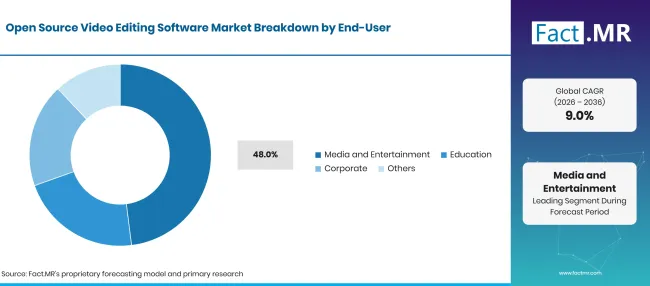
Open Source Video Editing Software Market Breakdown End User | Source: Fact.MR
| End-User | Share (2026) |
|---|---|
| Media and Entertainment (Leading segment) | 48.0% |
| Other segments combined | 52.0%* |
| Total | 100.0% |
Source: Fact.MR analysis. Updated Nov 6, 2026
Streaming channels, independent film units and online publishers produce footage every day, which keeps editing seats busy all year. Growth in video streaming services widens the pool of short-form and long-form content that needs cutting before release. Education buyers use open editors for teaching media literacy and recording lessons. Corporate teams handle training clips and internal updates, a use that overlaps with enterprise video platforms for hosting and distribution.
What is accelerating Open Source Video Editing Software Market adoption, and what is holding it back?
Rising video output, zero license cost and fast feature releases are drawing creators and institutions to open editors. Public procurement rules in Europe and the United States add policy support. Heavy hardware needs for 4K and HDR footage, thin paid support and friction with proprietary codecs and plugins still slow adoption in larger post-production houses.
Drivers Impact Analysis
| DRIVER | (~) % IMPACT ON CAGR | GEOGRAPHIC RELEVANCE | IMPACT TIMELINE |
|---|---|---|---|
| Growing appetite for low-cost tools to produce and edit video | +1.1% | Global | Medium term (2-4 years) |
| More creators publishing on streaming and social platforms | +1.0% | North America, Western Europe, East Asia | Medium term (2-4 years) |
| Smoother non-linear editing, faster rendering and better cross-platform support | +0.8% | North America, Western Europe, East Asia | Short term (<=2 years) |
| Wider use of multimedia editing in classrooms and workplace training | +0.7% | Global | Long term (>=4 years) |
| Open source preferences in public procurement and digital policy | +0.6% | Western Europe, North America, Latin America | Long term (>=4 years) |
Source: Fact.MR analysis. Updated Nov 6, 2026
Opportunity Impact Analysis
| OPPORTUNITY | (~) % IMPACT ON CAGR | GEOGRAPHIC RELEVANCE | IMPACT TIMELINE |
|---|---|---|---|
| Professional-grade editing and color grading capabilities | +0.7% | Global | Medium term (2-4 years) |
| Better handling of high-resolution footage and multi-track timelines | +0.6% | North America, Western Europe, East Asia | Medium term (2-4 years) |
| Growing uptake of open source editors in schools and universities | +0.5% | Latin America, South Asia & Pacific, Europe | Long term (>=4 years) |
| Easier interfaces and learning material for hobbyists and first-time editors | +0.4% | Global | Short term (<=2 years) |
Source: Fact.MR analysis. Updated Nov 6, 2026
Restraints Impact Analysis
| RESTRAINT | (~) % IMPACT ON CAGR | GEOGRAPHIC RELEVANCE | IMPACT TIMELINE |
|---|---|---|---|
| Powerful hardware needed to process high-resolution footage and heavy projects | -0.6% | Global | Short term (<=2 years) |
| Friction from proprietary codecs, plugins and specialized production pipelines | -0.5% | North America, Western Europe, East Asia | Medium term (2-4 years) |
| Few options for dedicated technical help and professional support | -0.4% | Global | Medium term (2-4 years) |
| Steep learning curve of complex interfaces and advanced editing features | -0.3% | Latin America, South Asia & Pacific, Middle East & Africa | Long term (>=4 years) |
Source: Fact.MR analysis. Updated Nov 6, 2026
Which countries are scaling the Open Source Video Editing Software Market through 2036?
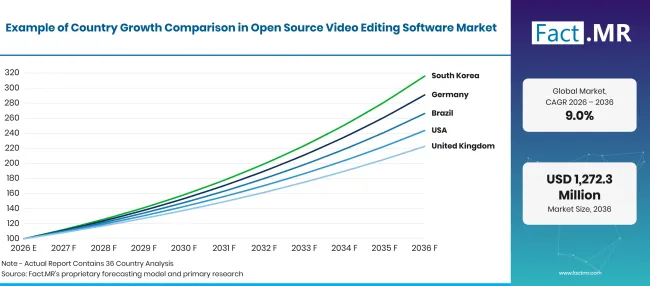
Factmr Open Source Video Editing Software Market Growth Index | Source: Fact.MR
| Country | CAGR (2026 to 2036) |
|---|---|
| Germany | 11.3% |
| Brazil | 10.3% |
| United States | 9.3% |
| United Kingdom | 8.3% |
| Japan | 7.4% |
Source: Fact.MR analysis. Updated Nov 6, 2026
Why is Germany emerging as a promising market?
11.3% CAGR, driven by digital sovereignty policy and open source priority in public procurement.
Germany set up a federal Ministry for Digital Transformation and Government Modernisation in 2025, and its Federal Modernisation Agenda gives open source priority in procurement under a planned Germany Stack platform, according to the European Commission’s Open Source Observatory [7]. A 2026 procurement law then added contract templates that require public buyers to consider open alternatives. Broadcasters, universities and agencies that follow these rules will look at open editors for training, archive and communication video.
What is driving Brazil’s market growth?
10.3% CAGR, backed by near-universal online video viewing and a revised digital government strategy.
In 2025, 90.5% of Brazilians aged 10 or older used the internet, and 89.3% of those users watched videos, films or series online, the national statistics office IBGE reported [8]. Such a viewing base supports a dense layer of small creators and studios who need editors without dollar-priced subscriptions. Brazil’s revised National Digital Government Strategy, issued in July 2026, lists 68 recommendations, 17 of them new, including digital and AI skills training for public servants [9].
What makes the United States an important growth market?
9.3% CAGR, helped by a large professional editing workforce and an open-first federal code policy.
The United States employed 39,400 film and video editors in 2025, and the Bureau of Labor Statistics sees that occupation growing 4% from 2025 to 2035 [10]. Policy also plays a part: the General Services Administration’s open source policy, signed in January 2026, requires new custom code to be developed in public repositories unless there is sufficient justification [11].
Where does the United Kingdom’s growth opportunity lie?
8.3% CAGR, reflecting heavy daily video viewing and an active independent production scene.
UK adults spent an average of four and a half hours online each day in 2025, and YouTube reached 94% of adults for an average of 51 minutes a day, Ofcom found [12]. Independent production houses and corporate video teams add steady professional use, though the country has no binding open source mandate for its public sector.
What is influencing Japan’s adoption outlook?
7.4% CAGR, as a mature video distribution market opens up to openly developed tools.
Japan’s video distribution market reached 6,740 billion yen in 2025, up 13.7% on the previous year, according to the Ministry of Internal Affairs and Communications [13]. Anime, gaming and corporate studios rely on established commercial suites, so open editors spread first among students and independent creators. Government practice is shifting too: the Digital Agency released parts of its GENAI environment as open source software in April 2026 under licenses that permit commercial use [14].
Who leads the Open Source Video Editing Software Market?
The field divides into three groups. Foundation-backed projects, led by Blender Foundation and KDE e.V., combine a funded core team with large volunteer communities, and they compete on breadth: Blender pairs its Video Sequencer with 3D, compositing and HDR color work [4], while Kdenlive keeps a fixed release rhythm focused on timeline tools [6].
Small firms such as Meltytech, LLC and OpenShot Studios, LLC form a second group that competes on ease of use and fast feature delivery; OpenShot’s August 2026 release added color wheels, LUT support, video scopes and locally run object masking [15]. Linux-first projects, Cinelerra-GG Community and the Flowblade project, serve technical editors who want deep control. Through 2036, the winners will be the projects that turn donations and grants into reliable release cycles while keeping hardware acceleration and codec support current.
Which companies are the key providers?
Key companies in the Open Source Video Editing Software Market include Blender Foundation, KDE e.V., Meltytech, LLC, OpenShot Studios, LLC, Cinelerra-GG Community and the Flowblade project.
- Blender Foundation
- KDE e.V.
- Meltytech, LLC
- OpenShot Studios, LLC
- Cinelerra-GG Community
- Flowblade project
Bibliography
- [1] International Telecommunication Union. (2025, November 17). Global number of Internet users increases, but disparities deepen key digital divides.
- [2] European Commission. (2026, January 12). Commission opens call for evidence on Open-Source Digital Ecosystems.
- [3] Eurostat. (2026, March 19). Online learning increasingly popular in the EU.
- [4] Blender Foundation. (2025, November 18). Blender 5.0 release notes.
- [5] Meltytech, LLC. (2026, June 25). New Version 26.6: High Dynamic Range.
- [6] KDE e.V. (2026, April 27). Kdenlive 26.04.0 released.
- [7] European Commission, Open Source Observatory. (2026, July 28). Germany Country Report: The Consolidation of a Commitment.
- [8] Instituto Brasileiro de Geografia e Estatística. (2026, July 2). Acesso à Internet e à televisão e posse de telefone móvel celular para uso pessoal 2025.
- [9] Secretaria de Governo Digital, Brazil. (2026, July 1). Revisão da Estratégia Nacional de Governo Digital: Ciclo 2024 a 2027.
- [10] U.S. Bureau of Labor Statistics. (2026, August 27). Film and Video Editors and Camera Operators: Occupational Outlook Handbook.
- [11] U.S. General Services Administration. (2026, January 22). GSA Open Source Software (OSS) Policy, 2107.1A CIO.
- [12] Ofcom. (2025, December 10). From apps to AI search: how the UK goes online in 2025.
- [13] Ministry of Internal Affairs and Communications, Japan. (2026, July). White Paper on Information and Communications in Japan 2026: Video distribution, music distribution and e-books.
- [14] Digital Agency, Government of Japan. (2026, April 24). Release of Government AI "GENAI" as Open Source Software (OSS).
- [15] OpenShot Studios, LLC. (2026, August 30). OpenShot 4.0: Record, Edit, and Color Like Never Before.
This Report Answers
- How is revenue split between non-linear editing, linear editing and motion graphics tools?
- Why do professional users account for the biggest share of application spending, and which features keep them on open tools?
- What role do Windows, macOS and Linux each play in editor adoption?
- How are media and entertainment buyers changing the way they use open editors compared with schools and corporate teams?
- Which development groups set the pace on rendering, HDR and plugin support?
- How do policy and video viewing trends separate Germany, Brazil, the United States, the United Kingdom and Japan?
What does the Open Source Video Editing Software Market cover?
This study tracks spending tied to video editing applications released under open source licenses. Revenue comes from paid builds, donations and memberships, support contracts, training and custom development linked to these editors.
Values are stated in USD million at the point of first sale or contract.
What is included in the scope?
Open source non-linear and linear editors, along with motion graphics tools that include qualifying video editing functions, are covered.
Paid distributions of open source editors through app stores, plus support, hosting and training services sold around them, are counted. Community editions used in professional, amateur and educational settings form part of the assessment. Plugin and effects packages released under open licenses for these editors are included when sold or funded alongside the core application.
What is excluded from the scope?
Proprietary editors, including free versions of closed-source suites, fall outside the boundary.
Streaming services, video hosting platforms and content distribution networks are not counted. Stand-alone graphic design tools and audio editors without video editing functions are excluded, as are spatial sound tools covered under 3D audio software. Cameras, graphics cards, storage and editing workstations are left out.
How Was the Analysis Built?
The analysis draws on 120+ sources, 35+ company portfolios, 25+ countries, and more than 20 industry interviews.
- Primary Research: Primary research includes discussions with manufacturers, service providers, technology developers, distributors, end users, and subject-matter experts. These conversations examine purchasing priorities, product adoption, operational challenges, approval requirements, competitive positioning, and the factors that influence wider market acceptance.
- Desk Research: Desk research covers government statistics, regulatory publications, company filings, trade data, technical studies, industry associations, standards, public policy, and other authoritative sources. Every source used in the analysis is documented in the bibliography.
- Market Sizing and Forecasting: Market estimates combine historical performance, demand indicators, pricing and volume trends, segment shares, company participation, country-level growth, adoption patterns, investment activity, and barriers to market expansion.
- Data Validation and Update Cycle: Findings are validated by comparing primary interviews with public data, company activity, regulatory changes, trade patterns, and industry developments. Regular updates review new product launches, capacity changes, partnerships, approvals, and shifts in commercial adoption.
Segmentation
What is the report’s scope and coverage?
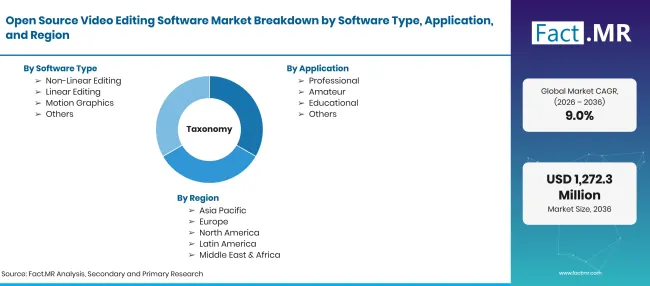
Open Source Video Editing Software Market Taxonomy | Source: Fact.MR
| Attribute | Details |
|---|---|
| Quantitative Units | USD million |
| Market Definition | Open source video editing software covers applications for cutting, arranging and finishing video whose source code is published under an open source license that permits use, modification and redistribution. |
| Software Type | Non-Linear Editing; Linear Editing; Motion Graphics; Others |
| Application | Professional; Amateur; Educational; Others |
| Platform | Windows; macOS; Linux; Others |
| End-User | Media and Entertainment; Education; Corporate; Others |
| Regions Covered | North America; Latin America; Western Europe; Eastern Europe; East Asia; South Asia & Pacific; Middle East & Africa |
| Countries Covered | Germany; Brazil; United States; United Kingdom; Japan |
| Companies Profiled | Blender Foundation; KDE e.V.; Meltytech, LLC; OpenShot Studios, LLC; Cinelerra-GG Community; Flowblade project |
| Forecast Period | 2026 to 2036 |
| Approach | Hybrid top-down and bottom-up model built from video creation activity by country, editor adoption across professional and amateur users, operating system mix, end-user demand and project release activity. |
Source: Fact.MR analysis. Updated Nov 6, 2026
How is the market segmented?
-
By Software Type
- Non-Linear Editing
- Linear Editing
- Motion Graphics
- Others
-
By Application
- Professional
- Amateur
- Educational
- Others
-
By Platform
- Windows
- macOS
- Linux
- Others
-
By End-User
- Media and Entertainment
- Education
- Corporate
- Others
-
By Region
- North America
- Latin America
- Western Europe
- Eastern Europe
- East Asia
- South Asia & Pacific
- Middle East & Africa
Frequently Asked Questions
How large is the open source video editing software market in 2026?
What growth rate will the open source video editing software market record?
Which software type leads?
Which application leads?
Which platform leads?
Which end-user leads?
Which country will grow quickest?
Who are the main companies?
What holds the market back?
Who worked on this report


Preview the report firsthand - request a free sample
Free SampleGet the brochure for pricing and purchase details
Download PDF