- Market Value (2025): USD 5.18 Bn
- Estimated Value (2026): USD 5.57 Bn
- Forecast Value (2036): USD 11.5 Bn
- CAGR (2026-2036): 7.5%
What is the GPS Anti-Jamming Market forecast to be worth by 2036?
USD 5.57 billion in 2026 to USD 11.5 billion by 2036 at a 7.5% CAGR.
- GPS anti-jamming demand came to USD 5.18 billion in 2025, with most orders placed by armed forces fitting protected antennas to aircraft, vehicles and ships already in service.
- Revenue will move from USD 5.57 billion in 2026 to USD 11.5 billion by 2036 as new drones, combat vehicles and aircraft leave the factory with anti-jam hardware built in.
- A 7.5% CAGR reflects steady retrofit work on legacy fleets plus a second wave of orders from unmanned and autonomous platforms that cannot fly or drive safely without a trusted position.
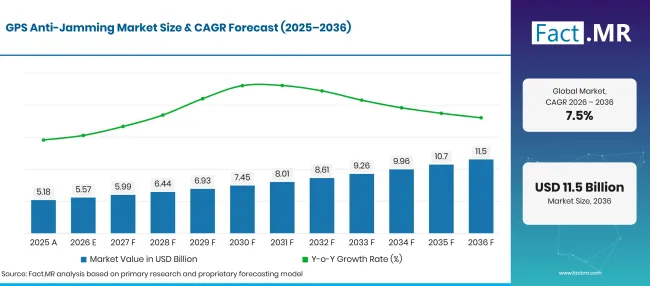
Gps Anti Jamming Market Forecast Global | Source: Fact.MR
| Year | Basis | Market Value (USD billion) |
|---|---|---|
| 2025 | Actual | 5.18 |
| 2026 | Estimate | 5.57 |
| 2036 | Forecast | 11.5 |
| CAGR 2026 to 2036 | Forecast period | 7.5% |
Source: Fact.MR analysis. Updated Nov 6, 2026
What are the defining numbers behind GPS Anti-Jamming Market growth?
Between 2026 and 2036 the market will gain USD 6.0 billion in new value, most of it tied to military platform programmes in Europe, North America and East Asia.
- Demand Drivers in the Market
- Interference is spreading beyond battlefields into everyday civil use. The EU Agency for the Space Programme warned in November 2026 that GNSS jamming and spoofing are on the rise near conflict zones, helped by cheap and widely available devices, and noted that Galileo’s open authentication service became operational in July 2025 [1]. Warnings of this kind push aircraft, ship and network operators to specify receivers that can reject hostile signals.
- Migration to the military M-code signal is opening a long replacement cycle across U.S. and allied fleets. Buyers who open an airframe or vehicle to swap the receiver often fit a protected antenna in the same maintenance slot, which lifts the value of each upgrade.
- Ground forces are adding assured navigation to robotic and crewed vehicles. Collins Aerospace demonstrated a small anti-jam navigation card for ground vehicles at a U.S. Army experiment in December 2025, where it kept a solution under many jammers and spoofers [2].
- Electronic warfare seen in recent conflicts has turned GPS denial into a planning assumption for NATO and Indo-Pacific forces. Budget lines for protected positioning are now written into vehicle, aircraft and munition programmes from the start.
- Key Segments Analyzed
- By Receiver Type: Military & Government Grade will hold 64.5% share in 2026, as only these receivers can process encrypted signals and pass defence security certification.
- By Technique: Nulling will account for 42.3% of 2026 revenue, since a nulling processor can blank several jammers at once with a compact antenna array.
- By Application: Flight Control will take 36.2% in 2026, given that both crewed aircraft and drones lose stability and mission safety when the GPS fix degrades.
- By End-User: Military will command 64.5% of 2026 value, because armed forces face deliberate jamming wherever they deploy.
- Analyst Opinion at Fact.MR
- Shambhu Nath Jha, Principal Consultant at Fact.MR, states, “Anti-jam protection is becoming a condition of platform acceptance, and buyers will stop treating it as an optional upgrade. Suppliers that can fit a nulling antenna into the size, weight and power budget of a small drone will win the volume orders of the next ten years. Civil aviation and critical infrastructure operators will follow the military lead once regulators tighten interference rules.”
- Strategic Implications
- Manufacturers should cut the size, weight and power of nulling and beam-steering units so they fit on small drones and loitering munitions.
- System integrators should design antenna mounts and data links for anti-jam hardware at the start of a platform programme, since late retrofits cost more and delay acceptance.
- Defence buyers should pair M-code receiver upgrades with antenna upgrades in the same contract to avoid opening the airframe twice.
- Investors should track export licensing and allied procurement agencies, because cross-border orders through bodies such as NATO partners and national materiel agencies set the pace for European demand.
Germany leads the country table at 9.0%, helped by a defence budget now above EUR 100 billion and a front-line role on NATO’s eastern flank. Brazil follows at 8.2%, where illegal jammers near airports are pushing both aviation and armed forces to protect their receivers. The United States, at 7.4%, grows from a far bigger installed base, so new orders add less in percentage terms. The United Kingdom at 6.6% spreads its spending across satellite and ground-based backup navigation. Japan closes the group at 5.9%, as its own regional satellite system already adds a layer of redundancy alongside GPS.
How does the GPS Anti-Jamming Market break down by segment?
Military & Government Grade will lead Receiver Type at 64.5%; Nulling will head Technique at 42.3%; Flight Control will lead Application at 36.2%; Military will hold End-User at 64.5% in 2026.
Which Receiver Type leads?
Military & Government Grade holds 64.5% of 2026 sales.
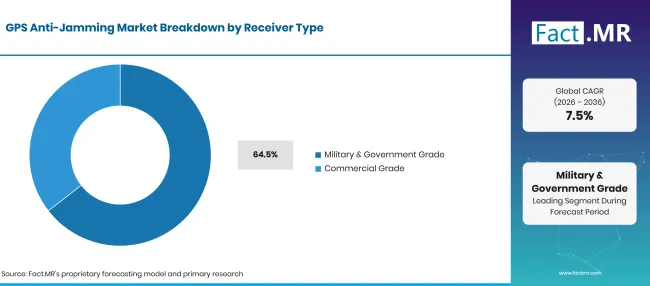
Gps Anti Jamming Market Breakdown Receiver Type | Source: Fact.MR
| Receiver Type | Share (2026) |
|---|---|
| Military & Government Grade (Leading segment) | 64.5% |
| Other segments combined | 35.5%* |
| Total | 100.0% |
Source: Fact.MR analysis. Updated Nov 6, 2026
Encrypted military codes, tamper protection and security certification set these receivers apart from consumer units. Defence ministries replace them on fixed cycles, often in batches covering a whole fleet, which keeps order books full for qualified suppliers. Programmes that pair the receiver with protected antennas also lift spending on military antenna systems at the same time. Commercial Grade units serve survey, port, timing and transport users that face accidental or criminal interference. Their prices are lower and export rules looser, so they spread faster in civil fleets and critical infrastructure. Wider adoption of anti-jam features in standard GPS receiver demand will widen the commercial base over the forecast period.
What supports Nulling within Technique?
Nulling takes 42.3% of 2026 revenue.
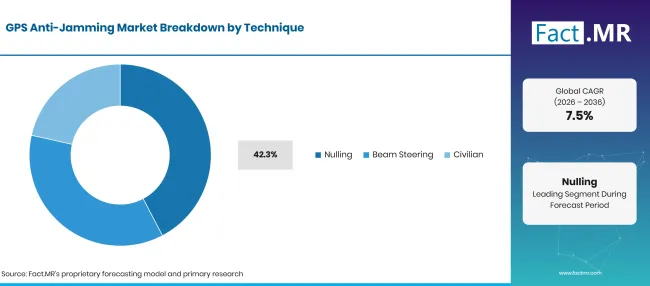
Gps Anti Jamming Market Breakdown Technique | Source: Fact.MR
| Technique | Share (2026) |
|---|---|
| Nulling (Leading segment) | 42.3% |
| Other segments combined | 57.7%* |
| Total | 100.0% |
Source: Fact.MR analysis. Updated Nov 6, 2026
A nulling processor steers deep reception gaps toward each jammer while keeping the satellites in view. Raytheon UK’s Landshield Plus, ordered for the CV90 infantry fighting vehicle, can block up to six jammers at once on the L1 and L2 bands, with deliveries running from 2025 to 2029 [3]. That balance of protection and compact size suits ground vehicles and mid-size drones. Beam Steering points antenna gain at the satellites and costs more, so it appears mainly on high-value aircraft and ships. Civilian techniques such as filtering and interference detection serve commercial receivers. Other methods, including inertial blending, fill gaps when every satellite signal is lost.
What leads the Application segment?
Flight Control captures 36.2% of 2026 demand.
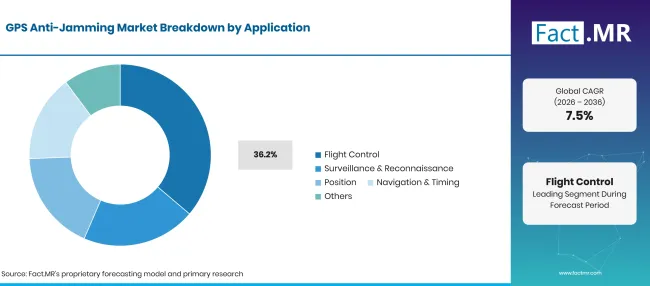
Gps Anti Jamming Market Breakdown Application | Source: Fact.MR
| Application | Share (2026) |
|---|---|
| Flight Control (Leading segment) | 36.2% |
| Other segments combined | 63.8%* |
| Total | 100.0% |
Source: Fact.MR analysis. Updated Nov 6, 2026
An aircraft or drone that loses its GPS fix can drift off course, miss a landing approach or lose its return-to-home function. In February 2026 Raytheon UK won an order for about 140 Landshield Plus systems for MQ-9B SkyGuardian and SeaGuardian aircraft, with deliveries starting in 2026 [4]. Unmanned fleets of this kind turn anti-jam protection into a flight safety item. Surveillance & Reconnaissance relies on an exact position to tag sensor data and images. Position, Navigation & Timing users, including networks and command posts, need a stable time signal as much as a location. Growth in counter-drone systems also raises the risk of friendly receivers being jammed, which pushes demand across all three uses.
How does End-User shape demand?
Military represents 64.5% of 2026 value.
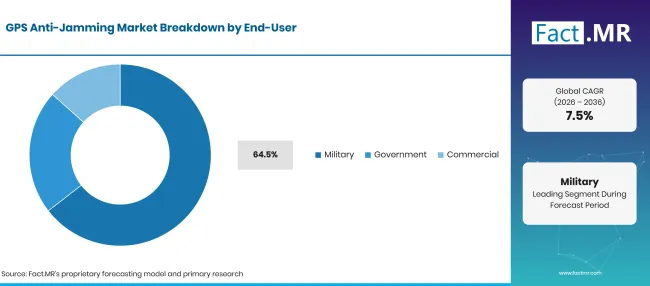
Gps Anti Jamming Market Breakdown End User | Source: Fact.MR
| End-User | Share (2026) |
|---|---|
| Military (Leading segment) | 64.5% |
| Other segments combined | 35.5%* |
| Total | 100.0% |
Source: Fact.MR analysis. Updated Nov 6, 2026
Armies, navies and air forces buy anti-jam gear for weapons, vehicles, ships and aircraft under multi-year programmes. Growth in electronic warfare spending means each new jammer fielded by an adversary creates a matching need for protection on the other side. Government users include border, coast guard and emergency services, which need a trusted fix during crises. Commercial users, such as airlines, shipping lines and telecom operators, buy smaller volumes but react fast when local interference incidents rise.
What is accelerating GPS Anti-Jamming Market adoption, and what is holding it back?
Electronic warfare in active conflict zones and a rising count of civil interference cases are pushing buyers to protect the receivers they field. M-code upgrades and drone programmes add steady volume. Cost, export controls and the work needed to integrate antenna arrays into older platforms slow wider uptake, especially among commercial and smaller government users.
Drivers Impact Analysis
| DRIVER | (~) % IMPACT ON CAGR | GEOGRAPHIC RELEVANCE | IMPACT TIMELINE |
|---|---|---|---|
| Armed forces adding protected antennas to aircraft, vehicles and ships | +1.4% | Global | Short term (<=2 years) |
| M-code receiver replacement cycles in the United States and allied forces | +1.1% | North America, Western Europe, East Asia | Medium term (2-4 years) |
| Growth of unmanned and autonomous platforms needing a trusted position | +0.9% | Global | Medium term (2-4 years) |
| Rising interference reports in civil aviation and shipping | +0.6% | Western Europe, Middle East & Africa | Short term (<=2 years) |
Source: Fact.MR analysis. Updated Nov 6, 2026
Opportunity Impact Analysis
| OPPORTUNITY | (~) % IMPACT ON CAGR | GEOGRAPHIC RELEVANCE | IMPACT TIMELINE |
|---|---|---|---|
| Small, low-power anti-jam units for drones and loitering munitions | +0.8% | Global | Medium term (2-4 years) |
| Commercial anti-jam receivers for ports, airports and timing networks | +0.5% | Western Europe, East Asia | Long term (>=4 years) |
| Multi-constellation receivers combining GPS with regional systems | +0.4% | East Asia, Western Europe | Long term (>=4 years) |
| Anti-jam retrofit of older helicopter and transport fleets | +0.3% | North America, Latin America | Medium term (2-4 years) |
Source: Fact.MR analysis. Updated Nov 6, 2026
Restraints Impact Analysis
| RESTRAINT | (~) % IMPACT ON CAGR | GEOGRAPHIC RELEVANCE | IMPACT TIMELINE |
|---|---|---|---|
| High unit cost of military-grade antenna arrays | -0.6% | Global | Short term (<=2 years) |
| Export controls on encrypted receivers and anti-jam technology | -0.4% | Global | Medium term (2-4 years) |
| Integration and certification work on legacy platforms | -0.3% | Global | Medium term (2-4 years) |
| Shortage of radio frequency engineering staff | -0.2% | North America, Western Europe | Long term (>=4 years) |
Source: Fact.MR analysis. Updated Nov 6, 2026
Which countries are scaling the GPS Anti-Jamming Market through 2036?
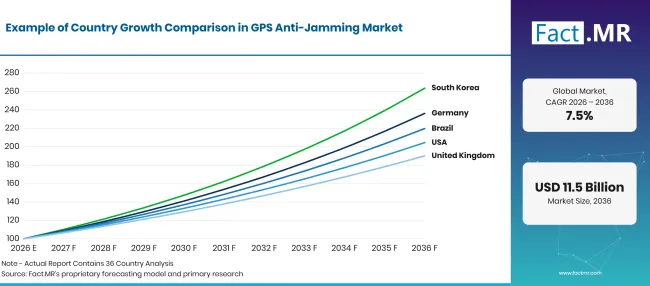
Gps Anti Jamming Market Growth Index | Source: Fact.MR
| Country | CAGR (2026 to 2036) |
|---|---|
| Germany | 9.0% |
| Brazil | 8.2% |
| United States | 7.4% |
| United Kingdom | 6.6% |
| Japan | 5.9% |
Source: Fact.MR analysis. Updated Nov 6, 2026
What supports GPS anti-jamming adoption in Germany?
9.0% CAGR, driven by a sharp rise in defence funding and exposure to Baltic jamming.
The Bundestag budget committee approved more than EUR 108 billion for defence and the Bundeswehr special fund in 2026 [5]. Part of that money goes to vehicles, aircraft and drones that now need protected navigation as standard. The Bundeswehr’s own explainer on electronic warfare lists a disturbed GPS signal and unreliable drone data as signs of an electromagnetic attack [6]. German buyers therefore treat anti-jam antennas as basic kit for units serving in Lithuania and elsewhere on the eastern flank.
How is Brazil developing demand?
8.2% CAGR, as authorities move against illegal jammers that disrupt aviation.
In September 2025 a joint police operation backed by Anatel shut down a clandestine workshop in Sorocaba that built GPS blockers and anti-drone jammers [7]. The same report links the case to earlier seizures in Belo Horizonte in January 2025 and in Rio de Janeiro in July 2025. Repeated incidents near airports encourage the Brazilian Air Force and airlines to fit receivers that can reject local interference.
What is supporting United States adoption?
7.4% CAGR, backed by a vast military user base and frequent interference testing.
A July 2026 interagency aviation safety bulletin from the U.S. Department of the Interior and the USDA Forest Service warns that GPS interference testing is routine and increasingly important [8]. It cites a May 2026 air ambulance crash in New Mexico where active military jamming may have contributed to a loss of navigation. M-code upgrades across the services keep orders flowing for receivers, antennas and integration work.
How is the United Kingdom developing demand?
6.6% CAGR, reflecting spending on both protected satellite receivers and ground-based backup navigation.
In May 2026 the Ministry of Defence awarded a GBP 6 million contract under the Urgent Compass programme to develop enhanced Long-Range Navigation, which keeps working when satellite signals are jammed [9]. The two-year effort aims at a deployable system by April 2028. British forces still buy anti-jam GPS antennas for vehicles and drones, yet a share of the navigation budget now goes to terrestrial backups.
What supports Japan’s adoption?
5.9% CAGR, helped by defence equipment upgrades and a regional satellite layer.
The Ministry of Defense’s 2025 white paper notes that many Self-Defense Force systems carry GPS receivers for self-position and missile guidance, and that the ministry plans to use the Quasi-Zenith Satellite System alongside GPS for redundancy [10]. JAXA scheduled the launch of the seventh Michibiki satellite for August 11, 2026 from Tanegashima Space Center [11]. A denser regional constellation lowers reliance on GPS alone, so anti-jam spending grows at a steadier pace than in Europe.
Who leads the GPS Anti-Jamming Market?
Competition falls into three tiers. Prime contractors with full navigation portfolios, namely RTX through Raytheon and Collins Aerospace, BAE Systems, L3Harris Technologies and Lockheed Martin, win on security clearance, M-code certification and the ability to bundle receivers with antennas for a whole platform. Raytheon UK widened its European reach in October 2026 when Sweden’s Defence Materiel Administration chose Landshield and Landshield Plus for land, sea and air platforms [12].
A second tier of specialists, led by NovAtel within Hexagon, sells exportable anti-jam antennas that integrators can drop onto vehicles, ships and drones without a long qualification cycle. Mayflower Communications forms a third group, focused on small, low-power anti-jam designs for weapons and compact unmanned systems. Through 2036 the winning edge will come from shrinking nulling hardware for small drones while keeping export approval simple for allied buyers.
Which companies are the key providers?
Key companies in the GPS Anti-Jamming Market include RTX (Raytheon), Collins Aerospace, BAE Systems, L3Harris Technologies, Lockheed Martin, NovAtel (Hexagon) and Mayflower Communications.
- RTX (Raytheon)
- Collins Aerospace
- BAE Systems
- L3Harris Technologies
- Lockheed Martin
- NovAtel (Hexagon)
- Mayflower Communications
Bibliography
- [1] EU Agency for the Space Programme. (2026, November 3). From jamming to emerging cyber threats: how to protect European Union’s space services.
- [2] RTX. (2025, December 22). RTX’s Collins Aerospace demonstrates latest development in anti-jam technology.
- [3] RTX. (2025, September 15). Raytheon UK to Supply GPS Anti-Jamming Solutions for International Armoured Vehicle Programme.
- [4] Raytheon UK. (2026, February 19). Raytheon UK to Deliver GPS Anti-Jamming Systems for remotely piloted aircraft.
- [5] Federal Ministry of Defence, Germany. (2025, November 14). Investitionen in unsere Sicherheit: Verteidigungshaushalt 2026.
- [6] Bundeswehr. (2025, September 24). Kontrolle im elektromagnetischen Raum.
- [7] Agência Gov, Government of Brazil. (2025, September 15). Operação desmantela fábrica clandestina de bloqueadores de sinais em SP.
- [8] U.S. Department of the Interior and USDA Forest Service. (2026, July 17). GPS Interference Testing: Interagency Aviation Accident Prevention Bulletin IA APB 26-07.
- [9] Ministry of Defence, United Kingdom. (2026, May 6). UK Armed Forces better protected with new jamming-proof navigation tech.
- [10] Ministry of Defense, Japan. (2025, July 15). Defense of Japan 2025: Strengthening cross-domain operational capabilities.
- [11] Japan Aerospace Exploration Agency. (2026, August 9). Launch time and Launch window of MICHIBIKI No. 7, Quasi-Zenith Satellite System (QZS-7) aboard H3 Launch Vehicle flight No.9.
- [12] RTX. (2026, October 21). Raytheon UK to strengthen NATO navigation resilience with GPS anti-jamming technology.
This Report Answers
- How much revenue goes to military and government receivers compared with commercial units?
- Why do buyers favour nulling over beam steering on most ground and drone platforms?
- In what ways do drone and helicopter programmes change flight control demand for protected navigation?
- Which of the five profiled countries add new orders at the quickest pace, and what defence or aviation events explain the gaps?
- How do prime contractors and antenna specialists compete for platform contracts?
- What cost, export and integration hurdles slow adoption among commercial users?
What does the GPS Anti-Jamming Market cover?
This study values the hardware that keeps a GPS receiver working under jamming. It counts anti-jam receivers, controlled reception pattern antennas and the processors that run nulling or beam-steering logic, sold either as standalone kits or as part of a platform build.
Revenue is booked at the point of sale to the platform owner or integrator, in current U.S. dollars. Upgrade kits sold with the hardware count in the year of delivery.
What is included in the scope?
Anti-jam GPS and multi-constellation receivers with military encryption or commercial interference rejection.
Controlled reception pattern antennas and antenna electronics fitted to armored vehicle fleets, aircraft, ships and drones.Nulling and beam-steering processors, plus interference detection modules sold with them.
What is excluded from the scope?
Standard GPS receivers in phones, cars and consumer devices with no dedicated anti-jam function.
Offensive jammers and wider electronic attack systems.Fire control and surveillance radar antenna arrays, even when mounted on the same platform.Satellite construction, ground control segments and navigation subscription services.
How Was the Analysis Built?
The analysis draws on 120+ sources, 35+ company portfolios, 25+ countries, and more than 20 industry interviews.
- Primary Research: Primary research includes discussions with manufacturers, service providers, technology developers, distributors, end users, and subject-matter experts. These conversations examine purchasing priorities, product adoption, operational challenges, approval requirements, competitive positioning, and the factors that influence wider market acceptance.
- Desk Research: Desk research covers government statistics, regulatory publications, company filings, trade data, technical studies, industry associations, standards, public policy, and other authoritative sources. Every source used in the analysis is documented in the bibliography.
- Market Sizing and Forecasting: Market estimates combine historical performance, demand indicators, pricing and volume trends, segment shares, company participation, country-level growth, adoption patterns, investment activity, and barriers to market expansion.
- Data Validation and Update Cycle: Findings are validated by comparing primary interviews with public data, company activity, regulatory changes, trade patterns, and industry developments. Regular updates review new product launches, capacity changes, partnerships, approvals, and shifts in commercial adoption.
Segmentation
What is the report’s scope and coverage?
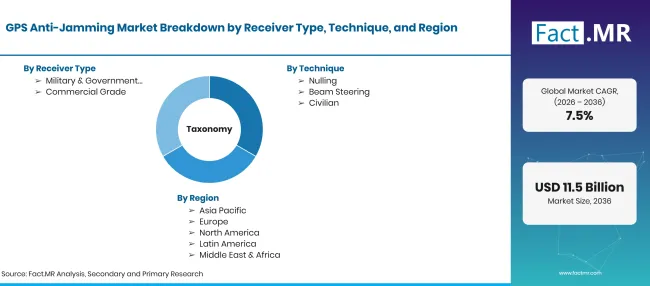
Gps Anti Jamming Market Taxonomy | Source: Fact.MR
| Attribute | Details |
|---|---|
| Quantitative Units | USD billion |
| Market Definition | Receivers, antennas and processing units that detect, suppress or reject intentional and accidental interference with GPS signals on military, government and commercial platforms. |
| Receiver Type | Military & Government Grade; Commercial Grade |
| Technique | Nulling; Beam Steering; Civilian; Others |
| Application | Flight Control; Surveillance & Reconnaissance; Position, Navigation & Timing; Others |
| End-User | Military; Government; Commercial |
| Regions Covered | North America; Latin America; Western Europe; Eastern Europe; East Asia; South Asia & Pacific; Middle East & Africa |
| Countries Covered | Germany; Brazil; United States; United Kingdom; Japan |
| Companies Profiled | RTX (Raytheon); Collins Aerospace; BAE Systems; L3Harris Technologies; Lockheed Martin; NovAtel (Hexagon); Mayflower Communications |
| Forecast Period | 2026 to 2036 |
| Approach | Platform-level count of anti-jam installations by country, multiplied by receiver and antenna prices for each technique and checked against defence procurement records. |
Source: Fact.MR analysis. Updated Nov 6, 2026
How is the market segmented?
-
By Receiver Type
- Military & Government Grade
- Commercial Grade
-
By Technique
- Nulling
- Beam Steering
- Civilian
- Others
-
By Application
- Flight Control
- Surveillance & Reconnaissance
- Position, Navigation & Timing
- Others
-
By End-User
- Military
- Government
- Commercial
-
By Region
- North America
- Latin America
- Western Europe
- Eastern Europe
- East Asia
- South Asia & Pacific
- Middle East & Africa
Frequently Asked Questions
How large is the GPS anti-jamming market in 2026?
What growth rate will the GPS anti-jamming market record?
Which receiver type leads?
Which technique leads?
Which application leads?
Which end-user leads?
Which country will grow quickest?
Who are the main companies?
What holds the market back?
Who worked on this report


Preview the report firsthand - request a free sample
Free SampleGet the brochure for pricing and purchase details
Download PDF