- Market Value (2025): USD 409.2 Mn
- Estimated Value (2026): USD 434.2 Mn
- Forecast Value (2036): USD 785.0 Mn
- CAGR (2026-2036): 6.1%
What is the Milk Frother Market forecast to be worth by 2036?
USD 434.2 million in 2026 to USD 785.0 million by 2036 at 6.1% CAGR.
- The milk frother market reached USD 409.2 million in 2025.
- Demand is projected to increase from USD 434.2 million in 2026 to USD 785.0 million by 2036.
- The market is forecast to record 6.1% CAGR from 2026 to 2036 as households and cafés support premium beverage preparation.
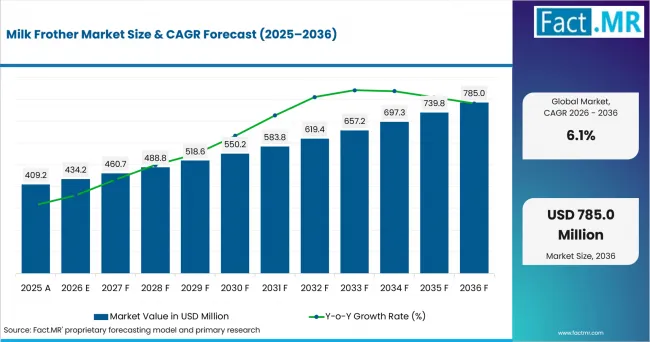
Milk Frother Market Value Analysis | Source: Fact.MR
What are the defining numbers behind Milk Frother Market growth?
USD 350.8 million absolute opportunity by 2036, led by Electric Milk Frothers and Household Beverage Preparation alongside Magnetic Frothing Technology and Retail Stores.
- Demand Drivers in the Market
- Residential consumers need repeatable foam texture for cappuccino, latte, cold foam, and cocoa routines.
- Home appliance retailers benefit from compact electric designs that fit countertop shopping and gifting.
- Coffee shops need durable tools so milk drinks stay consistent during rush periods.
- Online shoppers compare ratings, cleaning features, and power formats before buying.
- Key Segments Analyzed
- By Product: Electric Milk Frothers are expected to hold 37.40% share in 2026 due to simple operation and consistent foam texture.
- By Application: Household Beverage Preparation is projected to account for 79.20% share in 2026 as home coffee routines expand beyond basic brewing.
- By End Use: Residential Consumers are anticipated to capture 48.70% share in 2026 owing to daily use in kitchens and small apartments.
- By Technology: Magnetic Frothing Technology is estimated to represent 63.80% share in 2026 because enclosed whisk motion supports safer heating.
- By Formulation: Standalone Frothing Systems are forecast to hold 42.60% share in 2026 since shoppers prefer add-on appliances over full machine replacement.
- By Distribution Channel: Retail Stores are expected to account for 56.30% share in 2026 as shoppers still inspect appliance size and cleaning design.
- Analyst Opinion at Fact.MR
- Shambhu Nath Jha, Principal Consultant at Fact.MR, states, "Milk frothers now shape the home coffee setup. Acceptance is expected to depend on foam consistency and cleaning ease before shoppers pay for premium countertop systems. Brands that pair compact design with durable motors and clear milk-compatibility guidance are expected to gain stronger retail conversion."
- Strategic Implications
- Appliance brands should show foam quality across dairy and plant-based milk.
- Retailers should separate handheld, countertop, and integrated systems for easier comparison.
- Café operators should evaluate cleaning time and motor durability.
- Investors should separate direct frother demand from wider coffee machine cycles.
The UK at 7.4% CAGR through 2036, Germany at 7.0%, South Korea at 6.0%, and the USA and France at 5.4%. National retail, e-commerce and household-spending indicators cited in the country sections provide contextual evidence only and do not independently validate these milk-frother CAGRs.
How does the Milk Frother Market break down by segment?
Electric Milk Frothers lead Product at 37.4%; Household Beverage Preparation leads Application at 79.2%.
Which product dominates?
Electric Milk Frothers are projected to account for 37.4% share in 2026.
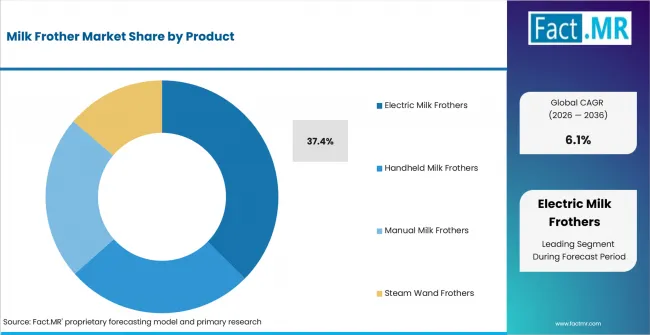
Milk Frother Market Analysis By Product | Source: Fact.MR
Electric Milk Frothers are expected to lead Product because they give users one-button foam with less skill. Automatic systems support repeatable texture in countertop units. Multifunction formats serve warm milk, cold foam, and cocoa. Breville’s official product portfolio includes the Milk Cafe countertop milk frother, providing direct product-level evidence for the company’s participation in this category.
What leads the Application segment?
Household Beverage Preparation is expected to hold 79.2% share in 2026.
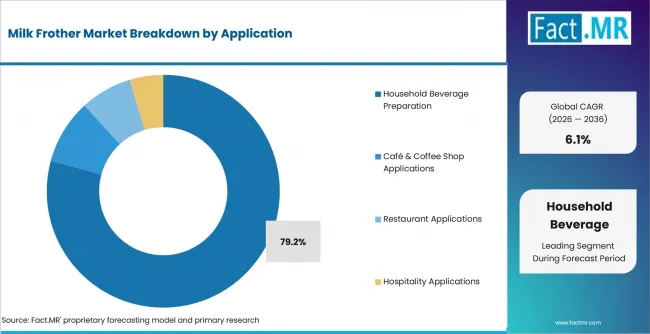
Milk Frother Market Analysis By Application | Source: Fact.MR
Household Beverage Preparation is projected to lead Application as most purchases support daily coffee routines. Coffee Preparation Applications add demand where espresso machines create milk-drink occasions. Specialty Beverage Applications are supported by cold foam. Nespresso’s official Aeroccino product information presents hot and cold milk frothing for coffee-and-milk recipes at home, providing direct product-level evidence for household frothing use.
How does End Use shape demand?
Residential Consumers are anticipated to lead with 48.7% share in 2026.
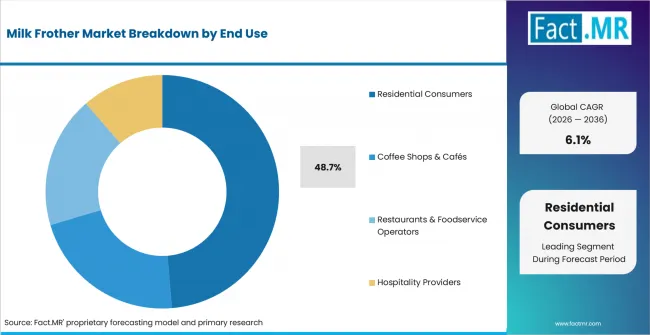
Milk Frother Market Analysis By End Use | Source: Fact.MR
Residential Consumers are anticipated to lead End Use because milk frothers solve one daily beverage task. Urban Households favor compact units that avoid espresso machine replacement. Suburban Households support countertop systems where kitchen space is less constrained. Nespresso’s official milk-frother guidance presents milk frothers as tools for preparing café-style coffee at home, providing direct product-level evidence for residential use.
What supports Magnetic Frothing Technology?
Magnetic Frothing Technology is estimated to represent 63.8% share in 2026.
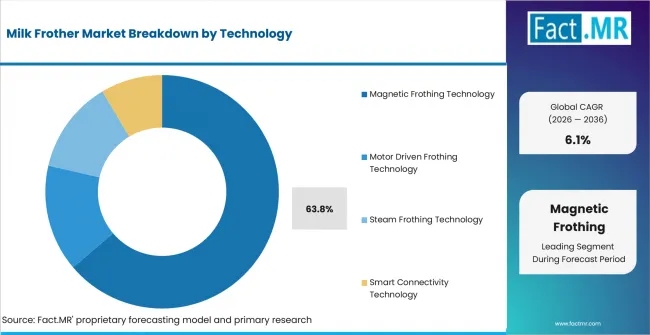
Milk Frother Market Analysis By Technology | Source: Fact.MR
Magnetic Frothing Technology is estimated to lead Technology because it supports enclosed countertop systems. Induction Driven Systems appeal to shoppers who want warm milk and foam from one base. Magnetic Whisk Systems simplify cleaning. JURA’s official Milk Frother product information states that its unit uses a magnetic drive, providing direct product-level evidence for magnetic frothing technology.
What supports Standalone Frothing Systems within Formulation?
Standalone Frothing Systems are forecast to hold 42.6% share in 2026.
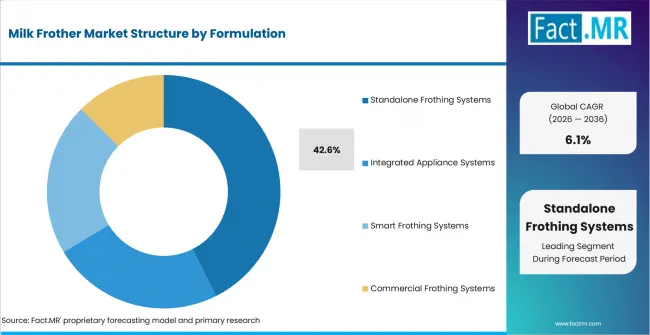
Milk Frother Market Analysis By Formulation | Source: Fact.MR
Standalone Frothing Systems are forecast to lead Formulation since shoppers add foam preparation separately. Countertop Configurations remain visible in appliance aisles. Portable Configurations serve users who want a smaller alternative. Melitta’s official product portfolio includes the standalone Cremio Milk Frother for warm and cold milk froth, providing direct product-level evidence for this format.
How does Distribution Channel influence buying?
Retail Stores are expected to account for 56.3% share in 2026.
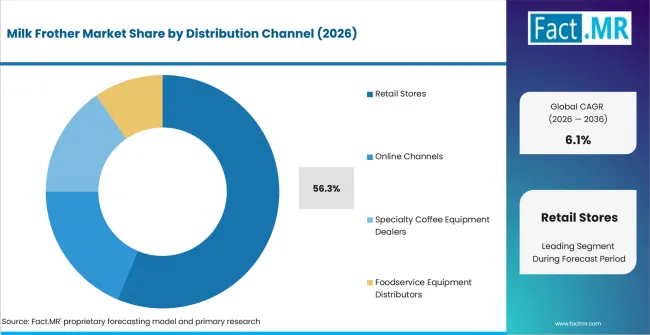
Milk Frother Market Analysis By Distribution Channel | Source: Fact.MR
Retail Stores are expected to lead Distribution Channel as shoppers compare size, finish, and cleaning design. Consumer Electronics Retailers support higher-priced countertop systems through staff advice. Home Appliance Retailers place frothers near kettles and coffee machines.
What is accelerating Milk Frother Market adoption, and what is holding it back?
At-home beverage preparation drives it; coffee price and appliance price sensitivity restrain it.
Drivers Impact Analysis
| DRIVER | (~) % IMPACT ON CAGR | GEOGRAPHIC RELEVANCE | IMPACT TIMELINE |
|---|---|---|---|
| At-home coffeehouse preparation | +1.8% | USA, UK, Germany | Short term (<= 2 years) |
| Electric and magnetic frothing systems | +1.4% | Europe, North America, East Asia | Short term (<= 2 years) |
| Retail and home appliance visibility | +1.0% | Retail-led markets | Medium term (2-4 years) |
| Café beverage menu standardization | +0.8% | UK, France, South Korea | Medium term (2-4 years) |
| Cold foam and specialty drink use | +0.6% | Urban consumer markets | Long term (>= 4 years) |
- At-home coffeehouse preparation: Consumers are expected to buy frothers as latte and cappuccino routines move into kitchens. Nespresso’s official milk-frother guidance presents milk frothers as tools for preparing café-style coffee at home.
- Electric and magnetic frothing systems: One-touch systems reduce the skill needed to make stable milk foam. Enclosed magnetic designs cut cleaning friction after daily use. Product choice is expected to move toward compact units that heat and froth in one cycle.
- Retail and home appliance visibility: Appliance shelves help shoppers compare capacity, finish, and cleaning access. Retailers group frothers with kettles and coffee machines. Placement is projected to support purchases where shoppers want a visible kitchen upgrade.
- Café beverage menu standardization: Independent cafés need repeatable texture across milk drinks during busy service periods. Manual wands and countertop units remain useful where full coffee systems are too costly. Commercial frothing systems are anticipated to gain attention when cleaning time and parts availability are documented.
- Cold foam and specialty drink use: Cold foam adds use occasions beyond hot cappuccino and latte preparation. Specialty drinks raise interest in rechargeable handheld formats. Demand is forecast to benefit when brands show cocoa, iced coffee, and plant-based recipes.
Opportunity Impact Analysis
| OPPORTUNITY | (~) % IMPACT ON CAGR | GEOGRAPHIC RELEVANCE | IMPACT TIMELINE |
|---|---|---|---|
| E-commerce marketplaces | +0.9% | USA, UK, South Korea | Short term (<= 2 years) |
| Connected appliance systems | +0.7% | Premium appliance markets | Medium term (2-4 years) |
| Specialty coffee dealers | +0.5% | Europe and North America | Medium term (2-4 years) |
| Commercial frothing systems | +0.4% | Cafés and hospitality channels | Long term (>= 4 years) |
- E-commerce marketplaces: Online channels help shoppers compare handheld and countertop units before purchase. The U.S. Census Bureau estimated that e-commerce accounted for 16.9% of total U.S. retail sales in Q1 2026; this is a broad retail-channel indicator rather than a measure of milk-frother sales. Appliance brands are expected to compete through ratings and cleaning claims.
- Connected appliance systems: App-connected frothers create opportunity where reminders reduce cleaning misses. Sensor Based Systems are expected to appeal to premium users who want temperature consistency. Adoption is expected to remain selective until simple benefits are clear in product pages.
- Specialty coffee dealers: Specialty dealers explain texture, jug capacity, and milk compatibility better than general appliance shelves. They serve shoppers who already buy beans and espresso tools. Dealers are anticipated to support premium conversion when staff demonstrate foam quality.
- Commercial frothing systems: Foodservice distributors serve operators needing capacity and durability proof. Hotels and cafés require easy cleaning because milk residue affects hygiene routines. Commercial demand is estimated to favor brands with service documentation and parts availability.
Restraints Impact Analysis
| RESTRAINT | (~) % IMPACT ON CAGR | GEOGRAPHIC RELEVANCE | IMPACT TIMELINE |
|---|---|---|---|
| Coffee and beverage price pressure | -1.0% | Germany, USA, France | Short term (<= 2 years) |
| Appliance price sensitivity | -0.8% | Mass retail markets | Short term (<= 2 years) |
| Cleaning and hygiene friction | -0.6% | Residential and café users | Medium term (2-4 years) |
| Durability expectations | -0.4% | Foodservice channels | Long term (>= 4 years) |
- Coffee and beverage price pressure: Higher input prices make optional accessories easier to delay. Destatis reported in February 2026 that coffee, tea, and cocoa prices were 18.2% higher year over year in January 2026. Households are expected to compare frother prices more closely.
- Appliance price sensitivity: Entry-level handheld products limit premium countertop pricing. Shoppers often treat frothers as accessories. Premium systems are projected to require clearer proof of heating control and cleaning convenience.
- Cleaning and hygiene friction: Milk residue around whisks and lids reduces satisfaction after daily use. Café operators face a larger burden because repeated milk handling needs faster cleaning. Brands are anticipated to improve repeat use through removable parts.
- Durability expectations: Foodservice use raises the need for warranty and parts support. Small motors and low-cost whisks are expected to fail faster under frequent service. Distributor acceptance is estimated to depend on replacement availability.
Which countries are scaling Milk Frother Market fastest?
- The country comparison spans 2.0 percentage points and forms three practical growth bands across the forecast period.
- The UK remains 0.4 percentage point above Germany through online appliance buying, foodservice beverage spending and strong at-home beverage preparation.
- Germany remains 1.0 percentage point above South Korea as retail recovery and electric appliance visibility support milk-frother demand.
- South Korea remains 0.6 percentage point above the USA through mobile commerce penetration and compact appliance buying.
- The USA and France are tied at 5.4% CAGR, with the USA supported by e-commerce reach and premium home coffee routines, while France benefits from household consumption and café beverage use.
- France closes the displayed range alongside the USA as household beverage spending and café use support milk-frother adoption.
Comparable CAGRs can create different entry conditions due to retail structure, e-commerce penetration, household beverage habits, appliance pricing and foodservice demand. Full report coverage includes North America, Latin America, Europe, East Asia, South Asia and Pacific, Middle East and Africa.
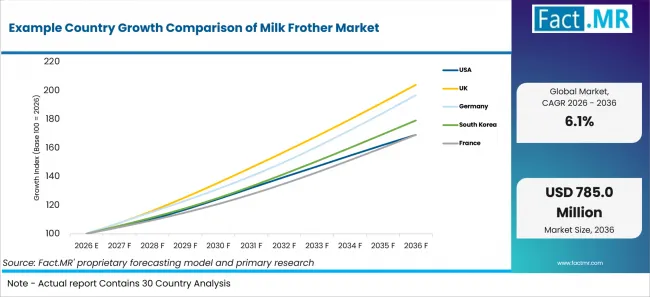
Example Country Growth Comparison Of Milk Frother Market | Source: Fact.MR
| Country | CAGR (2026-2036) |
|---|---|
| UK | 7.4% |
| Germany | 7.0% |
| South Korea | 6.0% |
| USA | 5.4% |
| France | 5.4% |
What supports UK adoption?
7.4% CAGR, supported by online appliance buying and foodservice beverage spending.
Online retail activity and foodservice spending provide a favorable backdrop for milk-frother demand in the UK. ONS reported that Great Britain online spending values rose 11.7% in Q2 2026 compared with Q2 2025. Defra reported UK expenditure on food and drink eaten out at GBP 137.7 billion in 2025, at constant 2023 prices.
How is Germany scaling demand?
7.0% CAGR, driven by retail recovery and electric appliance visibility.
Improving retail conditions and continued consumer exposure to electric kitchen appliances support Germany’s market outlook. Destatis reported that German retail sales rose 2.7% in real terms in 2025 versus 2024 and that prices for coffee, tea and cocoa were 18.2% higher in January 2026 than in January 2025.
How is South Korea developing demand?
6.0% CAGR, supported by mobile commerce and compact appliance buying.
High mobile-shopping participation gives compact beverage appliances a strong digital sales channel in South Korea. Statistics Korea reported that online shopping transaction value reached KRW 23.0335 trillion in July 2025, while mobile shopping accounted for 78.8% of total online shopping transaction value.
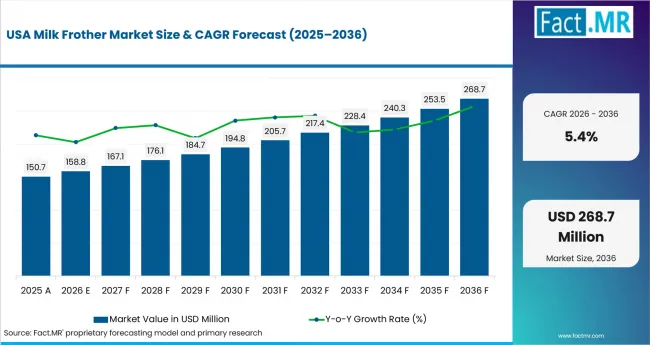
What underpins USA growth?
5.4% CAGR, backed by e-commerce reach and premium home coffee routines.
Milk Frother Market Country Value Analysis | Source: Fact.MR
Broad e-commerce reach supports product discovery and purchasing for home beverage appliances across the USA. The U.S. Census Bureau estimated seasonally adjusted Q1 2026 U.S. retail e-commerce sales at USD 326.7 billion, equal to 16.9% of total retail sales.
What supports France adoption?
5.4% CAGR, backed by household consumption and café beverage use.
Household spending and established beverage-consumption patterns provide demand support for milk-frothing appliances in France. INSEE reported that household final consumption expenditure increased 0.4% in volume in 2025 and that household spending on food and non-alcoholic beverages reached EUR 192.8 billion.
Who leads the Milk Frother Market?
Official product pages confirm direct milk-frother offerings from Nespresso/Nestlé, Breville, JURA, Melitta and Keurig. Glen Dimplex has direct market relevance through its Morphy Richards brand, while Philips has official Milk Twister product documentation.
Nespresso markets Aeroccino milk frothers; Breville markets the Milk Cafe; and JURA markets dedicated milk frothers. These are direct product-level links to the defined market rather than only adjacent coffee-machine exposure.
Melitta markets the Cremio Milk Frother, Keurig markets the K-Froth Hot and Cold Café Frother, and Morphy Richards, listed by Glen Dimplex as a consumer-appliance brand, markets an electric milk frother. Philips also provides official Milk Twister product documentation. Competition is expected to center on foam repeatability, cleaning design, heating control, retail reach, and daily-use convenience.
Which companies are the key providers?
Verified direct product evidence was found for Nespresso/Nestlé, Breville, JURA, Melitta, Keurig/Keurig Dr Pepper and Glen Dimplex through Morphy Richards. Philips also has official Milk Twister product documentation. Smeg is included as a verified provider with a dedicated milk-frother product range.
- Nestlé SA.
- Breville Group Limited
- JURA Elektroapparate AG
- De’Longhi S.p.A.
- Versuni (Philips brand)
- Keurig Dr Pepper Inc
- Melitta Group
- Smeg S.p.A.
Bibliography
- Department for Environment, Food & Rural Affairs. (2026, July 29). Chapter 14: The food chain. GOV.UK.
- Statistisches Bundesamt (Destatis). (2026, February 2). Einzelhandelsumsatz im Jahr 2025 real um 2,7 % höher als im Vorjahr [Retail sales in 2025 were 2.7% higher in real terms than in the previous year].
- Federal Statistical Office (Destatis). (2026, February 17). Inflation rate at +2.1% in January 2026.
- Beretti, P.-A., & Pereira, É. (2026, June 16). Household consumption in 2025: Household consumption slowed despite a sharp deceleration in prices. Insee.
- Melitta Group. (2026, March 31). Melitta Group preliminary figures for 2025.
- Nestlé. (2026, February 19). Full-year results 2025 and strategic update: Strong momentum, accelerating strategic change.
- Office for National Statistics. (2026, July 24). Retail sales, Great Britain: June 2026.
- Statistics Korea. (2025, September 1). Online shopping in July 2025.
- U.S. Census Bureau. (2026, May 18). Quarterly retail e-commerce sales: 1st quarter 2026.
This Report Answers
- The report provides strategic intelligence on the Milk Frother Market across Product and Application choices that shape consumer and foodservice buying.
- Segment analysis covers Electric Milk Frothers and Household Beverage Preparation as the share leaders within the 2026 market.
- Country outlook evaluates the UK and Germany alongside South Korea. The USA and France complete the growth comparison across the profiled markets.
- Competitive analysis profiles Nestlé S.A. and Breville Group Limited alongside JURA Elektroapparate AG. and Philips. Glen Dimplex, Keurig Dr Pepper, Melitta, and Smeg complete the verified provider set.
- Technology assessment covers Magnetic Frothing Technology and Motor Driven Frothing Technology. Steam Frothing Technology and Smart Connectivity Technology complete the technology view.
What does the Milk Frother Market cover?
Electric, handheld, manual, and steam frothing systems used for milk foam preparation.
The Milk Frother Market covers devices used to aerate milk for coffee, cocoa, cold foam, and specialty beverages. Coverage extends to standalone countertop systems, handheld frothers, manual press systems, steam wand units, and appliance-integrated formats.
The market differs from the broader coffee machine category because the core function is milk foam preparation. Espresso machines are included only when the analysis relates to integrated milk frothing, while unrelated brewing systems remain outside the product boundary.
What is included in the scope?
Milk frother systems used in household, café, restaurant, hospitality, and retail beverage preparation.
The scope includes Product, Application, End Use, Technology, Formulation, and Distribution Channel. Coverage spans electric units, handheld formats, manual pumps, steam wand systems, and appliance-integrated systems. The analysis also tracks household use and café beverage service. Adjacent demand from coffee pods and coffee machine categories is considered only where it supports milk foam preparation. Related premium beverage signals from specialty coffee are used to interpret drink-format adoption.
What is excluded from the scope?
General coffee brewers and unrelated kitchen appliances are outside the scope.
The scope excludes coffee makers that do not include or support a milk frothing function. It also excludes beverage ingredients, coffee beans, capsules, creamers, kettles, and blenders unless the item is sold as part of a frothing system. Commercial café equipment is included only when milk frothing is the relevant use case.
How Was the Analysis Built?
The analysis draws on public statistics, company and product sources, country data, and industry interviews.
- Primary Research: Primary research includes discussions with appliance manufacturers, coffee equipment distributors, retail buyers, café operators, and product specialists. These conversations examine product selection, cleaning expectations, price sensitivity, and retail placement.
- Desk Research: Desk research covers official statistics, retail data, e-commerce releases, company filings, product pages, and annual reports. The bibliography documents the public sources cited in the narrative.
- Market Sizing and Forecasting: Market estimates combine historical performance, retail indicators, segment shares, channel patterns, country-level growth, appliance replacement cycles, and beverage-use trends.
- Data Validation and Update Cycle: Findings are validated by comparing interview inputs with public data, company activity, product availability, and channel behavior. Regular updates review launches, partnerships, pricing shifts, and commercial adoption.
What is the report's scope and coverage?
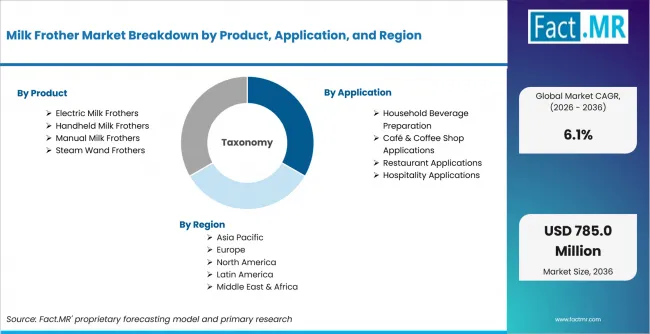
Milk Frother Market Breakdown By Product, Application, And Region | Source: Fact.MR
| Attribute | Details |
|---|---|
| Quantitative Units | USD million |
| Market Definition | Standalone and appliance-integrated tools used to create milk foam for coffee, cocoa, cold foam, and other beverage routines. |
| Product | Electric Milk Frothers; Automatic Frothing Systems; Multifunction Frothing Systems; Handheld Milk Frothers; Battery Operated Frothers; Rechargeable Frothers; Manual Milk Frothers; Pump Action Frothers; Press Frothing Systems; Steam Wand Frothers; Integrated Steam Wand Systems; Standalone Steam Frothers |
| Application | Household Beverage Preparation; Coffee Preparation Applications; Specialty Beverage Applications; Café and Coffee Shop Applications; Independent Café Applications; Chain Coffee Shop Applications; Restaurant Applications; Full Service Restaurant Applications; Quick Service Restaurant Applications; Hospitality Applications; Hotel Beverage Services; Event Catering Applications |
| End Use | Residential Consumers; Urban Households; Suburban Households; Coffee Shops and Cafés; Independent Coffee Shops; Coffee Chain Operators; Restaurants and Foodservice Operators; Casual Dining Operators; Quick Service Operators; Hospitality Providers; Hotels and Resorts; Catering Service Providers |
| Technology | Magnetic Frothing Technology; Induction Driven Systems; Magnetic Whisk Systems; Motor Driven Frothing Technology; High Torque Motor Systems; Energy Efficient Motor Systems; Steam Frothing Technology; Pressure Steam Systems; Automatic Steam Control Systems; Smart Connectivity Technology; App Connected Systems; Sensor Based Systems |
| Formulation | Standalone Frothing Systems; Countertop Configurations; Portable Configurations; Integrated Appliance Systems; Coffee Machine Integrated Systems; Kitchen Appliance Integrated Systems; Smart Frothing Systems; Automated Beverage Systems; Connected Appliance Systems; Commercial Frothing Systems; High Capacity Systems; Professional Barista Systems |
| Distribution Channel | Retail Stores; Consumer Electronics Retailers; Home Appliance Retailers; Online Channels; E-Commerce Marketplaces; Direct Brand Websites; Specialty Coffee Equipment Dealers; Professional Equipment Dealers; Premium Beverage Equipment Dealers; Foodservice Equipment Distributors; Restaurant Equipment Suppliers; Institutional Equipment Suppliers |
| Regions Covered | North America; Latin America; Europe; East Asia; South Asia and Pacific; Middle East and Africa |
| Countries Covered | USA; UK; Germany; South Korea; France |
| Key Companies Profiled | Nestlé SA.; Breville Group Limited; JURA Elektroapparate AG; De’Longhi S.p.A.; Versuni (Philips brand); Keurig Dr Pepper Inc; Melitta Group; Smeg S.p.A. |
| Forecast Period | 2026 to 2036 |
| Approach | Hybrid top-down and bottom-up approach using appliance retail demand; home coffee routines; café beverage menus; channel mix; product format comparisons; country adoption patterns; company portfolio review; and official statistics on retail, e-commerce, household consumption, and beverage spending. |
How is the market segmented?
-
By Product
- Electric Milk Frothers
- Automatic Frothing Systems
- Multifunction Frothing Systems
- Handheld Milk Frothers
- Battery Operated Frothers
- Rechargeable Frothers
- Manual Milk Frothers
- Pump Action Frothers
- Press Frothing Systems
- Steam Wand Frothers
- Integrated Steam Wand Systems
- Standalone Steam Frothers
- Electric Milk Frothers
-
By Application
- Household Beverage Preparation
- Coffee Preparation Applications
- Specialty Beverage Applications
- Café & Coffee Shop Applications
- Independent Café Applications
- Chain Coffee Shop Applications
- Restaurant Applications
- Full Service Restaurant Applications
- Quick Service Restaurant Applications
- Hospitality Applications
- Hotel Beverage Services
- Event Catering Applications
- Household Beverage Preparation
-
By End Use
- Residential Consumers
- Urban Households
- Suburban Households
- Coffee Shops & Cafés
- Independent Coffee Shops
- Coffee Chain Operators
- Restaurants & Foodservice Operators
- Casual Dining Operators
- Quick Service Operators
- Hospitality Providers
- Hotels & Resorts
- Catering Service Providers
- Residential Consumers
-
By Technology
- Magnetic Frothing Technology
- Induction Driven Systems
- Magnetic Whisk Systems
- Motor Driven Frothing Technology
- High Torque Motor Systems
- Energy Efficient Motor Systems
- Steam Frothing Technology
- Pressure Steam Systems
- Automatic Steam Control Systems
- Smart Connectivity Technology
- App Connected Systems
- Sensor Based Systems
- Magnetic Frothing Technology
-
By Formulation
- Standalone Frothing Systems
- Countertop Configurations
- Portable Configurations
- Integrated Appliance Systems
- Coffee Machine Integrated Systems
- Kitchen Appliance Integrated Systems
- Smart Frothing Systems
- Automated Beverage Systems
- Connected Appliance Systems
- Commercial Frothing Systems
- High Capacity Systems
- Professional Barista Systems
- Standalone Frothing Systems
-
By Distribution Channel
- Retail Stores
- Consumer Electronics Retailers
- Home Appliance Retailers
- Online Channels
- E-Commerce Marketplaces
- Direct Brand Websites
- Specialty Coffee Equipment Dealers
- Professional Equipment Dealers
- Premium Beverage Equipment Dealers
- Foodservice Equipment Distributors
- Restaurant Equipment Suppliers
- Institutional Equipment Suppliers
- Retail Stores
-
By Region
- North America
- Latin America
- Western Europe
- Eastern Europe
- East Asia
- South Asia and Pacific
- Middle East & Africa