- Market Value (2025): USD 2.3 Bn
- Estimated Value (2026): USD 2.4 Bn
- Forecast Value (2036): USD 3.8 Bn
- CAGR (2026-2036): 4.6%
What is the Ventilation Fan Market forecast to be worth by 2036?
USD 2.4 billion in 2026 and USD 3.8 billion by 2036, CAGR at 4.6%.
- The ventilation fan market reached USD 2.3 billion in 2025 as industrial replacement and building airflow projects supported steady order flow.
- Demand is projected to increase from USD 2.4 billion in 2026 to USD 3.8 billion by 2036.
- The market is forecast to record 4.6% CAGR from 2026 to 2036 owing to factory ventilation needs and controlled airflow in commercial buildings.
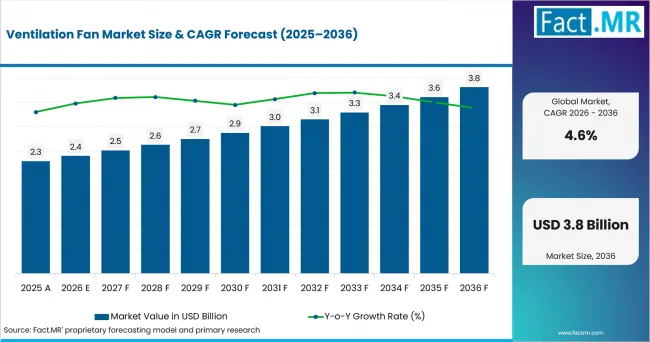
Ventilation Fan Market Value Analysis | Source: Fact.MR
What are the defining numbers behind Ventilation Fan Market growth?
USD 1.4 billion absolute opportunity by 2036, led by Axial Ventilation Fans and Industrial Ventilation alongside Industrial Facilities.
- Demand Drivers in the Market
- Plant engineers need axial ventilation fans that move high air volume across production floors without complex duct changes.
- Facility managers need industrial ventilation where heat, fumes and stale air affect work zones and equipment reliability.
- The U.S. Energy Information Administration reported in June 2025 that, by 2050, as much as 7% of U.S. commercial floorspace could require additional energy to meet data-center demand across most building types. EIA also projects related growth in commercial ventilation and space-cooling energy use.
- The U.S. Department of Energy requires energy-use and energy-efficiency representations for fans and blowers subject to 10 CFR § 431.174 to follow the applicable test procedures in Appendix A or Appendix B to Subpart J of 10 CFR Part 431.
- Key Segments Analyzed
- By Product: Axial Ventilation Fans are expected to hold 48.7% share in 2026 due to high-volume airflow needs in wall, roof and ducted factory layouts.
- By Application: Industrial Ventilation is projected to account for 74.1% share in 2026 owing to recurring demand from production floors and process areas.
- By End Use: Industrial Facilities are anticipated to capture 63.8% share in 2026 as factories require dependable air movement during shift operations.
- By Technology: Variable Speed Drive Technology is estimated to represent 36.5% share in 2026 since airflow control can lower waste during part-load operation.
- By System Type: Integrated Ventilation Systems are forecast to hold 57.9% share in 2026 as project teams prefer coordinated fans, controls and duct interfaces.
- By Distribution Channel: Direct Sales Channel is expected to account for 69.4% share in 2026 because engineered projects need sizing support before installation.
- Analyst Opinion at Fact.MR
- Shambhu Nath Jha, Principal Consultant at Fact.MR, states, “Ventilation fan purchasing is decided by fit, evidence and service access. Facilities are expected to favor fans that prove airflow duty before installation. Suppliers should combine motor control, noise data and local service support.”
- Strategic Implications
- Manufacturers should keep fan energy and test documentation ready because DOE test-procedure requirements govern how fan and blower efficiency and energy-use claims are represented.
- Facility teams should compare fan quotes against operating cost before approving variable speed or higher-efficiency packages.
- Distributors should maintain replacement stock for axial and roof fans where downtime can delay production or building occupancy work.
- System integrators should link fan controls with building automation so airflow changes can follow occupancy, temperature and process schedules.
Germany is projected to record 5.3% CAGR through 2036 supported by machinery and engineered factory airflow. Brazil is expected to post 4.8% CAGR as industrial production sustains replacement demand. The USA is forecast to advance at 4.4% CAGR owing to manufacturing construction and energy review. The UK is anticipated to reach 3.9% CAGR where repair work supports retrofits. Japan is estimated to register 3.5% CAGR as compact factories guide equipment selection.
How does the Ventilation Fan Market break down by segment?
Axial Ventilation Fans lead Product at 48.7%; Industrial Ventilation leads Application at 74.1%.
Which product dominates?
Axial Ventilation Fans are projected to account for 48.7% share in 2026.
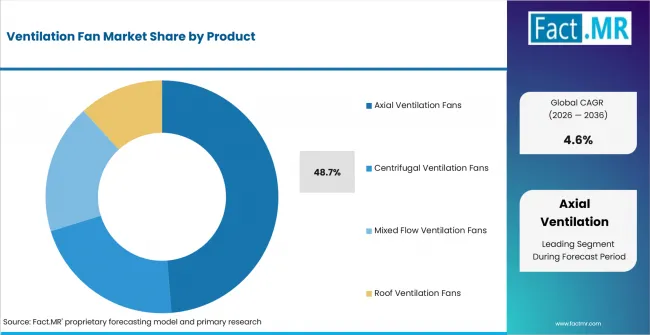
Ventilation Fan Market Analysis By Product | Source: Fact.MR
Axial Ventilation Fans are projected to lead Product demand due to their fit in high-volume air movement. Tube axial fans suit straight airflow paths. Vane axial fans help when operators need higher pressure recovery. Centrifugal, mixed flow and roof fans serve higher-resistance or compact projects.
What leads the Application segment?
Industrial Ventilation is expected to hold 74.1% share in 2026.
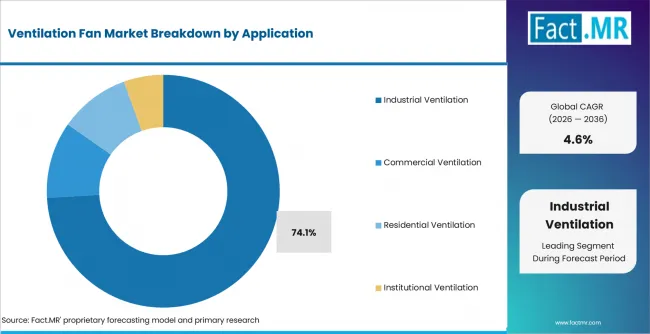
Ventilation Fan Market Analysis By Application | Source: Fact.MR
Industrial Ventilation is expected to lead Application revenue because factories need planned airflow across process rooms and production bays. Manufacturing facility ventilation handles heat and general air exchange. Process ventilation supports extraction around materials and equipment. ONS reported in July 2026 that Great Britain construction output grew 1.6% in the three months to May 2026.
How does End Use shape demand?
Industrial Facilities are anticipated to lead with 63.8% share in 2026.
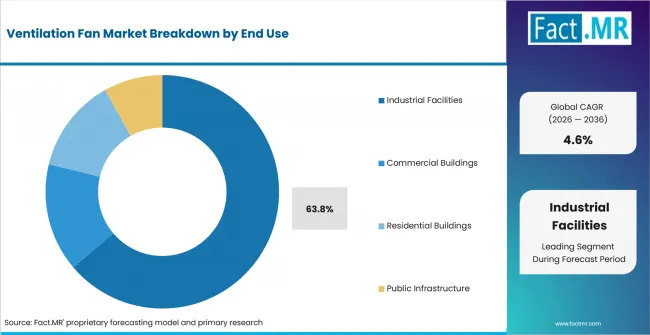
Ventilation Fan Market Analysis By End Use | Source: Fact.MR
Industrial Facilities are anticipated to lead End Use spending as factories need durable housings and serviceable motors. Manufacturing sites require repeatable airflow during long shifts. Process industries need fans that tolerate heat or dust. Commercial buildings and public infrastructure purchase more selectively.
What supports Variable Speed Drive Technology?
Variable Speed Drive Technology is estimated to represent 36.5% share in 2026.
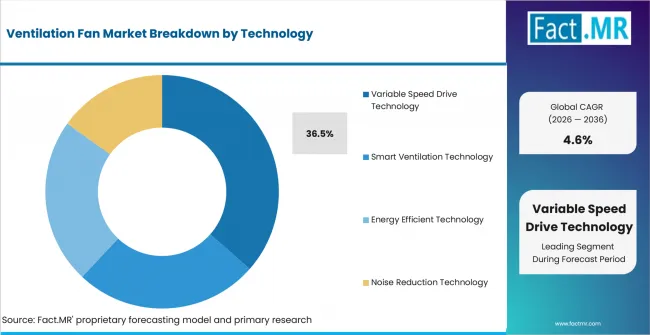
Ventilation Fan Market Analysis By Technology | Source: Fact.MR
Variable Speed Drive Technology is estimated to represent the main technology category because facilities can adjust airflow. AC drive systems fit many standardized industrial installations. DC drive systems suit smaller packaged units. Sensor based and connected systems help maintenance teams see faults earlier.
Which system type leads demand?
Integrated Ventilation Systems are forecast to hold 57.9% share in 2026.
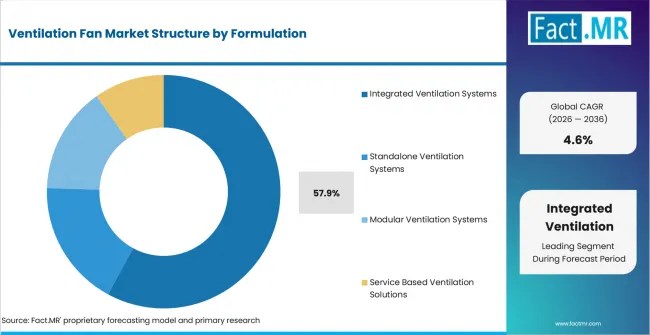
Ventilation Fan Market Analysis By Formulation | Source: Fact.MR
Integrated Ventilation Systems are forecast to lead System Type because contractors often want fans and controls planned together. Building integrated systems support commercial projects with wider HVAC controls. Standalone systems remain useful in smaller rooms or simple exhaust duties.
What supports Direct Sales Channel adoption?
Direct Sales Channel is expected to account for 69.4% share in 2026.
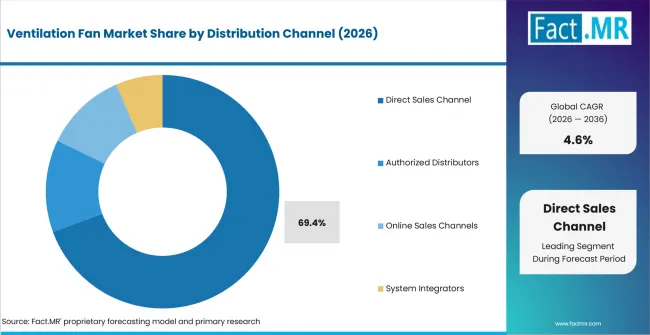
Ventilation Fan Market Analysis By Distribution Channel | Source: Fact.MR
Direct Sales Channel is expected to lead Distribution Channel spending as large projects need supplier input before purchase orders. OEM sales support equipment builders. Project based sales help contractors match airflow duty with duct pressure. Distributors handle faster replacement demand.
What is accelerating Ventilation Fan Market adoption, and what is holding it back?
Industrial airflow control drives it; installation cost and price pressure restrain it.
Drivers Impact Analysis
| DRIVER | (~) % IMPACT ON CAGR | GEOGRAPHIC RELEVANCE | IMPACT TIMELINE |
|---|---|---|---|
| Industrial airflow control | +1.1% | Germany, USA, Brazil | Short term (<= 2 years) |
| Variable speed retrofit | +0.9% | USA, UK, Japan | Short term (<= 2 years) |
| Building integrated ventilation | +0.8% | USA, UK, Germany | Medium term (2-4 years) |
| Direct project specification | +0.6% | Engineered projects | Medium term (2-4 years) |
| Residential and institutional replacement | +0.5% | Japan, UK, USA | Long term (>= 4 years) |
Source: Fact.MR analysis. Updated Aug 17, 2026
- Industrial airflow control: Factories are expected to increase ventilation spending where heat and air contaminants affect operations. Destatis's 5 February 2026 provisional release reported that new orders in the manufacture of machinery and equipment rose 11.5% month over month in December 2025. The statistic is used here as a directional machinery-activity indicator rather than as a direct measure of ventilation-fan demand.
- Variable speed retrofit: Variable speed drives are projected to gain where teams need airflow control without replacing every duct section. The case improves when energy review and shift schedules are managed together.
- Building integrated ventilation: Building integrated systems are anticipated to gain where contractors link fans with central controls. Adoption is slower when legacy controls cannot exchange data with newer fan packages.
- Direct project specification: Direct project specification is expected to support supplier selection because fan sizing depends on pressure and duct path. Smaller customers still use distributors when replacement duty is simple.
- Residential and institutional replacement: Residential and institutional replacement is forecast to support roof, mixed flow and compact fans. Ordering often follows maintenance cycles rather than large new-build programs.
Opportunity Impact Analysis
| OPPORTUNITY | (~) % IMPACT ON CAGR | GEOGRAPHIC RELEVANCE | IMPACT TIMELINE |
|---|---|---|---|
| Sensor enabled airflow control | +0.7% | USA, UK, Japan | Medium term (2-4 years) |
| Low noise roof fans | +0.5% | Urban buildings | Medium term (2-4 years) |
| Factory retrofit packages | +0.5% | Germany, Brazil, USA | Long term (>= 4 years) |
| Distributor led replacement | +0.4% | Regional repair markets | Long term (>= 4 years) |
Source: Fact.MR analysis. Updated Aug 17, 2026
- Sensor enabled airflow control: Sensor enabled airflow control is expected to create opportunity where buildings link ventilation to occupancy. Suppliers need simple interfaces because contractors resist systems that add commissioning time.
- Low noise roof fans: Low noise roof fans are projected to gain in dense buildings and institutional properties. The opportunity remains tied to projects where noise proof is checked before acceptance.
- Factory retrofit packages: Factory retrofit packages are anticipated to appeal to plants that need airflow improvement without long downtime windows. Suppliers still need accurate site checks before fixed-price offers.
- Distributor led replacement: Distributor led replacement is estimated to support standard fans used in smaller facilities. Online ordering is useful for repeat purchases but less suitable for engineered airflow problems.
Restraints Impact Analysis
| RESTRAINT | (~) % IMPACT ON CAGR | GEOGRAPHIC RELEVANCE | IMPACT TIMELINE |
|---|---|---|---|
| Installation and duct modification | -0.7% | Global | Short term (<= 2 years) |
| Motor and metal cost pressure | -0.5% | USA, Europe, Japan | Short term (<= 2 years) |
| Noise and vibration limits | -0.4% | Urban and institutional projects | Medium term (2-4 years) |
| Fragmented replacement buying | -0.3% | Small facilities | Long term (>= 4 years) |
Source: Fact.MR analysis. Updated Aug 17, 2026
- Installation and duct modification: Installation and duct modification are expected to restrain faster replacement where older buildings lack space for larger fans. Projects can move slowly when work must avoid production hours.
- Noise and vibration limits: Noise and vibration limits are forecast to shape product choice in hospitals and schools. Acoustic design can raise cost when fans need quieter housings or isolation mounts.
- Fragmented replacement buying: Fragmented replacement buying is expected to slow specification discipline in small facilities. Like-for-like orders can delay upgrades to variable speed or integrated systems.
Which countries are scaling Ventilation Fan Market fastest?
- The country comparison spans 1.8 percentage points and forms three practical growth bands across the forecast period.
- Germany remains 0.5 percentage point above Brazil due to machinery activity and engineered factory airflow demand.
- Brazil remains 0.4 percentage point above the USA as industrial production supports factory and warehouse fan replacement.
- The USA remains 0.5 percentage point above the UK owing to manufacturing construction and equipment efficiency review.
- The UK remains 0.4 percentage point above Japan where repair work supports replacement orders in older buildings.
- Japan closes the displayed range as compact factories and code-led building ventilation shape selective fan purchases.
Comparable CAGRs can create different entry conditions due to factory scale, building stock and local service depth. Full report coverage includes North America, Latin America, Europe, East Asia, South Asia and Pacific, Middle East and Africa.
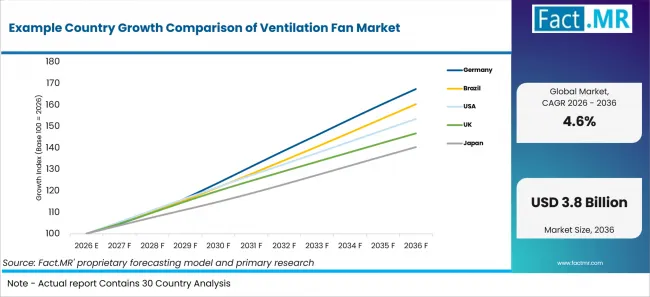
Example Country Growth Comparison Of Ventilation Fan Market | Source: Fact.MR
| Country | CAGR (2026-2036) |
|---|---|
| Germany | 5.3% |
| Brazil | 4.8% |
| USA | 4.4% |
| UK | 3.9% |
| Japan | 3.5% |
Source: Fact.MR analysis. Updated Aug 17, 2026
What supports Germany adoption?
5.3% CAGR, supported by machinery and metalworking ventilation replacement.
Germany benefits from a dense industrial base where engineers need reliable airflow in production spaces. Axial and centrifugal fans are expected to benefit from replacement work in machinery and metalworking. Destatis reported in March 2026 that the revised increase in real new manufacturing orders for December 2025 was 6.4% month over month. Vendors are expected to compete on duty proof and service access.
How is Brazil scaling demand?
4.8% CAGR, backed by industrial recovery and warehouse ventilation upgrades.
Brazil is supported by factory activity and logistics buildings that need practical ventilation upgrades. IBGE reported in March 2026 that Brazilian industrial production increased 1.8% in January 2026. Direct sales remain useful where project teams need fan sizing before installation.
What supports USA demand?
4.4% CAGR, supported by manufacturing construction and efficiency review.
The USA has a large installed base of factories, warehouses and commercial buildings that need regular fan replacement. Manufacturing projects create demand for ventilation tied to process heat. Efficiency review is expected to keep variable speed drives and documented fan performance visible in procurement.
How does the UK perform?
3.9% CAGR, led by industrial output and building repair activity.
The UK is shaped by refurbishment demand across older commercial and industrial buildings. ONS reported in July 2026 that repair and maintenance work grew 2.1% in the three months to May 2026. The statistic is used here as a directional retrofit indicator rather than as a direct measure of roof-fan or mixed-flow-fan demand.
What supports Japan’s growth?
3.5% CAGR, supported by compact factories and code-led building ventilation.
Japan’s demand is shaped by compact industrial sites where installation space is limited. METI reported in March 2026 that Japan’s revised, seasonally adjusted January 2026 production index reached 104.5, up 4.3% from the previous month.
Who leads the ventilation fan market?
Ebara Corporation, ACME Engineering & Manufacturing and Aerovent have directly verifiable ventilation-fan portfolios; portfolio evidence does not by itself establish market-share leadership.
Ebara Corporation has industrial equipment relevance across building and infrastructure airflow. ACME Engineering & Manufacturing supports propeller, roof and industrial fan products. Aerovent and Air Control Industries Ltd. extend the field through centrifugal, axial and process-air applications. ENERGY STAR lists Continental Fan’s TF100-EC at 100 CFM and 11.1 CFM/W, while Continental Fan rates the 100 CFM operating point at 1.0 sone; the 0.3-sone rating applies to the 50 CFM setting.
Which companies are the key providers?
Key companies include Ebara Corporation, ACME Engineering & Manufacturing, Aerovent, Air Control Industries Ltd., Airflow Developments Ltd., and Airmaster Fan Company.
- Ebara Corporation
- ACME Engineering & Manufacturing
- Aerovent
- Air Control Industries Ltd.
- Airflow Developments Ltd.
- Airmaster Fan Company
- AirMax Fans
- Axair Fans UK Ltd.
- Continental Fan Manufacturing Inc.
- Elta
- FAWENT SA
Bibliography
- Airmaster Fan Company. (2025, September 4). Investing in precision: Airmaster’s new laser goes live.
- U.S. Bureau of Labor Statistics. (2026, June 11). Producer Price Indexes – May 2026.
- Federal Statistical Office (Destatis). (2026, March 9). New orders in manufacturing in January 2026: -11.1% on the previous month [December 2025 revised to +6.4%].
- Brazilian Institute of Geography and Statistics. (2026, March 6). Industrial production up 1.8% in January. IBGE News Agency.
- Ministry of Economy, Trade and Industry. (2026, March 19). Indices of industrial production: Revised report for January 2026.
- Office for National Statistics. (2026, July 16). Construction output in Great Britain: May 2026.
- U.S. Energy Information Administration. (2025, June 25). Electricity use for commercial computing could surpass space cooling, ventilation.
This Report Answers
- The report provides strategic intelligence on the Ventilation Fan Market across Product and Application choices that shape industrial and building airflow projects.
- Segment analysis covers Axial Ventilation Fans and Industrial Ventilation as the share leaders within the 2026 market.
- Country outlook evaluates Germany and Brazil alongside the USA, UK and Japan across the profiled growth comparison.
- Competitive analysis profiles Ebara Corporation and ACME Engineering & Manufacturing alongside Aerovent and Air Control Industries Ltd. Airflow Developments Ltd., Airmaster Fan Company and other providers complete the supplier set.
- Technology assessment covers Variable Speed Drive Technology and Smart Ventilation Technology. Energy Efficient Technology and Noise Reduction Technology complete the product-planning view.
What does the Ventilation Fan Market cover?
Ventilation fans are powered air movement products used to move, exhaust or circulate air where comfort, process reliability or code compliance requires controlled airflow.
The Ventilation Fan Market covers axial, centrifugal, mixed flow and roof fans used in industrial, commercial, residential and institutional settings. Coverage extends to tube axial, vane axial, inline mixed flow and powered roof fan formats. The market includes standalone units and integrated ventilation systems.
What is included in the scope?
Ventilation fan demand is included where products support planned air exchange, heat removal, exhaust duty or process-area airflow. The scope includes direct sales, OEM supply, project based sales, distributors, online channels and system integrators. Industrial facilities and commercial buildings form the main demand base.
What is excluded from the scope?
General HVAC equipment remains outside the scope unless the item is a powered ventilation fan or bundled with fan installation. Air conditioners, chillers, filters and dampers are excluded when fan revenue cannot be separated. Consumer desk fans and decorative ceiling fans are excluded.
How Was the Analysis Built?
The analysis draws on 120+ sources, 35+ company portfolios, 25+ countries, and more than 20 industry interviews.
- Primary Research: Primary research includes discussions with manufacturers, service providers, technology developers, distributors, end users, procurement teams, and subject-matter experts. These conversations examine purchasing priorities, product adoption, operational challenges, approval requirements, competitive positioning, and the factors that influence wider market acceptance.
- Desk Research: Desk research covers government statistics, regulatory publications, company filings, trade data, technical studies, industry associations, standards, public policy, and other authoritative sources. Every source used in the analysis is documented in the bibliography.
- Market Sizing and Forecasting: Market estimates combine historical performance, demand indicators, pricing and volume trends, segment shares, company participation, country-level growth, adoption patterns, investment activity, and barriers to market expansion.
- Data Validation and Update Cycle: Findings are validated by comparing primary interviews with public data, company activity, regulatory changes, trade patterns, and industry developments. Regular updates review new product launches, capacity changes, partnerships, approvals, procurement trends, and shifts in commercial adoption.
Segmentation
What is the report’s scope and coverage?
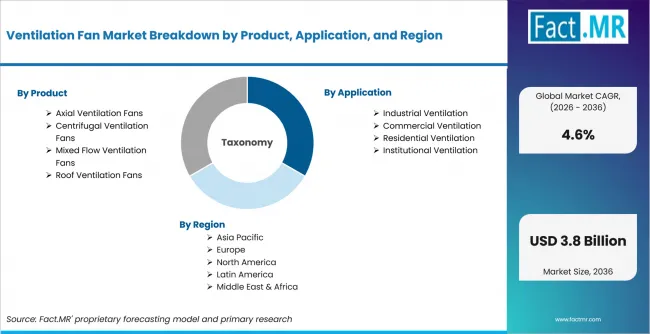
Ventilation Fan Market Breakdown By Product, Application, And Region | Source: Fact.MR
| Attribute | Details |
|---|---|
| Quantitative Units | USD billion in 2026 to USD billion by 2036 at CAGR |
| Market Definition | Powered ventilation fans used to exhaust stale air, remove heat, support air exchange and maintain airflow in industrial, commercial, residential and institutional settings |
| Product | Axial Ventilation Fans; Centrifugal Ventilation Fans; Mixed Flow Ventilation Fans; Roof Ventilation Fans |
| Application | Industrial Ventilation; Commercial Ventilation; Residential Ventilation; Institutional Ventilation |
| End Use | Industrial Facilities; Commercial Buildings; Residential Buildings; Public Infrastructure |
| Technology | Variable Speed Drive Technology; Smart Ventilation Technology; Energy Efficient Technology; Noise Reduction Technology |
| System Type | Integrated Ventilation Systems; Standalone Ventilation Systems; Modular Ventilation Systems |
| Distribution Channel | Direct Sales Channel; Authorized Distributors; Online Sales Channels; System Integrators |
| Regions Covered | North America; Latin America; Europe; East Asia; South Asia and Pacific; Middle East and Africa |
| Countries Covered | Germany; Brazil; USA; UK; Japan |
| Key Companies Profiled | Ebara Corporation; ACME Engineering & Manufacturing; Aerovent; Air Control Industries Ltd.; Airflow Developments Ltd.; Airmaster Fan Company; AirMax Fans; Axair Fans UK Ltd.; Continental Fan Manufacturing Inc.; Elta; FAWENT SA |
| Forecast Period | 2026 to 2036 |
| Approach | Hybrid top-down and bottom-up approach using fan product demand; industrial ventilation requirements; building repair indicators; country adoption patterns; energy efficiency review; channel structure; supplier portfolio checks; installed-base replacement and evidence review |
Source: Fact.MR analysis. Updated Aug 17, 2026
How is the market segmented?
-
By Product
- Axial Ventilation Fans
- Tube Axial Fans
- Vane Axial Fans
- Centrifugal Ventilation Fans
- Forward Curved Centrifugal Fans
- Backward Curved Centrifugal Fans
- Mixed Flow Ventilation Fans
- Inline Mixed Flow Fans
- Ducted Mixed Flow Fans
- Roof Ventilation Fans
- Powered Roof Fans
- Axial Ventilation Fans
-
By Application
- Industrial Ventilation
- Manufacturing Facility Ventilation
- Process Industry Ventilation
- Commercial Ventilation
- Office Building Ventilation
- Retail Ventilation
- Residential Ventilation
- Single Family Housing Ventilation
- Multi Family Housing Ventilation
- Institutional Ventilation
- Healthcare Facility Ventilation
- Educational Facility Ventilation
-
By End Use
- Industrial Facilities
- Manufacturing Facilities
- Process Industries
- Commercial Buildings
- Office Complexes
- Retail Establishments
- Residential Buildings
- Independent Residences
- Multi Unit Residences
- Public Infrastructure
- Healthcare Infrastructure
- Educational Infrastructure
- Industrial Facilities
-
By Technology
- Variable Speed Drive Technology
- AC Drive Systems
- DC Drive Systems
- Smart Ventilation Technology
- Sensor Based Systems
- Connected Ventilation Systems
- Energy Efficient Technology
- High Efficiency Motor Systems
- Noise Reduction Technology
- Acoustic Design Systems
- Vibration Control Systems
- Variable Speed Drive Technology
-
By System Type
- Integrated Ventilation Systems
- Building Integrated Systems
- Automation Integrated Systems
- Standalone Ventilation Systems
- Portable Ventilation Systems
- Fixed Installation Systems
- Modular Ventilation Systems
- Expandable Ventilation Units
- Application Specific Systems
- Integrated Ventilation Systems
-
By Distribution Channel
- Direct Sales Channel
- OEM Sales
- Project Based Sales
- Authorized Distributors
- Regional Distribution Networks
- Specialized Ventilation Distributors
- Online Sales Channels
- B2B E Commerce Platforms
- Manufacturer Direct Platforms
- System Integrators
- HVAC System Integrators
- Building Automation Integrators
- Direct Sales Channel
-
By Region
- North America
- Latin America
- Europe
- East Asia
- South Asia and Oceania
- Middle East and Africa
Frequently Asked Questions
How big is the ventilation fan market in 2026?
What is the CAGR of the ventilation fan market from 2026 to 2036?
Which product leads the ventilation fan market?
Which application leads the ventilation fan market?
Who are the leading companies in the ventilation fan market?
Who worked on this report


Preview the report firsthand - request a free sample
Free SampleGet the brochure for pricing and purchase details
Download PDF