- Market Value (2025): USD 2.9 Bn
- Estimated Value (2026): USD 3.1 Bn
- Forecast Value (2036): USD 5.4 Bn
- CAGR (2026-2036): 5.7%
What is the Poly Trucks Market forecast to be worth by 2036?
USD 3.1 billion in 2026 and USD 5.4 billion by 2036, at a 5.7% CAGR.
- The poly trucks market reached USD 2.9 billion in 2025 as internal handling needs remained steady across factories and service sites.
- Demand is projected to increase from USD 3.1 billion in 2026 to USD 5.4 billion by 2036.
- The market is forecast to record 5.7% CAGR from 2026 to 2036 as plant operators and laundries standardize molded trucks for routine movement.
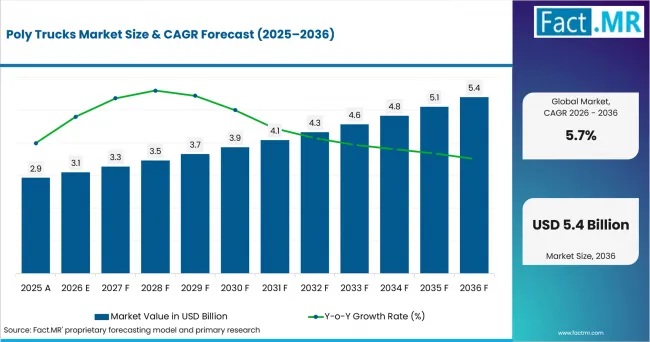
Poly Trucks Market Value Analysis | Source: Fact.MR
What are the defining numbers behind Poly Trucks Market growth?
USD 2.3 billion absolute opportunity by 2036, led by Utility Poly Trucks and Industrial Facilities alongside Direct Industrial Sales.
- Demand Drivers in the Market
- Facility managers need molded trucks that reduce strain during repetitive routes where floor distance and load weight decide replacement timing.
- Logistics teams need carts near receiving areas. The Bureau of Transportation Statistics reported in July 2026 that North American transborder freight reached USD 153.4 billion in May 2026.
- Laundry service teams need smooth interiors and reliable casters because linen movement depends on quick collection and wash-down routines.
- Warehouse procurement teams are expected to favor body designs that protect floors while keeping replacement wheels and handles easy to source.
- Key Segments Analyzed
- By Product: Utility Poly Trucks are expected to hold 78.20% share in 2026 owing to broad use across waste, linen and supply movement.
- By Application: Material Handling Applications are projected to account for 36.80% share in 2026 because factories and warehouses require durable load movement between work zones.
- By End Use: Industrial Facilities are anticipated to capture 63.70% share in 2026 since production floors rely on repeatable internal movement.
- By Technology: Rotational Molding Technology is estimated to represent 54.90% share in 2026 due to its value in seamless bodies and impact-tolerant forms.
- By Formulation: High Density Polyethylene Configurations are forecast to hold 47.60% share in 2026 because HDPE supports cleaning routines and abrasion exposure.
- By Distribution Channel: Direct Industrial Sales are expected to capture 71.30% share in 2026 as enterprise accounts standardize sizes, colors and replacement parts.
- Analyst Opinion at Fact.MR
- Shambhu Nath Jha, Principal Consultant at Fact.MR, states, "Poly trucks draw attention because purchasing links ergonomics with sanitation and load durability. Procurement is expected to move toward suppliers that document caster options and body capacity clearly. Better-positioned providers combine molded body quality with practical service support."
- Strategic Implications
- Procurement heads should compare load rating and wheel design before approving multi-site truck standards.
- Safety managers should review slopes, thresholds and push routes before selecting manual or assisted tilt formats. The U.S. Bureau of Labor Statistics reported in January 2026 that private employers recorded 2.5 million nonfatal injury and illness cases in 2024.
- Molded-product manufacturers should publish HDPE body specifications so facility accounts understand cleaning and abrasion limits.
- Industrial distributors should keep caster kits and lids near truck inventory because serviceability influences repeat orders.
Germany is expected to record 6.6% CAGR through 2036 owing to manufacturing depth. Brazil is projected to post 6.0% CAGR as service facilities expand internal movement. The USA is anticipated to advance at 5.4% CAGR due to warehouse scale. The UK is estimated to reach 4.8% CAGR with food manufacturing support. Japan is forecast to record 4.3% CAGR as compact sites favor smaller durable carts.
How does the Poly Trucks Market break down by segment?
Utility Poly Trucks are expected to lead Product at 78.20% share in 2026. Direct Industrial Sales are projected to lead Distribution Channel at 71.30% share in 2026.
Which product dominates?
Utility Poly Trucks are projected to account for 78.2% share in 2026.
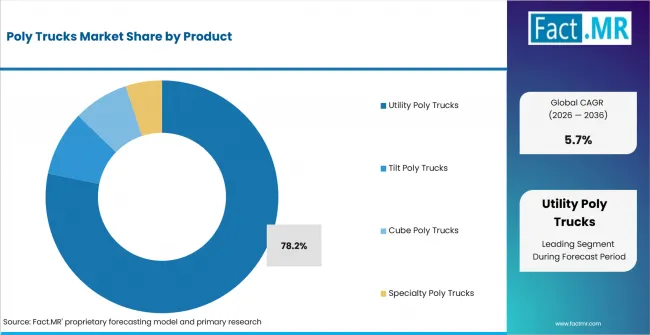
Poly Trucks Market Analysis By Product | Source: Fact.MR
Utility poly trucks are projected to lead Product because one body style serves waste rooms and production floors. General Purpose Poly Trucks support smaller loads where staff need a simple rolling container. Multi Use Poly Trucks address facilities that switch between supplies and refuse. Tilt Poly Trucks retain value where users need controlled dumping.
What leads the Application segment?
Material Handling Applications are expected to hold 36.8% share in 2026.
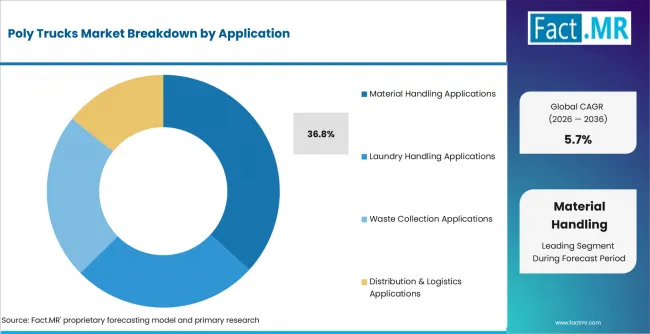
Poly Trucks Market Analysis By Application | Source: Fact.MR
Material Handling Applications are expected to lead because poly trucks solve daily movement needs before automation is justified. Warehouses use them for overflow and returns. Factories use carts for parts and scrap transfer.
How does End Use shape demand?
Industrial Facilities are anticipated to lead with 63.7% share in 2026.
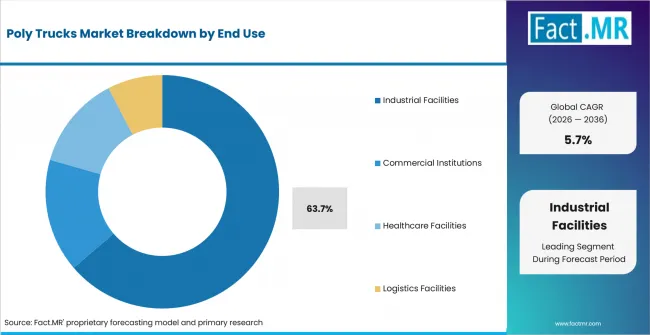
Poly Trucks Market Analysis By End Use | Source: Fact.MR
Industrial Facilities are anticipated to lead End Use because production sites need containers that tolerate impact and cleaning. Manufacturing plants use molded trucks for line-side movement and waste staging. Processing facilities need wheels that work on rough floors. Destatis reported in March 2026 that the revised increase in German manufacturing orders for December 2025 was 6.4% month over month.
What supports Rotational Molding Technology?
Rotational Molding Technology is estimated to represent 54.9% share in 2026.
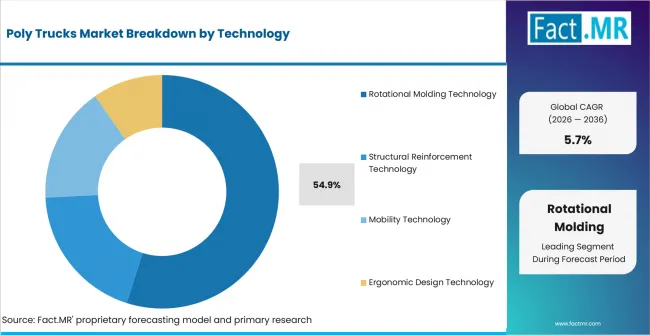
Poly Trucks Market Analysis By Technology | Source: Fact.MR
Rotational Molding Technology is estimated to lead Technology since large seamless bodies reduce weak points around corners. Single Wall Molding Systems serve lighter duty movement. Double Wall Molding Systems support routes that need added stiffness. Structural Reinforcement Technology remains relevant when carts meet sharp thresholds or uneven floors.
What supports High Density Polyethylene Configurations?
High Density Polyethylene Configurations are forecast to hold 47.6% share in 2026.
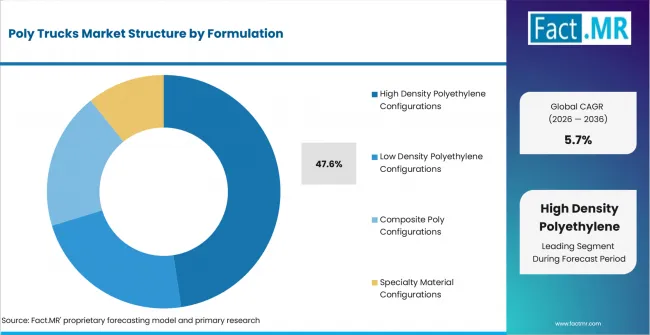
Poly Trucks Market Analysis By Formulation | Source: Fact.MR
High Density Polyethylene Configurations are forecast to lead Formulation because stiffness and washability define daily performance. Standard HDPE Systems cover general handling. Enhanced HDPE Systems serve heavier facilities where loads scrape sidewalls and floors. Low Density Polyethylene Configurations remain useful where flexible walls have value.
Which Distribution Channel leads?
Direct Industrial Sales are expected to capture 71.3% share in 2026.
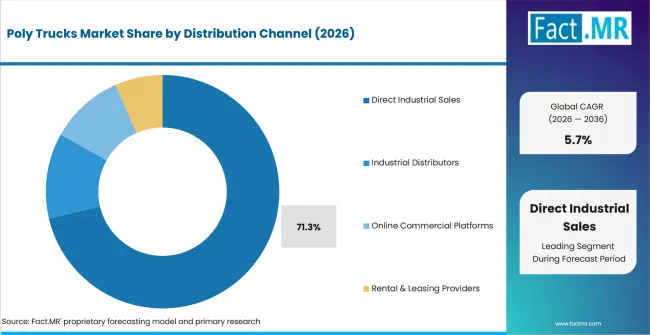
Poly Trucks Market Analysis By Distribution Channel | Source: Fact.MR
Direct Industrial Sales are expected to lead Distribution Channel because large accounts standardize sizes and casters across sites. Enterprise Procurement Channels help buyers repeat specifications after trial use. OEM Supply Channels serve account-specific accessories. Industrial Distributors remain useful for replacement parts and smaller accounts.
What is accelerating Poly Trucks Market adoption, and what is holding it back?
Industrial material handling drives it; freight cost and manual strain restrain it.
Drivers Impact Analysis
| DRIVER | (~) % IMPACT ON CAGR | GEOGRAPHIC RELEVANCE | IMPACT TIMELINE |
|---|---|---|---|
| Industrial material movement | +1.6% | Germany, USA, Brazil | Short term (<= 2 years) |
| Warehouse and logistics activity | +1.2% | USA, UK, Japan | Short term (<= 2 years) |
| Laundry and healthcare handling | +0.9% | USA, UK, Japan | Medium term (2-4 years) |
| Rotational molding capability | +0.8% | Germany, USA, Japan | Medium term (2-4 years) |
| Direct procurement standardization | +0.6% | Global multi-site accounts | Long term (>= 4 years) |
Source: Fact.MR analysis. Updated Aug 17, 2026
- Industrial material movement: Factories need molded trucks for scrap, loose parts, packaging and line-side movement. These routes keep utility bodies useful across daily floor work.
- Warehouse and logistics activity: Warehouse teams use poly trucks around returns and overflow picking. Higher freight flow raises pressure at receiving and staging points.
- Laundry and healthcare handling: Hospitals, hotels and laundries use large carts for linen movement. Smooth interiors and elevator fit are expected to shape supplier choice.
- Rotational molding capability: Rotomolded bodies support large seamless shapes. Procurement teams are projected to favor consistent wall thickness and caster mounting strength.
- Direct procurement standardization: Multi-site accounts reduce SKU complexity by selecting one supplier family. Matched lids, colors and parts are expected to support repeat buying.
Opportunity Impact Analysis
| OPPORTUNITY | (~) % IMPACT ON CAGR | GEOGRAPHIC RELEVANCE | IMPACT TIMELINE |
|---|---|---|---|
| Assisted movement options | +0.8% | USA and UK | Medium term (2-4 years) |
| Food and laundry sanitation packages | +0.7% | USA, Japan, UK | Medium term (2-4 years) |
| Color-coded facility programs | +0.5% | Healthcare and hospitality sites | Long term (>= 4 years) |
| Replacement-part bundles | +0.4% | Direct and distributor channels | Long term (>= 4 years) |
Source: Fact.MR analysis. Updated Aug 17, 2026
- Assisted movement options: Motorized tilt formats are expected to create a route into sites that evaluate ergonomics and route productivity in the same purchase.
- Food and laundry sanitation packages: Closed surfaces, liners and lids add value where cleaning routines decide cart approval. Buyers are expected to pay for easier wash-down.
- Color-coded facility programs: Color options help sites separate waste, linen and production tasks without changing the truck body. This supports facility-level standardization.
- Replacement-part bundles: Casters and handles decide how long a truck stays in service after rough floor movement. Bundled lids are expected to protect supplier retention.
Restraints Impact Analysis
| RESTRAINT | (~) % IMPACT ON CAGR | GEOGRAPHIC RELEVANCE | IMPACT TIMELINE |
|---|---|---|---|
| Caster and floor damage | -0.7% | High-use facilities | Short term (<= 2 years) |
| Freight cost on bulky bodies | -0.6% | Global | Short term (<= 2 years) |
| Manual handling injury risk | -0.5% | USA, UK, Japan | Medium term (2-4 years) |
| Low-cost substitution | -0.4% | Price-sensitive accounts | Medium term (2-4 years) |
Source: Fact.MR analysis. Updated Aug 17, 2026
- Caster and floor damage: Procurement teams are expected to reject carts when wheel noise, tracking or mounting support fails daily routes.
- Freight cost on bulky bodies: Nesting and stackable designs reduce shipping pressure but do not remove the delivered-cost penalty. Bulky bodies remain expensive to move.
- Manual handling injury risk: Heavy carts still create strain on slopes or damaged floors. Ergonomic options are anticipated to carry more weight in replacement decisions.
- Low-cost substitution: Some sites delay replacement with older metal carts, bins or general containers. This keeps pressure on entry-level poly truck pricing.
Which countries are scaling Poly Trucks Market fastest?
- The country comparison spans 2.3 percentage points and forms three practical growth bands across the forecast period.
- Germany remains 0.6 percentage point above Brazil through manufacturing depth and industrial replacement discipline.
- Brazil remains 0.6 percentage point above the USA as service facilities and retailers expand routine internal movement.
- The USA remains 0.6 percentage point above the UK because warehouse scale keeps wheeled handling equipment visible.
- The UK remains 0.5 percentage point above Japan as food manufacturing and institutional facilities support selective purchases.
- Japan closes the displayed range through compact logistics sites and labor-saving handling routines.
Comparable CAGRs create different entry conditions due to facility size, labor exposure, procurement channels and replacement discipline. Full report coverage includes North America, Latin America, Europe, East Asia, South Asia and Pacific, Middle East and Africa.
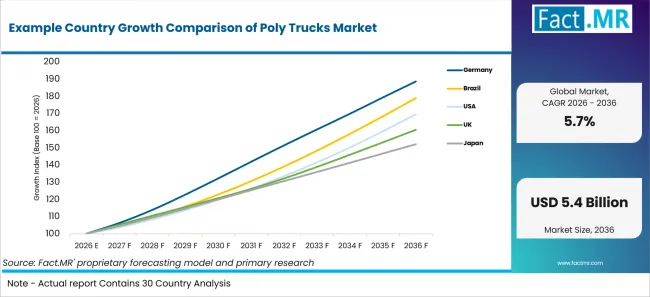
Example Country Growth Comparison Of Poly Trucks Market | Source: Fact.MR
| Country | CAGR |
|---|---|
| Germany | 6.6% |
| Brazil | 6.0% |
| USA | 5.4% |
| UK | 4.8% |
| Japan | 4.3% |
Source: Fact.MR analysis. Updated Aug 17, 2026
What supports Germany adoption?
6.6% CAGR, supported by manufacturing depth and industrial replacement.
German factories are expected to keep utility poly trucks in replacement plans where scrap, packaging and loose parts move between work zones. The market is forecast to record 6.6% CAGR from 2026 to 2036. Destatis reported in February 2026 that the real stock of manufacturing orders rose 1.2% month over month in December 2025.
How is Brazil scaling demand?
6.0% CAGR, driven by service activity and retail movement.
Brazilian service facilities are expected to use molded trucks where waste, stockroom items and back-of-house loads move daily. Poly truck demand is projected to post 6.0% CAGR through 2036. IBGE reported in February 2026 that Brazil services volume increased 2.8% in 2025.
What supports USA demand?
5.4% CAGR, backed by warehouse scale and safety-led replacement.
U.S. warehouses are expected to keep poly trucks close to returns, receiving docks and loose-load movement. The country is anticipated to advance at 5.4% CAGR from 2026 to 2036. Procurement teams are expected to favor trucks that reduce hand-carrying and allow serviceable wheels because multi-shift operations punish weak caster assemblies quickly.
How does the UK perform?
4.8% CAGR, led by food manufacturing and institutional handling.
UK demand is expected to remain tied to food plants, laundries and institutional facilities that need washable mobile containers. The market is estimated to record 4.8% CAGR through 2036. ONS reported in July 2026 that the manufacture of food represented 22.9% of total UK manufacturers' sales in 2025.
What supports Japan's growth?
4.3% CAGR, supported by commercial sales and compact logistics sites.
Japanese facilities are expected to favor smaller poly trucks that turn easily inside compact service and logistics spaces. The country is forecast to record 4.3% CAGR from 2026 to 2036. METI reported in April 2026 that Japan's 2025 commercial sales increased 1.3% to about 635 trillion yen.
Which companies have directly verifiable product coverage in the Poly Trucks Market?
Rubbermaid Commercial Products and Toter LLC show direct poly truck coverage, while Royal Basket Trucks LLC and Cambro Manufacturing Company strengthen application depth.
Rubbermaid Commercial Products supports direct coverage through rotomolded tilt trucks, bulk trucks and assisted movement options. Toter LLC adds industrial tilt trucks, cube trucks and mobile trucks for commercial and institutional waste movement. Royal Basket Trucks LLC strengthens the laundry and healthcare portion of the field through poly truck and bulk poly truck lines. Cambro Manufacturing Company supports utility movement through commercial utility trucks used around foodservice and facility operations.
Myers Industries Inc. broadens the material-handling comparison through Akro-Mils, Buckhorn and Jamco portfolios. Myers Industries reported in May 2026 that these Industrial portfolio brands covered containers and totes as well as carts and cabinets.
Which companies are the key providers?
Rubbermaid Commercial Products and Toter LLC are key providers. Royal Basket Trucks LLC and Cambro Manufacturing Company are also profiled. Myers Industries Inc. And Meese complete the provider set.
- Rubbermaid Commercial Products
- Cambro Manufacturing Company
- Toter LLC
- Royal Basket Trucks LLC
- Myers Industries Inc.
- Meese
Bibliography
- Brazilian Institute of Geography and Statistics. (2026, February 12). Volume of services down 0.4% in December and closes 2025 with a 2.8% increase. IBGE News Agency.
- Bureau of Transportation Statistics. (2026, July 22). North American transborder freight increased 16.1% May 2026 from May 2025. U.S. Department of Transportation.
- Federal Statistical Office (Destatis). (2026, March 9). New orders in manufacturing in January 2026: -11.1% on the previous month [December 2025 revised to +6.4%].
- Federal Statistical Office (Destatis). (2026, February 19). Stock of orders in manufacturing in December 2025: +1.2% on the previous month.
- Myers Industries, Inc. (2026, May 7). Myers Industries announces 2026 first quarter results.
- Office for National Statistics. (2026, July 24). UK manufacturers' sales by product: 2025.
- U.S. Bureau of Labor Statistics. (2026, January 22). Employer-reported workplace injuries and illnesses, 2023–2024.
- U.S. Census Bureau. (2026, July 16). Advance monthly sales for retail and food services, June 2026.
This Report Answers
- The report provides strategic intelligence on the Poly Trucks Market across Product and Application choices that shape internal material movement.
- Segment analysis covers Utility Poly Trucks and Material Handling Applications as the share leaders within the 2026 market.
- Country outlook evaluates Germany and Brazil alongside the USA, the UK and Japan across the displayed growth comparison.
- Competitive analysis profiles Rubbermaid Commercial Products and Toter LLC alongside Royal Basket Trucks LLC and Cambro Manufacturing Company.
- Technology assessment covers Rotational Molding Technology and Structural Reinforcement Technology. Mobility Technology and Ergonomic Design Technology complete the technology view.
- Use-case assessment covers material handling, laundry handling, waste collection and distribution or logistics applications.
- The analysis combines primary interviews, provider checks, official statistics and portfolio review to support the forecast view.
What does the Poly Trucks Market cover?
Utility, tilt, cube, laundry and waste handling poly trucks used for internal load movement.
The Poly Trucks Market covers molded plastic trucks with wheels, casters, lids, liners and handling accessories used inside facilities. Coverage includes utility, tilt, cube, laundry and waste handling formats.
The market differs from the wider cart and container category because products must be wheeled and used for internal movement. Static bins, outdoor refuse carts, forklifts, pallets and automated vehicles remain outside scope unless sold as part of a poly truck handling package.
What is included in the scope?
Poly truck systems used in factories, warehouses, laundries, hospitals and commercial buildings.
The scope includes Product, Application, End Use, Technology, Formulation and Distribution Channel. Coverage spans utility poly trucks, tilt poly trucks, cube poly trucks and specialty poly trucks. Cleanroom carts helps separate controlled-room carts from general poly trucks. Coverage on industrial tuggers clarifies why powered towing vehicles remain outside the boundary. pallet containers are included only when they are wheeled poly truck formats rather than pallet-sized storage systems.
What is excluded from the scope?
Static containers, forklifts, pallets and automated vehicles are outside the scope.
Static storage bins are excluded when they do not move on casters or wheels. Metal carts, pallet containers, powered industrial trucks, automated guided vehicles and outdoor curbside collection carts are outside scope unless the product is sold as a wheeled poly truck for internal handling.
How Was the Analysis Built?
The analysis draws on 120+ sources, 35+ company portfolios, 25+ countries, and more than 20 industry interviews.
- Primary Research: Primary research includes discussions with manufacturers, service providers, technology developers, distributors, end users, procurement teams, and subject-matter experts. These conversations examine purchasing priorities, product adoption, operational challenges, approval requirements, competitive positioning, and the factors that influence wider market acceptance.
- Desk Research: Desk research covers government statistics, regulatory publications, company filings, trade data, technical studies, industry associations, standards, public policy, and other authoritative sources. Every source used in the analysis is documented in the bibliography.
- Market Sizing and Forecasting: Market estimates combine historical performance, demand indicators, pricing and volume trends, segment shares, company participation, country-level growth, adoption patterns, investment activity, and barriers to market expansion.
- Data Validation and Update Cycle: Findings are validated by comparing primary interviews with public data, company activity, regulatory changes, trade patterns, and industry developments. Regular updates review new product launches, capacity changes, partnerships, approvals, procurement trends, and shifts in commercial adoption.
Segmentation
What is the report's scope and coverage?
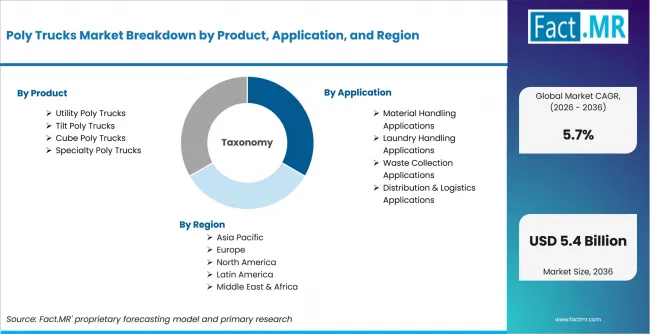
Poly Trucks Market Breakdown By Product, Application, And Region | Source: Fact.MR
| Attribute | Details |
|---|---|
| Quantitative Units | USD billion |
| Market Definition | Wheeled polyethylene trucks used to move bulk materials, waste, linen, supplies and loose loads inside industrial, commercial, healthcare, logistics and institutional facilities. |
| Product | Utility Poly Trucks; General Purpose Poly Trucks; Multi Use Poly Trucks; Tilt Poly Trucks; Cube Poly Trucks; Specialty Poly Trucks |
| Application | Material Handling Applications; Laundry Handling Applications; Waste Collection Applications; Distribution and Logistics Applications |
| End Use | Industrial Facilities; Commercial Institutions; Healthcare Facilities; Logistics Facilities |
| Technology | Rotational Molding Technology; Structural Reinforcement Technology; Mobility Technology; Ergonomic Design Technology |
| Formulation | High Density Polyethylene Configurations; Low Density Polyethylene Configurations; Composite Poly Configurations; Specialty Material Configurations |
| Distribution Channel | Direct Industrial Sales; Industrial Distributors; Online Commercial Platforms; Rental and Leasing Providers |
| Regions Covered | North America; Latin America; Europe; East Asia; South Asia and Pacific; Middle East and Africa |
| Countries Covered | Germany; Brazil; USA; UK; Japan |
| Key Companies Profiled | Rubbermaid Commercial Products; Cambro Manufacturing Company; Toter LLC; Royal Basket Trucks LLC; Myers Industries Inc.; Meese |
| Forecast Period | 2026 to 2036 |
| Approach | Hybrid top-down and bottom-up approach using facility handling needs; replacement patterns; country indicators; company portfolio review; distributor channel assessment and primary interviews. |
Source: Fact.MR analysis. Updated Aug 17, 2026
How is the market segmented?
-
By Product
- Utility Poly Trucks
- General Purpose Poly Trucks
- Multi Use Poly Trucks
- Tilt Poly Trucks
- Cube Poly Trucks
- Specialty Poly Trucks
- Utility Poly Trucks
-
By Application
- Material Handling Applications
- Warehouse Material Handling
- Factory Material Handling
- Laundry Handling Applications
- Waste Collection Applications
- Distribution and Logistics Applications
- Material Handling Applications
-
By End Use
- Industrial Facilities
- Manufacturing Facilities
- Processing Facilities
- Commercial Institutions
- Healthcare Facilities
- Logistics Facilities
- Industrial Facilities
-
By Technology
- Rotational Molding Technology
- Single Wall Molding Systems
- Double Wall Molding Systems
- Structural Reinforcement Technology
- Mobility Technology
- Ergonomic Design Technology
- Rotational Molding Technology
-
By Formulation
- High Density Polyethylene Configurations
- Standard HDPE Systems
- Enhanced HDPE Systems
- Low Density Polyethylene Configurations
- Composite Poly Configurations
- Specialty Material Configurations
- High Density Polyethylene Configurations
-
By Distribution Channel
- Direct Industrial Sales
- Enterprise Procurement Channels
- OEM Supply Channels
- Industrial Distributors
- Online Commercial Platforms
- Rental and Leasing Providers
- Direct Industrial Sales
-
By Region
- North America
- Latin America
- Europe
- East Asia
- South Asia and Oceania
- Middle East and Africa
Frequently Asked Questions
How big is the poly trucks market in 2026?
What is the CAGR of the poly trucks market from 2026 to 2036?
Which product leads the poly trucks market?
Which application leads the poly trucks market?
Who are the leading companies in the poly trucks market?
Who worked on this report


Preview the report firsthand - request a free sample
Free SampleGet the brochure for pricing and purchase details
Download PDF