- Market Value (2025): USD 456.5 Mn
- Estimated Value (2026): USD 520.0 Mn
- Forecast Value (2036): USD 1911.0 Mn
- CAGR (2026-2036): 13.9%
What is the Waterless Personal Cleansing Products Market forecast to be worth by 2036?
USD 520 million in 2026 to USD 1,911 million by 2036 at 13.9% CAGR.
- The waterless personal cleansing products market crossed a valuation of USD 456.5 million in 2025 as no-rinse body care and dry hair refresh products moved into wider retail testing.
- Demand is projected to increase from USD 520 million in 2026 to USD 1,911 million by 2036.
- The market is forecast to record a 13.9% CAGR from 2026 to 2036 owing to body care convenience, dry shampoo use and healthcare no-rinse routines.
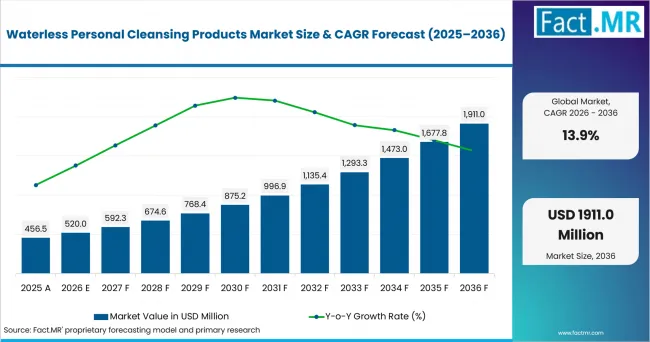
Waterless Personal Cleansing Products Market Value Analysis | Source: Fact.MR
What are the defining numbers behind Waterless Personal Cleansing Products Market growth?
USD 1,391 million absolute opportunity by 2036, led by no-rinse foams & gels, body applications and consumer/retail end use.
- Demand Drivers in the Market
- Retail shoppers need compact cleansing formats because gym, travel and commuting routines create use cases outside the bathroom.
- The U.S. Census Bureau reported in May 2026 that first-quarter 2026 U.S. retail e-commerce sales reached USD 326.7 billion.
- Healthcare buyers need body cleansing products that reduce bathing friction for patients, caregivers and institutional hygiene teams.
- Brand owners need cleaner product files because no-rinse claims must explain residue, fragrance and use instructions clearly.
- Key Segments Analyzed
- By Product Format: No-rinse foams & gels are expected to hold 34.0% share in 2026 due to their body-use fit and easier skin-feel testing.
- By Application: Body is projected to account for 38.0% share in 2026 owing to shower-free hygiene occasions and caregiver-led use.
- By End User: Consumer/retail is anticipated to capture 63.0% share in 2026 as drugstores, beauty shelves and online shops support trial.
- Analyst Opinion at Fact.MR
- Shambhu Nath Jha, Principal Consultant at Fact.MR, states, “Waterless cleansing succeeds only when it feels like a real hygiene step, not a compromise. Repeat purchase is expected to depend on residue control, fragrance comfort and clear instructions for use. Suppliers should combine mild formulations with claims evidence and retail packs that make the first trial simple.”
- Strategic Implications
- Brand owners should build claim files before launch because no-rinse cleansing needs proof around skin comfort and intended use.
- Retail teams should place foams and gels near travel care, dry shampoo and body wipes to reduce shopper confusion.
- Regulatory teams should maintain renewal calendars since FDA updated Cosmetics Direct materials in February 2026 for biennial facility registration.
- Packaging teams should explain disposal and refill routes where wipes, sticks and concentrated products compete for shelf approval.
Canada is forecast to record 15.9% CAGR through 2036 supported by health and personal care retail. The United States is projected to advance at 15.3% through online beauty reach and body cleansing use cases. Germany is anticipated to post 14.4% as drugstores test compact formats. France is estimated to reach 14.3% given its specialist beauty channel and strict product files. The United Kingdom is forecast to record 14.2% due to online product discovery. Japan is expected to reach 13.7% as compact routines support dry hair refresh and body wipes.
How does the Waterless Personal Cleansing Products Market break down by segment?
No-rinse foams & gels lead at 34.0%; Body leads at 38.0%; Consumer/retail leads at 63.0%.
Which product format dominates?
No-rinse foams & gels are projected to account for 34.0% share in 2026.
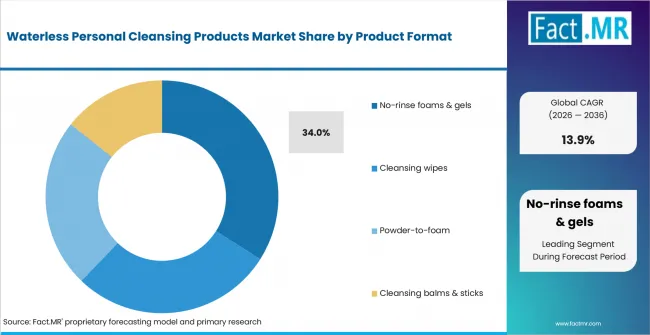
Waterless Personal Cleansing Products Market Analysis By Product Format | Source: Fact.MR
No-rinse foams and gels lead Product Format because they balance convenient cleansing with travel and daily-care use. Their application across body cleansing supports broad consumer appeal. Procter & Gamble introduced Gemz in November 2025 as a water-activated shampoo and conditioner tile following 14 years of research and development.
What leads the Application segment?
Body is expected to hold 38.0% share in 2026.
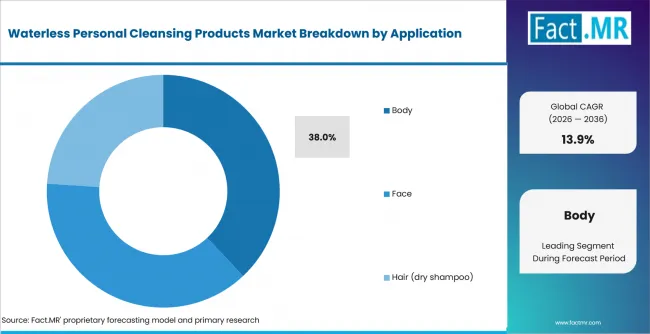
Waterless Personal Cleansing Products Market Analysis By Application | Source: Fact.MR
Body applications lead because waterless cleansing is particularly useful when conventional shower access is limited or inconvenient. No-rinse formats support travel, caregiving and everyday refresh routines, while brands focus on mild formulations, easy application and low residue to encourage repeat use across consumer and institutional settings.
How does End User shape demand?
Consumer/retail is anticipated to lead with 63.0% share in 2026.
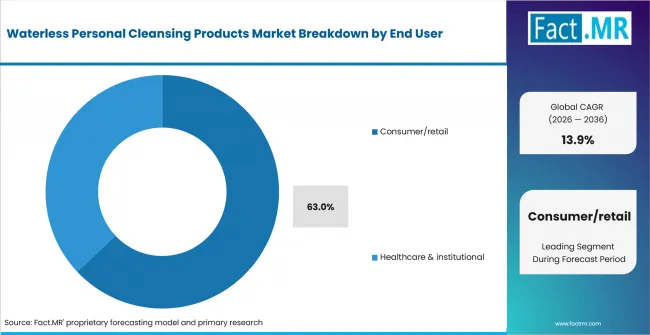
Waterless Personal Cleansing Products Market Analysis By End User | Source: Fact.MR
Consumer/retail leads End User because drugstores, beauty retailers and online channels make product discovery and trial easier. Buyers favor convenient cleansing formats with simple directions, mild formulations and clear use occasions. Wider availability across personal-care channels supports adoption among consumers seeking portable, water-saving and quick-refresh hygiene options.
What is accelerating Waterless Personal Cleansing Products Market adoption, and what is holding it back?
No-rinse convenience drives it; residue and claims proof restrain it.
Drivers Impact Analysis
| DRIVER | (~) % IMPACT ON CAGR | GEOGRAPHIC RELEVANCE | IMPACT TIMELINE |
|---|---|---|---|
| Shower-free hygiene occasions | +3.1% | North America and Europe | Short term (<= 2 years) |
| Retail e-commerce discovery | +2.5% | USA, UK, Japan | Short term (<= 2 years) |
| Healthcare no-rinse routines | +2.0% | USA, Canada, Europe | Medium term (2-4 years) |
| Compact travel formats | +1.7% | Urban retail markets | Medium term (2-4 years) |
| Low-water beauty positioning | +1.2% | Premium beauty channels | Long term (>= 4 years) |
Source: Fact.MR analysis. Updated Aug 17, 2026
- Shower-free hygiene occasions: No-rinse body cleansing is expected to increase where users need quick hygiene before work, travel or caregiving. Foams and gels support this use because they feel closer to a wash step than a dry wipe.
- Retail e-commerce discovery: Online discovery is anticipated to support smaller brands and subscription packs. Digital shelves give waterless brands a practical route to educate shoppers before store expansion.
- Healthcare no-rinse routines: Institutional care is expected to create steady demand where bathing assistance is difficult. Healthcare buyers still require gentle formulas and clean instructions before repeat purchasing.
- Compact travel formats: Travel and gym routines are forecast to support powders, tiles and sticks because liquid limits and bag space affect purchase behavior. Brands need packs that activate easily without leaving residue.
- Low-water beauty positioning: Beauty brands are projected to use waterless formats to reduce pack size and explain concentrated use. Claims need careful wording because low-water does not automatically mean lower impact.
Opportunity Impact Analysis
| OPPORTUNITY | (~) % IMPACT ON CAGR | GEOGRAPHIC RELEVANCE | IMPACT TIMELINE |
|---|---|---|---|
| Measured-dose tiles and tablets | +1.5% | USA, UK, Japan | Medium term (2-4 years) |
| Retail starter kits | +1.1% | North America and Europe | Short term (<= 2 years) |
| Institutional body care | +0.9% | USA, Canada, Europe | Medium term (2-4 years) |
| Refill and concentrated packs | +0.7% | Premium beauty channels | Long term (>= 4 years) |
Source: Fact.MR analysis. Updated Aug 17, 2026
- Measured-dose tiles and tablets: Single-dose formats are expected to lower mess and improve instructions for first-time users. Similar formats are anticipated to help brands explain waterless hair cleansing without asking shoppers to learn a new routine from scratch.
- Retail starter kits: Starter kits are projected to reduce adoption friction by combining instructions with trial-sized formats. Kits are expected to work best where body and hair use cases are separated clearly.
- Institutional body care: Healthcare channels are estimated to create opportunity when no-rinse products reduce caregiver effort during assisted bathing. Procurement is expected to favor suppliers that document fragrance, residue and wipe-material choices.
- Refill and concentrated packs: Concentrated formats are anticipated to appeal to premium shoppers when pack reduction is visible. Brands that pair concentrated formats with clear dosing are expected to gain better repeat purchase.
Restraints Impact Analysis
| RESTRAINT | (~) % IMPACT ON CAGR | GEOGRAPHIC RELEVANCE | IMPACT TIMELINE |
|---|---|---|---|
| Residue and skin-feel risk | -1.4% | Global | Short term (<= 2 years) |
| Claims documentation burden | -1.0% | USA, EU, UK | Short term (<= 2 years) |
| Wipe disposal concerns | -0.8% | Europe and North America | Medium term (2-4 years) |
| Premium price resistance | -0.6% | Mass retail channels | Medium term (2-4 years) |
Source: Fact.MR analysis. Updated Aug 17, 2026
- Residue and skin-feel risk: Waterless cleansing is constrained when users feel tackiness, fragrance load or visible powder after application. Brands are expected to test body and hair formats separately because acceptance signals differ.
- Claims documentation burden: Cosmetic claims require files that connect product wording with safety and use evidence.
- Wipe disposal concerns: Wipes face scrutiny when shoppers and retailers question end-of-use instructions. Retailers are expected to ask for stronger pack communication before expanding wipe-led no-rinse products.
- Premium price resistance: Waterless formats often cost more per use than standard body wash or shampoo. Price resistance is projected to remain higher in mass channels where value packs dominate replenishment decisions.
Which countries are scaling Waterless Personal Cleansing Products Market fastest?
- The country comparison spans 2.20 percentage points and forms three practical growth bands across the forecast period.
- Canada remains 0.55 percentage point above the United States as health and personal care retail supports no-rinse trial.
- The United States remains 0.94 percentage point above Germany due to e-commerce reach and body cleansing use cases.
- Germany remains 0.08 percentage point above France as drugstore channels test compact personal care formats.
- France remains 0.08 percentage point above the United Kingdom through specialist beauty retail and product-file discipline.
- The United Kingdom remains 0.55 percentage point above Japan as online beauty purchasing supports product discovery.
- Japan closes the displayed range because compact routines support adoption while repeat-use testing remains selective.
Comparable CAGRs can create different entry conditions due to retail channel depth, cosmetic documentation, water-aware routines and no-rinse use cases. The United States accounts for 32% of the displayed regional share, followed by the United Kingdom at 15% and France at 14%. Full report coverage includes North America, Latin America, Europe, East Asia, South Asia and Pacific, Middle East and Africa.
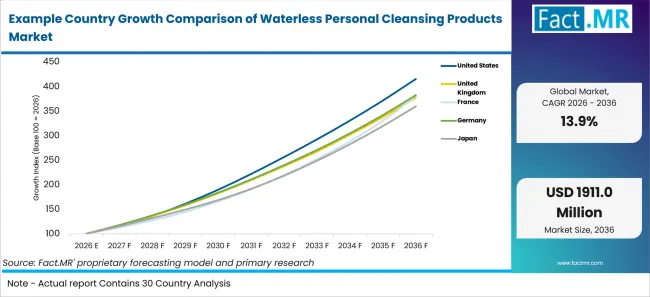
Example Country Growth Comparison Of Waterless Personal Cleansing Products Market | Source: Fact.MR
| Country | CAGR (2026-2036) |
|---|---|
| Canada | 15.9% |
| United States | 15.3% |
| Germany | 14.4% |
| France | 14.3% |
| United Kingdom | 14.2% |
| Japan | 13.7% |
Source: Fact.MR analysis. Updated Aug 17, 2026
What supports Canada adoption?
15.9% CAGR, supported by health and personal care retail and water-aware routines.
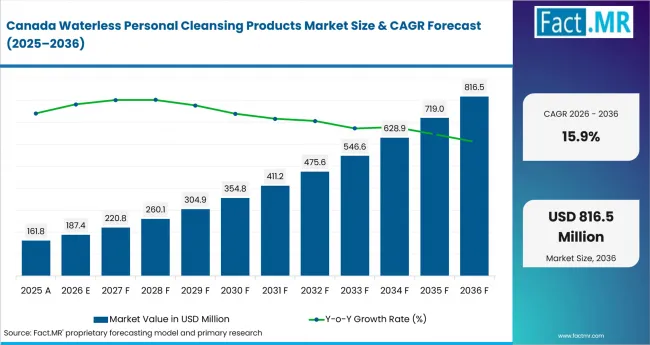
Waterless Personal Cleansing Products Market Country Value Analysis | Source: Fact.MR
Canada’s retail base supports trial for no-rinse foams, wipes and dry hair refresh products through drugstores and online channels. Canada is forecast to record 15.9% CAGR from 2026 to 2036 as health and personal care shelves keep a large addressable base. Statistics Canada’s July 2026 retail commodity table placed Q1 2026 sales for infant care, personal and beauty products at CAD 4.953687 billion. Brands still need simple claims because shoppers compare no-rinse products with standard body wash and low-cost wipes.
How is the United States scaling demand?
15.3% CAGR, driven by e-commerce reach and no-rinse body cleansing occasions.
The United States benefits from broad online beauty discovery and a large drugstore network. The country is projected to record 15.3% CAGR from 2026 to 2036 due to gym, travel and home-care routines that support shower-free cleansing. Retailers are expected to test foams near body wipes, deodorant and dry shampoo so shoppers understand the use case quickly. Repeat purchase still depends on mild residue control and clear disposal instructions.
What supports Germany growth from 2026 to 2036?
14.4% CAGR, backed by drugstore strength and online retail expansion.
Germany’s drugstore channel gives compact cleansing products a practical route into routine body care. The country is anticipated to post 14.4% CAGR from 2026 to 2036 as shoppers compare no-rinse products with solid cleansers and refills. Destatis reported in February 2026 that internet and mail-order retail rose 10.1% in real terms in 2025. Format approval remains selective because labels, safety files and activation instructions must be clear before wider retail placement.
How is France developing demand?
14.3% CAGR, led by specialist beauty retail and strict product-documentation discipline.
France’s beauty channel supports waterless cleansing when sensorial use and claims documentation are both strong. France is estimated to record 14.3% CAGR from 2026 to 2036 as body foams and facial formats move through pharmacies and specialist stores. DGCCRF said in February 2026 that it controlled 147 cosmetics establishments and examined more than 200 product information files.
How is the United Kingdom scaling demand?
14.2% CAGR, supported by cosmetics store recovery and online beauty purchasing.
The United Kingdom has a strong online discovery route for compact cleansing products and dry hair refresh. The country is forecast to record 14.2% CAGR from 2026 to 2036 as gym, commuting and festival routines create repeat occasions. ONS reported in April 2026 that sales volumes at cosmetics and toiletries stores in Great Britain rose across all three months of the first quarter of 2026. Brands still need disposal guidance and sensitive-skin wording before wipes, gels and foams receive wider shelf space.
How does Japan perform?
13.7% CAGR, shaped by compact routines and careful retail qualification.
Japan’s compact commuting routines support dry hair refresh, body wipes and small foam packs. Japan is expected to record 13.7% CAGR from 2026 to 2036 as online beauty purchase paths help shoppers find newer formats. METI reported in August 2025 that Japan’s 2024 B2C e-commerce market reached JPY 26.1 trillion, up 5.1% from 2023. Retail qualification is expected to favor simple activation instructions and low-residue formulas.
Who leads the Waterless Personal Cleansing Products Market?
Unilever and Procter & Gamble as the most scaled providers in the company set, with L'Oreal and Ethique adding beauty-led format relevance.
Unilever supports the market through personal care and beauty brands that reach mass retail and digital channels. Procter & Gamble adds direct relevance through Gemz and broader hair-care depth. L'Oreal strengthens the beauty-led route through professional haircare and specialist retail. Ethique extends the field through waterless solid-format personal care, while Necessaire contributes broader premium body-care relevance.
Which companies are the key providers?
Unilever, Procter & Gamble, L'Oreal, Ethique, Necessaire and Lush.
- Unilever
- Procter & Gamble
- L'Oreal
- Ethique
- Necessaire
- Lush
How is the market segmented?
-
By Product Format:
- No-rinse foams & gels
- Cleansing wipes
- Powder-to-foam
- Cleansing balms & sticks
-
By Application:
- Body
- Face
- Hair (dry shampoo)
-
By End User:
- Consumer/retail
- Healthcare & institutional
-
By Region:
- North America
- Latin America
- Europe
- East Asia
- South Asia and Oceania
- Middle East and Africa
Bibliography
- U.S. Food and Drug Administration. (2026, February 11). FDA updates web portal and informational materials to help cosmetic facilities prepare for biennial registration renewal.
- Direction générale de la concurrence, de la consommation et de la répression des fraudes. (2026, February 2). Cosmétiques : des TPE nouvelles dans le secteur qui méconnaissent trop souvent la réglementation.
- Ministry of Economy, Trade and Industry. (2025, August 26). Results of FY2024 E-Commerce Market Survey compiled.
- Office for National Statistics. (2026, April 24). Retail sales, Great Britain: March 2026.
- Procter & Gamble. (2025, November 13). Beyond the bottle: How Gemz is redefining haircare for the modern consumer.
- Statistics Canada. (2026, July 8). Quarterly retail commodity sales (Table 20-10-0071-01) [Data table].
- L’Oréal. (2025, June 30). L'Oréal signs an agreement to acquire Color Wow, one of the world's fastest growing and most innovative professional haircare brands.
This Report Answers
- The report provides strategic intelligence on the Waterless Personal Cleansing Products Market across Product Format choices that shape no-rinse body, face and hair routines.
- Segment analysis covers no-rinse foams & gels, body applications and consumer/retail end use as the 2026 share leaders.
- Country outlook evaluates Canada and the United States alongside Germany, France, the United Kingdom and Japan.
- Competitive analysis profiles Unilever and Procter & Gamble alongside L'Oreal, Ethique, Necessaire and Lush.
- Format assessment covers foams, gels, wipes, powder-to-foam products and solid cleansing formats where instructions and residue control guide repeat use.
What does the Waterless Personal Cleansing Products Market cover?
Waterless personal cleansing products are used to clean or refresh skin and hair when a full wash is not practical.
The market covers no-rinse foams, gels, cleansing wipes, powder-to-foam products, balms and sticks. Coverage is adjacent to bath and shower toiletries and foaming cleansers where body cleansing habits shape shopper expectations.
The market includes consumer retail and healthcare or institutional use. It includes products that require little or no rinse water and products activated by small amounts of water. Solid cleanser formats are included when they compete with no-rinse body, face or hair cleansing products.
What is included in the scope?
The scope includes Product Format, Application and End User alongside Region. Coverage spans no-rinse foams & gels, cleansing wipes and powder-to-foam products.
Cleansing balms & sticks are included where they replace liquid cleansing routines. Waterless beauty tablets are included when they support comparable water-activated personal cleansing behavior.
Body, face and hair applications are included. Consumer retail covers drugstores, beauty retail, online channels and direct brand sites. Healthcare and institutional use is included where no-rinse cleansing supports patient care, elder care or facility hygiene.
What is excluded from the scope?
General soaps, standard body washes and conventional rinse-off shampoos remain outside the scope unless their demand shifts directly toward no-rinse or low-water formats.
The scope excludes household cleaning wipes, disinfectant surface wipes and industrial water-saving chemicals. It also excludes medical antiseptics, prescription dermatology products and unrelated hygiene equipment. Company revenue without a clear connection to personal cleansing, body refresh or dry hair routines is excluded.
How Was the Analysis Built?
The analysis draws on more than 120 sources, 35 company portfolios, 25 countries and more than 20 industry interviews.
- Primary Research: Primary research includes discussions with personal care brands, contract manufacturers, packaging developers, retail buyers, healthcare procurement teams and subject-matter experts. These conversations examine product adoption, claim requirements, pack choices and retail placement.
- Desk Research: Desk research covers government statistics, regulator publications, company filings, company announcements, technical studies and public policy. Every source used in the analysis is documented in the bibliography.
- Market Sizing and Forecasting: Market estimates combine historical performance, demand indicators, segment shares, country-level growth, adoption patterns, retail activity and barriers to market expansion.
- Data Validation and Update Cycle: Findings are validated by comparing interviews with public data, company activity and regulatory changes. Regular updates review launches, packaging changes and claims guidance.
Segmentation
What is the report’s scope and coverage?
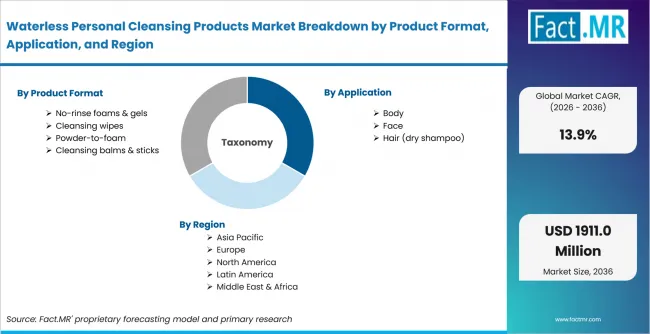
Waterless Personal Cleansing Products Market Breakdown By Product Format, Application, And Region | Source: Fact.MR
| Attribute | Details |
|---|---|
| Quantitative Units | USD million in 2026 to USD million by 2036 at CAGR |
| Market Definition | No-rinse and low-water personal cleansing products used for body, face and hair hygiene where residue control, skin feel, activation method and retail instructions decide repeat purchase. |
| Product Format | No-rinse foams & gels; Cleansing wipes; Powder-to-foam; Cleansing balms & sticks |
| Application | Body; Face; Hair (dry shampoo) |
| End User | Consumer/retail; Healthcare & institutional |
| Regions Covered | North America; Latin America; Europe; East Asia; South Asia and Pacific; Middle East and Africa |
| Countries Covered | Canada; United States; Germany; France; United Kingdom; Japan |
| Key Companies Profiled | Unilever; Procter & Gamble; L'Oreal; Ethique; Necessaire; Lush |
| Forecast Period | 2026 to 2036 |
| Approach | Hybrid top-down and bottom-up approach using personal care retail activity; e-commerce adoption; waterless beauty formats; no-rinse hygiene use cases; healthcare cleansing needs; product claims review; packaging and disposal guidance; country adoption patterns and company portfolio review |
Source: Fact.MR analysis. Updated Aug 17, 2026
Frequently Asked Questions
How big is the waterless personal cleansing products market in 2026?
What is the CAGR of the waterless personal cleansing products market from 2026 to 2036?
Which product format leads the waterless personal cleansing products market?
Which application leads the waterless personal cleansing products market?
Who are the leading companies in the waterless personal cleansing products market?
Who worked on this report


Preview the report firsthand - request a free sample
Free SampleGet the brochure for pricing and purchase details
Download PDF