- Market Value (2025): USD 3.2 Bn
- Estimated Value (2026): USD 3.4 Bn
- Forecast Value (2036): USD 5.9 Bn
- CAGR (2026-2036): 5.6%
What is the Mining Dust Control Market forecast to be worth by 2036?
USD 3.4 billion in 2026 to USD 5.9 billion by 2036 at 5.6% CAGR.
- The mining dust control market crossed a valuation of USD 3.2 billion in 2025 as mines funded suppression around roads and ore movement areas.
- Demand is projected to rise from USD 3.4 billion in 2026 to USD 5.9 billion by 2036 as operators extend control points across exposed work zones.
- The market is forecast to record 5.6% CAGR from 2026 to 2036 owing to safer work requirements and clearer documentation needs.
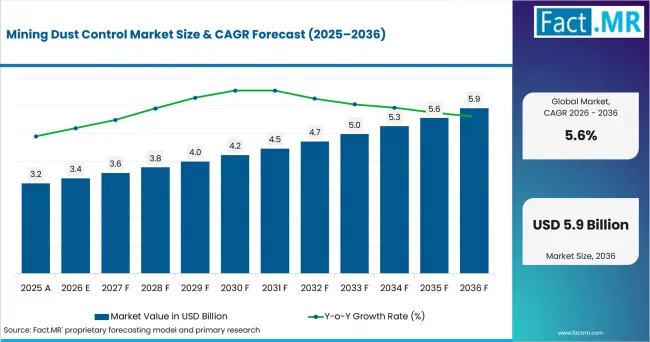
Mining Dust Control Market Value Analysis | Source: Fact.MR
What are the defining numbers behind Mining Dust Control Market growth?
USD 2.5 billion absolute opportunity by 2036.
- Demand Drivers in the Market
- Water-based systems give mines a practical first control point where spray coverage can be checked during normal inspection rounds.
- Material handling and transfer areas need suppression where ore drops from conveyors and releases repeat dust near workers.
- Surface operations need wider coverage since haul traffic and wind can move dust beyond the immediate work area.
- Stationary systems are expected to gain attention where mines want fixed nozzles and service routines for plant audits.
- Key Segments Analyzed
- By Product Type: Water-Based Dust Control Systems are expected to hold 40.3% share in 2026 due to simple fit across roads and plant transfer points.
- By Application: Material Handling and Transfer is projected to account for 30.6% share in 2026 where loading and discharge points release dust repeatedly.
- By End Use: Surface Mining is anticipated to capture 28.5% share in 2026 since open work zones need broader coverage across roads and stockpiles.
- By Distribution Channel: Direct Sales are estimated to represent 29.7% share in 2026 as large mines prefer supplier-led sizing and support.
- By Service Mode: Stationary Systems are forecast to hold 39.5% share in 2026 because fixed equipment supports repeat inspection and planned maintenance.
- Analyst Opinion at Fact.MR
- Shambhu Nath Jha states as Principal Consultant at Fact.MR, “Mining dust control suppliers must show how systems perform after installation. Buyers are expected to ask for service proof and spray design before wider rollout.”
- Strategic Implications
- Mine operators should connect dust-control spending with the exact area where exposure and downtime risk appear. Mining chemicals become useful when dosing rules are explained before approval.
- Suppliers can improve proposal quality by showing how spray points and filtration work during daily operation. This helps buyers compare installed performance.
- Investors should read Australia and Brazil through service distance and distributor depth. Demand from surface mining becomes more reliable when parts stay close to operating sites.
Australia is expected to record a 6.7% CAGR from 2026 to 2036 through remote mine-site service needs. Brazil is projected at 3.9% where distributors support material-handling sites. Canada is anticipated to grow at 6.2% as service coverage guides approval. The USA is estimated at 7.3% through documentation-led purchasing. Germany is forecast at 5.0% due to validation-led replacement demand. Japan is projected at 5.6% through reliability-focused adoption. The UK is expected to record 4.5% as buyers compare support and life-cycle value.
How does the Mining Dust Control Market break down by segment?
Water-Based Dust Control Systems are expected to lead Product Type at 30.6% share in 2026. Material Handling and Transfer is projected to lead Application at 27.0% share in 2026.
Why does Water-Based Dust Control Systems lead Product Type?
Water-Based Dust Control Systems are projected to account for 40.3% share in 2026.
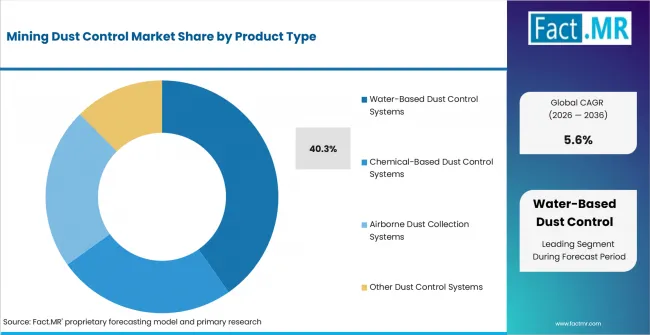
Mining Dust Control Market Analysis By Product Type | Source: Fact.MR
Mines favor water-based suppression because it is easy to specify for roads and transfer points. Chemical-based options retain demand where operators need longer surface binding.
Why does Material Handling and Transfer lead Application?
Material Handling and Transfer is expected to hold 30.6% share in 2026.
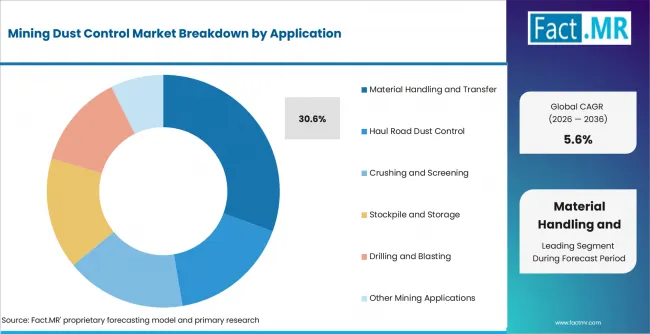
Mining Dust Control Market Analysis By Application | Source: Fact.MR
Dust release is common where ore or coal drops from conveyors or moves through loading points. Haul road controls remain useful when traffic and dry material raise untreated dust.
What supports Surface Mining within End Use?
Surface Mining is anticipated to represent 28.5% share in 2026.
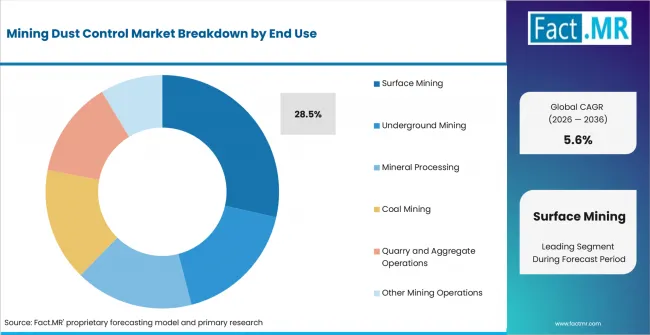
Mining Dust Control Market Analysis By End Use | Source: Fact.MR
Open-pit and open-cast sites create wider exposed surfaces than underground operations. Mineral processing and quarry operations retain demand where dust control must fit plant or enclosed areas.
How does Direct Sales shape the Distribution Channel segment?
Direct Sales are estimated to lead with 29.7% share in 2026.
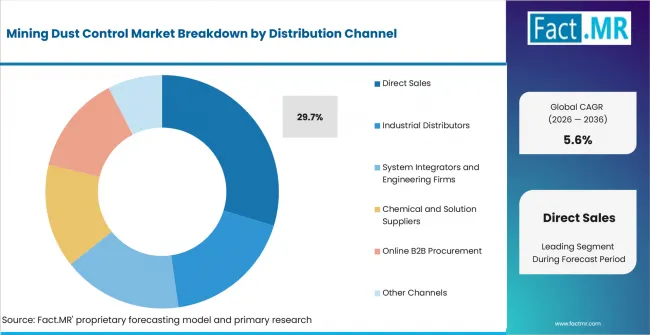
Mining Dust Control Market Analysis By Distribution Channel | Source: Fact.MR
Large mine operators want suppliers to explain sizing and service schedules before approval. Industrial distributors remain relevant when buyers need replacement supply or local account coverage.
Why do Stationary Systems lead Service Mode?
Stationary Systems are forecast to hold 39.5% share in 2026.
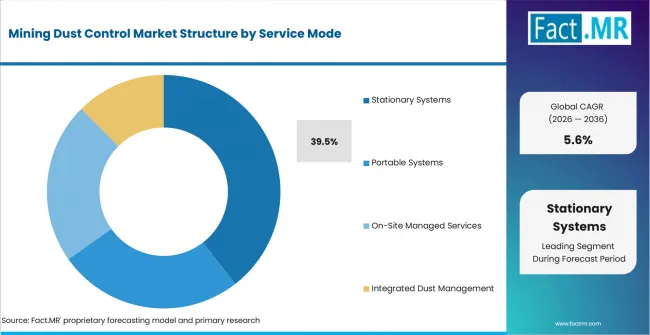
Mining Dust Control Market Analysis By Service Mode | Source: Fact.MR
Fixed installations suit continuous control points near crushers and stockpiles. Portable Systems still serve shifting work areas where mine layouts change more often.
What is accelerating Mining Dust Control Market adoption, and what is holding it back?
Demand is expected to rise through water-based dust control and greater use at transfer points. Site-specific engineering and lengthy budget approvals may slow adoption.
Drivers Impact Analysis
| DRIVER | (~) % IMPACT ON CAGR | GEOGRAPHIC RELEVANCE | IMPACT TIMELINE |
|---|---|---|---|
| Water-based system specification | +6.2% | Australia and Canada | Short term (<= 2 years) |
| Material handling and transfer controls | +3.9% | Brazil and USA | Short term (<= 2 years) |
| Surface mining exposure management | +5.0% | Australia and Germany | Medium term (2-4 years) |
| Stationary system standardization | +4.5% | Japan and UK | Medium term (2-4 years) |
| Service-led inspection routines | +0.7% | Remote mining regions | Long term (>= 4 years) |
Source: Fact.MR analysis. Updated Jul 31, 2026
- Water-based system specification: Mines are expected to use water-based controls first where roads and plant areas need clear suppression routines.
- Material handling and transfer controls: Loading points are expected to need better spray design since dust returns every time ore moves.
- Surface mining exposure management: Open operating areas are likely to raise demand for controls that handle wind and haul-truck movement.
Opportunity Impact Analysis
| OPPORTUNITY | (~) % IMPACT ON CAGR | GEOGRAPHIC RELEVANCE | IMPACT TIMELINE |
|---|---|---|---|
| Retrofit packages for transfer points | +3.9% | Australia and Brazil | Medium term (2-4 years) |
| Service and inspection contracts | +6.2% | Canada and USA | Medium term (2-4 years) |
| Water-use optimization packages | +0.6% | Dry mining regions | Long term (>= 4 years) |
| Integrated dust monitoring | +5.0% | Germany and Japan | Long term (>= 4 years) |
Source: Fact.MR analysis. Updated Jul 31, 2026
- Retrofit packages for transfer points: Existing conveyors and loading zones are expected to create demand without requiring full plant rebuilding.
- Service and inspection contracts: Providers can build repeat revenue when parts and technician support remain near mine sites.
- Water-use optimization packages: Chemical suppressants can help mines that need longer binding performance during dry periods.
Restraints Impact Analysis
| RESTRAINT | (~) % IMPACT ON CAGR | GEOGRAPHIC RELEVANCE | IMPACT TIMELINE |
|---|---|---|---|
| Site-level engineering cycles | -6.2% | Australia and Canada | Short term (<= 2 years) |
| Capital approval delays | -3.9% | Brazil and USA | Medium term (2-4 years) |
| Water availability and handling limits | -0.7% | Dry mining regions | Medium term (2-4 years) |
| Maintenance proof gaps | -0.5% | Remote sites | Long term (>= 4 years) |
Source: Fact.MR analysis. Updated Jul 31, 2026
- Site-level engineering cycles: Each mine has different roads and material moisture. Design work can extend approval before orders are released.
- Capital approval delays: Buyers may slow purchases when dust-control benefits are not tied to uptime or maintenance cost.
- Water availability and handling limits: Water-based systems can face resistance where mines must avoid runoff or conserve site water.
Which countries are scaling Mining Dust Control Market fastest?
The country comparison is defined by Australia’s lead and Brazil’s close second position. Canada and the USA form the middle pair. Germany and Japan join the UK closer to replacement-led demand. This pattern reflects service depth and the buyer’s need for proof before wider deployment.
- Australia records the highest listed CAGR because remote mines value dependable supplier support. Brazil follows closely where material handling sites benefit from distributor access.
- Canada stays near the global rate since distance makes service coverage central to approval. The USA trails Canada slightly as buyers review documentation and site fit before expansion.
- Germany reflects a validation-led path where buyers check performance before changing suppliers. Japan holds a measured position through reliability-led approval and compact site fit.
- The UK follows a slower path where buyers compare support and life-cycle value.
Comparable CAGRs can produce different entry conditions across these countries. Deployment timing depends on service depth and visible dust-control value.
The full report provides country-level CAGR analysis across major global regions.
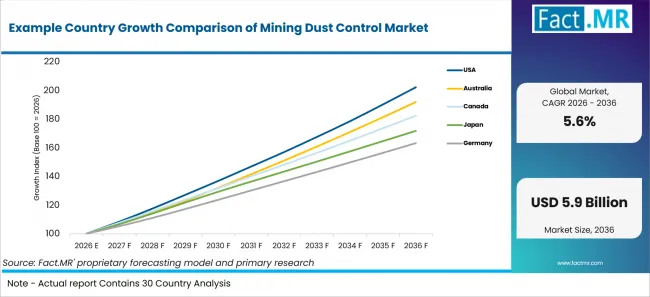
Example Country Growth Comparison Of Mining Dust Control Market | Source: Fact.MR
| Country | CAGR (2026-2036) |
|---|---|
| Australia | 6.7% |
| Brazil | 3.9% |
| Canada | 6.2% |
| USA | 7.3% |
| Germany | 5.0% |
| Japan | 5.6% |
| UK | 4.5% |
Source: Fact.MR analysis. Updated Jul 31, 2026
What supports Australia adoption?
6.7% CAGR, supported by remote mine-site service needs.
Australia’s remote mines evaluate supplier response before approving wider dust-control programs. Water-based systems gain preference when spray coverage can be checked on haul roads and transfer points during routine maintenance.
How is Brazil scaling demand?
6.3% CAGR, driven by material handling and distributor access.
Brazil’s growth is tied to loading and conveying operations that need repeat suppression during mineral movement. Regional distributors help buyers secure supply and field support without stretching internal maintenance teams.
What supports Canada adoption?
5.4% CAGR, backed by large mining geographies and service coverage.
Large operating distances shape Canada’s purchase route. Buyers compare equipment fit and maintenance access before extending dust-control systems across several sites.
How does USA demand develop?
5.2% CAGR, supported by documentation-led purchasing.
USA operators place weight on proof that a system fits the exact work area. Direct Sales remain useful when suppliers explain design duties and inspection expectations together.
What shapes Germany’s outlook?
4.9% CAGR, led by validation and equipment integration.
Germany’s outlook reflects buyers that review performance evidence before changing suppliers. Stationary Systems gain attention where fixed control points help teams keep maintenance records consistent.
How does Japan perform?
4.2% CAGR, supported by reliability-focused approval.
Japan’s growth follows a quality-led route where stable operation and compact installation matter. Water-based systems remain useful when the installation does not disrupt plant movement.
What supports UK demand?
4.0% CAGR, backed by supplier support and life-cycle review.
UK demand is expected to develop through support quality and regulatory fit. Material Handling and Transfer remains the clearest route where mineral movement creates repeat dust near work areas.
Who leads the Mining Dust Control Market?
Ecolab Inc. (Nalco Water) and BASF SE show direct relevance through water treatment and mining process chemicals. Cargill, Incorporated and Quaker Houghton broaden the provider field.
Ecolab Inc. (Nalco Water) supports mining customers through water-treatment capabilities. BASF SE adds chemical expertise for mining and mineral processing. Cargill, Incorporated contributes dust-control and road-treatment exposure. Quaker Houghton serves mining and industrial customers through fluids support. Borregaard AS and Global Road Technology (GRT) extend the field through binders. Midwest Industrial Supply, Inc. supports road stabilization. Benetech, Inc. adds transfer-point control offerings.
Which companies are the key providers?
Key companies include Ecolab Inc. (Nalco Water); BASF SE; Quaker Houghton; Borregaard AS; and Global Road Technology (GRT). Cargill, Incorporated is included. Midwest Industrial Supply, Inc. is included. Benetech, Inc. is included.
- Ecolab Inc. (Nalco Water)
- BASF SE
- Cargill, Incorporated
- Quaker Houghton
- Borregaard AS
- Midwest Industrial Supply, Inc.
- Global Road Technology (GRT)
- Benetech, Inc.
Bibliography
- Mine Safety and Health Administration. (2024, April 18). Lowering miners’ exposure to respirable crystalline silica and improving respiratory protection.
- National Institute for Occupational Safety and Health. (2024, June 18). Miner health. Centers for Disease Control and Prevention.
- Midwest Industrial Supply, Inc. (2024, May 13). New MSHA silica rule going into effect in June.
This Report Answers
- The report evaluates the Mining Dust Control Market across Product Type and Application choices that shape mine-site dust programs.
- Segment analysis covers Water-Based Dust Control Systems and Material Handling and Transfer as the 2026 share leaders.
- Country outlook evaluates Australia and Brazil alongside Canada and the USA. Germany and Japan complete the growth comparison with the UK.
- Competitive analysis profiles Ecolab Inc. (Nalco Water) and BASF SE alongside Quaker Houghton. Borregaard AS and Global Road Technology (GRT) complete part of the provider set. Cargill, Incorporated is profiled. Midwest Industrial Supply, Inc. is profiled. Benetech, Inc. is profiled.
- Service-mode assessment covers Stationary Systems and Portable Systems alongside on-site managed services and integrated dust management.
What does the Mining Dust Control Market cover?
Mining dust control covers systems and services that reduce airborne and fugitive dust during mine operations.
The Mining Dust Control Market covers water-based suppression and chemical binders. It also covers airborne collection systems and service-led dust management. Coverage extends to haul roads, transfer points and processing plants.
What is included in the scope?
Dust-control products and services are included when they are used directly in mining operations.
The scope includes Product Type and Application alongside End Use. It also covers Distribution Channel and Service Mode. It covers sprays, mist systems and managed programs.
What is excluded from the scope?
General infrastructure and equipment purchases without a dust-control function remain outside the scope of this market.
The scope excludes general ventilation and unrelated cleaning. Broad water-management spending remains outside scope without a direct connection to dust measurement or control.
How Was the Analysis Built?
The analysis draws on 120+ sources and 35+ company portfolios. It also uses 25+ countries and industry interviews.
- Primary Research: Primary research includes discussions with suppliers and end users. These conversations examine purchasing priorities and approval requirements. They also review the factors that influence wider market acceptance.
- Desk Research: Desk research covers regulatory publications and company filings. It also reviews technical studies and other authoritative sources. Every source used in the analysis is documented in the bibliography.
- Market Sizing and Forecasting: Market estimates combine historical performance and demand indicators. Segment shares and country-level growth are checked against adoption barriers.
- Data Validation and Update Cycle: Findings are validated by comparing primary interviews with public data and company activity. Regular updates review new product launches and procurement trends.
Segmentation
What is the report’s scope and coverage?
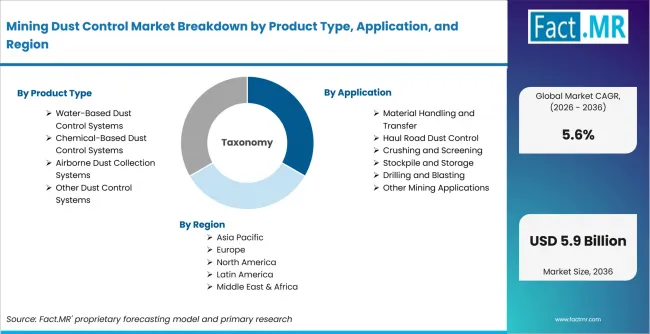
Mining Dust Control Market Breakdown By Product Type, Application, And Region | Source: Fact.MR
| Attribute | Details |
|---|---|
| Quantitative Units | USD billion in 2026 to USD billion by 2036 at CAGR |
| Market Definition | Commercial systems and services used to reduce airborne and fugitive dust during mining operations where roads and transfer points need routine control |
| Product Type | Water-Based Dust Control Systems; Water Spray Systems; Water Mist and Fogging Systems; Chemical-Based Dust Control Systems; Airborne Dust Collection Systems |
| Application | Material Handling and Transfer; Conveyor Systems; Transfer Points; Haul Road Dust Control; Crushing and Screening |
| End Use | Surface Mining; Open-Pit Mining; Open-Cast Mining; Underground Mining; Mineral Processing |
| Distribution Channel | Direct Sales; Direct Sales to Mining Companies; Long-Term Mining Contracts; Industrial Distributors; System Integrators and Engineering Firms |
| Service Mode | Stationary Systems; Fixed Dust Suppression Systems; Permanent Dust Collection Systems; Portable Systems; Integrated Dust Management |
| Regions Covered | North America; Latin America; Europe; East Asia; South Asia and Oceania; Middle East and Africa |
| Countries Covered | Australia; Brazil; Canada; USA; Germany; Japan; UK |
| Key Companies Profiled | Ecolab Inc. (Nalco Water); BASF SE; Quaker Houghton; Borregaard AS; Global Road Technology (GRT). Cargill, Incorporated. Midwest Industrial Supply, Inc. Benetech, Inc. |
| Forecast Period | 2026 to 2036 |
| Approach | Hybrid top-down and bottom-up approach using mine operating needs; dust-control product demand; segment shares; surface mining activity; service coverage; distributor access; water-use limits; maintenance requirements; country adoption patterns and company portfolio review |
Source: Fact.MR analysis. Updated Jul 31, 2026
How is the market segmented?
-
By Product Type
- Water-Based Dust Control Systems
- Water Spray Systems
- Water Mist and Fogging Systems
- Chemical-Based Dust Control Systems
- Surfactants and Wetting Agents
- Binders and Tackifiers
- Airborne Dust Collection Systems
- Baghouse Filters
- Cyclone Separators
- Other Dust Control Systems
- Foam Suppression Systems
- Filtration and Hybrid Systems
- Water-Based Dust Control Systems
-
By Application
- Material Handling and Transfer
- Conveyor Systems
- Transfer Points
- Haul Road Dust Control
- Mine Haul Roads
- Access and Transport Roads
- Crushing and Screening
- Crushers
- Screening Plants
- Stockpile and Storage
- Ore Stockpiles
- Coal and Mineral Storage
- Drilling and Blasting
- Drilling Operations
- Blasting Areas
- Other Mining Applications
- Tailings Management
- Waste Rock Handling
- Material Handling and Transfer
-
By End Use
- Surface Mining
- Open-Pit Mining
- Open-Cast Mining
- Underground Mining
- Coal Underground Mining
- Metal Underground Mining
- Mineral Processing
- Ore Processing Plants
- Mineral Concentration Facilities
- Coal Mining
- Thermal Coal Mining
- Metallurgical Coal Mining
- Quarry and Aggregate Operations
- Stone Quarries
- Sand and Gravel Operations
- Other Mining Operations
- Tailings and Waste Operations
- Specialty Mineral Mining
- Surface Mining
-
By Distribution Channel
- Direct Sales
- Direct Sales to Mining Companies
- Long-Term Mining Contracts
- Industrial Distributors
- Specialized Mining Distributors
- Regional Industrial Distributors
- System Integrators and Engineering Firms
- EPC Contractors
- Mining Engineering Companies
- Chemical and Solution Suppliers
- Direct Chemical Supply
- Managed Chemical Programs
- Online B2B Procurement
- Industrial E-Commerce Platforms
- Digital Procurement Portals
- Other Channels
- Local Agents
- Independent Representatives
- Direct Sales
-
By Service Mode
- Stationary Systems
- Fixed Dust Suppression Systems
- Permanent Dust Collection Systems
- Portable Systems
- Mobile Dust Suppression Units
- Portable Dust Collectors
- On-Site Managed Services
- Dust Monitoring Services
- Operator-Assisted Dust Control
- Integrated Dust Management
- Automated Dust Monitoring
- Smart Dust Suppression Systems
- Stationary Systems
-
By Region
- North America
- Latin America
- Europe
- East Asia
- South Asia and Oceania
- Middle East and Africa
Frequently Asked Questions
Which Product Type leads the market?
Which Application leads the market?
Which End Use category leads the market?
Which Distribution Channel leads the market?
Which Service Mode leads the market?
Which country records the highest listed CAGR?
What is the primary driver in this market?
What is the main restraint?
Why do stationary systems lead demand?
Who worked on this report


Preview the report firsthand - request a free sample
Free SampleGet the brochure for pricing and purchase details
Download PDF