- Market Value (2025): USD 15.5 Bn
- Estimated Value (2026): USD 16.4 Bn
- Forecast Value (2036): USD 28.2 Bn
- CAGR (2026-2036): 5.6%
What is the Modular Switch Market forecast to be worth by 2036?
USD 16.4 Billion in 2026 to USD 28.2 Billion by 2036, at a 5.6% CAGR.
- As per Fact.MR analysis, the modular switch market reached USD 15.5 Billion in 2025.
- Demand will increase from USD 16.4 Billion in 2026 to USD 28.2 Billion in 2036.
- The market is forecast to record a 5.6% CAGR during 2026 to 2036 driven by global residential urbanization, smart home lighting automation retrofits, stringent building electrical fire codes, and consumer migration toward premium interior aesthetic finishes.
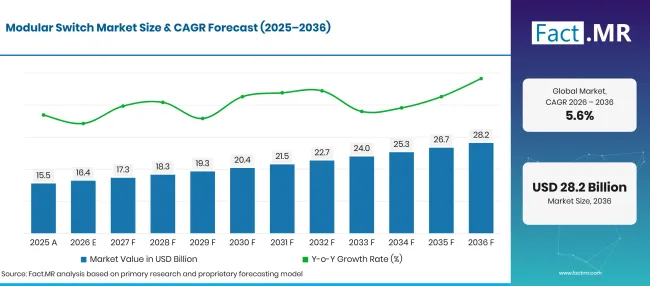
Factmr Modular Switch Market Forecast Global | Source: Fact.MR
| Year | Basis | Market Value (USD Billion) |
|---|---|---|
| 2025 | Actual | 15.5 |
| 2026 | Estimate | 16.4 |
| 2036 | Forecast | 28.2 |
| CAGR 2026 to 2036 | Forecast period | 5.6% |
Source: Fact.MR analysis. Updated Oct 21, 2026
What are the defining numbers behind Modular Switch Market growth?
USD 11.8 Billion absolute chance between 2026 and 2036, with toggle switches and residential applications generating the largest installation volume.
- Demand Drivers in the Market
- Strict international building codes and occupational electrical safety regulations mandate child-safe shuttered sockets, dead-front switchplate construction, and flame-retardant terminal materials across all commercial and residential structures [1]. Electrical inspectors and municipal safety boards enforce certified wiring device installations that prevent accidental finger contact and electrical arc-flash hazards. Homeowners and facility managers systematically replace hazardous semi-modular and traditional porcelain surface switches with recessed modular plates.
- Widespread integration of smart home ecosystems, voice assistants, and automated lighting controls is catalyzing consumer adoption of intelligent connected modular switches. High-energy electrical arcing fault experiments and switchgear enclosure testing confirm that modular electrical devices require rigorous thermal dissipation and spark-containment geometries to prevent structural ignition during abnormal grid surges [2]. Modern smart modular switches embed compact Wi-Fi, Zigbee, or Matter microcontrollers within standard gang wall boxes to deliver wireless smartphone switching and load monitoring.
- Rapid residential housing construction, commercial office revitalization, and urban infrastructure modernization across emerging and developed metropolises sustain multi-million-unit switchboard installations. Federal grid modernization funding programs and high-efficiency electrical equipment initiatives emphasize energy-efficient building load switching and smart metering compatibility [3]. Real estate developers partner directly with modular switch manufacturers to offer customizable designer switchplates that harmonize with contemporary luxury interior decor.
- Consumer preferences for premium aesthetics, minimalist interior styling, and tactile haptic feedback are transforming standard electrical wall switches from utilitarian utilities into prominent design elements. Rigorous arc-flash containment research conducted across electrical cabinets and distribution switch enclosures highlights the paramount importance of robust contact metallurgy, silver-nickel alloy contact points, and captive terminal screws [4]. Discerning property owners select brushed aluminum, tempered glass, matte black, and real wood faceplates that clip seamlessly onto modular sub-frames.
- Key Segments Analyzed
- By Type: Toggle Switches holds 46.3% share in 2026, preferred across residential and commercial properties for its intuitive tactile snap action, robust mechanical contact reliability, and long operational lifespan exceeding 100,000 switching cycles.
- By Application: Residential accounts for 48.3% share in 2026, driven by new apartment complex developments, single-family home renovations, and rising middle-class disposable expenditure on luxury electrical fittings.
- By Sales Channel: Direct Sales accounts for 36.0% share in 2026, driven by bulk contractor procurement agreements, direct developer-to-manufacturer bidding contracts, and commercial electrical turnkey projects.
- Analyst Opinion at Fact.MR
- Shambhu Nath Jha, Lead Consultant at Fact.MR, states, “The modular switch sector has permanently evolved from a low-involvement commodity hardware business into an active pillar of connected smart home infrastructure. Today’s property owners and electrical contractors demand absolute modularity—allowing traditional mechanical switches, USB fast-charging ports, dimmer dials, and wireless IoT relays to coexist harmoniously within a single universal gang plate. Switch manufacturers that master miniaturized solid-state electronics, flame-retardant resin molding, and Matter-compliant wireless interoperability will secure long-term procurement partnerships with top-tier construction developers.”
- Strategic Implications
- Electrical equipment manufacturers are integrating solid-state switching relays, micro-gap contacts, and eco-friendly dielectric polymers into modular switch assemblies. Advanced materials research confirms that eco-friendly dielectric insulation and robust contact arc-suppression chemistry drastically reduce thermal degradation and contact pitting under high inductive ballast loads [5]. Transitioning toward lead-free silver alloy contacts ensures compliance with global RoHS and REACH environmental directives.
- Modular switchmakers are redesigning internal terminal geometries to incorporate screwless push-in wire connectors and tool-free snap-in mechanisms. Reducing installation time by up to 40% per gang box delivers significant labor savings for electrical contractors executing large-scale high-rise residential and hotel construction projects.
- Leading electrical brands are forging strategic hardware partnerships with smart home platform providers, ensuring that smart modular switch lines achieve seamless out-of-the-box compatibility with Apple HomeKit, Google Home, Amazon Alexa, and Matter ecosystems. Providing local-mesh fallback operation guarantees that wall switches operate mechanically even during broadband internet outages.
- Supply chain executives are optimizing automated injection molding facilities and stamping presses to manufacture precision polycarbonate switchplates and silver-cadmium-free contact springs at scale. Vertically integrated production mitigates raw copper and resin price spikes while ensuring strict dimensional tolerances across modular grid assemblies.
Germany is projected to record a 6.0% CAGR, supported by advanced DIN-standard building codes, smart home KNX automation adoption, and heavy commercial building renovation activity. Brazil advances at 5.5%, fueled by residential urban housing expansion, municipal electrical safety standard enforcement, and rising demand for stylish interior fittings in São Paulo and Rio de Janeiro. The United States expands at 4.9%, driven by smart lighting retrofits, single-family home modernization, and high commercial construction spending. The United Kingdom achieves a 4.4% CAGR, underpinned by stringent BS 7671 wiring regulations, historical home electrical rewiring, and rapid luxury interior design upgrades. Japan registers a 3.9% CAGR, supported by seismic-resistant electrical building codes, compact urban apartment renovations, and high demand for antimicrobial tactile switches.
How does the Modular Switch Market break down by segment?
Toggle Switches 46.3%; Residential 48.3%; Direct Sales 36.0% in 2026.
Which Type dominates?
Toggle Switches holds 46.3% share in 2026.
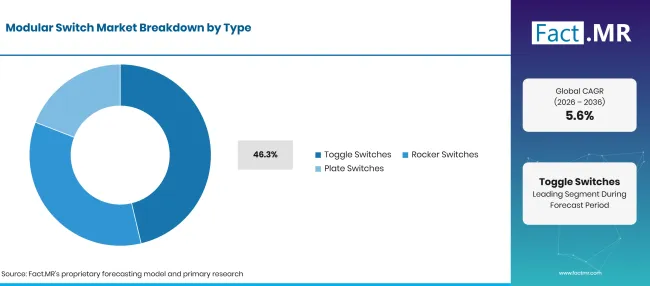
Factmr Modular Switch Market Breakdown Type | Source: Fact.MR
| Type | Share (2026) |
|---|---|
| Toggle Switches (Leading segment) | 46.3% |
| Other segments combined | 53.7%* |
| Total | 100.0% |
Source: Fact.MR analysis. Updated Oct 21, 2026
Toggle switches dominate global modular switch installations due to their proven mechanical durability, definitive tactile feedback, and intuitive flip operation. Electrical contractors trust mechanical toggle mechanisms because they contain fewer electronic components susceptible to power surges or lightning strikes. In heavy industrial and utility facilities, engineers coordinate low-voltage modular controls with upstream switchgear systems to establish coordinated protection throughout electrical distribution networks. Master electricians deploy comprehensive circuit breaker fuse and relay assemblies within sub-distribution panelboards to isolate branch circuits feeding modular switch gangs. Facilities also install heavy-duty molded case circuit breaker units at main service entrances to ensure complete fault clearing upstream of wall switchplates.
What leads the Application segment?
Residential accounts for 48.3% share in 2026.
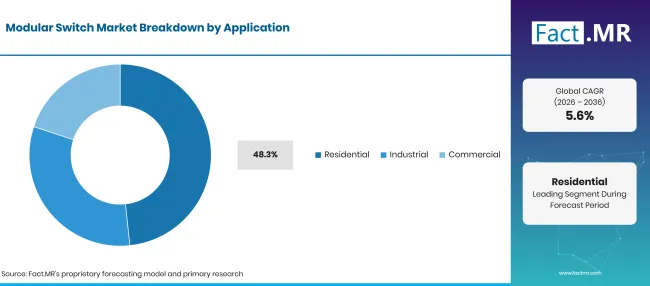
Factmr Modular Switch Market Breakdown Application | Source: Fact.MR
| Application | Share (2026) |
|---|---|
| Residential (Leading segment) | 48.3% |
| Other segments combined | 51.7%* |
| Total | 100.0% |
Source: Fact.MR analysis. Updated Oct 21, 2026
Residential housing represents nearly half of total modular switch market revenues, driven by massive urbanization, population growth, and high consumer spending on home aesthetics and smart lighting. Homeowners increasingly customize each room with dedicated modular configurations, combining two-way lighting switches, night lamps, fan regulators, and multi-pin international sockets. In major commercial substations powering high-density residential towers, utility operators deploy advanced gas insulated switchgears to ensure compact footprint efficiency and absolute fire safety. Similarly, municipal utilities maintain robust air insulated switchgears across suburban distribution yards to regulate secondary voltage stepping. Heavy power plants and industrial feeder networks utilize high-voltage vacuum circuit breaker systems to interrupt fault currents instantly without generating external fire hazards.
How does Sales Channel influence distribution?
Direct Sales accounts for 36.0% share in 2026.
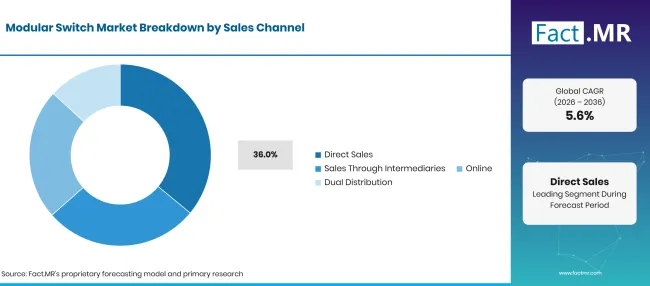
Factmr Modular Switch Market Breakdown Sales Channel | Source: Fact.MR
| Sales Channel | Share (2026) |
|---|---|
| Direct Sales (Leading segment) | 36.0% |
| Other segments combined | 64.0%* |
| Total | 100.0% |
Source: Fact.MR analysis. Updated Oct 21, 2026
Direct sales from electrical manufacturers to commercial contractors, large-scale real estate developers, and government infrastructure projects constitute the leading revenue channel. Major construction projects procure modular switches in high-volume containerized quantities directly from factory warehouses, securing negotiated bulk pricing, customized faceplate labeling, and extended contractor warranties. In modern green building projects, developers install efficient power switchgear alongside modular wall switches to earn LEED energy-efficiency building certifications. Commercial complexes frequently house a factory-assembled compact substation on-site to handle medium-voltage step-down transformations. Real-time facility management suites utilize an integrated substation monitoring system to balance circuit phase loads across building risers. To protect sensitive connected electronic switches against transient voltage spikes, panel builders install a certified surge arrester across main distribution busbars.
What is accelerating Modular Switch Market adoption, and what is holding it back?
Global residential urbanization, smart lighting automation integration, and stringent building fire safety standards accelerate market expansion. Counterfeit uncertified switch distribution in developing markets, fluctuating prices of raw copper and polycarbonate, and electrical wiring compatibility retrofitting hurdles restrict frictionless adoption.
Drivers Impact Analysis
| DRIVER | (~) % IMPACT ON CAGR | GEOGRAPHIC RELEVANCE | IMPACT TIMELINE |
|---|---|---|---|
| Rapid residential construction and smart home lighting automation retrofits | +1.3% | North America, Europe, Asia | Short term (<= 2 years) |
| Enforcement of strict building electrical safety and child-safe shutter codes | +1.1% | Global | Medium term (2–4 years) |
| Rising consumer spending on premium architectural and decorative interior finishes | +0.9% | North America, Europe | Medium term (2–4 years) |
| Integration of energy-saving wireless IoT controls within standard wall boxes | +0.8% | East Asia, Western Europe | Medium term (2–4 years) |
| Expanding commercial office renovation and hospitality construction projects | +0.6% | Global | Long term (>= 4 years) |
Source: Fact.MR analysis. Updated Oct 21, 2026
Opportunity Impact Analysis
| OPPORTUNITY | (~) % IMPACT ON CAGR | GEOGRAPHIC RELEVANCE | IMPACT TIMELINE |
|---|---|---|---|
| Matter-compatible smart modular switches enabling brand-agnostic automation | +1.2% | USA, Western Europe | Short term (<= 2 years) |
| High-wattage USB Type-C power delivery fast-charging modular socket modules | +1.0% | Global | Medium term (2–4 years) |
| Antimicrobial and touchless infrared gesture-controlled switchplates for healthcare | +0.8% | Europe, East Asia | Medium term (2–4 years) |
| Ultra-slim flush-to-wall architectural switch designs for luxury residences | +0.6% | North America, Middle East | Long term (>= 4 years) |
Source: Fact.MR analysis. Updated Oct 21, 2026
Restraints Impact Analysis
| RESTRAINT | (~) % IMPACT ON CAGR | GEOGRAPHIC RELEVANCE | IMPACT TIMELINE |
|---|---|---|---|
| Price volatility in high-conductivity copper terminals and engineering resins | -1.0% | Global | Short term (<= 2 years) |
| Influx of low-quality non-flame-retardant counterfeit switches in local markets | -0.8% | Latin America, South Asia | Medium term (2–4 years) |
| Rewiring complexities in older legacy buildings lacking neutral wire runs | -0.6% | North America, Europe | Medium term (2–4 years) |
| High cost-in-use premiums of intelligent connected switches vs mechanical units | -0.4% | Emerging Markets | Long term (>= 4 years) |
Source: Fact.MR analysis. Updated Oct 21, 2026
Which countries are scaling the Modular Switch Market through 2036?
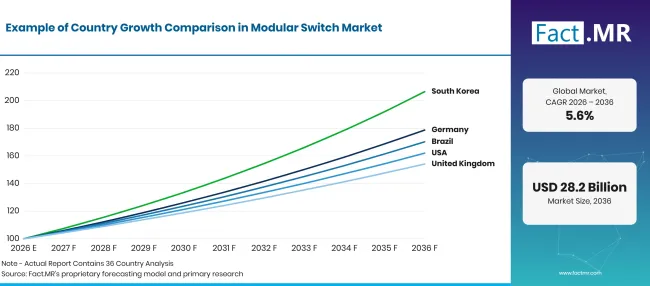
Factmr Modular Switch Market Growth Index | Source: Fact.MR
| Country | CAGR (2026–2036) |
|---|---|
| Germany | 6.0% |
| Brazil | 5.5% |
| USA | 4.9% |
| UK | 4.4% |
| Japan | 3.9% |
Source: Fact.MR analysis. Updated Oct 21, 2026
Why is Germany leading European modular switch development?
6.0% CAGR, driven by Germany’s stringent VDE and DIN electrical engineering standards, widespread smart home KNX bus automation integration, and high residential energy-efficiency retrofits.
Germany stands as Europe’s premier electrical engineering benchmark, with strict VDE (Association for Electrical, Electronic & Information Technologies) regulations mandating flawless terminal insulation, flame resistance, and arc-containment performance. German property owners and commercial builders invest heavily in KNX-compatible intelligent building control systems, where modular wall switches manage automated blinds, heating valves, and scene-specific lighting. Renovation of historical urban housing blocks across Berlin, Munich, and Frankfurt fuels strong demand for modular retrofits that fit within standard European circular back-boxes. German consumers prioritize robust, minimalist industrial design, favoring matte glass, brushed slate, and stainless-steel modular faceplates that guarantee decades of tactile operation.
What sustains rapid growth across Brazil?
5.5% CAGR, supported by extensive urban residential housing developments, strict NBR 5410 low-voltage installation compliance, and rising middle-class interest in modern interior decor.
Brazil is experiencing sustained modernization across its electrical distribution sector, propelled by real estate construction across São Paulo, Minas Gerais, and southern metropolitan hubs. Brazilian regulatory standard NBR 5410 enforces strict requirements for residential electrical installations, accelerating the retirement of dangerous ungrounded surface switches in favor of modular recessed plates featuring child-safe shutters. Local construction developers and architectural interior designers frequently select modular switch lines with interchangeable colored bezels to offer customized apartment packages. Domestic electrical retail distributors report rising consumer sales of modular USB charging sockets, digital dimmers, and outdoor weatherproof switchboxes designed for tropical climates.
How is the United States maintaining substantial market scale?
4.9% CAGR, propelled by robust single-family home remodeling, widespread smart lighting retrofit adoption, and massive commercial office construction spending.
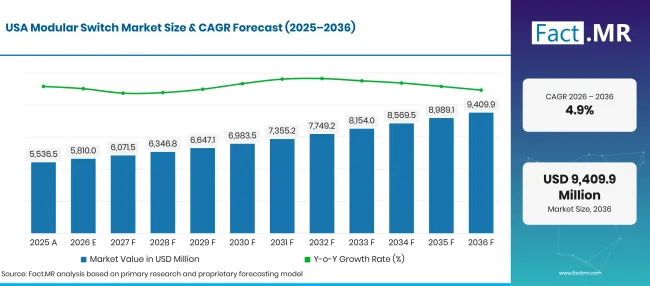
Factmr Modular Switch Market Forecast Usa | Source: Fact.MR
The United States represents a high-value market for modular wiring devices, where UL 20 and National Electrical Code (NEC) compliance govern all commercial and residential installations. American homeowners are actively upgrading conventional mechanical toggle switches to smart modular wall switches capable of scheduled automation, voice assistant synchronization, and energy consumption reporting. Commercial building managers across New York, Texas, and California install modular occupancy sensors and dual-relay switchplates to comply with Title 24 and ASHRAE commercial lighting energy conservation mandates. Leading electrical supply distributor networks stock extensive modular product lines to service millions of licensed electrical contractors.
What sustains modular switch demand in the United Kingdom?
4.4% CAGR, rooted in strict BS 7671 IET wiring standards, historical residential electrical rewiring projects, and strong consumer affinity for luxury decorative electrical accessories.
The United Kingdom maintains rigorous electrical installation standards enforced under BS 7671 (The IET Wiring Regulations) and Part P of the Building Regulations, requiring certified contractor sign-off on residential wiring changes. British consumers and boutique hospitality developers frequently replace standard white molded plastic switches with premium decorative metal-clad, brass, and nickel finish modular plates. Rapid adoption of smart lighting and app-controlled home automation has spurred widespread procurement of smart modular dimmers engineered to operate flawlessly without requiring neutral wire retrofits in older UK residential properties. Major electrical trade wholesalers across London and the Midlands maintain robust distribution networks supplying certified modular wiring accessories.
Why is Japan registering steady technological advancements?
3.9% CAGR, propelled by seismic-resistant electrical fixture requirements, compact urban micro-apartment developments, and widespread adoption of tactile, antimicrobial touch switches.
Japan operates under stringent PSE (Product Safety of Electrical Appliances and Materials) standards, requiring electrical switches to withstand intense seismic tremors without loose contact arcing or structural dislocation. Japanese apartment designers optimize compact urban living spaces by deploying high-density modular switchboards that pack multiple micro-toggles, night lights, and emergency battery-backed guidance lamps into single wall panels. Japanese healthcare facilities, nursing homes, and residential care complexes specify modular switches coated with silver-ion antimicrobial surfaces and equipped with extra-large rocker plates designed for easy palm or elbow actuation. Leading Tokyo electrical manufacturers continuously innovate in ultra-flat, silence-damped modular mechanisms that operate with near-zero mechanical click noise.
Who leads the Modular Switch Market?
Anchor Electricals (a subsidiary of Panasonic Corporation) maintains an iconic market presence across Asia, supplying immense volumes of durable, affordable, and designer modular switch series engineered for residential and commercial infrastructure. Havells India commands massive market reach, manufacturing premium modular switch lines, intelligent home automation accessories, and industrial low-voltage switchgear. Honeywell Electrical Devices and Systems India delivers precision-engineered modular wiring devices, smart lighting controllers, and integrated commercial building automation interfaces. Legrand India represents a global titan in electrical and digital building infrastructures, pioneering luxury modular switchplate collections, connected smart home ranges, and energy-efficient lighting controls.
Wipro operates an innovative consumer electrical and lighting division, supplying smart Wi-Fi modular switches, LED dimmers, and contemporary designer switchboards. ABB delivers world-class industrial electrification and smart building management solutions, offering KNX-integrated modular switches and ultra-reliable low-voltage distribution hardware. GE Vernova Inc. contributes extensive engineering heritage across electrical infrastructure, power switching, and distribution equipment. GM Kolors is renowned for trendsetting decorative modular switch designs, four-color faceplate collections, and home automation accessories. Orpat produces high-volume, reliable modular switches and consumer electrical appliances catering to budget-conscious suburban and rural construction projects. Philips Electronics (Signify) commands leadership in connected lighting systems, smart modular wall switches, and wireless smart home scene controllers.
Which companies are the key providers?
Key companies include Anchor Electricals; Havells India; Honeywell Electrical Devices and Systems India; Legrand India; Wipro; ABB; GE Vernova Inc.; GM Kolors; Orpat; and Philips Electronics.
- Anchor Electricals
- Havells India
- Honeywell Electrical Devices and Systems India
- Legrand India
- Wipro
- ABB
- GE Vernova Inc.
- GM Kolors
- Orpat
- Philips Electronics
Bibliography
- [1] Occupational Safety and Health Administration. (2025). Wiring methods, components, and equipment for general use: Switchboards, panelboards, and distribution switches (29 CFR § 1910.305). eCFR.
- [2] National Institute of Standards and Technology. (2025). Report on High-Energy Arcing Fault Experiments: Bus Duct and Switchgear Enclosures (NIST Technical Note 2245). NIST.
- [3] U.S. Department of Energy. (2025). Funding Opportunities to Ensure Electricity Grid Resilience and Next-Generation Switchgear Deployment. Office of Electricity.
- [4] National Institute of Standards and Technology & NRC. (2025). Electrical Cabinet and Switchgear Arc-Fault Experiments. NIST.
- [5] Zhang, L., et al. (2026). Photocatalytic degradation strategies and eco-friendly gas alternatives for switchgear dielectric insulation. iScience, 29(10), 110982.
This Report Answers
- The report evaluates mechanical cycle durability, terminal arc-suppression kinetics, and smart home wireless connectivity across toggle, rocker, and plate modular switches.
- Application assessments detail why residential housing construction and smart home lighting retrofits account for nearly half of total global installation demand.
- Country-level analysis investigates the building electrical codes and interior decoration trends enabling Germany and Brazil to lead regional growth projections.
- Material science comparisons examine flame retardance, dielectric breakdown voltage, and contact erosion rates across polycarbonate resins and silver-alloy contact metallurgy.
- Competitive profiling benchmarks automated injection molding capacities, smart home ecosystem certifications, and contractor loyalty programs across leading electrical accessory brands.
What does the Modular Switch Market cover?
The market encompasses commercial shipments of modular electrical wiring devices, including mechanical light switches, push-button switches, dimmer dials, multi-standard electrical sockets, USB charging modules, and IoT-enabled smart switch relays designed for flush mounting into wall back-boxes. It evaluates value creation across electrical equipment manufacturers, building infrastructure contractors, electrical wholesale distributors, and retail hardware chains. The analysis tracks product flows into single-family homes, multi-story apartment complexes, commercial office buildings, hotels, and light industrial facilities.
What is included in the scope?
The scope covers merchant wholesale shipments of finished modular switch mechanisms, supporting grid plates, decorative front faceplates, child-resistant shuttered power sockets, fan speed controllers, and smart wireless modular switch units. Revenue figures represent finished wiring device products valued at factory-gate and wholesale distribution pricing points. Both standard mechanical switches and connected smart electronic switches designed for modular gang wall mounting are fully integrated within report totals.
What is excluded from the scope?
The scope excludes main high-voltage utility transmission switchgear, outdoor high-voltage circuit breakers, heavy industrial substation busbars, and uninsulated bare electrical copper wiring cables. Traditional non-modular wooden surface switchboards, primitive porcelain tumbler switches, and industrial heavy-machinery motor disconnect switches are outside the modular wall switch scope. Electrical hand tools, contractor wire-stripping pliers, and building civil drywall construction materials are excluded from product market valuations.
How Was the Analysis Built?
The analysis draws on 120+ sources, 35+ company portfolios, 25+ countries, and more than 20 industry interviews.
- Primary Research: Primary research includes discussions with manufacturers, service providers, technology developers, distributors, end users, and subject-matter experts. These conversations examine purchasing priorities, product adoption, operational challenges, approval requirements, competitive positioning, and the factors that influence wider market acceptance.
- Desk Research: Desk research covers government statistics, regulatory publications, company filings, trade data, technical studies, industry associations, standards, public policy, and other authoritative sources. Every source used in the analysis is documented in the bibliography.
- Market Sizing and Forecasting: Market estimates combine historical performance, demand indicators, pricing and volume trends, segment shares, company participation, country-level growth, adoption patterns, investment activity, and barriers to market expansion.
- Data Validation and Update Cycle: Findings are validated by comparing primary interviews with public data, company activity, regulatory changes, trade patterns, and industry developments. Regular updates review new product launches, capacity changes, partnerships, approvals, and shifts in commercial adoption.
Segmentation
What is the report’s scope and coverage?
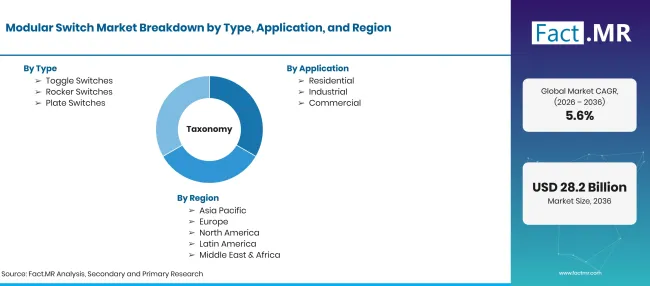
Factmr Modular Switch Market Taxonomy | Source: Fact.MR
| Attribute | Details |
|---|---|
| Quantitative Units | USD Billion in 2026 to USD Billion by 2036 at 5.6% CAGR |
| Market Definition | Commercial shipments of modular wall switches, grid plates, socket outlets, smart dimmers, and electronic wiring devices engineered for concealed electrical mounting in buildings. |
| Type | Toggle Switches; Rocker Switches; Plate Switches |
| Application | Residential; Industrial; Commercial |
| Sales Channel | Direct Sales; Sales Through Intermediaries; Online; Dual Distribution |
| Regions Covered | North America; Latin America; Western Europe; Eastern Europe; East Asia; South Asia & Pacific; Middle East & Africa |
| Countries Covered | Germany; Brazil; USA; UK; Japan |
| Companies Profiled | Anchor Electricals; Havells India; Honeywell Electrical Devices and Systems India; Legrand India; Wipro; ABB; GE Vernova Inc.; GM Kolors; Orpat; Philips Electronics |
| Forecast Period | 2026 to 2036 |
| Approach | Primary interviews with electrical contractors, building electrical engineers, smart home developers, and electrical trade wholesale distributors combined with global construction data audits. |
Source: Fact.MR analysis. Updated Oct 21, 2026
How is the market segmented?
-
By Type
- Toggle Switches
- Rocker Switches
- Plate Switches
-
By Application
- Residential
- Industrial
- Commercial
-
By Sales Channel
- Direct Sales
- Sales Through Intermediaries
- Online
- Dual Distribution
-
By Region
- North America
- Latin America
- Western Europe
- Eastern Europe
- East Asia
- South Asia & Pacific
- Middle East & Africa
Frequently Asked Questions
How big is the modular switch market in 2026?
What is the CAGR from 2026 to 2036?
Which type leads?
Which application leads?
Which companies participate in modular switches?
Who worked on this report


Preview the report firsthand - request a free sample
Free SampleGet the brochure for pricing and purchase details
Download PDF