Molded Pulp Buffers Market Size, Share, Growth and Forecast (2026 - 2036)

The Molded Pulp Buffers Market is segmented by Product Type, by Material Type, by Molded Pulp Process, by Function, by Sustainability Type, by End-Use Industry, by Distribution Channel, and by Region. Forecast for 2026 to 2036.

According to market estimates, the molded pulp buffers market stood at USD 663.0 million in 2025 and is projected to reach USD 712.7 million in 2026 and USD 1,468.9 million by 2036, expanding at a CAGR of 7.5% during the forecast period. Trays are expected to account for the largest market share of 27.1% in 2026, driven by their extensive usage in electronics packaging, food service applications, medical device transportation, and industrial product handling.

Molded Pulp Buffers Market Overview, Growth Outlook, and Forecast by Fact.MR

  • In 2025, the molded pulp buffers market was valued at USD 663.0 million.
  • Demand for molded pulp buffer solutions is projected to grow to USD 712.7 million in 2026 and reach USD 1,468.9 million by 2036.
  • The market is expected to expand at a CAGR of 7.5% during the forecast period.
  • The molded pulp buffers market is projected to create an absolute dollar opportunity of USD 756.2 million between 2026 and 2036.
  • Growing demand for sustainable protective packaging, substitution of plastic foam cushioning, development of e-commerce logistics, and increasing use of recyclable fiber-based packaging in the electronics, food & beverage, healthcare, and industrial end-use sectors are fuelling the market expansion. Market growth will likely be bolstered by ongoing regulations on single use plastic and rising investment in sustainable packaging solutions over the next years.
  • However, price volatility of raw materials, high tooling cost, moisture sensitivity and performance limitation in comparison with plastic-based protective packaging might hinder the market growth to some extent.
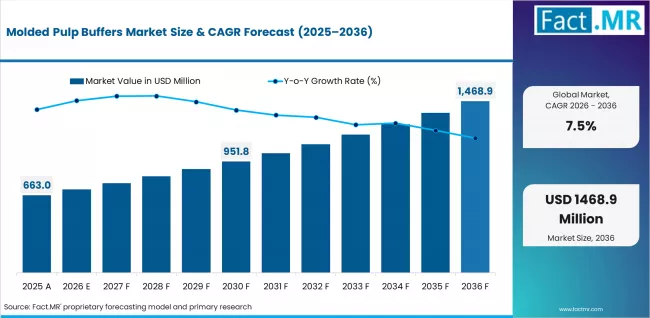
Molded Pulp Buffers Market  Value Analysis

Summary of the Molded Pulp Buffers Market

  • Market Snapshot
    • Global molded pulp buffers market revenue stood at USD 712.7 million in 2026 and is forecast to reach USD 1,468.9 million by 2036.
    • At a 7.5% CAGR from 2026 to 2036, the market is set to expand ~2.1x in value, creating an absolute dollar opportunity of USD 756.2 million.
    • Expansion is attributed to the growing demand for eco-friendly protective packaging, escalating substitution of plastic foam cushion material, and developing e-commerce logistics business on a global scale.
    • Increasing regulatory pressure towards single use plastics and higher penetration of recyclable packaging’s made of fibers is driving market growth.
    • The applications of protective packaging are revolutionizing with the development of thermoformed molded fiber technology solutions and individualized protective packaging in various industries.
  • Demand and Growth Drivers
    • Growing need for green and biodegradable protective packaging products
    • Growing substitution of plastic and EPS foam cushioning material
    • Rapid growth of e-commerce and parcel delivery services
    • Demand on the rise for protective packaging within the consumer goods and electronics markets
    • Rising investments in innovative sustainable fiber-based packaging solutions
    • Need for packaging solutions that provide:
      • Shock absorption and cushioning protection
      • Product stabilization during transit
      • Lightweight and recyclable packaging
      • Improved packaging sustainability
      • Cost-effective protective packaging
      • Reduced environmental impact
  • Product and Segment View
    • Trays hold 27.1% of product type share in 2026, emerging as the leading segment due to widespread use in electronics, foodservice, and medical packaging applications.
    • Recycled Paper Pulp accounts for 37.9% of material type share in 2026, positioning it as the dominant material segment owing to strong sustainability adoption and recycled fiber utilization.
    • Transfer Molded Pulp represents 37.4% of molded pulp process share in 2026, supported by cost efficiency and large-scale protective packaging production capabilities.
    • Cushioning & Shock Absorption account for 32.4% of function share in 2026, reflecting rising demand for impact-resistant transit packaging solutions.
    • Electronics & Consumer Goods accounted for 28.1% of end-use industry share in 2026, driven by increasing shipments of consumer electronics and demand for protective packaging inserts.
  • Geography and Competitive Outlook
    • Strong growth prospects exist across Asia Pacific, North America, and Europe owing to increasing sustainable packaging adoption, expanding e-commerce infrastructure, and rising regulatory restrictions on plastic packaging materials.
    • Some of the major growth regions in the Molded Pulp Buffers market include India (CAGR 10.0%), Japan (9.2%), China (8.9%), Canada (8.4%), United States (6.7%), South Korea (6.3%), United Kingdom (5.4%), and Germany (4.9%) throughout the forecast period.
    • Growth opportunities for the market depend on:
      • Rising investment in sustainable packaging solutions
      • Expansion of e-commerce logistics and protective packaging demand
      • Adoption of recyclable and compostable fiber-based materials
      • Increasing use of thermoformed molded pulp technologies
      • Regulatory restrictions on plastic-based protective packaging
      • Key companies active in this market include: Huhtamaki Oyj, Hartmann, Sonoco Products Company, WestRock Company, International Paper, Pactiv Evergreen, UFP Technologies, Cascades Inc., CKF Inc., and others.
  • Analyst Opinion
    • Shambhu Nath Jha, Principal Consultant at Fact.MR, opines, “Leaders at the CXO level are expected to recognize that the future competitive advantage in the molded pulp buffers market will increasingly depend on developing sustainable, lightweight, and high-performance protective packaging solutions capable of replacing plastic-based cushioning materials across e-commerce, electronics, healthcare, and industrial packaging applications.

Molded Pulp Buffers Market — At a Glance

Attribute Details
Market Value 2025 USD 663.0 Million
Market Value 2026 USD 712.7 Million
Market Value 2036 USD 1,468.9 Million
Absolute Dollar Opportunity USD 756.2 Million
Total Growth 106.10%
CAGR 7.50%
Growth Multiple 2.1x
Key Demand Theme Rising demand for sustainable protective packaging, replacement of plastic foam cushioning, expansion of e-commerce logistics, increasing adoption of recyclable fiber-based packaging, and regulatory pressure on single-use plastics
Leading Product Type Trays
Product Type Share 27.1%
Leading Material Type Recycled Paper Pulp
Material Type Share 37.9%
Leading Molded Pulp Process Transfer Molded Pulp
Molded Pulp Process Share 37.4%
Leading Function Cushioning & Shock Absorption
Function Share 32.4%
Leading End-Use Industry Electronics & Consumer Goods
End-Use Industry Share 28.1%
Key Growth Regions Asia Pacific, North America, Europe
Key Companies Huhtamaki Oyj, Hartmann, Sonoco Products Company, WestRock Company, International Paper, Pactiv Evergreen, UFP Technologies, Cascades Inc., CKF Inc.
Segmentation by Product Type Trays, End Caps, Clamshell Packaging, Corner Protectors, Cups & Holders, Inserts & Cushioning Components, Custom Molded Buffers
Segmentation by Material Type Recycled Paper Pulp, Virgin Pulp, Kraft Pulp, Bamboo Fiber, Bagasse (Sugarcane Fiber), Wood Pulp, Mixed Natural Fibers
Segmentation by Molded Pulp Process Thick Wall Molded Pulp, Transfer Molded Pulp, Thermoformed/Fine Molded Pulp, Processed Molded Pulp
Segmentation by Function Cushioning & Shock Absorption, Protective Packaging, Void Fill, Product Stabilization, Insulation, Transit Protection
Segmentation by Sustainability Type Recyclable Buffers, Compostable Buffers, Biodegradable Buffers
Segmentation by End-Use Industry Electronics & Consumer Goods, Food & Beverage, Healthcare & Medical Devices, Automotive Components, Personal Care & Cosmetics, Industrial Packaging, E-commerce & Logistics, Household Appliances
Segmentation by Distribution Channel Direct Sales/OEM Supply, Packaging Distributors, Online/B2B E-commerce Platforms
Segmentation by Region North America, Latin America, East Asia, South Asia & Pacific, Western Europe, Eastern Europe, Middle East & Africa

Key Growth Drivers, Constraints, and Opportunities
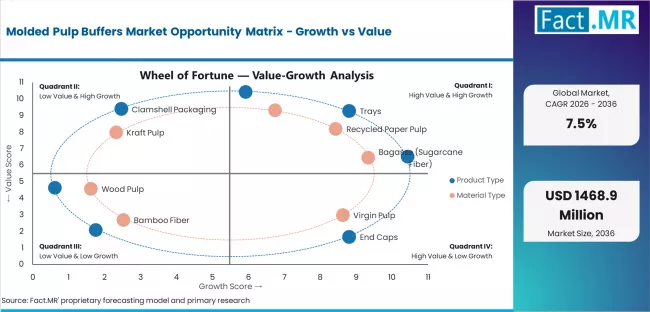
Molded Pulp Buffers Market Opportunity Matrix Growth Vs Value

Key Factors Driving Growth

  • The growing need for environmentally friendly and recycled protective packaging solutions is leading to the adoption of molded pulp buffers in various sectors.
  • The growing substitution of plastic foam cushion materials owing to government regulations on environment and sustainability is boosting the market growth around the globe.
  • Growth in e-commerce, electronics shipments and industrial logistics has led to increased demand for lightweight shock absorbent transit packaging.
Growth Driver Demand Impact Time Horizon Key Impact Area Fact.MR Insight
Rising demand for sustainable and recyclable protective packaging solutions High Short–Mid Term Eco-friendly transit packaging & plastic replacement Increasing regulatory restrictions on plastic packaging and growing sustainability commitments are accelerating adoption of molded pulp buffers across packaging industries globally.
Rapid expansion of e-commerce and protective logistics packaging High Short–Mid Term Shock-absorbing transit packaging & parcel protection Growing e-commerce shipments and demand for lightweight protective packaging solutions are supporting strong demand for molded pulp cushioning products and transit protection components.
Increasing replacement of EPS foam and plastic cushioning materials Medium-High Mid–Long Term Sustainable cushioning & fiber-based protective packaging Manufacturers are increasingly shifting toward biodegradable and recyclable molded fiber packaging to reduce environmental impact and comply with sustainability regulations.
Advancements in thermoformed molded fiber technologies Medium-High Mid–Long Term High-performance molded pulp packaging & precision cushioning Development of thermoformed and fine molded pulp technologies is improving product strength, aesthetics, and customization capabilities for electronics, healthcare, and industrial packaging applications.
Growing adoption across electronics, healthcare, and automotive industries Medium-High Mid–Long Term Customized protective packaging & product stabilization Rising demand for durable, lightweight, and sustainable protective packaging solutions is increasing adoption of molded pulp buffers in high-value and fragile product applications.

Key Market Constraints

  • Greater cost of tooling and customization than standard plastic packaging could prevent adoption by smaller and medium-sized producers.
  • Some restrictions on use of molded pulp buffers in heavy-duty or high-humidity environments, due to moisture sensitivity and relatively lower structural strength in some applications.
  • Availability of recycled fiber and raw material prices may fluctuate, resulting in potential impact on the production costs and supply results.

Key Opportunity Areas

  • The adoption of compostable and biodegradable packaging materials is on the rise, which is offering immense growth opportunities to the producers of molded pulp buffers.
  • Development of e-commerce logistics and sustainable shipping trends is contributing to the demand for recyclable protective transit packaging.
  • Growing application of customized molded fiber packaging in consumer electronics, EV battery components, and medical device packaging is anticipated to further foster the long-term market advancement.

Segment-wise Analysis of the Molded Pulp Buffers Market

  • Trays account for 27.1% share of the product type segment in 2026, driven by their widespread use in electronics packaging, foodservice applications, medical device transportation, and industrial protective packaging solutions.
  • Recycled Paper Pulp holds 37.9% share of the material type segment in 2026, supported by increasing adoption of sustainable packaging materials, growing regulatory pressure on plastic usage, and rising demand for recyclable fiber-based cushioning solutions.
  • Transfer Molded Pulp represents 37.4% share of the molded pulp process segment in 2026, owing to its cost efficiency, high-volume production capability, and extensive application in protective transit packaging and industrial cushioning products.

The molded pulp buffers market is segmented by product type, material type, molded pulp process, function, sustainability type, end-use industry, distribution channel, and region.

Which Product Type Segment Topped the Molded Pulp Buffers Market?
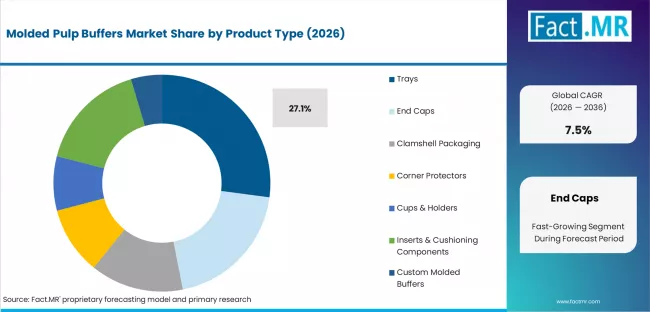
Molded Pulp Buffers Market Analysis By Product Type

It is estimated that Trays will account for the highest market share of 27.1% in the Molded Pulp Buffers Market by 2026. This is mainly attributed to rising demand for protective packaging in applications such as electronics, foodservice, healthcare, and industrial. Trays provide superior product stability, lightweight shipping protection and economical cushioning solutions, making them the go-to format for many high-volume packagers.

Which Material Type Segment Accounts for the Highest Share in the Market?
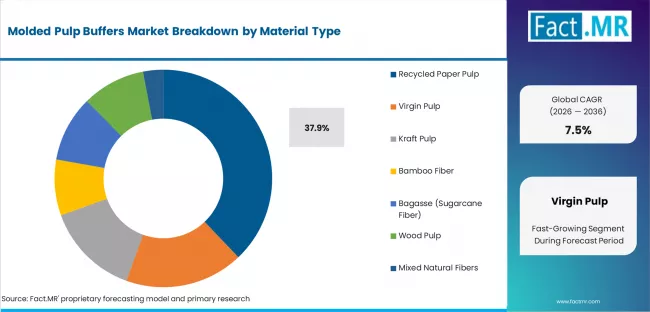
Molded Pulp Buffers Market Analysis By Material Type

The material type segment is expected to hold the largest market share of 37.9% by 2026 in the segment of market types with Recycled Paper Pulp. This leadership position is attributed to the stringent governmental regulations, increasing the adoption of recyclable packaging material and demand for sustainable fiber based cushioning solutions. Use of recycled pulp is gaining traction among manufacturers to minimize the environmental impact, comply with circular economy standards and substitute plastic-based protective packaging materials in various sectors.

Which Molded Pulp Process Segment Leads the Market?
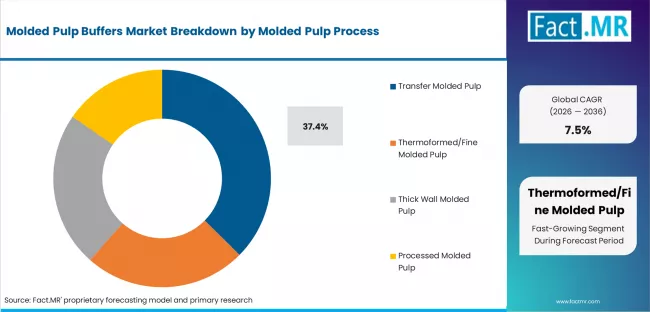
Molded Pulp Buffers Market Analysis By Molded Pulp Process

The Transfer Molded Pulp segment is estimated to hold the highest market share of 37.4% in 2026, attributed to its cost effectiveness, high production rate, and easy access in the industrial protective packaging. The method is popular for making trays, end caps, cushioning pads, and shipping packaging parts, because it's scalable and works well in mass production.

Which Function Segment Holds the Largest Share in the Market?
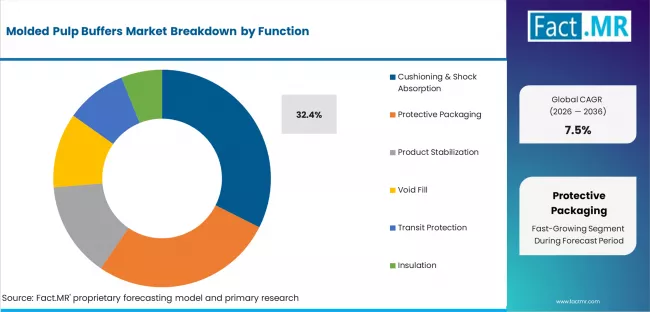
Molded Pulp Buffers Market Analysis By Function

Cushioning & Shock Absorption is projected to emerge as the leading function segment, accounting for 32.4% share in 2026. Growth is being driven by increasing demand for impact-resistant protective packaging across electronics, healthcare, automotive, and e-commerce industries.

Which End-Use Industry Segment Holds the Largest Share in the Market?
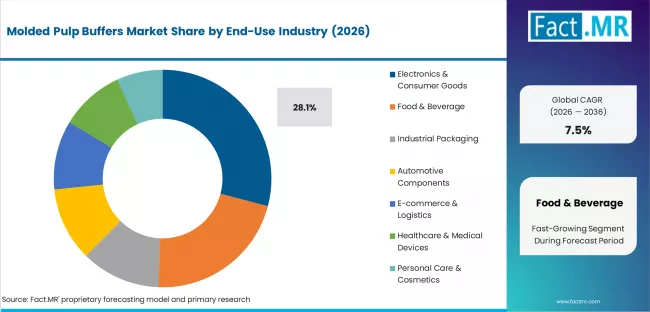
Molded Pulp Buffers Market Analysis By End Use Industry

Electronics & Consumer Goods is expected to remain the leading end-use industry segment, accounting for 28.1% share in 2026. This growth is supported by rising global shipments of smartphones, laptops, home appliances, and consumer electronics requiring lightweight, recyclable, and shock-absorbing protective packaging solutions. Increasing sustainability initiatives among electronics manufacturers are also accelerating the replacement of plastic foam packaging with molded fiber-based protective buffers.

Regional Outlook Across Key Markets

The geographies covered in this study include North America, Latin America, Western Europe, Eastern Europe, East Asia, South Asia & Pacific, and Middle East & Africa. Regional analysis includes assessment of sustainable packaging adoption, demand for protective transit packaging, regulatory developments related to plastic reduction, expansion of e-commerce logistics infrastructure, and growth in recyclable fiber-based packaging solutions across key industries.

Top Country Growth Comparison Molded Pulp Buffers Market Cagr (2026 2036)

CAGR Table

Country CAGR (%)
India 10.0%
Japan 9.2%
China 8.9%
South Korea 6.3%
United States 6.7%
United Kingdom 5.4%
Germany 4.9%

Source: Fact.MR (FMR) analysis, based on proprietary forecasting model and primary research.
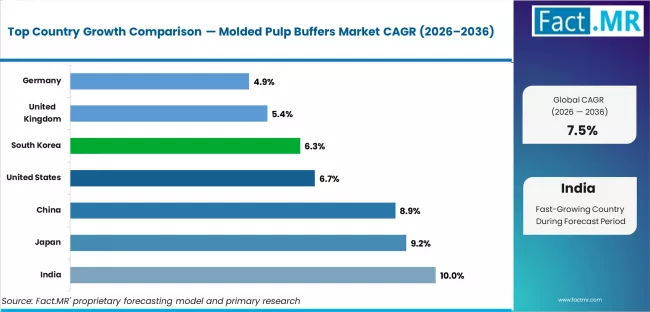
Molded Pulp Buffers Market Cagr Analysis By Country

North America Molded Pulp Buffers Market

The North American region is expected to have the largest share in the sustainable protective packaging solutions market in the Molded Pulp Buffers Market, attributed to growing environmental regulations, robust e-commerce logistics infrastructure, the increasing use of recyclable packaging materials, and higher substitution of plastic foam cushioning solutions. Companies like Huhtamaki, Sonoco Products Company, International Paper, UFP Technologies, are scaling investments in green molded fiber packaging technologies region wide.

  • U.S.: Demand for molded pulp buffers in the U.S. is projected to rise at 6.7% CAGR through 2036. Growth is driven by increasing adoption of recyclable protective packaging, expansion of e-commerce shipments, growing electronics packaging demand, and rising sustainability initiatives across industrial and consumer goods sectors.
  • Canada: Market growth in Canada is supported by increasing investments in sustainable packaging infrastructure, rising adoption of biodegradable protective packaging solutions, and growing regulatory focus on reducing plastic packaging waste across retail and logistics industries.

Europe Molded Pulp Buffers Market
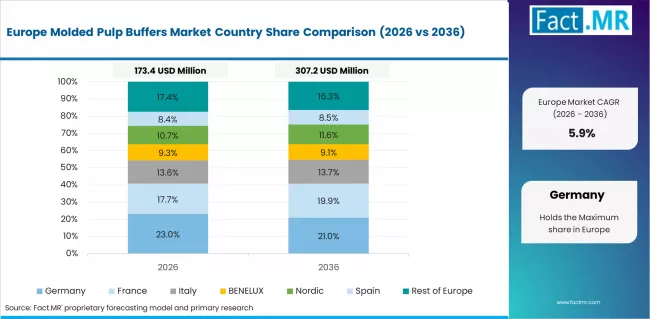
Molded Pulp Buffers Market Europe Country Market Share Analysis, 2026 & 2036

Europe is a key region for sustainable packaging solutions in the market due to the presence of stringent environmental norms, circular economy strategies, and growing use of fiber-based protective packaging solutions. Regional producers are prioritizing recyclable and compostable packaging solutions to align with sustainability goals and mitigate reliance on plastic packaging materials.

  • Germany: Demand for molded pulp buffers in Germany is projected to rise at 4.9% CAGR through 2036, driven by strong industrial packaging demand, sustainability regulations, and increasing adoption of recyclable transit packaging solutions across automotive and electronics industries.
  • U.K.: Molded pulp buffer demand in the U.K. is expected to grow at 5.4% CAGR through 2036 due to increasing replacement of EPS foam packaging, rising e-commerce activities, and growing demand for sustainable protective packaging across retail and logistics sectors.
  • France: Demand for molded pulp packaging solutions in France is supported by increasing environmental regulations, growing sustainable packaging adoption, and rising investments in biodegradable protective packaging technologies.

East Asia Molded Pulp Buffers Market
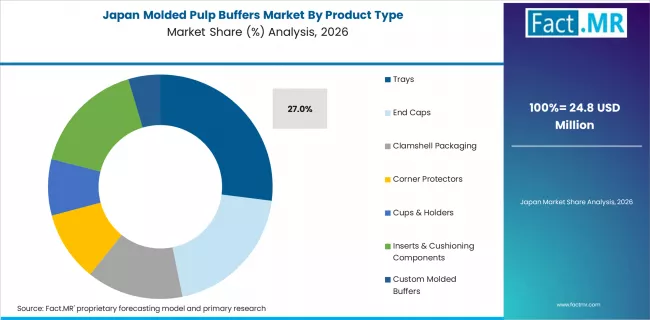
Molded Pulp Buffers Market Japan Market Share Analysis By Product Type

East Asia is a key region for production and consumption in the market owing to the presence of large electronics production, growth in export-oriented packaging demand and investments in the sustainable packaging materials. Regional producers are quickly embracing thermoformed molded fiber solutions for enhanced packaging performance and sustainability.

  • China: Demand for molded pulp buffers in China is projected to rise at 8.9% CAGR through 2036, driven by rapid growth in electronics manufacturing, expansion of e-commerce logistics, increasing exports, and rising adoption of recyclable protective packaging materials.
  • Japan: Molded pulp buffer demand in Japan is expected to grow at 9.2% CAGR through 2036 due to increasing demand for precision protective packaging, sustainable electronics packaging, and advanced thermoformed molded fiber technologies.
  • South Korea: Demand for molded pulp packaging solutions in South Korea is forecast to expand at 6.3% CAGR through 2036, supported by strong electronics exports, increasing sustainable packaging initiatives, and growing demand for lightweight transit protection solutions.
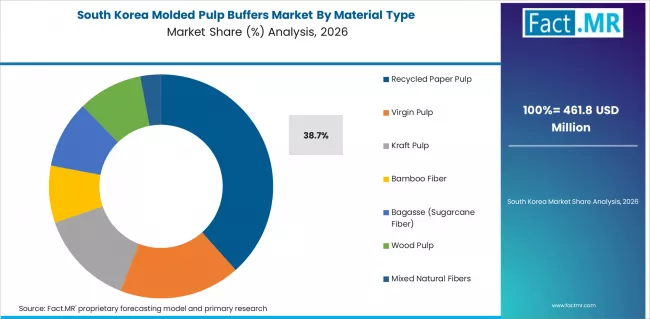
Molded Pulp Buffers Market South Korea Market Share Analysis By Material Type

South Asia & Pacific Molded Pulp Buffers Market

South Asia and Pacific is becoming a high growth area in the market due to the booming development of the e-commerce, an increase in the number of industries, production of consumer goods, and the attention of the regulations towards the adoption of sustainable packaging. Producers are increasingly investing in recycled fiber enabling protective packaging solutions to meet environmental regulations and export packaging needs.

  • India: Demand for molded pulp buffers in India is projected to rise at 10.0% CAGR through 2036, driven by rapid growth in e-commerce logistics, increasing electronics manufacturing, rising sustainable packaging investments, and growing replacement of plastic cushioning materials across consumer goods and industrial packaging sectors.

Fact.MR’s analysis of the Molded Pulp Buffers Market consists of country-wise assessment across North America, Latin America, Europe, East Asia, South Asia & Pacific, and Middle East & Africa. Readers can find detailed insights on regional demand trends, sustainable packaging adoption, protective packaging technologies, regulatory developments, competitive benchmarking, and long-term growth opportunities across major global markets.

Competitive Benchmarking and Company Positioning
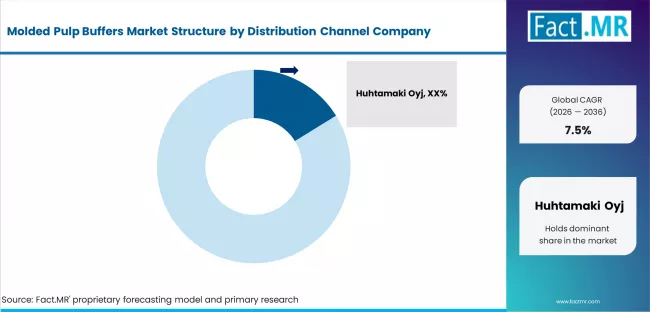
Molded Pulp Buffers Market Analysis By Company

Leading Companies Shaping the Molded Pulp Buffers Market

The molded pulp buffers market is moderately fragmented, and the key players are Huhtamaki Oyj, Hartmann, Sonoco Products Company, WestRock Company, International Paper, Pactiv Evergreen, UFP Technologies, Cascades Inc., CKF Inc., FiberCel Packaging. Market players compete on the basis of sustainable packaging solutions, molded fiber product development capabilities, customization options, scalability of production, performance of protective packaging and cost-effectiveness. Established players have a competitive advantage through strong manufacturing base, sophisticated thermoformed molded pulp technology, integrated supply chain, long-standing OEM partnerships, and global distribution in consumer electronics, healthcare, food & beverage, automotive, industrial packaging, e-commerce, and many more.

The leading players are also investing more in research and development (R&D) to develop new recyclable and biodegradable protective packaging products, high-performing molded fiber materials and innovative lightweight cushioning technologies to improve market position.

Recent Industry Developments

  • Huhtamaki – Zellwin Farms Company Acquisition (April 2025)
  • Huhtamaki announced the acquisition of Zellwin Farms Company to strengthen its molded fiber packaging production capabilities in North America. The acquisition supports the company’s expansion in sustainable molded pulp packaging, protective fiber solutions, and recyclable buffer products used across food packaging and industrial protective packaging applications. [1]
  • OPTIMA – PulPac Fiber Technology Partnership Expansion (May 2025)
  • OPTIMA Packaging Group became a shareholder in PulPac to expand collaboration in Dry Molded Fiber technologies aimed at accelerating sustainable molded fiber packaging production. The partnership supports development of recyclable and plastic-free protective packaging solutions for industrial, consumer goods, and molded pulp buffer applications. [2]
  • Guangdong Minjie Packaging – Molded Pulp Production Expansion (June 2025)
  • Guangdong Minjie Packaging expanded its molded pulp packaging manufacturing capabilities to address rising demand for eco-friendly protective packaging and sustainable cushioning products. The development strengthens the company’s position in molded pulp buffers, industrial packaging inserts, and fiber-based transit protection solutions. [3]
  • Stora Enso & Matrix Pack – Formed Fiber Packaging Innovation Partnership (June 2025)
  • Stora Enso partnered with Matrix Pack to accelerate innovation in formed fiber packaging technologies designed to replace plastic-based protective packaging materials. The collaboration focuses on scalable molded fiber packaging solutions for sustainable cushioning, food packaging, and protective pulp buffer applications. [4]
  • Huhtamaki – Fiber Packaging Business Segmentation Strategy (February 2025)
  • Huhtamaki announced the separation of its Fiber Foodservice business into two dedicated segments: Fiber Packaging and Foodservice Europe-Asia-Oceania. The restructuring is intended to strengthen the company’s strategic focus on molded fiber packaging, sustainable protective packaging technologies, and growth opportunities in recyclable molded pulp solutions. [5]

Leading Companies Shaping the Molded Pulp Buffers Market

  • Huhtamaki Oyj
  • Hartmann
  • Henry Molded Products
  • FiberCel Packaging
  • Pacific Pulp Molding
  • CKF Inc.
  • WestRock Company
  • International Paper
  • Pactiv Evergreen
  • Genpak

Sources and Research References

  • [1] Huhtamaki Oyj, “Huhtamaki acquires Zellwin Farms Company to expand molded fiber packaging capacity”, April 2025
  • [2] OPTIMA Packaging Group, “OPTIMA becomes a shareholder in PulPac, expanding partnership for fiber-based technologies”, May 2025
  • [3] Guangdong Minjie Packaging, “Minjie expands molded pulp packaging production capabilities for sustainable protective packaging applications”, June 2025
  • [4] Stora Enso & Matrix Pack, “Matrix Pack partnership for packaging innovation and formed fiber solutions”, June 2025
  • [5] Huhtamaki Oyj, “Huhtamaki to separate Fiber Foodservice business segment into two distinct segments: Fiber Packaging and Foodservice Europe-Asia-Oceania”, February 2025

Molded Pulp Buffers Market Definition

The molded pulp buffers market consists of eco-friendly protective packaging solutions made from recycled paper pulp, wood pulp, bagasse, bamboo fiber and other natural fibers. These products are designed for cushioning, shock absorption, product stabilization and protection in storage and transportation. Molded pulp buffers such as trays, end caps, clamshell packaging, corner protectors, inserts and more are emerging as green substitutes for plastics foam packaging material used in high-contact packaging. It caters for electronics, food & beverage, healthcare, automobile, industrial packaging, e-commerce and household appliances industries, among others, with the growth being propelled by the increasing demand for recyclable, biodegradable, and sustainable protective packaging solutions from across the globe.

Molded Pulp Buffers Market Inclusions

The report on the molded pulp buffers market estimation furnishes an assessment of the size of the global as well as regional markets till 2025. Segmentation is provided in detail for product type, material type, molded pulp process, function, sustainability type, end-use industry, and distribution channel. The report reveals a holistic view of global and regional growth prospects in terms of revenue generation, emerging competitive landscape with production technologies, pricing analysis, supply chain, sustainability, and regulatory evolving that engaged in fostering adoption of fiber-based protective packaging. Furthermore, the research examines recycling and biodegradable packaging, replacing plastic foam cushions, e-commerce packaging, thermoformed molded fiber solutions and opportunities for investment in the leading sectors and regions.

Molded Pulp Buffers Market Exclusions

Traditional paperboard packaging and protective packaging products that do not use molded pulp or fiber-based cushion technologies are not part of this report. Excluded is plastic foam packaging material such as EPS, EPE, bubble wrap, air cushion, double-sided corrugated protective packaging, non-molded paper packaging products. It also does not include conventional foodservice paper cups, folding cartons, or rigid packaging types that do not offer cushioning, shock-absorbing, or protection during transport.

Molded Pulp Buffers Market Research Methodology

  • Primary Research
    • Fact.MR conducted extensive primary interviews with molded fiber packaging manufacturers, protective packaging suppliers, raw material providers, packaging distributors, sustainability consultants, logistics companies, and end-use industries including electronics, food & beverage, healthcare, automotive, and e-commerce to validate market trends, demand patterns, and adoption rates.
  • Desk Research
    • The research draws on company annual reports, sustainability reports, packaging industry literature, government regulations concerning plastic reduction, trade journals, import-export data, investor presentations, packaging association information and industry white papers on the sustainable and molded fiber packaging sectors.
  • Market-Sizing and Forecasting
    • Fact.MR adopted a hybrid market modeling approach combining bottom-up revenue analysis of molded pulp packaging manufacturers with top-down assessment of sustainable protective packaging demand across key industries and regions.
  • Data Validation and Update Cycle
    • The market estimates were validated by triangulating the findings from the primary interviews, company financials, regional demand for packaging, sustainability adoption rates, raw material analysis, and historical data of protective packaging. The forecasts are periodically revised to take into account developments in the environmental regulations, the rise of e-commerce, new packaging solutions and the investments in fiber-based packaging.

Scope of Analysis
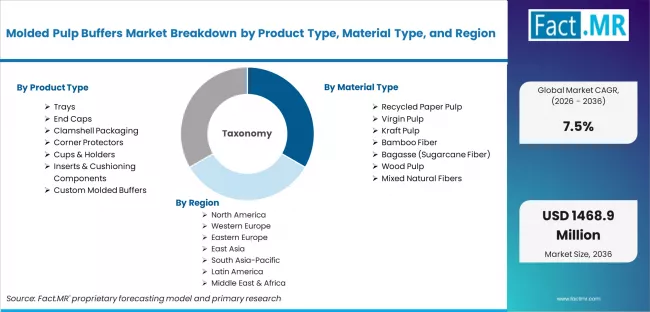
Molded Pulp Buffers Market Breakdown By Product Type, Material Type, And Region


Parameter
Details
Quantitative Units USD 663.0 Million (2025) to USD 1,468.9 Million (2036), at a CAGR of 7.5%
Market Definition The molded pulp buffers market covers sustainable protective packaging solutions manufactured from molded paper pulp, recycled fibers, and natural fiber materials designed to provide cushioning, shock absorption, product stabilization, and transit protection across packaging applications. These products include trays, end caps, clamshell packaging, corner protectors, inserts, and custom molded cushioning components used as eco-friendly alternatives to plastic foam and synthetic protective packaging materials across electronics, healthcare, food & beverage, automotive, industrial packaging, and e-commerce sectors.
Regions Covered North America, Eastern Europe, Western Europe, East Asia, South Asia & Pacific, Latin America, Middle East & Africa
Countries Covered USA, Canada, UK, Germany, China, Japan, India, South Korea, Brazil, Saudi Arabia, UAE, and 20+ countries
Key Companies Huhtamaki Oyj, Hartmann, Sonoco Products Company, WestRock Company, International Paper, Pactiv Evergreen, UFP Technologies, Cascades Inc., CKF Inc., and FiberCel Packaging
Forecast Period 2026 to 2036
Approach Hybrid demand-side and top-down methodology based on sustainable packaging adoption, protective packaging demand, replacement of plastic foam cushioning materials, e-commerce logistics expansion, and increasing investments in recyclable fiber-based packaging technologies, validated through primary interviews with molded fiber packaging manufacturers, packaging distributors, raw material suppliers, sustainability consultants, logistics providers, and industry experts across key regional markets.

Molded Pulp Buffers Market Segment

  • Molded Pulp Buffers Market by Product Type

    • Trays
      • Electronics Trays
      • Food Service Trays
      • Medical Device Trays
    • End Caps
      • Appliance End Caps
      • Electronics End Caps
      • Industrial Equipment End Caps
    • Clamshell Packaging
      • Consumer Goods Clamshells
      • Food Clamshells
      • Retail Packaging Clamshells
    • Corner Protectors
      • Furniture Protectors
      • Glass Product Protectors
      • Industrial Corner Guards
    • Cups & Holders
      • Beverage Cup Holders
      • Bottle Holders
      • Cosmetic Product Holders
    • Inserts & Cushioning Components
      • Shock-Absorbing Inserts
      • Protective Cushioning Pads
      • Multi-Product Inserts
    • Custom Molded Buffers
      • OEM-Specific Designs
      • Heavy-Duty Protective Buffers
      • Precision Molded Packaging
  • Molded Pulp Buffers Market by Material Type

    • Recycled Paper Pulp
    • Virgin Pulp
    • Kraft Pulp
    • Bamboo Fiber
    • Bagasse (Sugarcane Fiber)
    • Wood Pulp
    • Mixed Natural Fibers
  • Molded Pulp Buffers Market by Molded Pulp Process

    • Thick Wall Molded Pulp
    • Transfer Molded Pulp
    • Thermoformed/Fine Molded Pulp
    • Processed Molded Pulp
  • Molded Pulp Buffers Market by Function

    • Cushioning & Shock Absorption
    • Protective Packaging
    • Void Fill
    • Product Stabilization
    • Insulation
    • Transit Protection
  • Molded Pulp Buffers Market by Sustainability Type

    • Recyclable Buffers
    • Compostable Buffers
    • Biodegradable Buffers
  • Molded Pulp Buffers Market by End-Use Industry

    • Electronics & Consumer Goods
      • Smartphones & Accessories
      • Home Electronics
      • Consumer Electronics Devices
    • Food & Beverage
      • Beverage Bottle Packaging
      • Food Containers
      • Fresh Produce Packaging
    • Healthcare & Medical Devices
      • Diagnostic Equipment Packaging
      • Surgical Instrument Packaging
      • Pharmaceutical Transit Packaging
    • Automotive Components
      • Spare Parts Protection
      • EV Battery Component Packaging
      • Engine Component Buffers
    • Personal Care & Cosmetics
      • Cosmetic Bottle Inserts
      • Luxury Beauty Packaging
      • Fragile Glass Container Protection
    • Industrial Packaging
      • Machinery Components
      • Heavy Equipment Parts
      • Industrial Tool Packaging
    • E-commerce & Logistics
      • Parcel Shipment Protection
      • Returnable Packaging
      • Warehouse Distribution Packaging
    • Household Appliances
      • Kitchen Appliance Packaging
      • Small Home Appliance Buffers
      • White Goods Protective Inserts
  • Molded Pulp Buffers Market by Distribution Channel

    • Direct Sales/OEM Supply
    • Packaging Distributors
    • Online/B2B E-commerce Platforms
  • Molded Pulp Buffers Market by Region

    • North America
      • USA
      • Canada
      • Mexico
    • Latin America
      • Brazil
      • Chile
      • Rest of LATAM
    • East Asia
      • China
      • Japan
      • South Korea
      • Taiwan
    • South Asia & Pacific
      • India
      • Singapore
      • Australia
      • ASEAN
    • Western Europe
      • Germany
      • France
      • U.K.
      • Italy
      • Spain
      • BENELUX
      • Nordic
      • Rest of Western Europe
    • Eastern Europe
      • Poland
      • Hungary
      • Czech Republic
      • Balkan & Baltics
      • Rest of Eastern Europe
    • Middle East and Africa
      • Kingdom of Saudi Arabia
      • United Arab Emirates
      • South Africa
      • Rest of Middle East and Africa

- Frequently Asked Questions -

How large is the demand for Molded Pulp Buffers in the global market in 2025?

Demand for Molded Pulp Buffers in the global market is estimated to be valued at USD 663.0 million in 2025.

What will be the market size of the Molded Pulp Buffers Market by 2036?

The Molded Pulp Buffers Market is projected to reach USD 1,468.9 million by 2036.

What is the expected demand growth for the Molded Pulp Buffers Market between 2026 and 2036?

Demand for Molded Pulp Buffers is expected to grow at a CAGR of 7.5% between 2026 and 2036, supported by rising demand for sustainable protective packaging, increasing replacement of plastic foam cushioning materials, expansion of e-commerce logistics, and growing adoption of recyclable and biodegradable fiber-based packaging solutions across industries.

Which product type segment is expected to dominate the market?

Trays are expected to dominate the market, accounting for 27.1% share in 2026, driven by increasing usage in electronics packaging, foodservice applications, medical device transportation, and industrial protective packaging solutions.

How significant is the growth outlook for India in this market?

India is expected to grow at a CAGR of 10.0%, supported by rapid expansion of e-commerce logistics, increasing electronics manufacturing activities, rising sustainable packaging investments, and growing replacement of plastic-based protective packaging materials.

Which company is identified as a leading player in the Molded Pulp Buffers Market?

Huhtamaki Oyj is recognized as a leading player in the Molded Pulp Buffers Market, offering advanced molded fiber packaging solutions, sustainable protective packaging technologies, recyclable cushioning products, and customized molded pulp packaging systems across global industrial and consumer packaging markets.

Table of Content

  1. Molded Pulp Buffers Market - Executive Summary
  2. Market Overview
    • Market Definition and Introduction
    • Market Taxonomy/ Research Scope
  3. Global Molded Pulp Buffers Market Demand Analysis 2021-2025 and Forecast, 2026–2036
    • Historical Market Volume Analysis, 2021-2025
    • Current and Future Market Volume Forecast, 2026–2036
    • Y-o-Y Growth Trend Analysis
  4. Global Molded Pulp Buffers Market - Pricing Analysis
    • Product Category and Country-Level Pricing Analysis
    • Global Average Pricing Analysis Benchmark
    • Factors Influencing Pricing
    • Competitive Pricing Strategies
    • Price Trends and Forecasts
      • Historical price trends
      • Future price forecasts
  5. Global Molded Pulp Buffers Market Demand Analysis 2021-2025 and Forecast, 2026–2036
    • Historical Market Value Analysis, 2021-2025
    • Current and Future Market Value Forecast, 2026–2036
      • Y-o-Y Growth Trend Analysis
      • Absolute $ Opportunity Analysis
  6. Market Background and Foundation Data
    • Global Sustainable Protective Packaging Market Outlook, 2025
    • Penetration of Molded Pulp Buffers in the Global Fiber-Based Protective Packaging Market
    • Molded Pulp Buffers: Consumer and Industrial Buyer Perception Analysis
    • Recent Developments in Molded Pulp Buffers by Key Market Participants
    • Molded Pulp Buffers Production Analysis
      • By Region
      • By Key Companies
      • By Molded Pulp Process Technology
    • Trade Scenario, 2025
      • Import and Export Analysis
      • By Region
      • By Country
    • Molded Pulp Buffers Raw Material Sourcing Analysis
      • Recycled Paper Pulp Supply Trends
      • Virgin Fiber and Natural Fiber Sourcing Analysis
    • Investment Analysis in Molded Pulp Buffers
    • Packaging Supply Chain and Value Chain Analysis
    • Regulatory Landscape and Sustainability Compliance Framework
    • Technology Advancement Analysis in Molded Fiber Packaging
    • Pricing Analysis of Molded Pulp Buffers
      • Product Type
      • By Region
      • By Raw Material Type
    • ESG and Circular Economy Impact Assessment in Molded Pulp Packaging
    • Molded Pulp Buffers Market Opportunity Assessment
      • Total Available Market (US$ Mn)
      • Serviceable Addressable Market (US$ Mn)
      • Serviceable Obtainable Market (US$ Mn)
    • Porter’s Five Forces and PESTEL Analysis
    • Investment Feasibility Analysis
    • Macro-Economic Factors
    • Forecast Factors - Relevance & Impact
    • Industry Value and Supply Chain Analysis
      • List of Key Channel Partners
      • Profit Margin & Operating Margin at Each Node of Supply Chain.
      • Notes on Value Added at Each Node in the Value Chain
      • Factors Influencing Value Chain
    • Market Dynamics
      • Drivers
      • Restraints
      • Opportunity Analysis
    • Key Regulations & Certifications
  7. Global Molded Pulp Buffers Market Analysis 2021-2025 and Forecast 2026–2036, By Product Type
    • Introduction / Key Findings
    • Market Size & Volume Analysis by Market Taxonomy, 2021–2036
      • Trays
        • Electronics Trays
        • Food Service Trays
        • Medical Device Trays
      • End Caps
        • Appliance End Caps
        • Electronics End Caps
        • Industrial Equipment End Caps
      • Clamshell Packaging
        • Consumer Goods Clamshells
        • Food Clamshells
        • Retail Packaging Clamshells
      • Corner Protectors
        • Furniture Protectors
        • Glass Product Protectors
        • Industrial Corner Guards
      • Cups & Holders
        • Beverage Cup Holders
        • Bottle Holders
        • Cosmetic Product Holders
      • Inserts & Cushioning Components
        • Shock-Absorbing Inserts
        • Protective Cushioning Pads
        • Multi-Product Inserts
      • Custom Molded Buffers
        • OEM-Specific Designs
        • Heavy-Duty Protective Buffers
        • Precision Molded Packaging
    • Market Attractiveness Analysis by Product Type
  8. Global Molded Pulp Buffers Market Analysis 2021-2025 and Forecast 2026–2036, By Material Type
    • Introduction / Key Findings
    • Market Size & Volume Analysis by Market Taxonomy, 2021–2036
      • Recycled Paper Pulp
      • Virgin Pulp
      • Kraft Pulp
      • Bamboo Fiber
      • Bagasse (Sugarcane Fiber)
      • Wood Pulp
      • Mixed Natural Fibers
    • Market Attractiveness Analysis by Material Type
  9. Global Molded Pulp Buffers Market Analysis 2021-2025 and Forecast 2026–2036, By Molded Pulp Process
    • Introduction / Key Findings
    • Market Size & Volume Analysis by Market Taxonomy, 2021–2036
      • Thick Wall Molded Pulp
      • Transfer Molded Pulp
      • Thermoformed/Fine Molded Pulp
      • Processed Molded Pulp
    • Market Attractiveness Analysis by Molded Pulp Process
  10. Global Molded Pulp Buffers Market Analysis 2021-2025 and Forecast 2026–2036, By Function
    • Introduction / Key Findings
    • Market Size & Volume Analysis by Market Taxonomy, 2021–2036
      • Cushioning & Shock Absorption
      • Protective Packaging
      • Void Fill
      • Product Stabilization
      • Insulation
      • Transit Protection
    • Market Attractiveness Analysis by Function
  11. Global Molded Pulp Buffers Market Analysis 2021-2025 and Forecast 2026–2036, By Sustainability Type
    • Introduction / Key Findings
    • Market Size & Volume Analysis by Market Taxonomy, 2021–2036
      • Recyclable Buffers
      • Compostable Buffers
      • Biodegradable Buffers
    • Market Attractiveness Analysis by Sustainability Type
  12. Global Molded Pulp Buffers Market Analysis 2021-2025 and Forecast 2026–2036, By End-Use Industry
    • Introduction / Key Findings
    • Market Size & Volume Analysis by Market Taxonomy, 2021–2036
      • Electronics & Consumer Goods
        • Smartphones & Accessories
        • Home Electronics
        • Consumer Electronics Devices
      • Food & Beverage
        • Beverage Bottle Packaging
        • Food Containers
        • Fresh Produce Packaging
      • Healthcare & Medical Devices
        • Diagnostic Equipment Packaging
        • Surgical Instrument Packaging
        • Pharmaceutical Transit Packaging
      • Automotive Components
        • Spare Parts Protection
        • EV Battery Component Packaging
        • Engine Component Buffers
      • Personal Care & Cosmetics
        • Cosmetic Bottle Inserts
        • Luxury Beauty Packaging
        • Fragile Glass Container Protection
      • Industrial Packaging
        • Machinery Components
        • Heavy Equipment Parts
        • Industrial Tool Packaging
      • E-commerce & Logistics
        • Parcel Shipment Protection
        • Returnable Packaging
        • Warehouse Distribution Packaging
      • Household Appliances
        • Kitchen Appliance Packaging
        • Small Home Appliance Buffers
        • White Goods Protective Inserts
    • Market Attractiveness Analysis by End-Use Industry
  13. Global Molded Pulp Buffers Market Analysis 2021-2025 and Forecast 2026–2036, By Distribution Channel
    • Introduction / Key Findings
    • Market Size & Volume Analysis by Market Taxonomy, 2021–2036
      • Direct Sales/OEM Supply
      • Packaging Distributors
      • Online/B2B E-commerce Platforms
    • Market Attractiveness Analysis by Distribution Channel
  14. Global Molded Pulp Buffers Market Analysis and Forecast, by Region
    • Introduction / Key Findings
    • Market Size & Volume Analysis by Market Taxonomy, 2021–2036
      • North America
      • Latin America
      • Western Europe
      • Eastern Europe
      • East Asia
      • South Asia & Pacific
      • Middle East & Africa
    • Market Attractiveness Analysis by Region
  15. North America Molded Pulp Buffers Market Analysis and Forecast
    • Market Size & Volume Analysis by Market Taxonomy, 2021–2036
      • By Country
        • United States
        • Canada
        • Mexico
      • By Taxonomy
    • Market Attractiveness Analysis by Country & Taxonomy
  16. Latin America Molded Pulp Buffers Market Analysis and Forecast
    • Market Size & Volume Analysis by Market Taxonomy, 2021–2036
      • By Country
        • Brazil
        • Chile
        • Rest of LATAM
      • By Taxonomy
    • Market Attractiveness Analysis by Country & Taxonomy
  17. Western Europe Molded Pulp Buffers Market Analysis and Forecast
    • Market Size & Volume Analysis by Market Taxonomy, 2021–2036
      • By Country
        • Germany
        • Italy
        • France
        • United Kingdom
        • Spain
        • BENELUX
        • Nordics
        • Rest of Western Europe
      • By Taxonomy
    • Market Attractiveness Analysis by Country & Taxonomy
  18. Eastern Europe Molded Pulp Buffers Market Analysis and Forecast
    • Market Size & Volume Analysis by Market Taxonomy, 2021–2036
      • By Country
        • Russia
        • Hungary
        • Poland
        • Balkan & Baltics
        • Rest of Eastern Europe
      • By Taxonomy
    • Market Attractiveness Analysis by Country & Taxonomy
  19. East Asia Molded Pulp Buffers Market Analysis and Forecast
    • Market Size & Volume Analysis by Market Taxonomy, 2021–2036
      • By Country
        • China
        • Japan
        • South Korea
      • By Taxonomy
    • Market Attractiveness Analysis by Country & Taxonomy
  20. South Asia & Pacific Molded Pulp Buffers Market Analysis and Forecast
    • Market Size & Volume Analysis by Market Taxonomy, 2021–2036
      • By Country
        • India
        • ASEAN
        • Australia & New Zealand
        • Rest of South Asia & Pacific
      • By Taxonomy
    • Market Attractiveness Analysis by Country & Taxonomy
  21. Middle East & Africa Molded Pulp Buffers Market Analysis and Forecast
    • Market Size & Volume Analysis by Market Taxonomy, 2021–2036
      • By Country
        • Kingdom of Saudi Arabia
        • Other GCC Countries
        • Turkiye
        • South Africa
        • Other African Union
      • By Taxonomy
    • Market Attractiveness Analysis by Country & Taxonomy
  22. Country-level Molded Pulp Buffers Market Analysis and Forecast
    • Introduction
      • Market Value Proportion Analysis, By Key Countries
      • Global Vs. Country Growth Comparison
    • United States Molded Pulp Buffers Market Analysis
      • Market Size & Volume Analysis by Market Taxonomy, 2021–2036
        • By Product Type
        • By Material Type
        • By Molded Pulp Process
        • By Function
        • By Sustainability Type
        • By End-Use Industry
        • By Distribution Channel
      • Canada Molded Pulp Buffers Market Analysis
      • Mexico Molded Pulp Buffers Market Analysis
      • Brazil Molded Pulp Buffers Market Analysis
      • Chile Molded Pulp Buffers Market Analysis
      • Germany Molded Pulp Buffers Market Analysis
      • France Molded Pulp Buffers Market Analysis
      • Italy Molded Pulp Buffers Market Analysis
      • Spain Molded Pulp Buffers Market Analysis
      • United Kingdom Molded Pulp Buffers Market Analysis
      • BENELUX Molded Pulp Buffers Market Analysis
      • Nordics Molded Pulp Buffers Market Analysis
      • Poland Molded Pulp Buffers Market Analysis
      • Russia Molded Pulp Buffers Market Analysis
      • Hungary Molded Pulp Buffers Market Analysis
      • Balkan & Baltics Molded Pulp Buffers Market Analysis
      • China Molded Pulp Buffers Market Analysis
      • Japan Molded Pulp Buffers Market Analysis
      • South Korea Molded Pulp Buffers Market Analysis
      • India Molded Pulp Buffers Market Analysis
      • ASEAN Molded Pulp Buffers Market Analysis
      • ANZ Molded Pulp Buffers Market Analysis
      • KSA Molded Pulp Buffers Market Analysis
      • Other GCC Countries Molded Pulp Buffers Market Analysis
      • South Africa Molded Pulp Buffers Market Analysis
      • Türkiye Molded Pulp Buffers Market Analysis
    • Molded Pulp Buffers Market Structure Analysis
      • Market Analysis by Tier of Companies
      • Market Share Analysis of Top Players
      • Market Space for New Brands and Dollar Opportunity
      • Market Presence Analysis
        • Regional Footprint of Players
        • Product Footprint by Players
        • Application Footprint by Players
    • Molded Pulp Buffers Competition Analysis
      • Competition Dashboard
      • Pricing Analysis by Competition
      • Competition Benchmarking
      • Competition Deep Dive
        • Huhtamaki Oyj
          • Overview
          • Product Portfolio
          • Sales Footprint
          • Key Developments
          • SWOT Analysis
          • Strategy Overview
          • Key Financials
        • Hartmann
        • Henry Molded Products
        • FiberCel Packaging
        • Pacific Pulp Molding
        • CKF Inc.
        • WestRock Company
        • International Paper
        • Pactiv Evergreen
        • Genpak
        • Other Prominent Players
    • Primary Insights
    • Assumption & Acronyms Used
    • Research Methodology & Data Sources

List Of Table

  • Table 1: Global Market Value (USD Mn) Forecast by Region, 2021 to 2036
  • Table 2: Global Market Volume (Units) Forecast by Region, 2021 to 2036
  • Table 3: Global Market Value (USD Mn) Forecast by Product Type, 2021 to 2036
  • Table 4: Global Market Volume (Units) Forecast by Product Type, 2021 to 2036
  • Table 5: Global Market Value (USD Mn) Forecast by Material Type, 2021 to 2036
  • Table 6: Global Market Volume (Units) Forecast by Material Type, 2021 to 2036
  • Table 7: Global Market Value (USD Mn) Forecast by Molded Pulp Process, 2021 to 2036
  • Table 8: Global Market Volume (Units) Forecast by Molded Pulp Process, 2021 to 2036
  • Table 9: Global Market Value (USD Mn) Forecast by Function, 2021 to 2036
  • Table 10: Global Market Volume (Units) Forecast by Function, 2021 to 2036
  • Table 11: Global Market Value (USD Mn) Forecast by Sustainability Type, 2021 to 2036
  • Table 12: Global Market Volume (Units) Forecast by Sustainability Type, 2021 to 2036
  • Table 13: Global Market Value (USD Mn) Forecast by End-Use Industry, 2021 to 2036
  • Table 14: Global Market Volume (Units) Forecast by End-Use Industry, 2021 to 2036
  • Table 15: Global Market Value (USD Mn) Forecast by Distribution Channel, 2021 to 2036
  • Table 16: Global Market Volume (Units) Forecast by Distribution Channel, 2021 to 2036
  • Table 17: North America Market Value (USD Mn) Forecast by Country, 2021 to 2036
  • Table 18: North America Market Volume (Units) Forecast by Country, 2021 to 2036
  • Table 19: North America Market Value (USD Mn) Forecast by Product Type, 2021 to 2036
  • Table 20: North America Market Volume (Units) Forecast by Product Type, 2021 to 2036
  • Table 21: North America Market Value (USD Mn) Forecast by Material Type, 2021 to 2036
  • Table 22: North America Market Volume (Units) Forecast by Material Type, 2021 to 2036
  • Table 23: North America Market Value (USD Mn) Forecast by Molded Pulp Process, 2021 to 2036
  • Table 24: North America Market Volume (Units) Forecast by Molded Pulp Process, 2021 to 2036
  • Table 25: North America Market Value (USD Mn) Forecast by Function, 2021 to 2036
  • Table 26: North America Market Volume (Units) Forecast by Function, 2021 to 2036
  • Table 27: North America Market Value (USD Mn) Forecast by Sustainability Type, 2021 to 2036
  • Table 28: North America Market Volume (Units) Forecast by Sustainability Type, 2021 to 2036
  • Table 29: North America Market Value (USD Mn) Forecast by End-Use Industry, 2021 to 2036
  • Table 30: North America Market Volume (Units) Forecast by End-Use Industry, 2021 to 2036
  • Table 31: North America Market Value (USD Mn) Forecast by Distribution Channel, 2021 to 2036
  • Table 32: North America Market Volume (Units) Forecast by Distribution Channel, 2021 to 2036
  • Table 33: Latin America Market Value (USD Mn) Forecast by Country, 2021 to 2036
  • Table 34: Latin America Market Volume (Units) Forecast by Country, 2021 to 2036
  • Table 35: Latin America Market Value (USD Mn) Forecast by Product Type, 2021 to 2036
  • Table 36: Latin America Market Volume (Units) Forecast by Product Type, 2021 to 2036
  • Table 37: Latin America Market Value (USD Mn) Forecast by Material Type, 2021 to 2036
  • Table 38: Latin America Market Volume (Units) Forecast by Material Type, 2021 to 2036
  • Table 39: Latin America Market Value (USD Mn) Forecast by Molded Pulp Process, 2021 to 2036
  • Table 40: Latin America Market Volume (Units) Forecast by Molded Pulp Process, 2021 to 2036
  • Table 41: Latin America Market Value (USD Mn) Forecast by Function, 2021 to 2036
  • Table 42: Latin America Market Volume (Units) Forecast by Function, 2021 to 2036
  • Table 43: Latin America Market Value (USD Mn) Forecast by Sustainability Type, 2021 to 2036
  • Table 44: Latin America Market Volume (Units) Forecast by Sustainability Type, 2021 to 2036
  • Table 45: Latin America Market Value (USD Mn) Forecast by End-Use Industry, 2021 to 2036
  • Table 46: Latin America Market Volume (Units) Forecast by End-Use Industry, 2021 to 2036
  • Table 47: Latin America Market Value (USD Mn) Forecast by Distribution Channel, 2021 to 2036
  • Table 48: Latin America Market Volume (Units) Forecast by Distribution Channel, 2021 to 2036
  • Table 49: Western Europe Market Value (USD Mn) Forecast by Country, 2021 to 2036
  • Table 50: Western Europe Market Volume (Units) Forecast by Country, 2021 to 2036
  • Table 51: Western Europe Market Value (USD Mn) Forecast by Product Type, 2021 to 2036
  • Table 52: Western Europe Market Volume (Units) Forecast by Product Type, 2021 to 2036
  • Table 53: Western Europe Market Value (USD Mn) Forecast by Material Type, 2021 to 2036
  • Table 54: Western Europe Market Volume (Units) Forecast by Material Type, 2021 to 2036
  • Table 55: Western Europe Market Value (USD Mn) Forecast by Molded Pulp Process, 2021 to 2036
  • Table 56: Western Europe Market Volume (Units) Forecast by Molded Pulp Process, 2021 to 2036
  • Table 57: Western Europe Market Value (USD Mn) Forecast by Function, 2021 to 2036
  • Table 58: Western Europe Market Volume (Units) Forecast by Function, 2021 to 2036
  • Table 59: Western Europe Market Value (USD Mn) Forecast by Sustainability Type, 2021 to 2036
  • Table 60: Western Europe Market Volume (Units) Forecast by Sustainability Type, 2021 to 2036
  • Table 61: Western Europe Market Value (USD Mn) Forecast by End-Use Industry, 2021 to 2036
  • Table 62: Western Europe Market Volume (Units) Forecast by End-Use Industry, 2021 to 2036
  • Table 63: Western Europe Market Value (USD Mn) Forecast by Distribution Channel, 2021 to 2036
  • Table 64: Western Europe Market Volume (Units) Forecast by Distribution Channel, 2021 to 2036
  • Table 65: Eastern Europe Market Value (USD Mn) Forecast by Country, 2021 to 2036
  • Table 66: Eastern Europe Market Volume (Units) Forecast by Country, 2021 to 2036
  • Table 67: Eastern Europe Market Value (USD Mn) Forecast by Product Type, 2021 to 2036
  • Table 68: Eastern Europe Market Volume (Units) Forecast by Product Type, 2021 to 2036
  • Table 69: Eastern Europe Market Value (USD Mn) Forecast by Material Type, 2021 to 2036
  • Table 70: Eastern Europe Market Volume (Units) Forecast by Material Type, 2021 to 2036
  • Table 71: Eastern Europe Market Value (USD Mn) Forecast by Molded Pulp Process, 2021 to 2036
  • Table 72: Eastern Europe Market Volume (Units) Forecast by Molded Pulp Process, 2021 to 2036
  • Table 73: Eastern Europe Market Value (USD Mn) Forecast by Function, 2021 to 2036
  • Table 74: Eastern Europe Market Volume (Units) Forecast by Function, 2021 to 2036
  • Table 75: Eastern Europe Market Value (USD Mn) Forecast by Sustainability Type, 2021 to 2036
  • Table 76: Eastern Europe Market Volume (Units) Forecast by Sustainability Type, 2021 to 2036
  • Table 77: Eastern Europe Market Value (USD Mn) Forecast by End-Use Industry, 2021 to 2036
  • Table 78: Eastern Europe Market Volume (Units) Forecast by End-Use Industry, 2021 to 2036
  • Table 79: Eastern Europe Market Value (USD Mn) Forecast by Distribution Channel, 2021 to 2036
  • Table 80: Eastern Europe Market Volume (Units) Forecast by Distribution Channel, 2021 to 2036
  • Table 81: East Asia Market Value (USD Mn) Forecast by Country, 2021 to 2036
  • Table 82: East Asia Market Volume (Units) Forecast by Country, 2021 to 2036
  • Table 83: East Asia Market Value (USD Mn) Forecast by Product Type, 2021 to 2036
  • Table 84: East Asia Market Volume (Units) Forecast by Product Type, 2021 to 2036
  • Table 85: East Asia Market Value (USD Mn) Forecast by Material Type, 2021 to 2036
  • Table 86: East Asia Market Volume (Units) Forecast by Material Type, 2021 to 2036
  • Table 87: East Asia Market Value (USD Mn) Forecast by Molded Pulp Process, 2021 to 2036
  • Table 88: East Asia Market Volume (Units) Forecast by Molded Pulp Process, 2021 to 2036
  • Table 89: East Asia Market Value (USD Mn) Forecast by Function, 2021 to 2036
  • Table 90: East Asia Market Volume (Units) Forecast by Function, 2021 to 2036
  • Table 91: East Asia Market Value (USD Mn) Forecast by Sustainability Type, 2021 to 2036
  • Table 92: East Asia Market Volume (Units) Forecast by Sustainability Type, 2021 to 2036
  • Table 93: East Asia Market Value (USD Mn) Forecast by End-Use Industry, 2021 to 2036
  • Table 94: East Asia Market Volume (Units) Forecast by End-Use Industry, 2021 to 2036
  • Table 95: East Asia Market Value (USD Mn) Forecast by Distribution Channel, 2021 to 2036
  • Table 96: East Asia Market Volume (Units) Forecast by Distribution Channel, 2021 to 2036
  • Table 97: South Asia and Pacific Market Value (USD Mn) Forecast by Country, 2021 to 2036
  • Table 98: South Asia and Pacific Market Volume (Units) Forecast by Country, 2021 to 2036
  • Table 99: South Asia and Pacific Market Value (USD Mn) Forecast by Product Type, 2021 to 2036
  • Table 100: South Asia and Pacific Market Volume (Units) Forecast by Product Type, 2021 to 2036
  • Table 101: South Asia and Pacific Market Value (USD Mn) Forecast by Material Type, 2021 to 2036
  • Table 102: South Asia and Pacific Market Volume (Units) Forecast by Material Type, 2021 to 2036
  • Table 103: South Asia and Pacific Market Value (USD Mn) Forecast by Molded Pulp Process, 2021 to 2036
  • Table 104: South Asia and Pacific Market Volume (Units) Forecast by Molded Pulp Process, 2021 to 2036
  • Table 105: South Asia and Pacific Market Value (USD Mn) Forecast by Function, 2021 to 2036
  • Table 106: South Asia and Pacific Market Volume (Units) Forecast by Function, 2021 to 2036
  • Table 107: South Asia and Pacific Market Value (USD Mn) Forecast by Sustainability Type, 2021 to 2036
  • Table 108: South Asia and Pacific Market Volume (Units) Forecast by Sustainability Type, 2021 to 2036
  • Table 109: South Asia and Pacific Market Value (USD Mn) Forecast by End-Use Industry, 2021 to 2036
  • Table 110: South Asia and Pacific Market Volume (Units) Forecast by End-Use Industry, 2021 to 2036
  • Table 111: South Asia and Pacific Market Value (USD Mn) Forecast by Distribution Channel, 2021 to 2036
  • Table 112: South Asia and Pacific Market Volume (Units) Forecast by Distribution Channel, 2021 to 2036
  • Table 113: Middle East & Africa Market Value (USD Mn) Forecast by Country, 2021 to 2036
  • Table 114: Middle East & Africa Market Volume (Units) Forecast by Country, 2021 to 2036
  • Table 115: Middle East & Africa Market Value (USD Mn) Forecast by Product Type, 2021 to 2036
  • Table 116: Middle East & Africa Market Volume (Units) Forecast by Product Type, 2021 to 2036
  • Table 117: Middle East & Africa Market Value (USD Mn) Forecast by Material Type, 2021 to 2036
  • Table 118: Middle East & Africa Market Volume (Units) Forecast by Material Type, 2021 to 2036
  • Table 119: Middle East & Africa Market Value (USD Mn) Forecast by Molded Pulp Process, 2021 to 2036
  • Table 120: Middle East & Africa Market Volume (Units) Forecast by Molded Pulp Process, 2021 to 2036
  • Table 121: Middle East & Africa Market Value (USD Mn) Forecast by Function, 2021 to 2036
  • Table 122: Middle East & Africa Market Volume (Units) Forecast by Function, 2021 to 2036
  • Table 123: Middle East & Africa Market Value (USD Mn) Forecast by Sustainability Type, 2021 to 2036
  • Table 124: Middle East & Africa Market Volume (Units) Forecast by Sustainability Type, 2021 to 2036
  • Table 125: Middle East & Africa Market Value (USD Mn) Forecast by End-Use Industry, 2021 to 2036
  • Table 126: Middle East & Africa Market Volume (Units) Forecast by End-Use Industry, 2021 to 2036
  • Table 127: Middle East & Africa Market Value (USD Mn) Forecast by Distribution Channel, 2021 to 2036
  • Table 128: Middle East & Africa Market Volume (Units) Forecast by Distribution Channel, 2021 to 2036

List Of Figures

  • Figure 1: Global Market Volume (Units) Forecast 2021 to 2036
  • Figure 2: Global Market Pricing Analysis
  • Figure 3: Global Market Value (USD Mn) Forecast 2021 to 2036
  • Figure 4: Global Market Value Share and BPS Analysis by Product Type, 2026 and 2036
  • Figure 5: Global Market Y-o-Y Growth Comparison by Product Type, 2026 to 2036
  • Figure 6: Global Market Attractiveness Analysis by Product Type
  • Figure 7: Global Market Value Share and BPS Analysis by Material Type, 2026 and 2036
  • Figure 8: Global Market Y-o-Y Growth Comparison by Material Type, 2026 to 2036
  • Figure 9: Global Market Attractiveness Analysis by Material Type
  • Figure 10: Global Market Value Share and BPS Analysis by Molded Pulp Process, 2026 and 2036
  • Figure 11: Global Market Y-o-Y Growth Comparison by Molded Pulp Process, 2026 to 2036
  • Figure 12: Global Market Attractiveness Analysis by Molded Pulp Process
  • Figure 13: Global Market Value Share and BPS Analysis by Function, 2026 and 2036
  • Figure 14: Global Market Y-o-Y Growth Comparison by Function, 2026 to 2036
  • Figure 15: Global Market Attractiveness Analysis by Function
  • Figure 16: Global Market Value Share and BPS Analysis by Sustainability Type, 2026 and 2036
  • Figure 17: Global Market Y-o-Y Growth Comparison by Sustainability Type, 2026 to 2036
  • Figure 18: Global Market Attractiveness Analysis by Sustainability Type
  • Figure 19: Global Market Value Share and BPS Analysis by End-Use Industry, 2026 and 2036
  • Figure 20: Global Market Y-o-Y Growth Comparison by End-Use Industry, 2026 to 2036
  • Figure 21: Global Market Attractiveness Analysis by End-Use Industry
  • Figure 22: Global Market Value Share and BPS Analysis by Distribution Channel, 2026 and 2036
  • Figure 23: Global Market Y-o-Y Growth Comparison by Distribution Channel, 2026 to 2036
  • Figure 24: Global Market Attractiveness Analysis by Distribution Channel
  • Figure 25: Global Market Value (USD Mn) Share and BPS Analysis by Region, 2026 and 2036
  • Figure 26: Global Market Y-o-Y Growth Comparison by Region, 2026 to 2036
  • Figure 27: Global Market Attractiveness Analysis by Region
  • Figure 28: North America Market Incremental $ Opportunity, 2026 to 2036
  • Figure 29: Latin America Market Incremental $ Opportunity, 2026 to 2036
  • Figure 30: Western Europe Market Incremental $ Opportunity, 2026 to 2036
  • Figure 31: Eastern Europe Market Incremental $ Opportunity, 2026 to 2036
  • Figure 32: East Asia Market Incremental $ Opportunity, 2026 to 2036
  • Figure 33: South Asia and Pacific Market Incremental $ Opportunity, 2026 to 2036
  • Figure 34: Middle East & Africa Market Incremental $ Opportunity, 2026 to 2036
  • Figure 35: North America Market Value Share and BPS Analysis by Country, 2026 and 2036
  • Figure 36: North America Market Value Share and BPS Analysis by Product Type, 2026 and 2036
  • Figure 37: North America Market Y-o-Y Growth Comparison by Product Type, 2026 to 2036
  • Figure 38: North America Market Attractiveness Analysis by Product Type
  • Figure 39: North America Market Value Share and BPS Analysis by Material Type, 2026 and 2036
  • Figure 40: North America Market Y-o-Y Growth Comparison by Material Type, 2026 to 2036
  • Figure 41: North America Market Attractiveness Analysis by Material Type
  • Figure 42: North America Market Value Share and BPS Analysis by Molded Pulp Process, 2026 and 2036
  • Figure 43: North America Market Y-o-Y Growth Comparison by Molded Pulp Process, 2026 to 2036
  • Figure 44: North America Market Attractiveness Analysis by Molded Pulp Process
  • Figure 45: North America Market Value Share and BPS Analysis by Function, 2026 and 2036
  • Figure 46: North America Market Y-o-Y Growth Comparison by Function, 2026 to 2036
  • Figure 47: North America Market Attractiveness Analysis by Function
  • Figure 48: North America Market Value Share and BPS Analysis by Sustainability Type, 2026 and 2036
  • Figure 49: North America Market Y-o-Y Growth Comparison by Sustainability Type, 2026 to 2036
  • Figure 50: North America Market Attractiveness Analysis by Sustainability Type
  • Figure 51: North America Market Value Share and BPS Analysis by End-Use Industry, 2026 and 2036
  • Figure 52: North America Market Y-o-Y Growth Comparison by End-Use Industry, 2026 to 2036
  • Figure 53: North America Market Attractiveness Analysis by End-Use Industry
  • Figure 54: North America Market Value Share and BPS Analysis by Distribution Channel, 2026 and 2036
  • Figure 55: North America Market Y-o-Y Growth Comparison by Distribution Channel, 2026 to 2036
  • Figure 56: North America Market Attractiveness Analysis by Distribution Channel
  • Figure 57: Latin America Market Value Share and BPS Analysis by Country, 2026 and 2036
  • Figure 58: Latin America Market Value Share and BPS Analysis by Product Type, 2026 and 2036
  • Figure 59: Latin America Market Y-o-Y Growth Comparison by Product Type, 2026 to 2036
  • Figure 60: Latin America Market Attractiveness Analysis by Product Type
  • Figure 61: Latin America Market Value Share and BPS Analysis by Material Type, 2026 and 2036
  • Figure 62: Latin America Market Y-o-Y Growth Comparison by Material Type, 2026 to 2036
  • Figure 63: Latin America Market Attractiveness Analysis by Material Type
  • Figure 64: Latin America Market Value Share and BPS Analysis by Molded Pulp Process, 2026 and 2036
  • Figure 65: Latin America Market Y-o-Y Growth Comparison by Molded Pulp Process, 2026 to 2036
  • Figure 66: Latin America Market Attractiveness Analysis by Molded Pulp Process
  • Figure 67: Latin America Market Value Share and BPS Analysis by Function, 2026 and 2036
  • Figure 68: Latin America Market Y-o-Y Growth Comparison by Function, 2026 to 2036
  • Figure 69: Latin America Market Attractiveness Analysis by Function
  • Figure 70: Latin America Market Value Share and BPS Analysis by Sustainability Type, 2026 and 2036
  • Figure 71: Latin America Market Y-o-Y Growth Comparison by Sustainability Type, 2026 to 2036
  • Figure 72: Latin America Market Attractiveness Analysis by Sustainability Type
  • Figure 73: Latin America Market Value Share and BPS Analysis by End-Use Industry, 2026 and 2036
  • Figure 74: Latin America Market Y-o-Y Growth Comparison by End-Use Industry, 2026 to 2036
  • Figure 75: Latin America Market Attractiveness Analysis by End-Use Industry
  • Figure 76: Latin America Market Value Share and BPS Analysis by Distribution Channel, 2026 and 2036
  • Figure 77: Latin America Market Y-o-Y Growth Comparison by Distribution Channel, 2026 to 2036
  • Figure 78: Latin America Market Attractiveness Analysis by Distribution Channel
  • Figure 79: Western Europe Market Value Share and BPS Analysis by Country, 2026 and 2036
  • Figure 80: Western Europe Market Value Share and BPS Analysis by Product Type, 2026 and 2036
  • Figure 81: Western Europe Market Y-o-Y Growth Comparison by Product Type, 2026 to 2036
  • Figure 82: Western Europe Market Attractiveness Analysis by Product Type
  • Figure 83: Western Europe Market Value Share and BPS Analysis by Material Type, 2026 and 2036
  • Figure 84: Western Europe Market Y-o-Y Growth Comparison by Material Type, 2026 to 2036
  • Figure 85: Western Europe Market Attractiveness Analysis by Material Type
  • Figure 86: Western Europe Market Value Share and BPS Analysis by Molded Pulp Process, 2026 and 2036
  • Figure 87: Western Europe Market Y-o-Y Growth Comparison by Molded Pulp Process, 2026 to 2036
  • Figure 88: Western Europe Market Attractiveness Analysis by Molded Pulp Process
  • Figure 89: Western Europe Market Value Share and BPS Analysis by Function, 2026 and 2036
  • Figure 90: Western Europe Market Y-o-Y Growth Comparison by Function, 2026 to 2036
  • Figure 91: Western Europe Market Attractiveness Analysis by Function
  • Figure 92: Western Europe Market Value Share and BPS Analysis by Sustainability Type, 2026 and 2036
  • Figure 93: Western Europe Market Y-o-Y Growth Comparison by Sustainability Type, 2026 to 2036
  • Figure 94: Western Europe Market Attractiveness Analysis by Sustainability Type
  • Figure 95: Western Europe Market Value Share and BPS Analysis by End-Use Industry, 2026 and 2036
  • Figure 96: Western Europe Market Y-o-Y Growth Comparison by End-Use Industry, 2026 to 2036
  • Figure 97: Western Europe Market Attractiveness Analysis by End-Use Industry
  • Figure 98: Western Europe Market Value Share and BPS Analysis by Distribution Channel, 2026 and 2036
  • Figure 99: Western Europe Market Y-o-Y Growth Comparison by Distribution Channel, 2026 to 2036
  • Figure 100: Western Europe Market Attractiveness Analysis by Distribution Channel
  • Figure 101: Eastern Europe Market Value Share and BPS Analysis by Country, 2026 and 2036
  • Figure 102: Eastern Europe Market Value Share and BPS Analysis by Product Type, 2026 and 2036
  • Figure 103: Eastern Europe Market Y-o-Y Growth Comparison by Product Type, 2026 to 2036
  • Figure 104: Eastern Europe Market Attractiveness Analysis by Product Type
  • Figure 105: Eastern Europe Market Value Share and BPS Analysis by Material Type, 2026 and 2036
  • Figure 106: Eastern Europe Market Y-o-Y Growth Comparison by Material Type, 2026 to 2036
  • Figure 107: Eastern Europe Market Attractiveness Analysis by Material Type
  • Figure 108: Eastern Europe Market Value Share and BPS Analysis by Molded Pulp Process, 2026 and 2036
  • Figure 109: Eastern Europe Market Y-o-Y Growth Comparison by Molded Pulp Process, 2026 to 2036
  • Figure 110: Eastern Europe Market Attractiveness Analysis by Molded Pulp Process
  • Figure 111: Eastern Europe Market Value Share and BPS Analysis by Function, 2026 and 2036
  • Figure 112: Eastern Europe Market Y-o-Y Growth Comparison by Function, 2026 to 2036
  • Figure 113: Eastern Europe Market Attractiveness Analysis by Function
  • Figure 114: Eastern Europe Market Value Share and BPS Analysis by Sustainability Type, 2026 and 2036
  • Figure 115: Eastern Europe Market Y-o-Y Growth Comparison by Sustainability Type, 2026 to 2036
  • Figure 116: Eastern Europe Market Attractiveness Analysis by Sustainability Type
  • Figure 117: Eastern Europe Market Value Share and BPS Analysis by End-Use Industry, 2026 and 2036
  • Figure 118: Eastern Europe Market Y-o-Y Growth Comparison by End-Use Industry, 2026 to 2036
  • Figure 119: Eastern Europe Market Attractiveness Analysis by End-Use Industry
  • Figure 120: Eastern Europe Market Value Share and BPS Analysis by Distribution Channel, 2026 and 2036
  • Figure 121: Eastern Europe Market Y-o-Y Growth Comparison by Distribution Channel, 2026 to 2036
  • Figure 122: Eastern Europe Market Attractiveness Analysis by Distribution Channel
  • Figure 123: East Asia Market Value Share and BPS Analysis by Country, 2026 and 2036
  • Figure 124: East Asia Market Value Share and BPS Analysis by Product Type, 2026 and 2036
  • Figure 125: East Asia Market Y-o-Y Growth Comparison by Product Type, 2026 to 2036
  • Figure 126: East Asia Market Attractiveness Analysis by Product Type
  • Figure 127: East Asia Market Value Share and BPS Analysis by Material Type, 2026 and 2036
  • Figure 128: East Asia Market Y-o-Y Growth Comparison by Material Type, 2026 to 2036
  • Figure 129: East Asia Market Attractiveness Analysis by Material Type
  • Figure 130: East Asia Market Value Share and BPS Analysis by Molded Pulp Process, 2026 and 2036
  • Figure 131: East Asia Market Y-o-Y Growth Comparison by Molded Pulp Process, 2026 to 2036
  • Figure 132: East Asia Market Attractiveness Analysis by Molded Pulp Process
  • Figure 133: East Asia Market Value Share and BPS Analysis by Function, 2026 and 2036
  • Figure 134: East Asia Market Y-o-Y Growth Comparison by Function, 2026 to 2036
  • Figure 135: East Asia Market Attractiveness Analysis by Function
  • Figure 136: East Asia Market Value Share and BPS Analysis by Sustainability Type, 2026 and 2036
  • Figure 137: East Asia Market Y-o-Y Growth Comparison by Sustainability Type, 2026 to 2036
  • Figure 138: East Asia Market Attractiveness Analysis by Sustainability Type
  • Figure 139: East Asia Market Value Share and BPS Analysis by End-Use Industry, 2026 and 2036
  • Figure 140: East Asia Market Y-o-Y Growth Comparison by End-Use Industry, 2026 to 2036
  • Figure 141: East Asia Market Attractiveness Analysis by End-Use Industry
  • Figure 142: East Asia Market Value Share and BPS Analysis by Distribution Channel, 2026 and 2036
  • Figure 143: East Asia Market Y-o-Y Growth Comparison by Distribution Channel, 2026 to 2036
  • Figure 144: East Asia Market Attractiveness Analysis by Distribution Channel
  • Figure 145: South Asia and Pacific Market Value Share and BPS Analysis by Country, 2026 and 2036
  • Figure 146: South Asia and Pacific Market Value Share and BPS Analysis by Product Type, 2026 and 2036
  • Figure 147: South Asia and Pacific Market Y-o-Y Growth Comparison by Product Type, 2026 to 2036
  • Figure 148: South Asia and Pacific Market Attractiveness Analysis by Product Type
  • Figure 149: South Asia and Pacific Market Value Share and BPS Analysis by Material Type, 2026 and 2036
  • Figure 150: South Asia and Pacific Market Y-o-Y Growth Comparison by Material Type, 2026 to 2036
  • Figure 151: South Asia and Pacific Market Attractiveness Analysis by Material Type
  • Figure 152: South Asia and Pacific Market Value Share and BPS Analysis by Molded Pulp Process, 2026 and 2036
  • Figure 153: South Asia and Pacific Market Y-o-Y Growth Comparison by Molded Pulp Process, 2026 to 2036
  • Figure 154: South Asia and Pacific Market Attractiveness Analysis by Molded Pulp Process
  • Figure 155: South Asia and Pacific Market Value Share and BPS Analysis by Function, 2026 and 2036
  • Figure 156: South Asia and Pacific Market Y-o-Y Growth Comparison by Function, 2026 to 2036
  • Figure 157: South Asia and Pacific Market Attractiveness Analysis by Function
  • Figure 158: South Asia and Pacific Market Value Share and BPS Analysis by Sustainability Type, 2026 and 2036
  • Figure 159: South Asia and Pacific Market Y-o-Y Growth Comparison by Sustainability Type, 2026 to 2036
  • Figure 160: South Asia and Pacific Market Attractiveness Analysis by Sustainability Type
  • Figure 161: South Asia and Pacific Market Value Share and BPS Analysis by End-Use Industry, 2026 and 2036
  • Figure 162: South Asia and Pacific Market Y-o-Y Growth Comparison by End-Use Industry, 2026 to 2036
  • Figure 163: South Asia and Pacific Market Attractiveness Analysis by End-Use Industry
  • Figure 164: South Asia and Pacific Market Value Share and BPS Analysis by Distribution Channel, 2026 and 2036
  • Figure 165: South Asia and Pacific Market Y-o-Y Growth Comparison by Distribution Channel, 2026 to 2036
  • Figure 166: South Asia and Pacific Market Attractiveness Analysis by Distribution Channel
  • Figure 167: Middle East & Africa Market Value Share and BPS Analysis by Country, 2026 and 2036
  • Figure 168: Middle East & Africa Market Value Share and BPS Analysis by Product Type, 2026 and 2036
  • Figure 169: Middle East & Africa Market Y-o-Y Growth Comparison by Product Type, 2026 to 2036
  • Figure 170: Middle East & Africa Market Attractiveness Analysis by Product Type
  • Figure 171: Middle East & Africa Market Value Share and BPS Analysis by Material Type, 2026 and 2036
  • Figure 172: Middle East & Africa Market Y-o-Y Growth Comparison by Material Type, 2026 to 2036
  • Figure 173: Middle East & Africa Market Attractiveness Analysis by Material Type
  • Figure 174: Middle East & Africa Market Value Share and BPS Analysis by Molded Pulp Process, 2026 and 2036
  • Figure 175: Middle East & Africa Market Y-o-Y Growth Comparison by Molded Pulp Process, 2026 to 2036
  • Figure 176: Middle East & Africa Market Attractiveness Analysis by Molded Pulp Process
  • Figure 177: Middle East & Africa Market Value Share and BPS Analysis by Function, 2026 and 2036
  • Figure 178: Middle East & Africa Market Y-o-Y Growth Comparison by Function, 2026 to 2036
  • Figure 179: Middle East & Africa Market Attractiveness Analysis by Function
  • Figure 180: Middle East & Africa Market Value Share and BPS Analysis by Sustainability Type, 2026 and 2036
  • Figure 181: Middle East & Africa Market Y-o-Y Growth Comparison by Sustainability Type, 2026 to 2036
  • Figure 182: Middle East & Africa Market Attractiveness Analysis by Sustainability Type
  • Figure 183: Middle East & Africa Market Value Share and BPS Analysis by End-Use Industry, 2026 and 2036
  • Figure 184: Middle East & Africa Market Y-o-Y Growth Comparison by End-Use Industry, 2026 to 2036
  • Figure 185: Middle East & Africa Market Attractiveness Analysis by End-Use Industry
  • Figure 186: Middle East & Africa Market Value Share and BPS Analysis by Distribution Channel, 2026 and 2036
  • Figure 187: Middle East & Africa Market Y-o-Y Growth Comparison by Distribution Channel, 2026 to 2036
  • Figure 188: Middle East & Africa Market Attractiveness Analysis by Distribution Channel
  • Figure 189: Global Market – Tier Structure Analysis
  • Figure 190: Global Market – Company Share Analysis

Molded Pulp Buffers Market