- Base Value(2025): 0.3 Bn
- Estimated Value(2026): 0.4 Bn
- Forecast Value (2036): 1.2 Bn
- CAGR (2026 - 2036): 14.2%
Mobile Robotics Polymer Materials Market Forecast and Outlook By FactMR
- In 2025, the mobile robotics polymer materials market was valued at USD 0.3 billion.
- Based on Fact.MR analysis, demand for mobile robotics polymer materials is estimated to grow to USD 0.4 billion in 2026 and USD 1.2 billion by 2036.
- FACT.MR projects a CAGR of 14.2% during the forecast period.
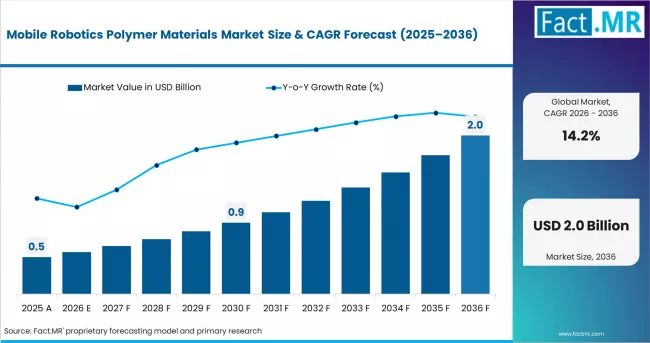
Mobile Robotics Polymer Materials Market Market Value Analysis | Source: Fact.MR
| Metric | Value |
|---|---|
| Estimated Value in 2026 | USD 0.4 billion |
| Forecast Value in 2036 | USD 1.2 billion |
| Forecast CAGR (2026 to 2036) | 14.2% |
Source: Fact.MR analysis. Updated May 15, 2026
Summary of Mobile Robotics Polymer Materials Market
- Market Definition
- Market covers engineering thermoplastics, high-performance polymers, and fiber composites used in AMR, UAV, and UGV platform structural and functional components globally.
- Demand Drivers
- AMR Logistics Deployment Scale: Global AMR installations in warehousing are growing at double-digit rates. Each platform requires qualified structural polymer grades, directly linking robot production volume to material demand.
- UAV Lightweighting Requirements: Payload efficiency mandates in commercial and defence UAV programmes are driving substitution of metal components with high-performance polymer and composite alternatives.
- Robot OEM Material Standardisation: Leading AMR and industrial robot manufacturers are consolidating to fewer certified polymer grades per platform line, creating large volume commitments with preferred material suppliers.
- Key Segments Analyzed
- By Material Type: Engineering thermoplastics lead with approximately 38% share in 2026, preferred for AMR chassis and service robot housings due to their balance of stiffness, weight, and processability.
- By Robotics Platform: Autonomous mobile robots and service robots together account for approximately 52% share in 2026, driven by logistics and healthcare deployment volumes.
- By Application: Industrial and logistics robotics holds approximately 43% share in 2026, the dominant end-use driven by e-commerce fulfilment centre AMR integration programmes.
- Analyst Opinion at FACT.MR
- Shambhu Nath Jha, Senior Analyst at Fact.MR, opines, CXOs will observe a clear split emerging in the market. Commodity plastic grades are losing design qualification in performance-critical robot platforms. They are increasingly excluded from advanced AMR and UAV applications. High-performance polymers are gaining priority in material selection. These materials meet strict durability and light weighting requirements.
- Strategic Implications
- Invest in engineering thermoplastic grades certified for AMR structural applications. This targets the largest platform segment and enables long-term supply agreements with top robot OEMs.
- Develop fiber-reinforced composite solutions for UAV airframe components. This captures the highest-margin application and aligns with defence and commercial UAV light weighting mandates.
- Build regional compounding capacity near major robot manufacturing clusters in China, Germany, and the United States to reduce lead times and qualify for platform-specific procurement contracts.
- Methodology
- Market sizing based on robot production volumes, average polymer material content per platform, and grade-specific selling prices. Validated with 2024–2025 producer and IFR data.
- Supported by robot OEM procurement disclosures, polymer producer annual reports, and IFR World Robotics production statistics.
- Forecasts incorporate robot platform production growth curves, material substitution timelines, and high-performance polymer capacity expansion announcements.
The market is projected to generate USD 0.8 billion in absolute opportunity between 2026 and 2036. Growth is structurally driven by AMR platform proliferation in logistics and healthcare, miniaturization requirements for UAV frames, and the shift toward certified high-performance polymers that meet robotic duty-cycle durability standards. Material qualification timelines and limited high-performance polymer supply constrain faster adoption.
Engineering polymer procurement for robotics is increasingly specification-driven. Robot OEMs are standardising material qualifications across platform variants, creating sticky supply relationships with certified polymer producers. Long-term material supply agreements tied to AMR platform programmes are becoming standard, particularly among top-tier logistics and industrial robot manufacturers in North America, Europe, and China.
India leads with a projected CAGR of approximately 17.5% through 2036, driven by expanding domestic robot manufacturing and government-backed automation incentives. France follows at 15.3%, supported by AMR platform investment and domestic robotics OEM activity. The United States grows at 16.7%, anchored by warehouse AMR deployments and defence UAV polymer procurement. China grows at 17.0%, driven by the world's largest AMR production base and domestic high-performance polymer capacity expansion. Germany records 14.0%, led by industrial robot structural component qualification requirements. Japan grows at 13.9%, driven by precision robot frame applications and advanced composite adoption.
Segmental Analysis
Mobile Robotics Polymer Materials Market Analysis by Material Type
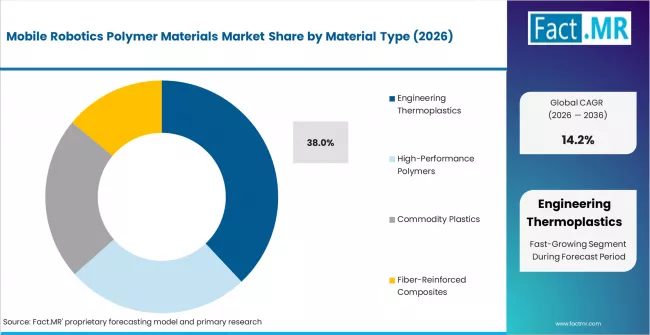
Mobile Robotics Polymer Materials Market Analysis By Material Type | Source: Fact.MR
Based on FACT.MR analysis, engineering thermoplastics hold approximately 38% share in 2026. They lead because AMR chassis, service robot housings, and UGV enclosures require the stiffness, impact resistance, and processability that engineering thermoplastics provide.
- BASF Ultramid Launch: BASF SE launched an updated Ultramid PA grade portfolio specifically engineered for mobile robot structural applications in Q3 2024. The grades target AMR chassis and service robot frames. The portfolio is qualified for robot OEM design databases in Europe and North America [1].
- Solvay PEEK Development: Solvay SA expanded its KetaSpire PEEK offering for robotics in 2025, targeting high-performance polymer demand in precision robot joints and UAV structural components. The material meets IEC 60068 thermal cycling standards applicable to outdoor mobile robot platforms [4].
- Composite Adoption Trend: Hexcel Corporation reported growing demand for carbon fiber composites in commercial UAV airframe applications in its 2024 annual report. Composite adoption in UAV structural components grew 19% in 2024, driven by payload efficiency requirements in logistics drone programmes in Asia Pacific and North America [5].
Mobile Robotics Polymer Materials Market Analysis by Robotics Platform
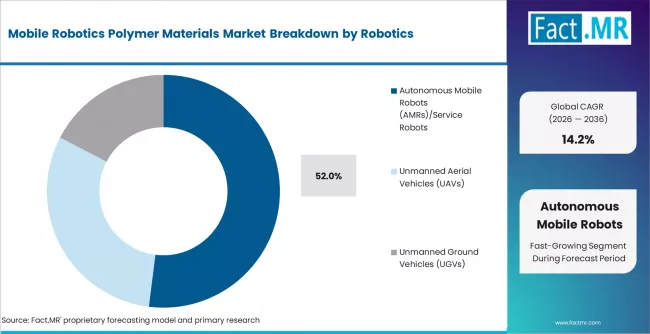
Mobile Robotics Polymer Materials Market Analysis By Robotics | Source: Fact.MR
Based on FACT.MR analysis, autonomous mobile robots and service robots together hold approximately 52% share in 2026. This platform cluster leads because logistics AMR deployments are the single largest volume driver and service robots in healthcare and retail are scaling rapidly.
- Covestro AMR Supply: Covestro AG expanded Makrolon polycarbonate supply agreements with AMR manufacturers in China and Germany in 2024. The agreements cover chassis and sensor housing applications. Covestro cited AMR platform growth as a key driver of its engineering plastics segment revenue in its H1 2024 results [2].
- DuPont UAV Materials: DuPont de Nemours expanded its Zytel nylon and Hytrel elastomer product lines for UAV structural and damping applications in 2024. The expansion targets commercial logistics drone OEMs in the United States and Europe. DuPont noted robotics as an emerging growth segment in its Q3 2024 investor presentation [3].
- UGV Platform Trend: Endeavor Robotics, acquired by FLIR Systems and now part of Teledyne Technologies, expanded UGV production for defence applications in 2024. Each UGV platform uses approximately 4–6 kg of engineering polymer in chassis and enclosure components, and increasing production volumes are driving cumulative material demand [6].
Drivers, Restraints, and Opportunities
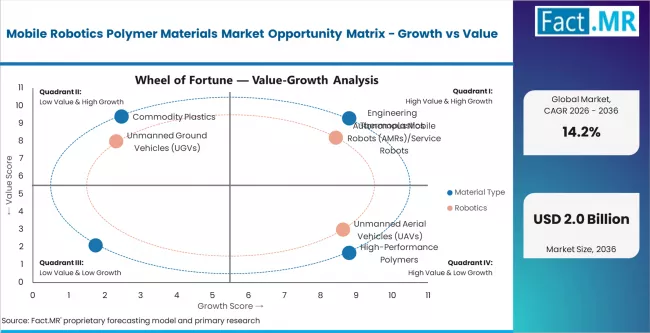
Mobile Robotics Polymer Materials Market Opportunity Matrix Growth Vs Value | Source: Fact.MR
FACT.MR analysts observe that the mobile robotics polymer materials market is in an early-growth phase, transitioning from fragmented spot procurement to specification-driven, platform-level material supply agreements.
Commodity plastics are losing qualification in performance-critical AMR and UAV platforms. Robot OEMs are shifting to engineering thermoplastics and high-performance polymers as duty-cycle standards tighten. This transition is value-accretive: even as volumes per platform remain modest, the shift to higher-grade materials expands revenue per kilogram significantly.
- EU Machinery Regulation 2023/1230: The new EU Machinery Regulation, entering full force in January 2027, is tightening material qualification standards for robot structural components sold in European markets.
- China AMR Production Expansion: China's AMR production base is the world's largest and continued to expand in 2024 and 2025. Domestic robot manufacturers are increasing polymer content per platform as they upgrade from basic chassis designs to precision-engineered structural components.
- US Warehouse Automation Investment: Amazon, Walmart, and major 3PL operators continued to deploy AMR fleets across US fulfilment centres throughout 2024. Each AMR installation cycle drives material procurement at robot OEM level. DuPont reported increased Zytel nylon demand for logistics robot applications in its Q3 2024 investor update, linking warehouse automation investment directly to engineering polymer volume growth.
Regional Analysis
The mobile robotics polymer materials market is assessed across Asia Pacific, North America, Europe, Latin America, and Middle East and Africa, covering 40+ countries with demand profiles shaped by robot production volumes, material qualification standards, robotics policy incentives, and engineering polymer supply infrastructure. The full report offers market attractiveness analysis by region and country.
.webp "Top Country Growth Comparison Mobile Robotics Polymer Materials Market Cagr (2026 2036)")
Top Country Growth Comparison Mobile Robotics Polymer Materials Market Cagr (2026 2036) | Source: Fact.MR
| Country | CAGR (2026 to 2036) |
|---|---|
| India | 17.5% (fastest) |
| China | 17.0% |
| United States | 16.7% |
| France | 15.3% |
| Germany | 14.0% |
| Japan | 13.9% |
Source: Fact.MR analysis. Updated May 15, 2026
Source: Fact.MR (FACT.MR) analysis, based on proprietary forecasting model and primary research
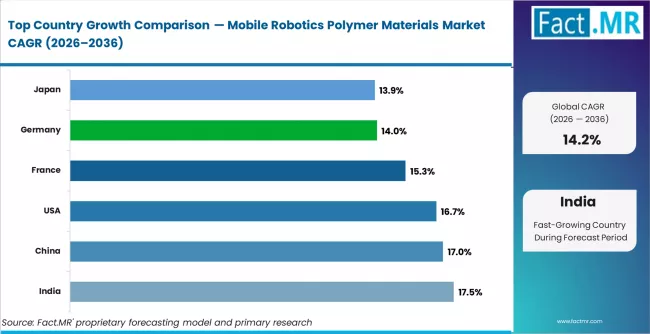
Mobile Robotics Polymer Materials Market Cagr Analysis By Country | Source: Fact.MR
Asia Pacific Mobile Robotics Polymer Materials Market Analysis
Asia Pacific is the production epicentre for mobile robotics polymer materials. China's AMR manufacturing base accounts for the region's dominant share. India is the fastest-growing market, driven by government automation incentives and domestic robot manufacturing investment.
- China: China is projected to rise at 17.0% CAGR through 2036. China is home to the world's largest AMR production base, with domestic manufacturers including Hikrobot, Geek+, and SIASUN expanding production volumes in 2024. The Ministry of Industry and Information Technology's Robot Industry Development Plan continued to incentivise domestic robot manufacturing and component localisation in 2024 and 2025, creating demand for certified polymer grades at domestic OEMs.
- India: Demand for mobile robotics polymer materials in India is projected to rise at approximately 17.5% CAGR through 2036, the fastest among all covered countries. India's Production Linked Incentive scheme for Advanced Chemistry Cells and related manufacturing sectors is generating investment in automated production facilities, each requiring AMR fleets and associated polymer material procurement. The Indian Government’s National Robotics Mission, launched through the Ministry of Electronics and Information Technology in 2024, is supporting domestic robot manufacturing capability development.
- Japan: Mobile robotics polymer materials in Japan is projected to rise at 13.9% CAGR through 2036. Japan's robot industry is characterised by precision manufacturing standards and high material qualification requirements. Fanuc Corporation and Yaskawa Electric expanded mobile robot platform production in 2024, incorporating certified engineering thermoplastic components in collaborative and logistics robot designs.
FACT.MR's analysis of the mobile robotics polymer materials market in Asia Pacific consists of country-wise assessment that includes China, India, Japan, South Korea, ASEAN, and Australia and New Zealand. Readers can find robot OEM polymer procurement trends, government incentive programme impacts, and engineering grade adoption benchmarks.
Europe Mobile Robotics Polymer Materials Market Analysis
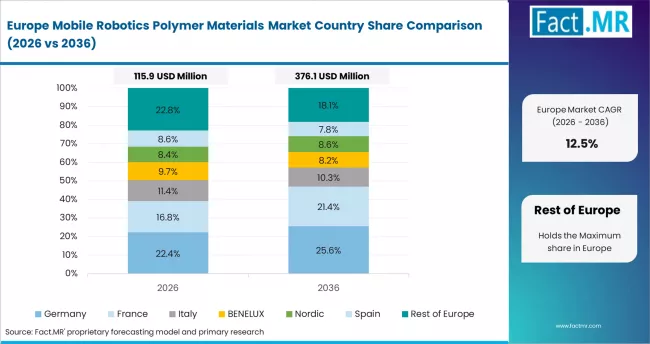
Mobile Robotics Polymer Materials Market Europe Country Market Share Analysis, 2026 & 2036 | Source: Fact.MR
Europe is the regulatory benchmark market for mobile robotics polymer qualification. EU Machinery Regulation compliance requirements are shaping material selection across the region. Procurement is specification-intensive and documentation-heavy. BASF SE and Covestro AG dominate regional engineering polymer supply to robotics OEMs through established qualification programmes.
- Germany: Growth for mobile robotics polymer materials in Germany is projected to rise at 14.0% CAGR through 2036. Germany's robot manufacturing sector, anchored by KUKA, Bosch Rexroth, and specialised AMR producers, maintains stringent material qualification standards for structural polymer components. The EU Machinery Regulation 2023/1230 is driving pre-qualification of polymer grades for robot structural applications ahead of its full implementation in January 2027.
- France: Demand for mobile robotics polymer materials in France is projected to rise at 15.3% CAGR through 2036. France's robotics sector is growing above the European average, driven by national investment in logistics automation and defence UAV platforms. The French government's France 2030 investment plan designated robotics as a priority sector, allocating EUR 500 million in 2024 for robot manufacturing and automation technology development.
FACT.MR's analysis of the mobile robotics polymer materials market in Europe consists of country-wise assessment that includes Germany, France, the United Kingdom, Italy, Spain, and BENELUX. Readers can find EU regulatory compliance impacts, engineering thermoplastic qualification trends, and robot OEM procurement profiles.
North America Mobile Robotics Polymer Materials Market Analysis
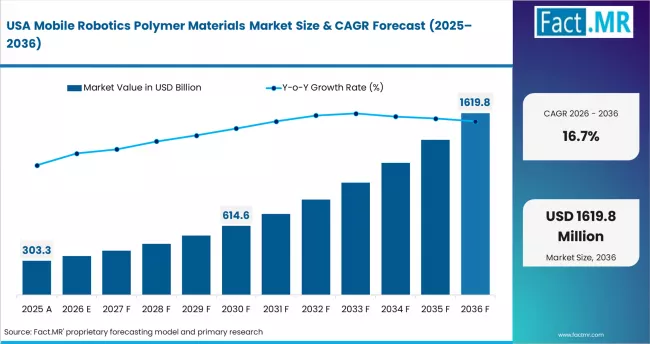
Mobile Robotics Polymer Materials Market Country Value Analysis | Source: Fact.MR
North America is a demand-volume-driven market for mobile robotics polymer materials. US warehouse automation investment and defence UAV polymer procurement are the primary demand drivers. DuPont and Celanese hold strong regional positions through engineering materials portfolios certified for AMR and UAV applications.
- United States: United States is projected to rise at 16.7% CAGR through 2036. The US combines the world's largest warehouse AMR deployment base with significant defence UAV polymer procurement, creating dual demand streams for certified engineering thermoplastics and high-performance composites. Amazon, Walmart, and major 3PL operators continued to expand AMR fleets across fulfilment centres in 2024 and 2025, driving procurement at robot OEM level for Zytel nylon and Hytrel elastomer components.
FACT.MR's analysis of the mobile robotics polymer materials market in North America consists of country-wise assessment that includes the United States, Canada, and Mexico. Readers can find warehouse automation AMR polymer demand data, defence UAV material procurement trends, and engineering thermoplastic grade adoption profiles.
Competitive Aligners for Market Players
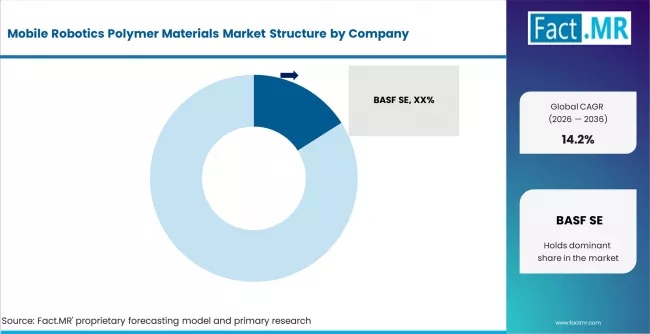
Mobile Robotics Polymer Materials Market Analysis By Company | Source: Fact.MR
Competition in the mobile robotics polymer materials market is shifting toward performance-driven differentiation. Vendors must prioritise strength-to-weight performance over cost efficiency. Material qualification is becoming a core competitive requirement.
High-performance polymer capability is the first key lever. Suppliers such as BASF SE, Covestro AG, and Solvay SA are investing in engineering and specialty polymers. These materials meet durability, thermal, and structural requirements for AMRs and UAVs. Vendors lacking advanced material portfolios risk exclusion from high-value applications.
OEM integration is critical. Material suppliers must work closely with robotics manufacturers during the design phase. Early-stage collaboration improves qualification success and embeds materials into long-term production programs. This creates supply lock-in and recurring demand.
Certification and testing capability is another differentiator. Robotics platforms require validated performance under real-world conditions. Vendors must provide documented reliability, lifecycle performance, and compliance with industry standards.
Lightweighting innovation is gaining importance. Materials that reduce weight while maintaining strength directly improve payload efficiency and battery performance. This is a key selection criterion for OEMs. Regional manufacturing and supply chain reliability also matter. OEMs prefer suppliers with consistent quality and scalable production capacity. This reduces risk in global deployment programs. Premium pricing is acceptable for high-performance polymers that deliver measurable efficiency gains. Vendors must clearly demonstrate value rather than compete on cost alone.
Key Players
- BASF SE
- Covestro AG
- Solvay SA
- DuPont de Nemours, Inc.
- Evonik Industries AG
- Celanese Corporation
Bibliography
- [1] BASF SE. (Q3 2024). Product Portfolio Update: Ultramid Polyamide Engineering Grade Launch for Mobile Robot Structural Applications Including AMR Chassis and Service Robot Frame Specifications in European and North American Markets. basf.com/global/en/media/news-releases
- [2] Covestro AG. (H1 2024). Half-Year Results and Engineering Plastics Segment Update: Makrolon Polycarbonate Supply Agreement Expansion with Autonomous Mobile Robot Manufacturers in China and Germany for Chassis and Sensor Housing Applications. covestro.com/en/investor-relations
- [3] DuPont de Nemours, Inc. (Q3 2024). Investor Presentation: Zytel Nylon and Hytrel Elastomer Demand Growth in Logistics Robot and Warehouse Automation Applications Including AMR Structural and Damping Component Procurement. investors.dupont.com
- [4] Solvay SA. (2025). Engineering Materials Product Expansion: KetaSpire PEEK Portfolio for Precision Robotics Joint and UAV Structural Component Applications Qualified Against IEC 60068 Thermal Cycling Standards for Outdoor and Industrial Mobile Robot Platforms. solvay.com/en/news
- [5] Hexcel Corporation. (2024). Annual Report 2024: Carbon Fiber Composite Demand Growth in Commercial UAV Airframe Applications Including 19% Volume Increase in 2024 Driven by Payload Efficiency Requirements in Logistics Drone Programmes. hexcel.com/investors
- [6] European Commission. (2024). EU Machinery Regulation 2023/1230 Implementation Guidance: Material Qualification Requirements for Robot Structural Components and Documentation Standards for Certified Polymer Grades in Mobile Robot Platforms Entering European Markets. ec. europa.eu/growth/sectors/mechanical-engineering/machinery
This Report Addresses
- Strategic intelligence on mobile robotics polymer material demand across engineering thermoplastics, high-performance polymers, commodity plastics, and fiber-reinforced composites for AMR, UAV, and UGV platforms globally.
- Market forecast from USD 0.4 billion in 2026 to USD 1.2 billion by 2036 at a CAGR of 14.2%.
- Opportunity mapping across China AMR production polymer localisation, India domestic robot manufacturing growth, US warehouse automation AMR demand, France logistics and UAV polymer investment, Germany EU Machinery Regulation compliance qualification, and Japan precision robot composite adoption.
- Segment analysis by material type (engineering thermoplastics, high-performance polymers, composites), robotics platform (AMR, UAV, UGV), and application (industrial logistics, service, healthcare) across global and regional markets.
- Regional outlook covering Asia Pacific robot production-linked polymer demand, North America AMR deployment and defence UAV material procurement, and Europe EU Machinery Regulation-driven material qualification activity.
- Competitive landscape of BASF SE, Covestro AG, Solvay SA, DuPont, Evonik, and Celanese, covering certified grade portfolio depth, OEM qualification relationships, and application engineering capability.
- Regulatory analysis covering EU Machinery Regulation 2023/1230 polymer qualification requirements, China MIIT robot industry development incentives, US defence UAV polymer procurement standards, and ISO standards applicable to robot structural materials.
- Report delivered in PDF, Excel, and presentation formats supported by primary interviews, IFR robot production statistics, polymer producer annual reports, and robot OEM procurement benchmarks.
Mobile Robotics Polymer Materials Market Definition
The mobile robotics polymer materials market covers engineering thermoplastics, high-performance polymers, commodity plastics, and fiber-reinforced composites supplied for structural, housing, and functional components in mobile robotic platforms.
Mobile Robotics Polymer Materials Market Inclusions
Covers global and regional forecasts from 2026 to 2036. Includes material type, robotics platform, and application segments. Covers engineering thermoplastics, high-performance polymers, fiber composites, and commodity grades across AMR, UAV, and UGV platforms through direct and distributor channels.
Mobile Robotics Polymer Materials Market Exclusions
Excludes metal structural components and electronic materials used in robotics platforms. Omits downstream finished robots and robotic systems. Excludes polymers used in stationary industrial robots not classified as mobile platforms. Focus remains on polymer and composite material inputs for mobile robot structural and functional applications.
Mobile Robotics Polymer Materials Market Research Methodology
- Primary Research:Interviews with polymer material procurement managers at robot OEMs, compounding specialists, and robotics platform engineers across key manufacturing regions.
- Desk Research:Uses company disclosures from BASF SE, Covestro AG, Solvay SA, and DuPont. Includes IFR robot production statistics and polymer application data from 2024–2025.
- Market-Sizing and Forecasting:Hybrid top-down and bottom-up model. Based on robot production volumes, average polymer content per platform type, and material selling prices by grade and application.
- Data Validation and Update Cycle:Validated using robot OEM procurement data and polymer producer shipment volumes. Cross-checked with IFR production benchmarks and industry expert interviews. Updated annually.
Segmentation
Scope of Report
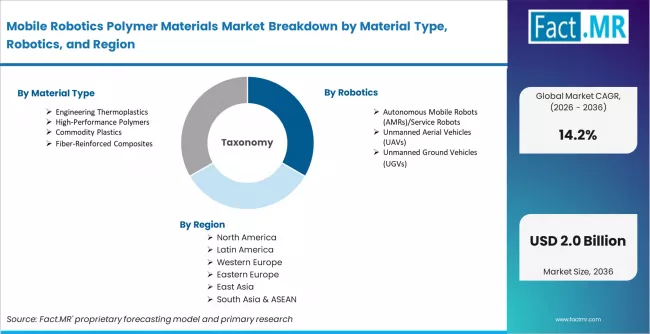
Mobile Robotics Polymer Materials Market Breakdown By Material Type, Robotics, And Region | Source: Fact.MR
| Attribute | Details |
|---|---|
| Quantitative Units | USD 0.4 billion (2026) to USD 1.2 billion (2036), at a CAGR of 14.2% |
| Market Definition | Engineering thermoplastics, high-performance polymers, commodity plastics, and fiber-reinforced composites supplied for structural, housing, and functional components in AMR, UAV, and UGV mobile robotic platforms globally. |
| Material Type Segmentation | Engineering Thermoplastics, High-Performance Polymers, Commodity Plastics, Fiber-Reinforced Composites |
| Robotics Platform Segmentation | Autonomous Mobile Robots/Service Robots, Unmanned Aerial Vehicles, Unmanned Ground Vehicles |
| Application Segmentation | Industrial & Logistics Robotics, Service Robotics, Healthcare Robotics |
| Application Coverage | AMR chassis and structural component polymer supply, UAV airframe lightweighting composites, UGV enclosure engineering thermoplastics, service robot housing materials, and healthcare robot biocompatible polymer grades. |
| Regions Covered | North America, Europe, Asia Pacific, Latin America, Middle East and Africa |
| Countries Covered | USA, Canada, Mexico, Germany, France, UK, Italy, Spain, Nordic, BENELUX, China, India, Japan, South Korea, ASEAN, Australia and New Zealand, Brazil, Argentina, Chile, Saudi Arabia, GCC, Turkey, South Africa, Rest of MEA |
| Key Companies Profiled | BASF SE, Covestro AG, Solvay SA, DuPont de Nemours Inc., Evonik Industries AG, Celanese Corporation |
| Forecast Period | 2026 to 2036 |
| Approach | Hybrid top-down and bottom-up model using robot production volumes, average polymer content per platform type, grade-specific selling prices, and primary interviews with robot OEM procurement managers and polymer compounding specialists. |
Source: Fact.MR analysis. Updated May 15, 2026
Mobile Robotics Polymer Materials Market by Segments
-
By Material Type:
- Engineering Thermoplastics
- High-Performance Polymers
- Commodity Plastics
- Fiber-Reinforced Composites
-
By Robotics Platform:
- Autonomous Mobile Robots (AMRs)/Service Robots
- Unmanned Aerial Vehicles (UAVs)
- Unmanned Ground Vehicles (UGVs)
-
By Application:
- Industrial & Logistics Robotics
- Service Robotics
- Healthcare Robotics
-
By Region:
- North America
- United States
- Canada
- Mexico
- Europe
- Germany
- France
- United Kingdom
- Italy
- Spain
- Nordic Countries
- BENELUX
- Rest of Western Europe
- Asia Pacific
- China
- India
- Japan
- South Korea
- ASEAN
- Australia and New Zealand
- Latin America
- Brazil
- Argentina
- Chile
- Rest of Latin America
- Middle East and Africa
- Saudi Arabia
- GCC Countries
- Turkey
- South Africa
- Rest of MEA
- North America
Frequently Asked Questions
How large is the mobile robotics polymer materials market in 2025?
What will the market size be in 2026?
What is the projected market size by 2036?
What is the expected CAGR from 2026 to 2036?
Which material type segment leads the market?
Which robotics platform holds the largest share?
Which country shows the fastest growth?
What is driving demand in this market?
Who worked on this report


Preview the report firsthand - request a free sample
Free SampleGet the brochure for pricing and purchase details
Download PDF