- Market Value (2025): USD 6.9 Bn
- Estimated Value (2026): USD 7.5 Bn
- Forecast Value (2036): USD 17.4 Bn
- CAGR (2026-2036): 8.7%
What is the Mono-Material Flexible Barriers Market forecast to be worth by 2036?
USD 7.5 Billion in 2026 to USD 17.4 Billion by 2036 at 8.7% CAGR.
- The Mono-Material Flexible Barriers Market crossed a valuation of USD 6.9 Billion in 2025.
- Demand is projected to increase from USD 7.5 Billion in 2026 to USD 17.4 Billion by 2036.
- The market is forecast to record an 8.7% CAGR from 2026 to 2036 as converters qualify recyclable PE and PP barrier webs for food and personal-care packs.
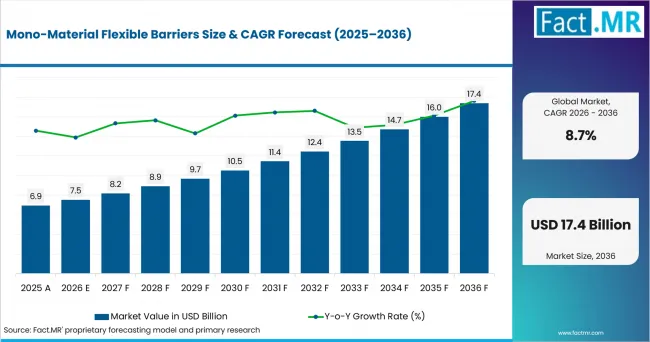
Mono Material Flexible Barriers Value Analysis | Source: Fact.MR
What are the defining numbers behind Mono-Material Flexible Barriers Market growth?
An absolute opportunity of USD 9.8 Billion is expected between 2026 and 2036.
- Demand Drivers in the Market
- Snack manufacturers need moisture and aroma protection that keeps crisp products stable during distribution and retail display.
- Frozen-food packers need puncture resistance and sealing consistency as mono-material pouches move through cold-chain handling.
- Pet-food brands need odor control and fat resistance while shifting pouch designs toward a single polymer family.
- Personal-care converters need flow wrap that controls moisture loss and still works with resealable label systems.
- Key Segments Analyzed
- By Polymer Platform: PE mono-material is expected to hold 34.0% share in 2026 because many film-recycling routes are built around polyethylene collection.
- By Barrier Technology: EVOH-compatible barrier is projected to account for 37.0% share in 2026 due to its oxygen-control role in food and pet-food packs.
- By Format: Printed rollstock is anticipated to capture 33.0% share in 2026 owing to its fit with high-speed form-fill-seal conversion.
- By End-use: Snacks are estimated to represent 36.0% share in 2026 supported by crispness protection, aroma retention and compact shelf formats.
- Analyst Opinion at Fact.MR
- Shambhu Nath Jha, Principal Consultant at Fact.MR, states, "The real qualification test is no longer a recyclability claim on its own. Brand teams are expected to ask whether a mono-material web protects the product, seals cleanly and survives the same filling line. Suppliers that pair barrier data with converter trials have a clearer route into repeat orders."
- Strategic Implications
- Converters should document line-speed windows for PE and PP structures before customer trials move into larger commercial runs.
- Film producers should pair oxygen and moisture-barrier claims with shelf-life data for snacks, pet food and chilled products.
- Brand teams should align pack artwork with sorting needs by avoiding heavy inks and labels that lower recycling-stream value.
- Retailers should compare recyclable flexible formats by product protection and store handling performance before changing pack standards.
China is expected to post 9.1% CAGR through 2036 due to e-commerce scale and food-packaging conversion. The USA is projected to record 8.6% CAGR as food spending keeps flexible packaging volumes broad. Japan is anticipated to hold 8.6% CAGR as compact food packs and packaging efficiency guide converter programs. Germany is forecast to advance at 8.4% CAGR because packaging recycling checks remain central to buyer reviews. France is estimated to reach 7.9% CAGR as EPR rules keep pack design under review.
How does the Mono-Material Flexible Barriers Market break down by segment?
PE mono-material leads Polymer Platform at 34.0%; EVOH-compatible barrier leads Barrier Technology at 37.0%.
Which Polymer Platform dominates?
PE mono-material is expected to hold 34.0% share in 2026.
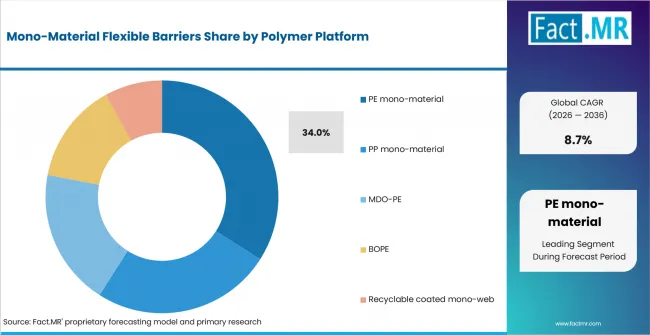
Mono Material Flexible Barriers Analysis By Polymer Platform | Source: Fact.MR
PE mono-material is the practical starting point for converters that already run polyethylene films in grocery, snack and household packs. PP mono-material remains useful where stiffness and heat tolerance are required, while MDO-PE and BOPE support downgauging inside one polymer family.
Amcor and Fedrigoni developed a recycle-ready wet wipe pack in May 2025 using Amcor’s AmPrima® Plus flow wrap with Fedrigoni’s semi-rigid label. The PE-based mono-material pack is designed for recycling in PE recycling streams across Europe, providing home and personal care brands with a mono-material route for wet wipe packaging.
What leads the Barrier Technology segment?
EVOH-compatible barrier is projected to account for 37.0% share in 2026.
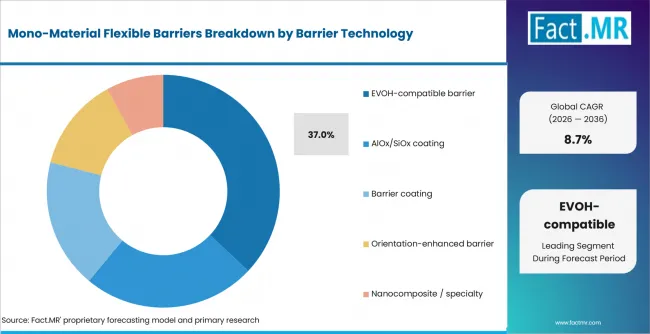
Mono Material Flexible Barriers Analysis By Barrier Technology | Source: Fact.MR
EVOH-compatible barrier leads where snacks, pet food and prepared foods need oxygen control within recyclable film designs. AlOx and SiOx coatings serve higher-barrier cases where transparency or flavor protection carries greater weight. Orientation-enhanced barriers help balance stiffness and downgauging.
How does Format shape demand?
Printed rollstock is anticipated to capture 33.0% share in 2026.
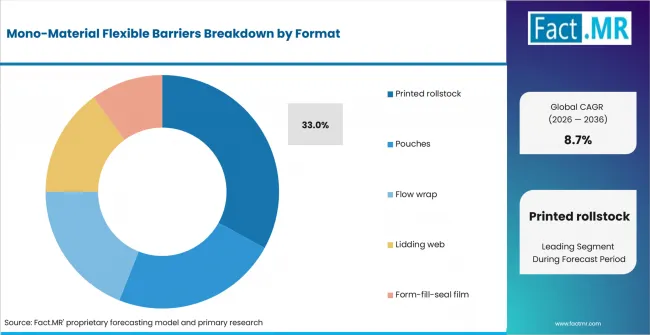
Mono Material Flexible Barriers Analysis By Format | Source: Fact.MR
Printed rollstock fits snack and frozen-food lines that convert film into packs at high speed. Pouches remain close behind when portion control or resealability shapes pack design. Flow wrap works well in personal care, while lidding web serves tray formats that need clean peel behavior.
What supports Snacks within End-use?
Snacks are estimated to represent 36.0% share in 2026.
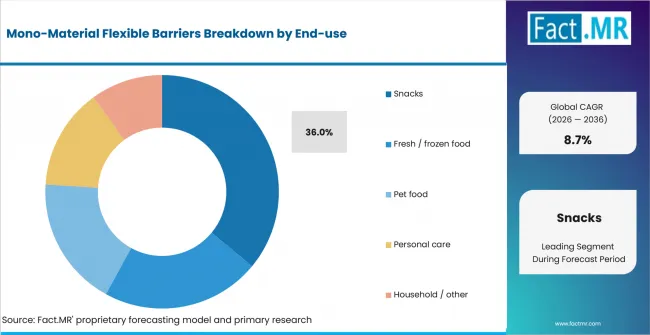
Mono Material Flexible Barriers Analysis By End Use | Source: Fact.MR
Snacks use flexible barriers because product quality can weaken quickly when crispness, aroma or grease control fails. Fresh and frozen food needs puncture resistance and freezer performance. Pet food adds odor and fat-barrier needs, while personal care needs moisture control.
What is accelerating Mono-Material Flexible Barriers Market adoption, and what is holding it back?
Design-for-recycling requirements drive it; barrier validation and sorting limits restrain it.
Drivers Impact Analysis
| DRIVER | (~) % IMPACT ON CAGR | GEOGRAPHIC RELEVANCE | IMPACT TIMELINE |
|---|---|---|---|
| Design-for-recycling rules | +1.7% | Europe, North America | Short term (<= 2 years) |
| Snack and frozen-food conversion | +1.4% | Global | Medium term (2-4 years) |
| Retailer packaging scorecards | +1.1% | USA, Europe | Medium term (2-4 years) |
| Coating and orientation upgrades | +0.8% | East Asia, Europe | Long term (>= 4 years) |
Opportunity Impact Analysis
| OPPORTUNITY | (~) % IMPACT ON CAGR | GEOGRAPHIC RELEVANCE | IMPACT TIMELINE |
|---|---|---|---|
| High-barrier mono-webs for snacks | +1.2% | Global | Short term (<= 2 years) |
| PCR-ready PE and PP formats | +0.9% | Europe, USA | Medium term (2-4 years) |
| Cold-chain pouch replacement | +0.7% | Japan, China | Medium term (2-4 years) |
| Personal-care flow wrap | +0.5% | Europe, North America | Long term (>= 4 years) |
Restraints Impact Analysis
| RESTRAINT | (~) % IMPACT ON CAGR | GEOGRAPHIC RELEVANCE | IMPACT TIMELINE |
|---|---|---|---|
| Shelf-life validation burden | -0.8% | Global | Short term (<= 2 years) |
| Recycling-stream variation | -0.6% | Europe, North America | Medium term (2-4 years) |
| Food-contact PCR limits | -0.4% | USA, Europe | Medium term (2-4 years) |
| Machinery changeover risk | -0.3% | Global | Long term (>= 4 years) |
Which countries are scaling the Mono-Material Flexible Barriers Market through 2036?
- The country comparison spans 1.2 percentage points across the forecast period.
- China remains 0.5 percentage point above the USA and Japan as online retail scale raises packaging-conversion needs.
- The USA and Japan share the same 8.6% CAGR, but the USA is shaped by food-spending scale while Japan is shaped by compact packaging needs.
- Germany remains 0.5 percentage point above France as recycling verification has a stronger role in packaging redesign.
- France closes the displayed range through EPR pressure and food-packaging replacement across household packaging streams.
Comparable CAGRs can create different entry conditions due to food-packaging mix, recycling rules, converter capability and brand approval cycles. Full report coverage includes North America, Latin America, Western Europe, Eastern Europe, East Asia, South Asia & Pacific, Middle East & Africa.
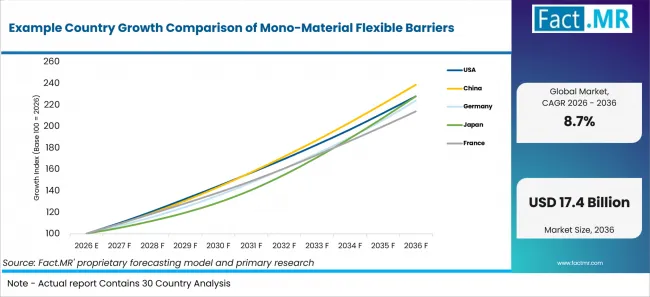
Example Country Growth Comparison Of Mono Material Flexible Barriers | Source: Fact.MR
| Country | CAGR |
|---|---|
| China | 9.1% |
| USA | 8.6% |
| Japan | 8.6% |
| Germany | 8.4% |
| France | 7.9% |
What supports China adoption?
9.1% CAGR, supported by online retail scale and food-pack conversion.
China’s flexible-packaging converters are expected to benefit from the scale of online food and household goods distribution. The National Bureau of Statistics of China reported in January 2026 that online retail sales reached 15,972.2 billion yuan in 2025. That channel scale raises the value of printed rollstock and pouches that protect products while meeting export and domestic recycling expectations.
How is the USA scaling demand?
8.6% CAGR, led by food-spending scale and recyclable pack redesign.
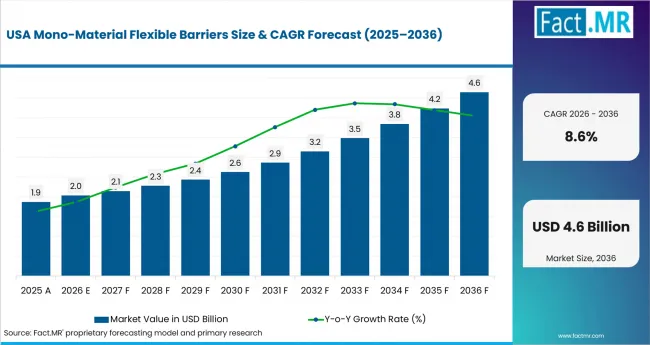
Mono Material Flexible Barriers Country Value Analysis | Source: Fact.MR
USA demand is projected to remain tied to the size of packaged food and snack consumption. USDA ERS reported in June 2026 that total U.S. food spending reached USD 2.51 trillion in 2025. That spending base gives snack brands and private-label food suppliers a broad reason to qualify recyclable flexible barriers that preserve shelf life.
What supports Japan growth?
8.6% CAGR, backed by compact packaging formats and converter efficiency.
Japan’s outlook is shaped by compact retail packs and high expectations for package quality. The Japan Packaging Institute reported that the shipment value of packaging materials and containers reached 6.1357 trillion yen in 2025. That production base supports testing of rollstock, pouches and lidding webs where barrier performance must fit dense retail and chilled-food distribution.
What is supporting Germany adoption?
8.4% CAGR, supported by packaging recycling checks and food-pack replacement.
Germany’s converter base is expected to treat recyclability proof as a central part of flexible-pack redesign. UBA and ZSVR reported in January 2026 that around 5.5 million tonnes of packaging waste collected through Germany’s dual systems were recovered in 2024. That recycling structure gives brand teams a reason to prefer PE and PP barrier webs with clear sorting compatibility.
How does France perform?
7.9% CAGR, led by EPR pressure and household packaging redesign.
France is anticipated to scale through food brands that need recyclable packs within an active household packaging system. ADEME reported in April 2026 that 4,893 kt were sorted for recycling in the 2024 household packaging and graphic-paper stream. That base keeps recyclability evidence visible when converters propose mono-material barriers for snacks and chilled foods.
Which companies are active in the Mono-Material Flexible Barriers Market?
Amcor, Mondi, Coveris and Constantia Flexibles provide commercially active mono-material flexible packaging and barrier solutions.
Amcor is an active provider through its AmPrima® recycle-ready flexible packaging portfolio and expanded its operations following completion of its combination with Berry Global in April 2025. Mondi adds direct relevance through mono-material FlowWrap and other flexible-packaging solutions for home and personal care applications.
Coveris participates through its recyclable MonoFlex monomaterial films and MonoFlexBP tray packaging for refrigerated goods. Constantia Flexibles adds EcoLamHighPlus and EcoVerHighPlus mono-material structures, with its August 2025 FACHPACK announcement confirming that pouches made from these materials would be demonstrated on Syntegon’s PMX line. ProAmpac contributes recyclable and recycle-ready flexible packaging technologies through its ProActive Sustainability portfolio.
Which companies are profiled in the market?
Companies profiled include Amcor, Mondi, Coveris, Constantia Flexibles and ProAmpac.
- Amcor plc, including Berry Global operations
- Mondi plc
- Coveris
- Constantia Flexibles
- ProAmpac
Bibliography
- Amcor. (2025a, April 30). Amcor completes combination with Berry Global; positioned to significantly enhance value for customers and shareholders.
- Amcor. (2025b, May 13). Amcor and Fedrigoni unveil breakthrough recycle-ready wet wipe packaging.
- Constantia Flexibles. (2025, August 12). FACHPACK 2025: Constantia Flexibles invests over €100 million and expands product portfolio.
- German Environment Agency, & Central Agency Packaging Register. (2026, January 27). Facts against myths: Packaging waste recycling in Germany is working.
- Mondi. (2026, June 2). Mondi introduces re/loop FlowWrap with 35% post-consumer recycled content for wet wipes packaging.
- National Bureau of Statistics of China. (2026, January 20). Total retail sales of consumer goods in December 2025.
- Van de Voorde, J., & Parisot, F. (2026, April 7). Emballages ménagers et papiers graphiques : données 2024. ADEME.
- Zeballos, E., & Sinclair, W. (2026, June 11). Total U.S. food spending reached $2.51 trillion in 2025. U.S. Department of Agriculture, Economic Research Service.
This Report Answers
- The report explains where mono-material flexible barriers are used across polymer platform and barrier technology.
- Segment analysis identifies PE mono-material and EVOH-compatible barrier as the main data-bearing segment leaders.
- Country analysis examines China, the USA, Japan, Germany and France across food packaging and recycling-design conditions.
- Competitive analysis reviews Amcor, Mondi, Coveris, Constantia Flexibles and ProAmpac across mono-material barrier capability.
- Application analysis assesses how snacks, fresh and frozen food, pet food and personal care influence format selection.
What does the Mono-Material Flexible Barriers Market cover?
The Mono-Material Flexible Barriers Market covers recyclable flexible packaging structures that use one main polymer family or a compatible mono-web design. It includes PE and PP films, oriented film structures, coated mono-webs and barrier technologies used to protect products during storage and distribution.
The assessment covers printed rollstock, pouches, flow wrap, lidding web and form-fill-seal film across food and personal-care applications. It focuses on packaging that combines barrier performance with recyclability-oriented material design.
What is included in the scope?
The scope includes PE mono-material, PP mono-material, MDO-PE, BOPE and recyclable coated mono-web structures used for flexible barrier packaging. The analysis aligns with adjacent coverage of high-recyclability mono-material flexible packaging, design-for-recycling packaging and sustainable packaging where material simplification supports recycling objectives. It includes EVOH-compatible barriers, AlOx and SiOx coatings, printed rollstock, pouches, flow wrap and lidding webs across snacks, fresh and frozen food, pet food, personal care and household applications.
What is excluded from the scope?
The scope excludes rigid plastic containers, paper-only packs, aluminum-foil laminates and conventional mixed-material flexible laminates that fall outside mono-material barrier design. Raw resins, converting machinery and adhesives sold as separate inputs are covered only when they are part of a mono-material flexible barrier system, including adjacent recyclable PU adhesives used in compatible recyclable laminates.
How Was the Analysis Built?
The analysis draws on 120+ sources, 35+ company portfolios, 25+ countries, and more than 20 industry interviews.
- Primary Research: Primary research includes discussions with film converters, packaging engineers, brand packaging teams, resin suppliers and coating specialists. These conversations examine barrier proof, line trials, sorting compatibility and replacement timing.
- Desk Research: Desk research covers government statistics, packaging regulation, company product pages, official newsroom announcements, recycling publications and technical material guidance.
- Market Sizing and Forecasting: Market estimates combine flexible-packaging use, application intensity, polymer platform mix, barrier technology fit, format shares and country-level packaging activity.
- Data Validation and Update Cycle: Findings are validated by comparing interviews with public data, company activity, packaging regulation, recycling indicators and product launches.
What is the report's scope and coverage?
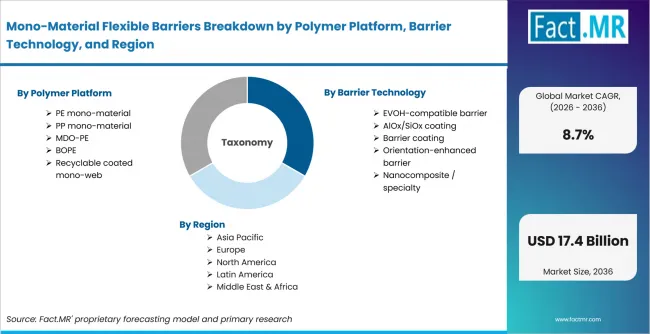
Mono Material Flexible Barriers Breakdown By Polymer Platform, Barrier Technology, And Region | Source: Fact.MR
| Attribute | Details |
|---|---|
| Quantitative Units | USD Billion in 2026 to USD Billion by 2036 at a CAGR |
| Market Definition | Mono-material flexible barrier packaging made mainly from one polymer family or recyclable coated mono-web structures used to protect packaged goods while improving recyclability. |
| Polymer Platform | PE mono-material; PP mono-material; MDO-PE; BOPE; Recyclable coated mono-web |
| Barrier Technology | EVOH-compatible barrier; AlOx and SiOx coating; Barrier coating; Orientation-enhanced barrier; Nanocomposite and specialty barrier |
| Format | Printed rollstock; Pouches; Flow wrap; Lidding web; Form-fill-seal film |
| End-use | Snacks; Fresh and frozen food; Pet food; Personal care; Household and other |
| Regions Covered | North America; Latin America; Western Europe; Eastern Europe; East Asia; South Asia & Pacific; Middle East & Africa |
| Countries Covered | China; USA; Japan; Germany; France |
| Key Companies Profiled | Amcor plc; Mondi plc; Coveris; Constantia Flexibles; ProAmpac |
| Forecast Period | 2026 to 2036 |
| Approach | Hybrid top-down and bottom-up approach using food-packaging demand, film-conversion formats, barrier technology fit, country recycling signals and provider portfolio review. |
How is the market segmented?
-
By Polymer Platform
- PE mono-material
- PP mono-material
- MDO-PE
- BOPE
- Recyclable coated mono-web
-
By Barrier Technology
- EVOH-compatible barrier
- AlOx and SiOx coating
- Barrier coating
- Orientation-enhanced barrier
- Nanocomposite and specialty barrier
-
By Format
- Printed rollstock
- Pouches
- Flow wrap
- Lidding web
- Form-fill-seal film
-
By End-use
- Snacks
- Fresh and frozen food
- Pet food
- Personal care
- Household and other
-
By Region
- North America
- Latin America
- Western Europe
- Eastern Europe
- East Asia
- South Asia & Pacific
- Middle East & Africa