- Market Value (2025): USD 110.1 Mn
- Estimated Value (2026): USD 125 Mn
- Forecast Value (2036): USD 443.5 Mn
- CAGR (2026-2036): 13.5%
What is the mooring load sensors market forecast to be worth by 2036?
USD 125 million in 2026 to USD 443.5 million by 2036, at 13.5% CAGR.
- The mooring load sensors market was valued at USD 110.1 million in 2025.
- It is projected to rise to USD 125 million in 2026 before reaching USD 443.5 million by 2036.
- The market is expected to expand at a 13.5% CAGR during the forecast period as ports strengthen berth safety and digital monitoring capabilities.
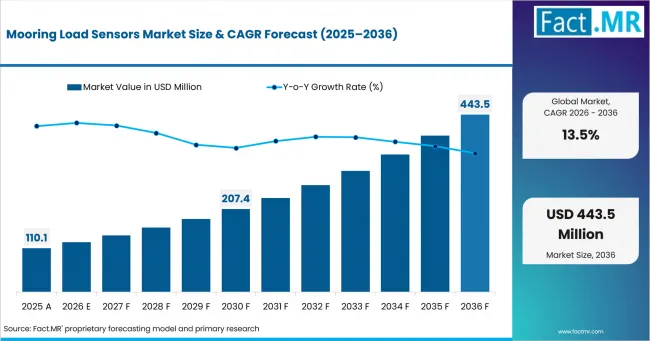
Mooring Load Sensors Market Market Value Analysis | Source: Fact.MR
What are the defining numbers behind mooring load sensors market growth?
USD 318.5 million absolute opportunity by 2036, supported by safer berth operations and connected port infrastructure.
- Demand Drivers in the Market
- Ports are increasing investment in real time mooring safety systems.
- Larger vessels require continuous monitoring of line tension during berthing.
- Offshore terminals are expanding digital monitoring across critical operations.
- Smart port programs support wider deployment of connected marine sensors.
- Key Segments Analyzed
- By Sensor Location: Hook mounted sensors are projected to account for 34.0% share in 2026 because they simplify installation while delivering accurate load measurement.
- By Connectivity: Wireless systems are expected to hold 36.0% share in 2026 because they reduce installation complexity across existing terminals.
- By Application: Berth safety is forecast to represent 33.0% share in 2026 because operators increasingly prioritize accident prevention.
- By Buyer Type: Marine terminals are expected to capture 41.0% share in 2026 because they remain the largest users of permanent monitoring systems.
- By Geography: The United States is projected to record a 14.2% CAGR through 2036 as investment in smart port infrastructure continues.
- Analyst Opinion at Fact.MR
- Shambhu Nath Jha, Senior Analyst at Fact.MR, states, "Digital monitoring is changing the way ports manage mooring operations. Reliable load sensing improves operational awareness while helping terminal operators respond before excessive line tension creates safety risks."
- Strategic Implications
- Equipment manufacturers should expand wireless monitoring capabilities for existing ports.
- Terminal operators should integrate load sensing with central control systems.
- Engineering firms should develop modular solutions that simplify retrofit projects.
- Technology providers should improve predictive alerts using continuous load data.
Mooring load sensors measure line tension during vessel berthing and cargo handling operations. The technology helps terminal operators detect overload conditions before they develop into safety incidents. This capability supports safer vessel movements and reduces unexpected downtime.
Demand is increasing across LNG terminals, container ports and offshore loading facilities where uninterrupted operations remain critical. Wireless communication, cloud monitoring and automated alert functions are improving the value of modern sensing systems. Digital port modernization programs also encourage wider deployment of connected monitoring equipment.
The United States is forecast to expand at 14.2% CAGR through 2036 because port modernization projects continue advancing. Germany is expected to register 13.8% CAGR as terminal automation gains wider acceptance. Japan is projected to grow at 13.5% CAGR due to continuous investment in maritime infrastructure. China is likely to record 13.2% CAGR as coastal port capacity expands. India is anticipated to achieve 12.8% CAGR as commercial ports strengthen operational safety standards.
How does the mooring load sensors market break down by segment?
Hook mounted sensors lead at 34.0%. Berth safety leads at 33.0%.
Which sensor location dominates?
Hook mounted sensors hold 34.0% share in 2026.
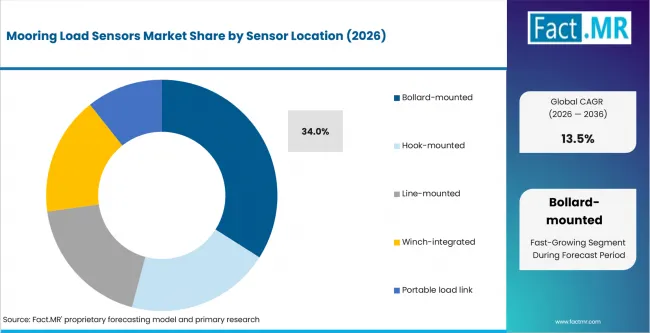
Mooring Load Sensors Market Analysis By Sensor Location | Source: Fact.MR
Hook mounted sensors are expected to account for 34.0% share in 2026 because they provide direct load measurement without major berth modifications. Port operators value their reliability during daily vessel movements. Bollard mounted systems suit fixed installations. Line mounted sensors support flexible deployment. Winch integrated designs improve continuous monitoring. Portable load links help temporary inspection work. NYK Line began real-world trials of the DynaMoor dynamic mooring system in Japan. The trial uses motion sensors to evaluate vessel movement and the effectiveness of automated mooring load control for safer port operations. [1]
Which connectivity dominates?
Wireless leads with 36.0% share in 2026.
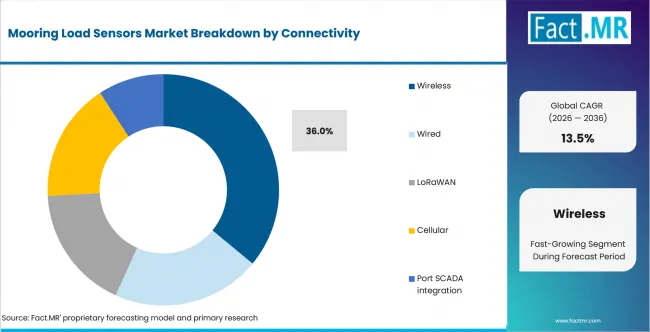
Mooring Load Sensors Market Analysis By Connectivity | Source: Fact.MR
Wireless connectivity is projected to capture 36.0% share in 2026 because installation is faster across existing port infrastructure. Operators also reduce cabling costs while expanding monitoring coverage. Wired systems remain common in permanent installations. LoRaWAN supports long range communication. Cellular networks improve remote access. Port SCADA integration strengthens centralized control. Cavotec signed an order valued at approximately EUR 2 million for its MoorMaster NxG automated vacuum mooring technology from Danish ferry operator Molslinjen A/S. The systems will be delivered to the ports of Odden and Aarhus, supporting battery-powered catamarans. [2]
Which application dominates?
Berth safety holds 33.0% share in 2026.
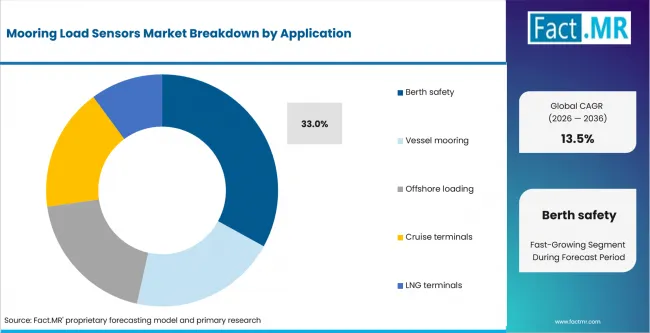
Mooring Load Sensors Market Analysis By Application | Source: Fact.MR
Berth safety remains the largest application because preventing excessive mooring loads reduces operational risk. The segment is expected to account for 33.0% share in 2026. Vessel mooring supports routine harbor operations. Offshore loading requires continuous monitoring. Cruise terminals focus on passenger safety. LNG terminals depend on stable mooring conditions during cargo transfer. LCM Systems supplied four 9.5-tonne submersible load shackles ordered by a Canadian company for monitoring tension in the mooring lines of wave-powered desalination devices. [3]
Which output dominates?
Line tension leads market with 39.0%.
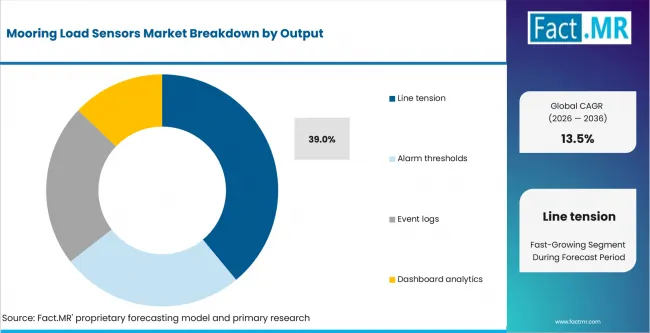
Mooring Load Sensors Market Analysis By Output | Source: Fact.MR
Line tension is expected to account for 39.0% share in 2026 because it provides the primary measurement required during mooring operations. Accurate tension data supports faster operational decisions. Alarm thresholds improve incident response. Event logs support operational reviews. Dashboard analytics simplify performance monitoring. Kawasaki announced the release of a Tension Monitoring System for Mooring Line, designed to improve safety and work efficiency in ship mooring operations. The system integrates a sensor in the braking mechanism of mooring equipment to convert brake holding force into numerical data. [4]
Which buyer type dominates?
Marine terminals lead with 41.0% share in 2026.
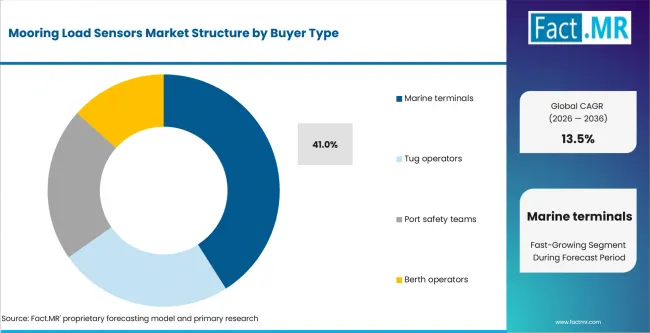
Mooring Load Sensors Market Analysis By Buyer Type | Source: Fact.MR
Marine terminals dominate because they operate fixed berths with continuous vessel traffic. The segment is expected to account for 41.0% share in 2026. Tug operators use portable monitoring during vessel movements. Port safety teams monitor high risk berths. Berth operators improve operational control through continuous sensing.
What is accelerating mooring load sensor adoption, and what is holding it back?
Smart port investment supports growth while high installation costs limit wider adoption.
Drivers Impact Analysis
| DRIVER | (~) % IMPACT ON CAGR | GEOGRAPHIC RELEVANCE | IMPACT TIMELINE |
|---|---|---|---|
| Smart port modernization | +1.1% | Global | Medium term (2-4 years) |
| Rising focus on berth safety | +0.9% | North America, Europe, Asia Pacific | Medium term (2-4 years) |
| Growth of LNG terminal projects | +0.8% | Asia Pacific, Middle East | Long term (≥4 years) |
| Expansion of offshore marine activity | +0.6% | Global | Medium term (2-4 years) |
| Adoption of wireless monitoring | +0.5% | Global | Short term (≤2 years) |
Source: Fact.MR analysis. Updated Jul 4, 2026
- Smart port modernization
- Port authorities are upgrading infrastructure with connected monitoring systems. Mooring load sensors improve operational visibility and safety.
- Berth safety focus
- Terminal operators increasingly monitor line loads to reduce accident risk. Continuous sensing supports faster operational decisions.
- LNG terminal projects
- New LNG terminals require dependable mooring systems during loading operations. Sensor deployment improves operational confidence.
- Offshore marine activity
- Offshore facilities continue strengthening mooring safety practices. Real time load monitoring reduces operational uncertainty.
- Wireless monitoring
- Wireless technology simplifies installation across existing berths. Operators can expand coverage without extensive civil work.
Opportunity Impact Analysis
| OPPORTUNITY | (~) % IMPACT ON CAGR | GEOGRAPHIC RELEVANCE | IMPACT TIMELINE |
|---|---|---|---|
| Predictive maintenance platforms | +0.8% | North America, Europe | Medium term (2-4 years) |
| SCADA integration projects | +0.7% | Global | Medium term (2-4 years) |
| Port digital twin deployment | +0.5% | Japan, Singapore, Europe | Long term (≥4 years) |
| Retrofit of existing berths | +0.4% | Global | Short term (≤2 years) |
Source: Fact.MR analysis. Updated Jul 4, 2026
- Predictive maintenance
- Historical load data helps identify abnormal stress before equipment failure. Ports can improve maintenance planning.
- SCADA integration
- Centralized monitoring improves operational coordination across terminals. Connected systems also strengthen incident response.
- Digital twins
- Virtual port models benefit from continuous sensor data. Accurate load information improves operational simulation.
- Berth retrofits
- Older terminals increasingly add monitoring without replacing existing infrastructure. Retrofit demand creates new project opportunities.
Restraints Impact Analysis
| RESTRAINT | (~) % IMPACT ON CAGR | GEOGRAPHIC RELEVANCE | IMPACT TIMELINE |
|---|---|---|---|
| High installation costs | -0.7% | Emerging markets | Medium term (2-4 years) |
| Complex integration with legacy systems | -0.5% | Global | Medium term (2-4 years) |
| Limited technical expertise | -0.4% | Developing regions | Short term (≤2 years) |
| Budget constraints for smaller ports | -0.3% | Global | Long term (≥4 years) |
Source: Fact.MR analysis. Updated Jul 4, 2026
- High installation costs
- Large terminals often require multiple sensing points across several berths. Initial investment may slow purchase decisions.
- Legacy system integration
- Older control systems may require additional engineering before new sensors can communicate effectively.
- Technical expertise
- Successful deployment depends on proper calibration and operational training. Some ports rely on external specialists.
- Budget constraints
- Smaller ports often prioritize essential infrastructure before advanced monitoring systems. This delays technology adoption in some regions.
Which countries are advancing mooring load sensor deployment fastest?
United States 14.2%; Germany 13.8%; Japan 13.5%; China 13.2%; India 12.8%.
Based on regional analysis, the mooring load sensors market is segmented into North America, Europe, East Asia, South Asia, Latin America, and the Middle East & Africa.
| Country | CAGR |
|---|---|
| United States | 14.2% |
| Germany | 13.8% |
| Japan | 13.5% |
| China | 13.2% |
| India | 12.8% |
Source: Fact.MR analysis. Updated Jul 4, 2026
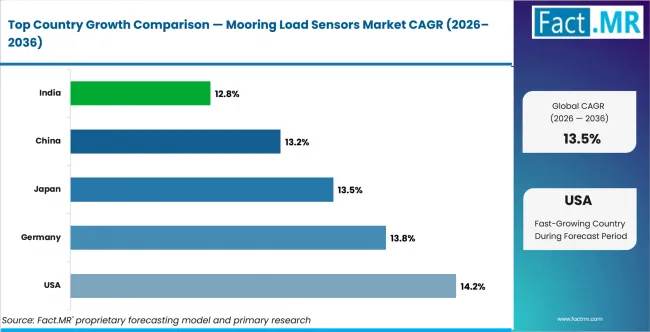
Mooring Load Sensors Market Cagr Analysis By Country | Source: Fact.MR
What is supporting demand in the United States?
14.2% CAGR, backed by smart port investment and berth safety upgrades.
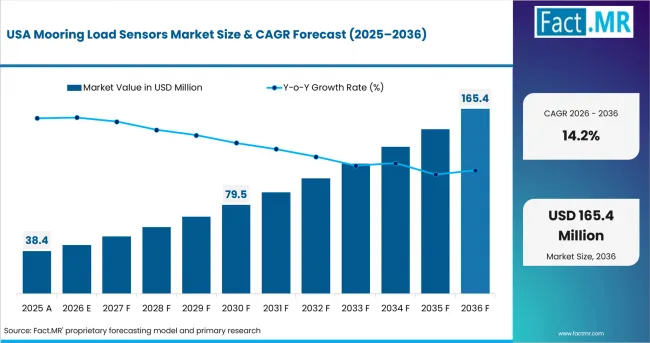
Mooring Load Sensors Market Country Value Analysis | Source: Fact.MR
The United States is projected to register 14.2% CAGR from 2026 to 2036 as port authorities modernize terminals with connected monitoring technologies. Commercial ports are placing greater attention on berth safety and operational reliability. Digital monitoring platforms support faster decision making during vessel operations. Suppliers offering integrated sensing systems are well placed to benefit from long term infrastructure programs.
Why is Germany strengthening market demand?
13.8% CAGR, supported by terminal automation and engineering upgrades.
Germany is expected to record 13.8% CAGR through 2036 as commercial ports adopt advanced monitoring equipment across busy terminals. Engineering upgrades continue improving berth efficiency and operational safety. Demand remains strongest where automation projects are linked with digital control systems.
What is encouraging adoption across Japan?
13.5% CAGR, driven by dependable port operations and technology investment.
Japan is likely to achieve 13.5% CAGR by 2036 as ports strengthen monitoring across high traffic marine facilities. Terminal operators place strong emphasis on operational precision and equipment reliability. Continuous sensing helps reduce unexpected disruption during vessel handling.
Why does China remain an important market?
13.2% CAGR, supported by expanding port infrastructure and cargo volumes.
China is forecast to expand at 13.2% CAGR as investment continues across commercial ports and coastal logistics hubs. Growing vessel traffic increases demand for accurate mooring load measurement. Digital infrastructure projects also support wider deployment of connected sensing equipment.
How is India building market momentum?
12.8% CAGR, driven by port expansion and stronger operational standards.
India is expected to record 12.8% CAGR by 2036 as commercial ports improve infrastructure and berth safety practices. Terminal modernization projects are creating opportunities for new monitoring installations. Greater focus on operational efficiency supports long term demand.
Who leads the mooring load sensors market?
Trelleborg Marine & Infrastructure and Straatman shape market competition.
The market brings together marine equipment manufacturers, sensing technology specialists and port engineering companies. Trelleborg Marine & Infrastructure has built a strong presence through integrated berth technology and digital port solutions. Straatman remains well established in automated mooring equipment and quick release hook systems used by major terminals.
Crosby Straightpoint focuses on precision load measurement through wireless load cells and industrial sensing products. James Fisher Fendercare supports customers through marine services and offshore operations. Campbell Scientific contributes data acquisition platforms that connect marine sensors with wider monitoring networks.
Competitive activity is moving toward complete monitoring ecosystems rather than standalone sensors. Customers increasingly evaluate software compatibility, maintenance support and system reliability alongside measurement accuracy. Suppliers with strong engineering capability and long service networks are expected to secure larger infrastructure projects.
Which companies are the key providers?
Trelleborg Marine & Infrastructure and Straatman are leading providers. Crosby Straightpoint remain important participants. James Fisher Fendercare and Campbell Scientific complete the competitive landscape.
- Trelleborg Marine & Infrastructure
- Straatman
- Crosby Straightpoint
- James Fisher Fendercare
- Campbell Scientific
Bibliography
- NYK Line. (2025, May 13). New DynaMoor mooring trial begins. NYK Line.
- Cavotec. (2025, December 15). Cavotec signs order for MoorMaster systems in Denmark worth about EUR 2 million. Cavotec.
- LCM Systems. (2024, April 19). 9.5 tonne submersible load shackles. LCM Systems.
- Kawasaki Heavy Industries, Ltd. (2024, April 8). Kawasaki releases a Tension Monitoring System for Mooring Line for its Safe Berthing/Unberthing Assist System, realizing work efficiency and safety improvements via digitalization of mooring operation. Kawasaki Heavy Industries.
- Cavotec. (2026, April 1). Cavotec signs EUR 13 million MoorMaster order in North America. Cavotec.
This Report Addresses
- Strategic assessment of mooring load sensors across commercial ports, offshore terminals and marine infrastructure.
- Segment evaluation covering Hook-mounted Sensors and Berth Safety.
- Country outlook for the United States, Germany, Japan, China and India.
- Competitive review of Trelleborg Marine & Infrastructure, Straatman, Crosby Straightpoint, James Fisher Fendercare and Campbell Scientific.
- Technology review covering wireless monitoring, LoRaWAN communication, SCADA integration, dashboard analytics and real time tension measurement.
- Operational assessment covering berth safety, vessel mooring, offshore loading, cruise terminals and LNG terminals.
- Market estimates validated through industry interviews, project tracking and supplier assessment.
What does the mooring load sensors market cover?
Load sensing systems that monitor mooring line forces across ports and offshore facilities.
The market includes bollard mounted sensors, hook mounted systems, line mounted devices, winch integrated solutions and portable load links. These products measure mooring tension and provide continuous operational visibility during vessel handling.
Only equipment designed for permanent or temporary mooring load measurement is covered. General industrial load cells and unrelated marine sensors remain outside the market definition.
What is included in the scope?
Monitoring systems developed for marine mooring safety.
The study includes wired networks, wireless communication, LoRaWAN connectivity, cellular monitoring and port SCADA integration. It also covers alarm management, dashboard analytics, event logging and line tension measurement.
Applications span berth safety, vessel mooring, offshore loading operations, cruise terminals and LNG terminals. The assessment includes solutions supplied to marine terminals, tug operators, port safety teams and berth operators.
What is excluded from the scope?
Marine equipment without mooring load measurement is excluded.
The study excludes navigation systems, radar equipment, vessel positioning software and standard port automation products that do not measure mooring line loads. Conventional crane sensors and unrelated industrial monitoring systems are also excluded.
How was the analysis built?
110+ sources, 42+ company portfolios, 28+ countries, 24+ interviews.
- Primary Research:
- Marine engineers, port authorities, terminal operators and equipment suppliers contributed operational insights. Discussions also included offshore logistics specialists and safety consultants.
- Desk Research:
- The assessment reviewed company product catalogues, maritime safety guidance, port modernization programs and marine engineering publications. Public procurement documents and technology announcements supported market evaluation.
- Market Sizing and Forecasting:
- Estimates were developed using terminal infrastructure investment, sensor installation trends, offshore activity and digital port adoption across major maritime regions.
- Data Validation and Update Cycle:
- Forecasts were cross checked through expert interviews, company validation and project level assessments. Recent installation activity and procurement patterns supported final estimates.
Segmentation
What is the report's scope and coverage?
| Attribute | Details |
|---|---|
| Market Definition | Sensor systems that measure mooring line loads across ports, terminals and offshore facilities |
| Sensor Location | Bollard-mounted; hook-mounted; line-mounted; winch-integrated; portable load link |
| Connectivity | Wired; wireless; LoRaWAN; cellular; port SCADA integration |
| Application | Berth safety; vessel mooring; offshore loading; cruise terminals; LNG terminals |
| Output | Line tension; alarm thresholds; event logs; dashboard analytics |
| Buyer Type | Marine terminals; tug operators; port safety teams; berth operators |
| Regions Covered | North America; Europe; East Asia; South Asia; Latin America; Middle East and Africa |
| Countries Covered | United States; Germany; Japan; China; India |
| Key Companies Profiled | Trelleborg Marine & Infrastructure; Straatman; Crosby Straightpoint; James Fisher Fendercare; Campbell Scientific |
| Forecast Period | 2026 to 2036 |
| Approach | Hybrid top down and bottom up approach using port investment, marine infrastructure projects, sensor deployment and expert validation |
Source: Fact.MR analysis. Updated Jul 4, 2026
How is the market segmented?
-
By Sensor Location:
- Bollard-mounted
- Hook-mounted
- Line-mounted
- Winch-integrated
- Portable load link
-
By Connectivity:
- Wired
- Wireless
- LoRaWAN
- Cellular
- Port SCADA integration
-
By Application:
- Berth safety
- Vessel mooring
- Offshore loading
- Cruise terminals
- LNG terminals
-
By Output:
- Line tension
- Alarm thresholds
- Event logs
- Dashboard analytics
-
By Buyer Type:
- Marine terminals
- Tug operators
- Port safety teams
- Berth operators
-
Region:
- North America
- United States
- Canada
- Mexico
- Europe
- Germany
- United Kingdom
- France
- Italy
- Spain
- Asia Pacific
- China
- Japan
- South Korea
- India
- Singapore
- Latin America
- Brazil
- Argentina
- Middle East & Africa
- GCC Countries
- South Africa
- Israel
- North America
Frequently Asked Questions
Which sensor location leads the Mooring Load Sensors Market?
Which connectivity leads the Mooring Load Sensors Market?
Which application leads the Mooring Load Sensors Market?
Which output leads the Mooring Load Sensors Market?
Which buyer type leads the Mooring Load Sensors Market?
Which region leads the Mooring Load Sensors Market?
Which country expands fastest in the Mooring Load Sensors Market?
Who worked on this report


Preview the report firsthand - request a free sample
Free SampleGet the brochure for pricing and purchase details
Download PDF