- Market Value (2025): USD 4.9 Bn
- Estimated Value (2026): USD 5.3 Bn
- Forecast Value (2036): USD 12.2 Bn
- CAGR (2026-2036): 8.6%
What is the Multi-Serve Alu-Free Cartons Market forecast to be worth by 2036?
USD 5.3 billion in 2026 to USD 12.2 billion by 2036 at an 8.6% CAGR.
- The Multi-Serve Alu-Free Cartons Market reached USD 4.9 billion in 2025.
- Demand is projected to increase from USD 5.3 billion in 2026 to USD 12.2 billion by 2036.
- The market is forecast to record 8.6% CAGR from 2026 to 2036 as beverage and dairy producers qualify aluminum-free barrier structures for larger pack sizes.
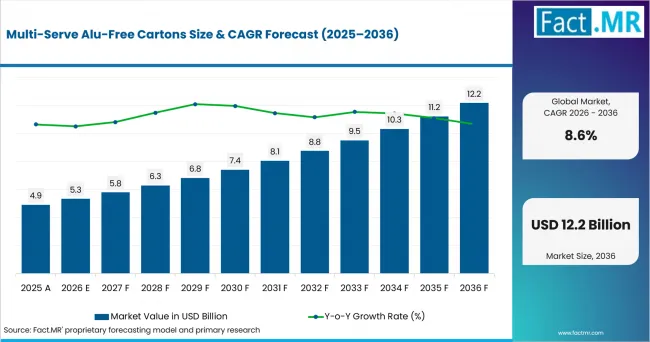
Multi Serve Alu Free Cartons Value Analysis | Source: Fact.MR
What are the defining numbers behind Multi-Serve Alu-Free Cartons Market growth?
An absolute opportunity of USD 6.8 billion is expected between 2026 and 2036.
- Demand Drivers in the Market
- Aseptic beverage fillers need full barrier protection for oxygen- and light-sensitive products in aluminum-free structures.
- Dairy processors need barrier changes that preserve filling-line productivity. Compatibility with installed aseptic equipment is expected to shorten qualification work and support wider use of multi-serve aluminum-free structures.
- Packaging engineers are working under tighter material-circularity rules. Regulation (EU) 2025/40 entered into force on 11 February 2025 and applies from 12 August 2026. The regulation requires all packaging to be recyclable from 2030, subject to the implementation timetable set out in Article 6. Design teams are expected to assess material composition alongside recycling pathways and food-contact performance. That combination can influence which barrier structures advance from testing into commercial runs.
- Key Segments Analyzed
- By Barrier Architecture: Polymer-coated paperboard is expected to hold 37.0% share in 2026 because it offers a practical route to fiber-rich structures while retaining sealability and moisture protection.
- By Pack Format: Aseptic beverage carton is projected to account for 33.0% share in 2026 as ambient dairy, juice, nectar, and plant-based beverages require long shelf life in multi-serve formats.
- By Barrier Requirement: Oxygen + light is anticipated to capture 34.0% share in 2026 since sensitive beverages need protection from oxidation and light-driven quality loss.
- By End-use: Dairy / alternatives is estimated to represent 31.0% share in 2026 owing to the established use of carton filling systems for milk and plant-based beverages.
- Analyst Opinion at Fact.MR
- Shambhu Nath Jha, Principal Consultant at Fact.MR, states, “The commercial test for aluminum-free cartons starts with barrier performance and filling-line fit. Brand owners are expected to favor materials that preserve shelf life while keeping conversion work manageable. Suppliers that combine product-protection evidence with line compatibility and recycling clarity are positioned for broader qualification.”
- Strategic Implications
- Carton-system suppliers should validate oxygen and light performance by product category before extending an aluminum-free structure across a wider beverage portfolio. Comparable design work in recyclable packaging is expected to raise demand for clearer qualification evidence. Comparable qualification priorities appear in design-for-recycling packaging programs. Qualification plans should link shelf-life data to the actual filling format and storage condition. That gives beverage producers a clearer basis for moving from pilot packs to recurring production.
- Converters should make sealing windows and filling-line adaptation requirements transparent so processors can compare process changes before approving aluminum-free barrier structures. Clear line-setting guidance is expected to reduce uncertainty during plant trials. It can also help engineering teams compare material options on a consistent operating basis.
- Paperboard and coating suppliers should document food-contact performance and fiber recovery behavior. Barrier simplification is increasingly assessed alongside coating function and recycling compatibility. Similar evidence requirements shape paper barrier coatings selection. Technical documentation should explain how the barrier performs after converting and filling. Recycling compatibility should be assessed at the same time so brands can evaluate package design as a complete system.
- Brand owners should prioritize pack formats that preserve shelf life and line efficiency during one-liter and family-size conversions. This is expected to keep barrier performance central to material selection. Family-size adoption is expected to depend on a balance between material reduction and product protection. Stable package handling can support broader use across retail beverage channels.
China is forecast to record 10.0% CAGR through 2036 as liquid-food volumes and updated paper-based food-packaging standards support wider qualification activity. The USA is projected to post 9.5% as beverage and dairy brands assess lower-material barrier formats under food-contact requirements. Germany is anticipated to advance at 9.3% under EU recyclability rules and active one-liter aluminum-free carton commercialization. France is estimated to register 8.8% as packaged food and beverage spending sustains carton demand while PPWR implementation raises design expectations. Japan is forecast to reach 7.6% as household consumption and established container-recycling systems support measured adoption.
How does the Multi-Serve Alu-Free Cartons Market break down by segment?
Polymer-coated paperboard leads Barrier Architecture at 37.0%; aseptic beverage carton leads Pack Format at 33.0%.
Which Barrier Architecture dominates?
Polymer-coated paperboard is expected to hold 37.0% share in 2026.
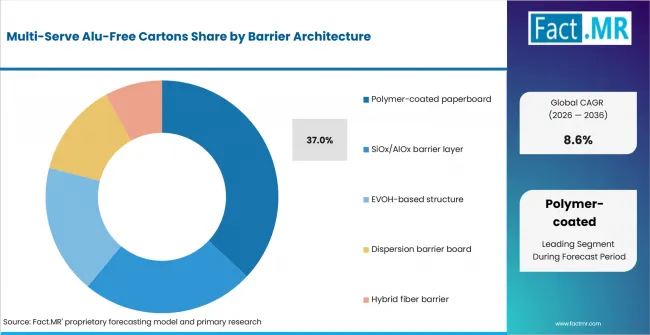
Multi Serve Alu Free Cartons Analysis By Barrier Architecture | Source: Fact.MR
Polymer-coated paperboard is expected to lead because paperboard supplies stiffness while thin functional layers provide sealing and moisture resistance. China published GB/T 36392-2025 on June 30, 2025 for coated paper and board used in food packaging. The standard took effect on January 1, 2026 and establishes current requirements and test methods for coated paper and board used in food-packaging applications. The substrate direction also aligns with broader paper packaging materials development. Its commercial position is strengthened when converters can use familiar paperboard handling processes. Barrier chemistry then becomes the main area for product-specific qualification.
What leads the Pack Format segment?
Aseptic beverage carton is projected to account for 33.0% share in 2026.
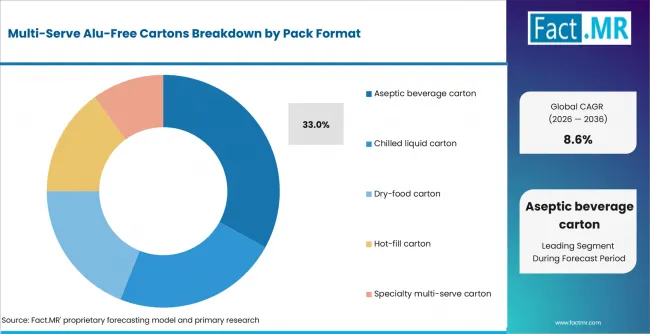
Multi Serve Alu Free Cartons Analysis By Pack Format | Source: Fact.MR
Aseptic beverage cartons are projected to lead because ambient drinks need long shelf life with stable barrier performance. Multi-serve dairy and juice applications favor formats that combine product protection with high-speed filling. Chilled liquid cartons serve refrigerated products while hot-fill and specialty cartons address different processing conditions. The format overlaps with ready-to-drink packaging where shelf stability and filling efficiency remain central. Multi-serve aseptic formats are expected to benefit from established filling infrastructure and retail acceptance. Their larger pack sizes also make material efficiency more visible to brand owners.
How does Barrier Requirement shape demand?
Oxygen + light is anticipated to capture 34.0% share in 2026.
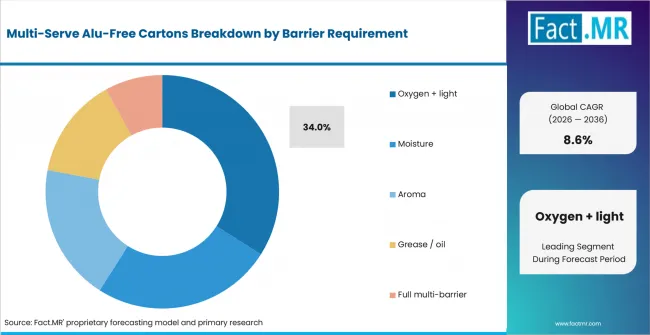
Multi Serve Alu Free Cartons Analysis By Barrier Requirement | Source: Fact.MR
Oxygen and light protection is anticipated to lead because sensitive beverages require stable barrier performance across storage and distribution. The requirement is especially relevant for juice, nectar, flavored milk, and plant-based beverages where exposure can alter product quality. These requirements are common across non-alcoholic beverage packaging formats for ambient beverages. Barrier selection is expected to vary with product sensitivity and target shelf life. Strong oxygen control remains especially relevant where flavor or nutrient quality can change during storage.
What supports Dairy / alternatives within End-use?
Dairy / alternatives is estimated to represent 31.0% share in 2026.
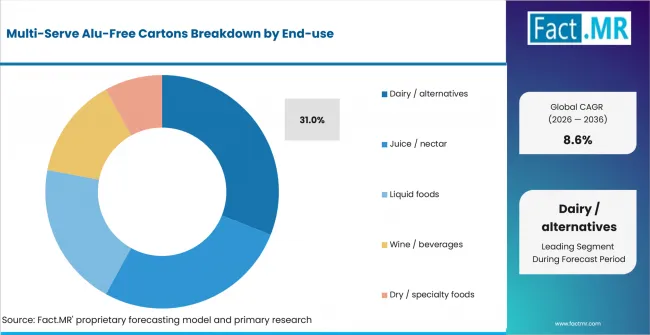
Multi Serve Alu Free Cartons Analysis By End Use | Source: Fact.MR
Dairy and alternative beverages are estimated to lead because carton filling is established across ambient milk and plant-based drinks. Multi-serve cartons support family-size formats where shelf stability and line efficiency remain important. Juice, nectar, liquid foods, wine, and specialty foods form additional end-use groups. The segment benefits from recurring household consumption and familiar family-size formats. Aluminum-free conversion is expected to progress where processors can preserve sealing reliability and storage performance.
What is accelerating Multi-Serve Alu-Free Cartons Market adoption, and what is holding it back?
Barrier simplification supports adoption; qualification requirements and recycling-system variation shape the pace of conversion.
Drivers Impact Analysis
| DRIVER | (~) % IMPACT ON CAGR | GEOGRAPHIC RELEVANCE | IMPACT TIMELINE |
|---|---|---|---|
| Aluminum-free full-barrier commercialization | +1.5% | Europe, East Asia | Short term (<= 2 years) |
| Installed filling-line compatibility | +1.2% | Global | Medium term (2-4 years) |
| Packaging recyclability requirements | +1.0% | Europe, North America | Medium term (2-4 years) |
| Ambient dairy and juice distribution | +0.8% | Global | Long term (>= 4 years) |
Source: Fact.MR analysis. Updated Sep 21, 2026
Opportunity Impact Analysis
| OPPORTUNITY | (~) % IMPACT ON CAGR | GEOGRAPHIC RELEVANCE | IMPACT TIMELINE |
|---|---|---|---|
| One-liter and family-size conversion | +1.1% | Europe, China | Short term (<= 2 years) |
| Paper-based barrier qualification | +0.9% | Europe, East Asia | Medium term (2-4 years) |
| Higher-fiber carton structures | +0.7% | Global | Long term (>= 4 years) |
Source: Fact.MR analysis. Updated Sep 21, 2026
Restraints Impact Analysis
| RESTRAINT | (~) % IMPACT ON CAGR | GEOGRAPHIC RELEVANCE | IMPACT TIMELINE |
|---|---|---|---|
| Product-specific barrier validation | -0.6% | Global | Short term (<= 2 years) |
| Filling-line sealing adaptation | -0.5% | Global | Medium term (2-4 years) |
| Uneven carton collection and recycling | -0.4% | Global | Long term (>= 4 years) |
Source: Fact.MR analysis. Updated Sep 21, 2026
Which countries are scaling Multi-Serve Alu-Free Cartons Market through 2036?
- The country comparison spans 2.4 percentage points across the forecast period.
- China remains 0.5 percentage point above the USA as liquid-food scale and updated paper-based packaging standards support qualification activity.
- The USA remains 0.2 percentage point above Germany as large packaged-food channels support multi-serve carton volumes.
- Germany remains 0.5 percentage point above France as beverage production and EU packaging rules shape barrier conversion programs.
- France remains 1.2 percentage points above Japan as packaged-food spending supports continued carton use.
- Japan closes the displayed range as established household spending and container-recycling systems support measured qualification.
Comparable CAGRs can create different entry conditions because liquid-food scale, filling-line compatibility, packaging regulation, and recycling systems vary by country. Full report coverage includes North America, Latin America, Western Europe, Eastern Europe, East Asia, South Asia & Pacific, Middle East & Africa.
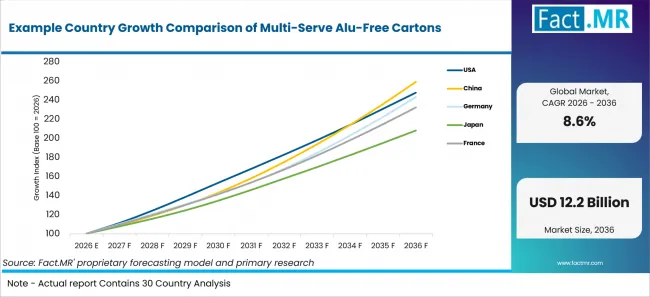
Example Country Growth Comparison Of Multi Serve Alu Free Cartons | Source: Fact.MR
| Country | CAGR (2026-2036) |
|---|---|
| China | 10.0% |
| United States | 9.5% |
| Germany | 9.3% |
| France | 8.8% |
| Japan | 7.6% |
Source: Fact.MR analysis. Updated Sep 21, 2026
What supports China adoption?
10.0% CAGR, supported by liquid-food scale and updated paper-based packaging standards.
China combines a large dairy-processing base with updated paper packaging requirements. The National Bureau of Statistics reported on 28 February 2026 that milk output reached 40.91 million tonnes in 2025, up 0.3% from 2024. Multi-serve aluminum-free cartons are expected to gain attention where processors want shelf-stable formats that pair fiber-rich structures with established aseptic filling. The country is forecast to record 10.0% CAGR through 2036 as suppliers align barrier performance with current food-packaging standards.
What supports USA adoption?
9.5% CAGR, supported by large packaged-food channels and barrier qualification activity.
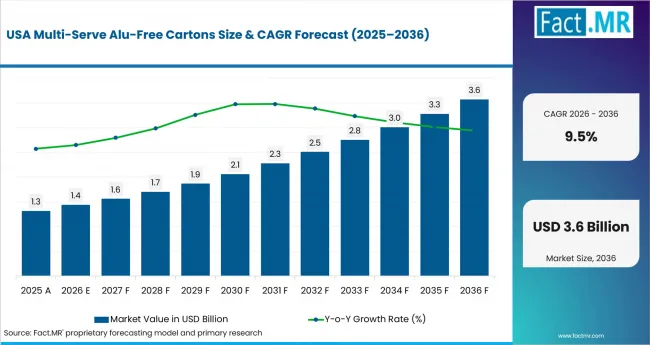
Multi Serve Alu Free Cartons Country Value Analysis | Source: Fact.MR
The USA offers a large packaged-food retail base for beverage and dairy formats. The U.S. Census Bureau reported on 3 September 2026 that food and beverage stores generated an estimated USD 982.2 billion in 2024 revenue. Multi-serve aluminum-free cartons are projected to benefit where brands seek lower-material barrier structures while preserving shelf life and filling efficiency. The country is forecast to record 9.5% CAGR through 2036 as qualification expands across high-volume liquid-food applications.
What supports Germany adoption?
9.3% CAGR, supported by beverage production and EU packaging-design requirements.
Germany combines established beverage production with a regulatory environment focused on packaging recyclability. Destatis reported on 30 March 2026 that German wine and must production reached 7.55 million hectoliters in 2025. Multi-serve aluminum-free cartons are anticipated to attract use where producers value lightweight family-size formats and documented barrier performance. Germany is projected to record 9.3% CAGR through 2036 as suppliers connect material simplification with line-compatible aseptic conversion.
What supports France adoption?
8.8% CAGR, supported by packaged-food spending and fiber-based packaging conversion.
France has a broad food and beverage consumption base that supports carton use across dairy, juice, and other liquid foods. INSEE reported on 16 June 2026 that household spending on food and non-alcoholic beverages reached EUR 192.8 billion in 2025. Aluminum-free multi-serve cartons are expected to gain relevance where brands seek fiber-rich primary packaging with verified shelf-life performance. France is forecast to record 8.8% CAGR through 2036 as barrier qualification broadens across packaged beverage applications. Related sustainable food packaging trends reinforce the focus on recyclable primary formats.
How does Japan perform?
7.6% CAGR, supported by household spending and established container-recycling systems.
Japan combines steady household spending with mature packaged-food distribution. The Statistics Bureau reported on 6 February 2026 that average monthly consumption expenditure for two-or-more-person households reached JPY 314,001 in 2025, up 4.6% in nominal terms. Multi-serve aluminum-free cartons are estimated to progress where beverage producers can match barrier protection with high-speed filling requirements. Japan is forecast to record 7.6% CAGR through 2036 as qualification advances across dairy and beverage formats.
Who leads the Multi-Serve Alu-Free Cartons Market?
SIG and Elopak have directly documented aluminum-free aseptic-carton solutions in multi-serve sizes. SIG commercialized SIG Terra Alu-free + Full barrier in a 1-liter aseptic carton format in 2025, providing full barrier protection without an aluminum layer. Elopak’s Pure-Pak® eSense is also an aluminum-free aseptic carton and is available in fill sizes from 500 ml to 2,000 ml. Tetra Pak has separately advanced paper-based aseptic-barrier technology. In December 2025, the company launched a Tetra Brik® Aseptic 200 ml Slim Leaf juice carton whose paper-based barrier replaces the traditional aluminum-foil layer. The commercial launch, however, is a 200 ml portion format rather than a multi-serve format.
Competitive development in this category is likely to focus on barrier performance, compatibility with commercial filling equipment, food-contact requirements and increasing the fiber share of packaging structures while maintaining the required shelf life. Multi-serve applications also place importance on dependable sealing and barrier protection throughout distribution and storage. Paperboard, coating and converting capabilities can support further development as beverage brands evaluate structures with higher renewable-material content and simplified material combinations.
Adjacent folding carton packaging technologies provide a useful reference for paperboard conversion and converting performance, while fresh food packaging provides an adjacent reference for food-contact packaging requirements. Commercial differentiation is likely to depend on the ability to transfer new barrier structures from development trials to established filling operations while maintaining package integrity and shelf-life requirements. Technical support during material and line qualification can also help converters and beverage producers evaluate new aseptic-carton structures.
Which companies are the key providers?
Key companies include SIG; Tetra Pak; and Elopak.
- SIG
- Tetra Pak
- Elopak
Bibliography
- Tetra Pak. (2025, December 10). Tetra Pak launches world-first paper-based barrier for juice packaging with García Carrión and advances new packaging material development.
- European Commission, Directorate-General for Environment. (2025, February 11). New rules enter into force for a more sustainable and competitive packaging economy.
- SIG. (2025, July 14). Now on shelves: SIG launches world's first aseptic 1-liter carton pack offering full barrier protection without an aluminum layer.
- State Administration for Market Regulation, & Standardization Administration of China. (2025, June 30). GB/T 36392-2025: Coated paper and board for food packaging.
- National Bureau of Statistics of China. (2026, February 28). Statistical communiqué of the People’s Republic of China on the 2025 national economic and social development.
- U.S. Census Bureau. (2026, September 3). Census Bureau releases new Annual Integrated Economic Survey data.
- Statistisches Bundesamt (Destatis). (2026, March 30). Weinerzeugung 2025: Rückgang um 2,6 % auf 7,55 Millionen Hektoliter.
- Beretti, P.-A., & Pereira, É. (2026, June 16). Household consumption in 2025: Household consumption slowed despite a sharp deceleration in prices. Insee Première, (2110).
- Statistics Bureau, Ministry of Internal Affairs and Communications. (2026, February 6). 2025 yearly average.
This Report Answers
- The report explains where multi-serve aluminum-free cartons are used across barrier architecture and pack format. It also covers barrier requirements and end-use applications across liquid-food packaging.
- Segment analysis identifies the leading subsegments and explains the barrier, filling-line and product-protection requirements supporting their adoption.
- Country analysis examines the listed markets and the packaging regulations, liquid-food demand, recycling systems and filling infrastructure influencing aluminum-free carton qualification.
- Competitive analysis reviews current providers across aluminum-free aseptic cartons, paper-based barrier systems and liquid-packaging board. It also covers adjacent fiber-based barrier capabilities relevant to multi-serve carton development.
- Application analysis assesses how oxygen and light protection, moisture control and sealing performance influence material selection. It also considers filling-line compatibility, shelf-life requirements and recyclability across dairy, juice, liquid foods, beverages and specialty-food applications.
What does the Multi-Serve Alu-Free Cartons Market cover?
The Multi-Serve Alu-Free Cartons Market covers multi-serve carton systems that replace the conventional aluminum foil layer with alternative barrier structures while preserving the protection required for food and beverage distribution. The assessment covers paperboard-based constructions and functional barrier layers used in ambient or chilled multi-serve formats.
The assessment covers polymer-coated paperboard, SiOx/AlOx barrier layers, EVOH-based structures, dispersion barrier board, and hybrid fiber barriers. Demand is assessed across aseptic beverage cartons, chilled liquid cartons, dry-food cartons, hot-fill cartons, and specialty multi-serve formats.
What is included in the scope?
Included formats cover aseptic and chilled liquid cartons, dry-food cartons, hot-fill cartons, and specialty multi-serve cartons where aluminum-free barrier design is central to the package.
End-use analysis covers dairy and alternatives, juice and nectar, liquid foods, wine and beverages, and dry specialty foods.
What is excluded from the scope?
Outside the scope are conventional cartons with a standard aluminum foil layer, bottles, cans, glass, flexible pouches, bag-in-box formats, and secondary corrugated cases.
Single-serve cartons enter the assessment only where the same barrier platform is deployed in multi-serve formats. Flexible, edible, and compostable packaging remain outside the assessed market boundary.
How Was the Analysis Built?
The analysis draws on 120+ sources, 35+ company portfolios, 25+ countries, and more than 20 industry interviews.
- Primary Research: Primary research includes discussions with manufacturers, service providers, technology developers, distributors, end users, and subject-matter experts. These conversations examine purchasing priorities, product adoption, operational challenges, approval requirements, competitive positioning, and the factors that influence wider market acceptance.
- Desk Research: Desk research covers government statistics, regulatory publications, company filings, trade data, technical studies, industry associations, standards, public policy, and other authoritative sources. Every source used in the analysis is documented in the bibliography.
- Market Sizing and Forecasting: Market estimates combine historical performance, demand indicators, pricing and volume trends, segment shares, company participation, country-level growth, adoption patterns, investment activity, and barriers to market expansion.
- Data Validation and Update Cycle: Findings are validated by comparing primary interviews with public data, company activity, regulatory changes, trade patterns, and industry developments. Regular updates review new product launches, capacity changes, partnerships, approvals, and shifts in commercial adoption.
Segmentation
What is the report’s scope and coverage?
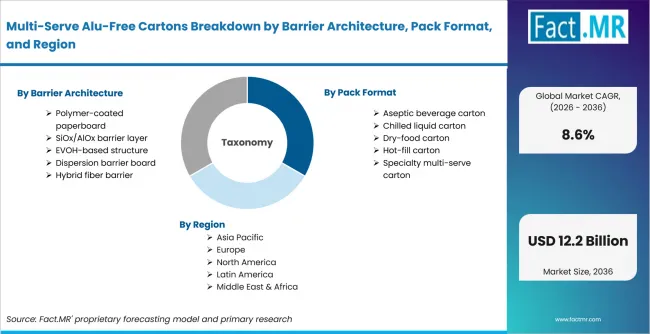
Multi Serve Alu Free Cartons Breakdown By Barrier Architecture, Pack Format, And Region | Source: Fact.MR
| Attribute | Details |
|---|---|
| Quantitative Units | USD billion |
| Market Definition | Multi-serve cartons for beverages, dairy, liquid foods, wine, and selected dry foods that use barrier structures without a conventional aluminum foil layer. |
| Barrier Architecture | Polymer-coated paperboard; SiOx/AlOx barrier layer; EVOH-based structure; Dispersion barrier board; Hybrid fiber barrier |
| Pack Format | Aseptic beverage carton; Chilled liquid carton; Dry-food carton; Hot-fill carton; Specialty multi-serve carton |
| Barrier Requirement | Oxygen + light; Moisture; Aroma; Grease / oil; Full multi-barrier |
| End-use | Dairy / alternatives; Juice / nectar; Liquid foods; Wine / beverages; Dry / specialty foods |
| Regions Covered | North America; Latin America; Western Europe; Eastern Europe; East Asia; South Asia & Pacific; Middle East & Africa |
| Countries Covered | United States; China; Germany; Japan; France |
| Key Companies Profiled | SIG; Tetra Pak; Elopak |
| Forecast Period | 2026 to 2036 |
| Approach | Hybrid top-down and bottom-up approach using carton system portfolios, barrier-material qualification, liquid-food application demand, country regulation, and provider activity review. |
Source: Fact.MR analysis. Updated Sep 21, 2026
How is the market segmented?
-
By Barrier Architecture
- Polymer-coated paperboard
- SiOx/AlOx barrier layer
- EVOH-based structure
- Dispersion barrier board
- Hybrid fiber barrier
-
By Pack Format
- Aseptic beverage carton
- Chilled liquid carton
- Dry-food carton
- Hot-fill carton
- Specialty multi-serve carton
-
By Barrier Requirement
- Oxygen + light
- Moisture
- Aroma
- Grease / oil
- Full multi-barrier
-
By End-use
- Dairy / alternatives
- Juice / nectar
- Liquid foods
- Wine / beverages
- Dry / specialty foods
-
By Region
- North America
- Latin America
- Western Europe
- Eastern Europe
- East Asia
- South Asia & Pacific
- Middle East & Africa
Frequently Asked Questions
How big is the Multi-Serve Alu-Free Cartons Market in 2026?
What is the CAGR of the Multi-Serve Alu-Free Cartons Market from 2026 to 2036?
Which Barrier Architecture leads the market?
Which Barrier Requirement leads the market?
Which companies are profiled in the Multi-Serve Alu-Free Cartons Market?
Who worked on this report


Preview the report firsthand - request a free sample
Free SampleGet the brochure for pricing and purchase details
Download PDF