- Market Value (2025): USD 8.66 Bn
- Estimated Value (2026): USD 9.11 Bn
- Forecast Value (2036): USD 15.1 Bn
- CAGR (2026-2036): 5.1%
What is the Stationary Gas Generator Market forecast to be worth by 2036?
USD 9.11 billion in 2026 to USD 15.1 billion by 2036 at a 5.1% CAGR.
- At USD 8.66 billion in 2025, the stationary gas generator market rested on factory backup systems, commercial standby units and a growing base of prime power projects.
- Revenue will expand from USD 9.11 billion in 2026 to USD 15.1 billion by 2036 as more sites move from grid-only supply to a mix of grid power and onsite gas generation.
- A 5.1% CAGR reflects steady replacement of aging diesel fleets with gas units, alongside new capacity for data centers and process plants.
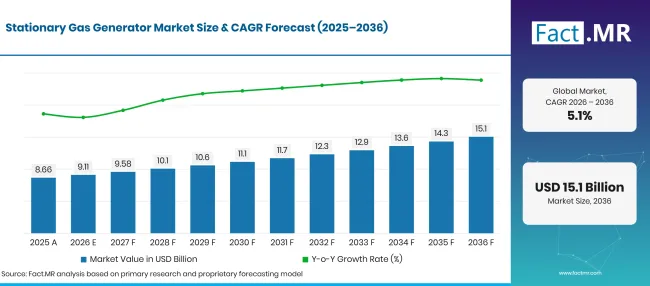
Stationary Gas Generator Market Forecast Global | Source: Fact.MR
| Year | Basis | Market Value (USD billion) |
|---|---|---|
| 2025 | Actual | 8.66 |
| 2026 | Estimate | 9.11 |
| 2036 | Forecast | 15.1 |
| CAGR 2026 to 2036 | Forecast period | 5.1% |
Source: Fact.MR analysis. Updated Nov 4, 2026
What are the defining numbers behind Stationary Gas Generator Market growth?
The 2026 to 2036 period will add USD 5.9 billion in new value, led by gas sets that protect manufacturing loads and critical buildings.
- Demand Drivers in the Market
- Gas already carries the power system in the United States, where natural gas produced about 40% of electricity in 2025 [1]. This depth of pipeline supply makes gas the default fuel for many new standby and prime power units.
- Biogas creates a second fuel stream for onsite generation. EPA AgSTAR counted 400 operating manure digester projects as of June 2024, with 82 producing electricity only and 109 running combined heat and power [2]. Each of these sites needs a gas engine able to handle variable fuel quality.
- New data centers and chip plants are lifting power demand in Japan, a trend the Agency for Natural Resources and Energy ties to digital transformation [3]. Operators of these sites want backup that starts fast and runs for long periods.
- Grid operators in several countries now plan for more controllable capacity as solar and wind shares grow. Gas sets that can start in minutes fit this role better than slow thermal units.
- Key Segments Analyzed
- By Fuel Type: Natural Gas will hold 42.3% share in 2026, as pipeline-fed units avoid the storage, testing and refuelling work that diesel tanks require.
- By Power Rating: Below 100 kW will account for 33.3% of 2026 revenue since small shops, clinics and homes need compact backup for a few essential circuits.
- By Application: Industrial will capture 43.4% in 2026, given that process lines lose output and material when power drops.
- By End-User: Manufacturing will represent 39.2% of 2026 value because factories run machines, controls and cooling that cannot restart cleanly after an outage.
- Analyst Opinion at Fact.MR
- Shambhu Nath Jha, Principal Consultant at Fact.MR, states, “Buyers will treat gas generators less as emergency insurance and more as working assets that earn their place through fuel savings and grid support. Suppliers that can deliver fast-start gas sets with clean emissions paperwork will win the specifications written by factory and data center owners. Pipeline access and local permit rules will shape where that demand shows up first.”
- Strategic Implications
- Manufacturers should build gas sets that start quickly and accept large load steps, since data center and factory buyers now test for both before approving a model.
- Distributors should pair equipment sales with permit support and long-term service plans, as emissions paperwork often delays installation more than delivery lead times.
- Facility owners should size units against the loads that truly need protection and check pipeline pressure before choosing gas over diesel.
- Investors should track biogas and behind-the-meter power projects, where long operating hours turn generators into revenue assets.
Germany leads the country set at 6.1%, as its regulator calls for new controllable capacity to back a grid with a rising renewable share. Brazil follows at 5.6%, with industrial self-generation and biogas giving onsite gas units a wide base. The United States, at 5.0%, trails Brazil by 0.6 points because a large installed fleet means more of its demand comes from replacement. Strong network reliability holds the United Kingdom to 4.5%, so backup buyers there focus on critical sites. Japan closes the group at 4.0%, where a mature market grows mainly through data center and chip plant projects.
How does the Stationary Gas Generator Market break down by segment?
Natural Gas will lead Fuel Type at 42.3%; Below 100 kW will head Power Rating at 33.3%; Industrial will take Application at 43.4%; Manufacturing will hold End-User at 39.2% in 2026.
Which Fuel Type leads?
Natural Gas holds 42.3% of 2026 sales.
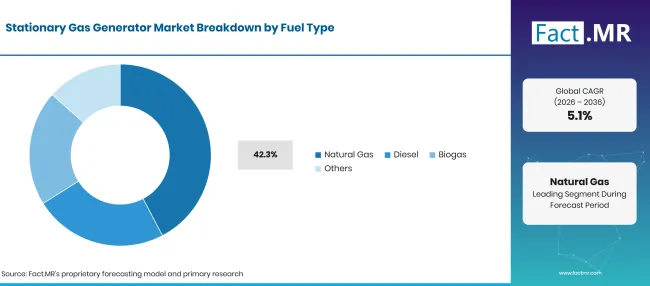
Stationary Gas Generator Market Breakdown Fuel Type | Source: Fact.MR
| Fuel Type | Share (2026) |
|---|---|
| Natural Gas (Leading segment) | 42.3% |
| Other segments combined | 57.7%* |
| Total | 100.0% |
Source: Fact.MR analysis. Updated Nov 4, 2026
Facility managers who already have a pipeline connection can run a gas set for days without arranging fuel trucks. Industrial customers used 60% of the 864 TWh of natural gas consumed in Germany in 2025, which shows how far gas networks already reach into factory sites [4]. Gas engines also avoid the fuel decay and tank testing that diesel storage requires. Diesel stays relevant where gas lines do not reach or where codes require stored fuel onsite. Biogas units serve farms, wastewater plants and landfill gas sites that turn waste into power. Others include propane and bi-fuel designs, and some buyers compare these with tri-fuel generator sets for flexibility.
What supports Below 100 kW within Power Rating?
Below 100 kW takes 33.3% of 2026 revenue.
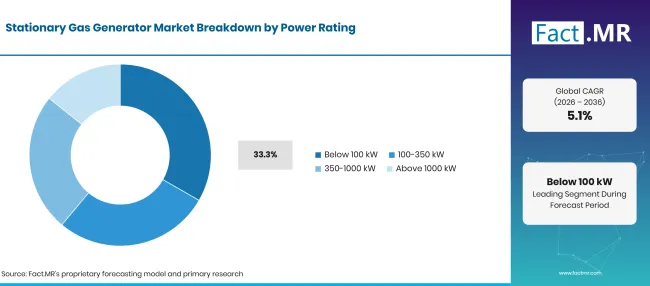
Stationary Gas Generator Market Breakdown Power Rating | Source: Fact.MR
| Power Rating | Share (2026) |
|---|---|
| Below 100 kW (Leading segment) | 33.3% |
| Other segments combined | 66.7%* |
| Total | 100.0% |
Source: Fact.MR analysis. Updated Nov 4, 2026
Small commercial buildings, clinics and homes usually protect lighting, refrigeration, network equipment and a few pumps. Compact units fit on a pad outside the building and connect to the existing gas meter. Installers can complete these jobs in days, which keeps project costs low and widens the buyer base. The 100 to 350 kW class serves schools, retail centers and mid-size plants. Units from 350 to 1,000 kW and above 1,000 kW go to hospitals, data centers and process sites, often in parallel sets. Buyers at the top end weigh gas engines against the large generators used in central plants.
How does Application shape demand?
Industrial represents 43.4% of 2026 value.
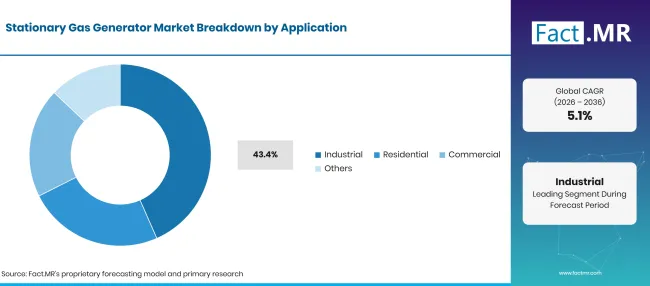
Stationary Gas Generator Market Breakdown Application | Source: Fact.MR
| Application | Share (2026) |
|---|---|
| Industrial (Leading segment) | 43.4% |
| Other segments combined | 56.6%* |
| Total | 100.0% |
Source: Fact.MR analysis. Updated Nov 4, 2026
A power cut on a production line can scrap material in process and damage motors on restart. Plant engineers therefore specify generators that carry critical loads until the grid returns or until operators shut down safely. Many sites now run gas sets during peak tariff periods as well, which spreads the cost over more operating hours. Commercial buyers include offices, retail, hotels and data centers that need continuity for tenants and servers. Residential demand comes from homeowners seeking automatic standby, a space where units compete with the portable inverter generators some households still prefer. Others cover telecom sites and public buildings.
What leads the End-User segment?
Manufacturing commands 39.2% of 2026 sales.
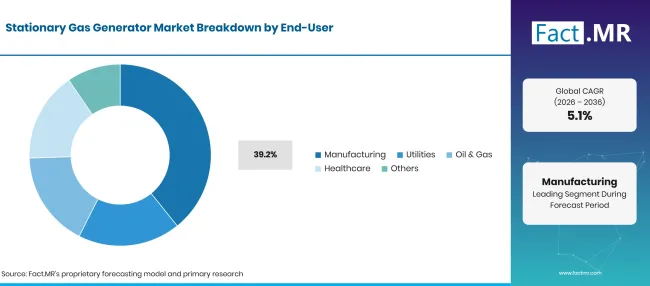
Stationary Gas Generator Market Breakdown End User | Source: Fact.MR
| End-User | Share (2026) |
|---|---|
| Manufacturing (Leading segment) | 39.2% |
| Other segments combined | 60.8%* |
| Total | 100.0% |
Source: Fact.MR analysis. Updated Nov 4, 2026
Food, chemical, metal and paper plants depend on constant power for motors, process heat controls and cooling. Even short outages can force cleaning cycles or batch losses that cost more than the generator itself. This is why factory buyers often choose prime-rated gas sets that can run for long periods. Utilities use gas units for peaking support and grid stability at distribution level. Oil and gas operators power compressors and remote sites, often burning field gas. Healthcare facilities need standby supply for theatres and life-support equipment under strict codes. Others include commercial property owners, telecom operators and public agencies.
What is accelerating Stationary Gas Generator Market adoption, and what is holding it back?
Pipeline gas access, rising power use at data centers and factories, and grid operators seeking flexible capacity are pushing sales upward. Biogas projects add a further fuel source. On the other side, high upfront cost, gas price swings and emissions permits slow decisions, while battery storage now competes for short-duration backup.
Drivers Impact Analysis
| DRIVER | (~) % IMPACT ON CAGR | GEOGRAPHIC RELEVANCE | IMPACT TIMELINE |
| Increasing backup electricity requirements across industrial facilities | +1.4% | Global | Short term (<=2 years) |
| Expansion of manufacturing and commercial infrastructure | +1.0% | Asia Pacific, Europe, North America | Medium term (2-4 years) |
| Wider installation of natural gas-based stationary generation systems | +0.8% | North America, Europe, Asia Pacific | Medium term (2-4 years) |
| Greater emphasis on electricity reliability and onsite generation | +0.6% | Global | Long term (>=4 years) |
Source: Fact.MR analysis. Updated Nov 4, 2026
Opportunity Impact Analysis
| OPPORTUNITY | (~) % IMPACT ON CAGR | GEOGRAPHIC RELEVANCE | IMPACT TIMELINE |
| Development of high-efficiency natural gas generator systems | +0.8% | Global | Short term (<=2 years) |
| Expansion of generator installations across critical infrastructure | +0.7% | North America, Europe, Asia Pacific | Medium term (2-4 years) |
| Integration of biogas with stationary electricity generation | +0.5% | Europe, South America, Asia Pacific | Medium term (2-4 years) |
| Development of lower-emission generator technologies and advanced controls | +0.4% | Europe, North America, East Asia | Long term (>=4 years) |
Source: Fact.MR analysis. Updated Nov 4, 2026
Restraints Impact Analysis
| RESTRAINT | (~) % IMPACT ON CAGR | GEOGRAPHIC RELEVANCE | IMPACT TIMELINE |
| High initial installation and equipment costs | -0.6% | Global | Short term (<=2 years) |
| Natural gas price volatility and infrastructure limitations | -0.5% | Global | Short term (<=2 years) |
| Air-emission requirements for stationary combustion engines | -0.4% | North America, Europe, Asia Pacific | Medium term (2-4 years) |
| Competition from battery storage and alternative backup systems | -0.3% | Global | Long term (>=4 years) |
Source: Fact.MR analysis. Updated Nov 4, 2026
Which countries are scaling the Stationary Gas Generator Market through 2036?
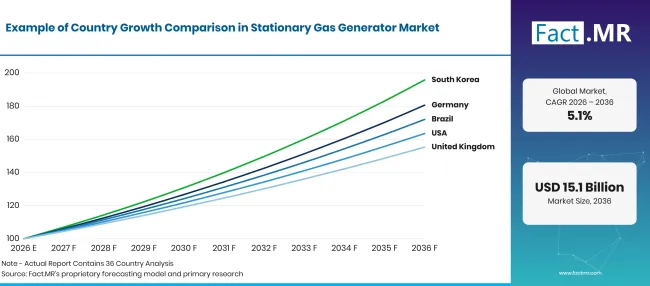
Stationary Gas Generator Market Growth Index | Source: Fact.MR
| Country | CAGR (2026 to 2036) |
|---|---|
| Germany | 6.1% |
| Brazil | 5.6% |
| United States | 5.0% |
| United Kingdom | 4.5% |
| Japan | 4.0% |
Source: Fact.MR analysis. Updated Nov 4, 2026
What supports stationary gas generator adoption in Germany?
6.1% CAGR, driven by a national push for new controllable power capacity.
The Federal Network Agency found in September 2025 that Germany will need about 22.4 GW of additional controllable capacity by 2035 to keep supply secure in its target scenario [5]. The agency also noted that investment in such capacity has so far fallen short. Gas imports reached 1,031 TWh in 2025 on preliminary figures, which keeps pipeline fuel available for onsite units at industrial parks [4].
How is Brazil developing demand?
5.6% CAGR, backed by strong industrial self-generation.
Brazil generated 775.9 TWh of electricity in 2025, up 3.3% on the prior year, and self-producers generated 22.7% of that total [6]. The same energy balance shows that 36.8% of natural gas consumed in 2025 went to power generation. Sugar mills, pulp plants and farms with organic waste give biogas units a further base outside the pipeline network.
What is supporting United States adoption?
5.0% CAGR, reflecting fleet replacement and data center construction.
The Environmental Protection Agency places natural gas engines in the spark ignition group under its stationary engine rules, updated in March 2026 [7]. Owners of most larger gas engines can either buy a certified unit or prove compliance through testing. These rules push buyers toward newer models with factory emissions certification. Behind-the-meter gas power for data centers in Texas and other states adds a fresh source of large orders.
How is the United Kingdom scaling demand?
4.5% CAGR, as critical sites add standby capacity.
The Department for Energy Security and Net Zero reported in December 2025 that electricity network reliability stayed above 99.9% in each year from 2021 to the 2024 to 2025 period [8]. The same report cited a derated winter margin of 6.1 GW for 2025 to 2026. High grid reliability limits mass backup buying, so demand centers on hospitals, data centers and process plants.
How does Japan perform?
4.0% CAGR, helped by power-hungry digital and chip projects.
The Cabinet approved the Seventh Strategic Energy Plan in February 2025, setting a 73% cut in greenhouse gas emissions by FY2040 from FY2013 levels [9]. Thermal sources still produced 67.5% of Japan’s electricity in FY2024, and the plan targets about 30 to 40% by FY2040 [10]. Gas generators that run cleaner than older thermal units will keep a place at data centers and fabs during this shift.
Who leads the Stationary Gas Generator Market?
The field splits into three groups. Engine-based generator specialists, Caterpillar, Cummins and Rolls-Royce Power Systems with its mtu brand, compete on fast start, fuel flexibility and dealer service for large prime and standby projects. Caterpillar and Wheeler agreed in August 2025 to supply G3520K generator sets for a Utah data center campus [11].
Rolls-Royce introduced fast-start mtu gas gensets for data centers in October 2025 [12]. Cummins agreed in June 2026 to supply natural gas generator sets for a Texas data center microgrid [13]. A second group, Generac and Rehlko, wins on dealer reach and packaged units for commercial and home buyers. GE Vernova and Mitsubishi Heavy Industries bring turbines and large gas engines to utility and industrial sites. Through 2036, the winners will be those who pair quick delivery with emissions compliance and service coverage close to the customer.
Which companies are the key providers?
Key companies in the Stationary Gas Generator Market include Caterpillar, Cummins, Generac, Rehlko, Rolls-Royce Power Systems, GE Vernova and Mitsubishi Heavy Industries.
- Caterpillar
- Cummins
- Generac
- Rehlko
- Rolls-Royce Power Systems
- GE Vernova
- Mitsubishi Heavy Industries
Bibliography
- [1] U.S. Energy Information Administration. (2026, January 16). Solar power generation drives electricity generation growth over the next two years.
- [2] U.S. Environmental Protection Agency. (2026, March 10). AgSTAR Data and Trends.
- [3] Agency for Natural Resources and Energy. (2025, August 22). A Detailed Outline of the Latest Strategic Energy Plan: Insights into Japan’s Energy in a Drastically Changing World (Part 1).
- [4] Bundesnetzagentur. (2026, January 12). Bundesnetzagentur publishes gas supply figures for 2025.
- [5] Bundesnetzagentur. (2025, September 3). Publication of security of supply monitoring.
- [6] Empresa de Pesquisa Energética. (2026, July 2). Análise Energética e Dados Agregados: Balanço Energético Nacional 2026.
- [7] U.S. Environmental Protection Agency. (2026, March 30). Compliance Requirements for Stationary Engines.
- [8] Department for Energy Security and Net Zero. (2025, December 17). Statutory security of supply report: 2025.
- [9] Ministry of Economy, Trade and Industry. (2025, February 18). Cabinet Decision on the Seventh Strategic Energy Plan.
- [10] Agency for Natural Resources and Energy. (2026, February). 10 Questions for Understanding the Current Energy Situation.
- [11] Caterpillar Inc. (2025, August 7). Joule, Caterpillar, and Wheeler Announce an Agreement to Power America’s Growing Data Center Energy Needs.
- [12] Rolls-Royce. (2025, October 2). Rolls-Royce introduces fast-start mtu gas gensets for powering data centers.
- [13] Cummins Inc. (2026, June 16). Cummins Natural Gas Generators to Power Large Scale Data Centers in West Texas
This Report Answers
- How is revenue split across fuel type, power rating, application and end-user?
- Why do pipeline gas units outsell diesel and biogas sets in fixed installations?
- Where do compact units below 100 kW win, and where do larger sets take over?
- What makes factories the biggest buyers of onsite gas power?
- How do Germany, Brazil, the United States, the United Kingdom and Japan differ in growth?
- Which suppliers compete in each power class, and what will decide orders through 2036?
What does the Stationary Gas Generator Market cover?
This study values fixed generator sets that burn natural gas, biogas, diesel or other fuels to supply standby, prime or continuous power at a single site. Values cover the engine or turbine, alternator, enclosure and controls sold as one package.
Revenue is counted at the manufacturer level in USD billion. Shares by fuel, rating, application and end-user are based on 2026 sales, and growth rates run from 2026 to 2036.
What is included in the scope?
Natural gas and biogas generator sets for standby, prime and continuous duty in factories, offices, hospitals, homes and utility sites are included.
Units across all power classes count, from compact home standby sets to multi-megawatt engines installed in parallel, including those compared with mainstream standby generator units.
Diesel and other fuel sets installed on fixed foundations are included as competing fuel options within the same buyer decision.
Factory-fitted controls, enclosures and transfer equipment shipped with the generator are included in the package value.
What is excluded from the scope?
Portable and towable generators, along with rental fleets, are excluded.
Utility-scale combined cycle plants and the electricity they sell are excluded.
Gas production, upgrading to pipeline-grade biomethane and fuel distribution are excluded.
Standalone battery storage, solar panels and general switchgear sold separately from a generator are excluded.
How Was the Analysis Built?
The analysis draws on 120+ sources, 35+ company portfolios, 25+ countries, and more than 20 industry interviews.
- Primary Research: Primary research includes discussions with manufacturers, service providers, technology developers, distributors, end users, and subject-matter experts. These conversations examine purchasing priorities, product adoption, operational challenges, approval requirements, competitive positioning, and the factors that influence wider market acceptance.
- Desk Research: Desk research covers government statistics, regulatory publications, company filings, trade data, technical studies, industry associations, standards, public policy, and other authoritative sources. Every source used in the analysis is documented in the bibliography.
- Market Sizing and Forecasting: Market estimates combine historical performance, demand indicators, pricing and volume trends, segment shares, company participation, country-level growth, adoption patterns, investment activity, and barriers to market expansion.
- Data Validation and Update Cycle: Findings are validated by comparing primary interviews with public data, company activity, regulatory changes, trade patterns, and industry developments. Regular updates review new product launches, capacity changes, partnerships, approvals, and shifts in commercial adoption.
Segmentation
What is the report’s scope and coverage?
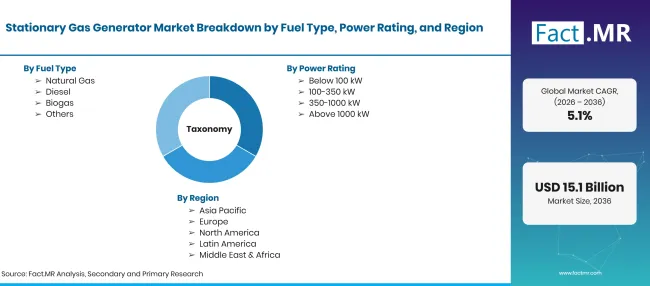
Stationary Gas Generator Market Taxonomy | Source: Fact.MR
| Attribute | Details |
|---|---|
| Quantitative Units | USD billion |
| Market Definition | Fixed-installation generator sets running mainly on natural gas, biogas or other fuels, used for standby, prime and continuous onsite power. |
| Fuel Type | Natural Gas; Diesel; Biogas; Others |
| Power Rating | Below 100 kW; 100 to 350 kW; 350 to 1,000 kW; Above 1,000 kW |
| Application | Industrial; Residential; Commercial; Others |
| End-User | Manufacturing; Utilities; Oil & Gas; Healthcare; Others |
| Regions Covered | North America; Latin America; Western Europe; Eastern Europe; East Asia; South Asia & Pacific; Middle East & Africa |
| Countries Covered | Germany; Brazil; United States; United Kingdom; Japan |
| Companies Profiled | Caterpillar; Cummins; Generac; Rehlko; Rolls-Royce Power Systems; GE Vernova; Mitsubishi Heavy Industries |
| Forecast Period | 2026 to 2036 |
| Approach | Unit shipments by power rating multiplied by average selling prices, checked against supplier order books and energy statistics in each country. |
Source: Fact.MR analysis. Updated Nov 4, 2026
How is the market segmented?
-
By Fuel Type
- Natural Gas
- Diesel
- Biogas
- Others
-
By Power Rating
- Below 100 kW
- 100 to 350 kW
- 350 to 1,000 kW
- Above 1,000 kW
-
By Application
- Industrial
- Residential
- Commercial
- Others
-
By End-User
- Manufacturing
- Utilities
- Oil & Gas
- Healthcare
- Others
-
By Region
- North America
- Latin America
- Western Europe
- Eastern Europe
- East Asia
- South Asia & Pacific
- Middle East & Africa
Frequently Asked Questions
How large is the stationary gas generator market in 2026?
What growth rate will the stationary gas generator market record?
Which fuel type leads?
Which power rating leads?
Which application leads?
Which end-user leads?
Which country will grow quickest?
Who are the main companies?
What holds the market back?
Who worked on this report


Preview the report firsthand - request a free sample
Free SampleGet the brochure for pricing and purchase details
Download PDF