- Base Value(2025): 1.3 Bn
- Estimated Value(2026): 1.4 Bn
- Forecast Value (2036): 3.5 Bn
- CAGR (2026 - 2036): 9.5%
Magnetic Stripe Readers Market Forecast 2026 to 2036
In 2025, the magnetic stripe readers market was valued at USD 1.3 billion. Based on Fact MR analysis, demand for magnetic stripe readers is estimated to grow to USD 1.4 billion in 2026 and USD 3.5 billion by 2036. FMR projects a CAGR of 9.5% during the forecast period.
The absolute dollar growth from 2026 to 2036 is USD 2.1 billion. This growth is driven by the increasing adoption of magnetic stripe readers in industries such as retail, transportation, and financial services, where quick and secure payment processing is critical. As businesses continue to upgrade their point-of-sale (POS) systems and move towards more efficient payment methods, the demand for magnetic stripe readers remains strong. However, challenges such as competition from more advanced technologies, like chip-based readers and mobile payment systems, could influence market dynamics in certain regions.
As Daniel Heffernan, Product Lead of Stripe Japan at Stripe, noted regarding hardware payment solutions (which include magnetic stripe readers) and enhancing the payment experience globally, ‘Through this collaboration, Stripe is proud to support NEC’s world‑renowned face recognition technology, enabling its use for payments through our unified commerce solution, Stripe Terminal.’
China leads with a CAGR of 12.8%, driven by rapid digital payment adoption and expanding retail infrastructure. India follows with 11.9%, supported by a growing shift towards digital payments in the retail and financial sectors. Germany grows at 10.9%, benefiting from strong demand for secure payment solutions in the European market. Brazil shows growth at 10.0%, fueled by the increasing use of electronic payments in various industries. The United States grows at 9.0%, reflecting steady demand for magnetic stripe readers in the retail and service sectors, despite the rise of chip-based payment systems.
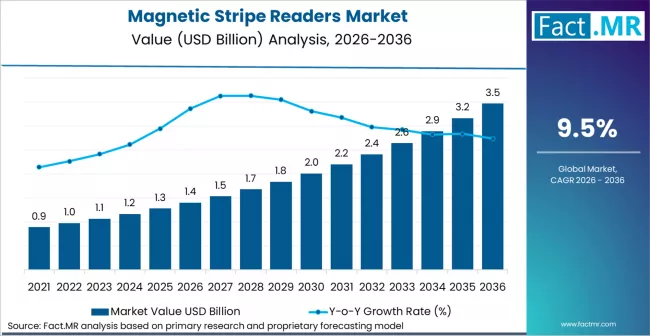
Magnetic Stripe Readers Market Market Value Analysis | Source: Fact.MR
Magnetic Stripe Readers Market
| Metric | Value |
|---|---|
| Estimated Value in (2026E) | USD 1.4 billion |
| Forecast Value in (2036F) | USD 3.5 billion |
| Forecast CAGR (2026 to 2036) | 9.5% |
Source: Fact.MR analysis. Updated Mar 6, 2026
Magnetic Stripe Readers Market Definition
The magnetic stripe readers market involves the manufacture and sale of devices that read encoded data stored on magnetic stripes, used to process transactions, verify identity, and access systems across commercial, financial, transport, and security applications.
Market Inclusions
This report covers global and regional market sizes for magnetic stripe readers over a defined forecast period, including device types (stand‑alone, integrated, mobile), application segments (payment, access control, transportation), and end‑use industries.
Market Exclusions
The scope excludes contactless readers (such as RFID/NFC systems), unrelated data capture tools (scanners not specific to magnetic stripes), and complete systems where magnetic stripe reader data is not separately quantified.
Research Methodology
- Primary Research: Interviews were conducted with device manufacturers, systems integrators, and procurement specialists.
- Desk Research: Data was sourced from industry reports, technology publications, and trade association statistics.
- Market‑Sizing and Forecasting: A hybrid model combining top‑down technology adoption forecasts with bottom‑up shipment and revenue data was used.
- Data Validation and Update Cycle: Findings were validated through expert review and aligned with recent production, adoption, and trade figures.
Summary of the Magnetic Stripe Readers Market
- Market Definition
- The Magnetic Stripe Readers Market involves devices that read encoded data stored on magnetic stripes. These readers are primarily used in payment processing, identity verification, and access control systems across sectors like retail, banking, transport, and security.
- Demand Drivers
- Digital Payment Adoption: The rise of digital payments and contactless systems is driving demand for secure and efficient magnetic stripe readers.
- Growing Retail & E-commerce Sectors: Increasing transactions in retail and financial services are fueling the need for reliable, fast, and secure payment systems.
- Expansion of Secure Access Solutions: Enhanced security requirements in sectors like transport and banking continue to promote the adoption of magnetic stripe readers.
- Key Segments Analyzed
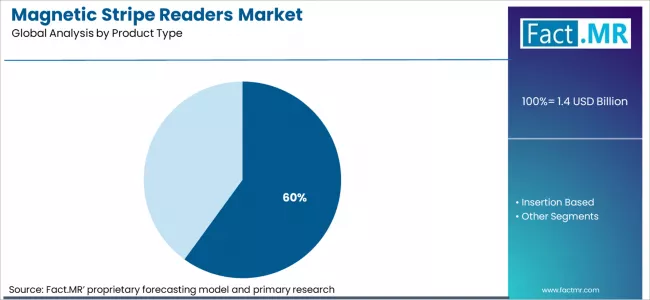
- Product Type: Swipe-based magnetic stripe readers are expected to dominate, holding 60% of the market share by 2026, due to their cost-effectiveness and integration into existing POS systems.
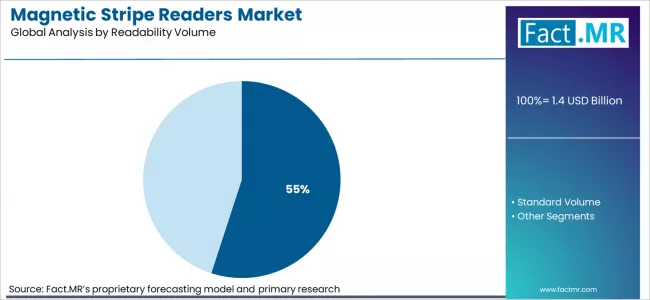
- Readability Volume: High-volume readability is projected to account for 55% of the market share by 2026, driven by high-traffic locations needing fast transaction processing.
- Geography: China leads with a CAGR of 12.8%, spurred by growing digital payment adoption and retail expansion.
- Analyst Opinion at Fact MR
- Shambhu Nath Jha, Principal Consultant at Fact MR, highlighted, “The strong growth in digital payments and the increasing demand for secure and efficient transaction processing will continue to propel the magnetic stripe readers market, especially in emerging economies.”
- Strategic Implications/Executive Takeaways
- Invest in Hybrid Reader Technologies: Manufacturers should develop hybrid magnetic stripe readers that also support EMV chips and contactless payment options to stay competitive in markets with evolving payment standards.
- Focus on High-Traffic Areas: Expanding product offerings in high-volume, high-traffic locations such as airports, stadiums, and retail environments will be key to capturing market growth.
- Leverage Emerging Markets: Companies should capitalize on the growing demand in regions like China and India, where the shift towards digital payments is accelerating.
- Methodology
- Primary Research: Interviews with device manufacturers, systems integrators, and procurement specialists.
- Desk Research: Data sourced from industry reports, technology publications, and trade association statistics.
- Market Sizing & Forecasting: A hybrid model combining top-down technology adoption forecasts with bottom-up shipment and revenue data.
Segmental Analysis
Magnetic Stripe Readers Market Analysis by Product Type
Magnetic Stripe Readers Market Analysis By Product Type | Source: Fact.MR
- Market Overview: Swipe-based magnetic stripe readers are expected to capture 60% of the market share by 2026. Swipe-based readers remain the most widely used due to their simplicity, cost-effectiveness, and the ease with which they can be integrated into various systems, including point-of-sale (POS) terminals and access control systems.
- Demand Drivers:
- Widespread Use in POS Systems: Swipe-based readers are commonly used in retail environments, where fast and secure card transactions are essential. Their ease of operation and low cost contribute to their dominance in the market.
- Lower Installation Costs: These readers are relatively inexpensive to install and maintain, making them a popular choice for businesses that need a reliable, cost-effective solution for card-based transactions.
- Continued Use in Legacy Systems: Many businesses still rely on swipe-based systems due to their compatibility with older equipment, further driving their demand in markets with established infrastructure.
Magnetic Stripe Readers Market Analysis by Readability Volume
Magnetic Stripe Readers Market Analysis By Readability Volume | Source: Fact.MR
- Market Overview: High volume readability is projected to hold 55% of the market share by 2026. High-volume magnetic stripe readers are preferred for environments that require fast and continuous card reading, such as in transportation, large retail stores, and security systems.
- Demand Drivers:
- High-Speed Transactions: High-volume readability is essential for environments where quick transactions are necessary, such as in transportation or high-traffic retail locations, driving demand for faster, more efficient readers.
- Increased Use in High-Traffic Locations: High-volume readers are commonly used in places with large foot traffic, like airports, stadiums, and shopping malls, where quick processing of a large number of transactions or access requests is needed.
- Improved Efficiency and Customer Experience: The ability to read cards faster and more accurately improves the overall efficiency of systems, enhancing the user experience and reducing wait times in high-traffic areas, making them a preferred choice in many industries.
Magnetic Stripe Readers Market Drivers, Restraints, and Opportunities
FMR analysts observe that the magnetic stripe readers market is a mature, compatibility‑anchored segment rooted in longstanding use for payment cards, access badges, ticketing, and ID verification. Historically, magnetic stripe technology was the standard for card‑based transactions; structural demand exists because vast installed bases still rely on swiped cards and legacy systems that require backward compatibility. The 2026 valuation reflects stable baseline demand tied to persistent use in retail, transportation, and security where simpler, low‑cost readers remain necessary.
While demand for basic magnetic stripe readers remains large in cost‑sensitive and legacy systems, growth is transitioning toward hybrid readers that support EMV chips, contactless/NFC, and mobile wallets. These advanced units command higher prices, contributing to net market value growth even as pure magnetic‑only reader volumes decline. The market exists because backward compatibility with existing card infrastructures and slow replacement cycles keep magnetic reader demand relevant even as new standards emerge.
- Legacy Compatibility Demand: Continued use of magnetic stripe cards in payments, access control, and ticketing drives demand for readers that support established systems.
- Technology Shift Pressure: Adoption of EMV and contactless standards is shifting demand toward hybrid readers that include magnetic stripe capability alongside newer interfaces.
- Regional Deployment Trends: In regions with slower EMV/contactless penetration, magnetic stripe readers remain significant, while advanced markets see hybrid reader growth tied to modern payment and access technologies.
Regional Analysis
The market analysis covers key global regions, including East Asia, South Asia, Western Europe, North America, and Latin America. It is segmented geographically, with specific market dynamics for each region. The full report provides a detailed market attractiveness analysis.
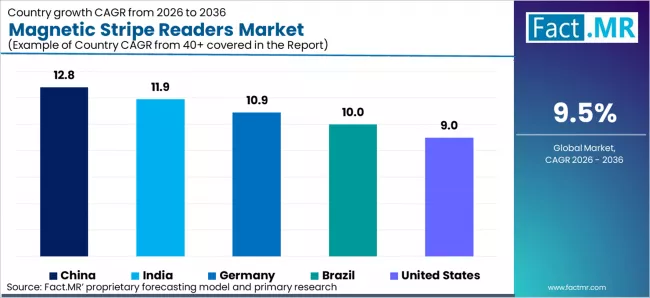
Magnetic Stripe Readers Market Cagr Analysis By Country | Source: Fact.MR
| Country | CAGR (2026-2036) |
|---|---|
| China | 12.8% |
| India | 11.9% |
| Germany | 10.9% |
| Brazil | 10.0% |
| United States | 9.0% |
Source: Fact.MR analysis. Updated Mar 6, 2026
Source: Fact MR (FMR) analysis, based on proprietary forecasting model and primary research.
East Asia:
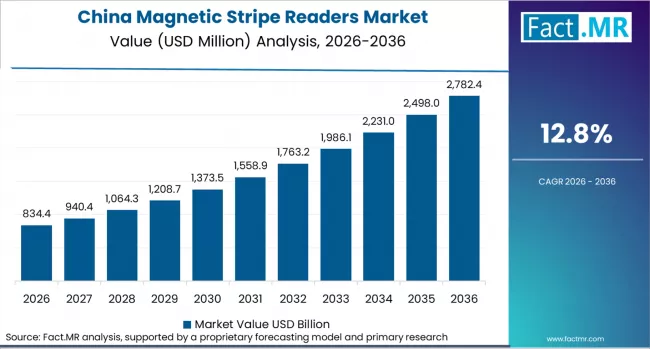
Magnetic Stripe Readers Market Country Value Analysis | Source: Fact.MR
In East Asia, China is the leading market for magnetic stripe readers, driven by the country's growing e-commerce, retail sectors, and the increasing need for secure transaction systems.
- China: Demand for magnetic stripe readers in China is projected to rise at 12.8% CAGR through 2036. China’s growing e-commerce and retail sectors, rising demand for secure payment systems, and increased adoption of advanced transaction technologies continue to drive market growth.
South Asia:
In South Asia, India is a major market for magnetic stripe readers, supported by the country's expanding retail and e-commerce industries, growing consumer demand for cashless payment solutions, and rising investments in secure payment infrastructure.
- India: Demand for magnetic stripe readers in India is projected to rise at 11.9% CAGR through 2036. India’s rapidly growing retail and e-commerce sectors, increased adoption of cashless payment systems, and rising government support for secure payment solutions contribute to market growth.
Western Europe:
In Western Europe, Germany is a key market for magnetic stripe readers, driven by the country's strong retail and financial sectors, rising demand for secure transactions, and growing interest in contactless payment solutions.
- Germany: Demand for magnetic stripe readers in Germany is projected to rise at 10.9% CAGR through 2036. Germany’s advanced retail and financial sectors, growing demand for secure payment systems, and increased focus on contactless payments continue to support market demand.
- France: Demand for magnetic stripe readers in France is projected to rise at 10.0% CAGR through 2036. France’s rising demand for secure and efficient payment solutions and growing focus on digital transaction infrastructure contribute to steady market growth.
North America:
In North America, the United States remains a significant market for magnetic stripe readers, supported by the country’s established retail, financial, and e-commerce industries, along with rising demand for secure and efficient payment technologies.
- United States: Demand for magnetic stripe readers in the U.S. is projected to rise at 9.0% CAGR through 2036. The USA’s strong retail and financial sectors, growing demand for secure transactions, and increasing adoption of digital payment systems continue to drive market growth.
Latin America:
In Latin America, Brazil is the largest market for magnetic stripe readers, driven by growing retail and e-commerce industries, increasing demand for secure payment solutions, and rising investments in digital payment infrastructure.
- Brazil: Demand for magnetic stripe readers in Brazil is projected to rise at 10.0% CAGR through 2036. Brazil’s expanding retail and e-commerce sectors, growing demand for cashless payment solutions, and increasing government initiatives to promote secure transactions continue to contribute to market growth.
Fact MR's analysis of the Magnetic Stripe Readers Market in East Asia, South Asia, Western Europe, North America, and Latin America consists of country-wise assessments that include China, India, Germany, Brazil, and the United States. Readers can find detailed trends, regulatory updates, and company-specific investments shaping the market’s growth in these countries.
What is the Competitive Structure and Buyer Behavior in the Magnetic Stripe Readers Market?
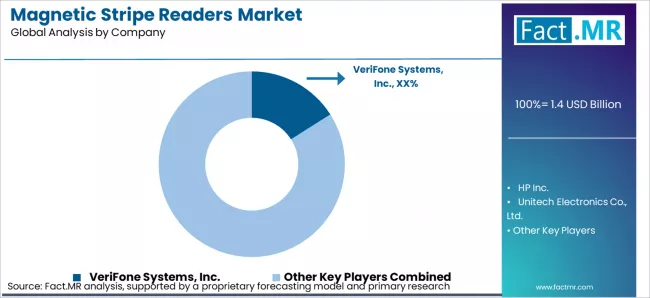
Magnetic Stripe Readers Market Analysis By Company | Source: Fact.MR
The magnetic stripe readers market is moderately fragmented, with established players such as VeriFone Systems, Inc., HP Inc., Honeywell International Inc., ID TECH, Inc., and MagTek, Inc. holding significant share, alongside other competitors including Unitech Electronics Co., Ltd., Posiflex Technology, Inc., Ingenico Group (now part of Worldline), Promag International, Inc., and Uniform Industrial Corp. The primary competitive variables are read accuracy, interface compatibility, reliability in high‑use environments, and integration with broader point‑of‑sale and access control systems. Companies with broad product portfolios, strong distribution channels, and established relationships with payment and retail solution providers have structural advantages, as they can offer integrated solutions and responsive technical support. Large enterprise and retail buyers exert notable leverage by qualifying multiple suppliers, negotiating volume pricing, and specifying performance standards tied to service level agreements. To manage supplier dependency, these buyers maintain diversified vendor lists and standardize product specifications across locations, which limits individual suppliers’ pricing power. Consequently, competition centers on delivering dependable performance, broad system compatibility, and reliable after‑sales support rather than on price alone.
Recent Industry Developments
- Launch of AI-Ready AXIUM Family: In February 2026, Ingenico unveiled its next-generation AXIUM device portfolio, which utilizes a unified Android 14 architecture to provide consistent MSR and EMV performance across mobile and countertop form factors while integrating AI-driven predictive maintenance and fraud detection.
- High-Security "MagneSafe" Integration: MagTek’s DynaFlex II Go, a secure card reader authenticator (SCRA), was integrated into multiple mobile POS and self-service platforms in January 2026, utilizing a "MagneSafe" read head that encrypts and tokenizes magnetic stripe data directly at the point of swipe to exceed PCI PTS v6.x standards.
Key Players of the Magnetic Stripe Readers Market
- VeriFone Systems, Inc.
- HP Inc.
- Unitech Electronics Co., Ltd.
- Posiflex Technology, Inc.
- Honeywell International Inc.
- ID TECH, Inc.
- Ingenico Group (now part of Worldline)
- MagTek, Inc.
- Promag International, Inc.
Uniform Industrial Corp.
Report Scope
| Metric | Value |
|---|---|
| Quantitative Units | USD 1.4 billion (2026) to USD 3.5 billion (2036), at a CAGR of 9.5% |
| Market Definition | The Magnetic Stripe Readers Market encompasses devices that read magnetic stripes for card-based transactions, used in applications like POS terminals, kiosks, entry/exit systems, and others in various end-use sectors. |
| By Product Type | Swipe Based, Insertion Based |
| By Readability Volume | High Volume, Standard Volume |
| By Connectivity | Wired, Wireless |
| By Application | POS Terminals, Kiosks, Entry/Exit, Others |
| By End Use | Retail, Banking, Transport, Others |
| Regions Covered | North America, Latin America, Europe, East Asia, South Asia, Oceania, Middle East and Africa |
| Countries Covered | United States, Canada, Mexico, Brazil, Argentina, Germany, France, United Kingdom, Italy, Spain, China, India, Japan, South Korea, Indonesia, Australia, and 40+ countries |
| Key Companies Profiled | VeriFone Systems, Inc., HP Inc., Unitech Electronics Co., Ltd., Posiflex Technology, Inc., Honeywell International Inc., ID TECH, Inc., Ingenico Group (now part of Worldline), MagTek, Inc., Promag International, Inc., Uniform Industrial Corp. |
| Forecast Period | 2026 to 2036 |
| Approach | Hybrid top-down and bottom-up market modeling validated through primary interviews with manufacturers and supported by trade data benchmarking and market research. |
Source: Fact.MR analysis. Updated Mar 6, 2026
Bibliographies
- Payment Card Industry Security Standards Council. (2024, June). Payment Card Industry Data Security Standard (PCI DSS), Version 4.0.1.
- Payment Card Industry Security Standards Council. (2023, September). Skimming prevention best practices for merchants.
- EMVCo. (2024, January). EMVCo annual report 2023.
- Aygen, A. (2023, January 27). EMV® technologies: 2023 priorities. EMVCo.
- EMVCo. (2026, February). EMV® specifications and associated bulletins (including Magstripe bulletins listing). EMVCo.
This report addresses
- Market intelligence enabling comprehensive assessment of leading countries and product segments across the Magnetic Stripe Readers Market globally.
- Market volume (sales units) estimates and 10-year revenue forecasts from 2026 to 2036, validated through manufacturer shipment data, channel partner surveys, and country-level demand modeling.
- Growth opportunity mapping across product types (Swipe Based, Insertion Based), readability volume (High Volume, Standard Volume), connectivity (Wired, Wireless), and applications (POS Terminals, Kiosks, Entry/Exit, Others).
- Segment and regional revenue forecasts by product type, readability volume, connectivity, application, end-use industry, and geography across 40+ countries.
- Competition strategy analysis covering dealer network structure, recent developments, product portfolio, USPs, and market share analysis.
- Product and regulatory compliance tracking aligned with payment security standards, access control systems, and industry certification requirements.
- Regulatory impact analysis addressing digital payment systems, transaction security mandates, and data protection regulations across key markets.
- Report delivery in PDF, Excel, PowerPoint, and interactive dashboard formats for executive, procurement, and operational planning use.
Segmentation
Magnetic Stripe Readers Market Key Segments
-
Product Type :
- Swipe Based
- Insertion Based
-
Readability Volume :
- High Volume
- Standard Volume
-
Connectivity :
- Wired
- Wireless
-
Application :
- POS Terminals
- Kiosks
- Entry/Exit
- Others
-
End-Use Industry :
- Retail
- Banking
- Transport
- Others
-
Region :
- North America
- USA
- Canada
- Mexico
- Europe
- Germany
- UK
- France
- Italy
- Spain
- Nordic Countries
- BENELUX
- Rest of Europe
- Asia Pacific
- China
- Japan
- South Korea
- India
- Australia
- Rest of Asia Pacific
- Latin America
- Brazil
- Argentina
- Rest of Latin America
- Middle East and Africa
- Kingdom of Saudi Arabia
- United Arab Emirates
- South Africa
- Rest of Middle East and Africa
- Other Regions
- Oceania
- Central Asia
- Other Markets
- North America
Frequently Asked Questions
How large is the demand for Magnetic Stripe Readers in the global market in 2026?
What will be the market size of Magnetic Stripe Readers in the global market by 2036?
What is the expected demand growth for Magnetic Stripe Readers in the global market between 2026 and 2036?
Which connectivity type is expected to dominate the market?
Which region is expected to show the highest growth rate for Magnetic Stripe Readers?
How significant is the growth outlook for India in this market?
What is the growth outlook for Germany in the Magnetic Stripe Readers market?
What is the growth forecast for Brazil in the Magnetic Stripe Readers market?
What is the growth forecast for the United States in the Magnetic Stripe Readers market?
Which company is identified as a leading player in the Magnetic Stripe Readers market?
What are Magnetic Stripe Readers used for?
What does the Magnetic Stripe Readers market include in this report?
How is the market forecast developed in this report?
What is meant by the Magnetic Stripe Readers market in this report?
Who worked on this report


Preview the report firsthand - request a free sample
Free SampleGet the brochure for pricing and purchase details
Download PDF