- Base Value(2025): 3.5 Bn
- Estimated Value(2026): 3.6 Bn
- Forecast Value (2036): 10.1 Bn
- CAGR (2026 - 2036): 10.8%
Network Operations Center As A Service Market Size, Share and Forecast and Outlook By Fact.MR
In 2025, the network operations center as a service market was valued at USD 3.5 billion. Fact MR analysis indicates demand for network operations center as a service is expected to reach USD 3.6 billion in 2026 and USD 10.1 billion by 2036. FMR estimates the market will expand at a CAGR of 10.8% across the forecast period.
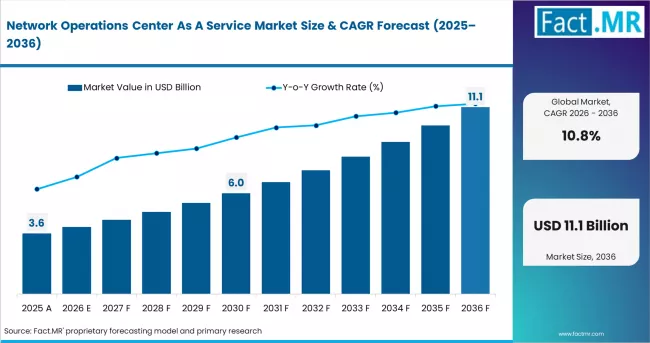
Network Operations Center As A Service Market Market Value Analysis | Source: Fact.MR
Network Operations Center As A Service Market
| Metric | Details |
|---|---|
| Industry Size (2026E) | USD 3.6 billion |
| Industry Value (2036F) | USD 10.1 billion |
| CAGR (2026 to 2036) | 10.8% |
Source: Fact.MR analysis. Updated May 4, 2026
- Market Definition
- The network operations center as a service market refers to outsourced service models delivering centralized monitoring, management, and optimization of enterprise IT network infrastructure through third-party providers. These services provide continuous supervision of network performance, incident detection, security monitoring, and infrastructure analytics across hybrid cloud, on-premise, and distributed enterprise environments. Organizations utilize NOC as a service to maintain uptime reliability, improve operational efficiency, and reduce internal infrastructure management complexity.
- Demand Drivers
- Increasing enterprise transition toward hybrid cloud environments requiring continuous monitoring of distributed IT infrastructure assets.
- Expansion of outsourcing strategies enabling organizations to reduce operational complexity associated with in-house network monitoring teams.
- Growing need for predictive network performance analytics supporting proactive incident identification and service continuity.
- Increasing adoption of automation platforms supporting event correlation, incident prioritization, and infrastructure diagnostics.
- Rising integration of AI-driven analytics supporting optimization of network reliability and performance lifecycle management.
- Expansion of digital enterprise ecosystems requiring centralized visibility across multi-vendor infrastructure environments.
- Key Segments Analyzed
- Enterprise Size: Large enterprises account for 62.4% share supported by high network complexity across distributed infrastructure environments.
- Support Model: Shared NOC represents 41.7% share supported by cost-efficient service delivery models utilizing centralized monitoring frameworks.
- Service Type: Remote monitoring and incident management drive adoption supported by continuous infrastructure performance requirements.
- End Use: IT and telecom, BFSI, healthcare, and government sectors demonstrate strong demand supported by high uptime requirements.
- Geography: India and China demonstrate strongest growth supported by enterprise digital infrastructure expansion, while the USA and Germany reflect mature managed services environments.
- Analyst Opinion at Fact MR
- Vishal Vaid, Senior Consultant at Fact MR, states, "Network operations center as a service represents a structural shift in enterprise IT management where infrastructure monitoring is increasingly procured as a subscription-based operational capability. Demand expansion reflects increasing complexity of hybrid cloud environments requiring continuous performance visibility across distributed digital ecosystems. Service providers are prioritizing automation frameworks, AI-driven diagnostics, and standardized incident response models supporting scalable network operations through 2036."
- Strategic Implications
- Expand automation capability supporting predictive incident management across complex hybrid infrastructure environments.
- Strengthen integration compatibility supporting interoperability with enterprise cloud platforms and legacy IT systems.
- Improve analytics capability supporting continuous optimization of network performance and uptime reliability.
- Expand shared NOC delivery frameworks supporting cost-efficient monitoring services across multiple enterprise clients.
- Strengthen cybersecurity monitoring integration supporting unified visibility across network performance and security analytics layers.
- Improve service level agreement performance management capability supporting consistent uptime delivery across enterprise digital infrastructure environments.
- Methodology
- Developed using primary interviews with managed service providers, enterprise IT administrators, telecom operators, and cloud infrastructure specialists.
- Supported through analysis of IT operations frameworks, service provider technical documentation, and enterprise outsourcing adoption trends.
- Market estimation applied hybrid modeling combining bottom-up managed service provider revenue analysis with top-down evaluation of enterprise IT infrastructure outsourcing demand.
- Data validated through triangulation using vendor capability disclosures, technical publications, and expert consultation inputs.
- Periodic updates incorporate developments in cloud adoption, AI-driven infrastructure analytics, and enterprise demand for outsourced network operations management services.
A CAGR of 10.8%, with value increasing from USD 3.6 billion to USD 10.1 billion, indicates a high growth contribution index driven by outsourcing of network monitoring and incident management across distributed IT environments. Expansion is supported by hybrid infrastructure complexity, while moderated by cybersecurity compliance costs, vendor lock-in concerns, and integration challenges with legacy systems.
India records the fastest growth at 12.9%, supported by increasing outsourcing of IT infrastructure monitoring across enterprise networks. China follows at 12.5%, driven by rising deployment of centralized network performance management platforms. The USA shows 10.9% growth, linked to adoption of subscription-based network monitoring services across distributed enterprise environments. The United Kingdom at 10.7% and Germany at 10.6% represent mature markets where demand is largely replacement-driven due to established managed services penetration. A structural constraint across mature markets is legacy system integration complexity, which slows transition from on-premise monitoring frameworks to service-based network operations models.
Segmental Analysis
Network Operations Center as a Service Market Analysis by Enterprise Size
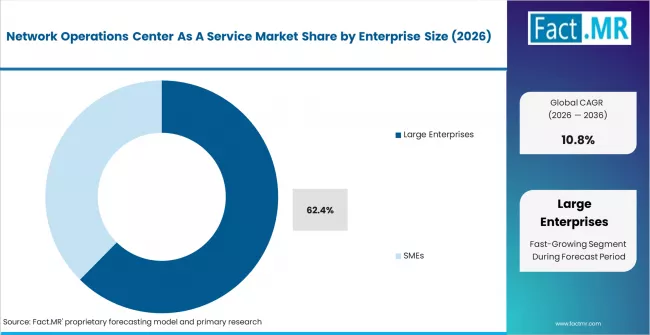
Network Operations Center As A Service Market Analysis By Enterprise Size | Source: Fact.MR
- Market Overview: Large enterprises are projected to hold 62.4% share of the network operations center as a service market in 2026. Adoption concentration reflects high network complexity across distributed IT environments requiring continuous infrastructure monitoring, incident detection, and performance optimization across enterprise-scale digital systems. Large organizations prioritize outsourced NOC capabilities to maintain operational continuity across hybrid cloud, on-premise, and multi-vendor network architectures.
- Demand Drivers:
- Infrastructure Complexity: Large enterprises operate extensive network environments requiring continuous monitoring of servers, applications, databases, and communication infrastructure components.
- Operational Continuity Requirements: Organizations deploy NOC as a service solutions to ensure uninterrupted network performance across geographically distributed operations requiring high uptime reliability.
- Resource Optimization: Enterprises utilize outsourced NOC services to reduce internal infrastructure management burden while maintaining centralized visibility across complex IT ecosystems.
Network Operations Center as a Service Market Analysis by Support Model
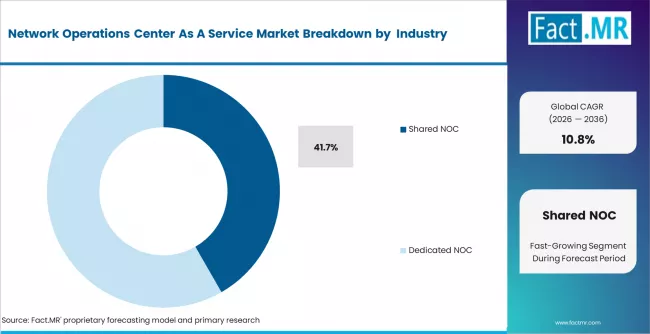
Network Operations Center As A Service Market Analysis By Support Model | Source: Fact.MR
- Market Overview: Shared NOC is estimated to account for 41.7% share in 2026, supported by demand for cost-efficient network monitoring services delivered through multi-client operational frameworks utilizing standardized monitoring platforms and centralized technical teams. Shared support environments enable service providers to deliver continuous monitoring without dedicated infrastructure allocation per client.
- Demand Drivers:
- Cost Efficiency Requirements: Shared NOC delivery models distribute operational costs across multiple clients, enabling accessible continuous monitoring services for organizations seeking controlled expenditure structures.
- Scalable Monitoring Capabilities: Service providers deploy standardized monitoring frameworks capable of supporting multiple client environments through centralized operational platforms.
- Service Standardization: Shared NOC models utilize predefined incident management workflows and performance monitoring protocols designed to maintain consistent service delivery across enterprise IT environments.
Key Dynamics
Network Operations Center as a Service Market Drivers, Restraints, and Opportunities
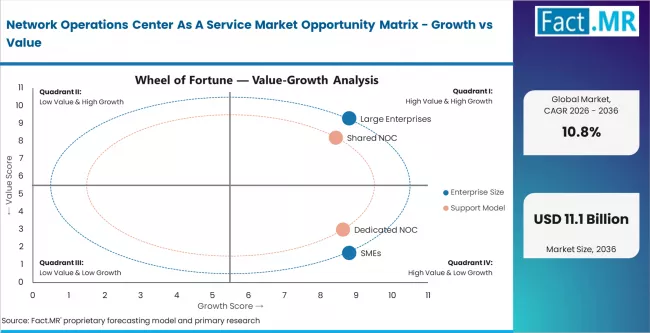
Network Operations Center As A Service Market Opportunity Matrix Growth Vs Value | Source: Fact.MR
Fact MR analysis indicates the market reflects a structurally growing managed infrastructure services segment shaped by enterprise transition from on-premise IT monitoring toward outsourced, cloud-integrated network performance management. Market size exists because modern enterprises operate hybrid multi-cloud environments with continuous uptime requirements across distributed applications, data centers, and connected devices. The current valuation reflects structural dependence on outsourced operational visibility as organizations reduce internal IT staffing costs while maintaining performance accountability across complex digital infrastructure ecosystems.
Current dynamics show declining reliance on internally managed network monitoring teams as enterprises adopt subscription-based NOC platforms delivering predictive analytics, automated incident remediation, and 24/7 uptime assurance. Advanced AI-driven monitoring services command higher contract pricing due to integration complexity and cybersecurity alignment requirements, while demand expands as digital service availability becomes directly linked to revenue continuity. The market reflects a structural shift toward proactive network reliability engineering where operational resilience is purchased as a managed outcome rather than maintained as internal capability.
- SLA Accountability Model: Service Level Agreements requiring uptime thresholds such as 99.9% availability are driving adoption of outsourced monitoring platforms capable of continuous performance tracking and rapid incident resolution.
- Hybrid Cloud Expansion: North America and Asia Pacific enterprises show strong adoption as distributed cloud architectures increase monitoring complexity across telecom, BFSI, and digital commerce infrastructure environments.
- AI Operations Integration: Transition from reactive troubleshooting toward predictive analytics platforms increases contract value as automated diagnostics reduce downtime risk and optimize network performance lifecycle management.
Regional Analysis
The network operations center as a service market is assessed across Asia Pacific, Europe, and North America, segmented by country-level demand for remote IT infrastructure monitoring, cloud network performance management, cybersecurity incident response, and managed network analytics services. Geographic variation reflects enterprise cloud adoption, digital infrastructure complexity, and demand for outsourced network management solutions. The full report offers market attractiveness analysis.
.webp "Top Country Growth Comparison Network Operations Center As A Service Market Cagr (2026 2036)")
Top Country Growth Comparison Network Operations Center As A Service Market Cagr (2026 2036) | Source: Fact.MR
CAGR Table
| Country | CAGR (2026–2036) |
|---|---|
| India | 12.9% |
| China | 12.5% |
| USA | 10.9% |
| UK | 10.7% |
| Germany | 10.6% |
Source: Fact.MR analysis. Updated May 4, 2026
Source: Fact MR analysis, based on proprietary forecasting model and primary research
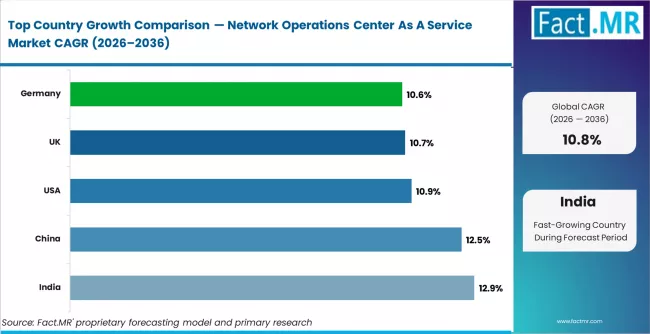
Network Operations Center As A Service Market Cagr Analysis By Country | Source: Fact.MR
Asia Pacific
Asia Pacific functions as the outsourced network management adoption hub supported by expansion of cloud computing infrastructure and increasing demand for remote IT monitoring services. Tata Consultancy Services strengthens managed network operations capability. Huawei Technologies Co., Ltd. expands enterprise network monitoring solution portfolio. HCLTech supports cloud-based infrastructure management service innovation.
- India: India is projected to record 12.9% CAGR in network operations center as a service through 2036. Digital India programme expansion (Ministry of Electronics and Information Technology, March 2023) supports enterprise IT infrastructure modernization. Tata Consultancy Services expanded managed network services portfolio (July 2023).
- China: China is expected to observe 12.5% CAGR in network operations center as a service through 2036. New Infrastructure Development Plan update (National Development and Reform Commission, January 2023) supports cloud network monitoring demand growth. Huawei Technologies Co., Ltd. expanded enterprise network analytics platform capability (May 2023).
North America
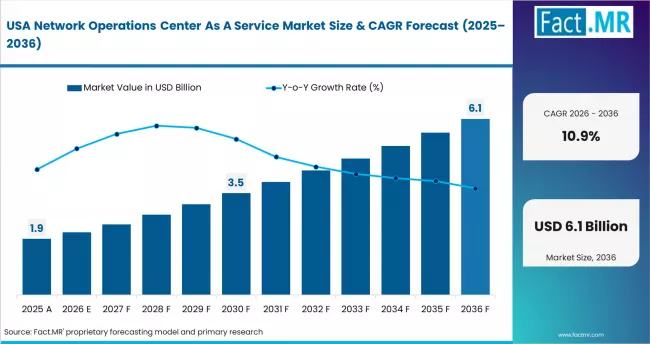
Network Operations Center As A Service Market Country Value Analysis | Source: Fact.MR
North America operates as the cloud network management commercialization center supported by high enterprise adoption of managed IT services and increasing cybersecurity monitoring requirements. IBM Corporation strengthens hybrid cloud network monitoring capability. Cisco Systems, Inc. expands network analytics software portfolio. DXC Technology supports managed infrastructure service delivery capability.
- USA: The USA is anticipated to expand at 10.9% CAGR in network operations center as a service through 2036. Federal Zero Trust Strategy implementation update (Office of Management and Budget, September 2023) supports enterprise network monitoring investment. Cisco Systems, Inc. expanded network observability software capability (June 2023).
Europe
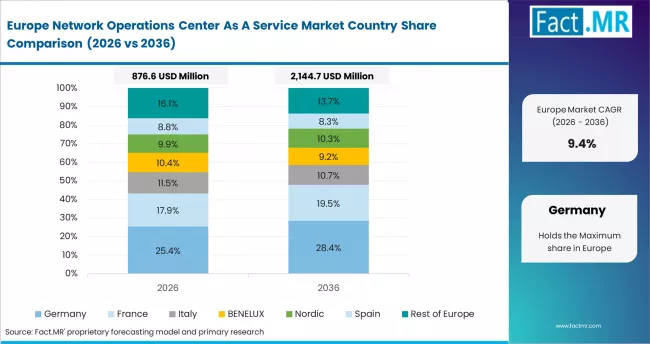
Network Operations Center As A Service Market Europe Country Market Share Analysis, 2026 & 2036 | Source: Fact.MR
Europe functions as the enterprise network compliance laboratory supported by strict data protection frameworks and increasing adoption of outsourced IT monitoring solutions. Atos SE strengthens managed network operations capability. BT Group plc expands enterprise connectivity monitoring services. Deutsche Telekom AG supports network performance analytics innovation.
- UK: The UK is forecast to grow at 10.7% CAGR in network operations center as a service through 2036. UK Cyber Strategy implementation update (Department for Science, Innovation and Technology, February 2023) supports managed network security monitoring adoption. BT Group plc expanded enterprise network management services (April 2023).
- Germany: Germany is projected to register 10.6% CAGR in network operations center as a service through 2036. Digital Strategy 2025 implementation update (Federal Ministry for Digital and Transport, January 2023) supports enterprise cloud monitoring adoption. Deutsche Telekom AG expanded network analytics infrastructure capability (August 2023).
Fact MR's analysis of network operations center as a service market in global regions consists of country-wise assessment that includes India, China, USA, UK, and Germany. Readers can find managed network monitoring demand trends, enterprise cloud infrastructure developments, regulatory compliance frameworks, and competitive service capability insights.
Competitive Landscape
What is the Competitive Structure of the Network Operations Center As A Service Market?
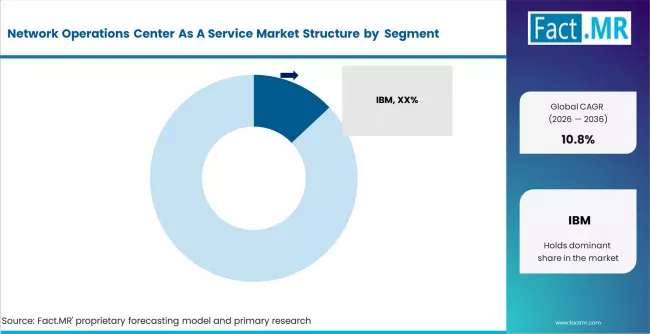
Network Operations Center As A Service Market Analysis By Company | Source: Fact.MR
The Network Operations Center As A Service Market demonstrates a moderately fragmented competitive structure, supported by participation from global IT service providers and managed service specialists offering remote infrastructure monitoring and incident management solutions. Leading companies including IBM, Fujitsu, Kaseya, Sify Technologies, ConnectWise, Park Place Technologies, and INOC collectively account for approximately 50–60% of market presence, particularly in enterprise-grade network monitoring and hybrid cloud infrastructure support services. Competitive positioning is primarily determined by service reliability, automation capability, cybersecurity integration, and scalability of monitoring platforms across distributed IT environments. Technical expertise in predictive analytics, event correlation, and service orchestration creates moderate entry barriers, limiting rapid expansion by smaller managed service providers lacking advanced monitoring infrastructure.
Structural advantages are observed among companies possessing established managed service platforms and long-term enterprise client relationships supporting recurring service contracts. IBM and Fujitsu benefit from integrated IT service portfolios covering infrastructure management, cybersecurity operations, and cloud optimization services. Buyers typically manage supplier dependency through multi-vendor managed service frameworks and evaluation of interoperability across existing IT management tools. Procurement decisions often consider service level agreement performance, incident response time consistency, and integration compatibility with enterprise IT architectures. Pricing power remains relatively balanced, though suppliers retain moderate leverage where automation capabilities and global service delivery infrastructure support continuous network performance management across complex digital environments.
Key Players of the Network Operations Center As A Service Market
- IBM
- Fujitsu
- Kaseya
- Sify Technologies
- Park Place Technologies
- INOC
- ConnectWise
- iGLASS Networks
- TailWind Voice & Data
- Structured
Bibliographies
- [1] Ministry of Electronics and Information Technology (India). (2023, March). Digital India programme expansion framework.
- [2] National Development and Reform Commission (China). (2023, January). New Infrastructure Development Plan update.
- [3] Office of Management and Budget (USA). (2023, September). Federal Zero Trust Strategy implementation update.
- [4] Department for Science, Innovation and Technology (UK). (2023, February). UK Cyber Strategy implementation update.
- [5] Federal Ministry for Digital and Transport (Germany). (2023, January). Digital Strategy 2025 implementation update.
- [6] Tata Consultancy Services. (2023, July). Managed network services portfolio expansion.
- [7] Huawei Technologies Co., Ltd. (2023, May). Enterprise network analytics platform capability expansion.
- [8] Cisco Systems, Inc. (2023, June). Network observability software capability expansion.
- [9] BT Group plc. (2023, April). Enterprise network management services expansion.
- [10] Deutsche Telekom AG. (2023, August). Network analytics infrastructure capability expansion.
This Report Addresses
- Market size estimation and revenue forecasts from 2026 to 2036, supported by validated enterprise IT outsourcing benchmarks and hybrid cloud infrastructure adoption indicators across managed network service environments.
- Growth opportunity mapping across remote monitoring, incident management, network performance optimization, security monitoring, and automation and analytics services aligned with distributed IT infrastructure management requirements.
- Segment and regional revenue forecasts covering dedicated NOC, shared NOC, and hybrid NOC delivery models used across large enterprises and SMEs operating in IT and telecom, BFSI, healthcare, manufacturing, retail, and government sectors.
- Competition strategy assessment including benchmarking of service level agreement performance metrics, incident response time capability, automation integration maturity, and interoperability across hybrid cloud and on-premise network environments.
- Regulatory impact analysis covering data protection compliance frameworks, cybersecurity governance standards, and enterprise IT service audit requirements influencing adoption of outsourced network monitoring models.
- Market report delivery in PDF, Excel, PPT, and structured data formats designed for CIOs, IT infrastructure managers, managed service providers, telecom operators, and enterprise network engineering teams.
- Supply chain vulnerability assessments identifying concentration risks in cloud monitoring platform providers, network observability software ecosystems, skilled technical workforce availability, and automation tool integration capacity supporting NOC service delivery infrastructure.
Network Operations Center As A Service Market Definition
The Network Operations Center as a Service market refers to outsourced IT service models that provide remote monitoring, management, and maintenance of network infrastructure through third-party providers. These services ensure continuous performance, uptime, and incident response across servers, cloud systems, and communication networks without requiring an in-house operations center.
Network Operations Center As A Service Market Inclusions
The report covers global and regional market size estimates, historical trends, and forecast outlook across the study period. It includes segmentation by service type such as remote monitoring, incident management, and infrastructure support, applications across enterprise IT environments, and end users including telecom providers, BFSI firms, healthcare organizations, and managed service providers. Pricing and service delivery models are also analyzed.
Network Operations Center As A Service Market Exclusions
The scope excludes standalone cybersecurity operations center services focused purely on threat detection without network performance monitoring. It does not include hardware sales such as servers, routers, or network switches. Internal IT support teams operating without outsourced service frameworks are excluded, focusing strictly on subscription-based NOC service delivery models.
Network Operations Center As A Service Market Research Methodology
- Primary Research: Interviews were conducted with managed service providers, cloud infrastructure vendors, telecom operators, enterprise IT managers, and network administrators responsible for outsourced infrastructure monitoring.
- Desk Research: Public sources including company service documentation, cloud computing publications, IT operations frameworks, and technology standards were reviewed to identify adoption trends and service structure.
- Market-Sizing and Forecasting: A hybrid model combining bottom-up analysis of managed service provider revenues and top-down evaluation of enterprise IT outsourcing demand was applied to estimate market size and growth outlook.
- Data Validation and Update Cycle: Findings were cross-verified using technical publications, vendor capability statements, and expert consultations. Periodic updates reflect changes in cloud adoption, network complexity, and enterprise demand for outsourced IT operations support.
Segmentation
Report Scope
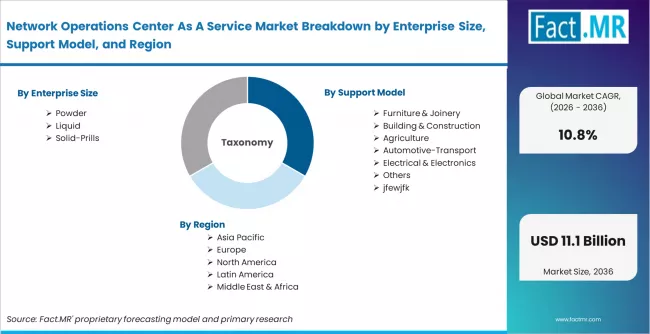
Network Operations Center As A Service Market Breakdown By Enterprise Size, Support Model, And Region | Source: Fact.MR
| Metric | Value |
|---|---|
| Quantitative Units | USD 3.6 billion (2026) to USD 10.1 billion (2036), at a CAGR of 10.8% |
| Market Definition | The network operations center as a service market includes outsourced network monitoring, management, and optimization services delivered through centralized operational platforms. These services support continuous supervision of network infrastructure, performance diagnostics, incident response management, and security monitoring across enterprise IT environments requiring high availability and operational continuity. |
| Service Type Segmentation | Remote monitoring, Incident management, Network performance optimization, Security monitoring, Automation & analytics |
| Support Model Segmentation | Dedicated NOC, Shared NOC, Hybrid NOC |
| Enterprise Size Segmentation | Large enterprises, SMEs |
| End Use Segmentation | IT & telecom, BFSI, Healthcare, Manufacturing, Retail, Government |
| Regions Covered | North America, Latin America, Europe, East Asia, South Asia, Oceania, Middle East and Africa |
| Countries Covered | United States, Canada, Mexico, Brazil, Argentina, Germany, France, United Kingdom, Italy, Spain, China, India, Japan, South Korea, Indonesia, Australia, and 40+ countries |
| Key Companies Profiled | IBM, Fujitsu, Kaseya, Sify Technologies, Park Place Technologies, INOC, ConnectWise, iGLASS Networks, TailWind Voice & Data, Structured |
| Forecast Period | 2026 to 2036 |
| Approach | Hybrid top-down and bottom-up market estimation validated through primary interviews with managed service providers, enterprise IT infrastructure managers, cloud service integrators, and network security specialists, supported by benchmarking of service adoption trends, enterprise outsourcing patterns, and evaluation of operational analytics integration across managed network service environments |
Source: Fact.MR analysis. Updated May 4, 2026
Network Operations Center as a Service Market Key Segments
-
Service Type:
- Remote Monitoring
- Incident Management
- Network Performance Optimization
- Security Monitoring
- Automation and Analytics
-
Support Model:
- Dedicated NOC
- Shared NOC
- Hybrid NOC
-
Enterprise Size:
- Large Enterprises
- SMEs
-
End Use:
- IT and Telecom
- BFSI
- Healthcare
- Manufacturing
- Retail
- Government
-
Region:
- North America
- USA
- Canada
- Mexico
- Europe
- Germany
- UK
- France
- Italy
- Spain
- Nordic Countries
- BENELUX
- Rest of Europe
- Asia Pacific
- China
- Japan
- South Korea
- India
- Australia
- Rest of Asia Pacific
- Latin America
- Brazil
- Argentina
- Rest of Latin America
- Middle East and Africa
- Kingdom of Saudi Arabia
- United Arab Emirates
- South Africa
- Rest of Middle East and Africa
- Other Regions
- Oceania
- Central Asia
- Other Markets
- North America
Frequently Asked Questions
How large is the demand for Network Operations Center as a Service in the global market in 2026?
What will be the market size of Network Operations Center as a Service in the global market by 2036?
What is the expected demand growth for Network Operations Center as a Service in the global market between 2026 and 2036?
Which Enterprise Size is poised to lead global demand by 2026?
What is Driving Network Operations Center as a Service Demand in India?
What is the India Growth Outlook in this Report?
What is Driving Network Operations Center as a Service Demand in China?
What is the China Growth Outlook in this Report?
What is Driving Network Operations Center as a Service Demand in the United States?
What is the United States Growth Outlook in this Report?
What is Driving Network Operations Center as a Service Demand in the United Kingdom?
What is the United Kingdom Growth Outlook in this Report?
What is Driving Network Operations Center as a Service Demand in Germany?
What is the Germany Growth Outlook in this Report?
Which Companies are Identified as Leading Participants in the Network Operations Center as a Service Market?
What is Network Operations Center as a Service and What is It Mainly Used For?
What does Network Operations Center as a Service Market Mean in this Report?
What is Included in the Scope of this Network Operations Center as a Service Market Report?
What is Excluded from the Scope of this Report?
What does Market Forecast Mean on this Page?
How is the Network Operations Center as a Service Market Forecast Developed in this Report?
What does Data Validation Approach Mean in this Report?
Who worked on this report


Preview the report firsthand - request a free sample
Free SampleGet the brochure for pricing and purchase details
Download PDF