Neurodivergent Workplace Support Services Market Size, Share, Growth and Forecast (2026 - 2036)
The Neurodivergent Workplace Support Services Market is segmented by Service Type, by Buyer Type, by Support Stage, by Delivery Model, by Neurodivergence Focus, by End Use, and by Region. Forecast for 2026 to 2036.
What is the neurodivergent workplace support services market forecast to be worth by 2036?
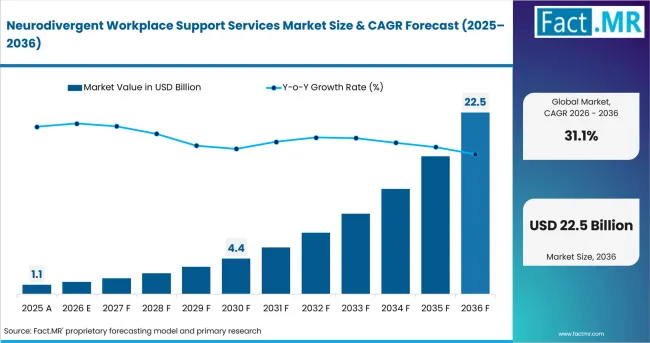
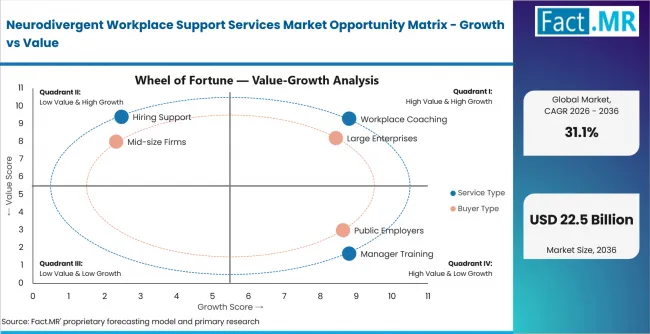
USD 1.50 billion in 2026 to USD 22.50 billion by 2036, at 31.1% CAGR.
- The neurodivergent workplace support services market crossed a valuation of USD 1.14 billion in 2025.
- Demand is expected to increase from USD 1.50 billion in 2026 to USD 22.50 billion by 2036.
- The market is forecast to record 31.1% CAGR from 2026 to 2036 as employers shift budgets from broad awareness courses to coaching, accommodation advisory and retention support.
What are the defining numbers behind neurodivergent workplace support services?
USD 21.0 billion absolute opportunity by 2036, led by the United Kingdom and the United States.
- Demand Drivers in the Market
- Employers need support because accommodation requests are moving from informal manager judgment into documented workplace processes.
- Public funding improves buyer confidence because grants can pay for practical support and workplace adjustments.
- Retention pressure supports coaching because replacing skilled employees can cost more than structured support.
- Talent programs need manager follow-through because placement alone does not solve disclosure and work-design needs.
- Key Segments Analyzed
- By Service Type: Workplace Coaching is expected to hold 30.0% share in 2026 as most programs begin with employee and manager sessions.
- By Buyer Type: Large Enterprises are likely to account for 48.0% share in 2026 because they manage formal accommodation teams and higher compliance exposure.
- By Support Stage: Retention Support is projected to hold 34.0% share in 2026 since employers often buy after disclosure or performance risk.
- By Delivery Model: Hybrid Coaching is expected to hold 42.0% share in 2026 due to remote sessions need to be paired with manager practice.
- By Neurodivergence Focus: Autism Support is likely to account for 34.0% share in 2026 as specialist employment programs have built early measurable service models around autistic talent.
- By End Use: Technology Roles are projected to hold 28.0% share in 2026 because many specialist providers first built programs around testing, data and software work.
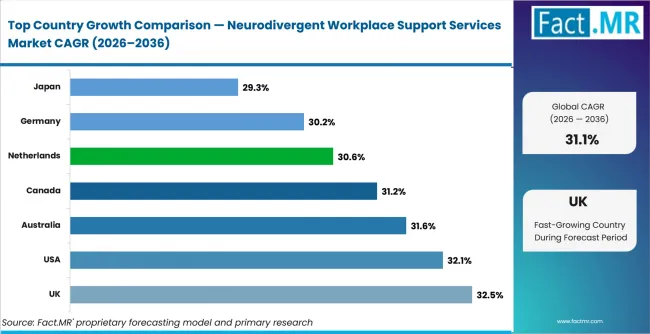
- By Geography: The United Kingdom is projected to record 32.5% CAGR through 2036 as Access to Work funding supports practical workplace support.
- Analyst Opinion at Fact.MR
- Shambhu Nath Jha of Fact.MR states, “Neurodivergent workplace support is moving from awareness content into practical work design. I see employers asking whether a provider can help managers change daily work routines and keep skilled employees in place. Providers that measure accommodation use and retention gains are better placed for larger employer programs.”
- Strategic Implications
- Employers should move from awareness sessions to role-specific support plans that managers can apply.
- Service providers need measurable outcomes because buyers compare retention and disclosure confidence.
- Public employment programs should simplify funding routes because small employers rarely buy without clear payment support.
- Talent platforms need employer coaching because placement without workplace change produces weaker retention.
Workplace coaching and accommodation planning form the core of this market. The Centers for Disease Control and Prevention reported in April 2025 that autism spectrum disorder prevalence among children aged 8 years reached 32.2 per 1,000 in 2022. [1] This supports long-range employer demand because larger diagnosed cohorts are moving toward higher education and work over the forecast period.
The United Kingdom is projected to record 32.5% CAGR through 2036 because Access to Work gives buyers a clearer funded route for support. The United States is forecast to grow at 32.1% CAGR as accommodation duties and enterprise programs support service budgets. Australia is expected to register 31.6% CAGR because autism prevalence reporting and disability support systems raise employer readiness. Canada is projected to post 31.2% CAGR as learning and developmental disability data supports workplace program design. The Netherlands is likely to advance at 30.6% CAGR because vocational reintegration systems create a service base. Germany is forecast to expand at 30.2% CAGR due to formal workplace governance. Japan is expected to post 29.3% CAGR as statutory disability employment rules support structured workplace adjustment.
How does the neurodivergent workplace support services market break down by segment?
Workplace Coaching leads at 30.0%; Large Enterprises lead at 48.0%.
Which service type dominates?
Workplace Coaching holds 30.0% share in 2026.
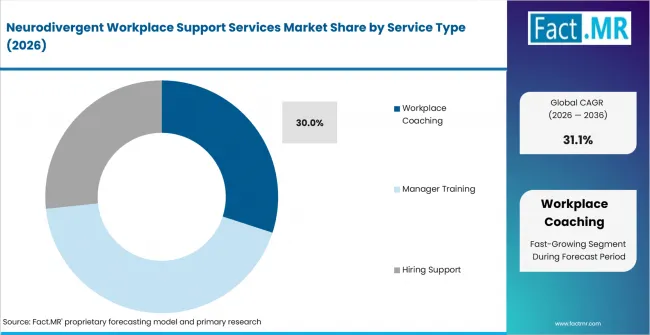
Workplace Coaching is expected to hold 30.0% share in 2026 because employer programs often start with one worker and one manager. The service helps convert needs into meeting rules, written task steps and communication changes. Coaching demand rises when employers need support after disclosure rather than another general training session.
Which buyer type dominates?
Large Enterprises hold 48.0% share in 2026.
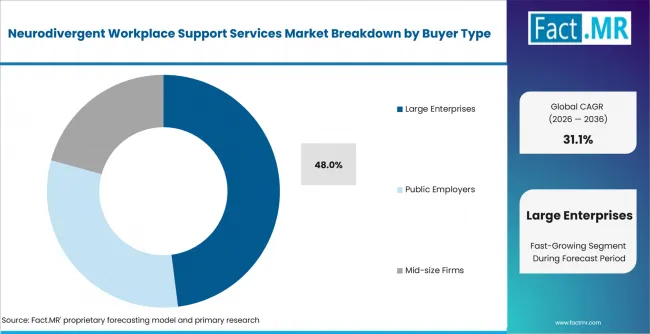
Large Enterprises lead because they manage higher accommodation volumes and more formal compliance workflows. These buyers often need provider evidence before support is rolled out across business units.
This buying pattern overlaps with human resources consulting when inclusion teams need outside support for workforce redesign and manager enablement.
Which support stage dominates?
Retention Support holds 34.0% share in 2026.

Retention Support leads because employers often purchase services after a disclosure, missed expectation or manager escalation. Providers that solve the retention problem can sell repeat programs instead of one-off sessions. This segment also links support spending to measurable workforce outcomes.
Which delivery model dominates?
Hybrid Coaching holds 42.0% share in 2026.
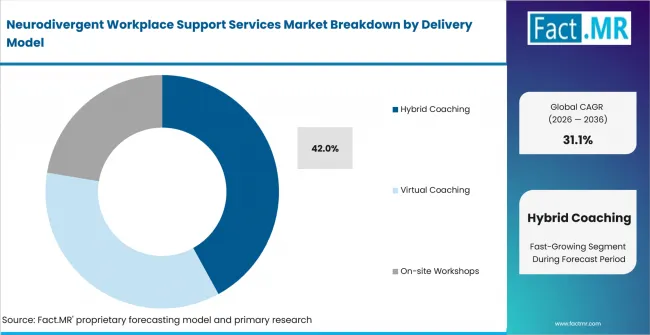
Hybrid Coaching leads because workers may prefer private remote coaching while managers still need live practice. The model supports dispersed teams and gives employers flexibility across offices and home-based work. It also lets providers combine individual guidance with team-level process change.
Program teams increasingly connect coaching records with workplace service platforms when support depends on access rules, workflow documentation and secure employee communication.
Which neurodivergence focus dominates?
Autism Support holds 34.0% share in 2026.
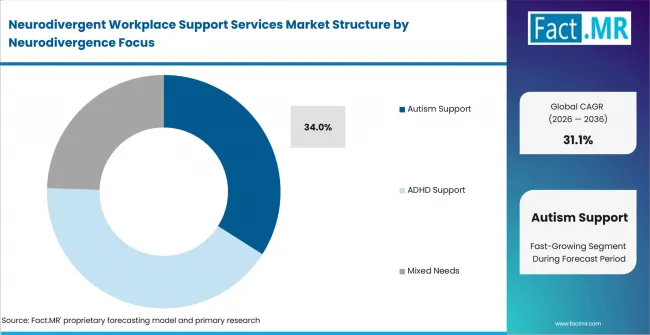
Autism Support leads because specialist providers built early workplace models around autistic talent programs. The Centers for Disease Control and Prevention data also shows a larger diagnosed cohort moving toward work over the next decade. Buyers value providers that understand sensory needs, communication preferences and role matching.
Which end use dominates?
Technology Roles hold 28.0% share in 2026.
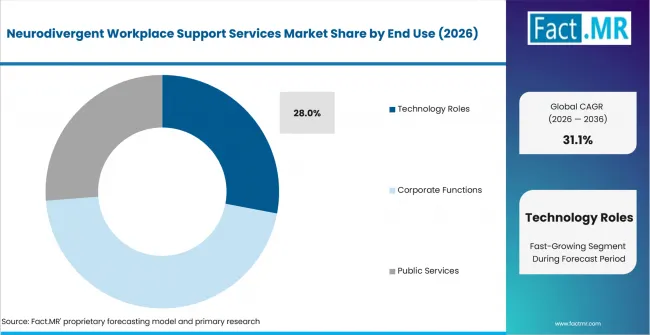
Technology Roles lead because specialist providers have proven delivery models in testing, data work and software support. Talent teams use neuroinclusive screening when standard interviews miss candidates who can perform the role.
This is why some employers compare neuroinclusive hiring support with HR recruitment services before selecting a specialist provider.
What is accelerating neurodivergent workplace support demand, and what is holding it back?
The main driver is the movement from awareness sessions to job-level support. Employers need a service that turns diagnosis and disclosure into workable changes inside tasks and teams. The Department for Work and Pensions reported that Access to Work provision was approved for 56,000 people in the 2024 to 2025 financial year. Total expenditure reached GBP 320.7 million. [3]
Accommodation handling also overlaps with mental health software when employers need clear referral records and confidential support routes.
The main restraint is manager readiness. Many supervisors receive awareness content but do not practice deadline adjustment, written instruction or sensory planning. Service uptake is also constrained when human resources, disability support and benefits teams do not share one budget owner.
Some employers use mental health apps as light support tools, but those products do not replace job coaching or manager training.
Where do the biggest neurodivergent workplace support opportunities sit?
Funded support pathways, manager training and neuroinclusive hiring services.
- Funded Support Pathways: Providers can help employers document needs and claim eligible support under public programs.
- Manager Training: Service firms can teach supervisors how to adapt meetings, instructions and performance check-ins.
- Neuroinclusive Hiring: Talent providers can redesign screening and interviews for qualified candidates who struggle with standard processes.
Employers that already run corporate wellness programs can add neurodivergent support when burnout and communication stress appear in workforce reviews.
Support providers may also connect their dashboards with on-demand wellness software when buyers want completion records and referral pathways without turning the service into clinical care.
Which countries are scaling neurodivergent workplace support services fastest?
United Kingdom 32.5% and United States 32.1%. Australia records 31.6% and Canada records 31.2%. Netherlands posts 30.6% while Germany reaches 30.2%. Japan records 29.3%.
Based on regional analysis, the neurodivergent workplace support services market is segmented into North America and Europe. It also covers Asia Pacific, Latin America and Middle East and Africa.
.webp)
| Country | CAGR |
|---|---|
| United Kingdom | 32.5% |
| United States | 32.1% |
| Australia | 31.6% |
| Canada | 31.2% |
| Netherlands | 30.6% |
| Germany | 30.2% |
| Japan | 29.3% |

What supports the United Kingdom lead?
32.5% CAGR, supported by Access to Work funding and formal employer adjustment needs.
The United Kingdom has a clear funded pathway among the reviewed countries. The Department for Work and Pensions reported 5.5 million disabled people in employment in the second quarter of 2025. The disability employment rate was 52.8% compared with 82.5% for non-disabled people. [4] Employers can use specialist coaching when workplace changes require assessment, worker guidance and manager action. Providers with Access to Work documentation skills have a clear route into smaller employers.
What supports the USA outlook?
32.1% CAGR, supported by accommodation exposure and large enterprise programs.
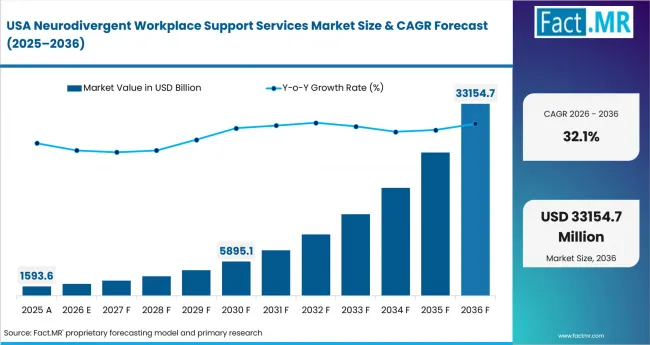
The United States is shaped by accommodation duties across large private employers. The United States Bureau of Labor Statistics reported in March 2026 that the unemployment rate for people with a disability reached 8.3% in 2025. The rate for people without a disability was 4.1%. [5] Employers need documented accommodation workflows before support programs scale across teams. Technology and professional services employers are early buyers because task design and communication standards affect retention.
Why does Australia matter?
31.6% CAGR, supported by autism prevalence reporting and formal disability service systems.
Australia has a rising identified autism population and a formal disability service environment. The Australian Bureau of Statistics reported in October 2024 that there were 290,900 autistic Australians in 2022. That number was 41.8% higher than in 2018. [6] Employers need support models that work across office and remote settings because disclosure needs vary by role. Providers can win by turning service plans into workday changes for managers.
What shapes Canada’s outlook?
31.2% CAGR, supported by learning and developmental disability data.
Canada has measurable learning and developmental disability cohorts that support employer planning. Statistics Canada reported in October 2024 that 5.6% of Canadians aged 15 and older had a learning disability in 2022. It also reported that 1.5% had a developmental disability. [7] Employer interest is strongest where communication and written work expectations affect role performance. Providers need bilingual and region-specific manager materials because employment support varies by province.
What supports the Netherlands outlook?
30.6% CAGR, supported by vocational reintegration systems and low disability unemployment.
The Netherlands benefits from a disability employment system that supports structured work reintegration. Eurostat reported in October 2025 that unemployment among people with a disability was 5.5% in the Netherlands in 2024. This was the lowest reported rate in the European comparison cited by Eurostat. [8] Suppliers can align coaching with occupational health and return-to-work pathways. Growth is lower than the United Kingdom because support routes are less centered on neurodivergence specifically.
What underpins Germany’s market?
30.2% CAGR, backed by formal disability hiring rules and careful workplace governance.
Germany has formal disability hiring rules and structured workplace governance. Eurostat reported in October 2025 that unemployment among people with a disability was 5.7% in Germany in 2024. [8] Employers need support that fits works council expectations and documented job adaptation processes. Suppliers with German-language coaching materials and clear documentation are better placed because procurement can move slowly.
How does Japan scale workplace support?
29.3% CAGR, supported by statutory disability employment rules and Hello Work support systems.
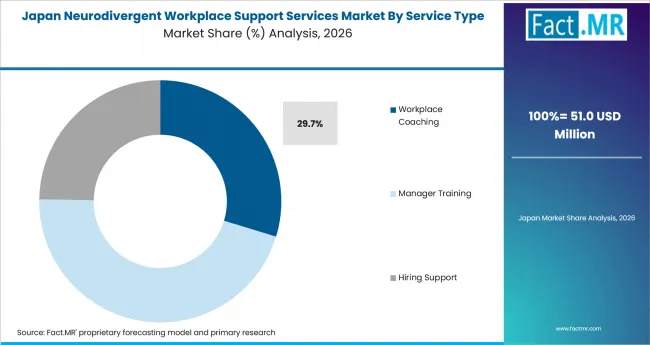
Japan is guided by statutory disability hiring requirements and careful employer risk review. The Ministry of Health, Labour and Welfare reported in November 2024 that the private-sector disability employment rate requirement was 2.5%. [9] The same source describes Hello Work support for job placement and workplace retention. Employers need role matching and manager instruction because disclosure can remain sensitive.
Who leads the neurodivergent workplace support services landscape?
Specialisterne and auticon lead through talent pathways. Genius Within leads through workplace assessment depth.
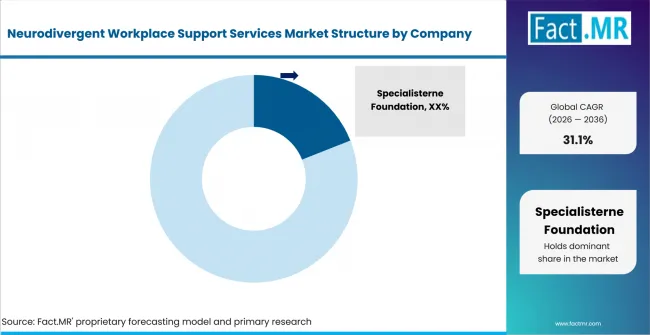
Provider competition is also shaped by artificial intelligence human resources services as large employers route candidates and employees toward support pathways. Specialist providers compete on workplace coaching evidence and employer-side change management. auticon shows the value of employing autistic technologists while advising clients. Specialisterne shows the value of connecting employers with neurodivergent talent and training support. Genius Within C.I.C. adds assessment and coaching depth for employers that need practical workplace adjustments.
Buyer selection is based on proof of outcomes and coach quality. It is also based on manager training depth and the ability to work inside existing human resources processes. Providers that only deliver awareness content are less likely to win larger programs. Competition is not led by one provider because the market includes coaching firms, talent pathway providers and assistive technology firms.
Which companies are the key players?
Specialisterne Foundation and auticon. Genius Within C.I.C. is also profiled. Mentra and Rangam are included as talent pathway providers.
- Specialisterne Foundation
- auticon
- Genius Within C.I.C.
- Everway
- Mentra
- Rangam
Bibliography
- [1] Shaw, K. A., Williams, S., Patrick, M. E., Valencia-Prado, M., Durkin, M. S., Howerton, E. M., Ladd-Acosta, C. M., Pas, E. T., Bakian, A. V., Bartholomew, P., Nieves-Muñoz, N., Sidwell, K., Alford, A., Bilder, D. A., DiRienzo, M., Fitzgerald, R. T., Furnier, S. M., Hudson, A. E., Pokoski, O. M., ... Maenner, M. J. (2025, April 17). Prevalence and early identification of autism spectrum disorder among children aged 4 and 8 years — Autism and Developmental Disabilities Monitoring Network, 16 sites, United States, 2022. MMWR Surveillance Summaries, 74(2), 1–22.
- [2] U.S. Bureau of Labor Statistics. (2025, April 25). 22.7 percent of people with a disability were employed in 2024. The Economics Daily.
- [3] Department for Work and Pensions. (2026, January 29). Access to Work statistics: April 2007 to March 2025. GOV.UK.
- [4] Department for Work and Pensions. (2026, March 24). The employment of disabled people 2025. GOV.UK.
- [5] U.S. Bureau of Labor Statistics. (2026, March 5). Unemployment rate for people with a disability rose to 8.3 percent in 2025. The Economics Daily.
- [6] Australian Bureau of Statistics. (2024, October 11). Autism in Australia, 2022.
- [7] Statistics Canada. (2024, October 8). Canadians with learning, developmental and memory disabilities, 2022. The Daily.
- [8] Eurostat. (2025, October 24). Disability statistics - unemployment and people outside the labour force. Statistics Explained.
- [9] Fujieda, S. (2024, November 25). From welfare to employment [Presentation]. Ministry of Health, Labour and Welfare.
- [10] Everway. (2026, January 28). Everway and Specialisterne USA partner to support workplace neuroinclusion.
- [11] Understood for All, Inc. (2026, May 12). Understood.org survey: Neurodiversity at work (2026).
- [12] IBM. (2025, March 20). IBM partners with Specialisterne to reskill over 200 neurodivergent jobseekers.
- [13] Specialisterne USA. (2024, July 17). The Hg Foundation partners with Specialisterne USA to support unemployed neurodivergent adults to train for and secure jobs in tech.
- [14] auticon. (2026, April 2). The Edge Effect: auticon Impact Report 2025.
- [15] Bank of Ireland. (2024, March 22). 48% of neurodivergent people have not disclosed their condition in work, according to Red C poll.
- [16] Specialisterne USA. (2026, April 27). Social Impact Report 2025: Transforming society by creating pathways for neurodivergent people to access and thrive at work.
- [17] Genius Within C.I.C. (n.d.). Ambitious for neurodivergent potential.
This Report Addresses
- Strategic intelligence on neurodivergent workplace support services across service type, buyer type and support stage.
- Forecast mapping from USD 1.50 billion in 2026 to USD 22.50 billion by 2036.
- Segment analysis covering Workplace Coaching, Large Enterprises, Retention Support and Hybrid Coaching.
- Regional outlook covering the United Kingdom, United States, Australia, Canada, Netherlands, Germany and Japan.
- Competitive analysis of Specialisterne Foundation, auticon, Genius Within C.I.C., Everway, Mentra and Rangam.
- Service assessment covering coaching, accommodation advisory, manager training and hiring support.
- Primary interviews, provider checks, official source review and public program validation support the forecast.
What does the neurodivergent workplace support services market cover?
Paid workplace coaching and accommodation planning. Manager training and neuroinclusive hiring support are included.
The neurodivergent workplace support services market covers paid services that help neurodivergent workers enter roles and remain in roles. It includes coaching and workplace needs assessment. It also covers accommodation advisory and manager training. Neuroinclusive hiring support is included when the service changes employer hiring practice. The market differs from clinical diagnosis because the service focus is workplace performance, disclosure support and manager action.
What is included in the scope?
Workplace coaching and manager training. Accommodation advisory and hiring support are included.
The scope includes employee coaching for communication and focus needs. It covers manager training that helps supervisors adjust meetings, task design and written instructions. It includes accommodation advisory, role redesign and neuroinclusive hiring support. It also includes assistive technology enablement when it is sold with workplace support rather than as a stand-alone software license.
What is excluded from the scope?
Clinical diagnosis and general therapy. Cash benefits and software-only tools without workplace support are excluded.
The scope excludes clinical diagnosis without employer or worker support services. It excludes general therapy and medical treatment unless they are tied to employer-funded job support. It excludes public cash benefits because the market measures service revenue. It also excludes generic diversity training that does not include neurodivergent workplace content.
How was the analysis built?
100+ sources and 45 company portfolios. The model covered 30 countries and 20+ interviews.
- Primary Research:
- Primary research includes interviews with workplace support providers and employer inclusion program teams. It includes input from human resources leaders and accommodation advisers.
- Desk Research:
- Desk research reviews official labor statistics and disability employment releases. It also covers provider service lines, public funding rules and specialist neuroinclusion programs.
- Market-Sizing and Forecasting:
- Forecasting uses employed disability populations, diagnosed cohort signals and paid support intensity. Service penetration by buyer type and country funding route supports the market assessment.
- Data Validation and Update Cycle:
- Forecasts are validated through provider checks and public program spending. Company developments and disability employment data help confirm market direction.
What is the report’s scope and coverage?

| Attribute | Details |
|---|---|
| Quantitative Units | USD Billion in 2026 to USD Billion by 2036 at CAGR |
| Market Definition | Paid employer and worker support services for neurodivergent workplace participation |
| Service Type | Workplace Coaching, Manager Training, Accommodation Advisory, Hiring Support, Audit Services |
| Buyer Type | Large Enterprises, Public Employers, Mid-size Firms, Universities, Staffing Partners |
| Support Stage | Retention Support, Recruitment Support, Onboarding Support, Manager Support, Career Progression |
| Delivery Model | Hybrid Coaching, Virtual Coaching, On-site Workshops, Platform Support, Managed Programs |
| Neurodivergence Focus | Autism Support, Attention Deficit Hyperactivity Disorder Support, Dyslexia Support, Mixed Needs, Dyspraxia Support |
| End Use | Technology Roles, Corporate Functions, Public Services, Professional Services, Retail Operations |
| Regions Covered | North America, Europe, Asia Pacific, Latin America, Middle East and Africa |
| Countries Covered | United Kingdom, United States, Australia, Canada, Netherlands, Germany, Japan |
| Key Companies Profiled | Specialisterne Foundation, auticon, Genius Within C.I.C., Everway, Mentra and Rangam |
| Forecast Period | 2026 to 2036 |
| Approach | Hybrid bottom-up and top-down approach using employed disability populations, public funding signals, provider capacity and service intensity |
How is the market segmented?
-
By Service Type:
- Workplace Coaching
- Manager Training
- Accommodation Advisory
- Hiring Support
- Audit Services
-
By Buyer Type:
- Large Enterprises
- Public Employers
- Mid-size Firms
- Universities
- Staffing Partners
-
By Support Stage:
- Retention Support
- Recruitment Support
- Onboarding Support
- Manager Support
- Career Progression
-
By Delivery Model:
- Hybrid Coaching
- Virtual Coaching
- On-site Workshops
- Platform Support
- Managed Programs
-
By Neurodivergence Focus:
- Autism Support
- ADHD Support
- Dyslexia Support
- Mixed Needs
- Dyspraxia Support
-
By End Use:
- Technology Roles
- Corporate Functions
- Public Services
- Professional Services
- Retail Operations
- Manufacturing Roles
-
By Region:
- North America
- United States
- Canada
- Mexico
- Latin America
- Brazil
- Argentina
- Rest of Latin America
- Europe
- Germany
- United Kingdom
- France
- Netherlands
- Italy
- Spain
- Rest of Europe
- Asia Pacific
- China
- India
- Japan
- South Korea
- Australia
- ASEAN
- Middle East & Africa
- GCC Countries
- South Africa
- UAE
- Rest of Middle East & Africa
- North America
- Frequently Asked Questions -
Which service type leads the Neurodivergent Workplace Support Services Market?
Workplace Coaching leads with 30.0% share in 2026 because most programs begin with employee and manager sessions.
Which buyer type leads the Neurodivergent Workplace Support Services Market?
Large Enterprises lead with 48.0% share in 2026 because they have formal accommodation teams and larger compliance exposure.
Which country expands faster in the Neurodivergent Workplace Support Services Market?
The United Kingdom is projected to record 32.5% CAGR through 2036 because Access to Work funding supports practical workplace support.
How does the United States perform in the Neurodivergent Workplace Support Services Market?
The United States is forecast to grow at 32.1% CAGR through 2036 as accommodation duties and enterprise programs support paid services.
How does Australia perform in the Neurodivergent Workplace Support Services Market?
Australia is expected to register 31.6% CAGR through 2036 because autism prevalence reporting and disability support systems raise employer readiness.
How does Canada perform in the Neurodivergent Workplace Support Services Market?
Canada is projected to post 31.2% CAGR through 2036 as learning and developmental disability data supports employer program design.
What is the primary driver in the Neurodivergent Workplace Support Services Market?
The primary driver is employer movement from awareness content to practical coaching and accommodation planning.
What is the main restraint in the Neurodivergent Workplace Support Services Market?
The main restraint is limited manager readiness and unclear budget ownership in smaller employers.
Why is retention support important in this market?
Retention support is important because employers often buy after disclosure or performance risk and need practical changes before avoidable exits occur.
Table of Content
- Executive Summary
- Global Market Outlook
- Demand to side Trends
- Supply to side Trends
- Technology Roadmap Analysis
- Analysis and Recommendations
- Market Overview
- Market Coverage / Taxonomy
- Market Definition / Scope / Limitations
- Research Methodology
- Chapter Orientation
- Analytical Lens and Working Hypotheses
- Market Structure, Signals, and Trend Drivers
- Benchmarking and Cross-market Comparability
- Market Sizing, Forecasting, and Opportunity Mapping
- Research Design and Evidence Framework
- Desk Research Programme (Secondary Evidence)
- Company Annual and Sustainability Reports
- Peer-reviewed Journals and Academic Literature
- Corporate Websites, Product Literature, and Technical Notes
- Earnings Decks and Investor Briefings
- Statutory Filings and Regulatory Disclosures
- Technical White Papers and Standards Notes
- Trade Journals, Industry Magazines, and Analyst Briefs
- Conference Proceedings, Webinars, and Seminar Materials
- Government Statistics Portals and Public Data Releases
- Press Releases and Reputable Media Coverage
- Specialist Newsletters and Curated Briefings
- Sector Databases and Reference Repositories
- Fact.MR Internal Proprietary Databases and Historical Market Datasets
- Subscription Datasets and Paid Sources
- Social Channels, Communities, and Digital Listening Inputs
- Additional Desk Sources
- Expert Input and Fieldwork (Primary Evidence)
- Primary Modes
- Qualitative Interviews and Expert Elicitation
- Quantitative Surveys and Structured Data Capture
- Blended Approach
- Why Primary Evidence is Used
- Field Techniques
- Interviews
- Surveys
- Focus Groups
- Observational and In-context Research
- Social and Community Interactions
- Stakeholder Universe Engaged
- C-suite Leaders
- Board Members
- Presidents and Vice Presidents
- R&D and Innovation Heads
- Technical Specialists
- Domain Subject-matter Experts
- Scientists
- Physicians and Other Healthcare Professionals
- Governance, Ethics, and Data Stewardship
- Research Ethics
- Data Integrity and Handling
- Primary Modes
- Tooling, Models, and Reference Databases
- Desk Research Programme (Secondary Evidence)
- Data Engineering and Model Build
- Data Acquisition and Ingestion
- Cleaning, Normalisation, and Verification
- Synthesis, Triangulation, and Analysis
- Quality Assurance and Audit Trail
- Market Background
- Market Dynamics
- Drivers
- Restraints
- Opportunity
- Trends
- Scenario Forecast
- Demand in Optimistic Scenario
- Demand in Likely Scenario
- Demand in Conservative Scenario
- Opportunity Map Analysis
- Product Life Cycle Analysis
- Supply Chain Analysis
- Investment Feasibility Matrix
- Value Chain Analysis
- PESTLE and Porter’s Analysis
- Regulatory Landscape
- Regional Parent Market Outlook
- Production and Consumption Statistics
- Import and Export Statistics
- Market Dynamics
- Global Market Analysis 2021 to 2025 and Forecast, 2026 to 2036
- Historical Market Size Value (USD Million) Analysis, 2021 to 2025
- Current and Future Market Size Value (USD Million) Projections, 2026 to 2036
- Y to o to Y Growth Trend Analysis
- Absolute $ Opportunity Analysis
- Global Market Pricing Analysis 2021 to 2025 and Forecast 2026 to 2036
- Global Market Analysis 2021 to 2025 and Forecast 2026 to 2036, By Service Type
- Introduction / Key Findings
- Historical Market Size Value (USD Million) Analysis By Service Type , 2021 to 2025
- Current and Future Market Size Value (USD Million) Analysis and Forecast By Service Type , 2026 to 2036
- Workplace Coaching
- Manager Training
- Hiring Support
- Workplace Coaching
- Y to o to Y Growth Trend Analysis By Service Type , 2021 to 2025
- Absolute $ Opportunity Analysis By Service Type , 2026 to 2036
- Global Market Analysis 2021 to 2025 and Forecast 2026 to 2036, By Buyer Type
- Introduction / Key Findings
- Historical Market Size Value (USD Million) Analysis By Buyer Type, 2021 to 2025
- Current and Future Market Size Value (USD Million) Analysis and Forecast By Buyer Type, 2026 to 2036
- Large Enterprises
- Public Employers
- Mid-size Firms
- Large Enterprises
- Y to o to Y Growth Trend Analysis By Buyer Type, 2021 to 2025
- Absolute $ Opportunity Analysis By Buyer Type, 2026 to 2036
- Global Market Analysis 2021 to 2025 and Forecast 2026 to 2036, By Support Stage
- Introduction / Key Findings
- Historical Market Size Value (USD Million) Analysis By Support Stage, 2021 to 2025
- Current and Future Market Size Value (USD Million) Analysis and Forecast By Support Stage, 2026 to 2036
- Retention Support
- Recruitment Support
- Onboarding Support
- Retention Support
- Y to o to Y Growth Trend Analysis By Support Stage, 2021 to 2025
- Absolute $ Opportunity Analysis By Support Stage, 2026 to 2036
- Global Market Analysis 2021 to 2025 and Forecast 2026 to 2036, By Delivery Model
- Introduction / Key Findings
- Historical Market Size Value (USD Million) Analysis By Delivery Model, 2021 to 2025
- Current and Future Market Size Value (USD Million) Analysis and Forecast By Delivery Model, 2026 to 2036
- Hybrid Coaching
- Virtual Coaching
- On-site Workshops
- Hybrid Coaching
- Y to o to Y Growth Trend Analysis By Delivery Model, 2021 to 2025
- Absolute $ Opportunity Analysis By Delivery Model, 2026 to 2036
- Global Market Analysis 2021 to 2025 and Forecast 2026 to 2036, By Neurodivergence Focus
- Introduction / Key Findings
- Historical Market Size Value (USD Million) Analysis By Neurodivergence Focus, 2021 to 2025
- Current and Future Market Size Value (USD Million) Analysis and Forecast By Neurodivergence Focus, 2026 to 2036
- Autism Support
- ADHD Support
- Mixed Needs
- Autism Support
- Y to o to Y Growth Trend Analysis By Neurodivergence Focus, 2021 to 2025
- Absolute $ Opportunity Analysis By Neurodivergence Focus, 2026 to 2036
- Global Market Analysis 2021 to 2025 and Forecast 2026 to 2036, By End Use
- Introduction / Key Findings
- Historical Market Size Value (USD Million) Analysis By End Use, 2021 to 2025
- Current and Future Market Size Value (USD Million) Analysis and Forecast By End Use, 2026 to 2036
- Technology Roles
- Corporate Functions
- Public Services
- Technology Roles
- Y to o to Y Growth Trend Analysis By End Use, 2021 to 2025
- Absolute $ Opportunity Analysis By End Use, 2026 to 2036
- Global Market Analysis 2021 to 2025 and Forecast 2026 to 2036, By Region
- Introduction
- Historical Market Size Value (USD Million) Analysis By Region, 2021 to 2025
- Current Market Size Value (USD Million) Analysis and Forecast By Region, 2026 to 2036
- North America
- Latin America
- Western Europe
- Eastern Europe
- East Asia
- South Asia and Pacific
- Middle East & Africa
- Market Attractiveness Analysis By Region
- North America Market Analysis 2021 to 2025 and Forecast 2026 to 2036, By Country
- Historical Market Size Value (USD Million) Trend Analysis By Market Taxonomy, 2021 to 2025
- Market Size Value (USD Million) Forecast By Market Taxonomy, 2026 to 2036
- By Country
- USA
- Canada
- Mexico
- By Service Type
- By Buyer Type
- By Support Stage
- By Delivery Model
- By Neurodivergence Focus
- By End Use
- By Country
- Market Attractiveness Analysis
- By Country
- By Service Type
- By Buyer Type
- By Support Stage
- By Delivery Model
- By Neurodivergence Focus
- By End Use
- Key Takeaways
- Latin America Market Analysis 2021 to 2025 and Forecast 2026 to 2036, By Country
- Historical Market Size Value (USD Million) Trend Analysis By Market Taxonomy, 2021 to 2025
- Market Size Value (USD Million) Forecast By Market Taxonomy, 2026 to 2036
- By Country
- Brazil
- Chile
- Rest of Latin America
- By Service Type
- By Buyer Type
- By Support Stage
- By Delivery Model
- By Neurodivergence Focus
- By End Use
- By Country
- Market Attractiveness Analysis
- By Country
- By Service Type
- By Buyer Type
- By Support Stage
- By Delivery Model
- By Neurodivergence Focus
- By End Use
- Key Takeaways
- Western Europe Market Analysis 2021 to 2025 and Forecast 2026 to 2036, By Country
- Historical Market Size Value (USD Million) Trend Analysis By Market Taxonomy, 2021 to 2025
- Market Size Value (USD Million) Forecast By Market Taxonomy, 2026 to 2036
- By Country
- Germany
- UK
- Italy
- Spain
- France
- Nordic
- BENELUX
- Rest of Western Europe
- By Service Type
- By Buyer Type
- By Support Stage
- By Delivery Model
- By Neurodivergence Focus
- By End Use
- By Country
- Market Attractiveness Analysis
- By Country
- By Service Type
- By Buyer Type
- By Support Stage
- By Delivery Model
- By Neurodivergence Focus
- By End Use
- Key Takeaways
- Eastern Europe Market Analysis 2021 to 2025 and Forecast 2026 to 2036, By Country
- Historical Market Size Value (USD Million) Trend Analysis By Market Taxonomy, 2021 to 2025
- Market Size Value (USD Million) Forecast By Market Taxonomy, 2026 to 2036
- By Country
- Russia
- Poland
- Hungary
- Balkan & Baltic
- Rest of Eastern Europe
- By Service Type
- By Buyer Type
- By Support Stage
- By Delivery Model
- By Neurodivergence Focus
- By End Use
- By Country
- Market Attractiveness Analysis
- By Country
- By Service Type
- By Buyer Type
- By Support Stage
- By Delivery Model
- By Neurodivergence Focus
- By End Use
- Key Takeaways
- East Asia Market Analysis 2021 to 2025 and Forecast 2026 to 2036, By Country
- Historical Market Size Value (USD Million) Trend Analysis By Market Taxonomy, 2021 to 2025
- Market Size Value (USD Million) Forecast By Market Taxonomy, 2026 to 2036
- By Country
- China
- Japan
- South Korea
- By Service Type
- By Buyer Type
- By Support Stage
- By Delivery Model
- By Neurodivergence Focus
- By End Use
- By Country
- Market Attractiveness Analysis
- By Country
- By Service Type
- By Buyer Type
- By Support Stage
- By Delivery Model
- By Neurodivergence Focus
- By End Use
- Key Takeaways
- South Asia and Pacific Market Analysis 2021 to 2025 and Forecast 2026 to 2036, By Country
- Historical Market Size Value (USD Million) Trend Analysis By Market Taxonomy, 2021 to 2025
- Market Size Value (USD Million) Forecast By Market Taxonomy, 2026 to 2036
- By Country
- India
- ASEAN
- Australia & New Zealand
- Rest of South Asia and Pacific
- By Service Type
- By Buyer Type
- By Support Stage
- By Delivery Model
- By Neurodivergence Focus
- By End Use
- By Country
- Market Attractiveness Analysis
- By Country
- By Service Type
- By Buyer Type
- By Support Stage
- By Delivery Model
- By Neurodivergence Focus
- By End Use
- Key Takeaways
- Middle East & Africa Market Analysis 2021 to 2025 and Forecast 2026 to 2036, By Country
- Historical Market Size Value (USD Million) Trend Analysis By Market Taxonomy, 2021 to 2025
- Market Size Value (USD Million) Forecast By Market Taxonomy, 2026 to 2036
- By Country
- Kingdom of Saudi Arabia
- Other GCC Countries
- Turkiye
- South Africa
- Other African Union
- Rest of Middle East & Africa
- By Service Type
- By Buyer Type
- By Support Stage
- By Delivery Model
- By Neurodivergence Focus
- By End Use
- By Country
- Market Attractiveness Analysis
- By Country
- By Service Type
- By Buyer Type
- By Support Stage
- By Delivery Model
- By Neurodivergence Focus
- By End Use
- Key Takeaways
- Key Countries Market Analysis
- USA
- Pricing Analysis
- Market Share Analysis, 2025
- By Service Type
- By Buyer Type
- By Support Stage
- By Delivery Model
- By Neurodivergence Focus
- By End Use
- Canada
- Pricing Analysis
- Market Share Analysis, 2025
- By Service Type
- By Buyer Type
- By Support Stage
- By Delivery Model
- By Neurodivergence Focus
- By End Use
- Mexico
- Pricing Analysis
- Market Share Analysis, 2025
- By Service Type
- By Buyer Type
- By Support Stage
- By Delivery Model
- By Neurodivergence Focus
- By End Use
- Brazil
- Pricing Analysis
- Market Share Analysis, 2025
- By Service Type
- By Buyer Type
- By Support Stage
- By Delivery Model
- By Neurodivergence Focus
- By End Use
- Chile
- Pricing Analysis
- Market Share Analysis, 2025
- By Service Type
- By Buyer Type
- By Support Stage
- By Delivery Model
- By Neurodivergence Focus
- By End Use
- Germany
- Pricing Analysis
- Market Share Analysis, 2025
- By Service Type
- By Buyer Type
- By Support Stage
- By Delivery Model
- By Neurodivergence Focus
- By End Use
- UK
- Pricing Analysis
- Market Share Analysis, 2025
- By Service Type
- By Buyer Type
- By Support Stage
- By Delivery Model
- By Neurodivergence Focus
- By End Use
- Italy
- Pricing Analysis
- Market Share Analysis, 2025
- By Service Type
- By Buyer Type
- By Support Stage
- By Delivery Model
- By Neurodivergence Focus
- By End Use
- Spain
- Pricing Analysis
- Market Share Analysis, 2025
- By Service Type
- By Buyer Type
- By Support Stage
- By Delivery Model
- By Neurodivergence Focus
- By End Use
- France
- Pricing Analysis
- Market Share Analysis, 2025
- By Service Type
- By Buyer Type
- By Support Stage
- By Delivery Model
- By Neurodivergence Focus
- By End Use
- India
- Pricing Analysis
- Market Share Analysis, 2025
- By Service Type
- By Buyer Type
- By Support Stage
- By Delivery Model
- By Neurodivergence Focus
- By End Use
- ASEAN
- Pricing Analysis
- Market Share Analysis, 2025
- By Service Type
- By Buyer Type
- By Support Stage
- By Delivery Model
- By Neurodivergence Focus
- By End Use
- Australia & New Zealand
- Pricing Analysis
- Market Share Analysis, 2025
- By Service Type
- By Buyer Type
- By Support Stage
- By Delivery Model
- By Neurodivergence Focus
- By End Use
- China
- Pricing Analysis
- Market Share Analysis, 2025
- By Service Type
- By Buyer Type
- By Support Stage
- By Delivery Model
- By Neurodivergence Focus
- By End Use
- Japan
- Pricing Analysis
- Market Share Analysis, 2025
- By Service Type
- By Buyer Type
- By Support Stage
- By Delivery Model
- By Neurodivergence Focus
- By End Use
- South Korea
- Pricing Analysis
- Market Share Analysis, 2025
- By Service Type
- By Buyer Type
- By Support Stage
- By Delivery Model
- By Neurodivergence Focus
- By End Use
- Russia
- Pricing Analysis
- Market Share Analysis, 2025
- By Service Type
- By Buyer Type
- By Support Stage
- By Delivery Model
- By Neurodivergence Focus
- By End Use
- Poland
- Pricing Analysis
- Market Share Analysis, 2025
- By Service Type
- By Buyer Type
- By Support Stage
- By Delivery Model
- By Neurodivergence Focus
- By End Use
- Hungary
- Pricing Analysis
- Market Share Analysis, 2025
- By Service Type
- By Buyer Type
- By Support Stage
- By Delivery Model
- By Neurodivergence Focus
- By End Use
- Kingdom of Saudi Arabia
- Pricing Analysis
- Market Share Analysis, 2025
- By Service Type
- By Buyer Type
- By Support Stage
- By Delivery Model
- By Neurodivergence Focus
- By End Use
- Turkiye
- Pricing Analysis
- Market Share Analysis, 2025
- By Service Type
- By Buyer Type
- By Support Stage
- By Delivery Model
- By Neurodivergence Focus
- By End Use
- South Africa
- Pricing Analysis
- Market Share Analysis, 2025
- By Service Type
- By Buyer Type
- By Support Stage
- By Delivery Model
- By Neurodivergence Focus
- By End Use
- USA
- Market Structure Analysis
- Competition Dashboard
- Competition Benchmarking
- Market Share Analysis of Top Players
- By Regional
- By Service Type
- By Buyer Type
- By Support Stage
- By Delivery Model
- By Neurodivergence Focus
- By End Use
- Competition Analysis
- Competition Deep Dive
- Specialisterne Foundation
- Overview
- Product Portfolio
- Profitability by Market Segments (Product/Age /Sales Channel/Region)
- Sales Footprint
- Strategy Overview
- Marketing Strategy
- Product Strategy
- Channel Strategy
- auticon
- Genius Within C.I.C.
- aEverway
- Mentra
- Rangam
- Specialisterne Foundation
- Competition Deep Dive
- Assumptions & Acronyms Used
List Of Table
- Table 1: Global Market Value (USD Million) Forecast by Region, 2021 to 2036
- Table 2: Global Market Value (USD Million) Forecast by Service Type, 2021 to 2036
- Table 3: Global Market Value (USD Million) Forecast by Buyer Type, 2021 to 2036
- Table 4: Global Market Value (USD Million) Forecast by Support Stage, 2021 to 2036
- Table 5: Global Market Value (USD Million) Forecast by Delivery Model, 2021 to 2036
- Table 6: Global Market Value (USD Million) Forecast by Neurodivergence Focus, 2021 to 2036
- Table 7: Global Market Value (USD Million) Forecast by End Use, 2021 to 2036
- Table 8: North America Market Value (USD Million) Forecast by Country, 2021 to 2036
- Table 9: North America Market Value (USD Million) Forecast by Service Type, 2021 to 2036
- Table 10: North America Market Value (USD Million) Forecast by Buyer Type, 2021 to 2036
- Table 11: North America Market Value (USD Million) Forecast by Support Stage, 2021 to 2036
- Table 12: North America Market Value (USD Million) Forecast by Delivery Model, 2021 to 2036
- Table 13: North America Market Value (USD Million) Forecast by Neurodivergence Focus, 2021 to 2036
- Table 14: North America Market Value (USD Million) Forecast by End Use, 2021 to 2036
- Table 15: Latin America Market Value (USD Million) Forecast by Country, 2021 to 2036
- Table 16: Latin America Market Value (USD Million) Forecast by Service Type, 2021 to 2036
- Table 17: Latin America Market Value (USD Million) Forecast by Buyer Type, 2021 to 2036
- Table 18: Latin America Market Value (USD Million) Forecast by Support Stage, 2021 to 2036
- Table 19: Latin America Market Value (USD Million) Forecast by Delivery Model, 2021 to 2036
- Table 20: Latin America Market Value (USD Million) Forecast by Neurodivergence Focus, 2021 to 2036
- Table 21: Latin America Market Value (USD Million) Forecast by End Use, 2021 to 2036
- Table 22: Western Europe Market Value (USD Million) Forecast by Country, 2021 to 2036
- Table 23: Western Europe Market Value (USD Million) Forecast by Service Type, 2021 to 2036
- Table 24: Western Europe Market Value (USD Million) Forecast by Buyer Type, 2021 to 2036
- Table 25: Western Europe Market Value (USD Million) Forecast by Support Stage, 2021 to 2036
- Table 26: Western Europe Market Value (USD Million) Forecast by Delivery Model, 2021 to 2036
- Table 27: Western Europe Market Value (USD Million) Forecast by Neurodivergence Focus, 2021 to 2036
- Table 28: Western Europe Market Value (USD Million) Forecast by End Use, 2021 to 2036
- Table 29: Eastern Europe Market Value (USD Million) Forecast by Country, 2021 to 2036
- Table 30: Eastern Europe Market Value (USD Million) Forecast by Service Type, 2021 to 2036
- Table 31: Eastern Europe Market Value (USD Million) Forecast by Buyer Type, 2021 to 2036
- Table 32: Eastern Europe Market Value (USD Million) Forecast by Support Stage, 2021 to 2036
- Table 33: Eastern Europe Market Value (USD Million) Forecast by Delivery Model, 2021 to 2036
- Table 34: Eastern Europe Market Value (USD Million) Forecast by Neurodivergence Focus, 2021 to 2036
- Table 35: Eastern Europe Market Value (USD Million) Forecast by End Use, 2021 to 2036
- Table 36: East Asia Market Value (USD Million) Forecast by Country, 2021 to 2036
- Table 37: East Asia Market Value (USD Million) Forecast by Service Type, 2021 to 2036
- Table 38: East Asia Market Value (USD Million) Forecast by Buyer Type, 2021 to 2036
- Table 39: East Asia Market Value (USD Million) Forecast by Support Stage, 2021 to 2036
- Table 40: East Asia Market Value (USD Million) Forecast by Delivery Model, 2021 to 2036
- Table 41: East Asia Market Value (USD Million) Forecast by Neurodivergence Focus, 2021 to 2036
- Table 42: East Asia Market Value (USD Million) Forecast by End Use, 2021 to 2036
- Table 43: South Asia and Pacific Market Value (USD Million) Forecast by Country, 2021 to 2036
- Table 44: South Asia and Pacific Market Value (USD Million) Forecast by Service Type, 2021 to 2036
- Table 45: South Asia and Pacific Market Value (USD Million) Forecast by Buyer Type, 2021 to 2036
- Table 46: South Asia and Pacific Market Value (USD Million) Forecast by Support Stage, 2021 to 2036
- Table 47: South Asia and Pacific Market Value (USD Million) Forecast by Delivery Model, 2021 to 2036
- Table 48: South Asia and Pacific Market Value (USD Million) Forecast by Neurodivergence Focus, 2021 to 2036
- Table 49: South Asia and Pacific Market Value (USD Million) Forecast by End Use, 2021 to 2036
- Table 50: Middle East & Africa Market Value (USD Million) Forecast by Country, 2021 to 2036
- Table 51: Middle East & Africa Market Value (USD Million) Forecast by Service Type, 2021 to 2036
- Table 52: Middle East & Africa Market Value (USD Million) Forecast by Buyer Type, 2021 to 2036
- Table 53: Middle East & Africa Market Value (USD Million) Forecast by Support Stage, 2021 to 2036
- Table 54: Middle East & Africa Market Value (USD Million) Forecast by Delivery Model, 2021 to 2036
- Table 55: Middle East & Africa Market Value (USD Million) Forecast by Neurodivergence Focus, 2021 to 2036
- Table 56: Middle East & Africa Market Value (USD Million) Forecast by End Use, 2021 to 2036
List Of Figures
- Figure 1: Global Market Pricing Analysis
- Figure 2: Global Market Value (USD Million) Forecast 2021-2036
- Figure 3: Global Market Value Share and BPS Analysis by Service Type, 2026 and 2036
- Figure 4: Global Market Y-o-Y Growth Comparison by Service Type, 2026 to 2036
- Figure 5: Global Market Attractiveness Analysis by Service Type
- Figure 6: Global Market Value Share and BPS Analysis by Buyer Type, 2026 and 2036
- Figure 7: Global Market Y-o-Y Growth Comparison by Buyer Type, 2026 to 2036
- Figure 8: Global Market Attractiveness Analysis by Buyer Type
- Figure 9: Global Market Value Share and BPS Analysis by Support Stage, 2026 and 2036
- Figure 10: Global Market Y-o-Y Growth Comparison by Support Stage, 2026 to 2036
- Figure 11: Global Market Attractiveness Analysis by Support Stage
- Figure 12: Global Market Value Share and BPS Analysis by Delivery Model, 2026 and 2036
- Figure 13: Global Market Y-o-Y Growth Comparison by Delivery Model, 2026 to 2036
- Figure 14: Global Market Attractiveness Analysis by Delivery Model
- Figure 15: Global Market Value Share and BPS Analysis by Neurodivergence Focus, 2026 and 2036
- Figure 16: Global Market Y-o-Y Growth Comparison by Neurodivergence Focus, 2026 to 2036
- Figure 17: Global Market Attractiveness Analysis by Neurodivergence Focus
- Figure 18: Global Market Value Share and BPS Analysis by End Use, 2026 and 2036
- Figure 19: Global Market Y-o-Y Growth Comparison by End Use, 2026 to 2036
- Figure 20: Global Market Attractiveness Analysis by End Use
- Figure 21: Global Market Value (USD Million) Share and BPS Analysis by Region, 2026 and 2036
- Figure 22: Global Market Y-o-Y Growth Comparison by Region, 2026 to 2036
- Figure 23: Global Market Attractiveness Analysis by Region
- Figure 24: North America Market Incremental Dollar Opportunity, 2026 to 2036
- Figure 25: Latin America Market Incremental Dollar Opportunity, 2026 to 2036
- Figure 26: Western Europe Market Incremental Dollar Opportunity, 2026 to 2036
- Figure 27: Eastern Europe Market Incremental Dollar Opportunity, 2026 to 2036
- Figure 28: East Asia Market Incremental Dollar Opportunity, 2026 to 2036
- Figure 29: South Asia and Pacific Market Incremental Dollar Opportunity, 2026 to 2036
- Figure 30: Middle East & Africa Market Incremental Dollar Opportunity, 2026 to 2036
- Figure 31: North America Market Value Share and BPS Analysis by Country, 2026 and 2036
- Figure 32: North America Market Value Share and BPS Analysis by Service Type, 2026 and 2036
- Figure 33: North America Market Y-o-Y Growth Comparison by Service Type, 2026 to 2036
- Figure 34: North America Market Attractiveness Analysis by Service Type
- Figure 35: North America Market Value Share and BPS Analysis by Buyer Type, 2026 and 2036
- Figure 36: North America Market Y-o-Y Growth Comparison by Buyer Type, 2026 to 2036
- Figure 37: North America Market Attractiveness Analysis by Buyer Type
- Figure 38: North America Market Value Share and BPS Analysis by Support Stage, 2026 and 2036
- Figure 39: North America Market Y-o-Y Growth Comparison by Support Stage, 2026 to 2036
- Figure 40: North America Market Attractiveness Analysis by Support Stage
- Figure 41: North America Market Value Share and BPS Analysis by Delivery Model, 2026 and 2036
- Figure 42: North America Market Y-o-Y Growth Comparison by Delivery Model, 2026 to 2036
- Figure 43: North America Market Attractiveness Analysis by Delivery Model
- Figure 44: North America Market Value Share and BPS Analysis by Neurodivergence Focus, 2026 and 2036
- Figure 45: North America Market Y-o-Y Growth Comparison by Neurodivergence Focus, 2026 to 2036
- Figure 46: North America Market Attractiveness Analysis by Neurodivergence Focus
- Figure 47: North America Market Value Share and BPS Analysis by End Use, 2026 and 2036
- Figure 48: North America Market Y-o-Y Growth Comparison by End Use, 2026 to 2036
- Figure 49: North America Market Attractiveness Analysis by End Use
- Figure 50: Latin America Market Value Share and BPS Analysis by Country, 2026 and 2036
- Figure 51: Latin America Market Value Share and BPS Analysis by Service Type, 2026 and 2036
- Figure 52: Latin America Market Y-o-Y Growth Comparison by Service Type, 2026 to 2036
- Figure 53: Latin America Market Attractiveness Analysis by Service Type
- Figure 54: Latin America Market Value Share and BPS Analysis by Buyer Type, 2026 and 2036
- Figure 55: Latin America Market Y-o-Y Growth Comparison by Buyer Type, 2026 to 2036
- Figure 56: Latin America Market Attractiveness Analysis by Buyer Type
- Figure 57: Latin America Market Value Share and BPS Analysis by Support Stage, 2026 and 2036
- Figure 58: Latin America Market Y-o-Y Growth Comparison by Support Stage, 2026 to 2036
- Figure 59: Latin America Market Attractiveness Analysis by Support Stage
- Figure 60: Latin America Market Value Share and BPS Analysis by Delivery Model, 2026 and 2036
- Figure 61: Latin America Market Y-o-Y Growth Comparison by Delivery Model, 2026 to 2036
- Figure 62: Latin America Market Attractiveness Analysis by Delivery Model
- Figure 63: Latin America Market Value Share and BPS Analysis by Neurodivergence Focus, 2026 and 2036
- Figure 64: Latin America Market Y-o-Y Growth Comparison by Neurodivergence Focus, 2026 to 2036
- Figure 65: Latin America Market Attractiveness Analysis by Neurodivergence Focus
- Figure 66: Latin America Market Value Share and BPS Analysis by End Use, 2026 and 2036
- Figure 67: Latin America Market Y-o-Y Growth Comparison by End Use, 2026 to 2036
- Figure 68: Latin America Market Attractiveness Analysis by End Use
- Figure 69: Western Europe Market Value Share and BPS Analysis by Country, 2026 and 2036
- Figure 70: Western Europe Market Value Share and BPS Analysis by Service Type, 2026 and 2036
- Figure 71: Western Europe Market Y-o-Y Growth Comparison by Service Type, 2026 to 2036
- Figure 72: Western Europe Market Attractiveness Analysis by Service Type
- Figure 73: Western Europe Market Value Share and BPS Analysis by Buyer Type, 2026 and 2036
- Figure 74: Western Europe Market Y-o-Y Growth Comparison by Buyer Type, 2026 to 2036
- Figure 75: Western Europe Market Attractiveness Analysis by Buyer Type
- Figure 76: Western Europe Market Value Share and BPS Analysis by Support Stage, 2026 and 2036
- Figure 77: Western Europe Market Y-o-Y Growth Comparison by Support Stage, 2026 to 2036
- Figure 78: Western Europe Market Attractiveness Analysis by Support Stage
- Figure 79: Western Europe Market Value Share and BPS Analysis by Delivery Model, 2026 and 2036
- Figure 80: Western Europe Market Y-o-Y Growth Comparison by Delivery Model, 2026 to 2036
- Figure 81: Western Europe Market Attractiveness Analysis by Delivery Model
- Figure 82: Western Europe Market Value Share and BPS Analysis by Neurodivergence Focus, 2026 and 2036
- Figure 83: Western Europe Market Y-o-Y Growth Comparison by Neurodivergence Focus, 2026 to 2036
- Figure 84: Western Europe Market Attractiveness Analysis by Neurodivergence Focus
- Figure 85: Western Europe Market Value Share and BPS Analysis by End Use, 2026 and 2036
- Figure 86: Western Europe Market Y-o-Y Growth Comparison by End Use, 2026 to 2036
- Figure 87: Western Europe Market Attractiveness Analysis by End Use
- Figure 88: Eastern Europe Market Value Share and BPS Analysis by Country, 2026 and 2036
- Figure 89: Eastern Europe Market Value Share and BPS Analysis by Service Type, 2026 and 2036
- Figure 90: Eastern Europe Market Y-o-Y Growth Comparison by Service Type, 2026 to 2036
- Figure 91: Eastern Europe Market Attractiveness Analysis by Service Type
- Figure 92: Eastern Europe Market Value Share and BPS Analysis by Buyer Type, 2026 and 2036
- Figure 93: Eastern Europe Market Y-o-Y Growth Comparison by Buyer Type, 2026 to 2036
- Figure 94: Eastern Europe Market Attractiveness Analysis by Buyer Type
- Figure 95: Eastern Europe Market Value Share and BPS Analysis by Support Stage, 2026 and 2036
- Figure 96: Eastern Europe Market Y-o-Y Growth Comparison by Support Stage, 2026 to 2036
- Figure 97: Eastern Europe Market Attractiveness Analysis by Support Stage
- Figure 98: Eastern Europe Market Value Share and BPS Analysis by Delivery Model, 2026 and 2036
- Figure 99: Eastern Europe Market Y-o-Y Growth Comparison by Delivery Model, 2026 to 2036
- Figure 100: Eastern Europe Market Attractiveness Analysis by Delivery Model
- Figure 101: Eastern Europe Market Value Share and BPS Analysis by Neurodivergence Focus, 2026 and 2036
- Figure 102: Eastern Europe Market Y-o-Y Growth Comparison by Neurodivergence Focus, 2026 to 2036
- Figure 103: Eastern Europe Market Attractiveness Analysis by Neurodivergence Focus
- Figure 104: Eastern Europe Market Value Share and BPS Analysis by End Use, 2026 and 2036
- Figure 105: Eastern Europe Market Y-o-Y Growth Comparison by End Use, 2026 to 2036
- Figure 106: Eastern Europe Market Attractiveness Analysis by End Use
- Figure 107: East Asia Market Value Share and BPS Analysis by Country, 2026 and 2036
- Figure 108: East Asia Market Value Share and BPS Analysis by Service Type, 2026 and 2036
- Figure 109: East Asia Market Y-o-Y Growth Comparison by Service Type, 2026 to 2036
- Figure 110: East Asia Market Attractiveness Analysis by Service Type
- Figure 111: East Asia Market Value Share and BPS Analysis by Buyer Type, 2026 and 2036
- Figure 112: East Asia Market Y-o-Y Growth Comparison by Buyer Type, 2026 to 2036
- Figure 113: East Asia Market Attractiveness Analysis by Buyer Type
- Figure 114: East Asia Market Value Share and BPS Analysis by Support Stage, 2026 and 2036
- Figure 115: East Asia Market Y-o-Y Growth Comparison by Support Stage, 2026 to 2036
- Figure 116: East Asia Market Attractiveness Analysis by Support Stage
- Figure 117: East Asia Market Value Share and BPS Analysis by Delivery Model, 2026 and 2036
- Figure 118: East Asia Market Y-o-Y Growth Comparison by Delivery Model, 2026 to 2036
- Figure 119: East Asia Market Attractiveness Analysis by Delivery Model
- Figure 120: East Asia Market Value Share and BPS Analysis by Neurodivergence Focus, 2026 and 2036
- Figure 121: East Asia Market Y-o-Y Growth Comparison by Neurodivergence Focus, 2026 to 2036
- Figure 122: East Asia Market Attractiveness Analysis by Neurodivergence Focus
- Figure 123: East Asia Market Value Share and BPS Analysis by End Use, 2026 and 2036
- Figure 124: East Asia Market Y-o-Y Growth Comparison by End Use, 2026 to 2036
- Figure 125: East Asia Market Attractiveness Analysis by End Use
- Figure 126: South Asia and Pacific Market Value Share and BPS Analysis by Country, 2026 and 2036
- Figure 127: South Asia and Pacific Market Value Share and BPS Analysis by Service Type, 2026 and 2036
- Figure 128: South Asia and Pacific Market Y-o-Y Growth Comparison by Service Type, 2026 to 2036
- Figure 129: South Asia and Pacific Market Attractiveness Analysis by Service Type
- Figure 130: South Asia and Pacific Market Value Share and BPS Analysis by Buyer Type, 2026 and 2036
- Figure 131: South Asia and Pacific Market Y-o-Y Growth Comparison by Buyer Type, 2026 to 2036
- Figure 132: South Asia and Pacific Market Attractiveness Analysis by Buyer Type
- Figure 133: South Asia and Pacific Market Value Share and BPS Analysis by Support Stage, 2026 and 2036
- Figure 134: South Asia and Pacific Market Y-o-Y Growth Comparison by Support Stage, 2026 to 2036
- Figure 135: South Asia and Pacific Market Attractiveness Analysis by Support Stage
- Figure 136: South Asia and Pacific Market Value Share and BPS Analysis by Delivery Model, 2026 and 2036
- Figure 137: South Asia and Pacific Market Y-o-Y Growth Comparison by Delivery Model, 2026 to 2036
- Figure 138: South Asia and Pacific Market Attractiveness Analysis by Delivery Model
- Figure 139: South Asia and Pacific Market Value Share and BPS Analysis by Neurodivergence Focus, 2026 and 2036
- Figure 140: South Asia and Pacific Market Y-o-Y Growth Comparison by Neurodivergence Focus, 2026 to 2036
- Figure 141: South Asia and Pacific Market Attractiveness Analysis by Neurodivergence Focus
- Figure 142: South Asia and Pacific Market Value Share and BPS Analysis by End Use, 2026 and 2036
- Figure 143: South Asia and Pacific Market Y-o-Y Growth Comparison by End Use, 2026 to 2036
- Figure 144: South Asia and Pacific Market Attractiveness Analysis by End Use
- Figure 145: Middle East & Africa Market Value Share and BPS Analysis by Country, 2026 and 2036
- Figure 146: Middle East & Africa Market Value Share and BPS Analysis by Service Type, 2026 and 2036
- Figure 147: Middle East & Africa Market Y-o-Y Growth Comparison by Service Type, 2026 to 2036
- Figure 148: Middle East & Africa Market Attractiveness Analysis by Service Type
- Figure 149: Middle East & Africa Market Value Share and BPS Analysis by Buyer Type, 2026 and 2036
- Figure 150: Middle East & Africa Market Y-o-Y Growth Comparison by Buyer Type, 2026 to 2036
- Figure 151: Middle East & Africa Market Attractiveness Analysis by Buyer Type
- Figure 152: Middle East & Africa Market Value Share and BPS Analysis by Support Stage, 2026 and 2036
- Figure 153: Middle East & Africa Market Y-o-Y Growth Comparison by Support Stage, 2026 to 2036
- Figure 154: Middle East & Africa Market Attractiveness Analysis by Support Stage
- Figure 155: Middle East & Africa Market Value Share and BPS Analysis by Delivery Model, 2026 and 2036
- Figure 156: Middle East & Africa Market Y-o-Y Growth Comparison by Delivery Model, 2026 to 2036
- Figure 157: Middle East & Africa Market Attractiveness Analysis by Delivery Model
- Figure 158: Middle East & Africa Market Value Share and BPS Analysis by Neurodivergence Focus, 2026 and 2036
- Figure 159: Middle East & Africa Market Y-o-Y Growth Comparison by Neurodivergence Focus, 2026 to 2036
- Figure 160: Middle East & Africa Market Attractiveness Analysis by Neurodivergence Focus
- Figure 161: Middle East & Africa Market Value Share and BPS Analysis by End Use, 2026 and 2036
- Figure 162: Middle East & Africa Market Y-o-Y Growth Comparison by End Use, 2026 to 2036
- Figure 163: Middle East & Africa Market Attractiveness Analysis by End Use
- Figure 164: Global Market - Tier Structure Analysis
- Figure 165: Global Market - Company Share Analysis