Menopause Care & Workplace Support Services Market Size, Share, Growth and Forecast (2026 - 2036)
The Menopause Care & Workplace Support Services Market is segmented by Service Type, by Care Stage, by Customer Type, by Delivery Model, by End Use and Region. Forecast for 2026 to 2036.
What is the menopause care and workplace support services market forecast to be worth by 2036?
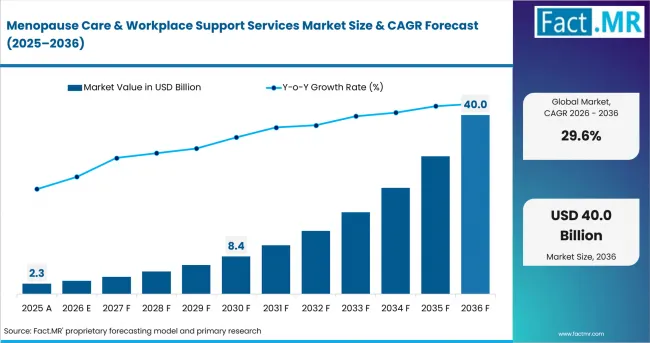
USD 3.0 billion in services in 2026 to USD 40.0 billion by 2036, at 29.6% CAGR.
- The menopause care and workplace support services market crossed a valuation of USD 2.3 billion in services in 2025.
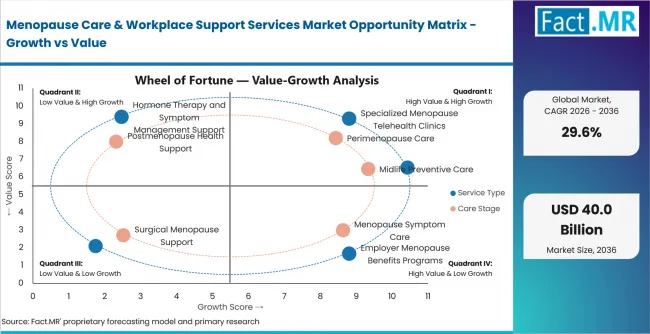
- Demand is expected to increase from USD 3.0 billion in services in 2026 to USD 40.0 billion by 2036.
- The market is forecast to record 29.6% CAGR during 2026 to 2036 as specialized clinics and employer benefits programs scale.
What are the defining numbers behind menopause care and workplace support services growth?
USD 37.0 billion absolute opportunity by 2036, led by the United Kingdom and the United States.
- Demand Drivers in the Market
- Women need specialist care because menopause symptoms can affect sleep and working life.
- Employers need benefits that support retention of experienced midlife employees.
- Health plans need structured care pathways for an undertreated population.
- Digital clinics need scalable care models across perimenopause and postmenopause.
- Key Segments Analyzed
- By Service Type: Specialized menopause telehealth clinics are expected to hold 36.0% share in 2026 as virtual access solves specialist-care gaps.
- By Care Stage: Perimenopause care leads because symptoms often begin before final menstrual period. The share is projected at 39.0% in 2026.
- By Customer Type: Employers and health plans are likely to account for 40.0% share in 2026 because benefits programs are becoming a formal access channel.
- By Delivery Model: Virtual clinic and app-based care leads as women need private access to specialist support. The model is projected to hold 42.0% share in 2026.
- By End Use: Symptom management and clinical care is expected to hold 38.0% share in 2026 as symptom relief drives first service adoption.
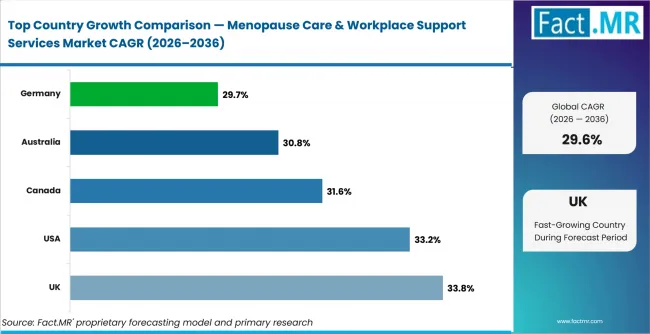
- By Geography: The United Kingdom is projected to record 33.8% CAGR through 2036 as workplace menopause guidance and employer action plans expand.
- Analyst Opinion at Fact.MR
- Shambhu Nath Jha, Senior Analyst at Fact.MR, states, “Menopause care is becoming a structured service market across workplaces and telehealth platforms. Employers are looking for ways to support midlife women and retain experienced talent. Providers that combine clinical care and workplace training will gain stronger access to women’s health benefits budgets.”
- Strategic Implications
- Employers should add menopause benefits to reduce attrition among experienced workers.
- Telehealth clinics need specialist provider networks that can support symptom management at scale.
- Health plans should treat menopause care as midlife preventive care, not a short-term consultation.
- Workplace platforms need policy training and confidential care navigation in one service model.
Specialized menopause clinics and employer benefits programs covering perimenopause-to-postmenopause care for the 1B+ women in menopause globally by 2030. WHO states that the global population of postmenopausal women is growing, and women aged 50 and over accounted for 26% of all women and girls globally in 2021. [1] This creates a large care base for midlife women’s health services.
The United Kingdom is projected to record 33.8% CAGR from 2026 to 2036 as workplace menopause guidance and employer action plans expand. The United States is likely to post 33.2% CAGR as Midi and other digital clinics scale through employers and health plans. Canada is expected to register 31.6% CAGR as employer benefits and midlife women’s health access improve. Australia is forecast to advance at 30.8% CAGR as telehealth care and workplace policies gain adoption. Germany is set to record 29.7% CAGR by 2036 as clinical care demand and employer support programs expand.
How does the menopause care and workplace support services market break down by segment?
Specialized Menopause Telehealth Clinics lead at 36.0%; Perimenopause Care leads at 39.0%.
Which service type dominates?
Specialized Menopause Telehealth Clinics hold 36.0% share in 2026.
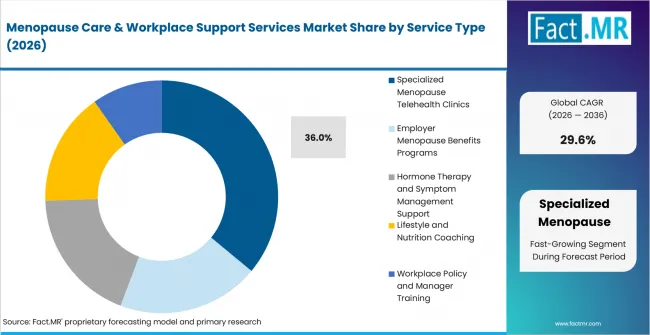
Specialized menopause telehealth clinics are expected to hold 36.0% share in 2026 because many women lack easy access to menopause-trained clinicians. Carrot launched a virtual menopause and midlife clinic in 2025 that gives members access to vetted menopause specialists, menopause-related medications, mental and emotional support, nutritionists and dietitians [2]. Virtual clinics can connect women with menopause-focused clinicians and coaches without long specialist wait times.
Which care stage dominates?
Perimenopause care leads because symptoms often begin before final menstrual period.
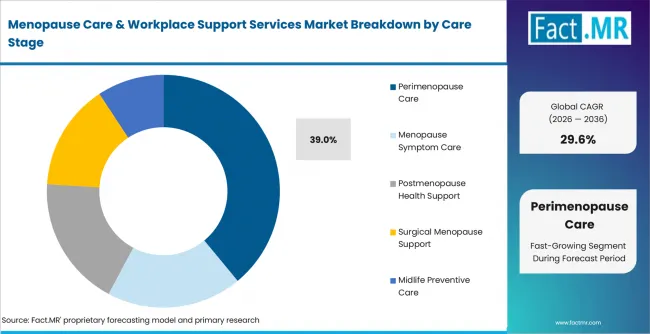
Perimenopause care leads because many women first seek help during irregular cycles and mood changes. The care stage is projected to capture 39.0% share in 2026 as awareness improves among women aged 40 to 55. EHRC guidance states that menopause usually happens between ages 45 and 55, and perimenopause is the stage with symptoms before periods stop. [3] Early care helps women manage symptoms before work and daily life are heavily disrupted.
Which customer type dominates?
Employers and Health Plans hold 40.0% share in 2026.
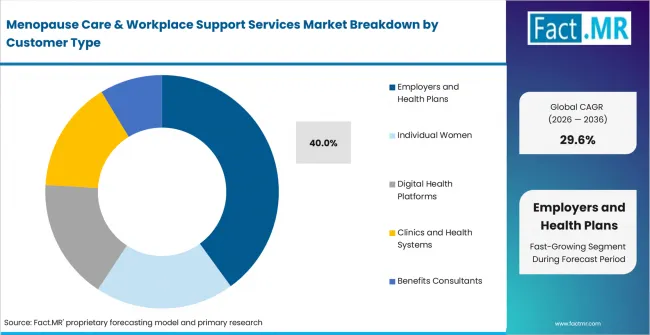
Employers and health plans are likely to account for 40.0% share in 2026 because workplace benefits are becoming a major access channel. Maven stated that its menopause program covered 3.5 million lives across more than 350 employers in 2024. [4] Employers need programs that support experienced employees and reduce avoidable exits. Health plans can also use menopause benefits to improve midlife women’s health access.
Which delivery model dominates?
Virtual Clinic and App-Based Care leads because women need private and flexible access.
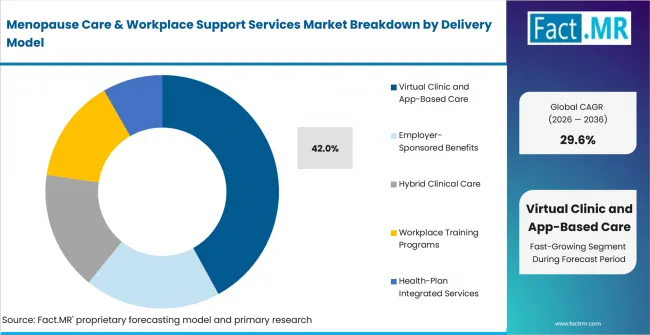
Virtual clinic and app-based care leads because menopause symptoms often require repeated support rather than a single visit. The model is projected to hold 42.0% share in 2026 as platforms combine clinicians and follow-up. Digital care fits workplace benefits because employees can access support privately.
Which end use dominates?
Symptom Management and Clinical Care holds 38.0% share in 2026.
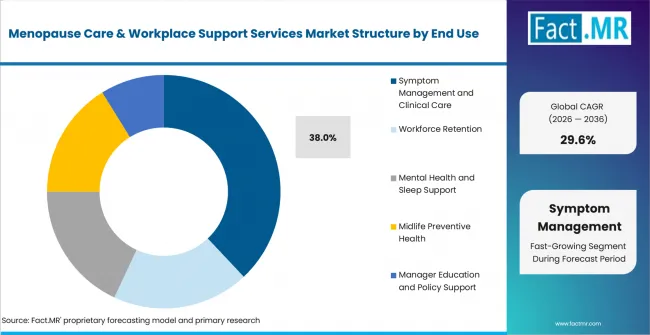
Symptom management and clinical care leads because relief from disruptive symptoms is the first reason women seek support. The end use is expected to hold 38.0% share in 2026 as women look for help with vasomotor symptoms and genitourinary symptoms. Care services combine clinical review with education and lifestyle support
What is accelerating menopause care and workplace support demand, and what is holding it back?
Workplace policy momentum and undertreated symptoms drive demand; stigma and care gaps restrain adoption.
Workplace policy momentum is the main driver. The Equality and Human Rights Commission’s 2024 menopause workplace guidance says employers should consider workplace adjustments and understand their legal duties to support workers experiencing menopausal symptoms [5]. This supports demand for menopause care and workplace support services as employers formalize policies and employee assistance routes.
The main restraint is stigma. Many women may not ask for support even if symptoms affect work and health. Providers must offer confidential access and clear education before adoption can scale.
Where do the biggest menopause care and workplace support opportunities sit?
Telehealth clinics and manager training.
- Telehealth Clinics: Providers can deliver menopause specialist access across regions with limited in-person care.
- Employer Benefits: Companies can support retention through confidential care and symptom management services.
- Manager Training: Workplace platforms can help managers support employees without stigma or inappropriate disclosure.
Which countries are scaling menopause care and workplace support services fastest?
United Kingdom 33.8%, United States 33.2%, Canada 31.6%, Australia 30.8%, Germany 29.7%.
Based on regional analysis, the menopause care and workplace support services market is segmented into Western Europe, North America, Asia Pacific, Latin America, and Middle East and Africa.
.webp)
| Country | CAGR |
|---|---|
| United Kingdom | 33.8% |
| United States | 33.2% |
| Canada | 31.6% |
| Australia | 30.8% |
| Germany | 29.7% |

What is powering the United Kingdom lead?
The United Kingdom is projected to record 33.8% CAGR through 2036 as workplace menopause guidance and employer action plans expand. Peppy gives the UK market an employer-benefit service model focused on menopause support. Demand will focus on workplace education and confidential care navigation. Employers will use these services to support retention and reduce avoidable absence among experienced workers.
How is the United States scaling menopause care demand?
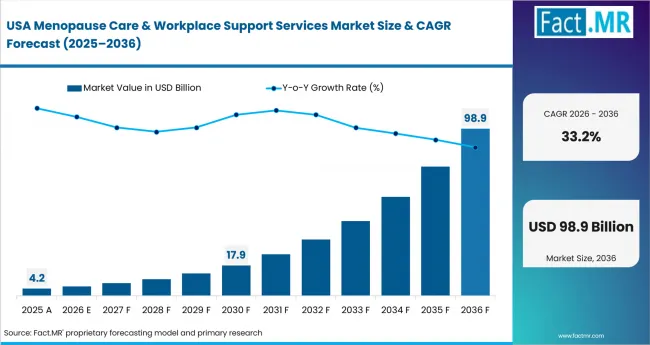
The United States is likely to post 33.2% CAGR through 2036 as Midi and other digital clinics scale through employers and health plans. U.S. demand will favor insured telehealth care and personalized symptom management. Growth will be strongest among large employers and health plans seeking women’s health benefits beyond fertility and maternity.
What underpins Canada’s growth?
Canada is expected to register 31.6% CAGR through 2036 as employer benefits and midlife women’s health access improve. Canadian employers are adding more gender-specific health support as workforce retention becomes a bigger priority. Women in midlife need symptom care and credible information. Employer benefit consultants can help companies introduce menopause support without creating stigma. Demand will favor virtual-care models that work across provinces. Growth will be strongest among large employers and professional services firms with midlife workforce concentration.
How is Australia scaling menopause workplace support?
Australia is forecast to advance at 30.8% CAGR through 2036 as telehealth care and workplace policies gain adoption. Employers are becoming more aware that menopause symptoms can affect productivity and participation. Telehealth gives women private access to clinicians and coaches, including outside major cities. Workplace programs can support managers and symptom education. Demand will favor integrated services that combine care navigation and employer guidance.
Why is Germany an important menopause care market?
Germany is set to record 29.7% CAGR through 2036 as clinical care demand and employer support programs expand. Women in midlife need evidence-based symptom support and preventive health guidance. German employers will increasingly treat menopause as a workforce health and retention issue. Health plans can support menopause care through structured consultations and digital pathways.
Who leads the menopause care and workplace support services landscape?

Midi Health and Peppy lead through menopause telehealth and employer benefit programs.
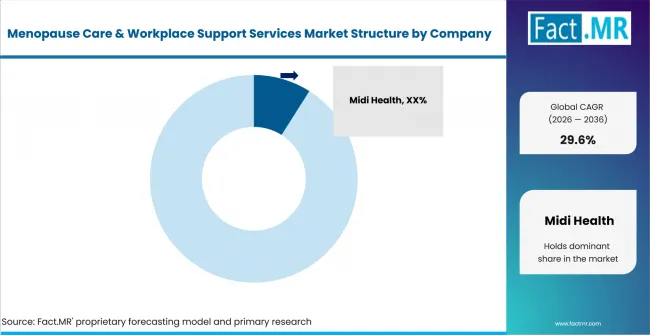
Menopause care and workplace support services are used by women and health plans that need structured support through midlife health changes. Midi Health provides virtual care for menopause and perimenopause and offers an employer access model. Maven Clinic provides Menopause and Midlife Health support through employer and health plan channels. Peppy provides menopause care as an employee benefit.
Elektra Health supports workplace menopause education and care access. Gennev, through Unified Women’s Healthcare, offers virtual menopause care supported by clinicians and registered dietitian nutritionists.
Competition through 2036 will depend on clinical access and measurable workforce outcomes. Providers that combine medical care with coaching and workplace training will be better placed. Telehealth clinics can win direct-to-consumer and insured care. Employer-benefit platforms can win HR budgets. Integrated women’s health providers can support menopause care alongside broader midlife health services.
Which companies are the key players?
Midi Health, Maven Clinic, Peppy, Elektra Health and Gennev.
- Midi Health
- Maven Clinic
- Peppy
- Elektra Health
- Gennev (Unified)
Bibliography
- [1] World Health Organization. (2024, October 16). Menopause. World Health Organization.
- [2] Carrot. (2025, February 4). Carrot launches virtual menopause and midlife clinic. Carrot.
- [3] Equality and Human Rights Commission. (2024, February 22). Menopause in the workplace: Guidance for employers. Equality and Human Rights Commission.
- [4] Maven Clinic. (2024, January 18). Maven Clinic and BSI partner to offer industry-leading menopause support to BSI employees worldwide. Maven Clinic.
- [5] Equality and Human Rights Commission. (2024, February 22). Menopause in the workplace: Guidance for employers. Equality and Human Rights Commission.
This Report Addresses
- Strategic intelligence on menopause care and workplace support services across service type, care stage and customer type.
- Segment analysis covering Specialized Menopause Telehealth Clinics, Perimenopause Care, Employers and Health Plans, Virtual Clinic and App-Based Care and Symptom Management.
- Regional outlook covering the United Kingdom, United States, Canada, Australia and Germany.
- Competitive analysis of Midi Health, Maven Clinic, Peppy, Elektra Health and Gennev.
- Service assessment covering menopause telehealth, employer benefits, symptom care and workplace policy support.
- Care-stage assessment covering perimenopause, menopause symptom care, postmenopause health and midlife preventive care.
- Primary interviews, provider checks, official source review and employer benefits validation support the forecast.
What does the menopause care and workplace support services market cover?
Specialized clinical care and employer benefit programs.
The menopause care and workplace support services market covers clinical and workplace services for women in perimenopause and postmenopause. It includes symptom management and manager training. The market differs from menopause drug markets because the focus is service delivery and employer benefits.
What is included in the scope?
Telehealth care and workplace policy services.
The scope includes specialized menopause consultations and ongoing symptom support. It covers employer-funded menopause benefits and policy guidance. It includes lifestyle coaching and mental health navigation tied to menopause care. It also includes midlife preventive care delivered through menopause-focused service platforms.
What is excluded from the scope?
Drug manufacturing and general wellness programs without menopause-specific support.
The scope excludes hormone therapy drug manufacturing and pharmaceutical sales. It excludes generic telehealth services with no menopause care component. It excludes broad wellness apps unless menopause support is part of the service. It also excludes workplace diversity programs that do not provide menopause policy or care support.
How was the analysis built?
100+ sources, 45+ company portfolios, 25+ countries, 20+ interviews.
- Primary Research: Primary research includes interviews with employer benefits teams and menopause care providers. It includes input from telehealth clinics and workplace wellbeing consultants.
- Desk Research: Desk research reviews WHO menopause evidence and workplace guidance. It covers official provider pages and menopause care service disclosures.
- Market-Sizing and Forecasting: Forecasting uses women aged 45 to 60 in covered regions and clinic service intensity. Telehealth penetration and payer coverage support the market assessment.
- Data Validation and Update Cycle: Forecasts are validated through provider checks and employer benefits review. Workplace policy updates and telehealth care expansion help confirm market direction.
What is the report’s scope and coverage?
| Attribute | Details |
|---|---|
| Quantitative Units | USD Billion in services in 2026 to USD Billion by 2036 |
| Market Definition | Specialized menopause clinics, telehealth and employer benefits programs covering perimenopause-to-postmenopause care |
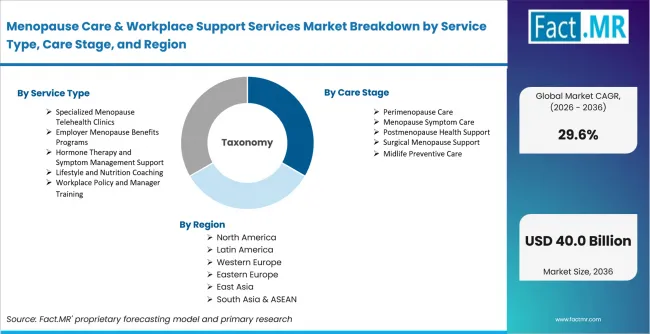
| Service Type | Specialized Menopause Telehealth Clinics, Employer Menopause Benefits Programs, Hormone Therapy and Symptom Management Support, Lifestyle and Nutrition Coaching, Workplace Policy and Manager Training |
| Care Stage | Perimenopause Care, Menopause Symptom Care, Postmenopause Health Support, Surgical Menopause Support, Midlife Preventive Care |
| Customer Type | Employers and Health Plans, Individual Women, Digital Health Platforms, Clinics and Health Systems, Benefits Consultants |
| Delivery Model | Virtual Clinic and App-Based Care, Employer-Sponsored Benefits, Hybrid Clinical Care, Workplace Training Programs, Health-Plan Integrated Services |
| End Use | Symptom Management and Clinical Care, Workforce Retention, Mental Health and Sleep Support, Midlife Preventive Health, Manager Education and Policy Support |
| Regions Covered | Western Europe, North America, Asia Pacific, Latin America, Middle East and Africa |
| Countries Covered | United Kingdom, United States, Canada, Australia, Germany |
| Key Companies Profiled | Midi Health, Maven Clinic, Peppy, Elektra Health and Gennev |
| Forecast Period | 2026 to 2036 |
| Approach | Hybrid top-down and bottom-up approach using women aged 45 to 60, employer benefit adoption, virtual clinic penetration, payer coverage and provider validation |
How is the market segmented?
-
By Service Type:
- Specialized Menopause Telehealth Clinics
- Employer Menopause Benefits Programs
- Hormone Therapy and Symptom Management Support
- Lifestyle and Nutrition Coaching
- Workplace Policy and Manager Training
-
By Care Stage:
- Perimenopause Care
- Menopause Symptom Care
- Postmenopause Health Support
- Surgical Menopause Support
- Midlife Preventive Care
-
By Customer Type:
- Employers and Health Plans
- Individual Women
- Digital Health Platforms
- Clinics and Health Systems
- Benefits Consultants
-
By Delivery Model:
- Virtual Clinic and App-Based Care
- Employer-Sponsored Benefits
- Hybrid Clinical Care
- Workplace Training Programs
- Health-Plan Integrated Services
-
By End Use:
- Symptom Management and Clinical Care
- Workforce Retention
- Mental Health and Sleep Support
- Midlife Preventive Health
- Manager Education and Policy Support
-
Region:
- North America
- United States
- Canada
- Europe
- United Kingdom
- Germany
- France
- Netherlands
- Spain
- Asia Pacific
- Australia
- Japan
- South Korea
- Singapore
- India
- Latin America
- Brazil
- Mexico
- Chile
- Middle East & Africa
- GCC Countries
- South Africa
- Israel
- North America
- Frequently Asked Questions -
Which service type leads the Menopause Care & Workplace Support Services Market?
Specialized Menopause Telehealth Clinics lead with 36.0% share in 2026 because virtual access solves specialist-care gaps.
Which country expands faster in the Menopause Care & Workplace Support Services Market?
The United Kingdom is projected to record 33.8% CAGR through 2036 as workplace menopause guidance and employer action plans expand.
How does the United States perform in the Menopause Care & Workplace Support Services Market?
The United States is likely to post 33.2% CAGR through 2036 as digital clinics scale through employers and health plans.
How does Canada perform in the Menopause Care & Workplace Support Services Market?
Canada is expected to register 31.6% CAGR through 2036 as employer benefits and midlife women’s health access improve.
How does Australia perform in the Menopause Care & Workplace Support Services Market?
Australia is forecast to advance at 30.8% CAGR through 2036 as telehealth care and workplace policies gain adoption.
How does Germany perform in the Menopause Care & Workplace Support Services Market?
Germany is set to record 29.7% CAGR through 2036 as clinical care demand and employer support programs expand.
What is the primary driver in the Menopause Care & Workplace Support Services Market?
The primary driver is unmet menopause care need combined with rising employer demand for workplace support.
What is the main restraint in the Menopause Care & Workplace Support Services Market?
The main restraint is stigma because menopause is still not discussed openly in many workplaces and health-care settings.
Why is perimenopause care important in this market?
Perimenopause care is important because symptoms often begin before final menstrual period and can affect daily life and work.
Table of Content
- Executive Summary
- Global Market Outlook
- Demand to side Trends
- Supply to side Trends
- Technology Roadmap Analysis
- Analysis and Recommendations
- Market Overview
- Market Coverage / Taxonomy
- Market Definition / Scope / Limitations
- Research Methodology
- Chapter Orientation
- Analytical Lens and Working Hypotheses
- Market Structure, Signals, and Trend Drivers
- Benchmarking and Cross-market Comparability
- Market Sizing, Forecasting, and Opportunity Mapping
- Research Design and Evidence Framework
- Desk Research Programme (Secondary Evidence)
- Company Annual and Sustainability Reports
- Peer-reviewed Journals and Academic Literature
- Corporate Websites, Product Literature, and Technical Notes
- Earnings Decks and Investor Briefings
- Statutory Filings and Regulatory Disclosures
- Technical White Papers and Standards Notes
- Trade Journals, Industry Magazines, and Analyst Briefs
- Conference Proceedings, Webinars, and Seminar Materials
- Government Statistics Portals and Public Data Releases
- Press Releases and Reputable Media Coverage
- Specialist Newsletters and Curated Briefings
- Sector Databases and Reference Repositories
- Fact.MR Internal Proprietary Databases and Historical Market Datasets
- Subscription Datasets and Paid Sources
- Social Channels, Communities, and Digital Listening Inputs
- Additional Desk Sources
- Expert Input and Fieldwork (Primary Evidence)
- Primary Modes
- Qualitative Interviews and Expert Elicitation
- Quantitative Surveys and Structured Data Capture
- Blended Approach
- Why Primary Evidence is Used
- Field Techniques
- Interviews
- Surveys
- Focus Groups
- Observational and In-context Research
- Social and Community Interactions
- Stakeholder Universe Engaged
- C-suite Leaders
- Board Members
- Presidents and Vice Presidents
- R&D and Innovation Heads
- Technical Specialists
- Domain Subject-matter Experts
- Scientists
- Physicians and Other Healthcare Professionals
- Governance, Ethics, and Data Stewardship
- Research Ethics
- Data Integrity and Handling
- Primary Modes
- Tooling, Models, and Reference Databases
- Desk Research Programme (Secondary Evidence)
- Data Engineering and Model Build
- Data Acquisition and Ingestion
- Cleaning, Normalisation, and Verification
- Synthesis, Triangulation, and Analysis
- Quality Assurance and Audit Trail
- Market Background
- Market Dynamics
- Drivers
- Restraints
- Opportunity
- Trends
- Scenario Forecast
- Demand in Optimistic Scenario
- Demand in Likely Scenario
- Demand in Conservative Scenario
- Opportunity Map Analysis
- Product Life Cycle Analysis
- Supply Chain Analysis
- Investment Feasibility Matrix
- Value Chain Analysis
- PESTLE and Porter’s Analysis
- Regulatory Landscape
- Regional Parent Market Outlook
- Production and Consumption Statistics
- Import and Export Statistics
- Market Dynamics
- Global Market Analysis 2021 to 2025 and Forecast, 2026 to 2036
- Historical Market Size Value (USD Million) Analysis, 2021 to 2025
- Current and Future Market Size Value (USD Million) Projections, 2026 to 2036
- Y to o to Y Growth Trend Analysis
- Absolute $ Opportunity Analysis
- Global Market Pricing Analysis 2021 to 2025 and Forecast 2026 to 2036
- Global Market Analysis 2021 to 2025 and Forecast 2026 to 2036, By Service Type
- Introduction / Key Findings
- Historical Market Size Value (USD Million) Analysis By Service Type , 2021 to 2025
- Current and Future Market Size Value (USD Million) Analysis and Forecast By Service Type , 2026 to 2036
- Specialized Menopause Telehealth Clinics
- Employer Menopause Benefits Programs
- Hormone Therapy and Symptom Management Support
- Lifestyle and Nutrition Coaching
- Workplace Policy and Manager Training
- Specialized Menopause Telehealth Clinics
- Y to o to Y Growth Trend Analysis By Service Type , 2021 to 2025
- Absolute $ Opportunity Analysis By Service Type , 2026 to 2036
- Global Market Analysis 2021 to 2025 and Forecast 2026 to 2036, By Care Stage
- Introduction / Key Findings
- Historical Market Size Value (USD Million) Analysis By Care Stage, 2021 to 2025
- Current and Future Market Size Value (USD Million) Analysis and Forecast By Care Stage, 2026 to 2036
- Perimenopause Care
- Menopause Symptom Care
- Postmenopause Health Support
- Surgical Menopause Support
- Midlife Preventive Care
- Perimenopause Care
- Y to o to Y Growth Trend Analysis By Care Stage, 2021 to 2025
- Absolute $ Opportunity Analysis By Care Stage, 2026 to 2036
- Global Market Analysis 2021 to 2025 and Forecast 2026 to 2036, By Customer Type
- Introduction / Key Findings
- Historical Market Size Value (USD Million) Analysis By Customer Type, 2021 to 2025
- Current and Future Market Size Value (USD Million) Analysis and Forecast By Customer Type, 2026 to 2036
- Employers and Health Plans
- Individual Women
- Digital Health Platforms
- Clinics and Health Systems
- Benefits Consultants
- Employers and Health Plans
- Y to o to Y Growth Trend Analysis By Customer Type, 2021 to 2025
- Absolute $ Opportunity Analysis By Customer Type, 2026 to 2036
- Global Market Analysis 2021 to 2025 and Forecast 2026 to 2036, By Delivery Model
- Introduction / Key Findings
- Historical Market Size Value (USD Million) Analysis By Delivery Model, 2021 to 2025
- Current and Future Market Size Value (USD Million) Analysis and Forecast By Delivery Model, 2026 to 2036
- Virtual Clinic and App-Based Care
- Employer-Sponsored Benefits
- Hybrid Clinical Care
- Workplace Training Programs
- Health-Plan Integrated Services
- Virtual Clinic and App-Based Care
- Y to o to Y Growth Trend Analysis By Delivery Model, 2021 to 2025
- Absolute $ Opportunity Analysis By Delivery Model, 2026 to 2036
- Global Market Analysis 2021 to 2025 and Forecast 2026 to 2036, By End Use
- Introduction / Key Findings
- Historical Market Size Value (USD Million) Analysis By End Use, 2021 to 2025
- Current and Future Market Size Value (USD Million) Analysis and Forecast By End Use, 2026 to 2036
- Symptom Management and Clinical Care
- Workforce Retention
- Mental Health and Sleep Support
- Midlife Preventive Health
- Manager Education and Policy Support
- Symptom Management and Clinical Care
- Y to o to Y Growth Trend Analysis By End Use, 2021 to 2025
- Absolute $ Opportunity Analysis By End Use, 2026 to 2036
- Global Market Analysis 2021 to 2025 and Forecast 2026 to 2036, By Region
- Introduction
- Historical Market Size Value (USD Million) Analysis By Region, 2021 to 2025
- Current Market Size Value (USD Million) Analysis and Forecast By Region, 2026 to 2036
- North America
- Latin America
- Western Europe
- Eastern Europe
- East Asia
- South Asia and Pacific
- Middle East & Africa
- Market Attractiveness Analysis By Region
- North America Market Analysis 2021 to 2025 and Forecast 2026 to 2036, By Country
- Historical Market Size Value (USD Million) Trend Analysis By Market Taxonomy, 2021 to 2025
- Market Size Value (USD Million) Forecast By Market Taxonomy, 2026 to 2036
- By Country
- USA
- Canada
- Mexico
- By Service Type
- By Care Stage
- By Customer Type
- By Delivery Model
- By End Use
- By Country
- Market Attractiveness Analysis
- By Country
- By Service Type
- By Care Stage
- By Customer Type
- By Delivery Model
- By End Use
- Key Takeaways
- Latin America Market Analysis 2021 to 2025 and Forecast 2026 to 2036, By Country
- Historical Market Size Value (USD Million) Trend Analysis By Market Taxonomy, 2021 to 2025
- Market Size Value (USD Million) Forecast By Market Taxonomy, 2026 to 2036
- By Country
- Brazil
- Chile
- Rest of Latin America
- By Service Type
- By Care Stage
- By Customer Type
- By Delivery Model
- By End Use
- By Country
- Market Attractiveness Analysis
- By Country
- By Service Type
- By Care Stage
- By Customer Type
- By Delivery Model
- By End Use
- Key Takeaways
- Western Europe Market Analysis 2021 to 2025 and Forecast 2026 to 2036, By Country
- Historical Market Size Value (USD Million) Trend Analysis By Market Taxonomy, 2021 to 2025
- Market Size Value (USD Million) Forecast By Market Taxonomy, 2026 to 2036
- By Country
- Germany
- UK
- Italy
- Spain
- France
- Nordic
- BENELUX
- Rest of Western Europe
- By Service Type
- By Care Stage
- By Customer Type
- By Delivery Model
- By End Use
- By Country
- Market Attractiveness Analysis
- By Country
- By Service Type
- By Care Stage
- By Customer Type
- By Delivery Model
- By End Use
- Key Takeaways
- Eastern Europe Market Analysis 2021 to 2025 and Forecast 2026 to 2036, By Country
- Historical Market Size Value (USD Million) Trend Analysis By Market Taxonomy, 2021 to 2025
- Market Size Value (USD Million) Forecast By Market Taxonomy, 2026 to 2036
- By Country
- Russia
- Poland
- Hungary
- Balkan & Baltic
- Rest of Eastern Europe
- By Service Type
- By Care Stage
- By Customer Type
- By Delivery Model
- By End Use
- By Country
- Market Attractiveness Analysis
- By Country
- By Service Type
- By Care Stage
- By Customer Type
- By Delivery Model
- By End Use
- Key Takeaways
- East Asia Market Analysis 2021 to 2025 and Forecast 2026 to 2036, By Country
- Historical Market Size Value (USD Million) Trend Analysis By Market Taxonomy, 2021 to 2025
- Market Size Value (USD Million) Forecast By Market Taxonomy, 2026 to 2036
- By Country
- China
- Japan
- South Korea
- By Service Type
- By Care Stage
- By Customer Type
- By Delivery Model
- By End Use
- By Country
- Market Attractiveness Analysis
- By Country
- By Service Type
- By Care Stage
- By Customer Type
- By Delivery Model
- By End Use
- Key Takeaways
- South Asia and Pacific Market Analysis 2021 to 2025 and Forecast 2026 to 2036, By Country
- Historical Market Size Value (USD Million) Trend Analysis By Market Taxonomy, 2021 to 2025
- Market Size Value (USD Million) Forecast By Market Taxonomy, 2026 to 2036
- By Country
- India
- ASEAN
- Australia & New Zealand
- Rest of South Asia and Pacific
- By Service Type
- By Care Stage
- By Customer Type
- By Delivery Model
- By End Use
- By Country
- Market Attractiveness Analysis
- By Country
- By Service Type
- By Care Stage
- By Customer Type
- By Delivery Model
- By End Use
- Key Takeaways
- Middle East & Africa Market Analysis 2021 to 2025 and Forecast 2026 to 2036, By Country
- Historical Market Size Value (USD Million) Trend Analysis By Market Taxonomy, 2021 to 2025
- Market Size Value (USD Million) Forecast By Market Taxonomy, 2026 to 2036
- By Country
- Kingdom of Saudi Arabia
- Other GCC Countries
- Turkiye
- South Africa
- Other African Union
- Rest of Middle East & Africa
- By Service Type
- By Care Stage
- By Customer Type
- By Delivery Model
- By End Use
- By Country
- Market Attractiveness Analysis
- By Country
- By Service Type
- By Care Stage
- By Customer Type
- By Delivery Model
- By End Use
- Key Takeaways
- Key Countries Market Analysis
- USA
- Pricing Analysis
- Market Share Analysis, 2025
- By Service Type
- By Care Stage
- By Customer Type
- By Delivery Model
- By End Use
- Canada
- Pricing Analysis
- Market Share Analysis, 2025
- By Service Type
- By Care Stage
- By Customer Type
- By Delivery Model
- By End Use
- Mexico
- Pricing Analysis
- Market Share Analysis, 2025
- By Service Type
- By Care Stage
- By Customer Type
- By Delivery Model
- By End Use
- Brazil
- Pricing Analysis
- Market Share Analysis, 2025
- By Service Type
- By Care Stage
- By Customer Type
- By Delivery Model
- By End Use
- Chile
- Pricing Analysis
- Market Share Analysis, 2025
- By Service Type
- By Care Stage
- By Customer Type
- By Delivery Model
- By End Use
- Germany
- Pricing Analysis
- Market Share Analysis, 2025
- By Service Type
- By Care Stage
- By Customer Type
- By Delivery Model
- By End Use
- UK
- Pricing Analysis
- Market Share Analysis, 2025
- By Service Type
- By Care Stage
- By Customer Type
- By Delivery Model
- By End Use
- Italy
- Pricing Analysis
- Market Share Analysis, 2025
- By Service Type
- By Care Stage
- By Customer Type
- By Delivery Model
- By End Use
- Spain
- Pricing Analysis
- Market Share Analysis, 2025
- By Service Type
- By Care Stage
- By Customer Type
- By Delivery Model
- By End Use
- France
- Pricing Analysis
- Market Share Analysis, 2025
- By Service Type
- By Care Stage
- By Customer Type
- By Delivery Model
- By End Use
- India
- Pricing Analysis
- Market Share Analysis, 2025
- By Service Type
- By Care Stage
- By Customer Type
- By Delivery Model
- By End Use
- ASEAN
- Pricing Analysis
- Market Share Analysis, 2025
- By Service Type
- By Care Stage
- By Customer Type
- By Delivery Model
- By End Use
- Australia & New Zealand
- Pricing Analysis
- Market Share Analysis, 2025
- By Service Type
- By Care Stage
- By Customer Type
- By Delivery Model
- By End Use
- China
- Pricing Analysis
- Market Share Analysis, 2025
- By Service Type
- By Care Stage
- By Customer Type
- By Delivery Model
- By End Use
- Japan
- Pricing Analysis
- Market Share Analysis, 2025
- By Service Type
- By Care Stage
- By Customer Type
- By Delivery Model
- By End Use
- South Korea
- Pricing Analysis
- Market Share Analysis, 2025
- By Service Type
- By Care Stage
- By Customer Type
- By Delivery Model
- By End Use
- Russia
- Pricing Analysis
- Market Share Analysis, 2025
- By Service Type
- By Care Stage
- By Customer Type
- By Delivery Model
- By End Use
- Poland
- Pricing Analysis
- Market Share Analysis, 2025
- By Service Type
- By Care Stage
- By Customer Type
- By Delivery Model
- By End Use
- Hungary
- Pricing Analysis
- Market Share Analysis, 2025
- By Service Type
- By Care Stage
- By Customer Type
- By Delivery Model
- By End Use
- Kingdom of Saudi Arabia
- Pricing Analysis
- Market Share Analysis, 2025
- By Service Type
- By Care Stage
- By Customer Type
- By Delivery Model
- By End Use
- Turkiye
- Pricing Analysis
- Market Share Analysis, 2025
- By Service Type
- By Care Stage
- By Customer Type
- By Delivery Model
- By End Use
- South Africa
- Pricing Analysis
- Market Share Analysis, 2025
- By Service Type
- By Care Stage
- By Customer Type
- By Delivery Model
- By End Use
- USA
- Market Structure Analysis
- Competition Dashboard
- Competition Benchmarking
- Market Share Analysis of Top Players
- By Regional
- By Service Type
- By Care Stage
- By Customer Type
- By Delivery Model
- By End Use
- Competition Analysis
- Competition Deep Dive
- Midi Health
- Overview
- Product Portfolio
- Profitability by Market Segments (Product/Age /Sales Channel/Region)
- Sales Footprint
- Strategy Overview
- Marketing Strategy
- Product Strategy
- Channel Strategy
- Maven Clinic
- Peppy
- Elektra Health
- Gennev (Unified)
- Midi Health
- Competition Deep Dive
- Assumptions & Acronyms Used
List Of Table
- Table 1: Global Market Value (USD Million) Forecast by Region, 2021 to 2036
- Table 2: Global Market Value (USD Million) Forecast by Service Type, 2021 to 2036
- Table 3: Global Market Value (USD Million) Forecast by Care Stage, 2021 to 2036
- Table 4: Global Market Value (USD Million) Forecast by Customer Type, 2021 to 2036
- Table 5: Global Market Value (USD Million) Forecast by Delivery Model, 2021 to 2036
- Table 6: Global Market Value (USD Million) Forecast by End Use, 2021 to 2036
- Table 7: North America Market Value (USD Million) Forecast by Country, 2021 to 2036
- Table 8: North America Market Value (USD Million) Forecast by Service Type, 2021 to 2036
- Table 9: North America Market Value (USD Million) Forecast by Care Stage, 2021 to 2036
- Table 10: North America Market Value (USD Million) Forecast by Customer Type, 2021 to 2036
- Table 11: North America Market Value (USD Million) Forecast by Delivery Model, 2021 to 2036
- Table 12: North America Market Value (USD Million) Forecast by End Use, 2021 to 2036
- Table 13: Latin America Market Value (USD Million) Forecast by Country, 2021 to 2036
- Table 14: Latin America Market Value (USD Million) Forecast by Service Type, 2021 to 2036
- Table 15: Latin America Market Value (USD Million) Forecast by Care Stage, 2021 to 2036
- Table 16: Latin America Market Value (USD Million) Forecast by Customer Type, 2021 to 2036
- Table 17: Latin America Market Value (USD Million) Forecast by Delivery Model, 2021 to 2036
- Table 18: Latin America Market Value (USD Million) Forecast by End Use, 2021 to 2036
- Table 19: Western Europe Market Value (USD Million) Forecast by Country, 2021 to 2036
- Table 20: Western Europe Market Value (USD Million) Forecast by Service Type, 2021 to 2036
- Table 21: Western Europe Market Value (USD Million) Forecast by Care Stage, 2021 to 2036
- Table 22: Western Europe Market Value (USD Million) Forecast by Customer Type, 2021 to 2036
- Table 23: Western Europe Market Value (USD Million) Forecast by Delivery Model, 2021 to 2036
- Table 24: Western Europe Market Value (USD Million) Forecast by End Use, 2021 to 2036
- Table 25: Eastern Europe Market Value (USD Million) Forecast by Country, 2021 to 2036
- Table 26: Eastern Europe Market Value (USD Million) Forecast by Service Type, 2021 to 2036
- Table 27: Eastern Europe Market Value (USD Million) Forecast by Care Stage, 2021 to 2036
- Table 28: Eastern Europe Market Value (USD Million) Forecast by Customer Type, 2021 to 2036
- Table 29: Eastern Europe Market Value (USD Million) Forecast by Delivery Model, 2021 to 2036
- Table 30: Eastern Europe Market Value (USD Million) Forecast by End Use, 2021 to 2036
- Table 31: East Asia Market Value (USD Million) Forecast by Country, 2021 to 2036
- Table 32: East Asia Market Value (USD Million) Forecast by Service Type, 2021 to 2036
- Table 33: East Asia Market Value (USD Million) Forecast by Care Stage, 2021 to 2036
- Table 34: East Asia Market Value (USD Million) Forecast by Customer Type, 2021 to 2036
- Table 35: East Asia Market Value (USD Million) Forecast by Delivery Model, 2021 to 2036
- Table 36: East Asia Market Value (USD Million) Forecast by End Use, 2021 to 2036
- Table 37: South Asia and Pacific Market Value (USD Million) Forecast by Country, 2021 to 2036
- Table 38: South Asia and Pacific Market Value (USD Million) Forecast by Service Type, 2021 to 2036
- Table 39: South Asia and Pacific Market Value (USD Million) Forecast by Care Stage, 2021 to 2036
- Table 40: South Asia and Pacific Market Value (USD Million) Forecast by Customer Type, 2021 to 2036
- Table 41: South Asia and Pacific Market Value (USD Million) Forecast by Delivery Model, 2021 to 2036
- Table 42: South Asia and Pacific Market Value (USD Million) Forecast by End Use, 2021 to 2036
- Table 43: Middle East & Africa Market Value (USD Million) Forecast by Country, 2021 to 2036
- Table 44: Middle East & Africa Market Value (USD Million) Forecast by Service Type, 2021 to 2036
- Table 45: Middle East & Africa Market Value (USD Million) Forecast by Care Stage, 2021 to 2036
- Table 46: Middle East & Africa Market Value (USD Million) Forecast by Customer Type, 2021 to 2036
- Table 47: Middle East & Africa Market Value (USD Million) Forecast by Delivery Model, 2021 to 2036
- Table 48: Middle East & Africa Market Value (USD Million) Forecast by End Use, 2021 to 2036
List Of Figures
- Figure 1: Global Market Pricing Analysis
- Figure 2: Global Market Value (USD Million) Forecast 2021-2036
- Figure 3: Global Market Value Share and BPS Analysis by Service Type, 2026 and 2036
- Figure 4: Global Market Y-o-Y Growth Comparison by Service Type, 2026 to 2036
- Figure 5: Global Market Attractiveness Analysis by Service Type
- Figure 6: Global Market Value Share and BPS Analysis by Care Stage, 2026 and 2036
- Figure 7: Global Market Y-o-Y Growth Comparison by Care Stage, 2026 to 2036
- Figure 8: Global Market Attractiveness Analysis by Care Stage
- Figure 9: Global Market Value Share and BPS Analysis by Customer Type, 2026 and 2036
- Figure 10: Global Market Y-o-Y Growth Comparison by Customer Type, 2026 to 2036
- Figure 11: Global Market Attractiveness Analysis by Customer Type
- Figure 12: Global Market Value Share and BPS Analysis by Delivery Model, 2026 and 2036
- Figure 13: Global Market Y-o-Y Growth Comparison by Delivery Model, 2026 to 2036
- Figure 14: Global Market Attractiveness Analysis by Delivery Model
- Figure 15: Global Market Value Share and BPS Analysis by End Use, 2026 and 2036
- Figure 16: Global Market Y-o-Y Growth Comparison by End Use, 2026 to 2036
- Figure 17: Global Market Attractiveness Analysis by End Use
- Figure 18: Global Market Value (USD Million) Share and BPS Analysis by Region, 2026 and 2036
- Figure 19: Global Market Y-o-Y Growth Comparison by Region, 2026 to 2036
- Figure 20: Global Market Attractiveness Analysis by Region
- Figure 21: North America Market Incremental Dollar Opportunity, 2026 to 2036
- Figure 22: Latin America Market Incremental Dollar Opportunity, 2026 to 2036
- Figure 23: Western Europe Market Incremental Dollar Opportunity, 2026 to 2036
- Figure 24: Eastern Europe Market Incremental Dollar Opportunity, 2026 to 2036
- Figure 25: East Asia Market Incremental Dollar Opportunity, 2026 to 2036
- Figure 26: South Asia and Pacific Market Incremental Dollar Opportunity, 2026 to 2036
- Figure 27: Middle East & Africa Market Incremental Dollar Opportunity, 2026 to 2036
- Figure 28: North America Market Value Share and BPS Analysis by Country, 2026 and 2036
- Figure 29: North America Market Value Share and BPS Analysis by Service Type, 2026 and 2036
- Figure 30: North America Market Y-o-Y Growth Comparison by Service Type, 2026 to 2036
- Figure 31: North America Market Attractiveness Analysis by Service Type
- Figure 32: North America Market Value Share and BPS Analysis by Care Stage, 2026 and 2036
- Figure 33: North America Market Y-o-Y Growth Comparison by Care Stage, 2026 to 2036
- Figure 34: North America Market Attractiveness Analysis by Care Stage
- Figure 35: North America Market Value Share and BPS Analysis by Customer Type, 2026 and 2036
- Figure 36: North America Market Y-o-Y Growth Comparison by Customer Type, 2026 to 2036
- Figure 37: North America Market Attractiveness Analysis by Customer Type
- Figure 38: North America Market Value Share and BPS Analysis by Delivery Model, 2026 and 2036
- Figure 39: North America Market Y-o-Y Growth Comparison by Delivery Model, 2026 to 2036
- Figure 40: North America Market Attractiveness Analysis by Delivery Model
- Figure 41: North America Market Value Share and BPS Analysis by End Use, 2026 and 2036
- Figure 42: North America Market Y-o-Y Growth Comparison by End Use, 2026 to 2036
- Figure 43: North America Market Attractiveness Analysis by End Use
- Figure 44: Latin America Market Value Share and BPS Analysis by Country, 2026 and 2036
- Figure 45: Latin America Market Value Share and BPS Analysis by Service Type, 2026 and 2036
- Figure 46: Latin America Market Y-o-Y Growth Comparison by Service Type, 2026 to 2036
- Figure 47: Latin America Market Attractiveness Analysis by Service Type
- Figure 48: Latin America Market Value Share and BPS Analysis by Care Stage, 2026 and 2036
- Figure 49: Latin America Market Y-o-Y Growth Comparison by Care Stage, 2026 to 2036
- Figure 50: Latin America Market Attractiveness Analysis by Care Stage
- Figure 51: Latin America Market Value Share and BPS Analysis by Customer Type, 2026 and 2036
- Figure 52: Latin America Market Y-o-Y Growth Comparison by Customer Type, 2026 to 2036
- Figure 53: Latin America Market Attractiveness Analysis by Customer Type
- Figure 54: Latin America Market Value Share and BPS Analysis by Delivery Model, 2026 and 2036
- Figure 55: Latin America Market Y-o-Y Growth Comparison by Delivery Model, 2026 to 2036
- Figure 56: Latin America Market Attractiveness Analysis by Delivery Model
- Figure 57: Latin America Market Value Share and BPS Analysis by End Use, 2026 and 2036
- Figure 58: Latin America Market Y-o-Y Growth Comparison by End Use, 2026 to 2036
- Figure 59: Latin America Market Attractiveness Analysis by End Use
- Figure 60: Western Europe Market Value Share and BPS Analysis by Country, 2026 and 2036
- Figure 61: Western Europe Market Value Share and BPS Analysis by Service Type, 2026 and 2036
- Figure 62: Western Europe Market Y-o-Y Growth Comparison by Service Type, 2026 to 2036
- Figure 63: Western Europe Market Attractiveness Analysis by Service Type
- Figure 64: Western Europe Market Value Share and BPS Analysis by Care Stage, 2026 and 2036
- Figure 65: Western Europe Market Y-o-Y Growth Comparison by Care Stage, 2026 to 2036
- Figure 66: Western Europe Market Attractiveness Analysis by Care Stage
- Figure 67: Western Europe Market Value Share and BPS Analysis by Customer Type, 2026 and 2036
- Figure 68: Western Europe Market Y-o-Y Growth Comparison by Customer Type, 2026 to 2036
- Figure 69: Western Europe Market Attractiveness Analysis by Customer Type
- Figure 70: Western Europe Market Value Share and BPS Analysis by Delivery Model, 2026 and 2036
- Figure 71: Western Europe Market Y-o-Y Growth Comparison by Delivery Model, 2026 to 2036
- Figure 72: Western Europe Market Attractiveness Analysis by Delivery Model
- Figure 73: Western Europe Market Value Share and BPS Analysis by End Use, 2026 and 2036
- Figure 74: Western Europe Market Y-o-Y Growth Comparison by End Use, 2026 to 2036
- Figure 75: Western Europe Market Attractiveness Analysis by End Use
- Figure 76: Eastern Europe Market Value Share and BPS Analysis by Country, 2026 and 2036
- Figure 77: Eastern Europe Market Value Share and BPS Analysis by Service Type, 2026 and 2036
- Figure 78: Eastern Europe Market Y-o-Y Growth Comparison by Service Type, 2026 to 2036
- Figure 79: Eastern Europe Market Attractiveness Analysis by Service Type
- Figure 80: Eastern Europe Market Value Share and BPS Analysis by Care Stage, 2026 and 2036
- Figure 81: Eastern Europe Market Y-o-Y Growth Comparison by Care Stage, 2026 to 2036
- Figure 82: Eastern Europe Market Attractiveness Analysis by Care Stage
- Figure 83: Eastern Europe Market Value Share and BPS Analysis by Customer Type, 2026 and 2036
- Figure 84: Eastern Europe Market Y-o-Y Growth Comparison by Customer Type, 2026 to 2036
- Figure 85: Eastern Europe Market Attractiveness Analysis by Customer Type
- Figure 86: Eastern Europe Market Value Share and BPS Analysis by Delivery Model, 2026 and 2036
- Figure 87: Eastern Europe Market Y-o-Y Growth Comparison by Delivery Model, 2026 to 2036
- Figure 88: Eastern Europe Market Attractiveness Analysis by Delivery Model
- Figure 89: Eastern Europe Market Value Share and BPS Analysis by End Use, 2026 and 2036
- Figure 90: Eastern Europe Market Y-o-Y Growth Comparison by End Use, 2026 to 2036
- Figure 91: Eastern Europe Market Attractiveness Analysis by End Use
- Figure 92: East Asia Market Value Share and BPS Analysis by Country, 2026 and 2036
- Figure 93: East Asia Market Value Share and BPS Analysis by Service Type, 2026 and 2036
- Figure 94: East Asia Market Y-o-Y Growth Comparison by Service Type, 2026 to 2036
- Figure 95: East Asia Market Attractiveness Analysis by Service Type
- Figure 96: East Asia Market Value Share and BPS Analysis by Care Stage, 2026 and 2036
- Figure 97: East Asia Market Y-o-Y Growth Comparison by Care Stage, 2026 to 2036
- Figure 98: East Asia Market Attractiveness Analysis by Care Stage
- Figure 99: East Asia Market Value Share and BPS Analysis by Customer Type, 2026 and 2036
- Figure 100: East Asia Market Y-o-Y Growth Comparison by Customer Type, 2026 to 2036
- Figure 101: East Asia Market Attractiveness Analysis by Customer Type
- Figure 102: East Asia Market Value Share and BPS Analysis by Delivery Model, 2026 and 2036
- Figure 103: East Asia Market Y-o-Y Growth Comparison by Delivery Model, 2026 to 2036
- Figure 104: East Asia Market Attractiveness Analysis by Delivery Model
- Figure 105: East Asia Market Value Share and BPS Analysis by End Use, 2026 and 2036
- Figure 106: East Asia Market Y-o-Y Growth Comparison by End Use, 2026 to 2036
- Figure 107: East Asia Market Attractiveness Analysis by End Use
- Figure 108: South Asia and Pacific Market Value Share and BPS Analysis by Country, 2026 and 2036
- Figure 109: South Asia and Pacific Market Value Share and BPS Analysis by Service Type, 2026 and 2036
- Figure 110: South Asia and Pacific Market Y-o-Y Growth Comparison by Service Type, 2026 to 2036
- Figure 111: South Asia and Pacific Market Attractiveness Analysis by Service Type
- Figure 112: South Asia and Pacific Market Value Share and BPS Analysis by Care Stage, 2026 and 2036
- Figure 113: South Asia and Pacific Market Y-o-Y Growth Comparison by Care Stage, 2026 to 2036
- Figure 114: South Asia and Pacific Market Attractiveness Analysis by Care Stage
- Figure 115: South Asia and Pacific Market Value Share and BPS Analysis by Customer Type, 2026 and 2036
- Figure 116: South Asia and Pacific Market Y-o-Y Growth Comparison by Customer Type, 2026 to 2036
- Figure 117: South Asia and Pacific Market Attractiveness Analysis by Customer Type
- Figure 118: South Asia and Pacific Market Value Share and BPS Analysis by Delivery Model, 2026 and 2036
- Figure 119: South Asia and Pacific Market Y-o-Y Growth Comparison by Delivery Model, 2026 to 2036
- Figure 120: South Asia and Pacific Market Attractiveness Analysis by Delivery Model
- Figure 121: South Asia and Pacific Market Value Share and BPS Analysis by End Use, 2026 and 2036
- Figure 122: South Asia and Pacific Market Y-o-Y Growth Comparison by End Use, 2026 to 2036
- Figure 123: South Asia and Pacific Market Attractiveness Analysis by End Use
- Figure 124: Middle East & Africa Market Value Share and BPS Analysis by Country, 2026 and 2036
- Figure 125: Middle East & Africa Market Value Share and BPS Analysis by Service Type, 2026 and 2036
- Figure 126: Middle East & Africa Market Y-o-Y Growth Comparison by Service Type, 2026 to 2036
- Figure 127: Middle East & Africa Market Attractiveness Analysis by Service Type
- Figure 128: Middle East & Africa Market Value Share and BPS Analysis by Care Stage, 2026 and 2036
- Figure 129: Middle East & Africa Market Y-o-Y Growth Comparison by Care Stage, 2026 to 2036
- Figure 130: Middle East & Africa Market Attractiveness Analysis by Care Stage
- Figure 131: Middle East & Africa Market Value Share and BPS Analysis by Customer Type, 2026 and 2036
- Figure 132: Middle East & Africa Market Y-o-Y Growth Comparison by Customer Type, 2026 to 2036
- Figure 133: Middle East & Africa Market Attractiveness Analysis by Customer Type
- Figure 134: Middle East & Africa Market Value Share and BPS Analysis by Delivery Model, 2026 and 2036
- Figure 135: Middle East & Africa Market Y-o-Y Growth Comparison by Delivery Model, 2026 to 2036
- Figure 136: Middle East & Africa Market Attractiveness Analysis by Delivery Model
- Figure 137: Middle East & Africa Market Value Share and BPS Analysis by End Use, 2026 and 2036
- Figure 138: Middle East & Africa Market Y-o-Y Growth Comparison by End Use, 2026 to 2036
- Figure 139: Middle East & Africa Market Attractiveness Analysis by End Use
- Figure 140: Global Market - Tier Structure Analysis
- Figure 141: Global Market - Company Share Analysis