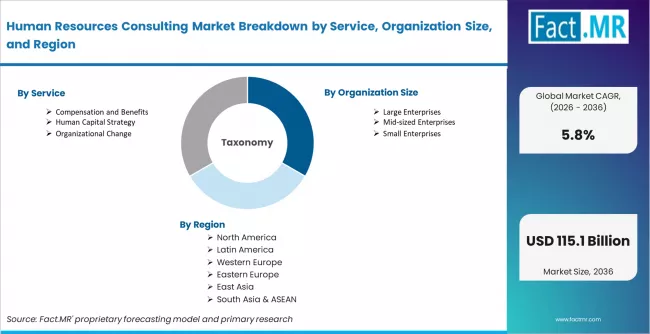
Human Resources Consulting Market Size, Share, Growth and Forecast (2026 - 2036)
The Human Resources Consulting Market is segmented by Service (Human Capital Strategy, Compensation and Benefits, Organizational Change, Talent Management, Learning and Development, HR Function, and HR Analytics), Organization Size (Large Enterprises, Mid-sized Enterprises, Small Enterprises, and Start-ups), Engagement Model (Project-Based Consulting, Retainer-Based Consulting, Managed HR Advisory, and Transformation Programs), End-use Industry (BFSI, Consumer Markets, Technology, Life Sciences and Healthcare, Government and Public Services, and Media and Telecommunications), and Delivery Mode (On-site Consulting, Remote Consulting, Hybrid Consulting, and HR Technology-Enabled Consulting). Forecast for 2026 to 2036.
Fact.MR analysis indicates that the human resources consulting market is moving through a workforce redesign cycle. Enterprises are using HR consultants to manage compensation structures, talent gaps, workforce planning, and HR technology change. Demand is no longer limited to policy support. Buyers now want advisory partners that can link people strategy with cost control, retention, compliance, and productivity.
Human Resources Consulting Market Forecast and Outlook By FACT. MR
- The human resources consulting market was valued at USD 58.5 billion in 2025. According to Fact.MR, demand is projected to reach USD 61.9 billion in 2026 and expand to USD 108.8 billion by 2036, reflecting a CAGR of 5.8% during the forecast period.
- The market is expected to generate an absolute opportunity of USD 46.9 billion between 2026 and 2036, supported by evolving workforce strategies.
- Growth is being driven by workforce restructuring, compensation redesign, and increasing adoption of HR technology platforms.
- Data from U.S. Bureau of Labor Statistics indicates steady demand for human resources management roles, reinforcing the broader need for specialized HR expertise.
- External consulting firms gain relevance when organizations require capabilities beyond routine HR administration, including organizational design, talent strategy, and digital HR transformation. [1]
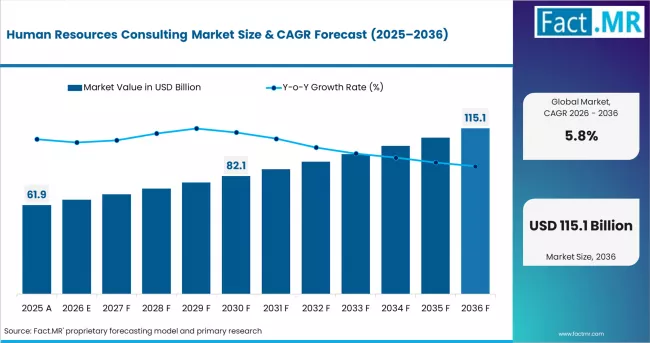
Summary of Human Resources Consulting Market
- Market Definition
- The market includes consulting services that help organizations improve workforce strategy, HR operations, compensation programs, and talent systems.
- Demand Drivers
- HR directors need consulting support to redesign roles and workforce structures.
- Compensation heads use consultants to benchmark rewards and manage benefits cost.
- Talent leaders rely on advisory support for succession planning and skills development.
- Key Segments Analyzed
- By Service: Compensation and benefits is estimated to lead with 35.0% share in 2026, supported by pay benchmarking and benefits cost review.
- By Organization Size: Large enterprises are expected to account for 58.0% share in 2026 because complex workforces need specialist advisory support.
- By Engagement Model: Project-based consulting is projected to hold 46.0% share in 2026 due to defined transformation and rewards assignments.
- By End-use Industry: BFSI is expected to hold 24.0% share in 2026, supported by workforce regulation and retention needs.
- By Delivery Mode: Hybrid consulting is projected to account for 52.0% share in 2026 because HR projects need both remote analysis and leadership workshops.
- Analyst Opinion at Fact.MR
- Shambhu Nath Jha, Senior Analyst at Fact.MR, opines, “Human resources consulting is shifting from policy support to workforce decision support. Enterprises want consultants who can connect pay, skills, organization design, and HR technology into practical operating choices. Firms that bring credible data and implementation discipline will outperform advisory-only providers.”
- Strategic Implications
- HR consulting firms should build stronger people analytics and compensation advisory capabilities.
- Enterprise buyers need consultants that can connect workforce redesign with measurable business needs.
- Regional expansion should focus on markets where formal employment growth and HR technology adoption are rising.
- Methodology
- Sizing Base: Market sizing uses consulting engagement value, service-line mix, client size, and industry-level HR spending patterns.
- Evidence Inputs: Analysis includes BLS labor data, SBA employer information, SHRM resources, and company disclosures.
- Forecast Design: Forecasts account for HR digitalization, benefits redesign, enterprise restructuring, and workforce retention pressure.
| Metric | Value |
|---|---|
| Estimated Value in 2026 | USD 61.9 billion |
| Forecast Value in 2036 | USD 108.8 billion |
| Forecast CAGR (2026 to 2036) | 5.8% |
Workforce data and people analytics are becoming stronger buying filters. SHRM highlights the role of people analytics in improving HR decisions, which supports demand for consulting around analytics design and HR function modernization [3]. Data security also matters because HR consulting often involves payroll, employee records, benefits data, and sensitive workforce information. Consulting firms with stronger governance and technology controls are better placed for enterprise HR transformation work.
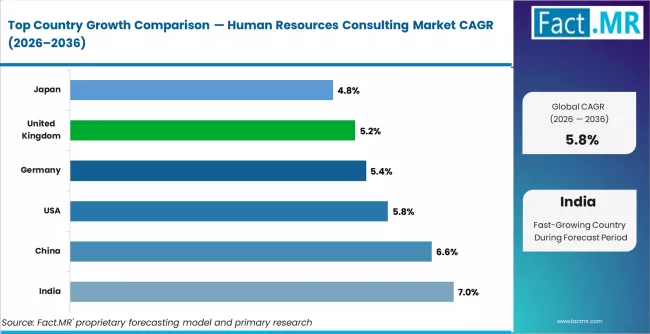
India is projected to grow at 7.0% CAGR through 2036. China follows at 6.6% CAGR, supported by enterprise formalization and workforce planning needs. The United States records 5.8% CAGR, linked to HR analytics and benefits consulting. Germany grows at 5.4% CAGR, supported by workforce compliance and industrial talent planning. The United Kingdom advances at 5.2% CAGR, driven by organizational change programs. Japan grows at 4.8% CAGR, supported by workforce aging and talent retention needs.
Segmental Analysis
Human Resources Consulting Market Analysis by Service
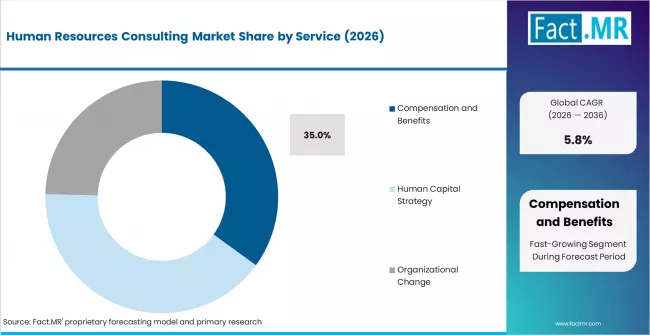
Compensation and benefits is estimated to hold 35.0% share in 2026, as employers need external support to design pay structures, benefits plans, and executive rewards in a competitive labor environment. Compensation assignments often require benchmarking, role mapping, and cost modeling that internal HR teams may not handle at scale. Human capital strategy supports long-term workforce planning and leadership alignment. Talent management remains important where companies need succession and skills frameworks. HR analytics is growing faster because firms want evidence-based workforce decisions. Buyers that delay compensation review may face retention pressure and weaker hiring competitiveness.
- Rewards Benchmarking: Compensation consulting helps employers align pay with hiring and retention needs.
- Workforce Planning: Human capital strategy supports role design and future skills planning.
- People Analytics: HR analytics helps leaders use workforce data in decisions.
Human Resources Consulting Market Analysis by Organization Size
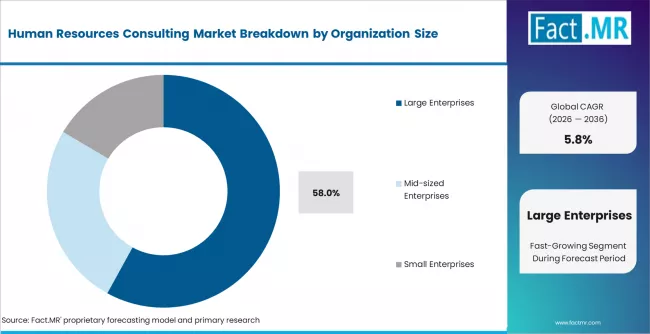
Large enterprises are expected to account for 58.0% share in 2026. This segment leads because complex workforce structures require specialist support across rewards, change management, and HR technology programs. Large companies often operate across several jurisdictions, which makes compensation design and compliance more difficult. Mid-sized enterprises use consulting support when they formalize HR processes or expand into new regions. Small enterprises rely on consultants for practical HR policies, employee handbooks, and hiring support. Start-ups use advisory help when they need scalable people practices. Large enterprises lead because their HR decisions carry higher cost exposure and organizational risk.
- Complex Workforces: Large enterprises need advisory support across functions and geographies.
- Growth Formalization: Mid-sized firms use consultants to strengthen HR processes.
- Scalable Practices: Start-ups need people systems before rapid hiring creates confusion.
Human Resources Consulting Market Analysis by Engagement Model
Project-based consulting remains the preferred engagement model because it offers defined deliverables, fixed timelines, and clearer budget control for initiatives such as compensation reviews, organization redesign, and HR system planning. It allows HR leaders to tie consulting spend directly to measurable outputs and outcomes. Project-based consulting is projected to hold 46.0% share over the forecast period. Retainer-based models continue to serve clients needing ongoing advisory access, while managed HR advisory supports firms seeking consistent support without expanding internal teams. Larger transformation programs combine operating model redesign with change management, but project-based work leads due to stronger cost visibility and accountability, reducing the risk of scope creep and budget drift.
- Defined Scope: Project-based consulting supports clear deliverables and budget control.
- Ongoing Advice: Retainer models help clients access HR expertise throughout the year.
- Transformation Depth: Larger programs support HR operating model redesign.
Human Resources Consulting Market Analysis by End-use Industry
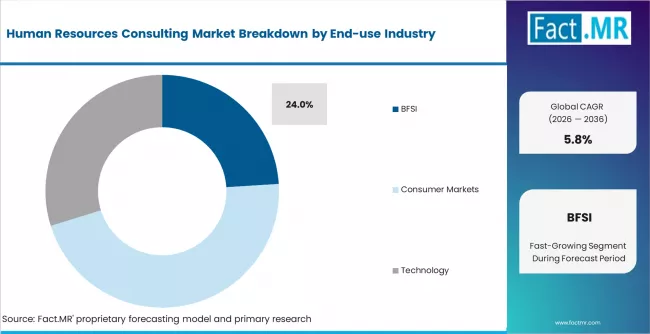
BFSI is expected to reach 24.0% share over the study period as, banks, insurers, and financial service firms face retention pressure, compliance expectations, and role redesign from digital operations. Compensation structures in BFSI must balance performance incentives with risk controls. Technology firms use HR consulting to manage skills shortages and fast-changing workforce models. Life sciences and healthcare clients need workforce planning for specialized roles. Government and public services use consultants for organization redesign and workforce modernization. Consumer markets need support for frontline retention. BFSI leads because people risk and pay design are closely tied to business performance.
- Pay Governance: BFSI needs compensation structures aligned with performance and risk.
- Skills Pressure: Technology firms use consultants to manage fast-changing talent needs.
- Workforce Modernization: Public sector clients need support for role redesign.
Human Resources Consulting Market Analysis by Delivery Mode
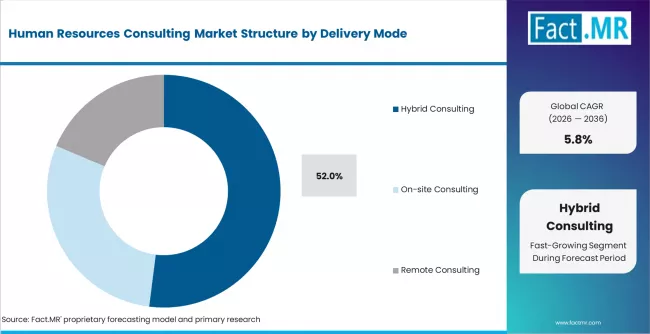
Hybrid consulting is projected to account for 52.0% share in 2026. This mode leads because HR projects often combine remote data work with in-person leadership sessions. Consultants can analyze pay data, workforce metrics, and HR process documents remotely, while workshops help align executives around change. On-site consulting remains important for sensitive restructuring and culture programs. Remote consulting suits smaller assignments and policy support. HR technology-enabled consulting is gaining ground as firms use analytics platforms and digital assessment tools. Hybrid delivery leads because it balances efficiency with trust-building during major workforce decisions.
- Data Workflows: Hybrid consulting supports remote analysis and in-person decision sessions.
- Leadership Alignment: On-site workshops help executives agree on workforce changes.
- Digital Advisory: HR technology-enabled work supports faster diagnostics and reporting.
Human Resources Consulting Market Drivers, Restraints, and Opportunities
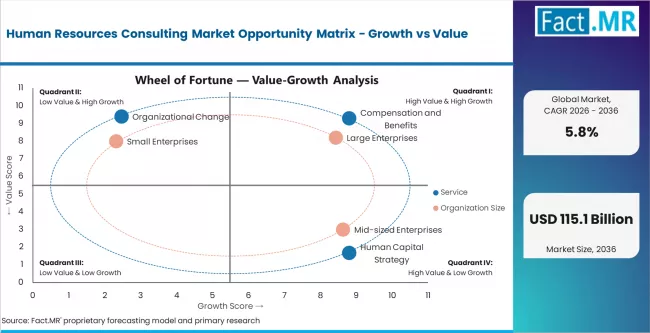
Fact.MR analysts observe that human resources consulting demand is supported by workforce complexity, benefits redesign, and HR technology change. BLS data on HR managers reflects the continued need for professionals who oversee recruitment, employee relations, and compensation work. SBA data shows the scale of small businesses in the United States, which supports consulting demand among firms without deep internal HR teams. SHRM people analytics resources point to rising interest in data-backed HR decisions.
Data sensitivity remains the main restraint. HR consultants often handle employee pay, benefits, performance records, and demographic information. The U.S. Equal Employment Opportunity Commission provides guidance on employment discrimination rules, which keeps HR policy and workforce decisions under legal scrutiny [5]. Consulting firms must protect employee data and avoid generic recommendations that fail to match workplace realities. Buyers also resist advisory fees when outcomes are poorly defined.
Opportunities in the Human Resources Consulting Market
- People Analytics: Consulting firms can help clients build workforce dashboards and decision frameworks.
- Rewards Redesign: Employers need pay structures that support retention and cost discipline.
- HR Operating Models: Organizations create demand for consultants when they redesign HR roles and service delivery.
Regional Analysis
.webp)
The human resources consulting market is assessed across North America, Europe, Asia Pacific, Latin America, and Middle East and Africa, covering 30+ countries with demand profiles shaped by employment growth, HR technology adoption, regulatory complexity, and enterprise restructuring.
| Country | CAGR (2026 to 2036) |
|---|---|
| India | 7.0% |
| China | 6.6% |
| USA | 5.8% |
| Germany | 5.4% |
| United Kingdom | 5.2% |
| Japan | 4.8% |
Source: Fact.MR analysis, based on proprietary forecasting model and primary research
Asia Pacific Human Resources Consulting Market Analysis
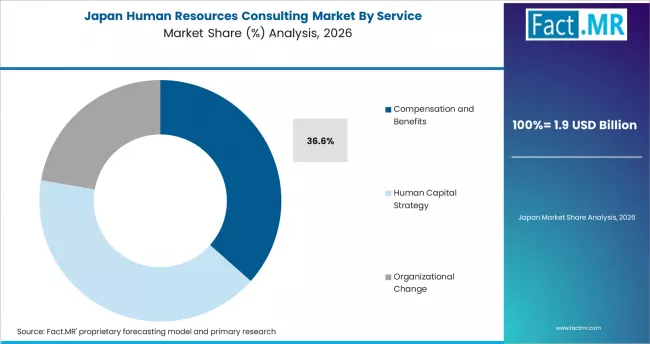
Asia Pacific records faster growth because formal employment, digital workforce systems, and enterprise expansion are raising HR advisory needs. India benefits from corporate hiring and fast-growing services sectors. China supports demand through large enterprise restructuring and workforce planning. Japan grows at a steadier rate because established firms move carefully on organization change. Regional consulting firms need local labor knowledge and practical implementation support.
- India: Human resources consulting demand in India is projected to grow at 7.0% CAGR from 2026 to 2036. IT services, start-ups, financial firms, and expanding manufacturing companies need HR support as hiring scales. Employers use consultants for compensation design, talent planning, and HR policy formation. Mid-sized firms are formalizing HR structures as they expand beyond founder-led management. Consulting firms with local compensation data and execution support can gain repeat assignments.
- China: China’s demand is tied to enterprise restructuring, workforce planning, and HR digitalization. Large companies need support in role design and talent retention as business models change. The market is projected to expand at 6.6% CAGR by 2036. Compensation and benefits consulting remains important where firms compete for skilled employees. Advisory firms with sector depth and strong local implementation teams are better placed to serve large clients.
- Japan: Japan has stable demand from workforce aging, succession planning, and organizational redesign. Growth is slower because many large employers use established internal HR systems. Human resources consulting in Japan is expected to register 4.8% CAGR over the foreseen period, demand comes from talent retention, leadership development, and HR function modernization. Consultants need cultural understanding and careful change management to win long-term client trust.
North America Human Resources Consulting Market Analysis
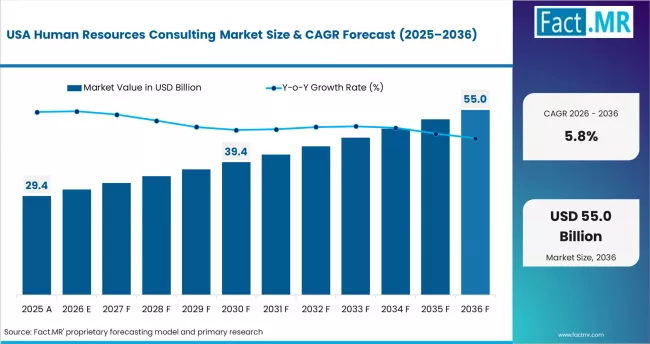
North America remains a high-value region because large enterprises spend heavily on rewards, analytics, and workforce transformation. The United States leads regional demand due to complex benefits structures and strong consulting firm presence. BLS employment and wage resources support the continued importance of HR management roles in organizations. Buyers expect strong data capability and industry-specific HR advice.
- USA: The U.S. human resources consulting market is forecast to grow at 5.8% CAGR through 2036. Employers need support for benefits design, pay transparency, and workforce analytics. HR teams use consultants where internal capacity is limited or change programs need independent review. Employment rules and workplace practices add complexity to HR decisions. Consulting firms gain advantage through data tools, implementation support, and credible compensation benchmarking.
Europe Human Resources Consulting Market Analysis
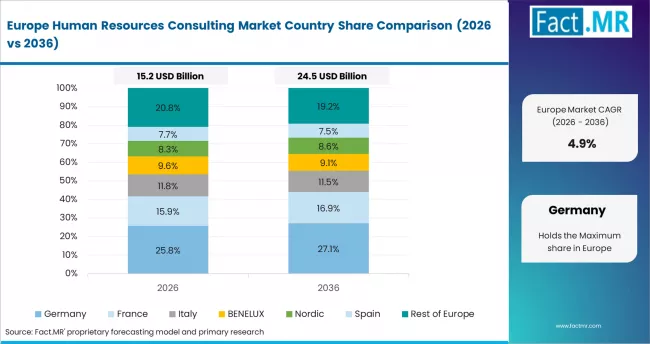
Europe grows through workforce regulation, pay governance, and organization change programs. Germany and the United Kingdom are key markets because large employers face skills gaps, labor cost pressure, and HR transformation needs. European buyers often expect careful compliance review before major workforce changes. Consulting firms need strong labor market knowledge and sector-specific advisory teams.
- Germany: Germany’s HR consulting demand is supported by industrial workforce planning and skills transition. Employers need support for role redesign, benefits review, and leadership development. The market is projected to record 5.4% CAGR over the study period. Mid-sized industrial companies use consultants when internal HR teams need specialist labor insight. Advisory firms with sector knowledge and works council sensitivity can protect stronger client relationships.
- United Kingdom: UK employers are using HR consultants for organizational change, rewards design, and workforce policy review. Service-sector employers need support as hybrid work and talent retention remain active issues. Human resources consulting is projected to grow at 5.2% CAGR from 2026 to 2036. Buyers value practical recommendations because HR changes often affect managers and employees quickly. Consulting firms with strong change management capability are better positioned.
Competitive Aligners for Market Players
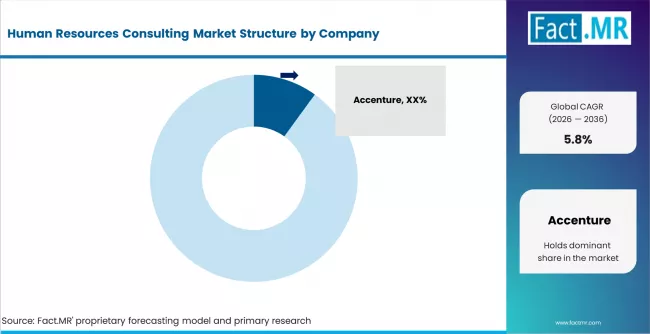
The human resources consulting market is moderately fragmented, with global consulting firms, specialist rewards advisors, HR technology consultants, and independent HR experts competing for client budgets. Large firms gain through global delivery networks and enterprise relationships. Specialist firms compete where buyers need deeper expertise in compensation, HR analytics, or leadership assessment. [4]
Competitive advantage depends on data credibility, implementation ability, and sector knowledge. Buyers increasingly expect consultants to support decisions with benchmarks and workforce evidence. Firms that provide advice without execution support can lose ground to providers with technology tools and change management capability. HR consulting is becoming more outcome-linked because clients want measurable gains in retention, productivity, and cost control.
The market is divided between broad management consulting firms and HR-specialist advisors. Broad firms compete on transformation and enterprise strategy. HR specialists compete on technical depth in rewards, talent, and people analytics. Providers that combine advisory credibility with delivery support are positioned to win larger HR transformation programs.
Key Players in Human Resources Consulting Market
- Accenture
- Aon plc
- Automatic Data Processing, Inc.
- Bain & Company
- Boston Consulting Group
- Capgemini
- Deloitte
- Ernst & Young
- Huron Consulting Group
- Kearney
- Korn Ferry
- KPMG
- McKinsey & Company
- Mercer
- Milliman, Inc.
Bibliography
- [1]. U.S. Bureau of Labor Statistics. Human Resources Managers, Occupational Outlook Handbook. BLS.
- [2]. U.S. Small Business Administration. Frequently Asked Questions About Small Business. SBA.
- [3]. Society for Human Resource Management. People Analytics. SHRM.
- [4]. Automatic Data Processing, Inc. Annual Report 2024. ADP.
- [5]. U.S. Equal Employment Opportunity Commission. Prohibited Employment Policies and Practices. EEOC.
This Report Addresses
- Strategic intelligence on human resources consulting demand across workforce strategy, compensation planning, talent management, HR analytics, organizational change, and HR function transformation.
- Market forecast from USD 61.9 billion in 2026 to USD 108.8 billion by 2036 at a CAGR of 5.8%.
- Segment analysis by service, organization size, engagement model, end-use industry, and delivery mode, covering compensation and benefits, large enterprises, project-based consulting, BFSI, and hybrid consulting.
- Growth opportunity mapping across India, China, the USA, Germany, the United Kingdom, and Japan. India is projected to record the fastest growth at 7.0% CAGR through 2036, followed by China at 6.6% CAGR.
- Regional outlook covering Asia Pacific formal employment growth, North America rewards and analytics consulting, Europe workforce regulation, and Japan succession planning needs.
- Competitive analysis of Accenture, Aon, ADP, Bain & Company, BCG, Capgemini, Deloitte, EY, Huron, Kearney, Korn Ferry, KPMG, McKinsey, Mercer, Milliman, Oliver Wyman, Paychex, PwC, TriNet, and WTW.
- Report delivered with market sizing, segment forecasts, regional outlook, and competitive assessment. Supported by HR buyer interviews, consulting service revenue patterns, labor market resources, company disclosures, SHRM people analytics resources, and workforce policy references.
Human Resources Consulting Market Definition
The market covers advisory and implementation services that help organizations design, manage, and improve human resource functions. It includes compensation and benefits consulting, workforce strategy, talent management, learning and development, HR analytics, organizational change, and HR function transformation. Scope is limited to professional consulting services tied to people strategy, HR operations, and workforce management.
Human Resources Consulting Market Inclusions
The market includes project-based advisory, retainer-based HR consulting, managed HR advisory, workforce transformation programs, and HR technology-enabled consulting. It covers services used by enterprises, public institutions, start-ups, and mid-sized firms to improve employee programs, HR processes, talent planning, and compliance readiness. HR analytics, rewards design, and change management services are included when delivered as consulting engagements.
Human Resources Consulting Market Exclusions
The market excludes payroll processing sold as a standalone outsourced service, staffing agency placement fees, employee background checks sold separately, legal services, and software subscriptions without consulting support. It does not include internal HR department costs. Recruitment process outsourcing is excluded unless offered as part of a broader HR consulting assignment.
Human Resources Consulting Market Research Methodology
- Primary Research: Interviews with HR directors, compensation heads, workforce planning leaders, talent management officers, and HR transformation consultants.
- Desk Research: Review includes labor statistics, official small business data, SHRM HR resources, company annual reports, and consulting firm disclosures. [2]
- Market-Sizing and Forecasting: The model uses enterprise spending on HR advisory, project pricing, consultant utilization, service mix, and end-use industry demand.
- Data Validation and Update Cycle: Forecasts are validated using consulting firm disclosures, HR buyer interviews, labor market signals, and service-line revenue patterns.
Scope of Report

| Attribute | Details |
|---|---|
| Quantitative Units | USD 58.5 billion (2025), USD 61.9 billion (2026), and USD 108.8 billion (2036), at a CAGR of 5.8% from 2026 to 2036 |
| Market Definition | Consulting services that support workforce strategy, HR operations, compensation programs, talent systems, and organizational change. |
| Service Segmentation | Human Capital Strategy, Compensation and Benefits, Organizational Change, Talent Management, Learning and Development, HR Function, HR Analytics |
| Organization Size Segmentation | Large Enterprises, Mid-sized Enterprises, Small Enterprises, Start-ups |
| Engagement Model Segmentation | Project-Based Consulting, Retainer-Based Consulting, Managed HR Advisory, Transformation Programs |
| End-use Industry Segmentation | BFSI, Consumer Markets, Technology, Life Sciences and Healthcare, Government and Public Services, Media and Telecommunications |
| Delivery Mode Segmentation | On-site Consulting, Remote Consulting, Hybrid Consulting, HR Technology-Enabled Consulting |
| Regions Covered | North America, Europe, Asia Pacific, Latin America, Middle East and Africa |
| Countries Covered | USA, Canada, Germany, UK, France, Nordics, China, Japan, India, South Korea, GCC countries, Brazil, Mexico, South Africa, and 30+ countries |
| Key Companies Profiled | Accenture, Aon, ADP, Bain & Company, BCG, Capgemini, Deloitte, EY, Huron, Kearney, Korn Ferry, KPMG, McKinsey, Mercer, Milliman, Oliver Wyman, Paychex, PwC, TriNet, WTW |
| Forecast Period | 2026 to 2036 |
| Approach | Hybrid top-down and bottom-up model using consulting service revenue, engagement pricing, client size, HR transformation activity, and HR buyer interviews. |
Human Resources Consulting Market by Segments
-
By Service:
- Human Capital Strategy
- Compensation and Benefits
- Organizational Change
- Talent Management
- Learning and Development
- HR Function
- HR Analytics
-
By Organization Size:
- Large Enterprises
- Mid-sized Enterprises
- Small Enterprises
- Start-ups
-
By Engagement Model:
- Project-Based Consulting
- Retainer-Based Consulting
- Managed HR Advisory
- Transformation Programs
-
By End-use Industry:
- BFSI
- Consumer Markets
- Technology
- Life Sciences and Healthcare
- Government and Public Services
- Media and Telecommunications
-
By Delivery Mode:
- On-site Consulting
- Remote Consulting
- Hybrid Consulting
- HR Technology-Enabled Consulting
-
By Region:
- North America
- United States
- Canada
- Mexico
- Latin America
- Brazil
- Argentina
- Chile
- Rest of Latin America
- Western Europe
- Germany
- France
- United Kingdom
- Italy
- Spain
- Nordic Countries
- BENELUX
- Rest of Western Europe
- Eastern Europe
- Russia
- Poland
- Hungary
- Balkan and Baltic
- Rest of Eastern Europe
- East Asia
- China
- Japan
- South Korea
- South Asia and Pacific
- India
- ASEAN
- Australia and New Zealand
- Rest of South Asia and Pacific
- Middle East and Africa
- Kingdom of Saudi Arabia
- Other GCC Countries
- Turkey
- South Africa
- Rest of Middle East and Africa
- North America
- Frequently Asked Questions -
How large is the human resources consulting market in 2026?
The market is estimated to reach USD 61.9 billion in 2026.
What will the human resources consulting market be valued at by 2036?
The market is forecast to reach USD 108.8 billion by 2036.
What CAGR is projected from 2026 to 2036?
The market is projected to grow at a 5.8% CAGR during the forecast period.
Which service segment leads the market?
Compensation and benefits leads with an estimated 35.0% share in 2026.
Which organization size holds the largest share?
Large enterprises lead with an estimated 58.0% share in 2026.
Which engagement model leads demand?
Project-based consulting leads with an estimated 46.0% share in 2026.
Which end-use industry holds the highest share?
BFSI leads with an estimated 24.0% share in 2026.
Which delivery mode leads the market?
Hybrid consulting leads with an estimated 52.0% share in 2026.
Which country grows fastest through 2036?
India leads with a projected 7.0% CAGR through 2036.
Why does compensation and benefits lead demand?
It leads because employers need pay benchmarking and benefits cost control.
Why do large enterprises dominate demand?
Large enterprises need specialist support for complex workforce and rewards structures.
Why is project-based consulting preferred?
Project-based work gives HR buyers defined deliverables and clearer budgets.
Why is BFSI a leading end-use industry?
BFSI needs workforce advisory support for retention, pay governance, and role redesign.
What is the main restraint for the market?
Employee data sensitivity and unclear consulting outcomes can slow buyer decisions.
Why is HR analytics gaining attention?
HR analytics helps leaders use workforce data for better people decisions.
Why is India growing faster than mature markets?
India is growing faster because formal employment and HR process adoption are expanding.
Why is Japan growing at a slower rate?
Japan grows slower because established firms often move carefully on workforce change.
What shapes supplier success in this market?
Supplier success depends on data credibility, sector knowledge, and implementation support.
How do regulations affect HR consulting?
Regulations affect HR consulting by increasing the need for compliant policies and workforce decisions.
Why is hybrid consulting gaining share?
Hybrid consulting combines remote analysis with in-person leadership alignment.
What opportunity exists for consulting firms?
Consulting firms can gain through rewards redesign, HR analytics, and operating model work.
What does the report measure across segments?
The report measures demand by service, organization size, engagement model, end-use industry, delivery mode, and region.
Table of Content
- Executive Summary
- Global Market Outlook
- Demand to side Trends
- Supply to side Trends
- Technology Roadmap Analysis
- Analysis and Recommendations
- Market Overview
- Market Coverage / Taxonomy
- Market Definition / Scope / Limitations
- Research Methodology
- Chapter Orientation
- Analytical Lens and Working Hypotheses
- Market Structure, Signals, and Trend Drivers
- Benchmarking and Cross-market Comparability
- Market Sizing, Forecasting, and Opportunity Mapping
- Research Design and Evidence Framework
- Desk Research Programme (Secondary Evidence)
- Company Annual and Sustainability Reports
- Peer-reviewed Journals and Academic Literature
- Corporate Websites, Product Literature, and Technical Notes
- Earnings Decks and Investor Briefings
- Statutory Filings and Regulatory Disclosures
- Technical White Papers and Standards Notes
- Trade Journals, Industry Magazines, and Analyst Briefs
- Conference Proceedings, Webinars, and Seminar Materials
- Government Statistics Portals and Public Data Releases
- Press Releases and Reputable Media Coverage
- Specialist Newsletters and Curated Briefings
- Sector Databases and Reference Repositories
- Fact.MR Internal Proprietary Databases and Historical Market Datasets
- Subscription Datasets and Paid Sources
- Social Channels, Communities, and Digital Listening Inputs
- Additional Desk Sources
- Expert Input and Fieldwork (Primary Evidence)
- Primary Modes
- Qualitative Interviews and Expert Elicitation
- Quantitative Surveys and Structured Data Capture
- Blended Approach
- Why Primary Evidence is Used
- Field Techniques
- Interviews
- Surveys
- Focus Groups
- Observational and In-context Research
- Social and Community Interactions
- Stakeholder Universe Engaged
- C-suite Leaders
- Board Members
- Presidents and Vice Presidents
- R&D and Innovation Heads
- Technical Specialists
- Domain Subject-matter Experts
- Scientists
- Physicians and Other Healthcare Professionals
- Governance, Ethics, and Data Stewardship
- Research Ethics
- Data Integrity and Handling
- Primary Modes
- Tooling, Models, and Reference Databases
- Desk Research Programme (Secondary Evidence)
- Data Engineering and Model Build
- Data Acquisition and Ingestion
- Cleaning, Normalisation, and Verification
- Synthesis, Triangulation, and Analysis
- Quality Assurance and Audit Trail
- Market Background
- Market Dynamics
- Drivers
- Restraints
- Opportunity
- Trends
- Scenario Forecast
- Demand in Optimistic Scenario
- Demand in Likely Scenario
- Demand in Conservative Scenario
- Opportunity Map Analysis
- Product Life Cycle Analysis
- Supply Chain Analysis
- Investment Feasibility Matrix
- Value Chain Analysis
- PESTLE and Porter’s Analysis
- Regulatory Landscape
- Regional Parent Market Outlook
- Production and Consumption Statistics
- Import and Export Statistics
- Market Dynamics
- Global Market Analysis 2021 to 2025 and Forecast, 2026 to 2036
- Historical Market Size Value (USD Million) Analysis, 2021 to 2025
- Current and Future Market Size Value (USD Million) Projections, 2026 to 2036
- Y to o to Y Growth Trend Analysis
- Absolute $ Opportunity Analysis
- Global Market Pricing Analysis 2021 to 2025 and Forecast 2026 to 2036
- Global Market Analysis 2021 to 2025 and Forecast 2026 to 2036, By Service Type
- Introduction / Key Findings
- Historical Market Size Value (USD Million) Analysis By Service Type , 2021 to 2025
- Current and Future Market Size Value (USD Million) Analysis and Forecast By Service Type , 2026 to 2036
- HVAC Services
- Plumbing Services
- Fire Protection Services
- HVAC Services
- Y to o to Y Growth Trend Analysis By Service Type , 2021 to 2025
- Absolute $ Opportunity Analysis By Service Type , 2026 to 2036
- Global Market Analysis 2021 to 2025 and Forecast 2026 to 2036, By End-use Industry
- Introduction / Key Findings
- Historical Market Size Value (USD Million) Analysis By End-use Industry, 2021 to 2025
- Current and Future Market Size Value (USD Million) Analysis and Forecast By End-use Industry, 2026 to 2036
- Commercial
- Industrial
- Residential
- Commercial
- Y to o to Y Growth Trend Analysis By End-use Industry, 2021 to 2025
- Absolute $ Opportunity Analysis By End-use Industry, 2026 to 2036
- Global Market Analysis 2021 to 2025 and Forecast 2026 to 2036, By Application
- Introduction / Key Findings
- Historical Market Size Value (USD Million) Analysis By Application, 2021 to 2025
- Current and Future Market Size Value (USD Million) Analysis and Forecast By Application, 2026 to 2036
- Maintenance & Repair
- Installation
- Asset Management
- Maintenance & Repair
- Y to o to Y Growth Trend Analysis By Application, 2021 to 2025
- Absolute $ Opportunity Analysis By Application, 2026 to 2036
- Global Market Analysis 2021 to 2025 and Forecast 2026 to 2036, By Location
- Introduction / Key Findings
- Historical Market Size Value (USD Million) Analysis By Location, 2021 to 2025
- Current and Future Market Size Value (USD Million) Analysis and Forecast By Location, 2026 to 2036
- On-site Services
- Off-site/Workshop Services
- On-site Services
- Y to o to Y Growth Trend Analysis By Location, 2021 to 2025
- Absolute $ Opportunity Analysis By Location, 2026 to 2036
- Global Market Analysis 2021 to 2025 and Forecast 2026 to 2036, By Region
- Introduction
- Historical Market Size Value (USD Million) Analysis By Region, 2021 to 2025
- Current Market Size Value (USD Million) Analysis and Forecast By Region, 2026 to 2036
- North America
- Latin America
- Western Europe
- Eastern Europe
- East Asia
- South Asia and Pacific
- Middle East & Africa
- Market Attractiveness Analysis By Region
- North America Market Analysis 2021 to 2025 and Forecast 2026 to 2036, By Country
- Historical Market Size Value (USD Million) Trend Analysis By Market Taxonomy, 2021 to 2025
- Market Size Value (USD Million) Forecast By Market Taxonomy, 2026 to 2036
- By Country
- USA
- Canada
- Mexico
- By Service Type
- By End-use Industry
- By Application
- By Location
- By Country
- Market Attractiveness Analysis
- By Country
- By Service Type
- By End-use Industry
- By Application
- By Location
- Key Takeaways
- Latin America Market Analysis 2021 to 2025 and Forecast 2026 to 2036, By Country
- Historical Market Size Value (USD Million) Trend Analysis By Market Taxonomy, 2021 to 2025
- Market Size Value (USD Million) Forecast By Market Taxonomy, 2026 to 2036
- By Country
- Brazil
- Chile
- Rest of Latin America
- By Service Type
- By End-use Industry
- By Application
- By Location
- By Country
- Market Attractiveness Analysis
- By Country
- By Service Type
- By End-use Industry
- By Application
- By Location
- Key Takeaways
- Western Europe Market Analysis 2021 to 2025 and Forecast 2026 to 2036, By Country
- Historical Market Size Value (USD Million) Trend Analysis By Market Taxonomy, 2021 to 2025
- Market Size Value (USD Million) Forecast By Market Taxonomy, 2026 to 2036
- By Country
- Germany
- UK
- Italy
- Spain
- France
- Nordic
- BENELUX
- Rest of Western Europe
- By Service Type
- By End-use Industry
- By Application
- By Location
- By Country
- Market Attractiveness Analysis
- By Country
- By Service Type
- By End-use Industry
- By Application
- By Location
- Key Takeaways
- Eastern Europe Market Analysis 2021 to 2025 and Forecast 2026 to 2036, By Country
- Historical Market Size Value (USD Million) Trend Analysis By Market Taxonomy, 2021 to 2025
- Market Size Value (USD Million) Forecast By Market Taxonomy, 2026 to 2036
- By Country
- Russia
- Poland
- Hungary
- Balkan & Baltic
- Rest of Eastern Europe
- By Service Type
- By End-use Industry
- By Application
- By Location
- By Country
- Market Attractiveness Analysis
- By Country
- By Service Type
- By End-use Industry
- By Application
- By Location
- Key Takeaways
- East Asia Market Analysis 2021 to 2025 and Forecast 2026 to 2036, By Country
- Historical Market Size Value (USD Million) Trend Analysis By Market Taxonomy, 2021 to 2025
- Market Size Value (USD Million) Forecast By Market Taxonomy, 2026 to 2036
- By Country
- China
- Japan
- South Korea
- By Service Type
- By End-use Industry
- By Application
- By Location
- By Country
- Market Attractiveness Analysis
- By Country
- By Service Type
- By End-use Industry
- By Application
- By Location
- Key Takeaways
- South Asia and Pacific Market Analysis 2021 to 2025 and Forecast 2026 to 2036, By Country
- Historical Market Size Value (USD Million) Trend Analysis By Market Taxonomy, 2021 to 2025
- Market Size Value (USD Million) Forecast By Market Taxonomy, 2026 to 2036
- By Country
- India
- ASEAN
- Australia & New Zealand
- Rest of South Asia and Pacific
- By Service Type
- By End-use Industry
- By Application
- By Location
- By Country
- Market Attractiveness Analysis
- By Country
- By Service Type
- By End-use Industry
- By Application
- By Location
- Key Takeaways
- Middle East & Africa Market Analysis 2021 to 2025 and Forecast 2026 to 2036, By Country
- Historical Market Size Value (USD Million) Trend Analysis By Market Taxonomy, 2021 to 2025
- Market Size Value (USD Million) Forecast By Market Taxonomy, 2026 to 2036
- By Country
- Kingdom of Saudi Arabia
- Other GCC Countries
- Turkiye
- South Africa
- Other African Union
- Rest of Middle East & Africa
- By Service Type
- By End-use Industry
- By Application
- By Location
- By Country
- Market Attractiveness Analysis
- By Country
- By Service Type
- By End-use Industry
- By Application
- By Location
- Key Takeaways
- Key Countries Market Analysis
- USA
- Pricing Analysis
- Market Share Analysis, 2025
- By Service Type
- By End-use Industry
- By Application
- By Location
- Canada
- Pricing Analysis
- Market Share Analysis, 2025
- By Service Type
- By End-use Industry
- By Application
- By Location
- Mexico
- Pricing Analysis
- Market Share Analysis, 2025
- By Service Type
- By End-use Industry
- By Application
- By Location
- Brazil
- Pricing Analysis
- Market Share Analysis, 2025
- By Service Type
- By End-use Industry
- By Application
- By Location
- Chile
- Pricing Analysis
- Market Share Analysis, 2025
- By Service Type
- By End-use Industry
- By Application
- By Location
- Germany
- Pricing Analysis
- Market Share Analysis, 2025
- By Service Type
- By End-use Industry
- By Application
- By Location
- UK
- Pricing Analysis
- Market Share Analysis, 2025
- By Service Type
- By End-use Industry
- By Application
- By Location
- Italy
- Pricing Analysis
- Market Share Analysis, 2025
- By Service Type
- By End-use Industry
- By Application
- By Location
- Spain
- Pricing Analysis
- Market Share Analysis, 2025
- By Service Type
- By End-use Industry
- By Application
- By Location
- France
- Pricing Analysis
- Market Share Analysis, 2025
- By Service Type
- By End-use Industry
- By Application
- By Location
- India
- Pricing Analysis
- Market Share Analysis, 2025
- By Service Type
- By End-use Industry
- By Application
- By Location
- ASEAN
- Pricing Analysis
- Market Share Analysis, 2025
- By Service Type
- By End-use Industry
- By Application
- By Location
- Australia & New Zealand
- Pricing Analysis
- Market Share Analysis, 2025
- By Service Type
- By End-use Industry
- By Application
- By Location
- China
- Pricing Analysis
- Market Share Analysis, 2025
- By Service Type
- By End-use Industry
- By Application
- By Location
- Japan
- Pricing Analysis
- Market Share Analysis, 2025
- By Service Type
- By End-use Industry
- By Application
- By Location
- South Korea
- Pricing Analysis
- Market Share Analysis, 2025
- By Service Type
- By End-use Industry
- By Application
- By Location
- Russia
- Pricing Analysis
- Market Share Analysis, 2025
- By Service Type
- By End-use Industry
- By Application
- By Location
- Poland
- Pricing Analysis
- Market Share Analysis, 2025
- By Service Type
- By End-use Industry
- By Application
- By Location
- Hungary
- Pricing Analysis
- Market Share Analysis, 2025
- By Service Type
- By End-use Industry
- By Application
- By Location
- Kingdom of Saudi Arabia
- Pricing Analysis
- Market Share Analysis, 2025
- By Service Type
- By End-use Industry
- By Application
- By Location
- Turkiye
- Pricing Analysis
- Market Share Analysis, 2025
- By Service Type
- By End-use Industry
- By Application
- By Location
- South Africa
- Pricing Analysis
- Market Share Analysis, 2025
- By Service Type
- By End-use Industry
- By Application
- By Location
- USA
- Market Structure Analysis
- Competition Dashboard
- Competition Benchmarking
- Market Share Analysis of Top Players
- By Regional
- By Service Type
- By End-use Industry
- By Application
- By Location
- Competition Analysis
- Competition Deep Dive
- WSP Global Inc.
- Overview
- Product Portfolio
- Profitability by Market Segments (Product/Age /Sales Channel/Region)
- Sales Footprint
- Strategy Overview
- Marketing Strategy
- Product Strategy
- Channel Strategy
- Sterling and Wilson Pvt Ltd
- PSI Repair Services
- McGill Associates
- L&H Industrial
- Johnson Controls International plc
- Siemens Smart Infrastructure
- WSP Global Inc.
- Competition Deep Dive
- Assumptions & Acronyms Used
List Of Table
- Table 1: Global Market Value (USD Million) Forecast by Region, 2021 to 2036
- Table 2: Global Market Value (USD Million) Forecast by Service Type , 2021 to 2036
- Table 3: Global Market Value (USD Million) Forecast by End-use Industry, 2021 to 2036
- Table 4: Global Market Value (USD Million) Forecast by Application, 2021 to 2036
- Table 5: Global Market Value (USD Million) Forecast by Location, 2021 to 2036
- Table 6: North America Market Value (USD Million) Forecast by Country, 2021 to 2036
- Table 7: North America Market Value (USD Million) Forecast by Service Type , 2021 to 2036
- Table 8: North America Market Value (USD Million) Forecast by End-use Industry, 2021 to 2036
- Table 9: North America Market Value (USD Million) Forecast by Application, 2021 to 2036
- Table 10: North America Market Value (USD Million) Forecast by Location, 2021 to 2036
- Table 11: Latin America Market Value (USD Million) Forecast by Country, 2021 to 2036
- Table 12: Latin America Market Value (USD Million) Forecast by Service Type , 2021 to 2036
- Table 13: Latin America Market Value (USD Million) Forecast by End-use Industry, 2021 to 2036
- Table 14: Latin America Market Value (USD Million) Forecast by Application, 2021 to 2036
- Table 15: Latin America Market Value (USD Million) Forecast by Location, 2021 to 2036
- Table 16: Western Europe Market Value (USD Million) Forecast by Country, 2021 to 2036
- Table 17: Western Europe Market Value (USD Million) Forecast by Service Type , 2021 to 2036
- Table 18: Western Europe Market Value (USD Million) Forecast by End-use Industry, 2021 to 2036
- Table 19: Western Europe Market Value (USD Million) Forecast by Application, 2021 to 2036
- Table 20: Western Europe Market Value (USD Million) Forecast by Location, 2021 to 2036
- Table 21: Eastern Europe Market Value (USD Million) Forecast by Country, 2021 to 2036
- Table 22: Eastern Europe Market Value (USD Million) Forecast by Service Type , 2021 to 2036
- Table 23: Eastern Europe Market Value (USD Million) Forecast by End-use Industry, 2021 to 2036
- Table 24: Eastern Europe Market Value (USD Million) Forecast by Application, 2021 to 2036
- Table 25: Eastern Europe Market Value (USD Million) Forecast by Location, 2021 to 2036
- Table 26: East Asia Market Value (USD Million) Forecast by Country, 2021 to 2036
- Table 27: East Asia Market Value (USD Million) Forecast by Service Type , 2021 to 2036
- Table 28: East Asia Market Value (USD Million) Forecast by End-use Industry, 2021 to 2036
- Table 29: East Asia Market Value (USD Million) Forecast by Application, 2021 to 2036
- Table 30: East Asia Market Value (USD Million) Forecast by Location, 2021 to 2036
- Table 31: South Asia and Pacific Market Value (USD Million) Forecast by Country, 2021 to 2036
- Table 32: South Asia and Pacific Market Value (USD Million) Forecast by Service Type , 2021 to 2036
- Table 33: South Asia and Pacific Market Value (USD Million) Forecast by End-use Industry, 2021 to 2036
- Table 34: South Asia and Pacific Market Value (USD Million) Forecast by Application, 2021 to 2036
- Table 35: South Asia and Pacific Market Value (USD Million) Forecast by Location, 2021 to 2036
- Table 36: Middle East & Africa Market Value (USD Million) Forecast by Country, 2021 to 2036
- Table 37: Middle East & Africa Market Value (USD Million) Forecast by Service Type , 2021 to 2036
- Table 38: Middle East & Africa Market Value (USD Million) Forecast by End-use Industry, 2021 to 2036
- Table 39: Middle East & Africa Market Value (USD Million) Forecast by Application, 2021 to 2036
- Table 40: Middle East & Africa Market Value (USD Million) Forecast by Location, 2021 to 2036
List Of Figures
- Figure 1: Global Market Pricing Analysis
- Figure 2: Global Market Value (USD Million) Forecast 2021-2036
- Figure 3: Global Market Value Share and BPS Analysis by Service Type , 2026 and 2036
- Figure 4: Global Market Y-o-Y Growth Comparison by Service Type , 2026 to 2036
- Figure 5: Global Market Attractiveness Analysis by Service Type
- Figure 6: Global Market Value Share and BPS Analysis by End-use Industry, 2026 and 2036
- Figure 7: Global Market Y-o-Y Growth Comparison by End-use Industry, 2026 to 2036
- Figure 8: Global Market Attractiveness Analysis by End-use Industry
- Figure 9: Global Market Value Share and BPS Analysis by Application, 2026 and 2036
- Figure 10: Global Market Y-o-Y Growth Comparison by Application, 2026 to 2036
- Figure 11: Global Market Attractiveness Analysis by Application
- Figure 12: Global Market Value Share and BPS Analysis by Location, 2026 and 2036
- Figure 13: Global Market Y-o-Y Growth Comparison by Location, 2026 to 2036
- Figure 14: Global Market Attractiveness Analysis by Location
- Figure 15: Global Market Value (USD Million) Share and BPS Analysis by Region, 2026 and 2036
- Figure 16: Global Market Y-o-Y Growth Comparison by Region, 2026 to 2036
- Figure 17: Global Market Attractiveness Analysis by Region
- Figure 18: North America Market Incremental Dollar Opportunity, 2026 to 2036
- Figure 19: Latin America Market Incremental Dollar Opportunity, 2026 to 2036
- Figure 20: Western Europe Market Incremental Dollar Opportunity, 2026 to 2036
- Figure 21: Eastern Europe Market Incremental Dollar Opportunity, 2026 to 2036
- Figure 22: East Asia Market Incremental Dollar Opportunity, 2026 to 2036
- Figure 23: South Asia and Pacific Market Incremental Dollar Opportunity, 2026 to 2036
- Figure 24: Middle East & Africa Market Incremental Dollar Opportunity, 2026 to 2036
- Figure 25: North America Market Value Share and BPS Analysis by Country, 2026 and 2036
- Figure 26: North America Market Value Share and BPS Analysis by Service Type , 2026 and 2036
- Figure 27: North America Market Y-o-Y Growth Comparison by Service Type , 2026 to 2036
- Figure 28: North America Market Attractiveness Analysis by Service Type
- Figure 29: North America Market Value Share and BPS Analysis by End-use Industry, 2026 and 2036
- Figure 30: North America Market Y-o-Y Growth Comparison by End-use Industry, 2026 to 2036
- Figure 31: North America Market Attractiveness Analysis by End-use Industry
- Figure 32: North America Market Value Share and BPS Analysis by Application, 2026 and 2036
- Figure 33: North America Market Y-o-Y Growth Comparison by Application, 2026 to 2036
- Figure 34: North America Market Attractiveness Analysis by Application
- Figure 35: North America Market Value Share and BPS Analysis by Location, 2026 and 2036
- Figure 36: North America Market Y-o-Y Growth Comparison by Location, 2026 to 2036
- Figure 37: North America Market Attractiveness Analysis by Location
- Figure 38: Latin America Market Value Share and BPS Analysis by Country, 2026 and 2036
- Figure 39: Latin America Market Value Share and BPS Analysis by Service Type , 2026 and 2036
- Figure 40: Latin America Market Y-o-Y Growth Comparison by Service Type , 2026 to 2036
- Figure 41: Latin America Market Attractiveness Analysis by Service Type
- Figure 42: Latin America Market Value Share and BPS Analysis by End-use Industry, 2026 and 2036
- Figure 43: Latin America Market Y-o-Y Growth Comparison by End-use Industry, 2026 to 2036
- Figure 44: Latin America Market Attractiveness Analysis by End-use Industry
- Figure 45: Latin America Market Value Share and BPS Analysis by Application, 2026 and 2036
- Figure 46: Latin America Market Y-o-Y Growth Comparison by Application, 2026 to 2036
- Figure 47: Latin America Market Attractiveness Analysis by Application
- Figure 48: Latin America Market Value Share and BPS Analysis by Location, 2026 and 2036
- Figure 49: Latin America Market Y-o-Y Growth Comparison by Location, 2026 to 2036
- Figure 50: Latin America Market Attractiveness Analysis by Location
- Figure 51: Western Europe Market Value Share and BPS Analysis by Country, 2026 and 2036
- Figure 52: Western Europe Market Value Share and BPS Analysis by Service Type , 2026 and 2036
- Figure 53: Western Europe Market Y-o-Y Growth Comparison by Service Type , 2026 to 2036
- Figure 54: Western Europe Market Attractiveness Analysis by Service Type
- Figure 55: Western Europe Market Value Share and BPS Analysis by End-use Industry, 2026 and 2036
- Figure 56: Western Europe Market Y-o-Y Growth Comparison by End-use Industry, 2026 to 2036
- Figure 57: Western Europe Market Attractiveness Analysis by End-use Industry
- Figure 58: Western Europe Market Value Share and BPS Analysis by Application, 2026 and 2036
- Figure 59: Western Europe Market Y-o-Y Growth Comparison by Application, 2026 to 2036
- Figure 60: Western Europe Market Attractiveness Analysis by Application
- Figure 61: Western Europe Market Value Share and BPS Analysis by Location, 2026 and 2036
- Figure 62: Western Europe Market Y-o-Y Growth Comparison by Location, 2026 to 2036
- Figure 63: Western Europe Market Attractiveness Analysis by Location
- Figure 64: Eastern Europe Market Value Share and BPS Analysis by Country, 2026 and 2036
- Figure 65: Eastern Europe Market Value Share and BPS Analysis by Service Type , 2026 and 2036
- Figure 66: Eastern Europe Market Y-o-Y Growth Comparison by Service Type , 2026 to 2036
- Figure 67: Eastern Europe Market Attractiveness Analysis by Service Type
- Figure 68: Eastern Europe Market Value Share and BPS Analysis by End-use Industry, 2026 and 2036
- Figure 69: Eastern Europe Market Y-o-Y Growth Comparison by End-use Industry, 2026 to 2036
- Figure 70: Eastern Europe Market Attractiveness Analysis by End-use Industry
- Figure 71: Eastern Europe Market Value Share and BPS Analysis by Application, 2026 and 2036
- Figure 72: Eastern Europe Market Y-o-Y Growth Comparison by Application, 2026 to 2036
- Figure 73: Eastern Europe Market Attractiveness Analysis by Application
- Figure 74: Eastern Europe Market Value Share and BPS Analysis by Location, 2026 and 2036
- Figure 75: Eastern Europe Market Y-o-Y Growth Comparison by Location, 2026 to 2036
- Figure 76: Eastern Europe Market Attractiveness Analysis by Location
- Figure 77: East Asia Market Value Share and BPS Analysis by Country, 2026 and 2036
- Figure 78: East Asia Market Value Share and BPS Analysis by Service Type , 2026 and 2036
- Figure 79: East Asia Market Y-o-Y Growth Comparison by Service Type , 2026 to 2036
- Figure 80: East Asia Market Attractiveness Analysis by Service Type
- Figure 81: East Asia Market Value Share and BPS Analysis by End-use Industry, 2026 and 2036
- Figure 82: East Asia Market Y-o-Y Growth Comparison by End-use Industry, 2026 to 2036
- Figure 83: East Asia Market Attractiveness Analysis by End-use Industry
- Figure 84: East Asia Market Value Share and BPS Analysis by Application, 2026 and 2036
- Figure 85: East Asia Market Y-o-Y Growth Comparison by Application, 2026 to 2036
- Figure 86: East Asia Market Attractiveness Analysis by Application
- Figure 87: East Asia Market Value Share and BPS Analysis by Location, 2026 and 2036
- Figure 88: East Asia Market Y-o-Y Growth Comparison by Location, 2026 to 2036
- Figure 89: East Asia Market Attractiveness Analysis by Location
- Figure 90: South Asia and Pacific Market Value Share and BPS Analysis by Country, 2026 and 2036
- Figure 91: South Asia and Pacific Market Value Share and BPS Analysis by Service Type , 2026 and 2036
- Figure 92: South Asia and Pacific Market Y-o-Y Growth Comparison by Service Type , 2026 to 2036
- Figure 93: South Asia and Pacific Market Attractiveness Analysis by Service Type
- Figure 94: South Asia and Pacific Market Value Share and BPS Analysis by End-use Industry, 2026 and 2036
- Figure 95: South Asia and Pacific Market Y-o-Y Growth Comparison by End-use Industry, 2026 to 2036
- Figure 96: South Asia and Pacific Market Attractiveness Analysis by End-use Industry
- Figure 97: South Asia and Pacific Market Value Share and BPS Analysis by Application, 2026 and 2036
- Figure 98: South Asia and Pacific Market Y-o-Y Growth Comparison by Application, 2026 to 2036
- Figure 99: South Asia and Pacific Market Attractiveness Analysis by Application
- Figure 100: South Asia and Pacific Market Value Share and BPS Analysis by Location, 2026 and 2036
- Figure 101: South Asia and Pacific Market Y-o-Y Growth Comparison by Location, 2026 to 2036
- Figure 102: South Asia and Pacific Market Attractiveness Analysis by Location
- Figure 103: Middle East & Africa Market Value Share and BPS Analysis by Country, 2026 and 2036
- Figure 104: Middle East & Africa Market Value Share and BPS Analysis by Service Type , 2026 and 2036
- Figure 105: Middle East & Africa Market Y-o-Y Growth Comparison by Service Type , 2026 to 2036
- Figure 106: Middle East & Africa Market Attractiveness Analysis by Service Type
- Figure 107: Middle East & Africa Market Value Share and BPS Analysis by End-use Industry, 2026 and 2036
- Figure 108: Middle East & Africa Market Y-o-Y Growth Comparison by End-use Industry, 2026 to 2036
- Figure 109: Middle East & Africa Market Attractiveness Analysis by End-use Industry
- Figure 110: Middle East & Africa Market Value Share and BPS Analysis by Application, 2026 and 2036
- Figure 111: Middle East & Africa Market Y-o-Y Growth Comparison by Application, 2026 to 2036
- Figure 112: Middle East & Africa Market Attractiveness Analysis by Application
- Figure 113: Middle East & Africa Market Value Share and BPS Analysis by Location, 2026 and 2036
- Figure 114: Middle East & Africa Market Y-o-Y Growth Comparison by Location, 2026 to 2036
- Figure 115: Middle East & Africa Market Attractiveness Analysis by Location
- Figure 116: Global Market - Tier Structure Analysis
- Figure 117: Global Market - Company Share Analysis