Zero Knowledge Proof Market Size, Share, Growth and Forecast (2026 - 2036)
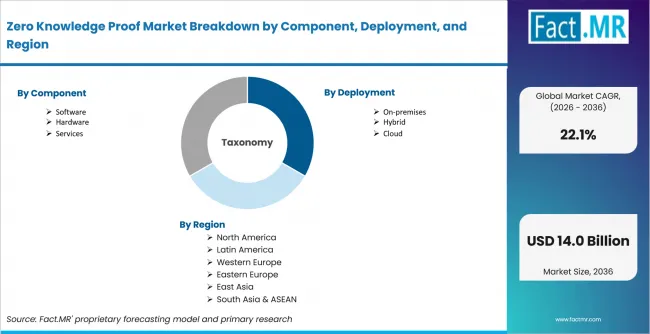
The Zero Knowledge Proof Market is segmented by Component (Software, Hardware, and Services), by Deployment (On-premises, Hybrid, and Cloud), by Type, by Application, by End Use, by Enterprise Size, and by Region. Forecast for 2026 to 2036.
Zero Knowledge Proof Market Forecast and Outlook by Fact.MR
- The zero knowledge proof market was valued at USD 1.7 billion in 2025.
- Based on Fact.MR analysis, demand is estimated to grow to USD 1.9 billion in 2026 and USD 14.0 billion by 2036.
- Fact.MR projects a CAGR of 22.1% during the forecast period.
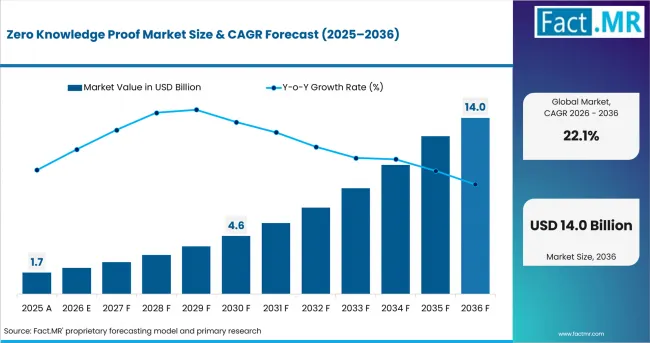
| Metric | Value |
|---|---|
| Estimated Value in 2026 | USD 1.9 billion |
| Forecast Value in 2036 | USD 14.0 billion |
| Forecast CAGR (2026 to 2036) | 22.1% |
Summary of the Zero Knowledge Proof Market
- Demand Drivers
- Financial identity checks are bringing proof systems into banking workflows. The Federal Trade Commission received 6.5 million consumer reports in 2024. This supports demand for privacy-preserving identity checks that reduce repeated personal data sharing. [2]
- Internet crime losses keep security leaders focused on safer transactions. The Federal Bureau of Investigation said 2024 internet crime reports covered losses above USD 16 billion. This supports private proof tools for payments and account validation. [3]
- Data breach exposure is raising interest in claim proof without data exchange. The Identity Theft Resource Center tracked 3,158 U.S. data compromises in 2024. This pushes regulated firms to reduce stored identity data. [4]
- Key Segments Analyzed
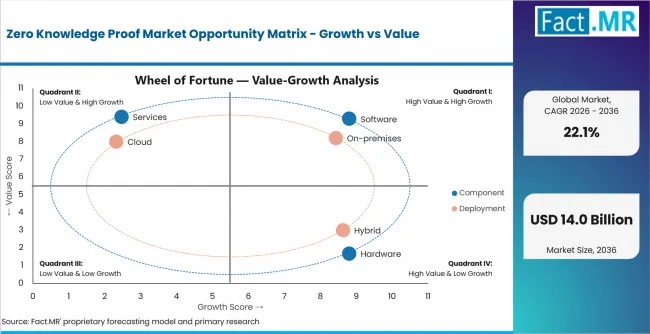
- By Component: Software holds 52.7% share in 2026 because developer kits and verifier libraries form the main spending layer for proof generation.
- By Deployment: On-premises systems hold 54.2% share in 2026 since banks and public agencies prefer local control for sensitive proof generation.
- By Type: Non-interactive proofs lead with 69.4% share in 2026 because one-step proof submission fits blockchain settlement and online credential checks.
- By Application: Identity verification accounts for 28.4% share in 2026 as firms verify age and account status with less personal data transfer.
- By End Use: Banking and financial services hold 31.6% share in 2026 because payment checks and customer identity controls create direct proof software spending.
- By Enterprise Size: Large enterprises capture 68.9% share in 2026 since banks and cloud platforms have the budget to test proof systems at scale.
- Analyst Opinion at Fact.MR
- Shambhu Nath Jha, Principal Consultant at Fact.MR, opines, “CXOs will view zero knowledge proof as a privacy control that reduces data exposure during verification. The strongest uptake will come from identity and audit workflows that need proof without raw data transfer.”
- Strategic Implications
- Suppliers should offer proof software with simple developer tools for payment and identity users. Complex cryptography needs clean verifier workflows.
- Vendors should build audit controls for regulated accounts and credential issuers. Strong budgets will come from firms that need proof records without copying personal data.
- Hardware and cloud vendors should reduce proof cost per transaction. Lower proof cost can move zero knowledge proof from blockchain projects into routine enterprise checks.
The market is set to generate an incremental revenue opportunity of USD 12.1 billion between 2026 and 2036. Market expansion is linked to identity checks, private payments, and compliance proof entering regulated digital workflows. Proof generation cost and limited cryptography skills may slow adoption across smaller firms.
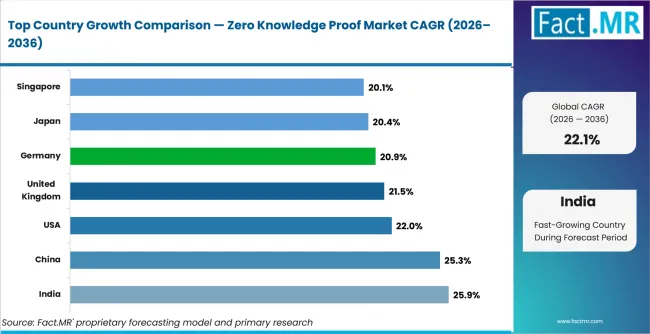
India is projected to record a 25.9% CAGR through 2036 as data protection rules and payment identity checks push banks toward private verification. China follows at 25.3% CAGR from 2026 to 2036, helped by personal information rules and platform payment scale. The United States grows at 22.0% CAGR by 2036 as financial fraud and cloud identity programs keep proof systems in enterprise security budgets. The United Kingdom advances at 21.5% CAGR through 2036 as fintech firms and online identity pilots create demand for selective disclosure. Germany records 20.9% CAGR by 2036 as privacy audits push regulated firms toward verifiable claims with less shared data. Japan expands at 20.4% CAGR from 2926 to 2036 as financial institutions and public identity programs review controlled proof systems for credential validation. Singapore grows at 20.1% CAGR through 2036 as fintech regulation and cross-border payment activity favor verification that preserves privacy.
Segmental Analysis
Zero Knowledge Proof Market Analysis by Component
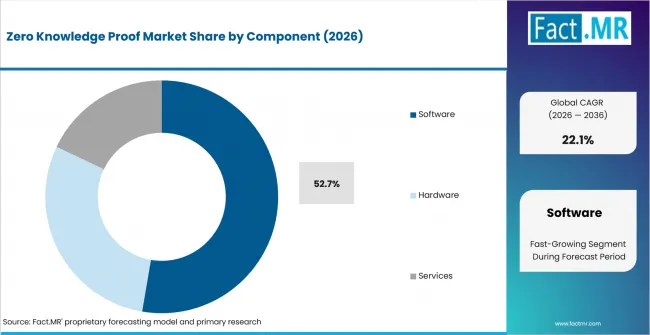
Software is likely to hold 52.7% share in 2026 because proof engines and verifier libraries form the main spending layer. Developer kits help payment and identity software users build proof workflows. The World Wide Web Consortium published Verifiable Credentials 2.0 as a W3C Standard in May 2025, giving identity software users a clearer base for private credential exchange. [5]
- Software Demand: Proof engines and verifier libraries receive large software budgets because they connect with payment and identity platforms.
- Hardware Acceleration: Proof hardware gains attention as high proof volume increases compute pressure for blockchain and private account checks.
- Services Role: Integration services support enterprise pilots because internal security staff often lack cryptography skills.
Zero Knowledge Proof Market Analysis by Deployment
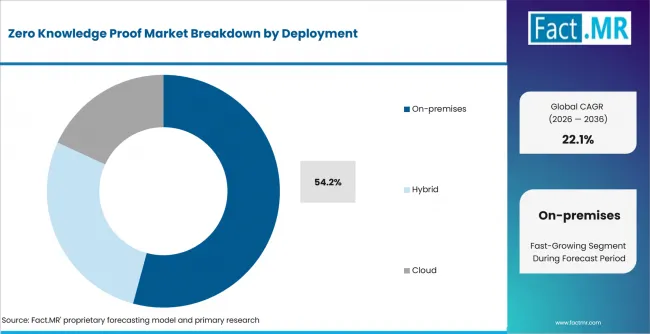
On-premises systems are forecast to hold 54.2% share in 2026 because banks and public agencies prefer local control for sensitive proof generation. This reflects stricter review of data movement before cloud-based proof verification is approved.
- Local Control: Regulated institutions keep proof generation close to internal systems so customer records are not copied into outside tools.
- Hybrid Path: Hybrid setups grow in payments because firms can create proofs internally and verify them through partner systems.
- Cloud Entry: Cloud proof services help software firms test faster with lower infrastructure effort during early pilots.
Zero Knowledge Proof Market Analysis by Type
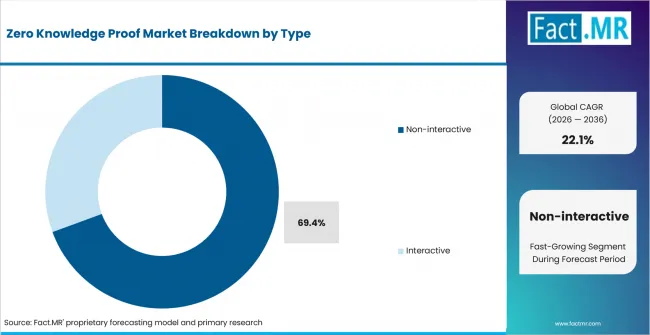
Non-interactive proofs are expected to hold 69.4% share in 2026 because one submitted proof can be checked without repeated exchange. This format suits blockchain settlement and credential checks with high transaction volume.
- Non-interactive Use: Blockchain and credential platforms prefer one-step proof checks because they reduce communication load.
- Interactive Proofs: Authentication workflows use challenge-response checks for live user sessions that need quick confirmation.
- Short Proof Need: Firms favor smaller proof files because large proofs raise storage and network costs in high-volume applications.
Zero Knowledge Proof Market Analysis by Application
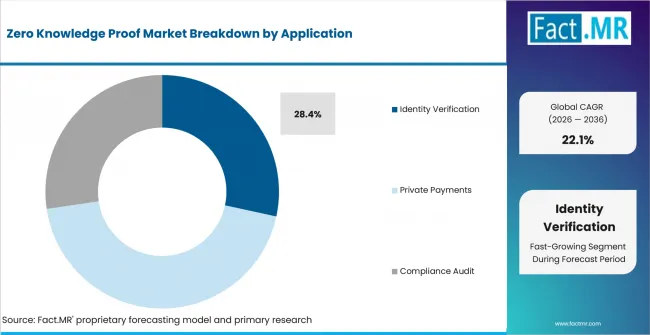
Identity verification is likely to hold 28.4% share in 2026 because firms need to confirm age, account status or access rights with less personal data transfer. This share comes from private credential checks in banking, workplace access and public services.
- Identity Verification: Credential issuers use proof systems to confirm selected claims without sending full records to every verifier.
- Private Payments: Payment networks test proofs that confirm funds and compliance status without showing full transaction details.
- Compliance Audit: Audit staff use proof records to confirm rule adherence while sensitive customer data stays inside approved systems.
Zero Knowledge Proof Market Analysis by End Use
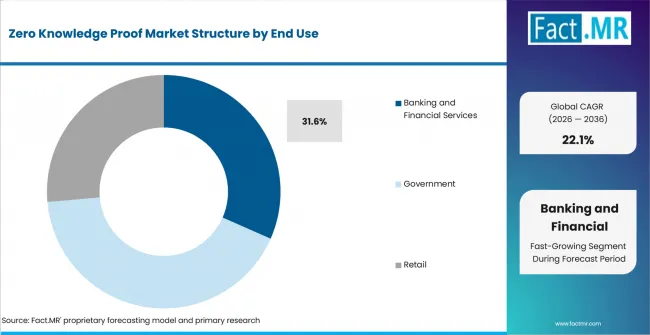
Banking and financial services are forecast to hold 31.6% share in 2026 because payment checks, reserve proof and customer identity controls create near-term software spending. This segment has a clear link between privacy rules and transaction verification.
- Banking Applications: Banks use proof systems to verify identity and transaction status with lower exposure of customer records.
- Government Identity: Public agencies study private credential checks for benefits, licensing and citizen access programs.
- Healthcare Records: Healthcare users test proofs that confirm eligibility or consent without sharing full patient files.
Zero Knowledge Proof Market Analysis by Enterprise Size
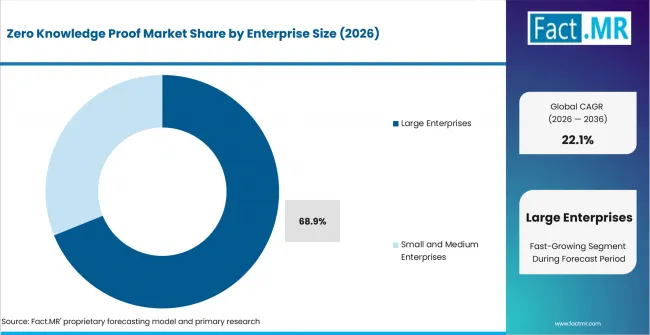
Large enterprises are expected to hold 68.9% share in 2026 because banks, exchanges and cloud platforms have the budget to test proof systems at scale. This share reflects higher engineering capacity and greater exposure to privacy audits.
- Large Enterprise Spending: Large firms fund proof software earlier because they handle repeated identity checks and regulated data exchanges.
- Smaller Firm Entry: Smaller firms adopt managed proof tools after vendors reduce setup effort and offer clearer pricing.
- Platform Buying: Cloud and blockchain platforms influence supplier selection because developer programs shape proof tool use.
Drivers, Restraints, and Opportunities

The zero knowledge proof market grows as identity and payment systems need verification without copying personal records. Firms connect proof tools with cyber security systems and identity verification services so privacy controls work inside existing security workflows.
Adoption can slow because proof generation is costly and internal skill is limited. Firms that already use identity as a service or software defined security can move faster because policy control and identity data flows are already mapped.
- Private Identity Proof: Online credential programs need proof-based age, status and access checks that reveal only the claim needed.
- Proof Cost Pressure: Compute cost can slow high-volume payment use because each proof needs processing before verification.
- Compliance Opportunity: Proof records can support audits by confirming rule checks without storing full customer data.
Regional Analysis
The zero knowledge proof market is assessed across North America, Europe, Asia Pacific, Latin America, and the Middle East and Africa. The country view covers component, deployment model, proof type, application, end use, and enterprise size.
.webp)
| Country | CAGR (2026 to 2036) |
|---|---|
| India | 25.9% |
| China | 25.3% |
| United States | 22.0% |
| United Kingdom | 21.5% |
| Germany | 20.9% |
| Japan | 20.4% |
| Singapore | 20.1% |

Asia Pacific Zero Knowledge Proof Market Analysis
Asia Pacific records the fastest market expansion since payments, identity checks and blockchain development create early proof software demand.
- India: India is projected to grow at 25.9% CAGR by 2036 since payment identity checks and data protection compliance push banks toward private verification. Local fintech firms are expected to favor managed tools first before building custom proof circuits.
- China: China is projected to expand at 25.3% CAGR through 2036 since personal information rules and platform payment scale require stronger claim verification with less data movement. Large internet firms can test proof systems inside identity and wallet environments.
- Japan: Japan is forecast at 20.4% CAGR from 2026 to 2036 since financial institutions and public identity programs prefer controlled proof systems for credential validation. Enterprise buyers will move gradually due to long review cycles for new security tools.
North America Zero Knowledge Proof Market Analysis
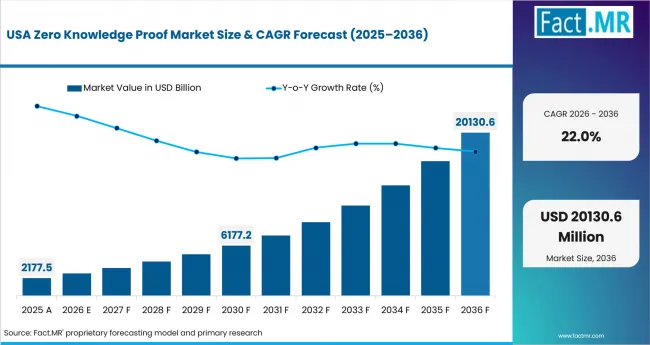
North America has a major near-term revenue pool as enterprise security budgets and blockchain developer activity support proof software spending. Financial firms connect proof work with transaction monitoring to validate payment behavior without wider data exposure.
- United States: The United States is projected to grow at 22.0% CAGR through 2036 since cyber fraud losses and cloud identity programs create direct demand for private account checks. Venture-backed proof vendors and large cloud partners keep the country central to tool development.
Europe Zero Knowledge Proof Market Analysis

Europe shows steady privacy driven demand as regulated firms seek verification methods that reduce data sharing. Financial firms connect proof tools with financial analytics so risk teams can validate claims without copying full account records.
- Germany: Germany is projected to grow at 20.9% CAGR from 2026 to 2036 since privacy audits and industrial software controls support claim proof in regulated data exchange. Enterprise adoption will center on identity, audit and supply record validation.
- United Kingdom: The United Kingdom is forecast at 21.5% CAGR by 2036 since fintech firms and online identity pilots create a practical path for selective disclosure. Banks are expected to evaluate proof tools for fraud review and account status checks.
Southeast Asia Zero Knowledge Proof Market Analysis
Singapore acts as a South Asia and Pacific testing hub for proof systems because payment firms and compliance technology vendors support cross-border financial workflows. Security departments compare proof tools with cloud access security brokers and biometric as a service for layered access control.
- Singapore: Singapore is projected to grow at 20.1% CAGR by 2036 since fintech regulation and cross-border payment activity favor privacy preserving verification. Local demand will stay concentrated in banking, exchange and compliance software accounts.
Competitive Aligners for Market Players

Zero knowledge proof suppliers compete on proof speed, developer tools and audit support. Aleo launched its mainnet in September 2024 and said developers had created 350 applications on Aleo. This shows how proof platforms are moving toward application ecosystems. [7]
Cloud partnerships are shaping supplier reach. Aleo said its February 2025 Google Cloud collaboration gave snarkVM workloads a 10% performance boost on Axion virtual machines. This shows why proof cost and compute access affect vendor choice. [6]
Identity applications are moving from concept to working software. Aztec described StealthNote in June 2025 as a private posting app that proves organization membership through zero knowledge proofs without revealing user identity. [8]
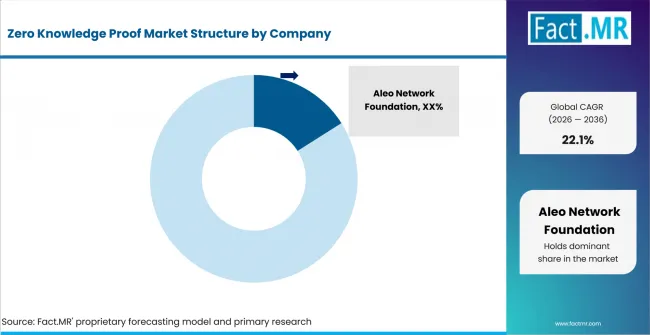
Competition is led by specialized proof networks and large technology firms that support developer tools, wallets and verifier infrastructure. Smaller vendors can win focused accounts if their tools reduce proof setup time and simplify audit records.
Key Players
- Aleo Network Foundation
- Aztec Foundation
- Provable
- Polygon Labs
- StarkWare
- RISC Zero
- IBM Corporation
- Microsoft Corporation
Bibliography
- [1] National Institute of Standards and Technology. (2024, September 24–26). NIST workshop on privacy-enhancing cryptography 2024.
- [2] Federal Trade Commission. (2025, March 10). New FTC data show a big jump in reported losses to fraud to $12.5 billion in 2024.
- [3] Federal Bureau of Investigation. (2025, April 23). FBI releases annual Internet Crime Report.
- [4] Identity Theft Resource Center. (2025, January 28). Identity Theft Resource Center’s 2024 Annual Data Breach Report reveals near-record number of compromises and victim notices.
- [5] World Wide Web Consortium. (2025, May 15). W3C publishes Verifiable Credentials 2.0 as a W3C Standard, making expression, exchange, and verification of digital credentials easier and more secure.
- [6] Aleo Network Foundation. (2025, February 27). Aleo collaborates with Google Cloud to advance privacy-preserving computing.
- [7] Aleo Network Foundation. (2024, September 18). Aleo Mainnet is here.
- [8] Lisa A. (2025, June 4). StealthNote: The decentralized, private Glassdoor of Web3. Aztec Network.
This Report Addresses
- Strategic demand analysis for zero knowledge proof systems across identity verification and private payment applications. Coverage includes banking, government, healthcare, retail, and enterprise technology users globally.
- Market forecast from USD 1.9 billion in 2026 to USD 14.0 billion by 2036 at 22.1% CAGR. The analysis covers component, deployment, type, application, end use, and enterprise size.
- Opportunity mapping across India, China, the United States, the United Kingdom, Germany, Japan, and Singapore. The assessment reflects privacy rules, payment identity checks, and enterprise security spending.
- Segment analysis by component, deployment model, proof type, application, end use, and enterprise size with regional forecasts through 2036.
- Competitive analysis of Aleo Network Foundation, Aztec Foundation, Provable, Polygon Labs, StarkWare, RISC Zero, IBM Corporation, and Microsoft Corporation. Coverage includes proof speed, developer tooling, audit support, and enterprise integration strength.
- Regulatory and standards impact analysis covering NIST privacy-enhancing cryptography activity, W3C Verifiable Credentials 2.0, fraud reporting, internet crime losses, and data breach exposure.
- Report delivery in PDF, Excel, and presentation formats supported by vendor documentation, standards updates, proof network activity, and enterprise security interviews.
Zero Knowledge Proof Market Definition
The zero knowledge proof market covers software, hardware, and service systems that verify a claim without exposing the underlying confidential data. These systems support identity checks, private payments, compliance proof, and secure data sharing across banking, government, healthcare, retail, and enterprise technology users.
Zero Knowledge Proof Market Inclusions
Covers global and regional market forecasts from 2026 to 2036 by component, deployment, proof type, application, end use, and enterprise size. Includes software proof engines, verifier libraries, developer kits, proof acceleration hardware, and integration services used across on-premises, hybrid, and cloud environments.
Zero Knowledge Proof Market Exclusions
Excludes basic encryption tools that do not generate or verify zero knowledge proofs. Omits general cybersecurity software used only for access control, data storage, or network protection without proof creation. Excludes blockchain platforms, payment networks, and identity systems unless zero knowledge proof capability is the direct revenue-generating component.
Zero Knowledge Proof Market Research Methodology
- Primary Research
- Interviews with cryptography software vendors, enterprise security teams, blockchain infrastructure providers, banking technology managers, and compliance software specialists across the United States, China, India, Germany, the United Kingdom, Japan, and Singapore.
- Desk Research
- Analysis of Aleo Network Foundation, Aztec Foundation, Provable, Polygon Labs, StarkWare, RISC Zero, IBM Corporation, and Microsoft Corporation public releases. Supplemented by NIST privacy-enhancing cryptography materials, W3C verifiable credential standards, FTC fraud data, FBI internet crime reporting, and data breach reports.
- Market-Sizing and Forecasting
- Hybrid model combining top-down software security spending allocation with bottom-up proof tool adoption by application area. Proof engine revenue, hardware acceleration demand, integration service spending, and deployment preference are modeled independently and aggregated across all regions.
- Data Validation and Update Cycle
- Validated through vendor product documentation, proof network activity, enterprise security deployment reviews, standards updates, and supplier interviews. Updated annually with privacy regulation changes, verifiable credential standards, proof computing performance changes, and enterprise adoption signals.
Scope of the Report

| Attribute | Details |
|---|---|
| Quantitative Units | USD 1.9 billion (2026) to USD 14.0 billion (2036), at a CAGR of 22.1% |
| Market Definition | Zero knowledge proof systems used to verify claims without exposing confidential data across identity checks, private payments, compliance proof, and secure data sharing applications globally. |
| Component Segmentation | Software, Hardware, Services |
| Deployment Segmentation | On-premises, Hybrid, Cloud |
| Type Segmentation | Non-interactive, Interactive |
| Application Coverage | Identity Verification, Private Payments, Compliance Audit, Data Sharing |
| End Use Coverage | Banking and Financial Services, Government, Healthcare, Retail, Enterprise Technology |
| Enterprise Size Coverage | Large Enterprises, Small and Medium Enterprises |
| Regions Covered | North America, Latin America, Western Europe, Eastern Europe, East Asia, South Asia and Pacific, Middle East and Africa |
| Countries Covered | United States, China, India, Germany, United Kingdom, Japan, Singapore |
| Key Companies Profiled | Aleo Network Foundation, Aztec Foundation, Provable, Polygon Labs, StarkWare, RISC Zero, IBM Corporation, Microsoft Corporation |
| Forecast Period | 2026 to 2036 |
| Approach | Hybrid top-down and bottom-up model using software security spending allocation, proof tool adoption by application area, proof engine revenue, hardware acceleration demand, integration service spending, vendor documentation, standards updates, and primary interviews with cryptography vendors and enterprise security teams. |
Zero Knowledge Proof Market by Segment
-
By Component
- Software
- Hardware
- Services
-
By Deployment
- On-premises
- Hybrid
- Cloud
-
By Type
- Non-interactive
- Interactive
-
By Application
- Identity Verification
- Private Payments
- Compliance Audit
- Data Sharing
-
By End Use
- Banking and Financial Services
- Government
- Healthcare
- Retail
- Enterprise Technology
-
By Enterprise Size
- Large Enterprises
- Small and Medium Enterprises
-
By Region
- North America
- Latin America
- Western Europe
- Eastern Europe
- East Asia
- South Asia and Pacific
- Middle East and Africa
- UAE
- Saudi Arabia
- South Africa
- Rest of Middle East & Africa
- North America
- Frequently Asked Questions -
How large is the global zero knowledge proof market in 2025?
The global zero knowledge proof market was valued at USD 1.7 billion in 2025.
What will the zero knowledge proof market size be in 2026?
Based on Fact.MR analysis, demand for zero knowledge proof systems is estimated to grow to USD 1.9 billion in 2026.
What is the projected zero knowledge proof market size by 2036?
The market is projected to reach USD 14.0 billion by 2036, creating USD 12.1 billion in incremental revenue opportunity.
What is the expected CAGR for the zero knowledge proof market from 2026 to 2036?
Fact.MR projects a CAGR of 22.1% for the global zero knowledge proof market during the forecast period.
Which component segment leads the zero knowledge proof market?
Software leads with 52.7% share in 2026 because proof engines and verifier libraries form the main spending layer.
Which deployment segment holds the largest zero knowledge proof market share?
On-premises systems lead with 54.2% share in 2026 since banks and public agencies prefer local control for sensitive proof generation.
Which type segment leads the zero knowledge proof market?
Non-interactive proofs lead with 69.4% share in 2026 because one-step proof submission fits blockchain settlement and credential checks.
Which application holds the largest zero knowledge proof market share?
Identity verification accounts for 28.4% share in 2026 as firms verify age, account status, and access rights with less data transfer.
Which end use segment leads the zero knowledge proof market?
Banking and financial services hold 31.6% share in 2026 because payment checks and customer identity controls create direct proof software spending.
Which enterprise size segment leads the zero knowledge proof market?
Large enterprises capture 68.9% share in 2026 because banks, exchanges, and cloud platforms have budget to test proof systems at scale.
Which country shows the fastest growth in the zero knowledge proof market?
India leads at 25.9% CAGR through 2036 as data protection rules and payment identity checks push banks toward private verification.
Table of Content
- Executive Summary
- Global Market Outlook
- Demand to side Trends
- Supply to side Trends
- Technology Roadmap Analysis
- Analysis and Recommendations
- Market Overview
- Market Coverage / Taxonomy
- Market Definition / Scope / Limitations
- Research Methodology
- Chapter Orientation
- Analytical Lens and Working Hypotheses
- Market Structure, Signals, and Trend Drivers
- Benchmarking and Cross-market Comparability
- Market Sizing, Forecasting, and Opportunity Mapping
- Research Design and Evidence Framework
- Desk Research Programme (Secondary Evidence)
- Company Annual and Sustainability Reports
- Peer-reviewed Journals and Academic Literature
- Corporate Websites, Product Literature, and Technical Notes
- Earnings Decks and Investor Briefings
- Statutory Filings and Regulatory Disclosures
- Technical White Papers and Standards Notes
- Trade Journals, Industry Magazines, and Analyst Briefs
- Conference Proceedings, Webinars, and Seminar Materials
- Government Statistics Portals and Public Data Releases
- Press Releases and Reputable Media Coverage
- Specialist Newsletters and Curated Briefings
- Sector Databases and Reference Repositories
- Fact.MR Internal Proprietary Databases and Historical Market Datasets
- Subscription Datasets and Paid Sources
- Social Channels, Communities, and Digital Listening Inputs
- Additional Desk Sources
- Expert Input and Fieldwork (Primary Evidence)
- Primary Modes
- Qualitative Interviews and Expert Elicitation
- Quantitative Surveys and Structured Data Capture
- Blended Approach
- Why Primary Evidence is Used
- Field Techniques
- Interviews
- Surveys
- Focus Groups
- Observational and In-context Research
- Social and Community Interactions
- Stakeholder Universe Engaged
- C-suite Leaders
- Board Members
- Presidents and Vice Presidents
- R&D and Innovation Heads
- Technical Specialists
- Domain Subject-matter Experts
- Scientists
- Physicians and Other Healthcare Professionals
- Governance, Ethics, and Data Stewardship
- Research Ethics
- Data Integrity and Handling
- Primary Modes
- Tooling, Models, and Reference Databases
- Desk Research Programme (Secondary Evidence)
- Data Engineering and Model Build
- Data Acquisition and Ingestion
- Cleaning, Normalisation, and Verification
- Synthesis, Triangulation, and Analysis
- Quality Assurance and Audit Trail
- Market Background
- Market Dynamics
- Drivers
- Restraints
- Opportunity
- Trends
- Scenario Forecast
- Demand in Optimistic Scenario
- Demand in Likely Scenario
- Demand in Conservative Scenario
- Opportunity Map Analysis
- Product Life Cycle Analysis
- Supply Chain Analysis
- Investment Feasibility Matrix
- Value Chain Analysis
- PESTLE and Porter’s Analysis
- Regulatory Landscape
- Regional Parent Market Outlook
- Production and Consumption Statistics
- Import and Export Statistics
- Market Dynamics
- Global Market Analysis 2021 to 2025 and Forecast, 2026 to 2036
- Historical Market Size Value (USD Million) Analysis, 2021 to 2025
- Current and Future Market Size Value (USD Million) Projections, 2026 to 2036
- Y to o to Y Growth Trend Analysis
- Absolute $ Opportunity Analysis
- Global Market Pricing Analysis 2021 to 2025 and Forecast 2026 to 2036
- Global Market Analysis 2021 to 2025 and Forecast 2026 to 2036, By Product Type
- Introduction / Key Findings
- Historical Market Size Value (USD Million) Analysis By Product Type , 2021 to 2025
- Current and Future Market Size Value (USD Million) Analysis and Forecast By Product Type , 2026 to 2036
- Wearable Accelerometer Sensors
- Implantable Accelerometer Sensors
- Patch-Based Sensors
- Wearable Accelerometer Sensors
- Y to o to Y Growth Trend Analysis By Product Type , 2021 to 2025
- Absolute $ Opportunity Analysis By Product Type , 2026 to 2036
- Global Market Analysis 2021 to 2025 and Forecast 2026 to 2036, By Axis Type
- Introduction / Key Findings
- Historical Market Size Value (USD Million) Analysis By Axis Type, 2021 to 2025
- Current and Future Market Size Value (USD Million) Analysis and Forecast By Axis Type, 2026 to 2036
- Three-Axis
- Six-Axis IMU-Based Sensors
- Multi-Sensor Motion Modules
- Three-Axis
- Y to o to Y Growth Trend Analysis By Axis Type, 2021 to 2025
- Absolute $ Opportunity Analysis By Axis Type, 2026 to 2036
- Global Market Analysis 2021 to 2025 and Forecast 2026 to 2036, By Application
- Introduction / Key Findings
- Historical Market Size Value (USD Million) Analysis By Application, 2021 to 2025
- Current and Future Market Size Value (USD Million) Analysis and Forecast By Application, 2026 to 2036
- Patient Activity Monitoring
- Fall Detection
- Sleep Tracking
- Patient Activity Monitoring
- Y to o to Y Growth Trend Analysis By Application, 2021 to 2025
- Absolute $ Opportunity Analysis By Application, 2026 to 2036
- Global Market Analysis 2021 to 2025 and Forecast 2026 to 2036, By End User
- Introduction / Key Findings
- Historical Market Size Value (USD Million) Analysis By End User, 2021 to 2025
- Current and Future Market Size Value (USD Million) Analysis and Forecast By End User, 2026 to 2036
- Medical Device Manufacturers
- Home Healthcare Providers
- Hospitals
- Medical Device Manufacturers
- Y to o to Y Growth Trend Analysis By End User, 2021 to 2025
- Absolute $ Opportunity Analysis By End User, 2026 to 2036
- Global Market Analysis 2021 to 2025 and Forecast 2026 to 2036, By Sales Channel
- Introduction / Key Findings
- Historical Market Size Value (USD Million) Analysis By Sales Channel, 2021 to 2025
- Current and Future Market Size Value (USD Million) Analysis and Forecast By Sales Channel, 2026 to 2036
- Direct OEM Supply
- Distributor Sales
- Clinical Trial Platform Supply
- Direct OEM Supply
- Y to o to Y Growth Trend Analysis By Sales Channel, 2021 to 2025
- Absolute $ Opportunity Analysis By Sales Channel, 2026 to 2036
- Global Market Analysis 2021 to 2025 and Forecast 2026 to 2036, By Region
- Introduction
- Historical Market Size Value (USD Million) Analysis By Region, 2021 to 2025
- Current Market Size Value (USD Million) Analysis and Forecast By Region, 2026 to 2036
- North America
- Latin America
- Western Europe
- Eastern Europe
- East Asia
- South Asia and Pacific
- Middle East & Africa
- Market Attractiveness Analysis By Region
- North America Market Analysis 2021 to 2025 and Forecast 2026 to 2036, By Country
- Historical Market Size Value (USD Million) Trend Analysis By Market Taxonomy, 2021 to 2025
- Market Size Value (USD Million) Forecast By Market Taxonomy, 2026 to 2036
- By Country
- USA
- Canada
- Mexico
- By Product Type
- By Axis Type
- By Application
- By End User
- By Sales Channel
- By Country
- Market Attractiveness Analysis
- By Country
- By Product Type
- By Axis Type
- By Application
- By End User
- By Sales Channel
- Key Takeaways
- Latin America Market Analysis 2021 to 2025 and Forecast 2026 to 2036, By Country
- Historical Market Size Value (USD Million) Trend Analysis By Market Taxonomy, 2021 to 2025
- Market Size Value (USD Million) Forecast By Market Taxonomy, 2026 to 2036
- By Country
- Brazil
- Chile
- Rest of Latin America
- By Product Type
- By Axis Type
- By Application
- By End User
- By Sales Channel
- By Country
- Market Attractiveness Analysis
- By Country
- By Product Type
- By Axis Type
- By Application
- By End User
- By Sales Channel
- Key Takeaways
- Western Europe Market Analysis 2021 to 2025 and Forecast 2026 to 2036, By Country
- Historical Market Size Value (USD Million) Trend Analysis By Market Taxonomy, 2021 to 2025
- Market Size Value (USD Million) Forecast By Market Taxonomy, 2026 to 2036
- By Country
- Germany
- UK
- Italy
- Spain
- France
- Nordic
- BENELUX
- Rest of Western Europe
- By Product Type
- By Axis Type
- By Application
- By End User
- By Sales Channel
- By Country
- Market Attractiveness Analysis
- By Country
- By Product Type
- By Axis Type
- By Application
- By End User
- By Sales Channel
- Key Takeaways
- Eastern Europe Market Analysis 2021 to 2025 and Forecast 2026 to 2036, By Country
- Historical Market Size Value (USD Million) Trend Analysis By Market Taxonomy, 2021 to 2025
- Market Size Value (USD Million) Forecast By Market Taxonomy, 2026 to 2036
- By Country
- Russia
- Poland
- Hungary
- Balkan & Baltic
- Rest of Eastern Europe
- By Product Type
- By Axis Type
- By Application
- By End User
- By Sales Channel
- By Country
- Market Attractiveness Analysis
- By Country
- By Product Type
- By Axis Type
- By Application
- By End User
- By Sales Channel
- Key Takeaways
- East Asia Market Analysis 2021 to 2025 and Forecast 2026 to 2036, By Country
- Historical Market Size Value (USD Million) Trend Analysis By Market Taxonomy, 2021 to 2025
- Market Size Value (USD Million) Forecast By Market Taxonomy, 2026 to 2036
- By Country
- China
- Japan
- South Korea
- By Product Type
- By Axis Type
- By Application
- By End User
- By Sales Channel
- By Country
- Market Attractiveness Analysis
- By Country
- By Product Type
- By Axis Type
- By Application
- By End User
- By Sales Channel
- Key Takeaways
- South Asia and Pacific Market Analysis 2021 to 2025 and Forecast 2026 to 2036, By Country
- Historical Market Size Value (USD Million) Trend Analysis By Market Taxonomy, 2021 to 2025
- Market Size Value (USD Million) Forecast By Market Taxonomy, 2026 to 2036
- By Country
- India
- ASEAN
- Australia & New Zealand
- Rest of South Asia and Pacific
- By Product Type
- By Axis Type
- By Application
- By End User
- By Sales Channel
- By Country
- Market Attractiveness Analysis
- By Country
- By Product Type
- By Axis Type
- By Application
- By End User
- By Sales Channel
- Key Takeaways
- Middle East & Africa Market Analysis 2021 to 2025 and Forecast 2026 to 2036, By Country
- Historical Market Size Value (USD Million) Trend Analysis By Market Taxonomy, 2021 to 2025
- Market Size Value (USD Million) Forecast By Market Taxonomy, 2026 to 2036
- By Country
- Kingdom of Saudi Arabia
- Other GCC Countries
- Turkiye
- South Africa
- Other African Union
- Rest of Middle East & Africa
- By Product Type
- By Axis Type
- By Application
- By End User
- By Sales Channel
- By Country
- Market Attractiveness Analysis
- By Country
- By Product Type
- By Axis Type
- By Application
- By End User
- By Sales Channel
- Key Takeaways
- Key Countries Market Analysis
- USA
- Pricing Analysis
- Market Share Analysis, 2025
- By Product Type
- By Axis Type
- By Application
- By End User
- By Sales Channel
- Canada
- Pricing Analysis
- Market Share Analysis, 2025
- By Product Type
- By Axis Type
- By Application
- By End User
- By Sales Channel
- Mexico
- Pricing Analysis
- Market Share Analysis, 2025
- By Product Type
- By Axis Type
- By Application
- By End User
- By Sales Channel
- Brazil
- Pricing Analysis
- Market Share Analysis, 2025
- By Product Type
- By Axis Type
- By Application
- By End User
- By Sales Channel
- Chile
- Pricing Analysis
- Market Share Analysis, 2025
- By Product Type
- By Axis Type
- By Application
- By End User
- By Sales Channel
- Germany
- Pricing Analysis
- Market Share Analysis, 2025
- By Product Type
- By Axis Type
- By Application
- By End User
- By Sales Channel
- UK
- Pricing Analysis
- Market Share Analysis, 2025
- By Product Type
- By Axis Type
- By Application
- By End User
- By Sales Channel
- Italy
- Pricing Analysis
- Market Share Analysis, 2025
- By Product Type
- By Axis Type
- By Application
- By End User
- By Sales Channel
- Spain
- Pricing Analysis
- Market Share Analysis, 2025
- By Product Type
- By Axis Type
- By Application
- By End User
- By Sales Channel
- France
- Pricing Analysis
- Market Share Analysis, 2025
- By Product Type
- By Axis Type
- By Application
- By End User
- By Sales Channel
- India
- Pricing Analysis
- Market Share Analysis, 2025
- By Product Type
- By Axis Type
- By Application
- By End User
- By Sales Channel
- ASEAN
- Pricing Analysis
- Market Share Analysis, 2025
- By Product Type
- By Axis Type
- By Application
- By End User
- By Sales Channel
- Australia & New Zealand
- Pricing Analysis
- Market Share Analysis, 2025
- By Product Type
- By Axis Type
- By Application
- By End User
- By Sales Channel
- China
- Pricing Analysis
- Market Share Analysis, 2025
- By Product Type
- By Axis Type
- By Application
- By End User
- By Sales Channel
- Japan
- Pricing Analysis
- Market Share Analysis, 2025
- By Product Type
- By Axis Type
- By Application
- By End User
- By Sales Channel
- South Korea
- Pricing Analysis
- Market Share Analysis, 2025
- By Product Type
- By Axis Type
- By Application
- By End User
- By Sales Channel
- Russia
- Pricing Analysis
- Market Share Analysis, 2025
- By Product Type
- By Axis Type
- By Application
- By End User
- By Sales Channel
- Poland
- Pricing Analysis
- Market Share Analysis, 2025
- By Product Type
- By Axis Type
- By Application
- By End User
- By Sales Channel
- Hungary
- Pricing Analysis
- Market Share Analysis, 2025
- By Product Type
- By Axis Type
- By Application
- By End User
- By Sales Channel
- Kingdom of Saudi Arabia
- Pricing Analysis
- Market Share Analysis, 2025
- By Product Type
- By Axis Type
- By Application
- By End User
- By Sales Channel
- Turkiye
- Pricing Analysis
- Market Share Analysis, 2025
- By Product Type
- By Axis Type
- By Application
- By End User
- By Sales Channel
- South Africa
- Pricing Analysis
- Market Share Analysis, 2025
- By Product Type
- By Axis Type
- By Application
- By End User
- By Sales Channel
- USA
- Market Structure Analysis
- Competition Dashboard
- Competition Benchmarking
- Market Share Analysis of Top Players
- By Regional
- By Product Type
- By Axis Type
- By Application
- By End User
- By Sales Channel
- Competition Analysis
- Competition Deep Dive
- STMicroelectronics N.V.
- Overview
- Product Portfolio
- Profitability by Market Segments (Product/Age /Sales Channel/Region)
- Sales Footprint
- Strategy Overview
- Marketing Strategy
- Product Strategy
- Channel Strategy
- Analog Devices, Inc.
- Bosch Sensortec GmbH
- TE Connectivity Ltd.
- Murata Manufacturing Co., Ltd.
- STMicroelectronics N.V.
- Competition Deep Dive
- Assumptions & Acronyms Used
List Of Table
- Table 1: Global Market Value (USD Million) Forecast by Region, 2021 to 2036
- Table 2: Global Market Value (USD Million) Forecast by Product Type, 2021 to 2036
- Table 3: Global Market Value (USD Million) Forecast by Axis Type, 2021 to 2036
- Table 4: Global Market Value (USD Million) Forecast by Application, 2021 to 2036
- Table 5: Global Market Value (USD Million) Forecast by End User, 2021 to 2036
- Table 6: Global Market Value (USD Million) Forecast by Sales Channel, 2021 to 2036
- Table 7: North America Market Value (USD Million) Forecast by Country, 2021 to 2036
- Table 8: North America Market Value (USD Million) Forecast by Product Type, 2021 to 2036
- Table 9: North America Market Value (USD Million) Forecast by Axis Type, 2021 to 2036
- Table 10: North America Market Value (USD Million) Forecast by Application, 2021 to 2036
- Table 11: North America Market Value (USD Million) Forecast by End User, 2021 to 2036
- Table 12: North America Market Value (USD Million) Forecast by Sales Channel, 2021 to 2036
- Table 13: Latin America Market Value (USD Million) Forecast by Country, 2021 to 2036
- Table 14: Latin America Market Value (USD Million) Forecast by Product Type, 2021 to 2036
- Table 15: Latin America Market Value (USD Million) Forecast by Axis Type, 2021 to 2036
- Table 16: Latin America Market Value (USD Million) Forecast by Application, 2021 to 2036
- Table 17: Latin America Market Value (USD Million) Forecast by End User, 2021 to 2036
- Table 18: Latin America Market Value (USD Million) Forecast by Sales Channel, 2021 to 2036
- Table 19: Western Europe Market Value (USD Million) Forecast by Country, 2021 to 2036
- Table 20: Western Europe Market Value (USD Million) Forecast by Product Type, 2021 to 2036
- Table 21: Western Europe Market Value (USD Million) Forecast by Axis Type, 2021 to 2036
- Table 22: Western Europe Market Value (USD Million) Forecast by Application, 2021 to 2036
- Table 23: Western Europe Market Value (USD Million) Forecast by End User, 2021 to 2036
- Table 24: Western Europe Market Value (USD Million) Forecast by Sales Channel, 2021 to 2036
- Table 25: Eastern Europe Market Value (USD Million) Forecast by Country, 2021 to 2036
- Table 26: Eastern Europe Market Value (USD Million) Forecast by Product Type, 2021 to 2036
- Table 27: Eastern Europe Market Value (USD Million) Forecast by Axis Type, 2021 to 2036
- Table 28: Eastern Europe Market Value (USD Million) Forecast by Application, 2021 to 2036
- Table 29: Eastern Europe Market Value (USD Million) Forecast by End User, 2021 to 2036
- Table 30: Eastern Europe Market Value (USD Million) Forecast by Sales Channel, 2021 to 2036
- Table 31: East Asia Market Value (USD Million) Forecast by Country, 2021 to 2036
- Table 32: East Asia Market Value (USD Million) Forecast by Product Type, 2021 to 2036
- Table 33: East Asia Market Value (USD Million) Forecast by Axis Type, 2021 to 2036
- Table 34: East Asia Market Value (USD Million) Forecast by Application, 2021 to 2036
- Table 35: East Asia Market Value (USD Million) Forecast by End User, 2021 to 2036
- Table 36: East Asia Market Value (USD Million) Forecast by Sales Channel, 2021 to 2036
- Table 37: South Asia and Pacific Market Value (USD Million) Forecast by Country, 2021 to 2036
- Table 38: South Asia and Pacific Market Value (USD Million) Forecast by Product Type, 2021 to 2036
- Table 39: South Asia and Pacific Market Value (USD Million) Forecast by Axis Type, 2021 to 2036
- Table 40: South Asia and Pacific Market Value (USD Million) Forecast by Application, 2021 to 2036
- Table 41: South Asia and Pacific Market Value (USD Million) Forecast by End User, 2021 to 2036
- Table 42: South Asia and Pacific Market Value (USD Million) Forecast by Sales Channel, 2021 to 2036
- Table 43: Middle East & Africa Market Value (USD Million) Forecast by Country, 2021 to 2036
- Table 44: Middle East & Africa Market Value (USD Million) Forecast by Product Type, 2021 to 2036
- Table 45: Middle East & Africa Market Value (USD Million) Forecast by Axis Type, 2021 to 2036
- Table 46: Middle East & Africa Market Value (USD Million) Forecast by Application, 2021 to 2036
- Table 47: Middle East & Africa Market Value (USD Million) Forecast by End User, 2021 to 2036
- Table 48: Middle East & Africa Market Value (USD Million) Forecast by Sales Channel, 2021 to 2036
List Of Figures
- Figure 1: Global Market Pricing Analysis
- Figure 2: Global Market Value (USD Million) Forecast 2021-2036
- Figure 3: Global Market Value Share and BPS Analysis by Product Type, 2026 and 2036
- Figure 4: Global Market Y-o-Y Growth Comparison by Product Type, 2026 to 2036
- Figure 5: Global Market Attractiveness Analysis by Product Type
- Figure 6: Global Market Value Share and BPS Analysis by Axis Type, 2026 and 2036
- Figure 7: Global Market Y-o-Y Growth Comparison by Axis Type, 2026 to 2036
- Figure 8: Global Market Attractiveness Analysis by Axis Type
- Figure 9: Global Market Value Share and BPS Analysis by Application, 2026 and 2036
- Figure 10: Global Market Y-o-Y Growth Comparison by Application, 2026 to 2036
- Figure 11: Global Market Attractiveness Analysis by Application
- Figure 12: Global Market Value Share and BPS Analysis by End User, 2026 and 2036
- Figure 13: Global Market Y-o-Y Growth Comparison by End User, 2026 to 2036
- Figure 14: Global Market Attractiveness Analysis by End User
- Figure 15: Global Market Value Share and BPS Analysis by Sales Channel, 2026 and 2036
- Figure 16: Global Market Y-o-Y Growth Comparison by Sales Channel, 2026 to 2036
- Figure 17: Global Market Attractiveness Analysis by Sales Channel
- Figure 18: Global Market Value (USD Million) Share and BPS Analysis by Region, 2026 and 2036
- Figure 19: Global Market Y-o-Y Growth Comparison by Region, 2026 to 2036
- Figure 20: Global Market Attractiveness Analysis by Region
- Figure 21: North America Market Incremental Dollar Opportunity, 2026 to 2036
- Figure 22: Latin America Market Incremental Dollar Opportunity, 2026 to 2036
- Figure 23: Western Europe Market Incremental Dollar Opportunity, 2026 to 2036
- Figure 24: Eastern Europe Market Incremental Dollar Opportunity, 2026 to 2036
- Figure 25: East Asia Market Incremental Dollar Opportunity, 2026 to 2036
- Figure 26: South Asia and Pacific Market Incremental Dollar Opportunity, 2026 to 2036
- Figure 27: Middle East & Africa Market Incremental Dollar Opportunity, 2026 to 2036
- Figure 28: North America Market Value Share and BPS Analysis by Country, 2026 and 2036
- Figure 29: North America Market Value Share and BPS Analysis by Product Type, 2026 and 2036
- Figure 30: North America Market Y-o-Y Growth Comparison by Product Type, 2026 to 2036
- Figure 31: North America Market Attractiveness Analysis by Product Type
- Figure 32: North America Market Value Share and BPS Analysis by Axis Type, 2026 and 2036
- Figure 33: North America Market Y-o-Y Growth Comparison by Axis Type, 2026 to 2036
- Figure 34: North America Market Attractiveness Analysis by Axis Type
- Figure 35: North America Market Value Share and BPS Analysis by Application, 2026 and 2036
- Figure 36: North America Market Y-o-Y Growth Comparison by Application, 2026 to 2036
- Figure 37: North America Market Attractiveness Analysis by Application
- Figure 38: North America Market Value Share and BPS Analysis by End User, 2026 and 2036
- Figure 39: North America Market Y-o-Y Growth Comparison by End User, 2026 to 2036
- Figure 40: North America Market Attractiveness Analysis by End User
- Figure 41: North America Market Value Share and BPS Analysis by Sales Channel, 2026 and 2036
- Figure 42: North America Market Y-o-Y Growth Comparison by Sales Channel, 2026 to 2036
- Figure 43: North America Market Attractiveness Analysis by Sales Channel
- Figure 44: Latin America Market Value Share and BPS Analysis by Country, 2026 and 2036
- Figure 45: Latin America Market Value Share and BPS Analysis by Product Type, 2026 and 2036
- Figure 46: Latin America Market Y-o-Y Growth Comparison by Product Type, 2026 to 2036
- Figure 47: Latin America Market Attractiveness Analysis by Product Type
- Figure 48: Latin America Market Value Share and BPS Analysis by Axis Type, 2026 and 2036
- Figure 49: Latin America Market Y-o-Y Growth Comparison by Axis Type, 2026 to 2036
- Figure 50: Latin America Market Attractiveness Analysis by Axis Type
- Figure 51: Latin America Market Value Share and BPS Analysis by Application, 2026 and 2036
- Figure 52: Latin America Market Y-o-Y Growth Comparison by Application, 2026 to 2036
- Figure 53: Latin America Market Attractiveness Analysis by Application
- Figure 54: Latin America Market Value Share and BPS Analysis by End User, 2026 and 2036
- Figure 55: Latin America Market Y-o-Y Growth Comparison by End User, 2026 to 2036
- Figure 56: Latin America Market Attractiveness Analysis by End User
- Figure 57: Latin America Market Value Share and BPS Analysis by Sales Channel, 2026 and 2036
- Figure 58: Latin America Market Y-o-Y Growth Comparison by Sales Channel, 2026 to 2036
- Figure 59: Latin America Market Attractiveness Analysis by Sales Channel
- Figure 60: Western Europe Market Value Share and BPS Analysis by Country, 2026 and 2036
- Figure 61: Western Europe Market Value Share and BPS Analysis by Product Type, 2026 and 2036
- Figure 62: Western Europe Market Y-o-Y Growth Comparison by Product Type, 2026 to 2036
- Figure 63: Western Europe Market Attractiveness Analysis by Product Type
- Figure 64: Western Europe Market Value Share and BPS Analysis by Axis Type, 2026 and 2036
- Figure 65: Western Europe Market Y-o-Y Growth Comparison by Axis Type, 2026 to 2036
- Figure 66: Western Europe Market Attractiveness Analysis by Axis Type
- Figure 67: Western Europe Market Value Share and BPS Analysis by Application, 2026 and 2036
- Figure 68: Western Europe Market Y-o-Y Growth Comparison by Application, 2026 to 2036
- Figure 69: Western Europe Market Attractiveness Analysis by Application
- Figure 70: Western Europe Market Value Share and BPS Analysis by End User, 2026 and 2036
- Figure 71: Western Europe Market Y-o-Y Growth Comparison by End User, 2026 to 2036
- Figure 72: Western Europe Market Attractiveness Analysis by End User
- Figure 73: Western Europe Market Value Share and BPS Analysis by Sales Channel, 2026 and 2036
- Figure 74: Western Europe Market Y-o-Y Growth Comparison by Sales Channel, 2026 to 2036
- Figure 75: Western Europe Market Attractiveness Analysis by Sales Channel
- Figure 76: Eastern Europe Market Value Share and BPS Analysis by Country, 2026 and 2036
- Figure 77: Eastern Europe Market Value Share and BPS Analysis by Product Type, 2026 and 2036
- Figure 78: Eastern Europe Market Y-o-Y Growth Comparison by Product Type, 2026 to 2036
- Figure 79: Eastern Europe Market Attractiveness Analysis by Product Type
- Figure 80: Eastern Europe Market Value Share and BPS Analysis by Axis Type, 2026 and 2036
- Figure 81: Eastern Europe Market Y-o-Y Growth Comparison by Axis Type, 2026 to 2036
- Figure 82: Eastern Europe Market Attractiveness Analysis by Axis Type
- Figure 83: Eastern Europe Market Value Share and BPS Analysis by Application, 2026 and 2036
- Figure 84: Eastern Europe Market Y-o-Y Growth Comparison by Application, 2026 to 2036
- Figure 85: Eastern Europe Market Attractiveness Analysis by Application
- Figure 86: Eastern Europe Market Value Share and BPS Analysis by End User, 2026 and 2036
- Figure 87: Eastern Europe Market Y-o-Y Growth Comparison by End User, 2026 to 2036
- Figure 88: Eastern Europe Market Attractiveness Analysis by End User
- Figure 89: Eastern Europe Market Value Share and BPS Analysis by Sales Channel, 2026 and 2036
- Figure 90: Eastern Europe Market Y-o-Y Growth Comparison by Sales Channel, 2026 to 2036
- Figure 91: Eastern Europe Market Attractiveness Analysis by Sales Channel
- Figure 92: East Asia Market Value Share and BPS Analysis by Country, 2026 and 2036
- Figure 93: East Asia Market Value Share and BPS Analysis by Product Type, 2026 and 2036
- Figure 94: East Asia Market Y-o-Y Growth Comparison by Product Type, 2026 to 2036
- Figure 95: East Asia Market Attractiveness Analysis by Product Type
- Figure 96: East Asia Market Value Share and BPS Analysis by Axis Type, 2026 and 2036
- Figure 97: East Asia Market Y-o-Y Growth Comparison by Axis Type, 2026 to 2036
- Figure 98: East Asia Market Attractiveness Analysis by Axis Type
- Figure 99: East Asia Market Value Share and BPS Analysis by Application, 2026 and 2036
- Figure 100: East Asia Market Y-o-Y Growth Comparison by Application, 2026 to 2036
- Figure 101: East Asia Market Attractiveness Analysis by Application
- Figure 102: East Asia Market Value Share and BPS Analysis by End User, 2026 and 2036
- Figure 103: East Asia Market Y-o-Y Growth Comparison by End User, 2026 to 2036
- Figure 104: East Asia Market Attractiveness Analysis by End User
- Figure 105: East Asia Market Value Share and BPS Analysis by Sales Channel, 2026 and 2036
- Figure 106: East Asia Market Y-o-Y Growth Comparison by Sales Channel, 2026 to 2036
- Figure 107: East Asia Market Attractiveness Analysis by Sales Channel
- Figure 108: South Asia and Pacific Market Value Share and BPS Analysis by Country, 2026 and 2036
- Figure 109: South Asia and Pacific Market Value Share and BPS Analysis by Product Type, 2026 and 2036
- Figure 110: South Asia and Pacific Market Y-o-Y Growth Comparison by Product Type, 2026 to 2036
- Figure 111: South Asia and Pacific Market Attractiveness Analysis by Product Type
- Figure 112: South Asia and Pacific Market Value Share and BPS Analysis by Axis Type, 2026 and 2036
- Figure 113: South Asia and Pacific Market Y-o-Y Growth Comparison by Axis Type, 2026 to 2036
- Figure 114: South Asia and Pacific Market Attractiveness Analysis by Axis Type
- Figure 115: South Asia and Pacific Market Value Share and BPS Analysis by Application, 2026 and 2036
- Figure 116: South Asia and Pacific Market Y-o-Y Growth Comparison by Application, 2026 to 2036
- Figure 117: South Asia and Pacific Market Attractiveness Analysis by Application
- Figure 118: South Asia and Pacific Market Value Share and BPS Analysis by End User, 2026 and 2036
- Figure 119: South Asia and Pacific Market Y-o-Y Growth Comparison by End User, 2026 to 2036
- Figure 120: South Asia and Pacific Market Attractiveness Analysis by End User
- Figure 121: South Asia and Pacific Market Value Share and BPS Analysis by Sales Channel, 2026 and 2036
- Figure 122: South Asia and Pacific Market Y-o-Y Growth Comparison by Sales Channel, 2026 to 2036
- Figure 123: South Asia and Pacific Market Attractiveness Analysis by Sales Channel
- Figure 124: Middle East & Africa Market Value Share and BPS Analysis by Country, 2026 and 2036
- Figure 125: Middle East & Africa Market Value Share and BPS Analysis by Product Type, 2026 and 2036
- Figure 126: Middle East & Africa Market Y-o-Y Growth Comparison by Product Type, 2026 to 2036
- Figure 127: Middle East & Africa Market Attractiveness Analysis by Product Type
- Figure 128: Middle East & Africa Market Value Share and BPS Analysis by Axis Type, 2026 and 2036
- Figure 129: Middle East & Africa Market Y-o-Y Growth Comparison by Axis Type, 2026 to 2036
- Figure 130: Middle East & Africa Market Attractiveness Analysis by Axis Type
- Figure 131: Middle East & Africa Market Value Share and BPS Analysis by Application, 2026 and 2036
- Figure 132: Middle East & Africa Market Y-o-Y Growth Comparison by Application, 2026 to 2036
- Figure 133: Middle East & Africa Market Attractiveness Analysis by Application
- Figure 134: Middle East & Africa Market Value Share and BPS Analysis by End User, 2026 and 2036
- Figure 135: Middle East & Africa Market Y-o-Y Growth Comparison by End User, 2026 to 2036
- Figure 136: Middle East & Africa Market Attractiveness Analysis by End User
- Figure 137: Middle East & Africa Market Value Share and BPS Analysis by Sales Channel, 2026 and 2036
- Figure 138: Middle East & Africa Market Y-o-Y Growth Comparison by Sales Channel, 2026 to 2036
- Figure 139: Middle East & Africa Market Attractiveness Analysis by Sales Channel
- Figure 140: Global Market - Tier Structure Analysis
- Figure 141: Global Market - Company Share Analysis