Nitrous Oxide Minimized Fertilizer Regime Market

Nitrous Oxide Minimized Fertilizer Regime Market Size and Share Forecast Outlook 2026 to 2036

Nitrous oxide minimized fertilizer regime market is projected to grow from USD 197.2 million in 2026 to USD 657.6 million by 2036, at a CAGR of 12.8%. Cereals will dominate with a 47.1% market share, while granular will lead the form segment with a 42.4% share.

Nitrous-Oxide Minimized Fertilizer Regime Market Forecast and Outlook 2026 to 2036

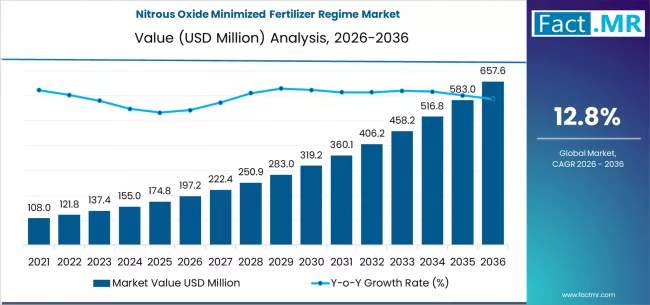
The global market for nitrous-oxide-minimized fertilizer regimes is projected to expand significantly, growing from USD 197.18 million in 2026 to USD 657.58 million by 2036, advancing at a CAGR of 12.8%. This market addresses a potent yet often overlooked climate forcer, which is nitrous oxide. The sector represents a fundamental shift from commodity nitrogen fertilizer sales toward integrated, science-based management programs designed to maximize nitrogen use efficiency and minimize N₂O emissions from agricultural soils.

Key Takeaways from the Nitrous Oxide Minimized Fertilizer Regime Market

  • Market Value for 2026: USD 197.18 Million
  • Market Value for 2036: USD 657.58 Million
  • Forecast CAGR (2026-2036): 12.8%
  • Leading Crop Type Segment (2026): Cereals (47%)
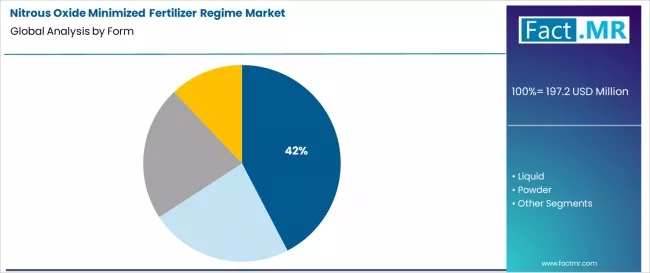
  • Leading Form Segment (2026): Granular (42%)
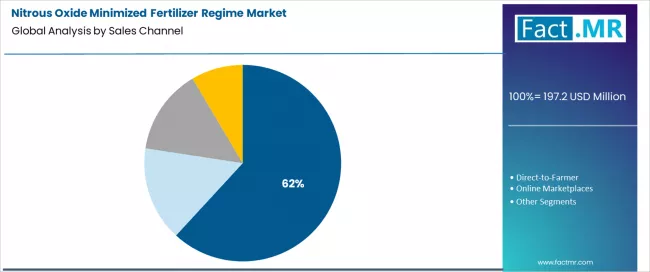
  • Leading Sales Channel Segment (2026): Ag-Retailers (62%)
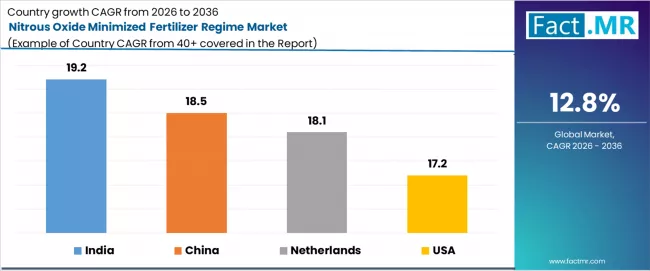
  • Key Growth Countries: India (19.2% CAGR), China (18.5% CAGR), Netherlands (18.1% CAGR), USA (17.2% CAGR)
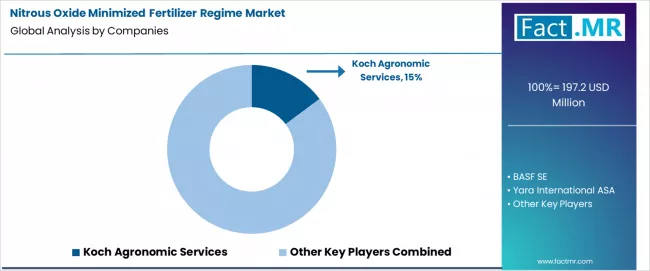
  • Key Players in the Market: Koch Agronomic Services, BASF SE, Yara International ASA, Nutrien, CF Industries, EuroChem Group A.G.

Nitrous Oxide Minimized Fertilizer Regime Market Market Value Analysis

Growth is driven by the increasing integration of agriculture into binding climate policy frameworks and the emergence of regulated carbon markets. These regimes typically combine stabilized nitrogen fertilizers with precision application technologies, soil health amendments, and tailored agronomic advice. The value proposition extends beyond emission reduction, offering farmers tangible benefits through reduced fertilizer input costs, improved yield stability, and access to new revenue streams via verified carbon credits.

The market’s evolution is characterized by a transition from standalone products to comprehensive, data-driven service models. Success depends on the ability to accurately measure, report, and verify emission reductions at scale, creating a credible link between practice change and climate impact. This requires collaboration across the value chain, from input manufacturers and technology providers to agronomists and carbon program developers.

Metric

Metric Value
Market Value (2026) USD 197.18 Million
Market Forecast Value (2036) USD 657.58 Million
Forecast CAGR (2026-2036) 12.8%

Category

Category Segments
Crop Type Cereals, Oilseeds, Fruits, Vegetables
Form Granular, Liquid, Powder, Suspension
Sales Channel Ag-Retailers, Direct-to-Farmer, Online Marketplaces, Cooperatives
Region North America, Latin America, Western Europe, Eastern Europe, East Asia, South Asia & Pacific, MEA

Segmental Analysis

By Crop Type, Which System Demands the Greatest Nitrogen Precision?

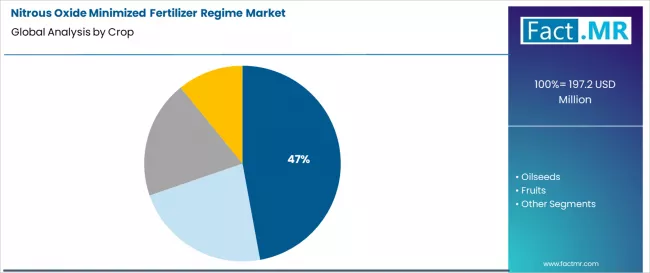
Nitrous Oxide Minimized Fertilizer Regime Market Analysis By Crop

Cereals, dominated by corn, wheat, and barley, leads with a 47% share. These high-nitrogen-demand crops cover vast acreages, representing the largest source of potential N₂O emissions and efficiency gains.

The economic scale of cereal production justifies investment in enhanced efficiency fertilizers and precision management programs. Regimes for cereals are highly developed, often integrating inhibitor-treated urea or polymer-coated products with variable rate application maps derived from yield data.

By Form, Which is Most Conducive to Incorporating Stabilizers?

Nitrous Oxide Minimized Fertilizer Regime Market Analysis By Form

Granular form holds a 42% share as the dominant carrier for nitrification inhibitors like nitrapyrin or DCD. The manufacturing process allows for the uniform coating or impregnation of stabilizers onto granular urea or NPK fertilizers.

This form also facilitates the deep placement or side-dressing applications that are critical for reducing nitrogen loss pathways, making it the preferred physical format for delivering controlled-release and stabilized nitrogen in broadacre cropping.

By Sales Channel, Where is Agronomic Trust Built?

Nitrous Oxide Minimized Fertilizer Regime Market Analysis By Sales Channel

Ag-retailers are the critical channel, commanding a 62% share. Implementing an effective N₂O-minimized regime requires trusted agronomic counsel. Local retailers provide the essential link, educating growers on the correct use of stabilized products, interpreting soil test results, and calibrating application equipment. Their role in bundling inputs, services, and even facilitating entry into carbon programs makes them indispensable for market penetration and farmer adoption.

What are the Drivers, Restraints, and Key Trends of the Nitrous Oxide Minimized Fertilizer Regime Market?

The primary driver is the escalating regulatory and market pressure to decarbonize the food supply chain. Government policies are beginning to mandate or incentivize climate-smart practices, while food corporations and grain traders are setting ambitious Scope 3 emission targets that include fertilizer use. The maturation of voluntary and regulated carbon markets now offers a direct financial return for verified nitrous oxide reduction, transforming it from a cost into an investment.

A significant restraint is the higher upfront cost of enhanced efficiency fertilizers and the technical knowledge required for optimal regime implementation. The complexity and cost of rigorous, in-field nitrous oxide MRV can also be a barrier to scaling carbon credit programs. Farmer skepticism regarding the yield robustness of reduced nitrogen rates and the reliability of carbon payments can slow adoption without strong local demonstration and guaranteed outcomes.

Key trends include the digital integration of MRV, using soil sensors, remote sensing, and biogeochemical models to estimate emissions reductions with lower cost and complexity. There is a strong move toward full-system nutrient stewardship programs that combine nitrogen stabilizers with cover crops and reduced tillage for compounded soil health and climate benefits. Regulatory support in the form of nitrogen management mandates or green procurement policies is also emerging as a powerful market-shaping force.

Analysis of the Nitrous Oxide Minimized Fertilizer Regime Market by Key Countries

Nitrous Oxide Minimized Fertilizer Regime Market Cagr Analysis By Country

Country CAGR (2026-2036)
India 19.2%
China 18.5%
Netherlands 18.1%
USA 17.2%

How is India's Fertilizer Subsidy Policy and Scale Influencing Growth?

India’s leading CAGR of 19.2% is linked to its massive nitrogen fertilizer consumption and the government’s urgent policy shift. The PM-PRANAM scheme incentivizes states to promote alternative fertilizers and reduce conventional urea use.

Promoting neem-coated urea is a central strategy. This policy-driven push, combined with the vast scale of Indian cereal production and growing corporate sustainability initiatives in the agri-sector, creates a powerful accelerator for adoption.

What is the Impact of China's Zero Growth and Pollution Control Policies?

China’s 18.5% growth is directly tied to its national "Fertilizer Use Zero Growth" action plan and Blue Sky war on pollution. The government actively promotes stabilized and controlled-release fertilizers through subsidies to improve efficiency and reduce environmental nitrogen losses, including nitrous oxide.

Large-scale farming operations are primary targets for these state-encouraged regimes, making China a high-volume, policy-driven market for advanced nitrogen management technologies.

Why are the Netherlands a Frontrunner in Regulatory Stringency?

The Netherlands' 18.1% CAGR reflects its position at the forefront of EU agricultural environmental regulation. Facing drastic mandated reductions in nitrogen deposition, Dutch farmers are compelled to adopt the most efficient practices.

The use of urease and nitrification inhibitors is considered a key best available technique. This regulatory environment, combined with high farmer knowledge and a focus on premium production, creates a concentrated market for high-efficacy, proven N₂O-minimization regimes.

How is the USA's Evolving Carbon and Policy Landscape Shaping the Market?

Nitrous Oxide Minimized Fertilizer Regime Market Country Value Analysis

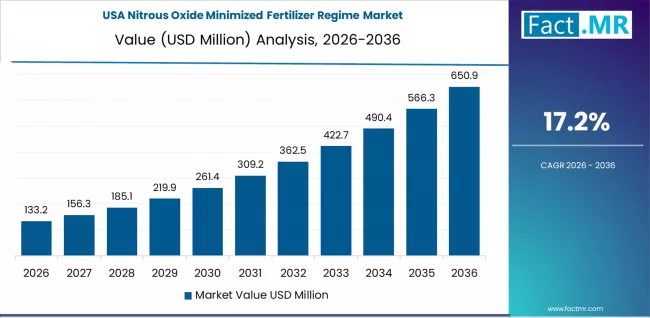
A dynamic mix of private-sector carbon programs and evolving federal policy fuels the USA’s 17.2% growth. Major carbon platforms actively recruit growers using enhanced efficiency fertilizers, creating a direct financial incentive.

USDA programs provide cost-share support for these practices. The large scale of corn and wheat production, combined with growing climate consciousness in the supply chain, drives significant and scalable adoption, particularly in the Midwest.

Competitive Landscape of the Nitrous-Oxide-Minimized Fertilizer Regime Market

Nitrous Oxide Minimized Fertilizer Regime Market Analysis By Company

Established nitrogen fertilizer producers with proprietary stabilizer technologies, specialty chemical companies, and a growing ecosystem of digital MRV and carbon program platforms define the competitive landscape.

Competition is intense around the performance and environmental fate of inhibitor chemistries, the ability to offer integrated digital-agronomic solutions, and success in forming partnerships with carbon program operators and major food companies. Building a reputation for scientific credibility and generating robust, third-party-validated data on emission reductions are key competitive advantages.

Key Players in the Nitrous-Oxide-Minimized Fertilizer Regime Market

  • Koch Agronomic Services
  • BASF SE
  • Yara International ASA
  • Nutrien
  • CF Industries
  • EuroChem Group A.G.

Scope of Report

Items Values
Quantitative Units USD Million
Crop Type Cereals, Oilseeds, Fruits, Vegetables
Form Granular, Liquid, Powder, Suspension
Sales Channel Ag-Retailers, Direct-to-Farmer, Online Marketplaces, Cooperatives
Key Countries USA, Netherlands, China, India
Key Companies Koch Agronomic Services, BASF SE, Yara International ASA, Nutrien, CF Industries, EuroChem Group A.G.
Additional Analysis Agronomic efficacy and N₂O reduction potential of different inhibitor chemistries; analysis of MRV methodologies and their costs; economic modeling of carbon credit generation per hectare; review of global and national regulatory drivers; supply chain integration models with food corporations; long-term soil health impacts of stabilized nitrogen regimes.

Market by Segments

  • Crop Type :

    • Cereals
    • Oilseeds
    • Fruits
    • Vegetables
  • Form :

    • Granular
    • Liquid
    • Powder
    • Suspension
  • Sales Channel :

    • Ag-Retailers
    • Direct-to-Farmer
    • Online Marketplaces
    • Cooperatives
  • Region :

    • North America
      • USA
      • Canada
    • Latin America
      • Brazil
      • Mexico
      • Argentina
      • Rest of Latin America
    • Western Europe
      • Germany
      • UK
      • France
      • Spain
      • Italy
      • Netherlands
      • BENELUX
      • Rest of Western Europe
    • Eastern Europe
      • Russia
      • Poland
      • Czech Republic
      • Rest of Eastern Europe
    • East Asia
      • China
      • Japan
      • South Korea
      • Rest of East Asia
    • South Asia & Pacific
      • India
      • ASEAN
      • Australia
      • Rest of South Asia & Pacific
    • MEA
      • Saudi Arabia
      • UAE
      • Turkiye
      • Rest of MEA

Table of Content

  1. Executive Summary
    • Global Market Outlook
    • Demand to side Trends
    • Supply to side Trends
    • Technology Roadmap Analysis
    • Analysis and Recommendations
  2. Market Overview
    • Market Coverage / Taxonomy
    • Market Definition / Scope / Limitations
  3. Market Background
    • Market Dynamics
      • Drivers
      • Restraints
      • Opportunity
      • Trends
    • Scenario Forecast
      • Demand in Optimistic Scenario
      • Demand in Likely Scenario
      • Demand in Conservative Scenario
    • Opportunity Map Analysis
    • Product Life Cycle Analysis
    • Supply Chain Analysis
    • Investment Feasibility Matrix
    • Value Chain Analysis
    • PESTLE and Porter’s Analysis
    • Regulatory Landscape
    • Regional Parent Market Outlook
    • Production and Consumption Statistics
    • Import and Export Statistics
  4. Global Market Analysis 2021 to 2025 and Forecast, 2026 to 2036
    • Historical Market Size Value (USD Million) Analysis, 2021 to 2025
    • Current and Future Market Size Value (USD Million) Projections, 2026 to 2036
      • Y to o to Y Growth Trend Analysis
      • Absolute $ Opportunity Analysis
  5. Global Market Pricing Analysis 2021 to 2025 and Forecast 2026 to 2036
  6. Global Market Analysis 2021 to 2025 and Forecast 2026 to 2036, By Crop
    • Introduction / Key Findings
    • Historical Market Size Value (USD Million) Analysis By Crop, 2021 to 2025
    • Current and Future Market Size Value (USD Million) Analysis and Forecast By Crop, 2026 to 2036
      • Cereals
      • Oilseeds
      • Fruits
      • Vegetables
    • Y to o to Y Growth Trend Analysis By Crop, 2021 to 2025
    • Absolute $ Opportunity Analysis By Crop, 2026 to 2036
  7. Global Market Analysis 2021 to 2025 and Forecast 2026 to 2036, By Form
    • Introduction / Key Findings
    • Historical Market Size Value (USD Million) Analysis By Form, 2021 to 2025
    • Current and Future Market Size Value (USD Million) Analysis and Forecast By Form, 2026 to 2036
      • Granular
      • Liquid
      • Powder
      • Suspension
    • Y to o to Y Growth Trend Analysis By Form, 2021 to 2025
    • Absolute $ Opportunity Analysis By Form, 2026 to 2036
  8. Global Market Analysis 2021 to 2025 and Forecast 2026 to 2036, By Sales Channel
    • Introduction / Key Findings
    • Historical Market Size Value (USD Million) Analysis By Sales Channel, 2021 to 2025
    • Current and Future Market Size Value (USD Million) Analysis and Forecast By Sales Channel, 2026 to 2036
      • Ag-Retailers
      • Direct-to-Farmer
      • Online Marketplaces
      • Cooperatives
    • Y to o to Y Growth Trend Analysis By Sales Channel, 2021 to 2025
    • Absolute $ Opportunity Analysis By Sales Channel, 2026 to 2036
  9. Global Market Analysis 2021 to 2025 and Forecast 2026 to 2036, By Region
    • Introduction
    • Historical Market Size Value (USD Million) Analysis By Region, 2021 to 2025
    • Current Market Size Value (USD Million) Analysis and Forecast By Region, 2026 to 2036
      • North America
      • Latin America
      • Western Europe
      • Eastern Europe
      • East Asia
      • South Asia and Pacific
      • Middle East & Africa
    • Market Attractiveness Analysis By Region
  10. North America Market Analysis 2021 to 2025 and Forecast 2026 to 2036, By Country
    • Historical Market Size Value (USD Million) Trend Analysis By Market Taxonomy, 2021 to 2025
    • Market Size Value (USD Million) Forecast By Market Taxonomy, 2026 to 2036
      • By Country
        • USA
        • Canada
        • Mexico
      • By Crop
      • By Form
      • By Sales Channel
    • Market Attractiveness Analysis
      • By Country
      • By Crop
      • By Form
      • By Sales Channel
    • Key Takeaways
  11. Latin America Market Analysis 2021 to 2025 and Forecast 2026 to 2036, By Country
    • Historical Market Size Value (USD Million) Trend Analysis By Market Taxonomy, 2021 to 2025
    • Market Size Value (USD Million) Forecast By Market Taxonomy, 2026 to 2036
      • By Country
        • Brazil
        • Chile
        • Rest of Latin America
      • By Crop
      • By Form
      • By Sales Channel
    • Market Attractiveness Analysis
      • By Country
      • By Crop
      • By Form
      • By Sales Channel
    • Key Takeaways
  12. Western Europe Market Analysis 2021 to 2025 and Forecast 2026 to 2036, By Country
    • Historical Market Size Value (USD Million) Trend Analysis By Market Taxonomy, 2021 to 2025
    • Market Size Value (USD Million) Forecast By Market Taxonomy, 2026 to 2036
      • By Country
        • Germany
        • UK
        • Italy
        • Spain
        • France
        • Nordic
        • BENELUX
        • Rest of Western Europe
      • By Crop
      • By Form
      • By Sales Channel
    • Market Attractiveness Analysis
      • By Country
      • By Crop
      • By Form
      • By Sales Channel
    • Key Takeaways
  13. Eastern Europe Market Analysis 2021 to 2025 and Forecast 2026 to 2036, By Country
    • Historical Market Size Value (USD Million) Trend Analysis By Market Taxonomy, 2021 to 2025
    • Market Size Value (USD Million) Forecast By Market Taxonomy, 2026 to 2036
      • By Country
        • Russia
        • Poland
        • Hungary
        • Balkan & Baltic
        • Rest of Eastern Europe
      • By Crop
      • By Form
      • By Sales Channel
    • Market Attractiveness Analysis
      • By Country
      • By Crop
      • By Form
      • By Sales Channel
    • Key Takeaways
  14. East Asia Market Analysis 2021 to 2025 and Forecast 2026 to 2036, By Country
    • Historical Market Size Value (USD Million) Trend Analysis By Market Taxonomy, 2021 to 2025
    • Market Size Value (USD Million) Forecast By Market Taxonomy, 2026 to 2036
      • By Country
        • China
        • Japan
        • South Korea
      • By Crop
      • By Form
      • By Sales Channel
    • Market Attractiveness Analysis
      • By Country
      • By Crop
      • By Form
      • By Sales Channel
    • Key Takeaways
  15. South Asia and Pacific Market Analysis 2021 to 2025 and Forecast 2026 to 2036, By Country
    • Historical Market Size Value (USD Million) Trend Analysis By Market Taxonomy, 2021 to 2025
    • Market Size Value (USD Million) Forecast By Market Taxonomy, 2026 to 2036
      • By Country
        • India
        • ASEAN
        • Australia & New Zealand
        • Rest of South Asia and Pacific
      • By Crop
      • By Form
      • By Sales Channel
    • Market Attractiveness Analysis
      • By Country
      • By Crop
      • By Form
      • By Sales Channel
    • Key Takeaways
  16. Middle East & Africa Market Analysis 2021 to 2025 and Forecast 2026 to 2036, By Country
    • Historical Market Size Value (USD Million) Trend Analysis By Market Taxonomy, 2021 to 2025
    • Market Size Value (USD Million) Forecast By Market Taxonomy, 2026 to 2036
      • By Country
        • Kingdom of Saudi Arabia
        • Other GCC Countries
        • Turkiye
        • South Africa
        • Other African Union
        • Rest of Middle East & Africa
      • By Crop
      • By Form
      • By Sales Channel
    • Market Attractiveness Analysis
      • By Country
      • By Crop
      • By Form
      • By Sales Channel
    • Key Takeaways
  17. Key Countries Market Analysis
    • USA
      • Pricing Analysis
      • Market Share Analysis, 2025
        • By Crop
        • By Form
        • By Sales Channel
    • Canada
      • Pricing Analysis
      • Market Share Analysis, 2025
        • By Crop
        • By Form
        • By Sales Channel
    • Mexico
      • Pricing Analysis
      • Market Share Analysis, 2025
        • By Crop
        • By Form
        • By Sales Channel
    • Brazil
      • Pricing Analysis
      • Market Share Analysis, 2025
        • By Crop
        • By Form
        • By Sales Channel
    • Chile
      • Pricing Analysis
      • Market Share Analysis, 2025
        • By Crop
        • By Form
        • By Sales Channel
    • Germany
      • Pricing Analysis
      • Market Share Analysis, 2025
        • By Crop
        • By Form
        • By Sales Channel
    • UK
      • Pricing Analysis
      • Market Share Analysis, 2025
        • By Crop
        • By Form
        • By Sales Channel
    • Italy
      • Pricing Analysis
      • Market Share Analysis, 2025
        • By Crop
        • By Form
        • By Sales Channel
    • Spain
      • Pricing Analysis
      • Market Share Analysis, 2025
        • By Crop
        • By Form
        • By Sales Channel
    • France
      • Pricing Analysis
      • Market Share Analysis, 2025
        • By Crop
        • By Form
        • By Sales Channel
    • India
      • Pricing Analysis
      • Market Share Analysis, 2025
        • By Crop
        • By Form
        • By Sales Channel
    • ASEAN
      • Pricing Analysis
      • Market Share Analysis, 2025
        • By Crop
        • By Form
        • By Sales Channel
    • Australia & New Zealand
      • Pricing Analysis
      • Market Share Analysis, 2025
        • By Crop
        • By Form
        • By Sales Channel
    • China
      • Pricing Analysis
      • Market Share Analysis, 2025
        • By Crop
        • By Form
        • By Sales Channel
    • Japan
      • Pricing Analysis
      • Market Share Analysis, 2025
        • By Crop
        • By Form
        • By Sales Channel
    • South Korea
      • Pricing Analysis
      • Market Share Analysis, 2025
        • By Crop
        • By Form
        • By Sales Channel
    • Russia
      • Pricing Analysis
      • Market Share Analysis, 2025
        • By Crop
        • By Form
        • By Sales Channel
    • Poland
      • Pricing Analysis
      • Market Share Analysis, 2025
        • By Crop
        • By Form
        • By Sales Channel
    • Hungary
      • Pricing Analysis
      • Market Share Analysis, 2025
        • By Crop
        • By Form
        • By Sales Channel
    • Kingdom of Saudi Arabia
      • Pricing Analysis
      • Market Share Analysis, 2025
        • By Crop
        • By Form
        • By Sales Channel
    • Turkiye
      • Pricing Analysis
      • Market Share Analysis, 2025
        • By Crop
        • By Form
        • By Sales Channel
    • South Africa
      • Pricing Analysis
      • Market Share Analysis, 2025
        • By Crop
        • By Form
        • By Sales Channel
  18. Market Structure Analysis
    • Competition Dashboard
    • Competition Benchmarking
    • Market Share Analysis of Top Players
      • By Regional
      • By Crop
      • By Form
      • By Sales Channel
  19. Competition Analysis
    • Competition Deep Dive
      • Koch Agronomic Services
        • Overview
        • Product Portfolio
        • Profitability by Market Segments (Product/Age /Sales Channel/Region)
        • Sales Footprint
        • Strategy Overview
          • Marketing Strategy
          • Product Strategy
          • Channel Strategy
      • BASF SE
      • Yara International ASA
      • Nutrien
      • CF Industries
      • EuroChem Group A.G.
  20. Assumptions & Acronyms Used
  21. Research Methodology

List Of Table

  • Table 1: Global Market Value (USD Million) Forecast by Region, 2021 to 2036
  • Table 2: Global Market Value (USD Million) Forecast by Crop, 2021 to 2036
  • Table 3: Global Market Value (USD Million) Forecast by Form, 2021 to 2036
  • Table 4: Global Market Value (USD Million) Forecast by Sales Channel, 2021 to 2036
  • Table 5: North America Market Value (USD Million) Forecast by Country, 2021 to 2036
  • Table 6: North America Market Value (USD Million) Forecast by Crop, 2021 to 2036
  • Table 7: North America Market Value (USD Million) Forecast by Form, 2021 to 2036
  • Table 8: North America Market Value (USD Million) Forecast by Sales Channel, 2021 to 2036
  • Table 9: Latin America Market Value (USD Million) Forecast by Country, 2021 to 2036
  • Table 10: Latin America Market Value (USD Million) Forecast by Crop, 2021 to 2036
  • Table 11: Latin America Market Value (USD Million) Forecast by Form, 2021 to 2036
  • Table 12: Latin America Market Value (USD Million) Forecast by Sales Channel, 2021 to 2036
  • Table 13: Western Europe Market Value (USD Million) Forecast by Country, 2021 to 2036
  • Table 14: Western Europe Market Value (USD Million) Forecast by Crop, 2021 to 2036
  • Table 15: Western Europe Market Value (USD Million) Forecast by Form, 2021 to 2036
  • Table 16: Western Europe Market Value (USD Million) Forecast by Sales Channel, 2021 to 2036
  • Table 17: Eastern Europe Market Value (USD Million) Forecast by Country, 2021 to 2036
  • Table 18: Eastern Europe Market Value (USD Million) Forecast by Crop, 2021 to 2036
  • Table 19: Eastern Europe Market Value (USD Million) Forecast by Form, 2021 to 2036
  • Table 20: Eastern Europe Market Value (USD Million) Forecast by Sales Channel, 2021 to 2036
  • Table 21: East Asia Market Value (USD Million) Forecast by Country, 2021 to 2036
  • Table 22: East Asia Market Value (USD Million) Forecast by Crop, 2021 to 2036
  • Table 23: East Asia Market Value (USD Million) Forecast by Form, 2021 to 2036
  • Table 24: East Asia Market Value (USD Million) Forecast by Sales Channel, 2021 to 2036
  • Table 25: South Asia and Pacific Market Value (USD Million) Forecast by Country, 2021 to 2036
  • Table 26: South Asia and Pacific Market Value (USD Million) Forecast by Crop, 2021 to 2036
  • Table 27: South Asia and Pacific Market Value (USD Million) Forecast by Form, 2021 to 2036
  • Table 28: South Asia and Pacific Market Value (USD Million) Forecast by Sales Channel, 2021 to 2036
  • Table 29: Middle East & Africa Market Value (USD Million) Forecast by Country, 2021 to 2036
  • Table 30: Middle East & Africa Market Value (USD Million) Forecast by Crop, 2021 to 2036
  • Table 31: Middle East & Africa Market Value (USD Million) Forecast by Form, 2021 to 2036
  • Table 32: Middle East & Africa Market Value (USD Million) Forecast by Sales Channel, 2021 to 2036

List Of Figures

  • Figure 1: Global Market Pricing Analysis
  • Figure 2: Global Market Value (USD Million) Forecast 2021 to 2036
  • Figure 3: Global Market Value Share and BPS Analysis by Crop, 2026 and 2036
  • Figure 4: Global Market Y to o to Y Growth Comparison by Crop, 2026 to 2036
  • Figure 5: Global Market Attractiveness Analysis by Crop
  • Figure 6: Global Market Value Share and BPS Analysis by Form, 2026 and 2036
  • Figure 7: Global Market Y to o to Y Growth Comparison by Form, 2026 to 2036
  • Figure 8: Global Market Attractiveness Analysis by Form
  • Figure 9: Global Market Value Share and BPS Analysis by Sales Channel, 2026 and 2036
  • Figure 10: Global Market Y to o to Y Growth Comparison by Sales Channel, 2026 to 2036
  • Figure 11: Global Market Attractiveness Analysis by Sales Channel
  • Figure 12: Global Market Value (USD Million) Share and BPS Analysis by Region, 2026 and 2036
  • Figure 13: Global Market Y to o to Y Growth Comparison by Region, 2026 to 2036
  • Figure 14: Global Market Attractiveness Analysis by Region
  • Figure 15: North America Market Incremental Dollar Opportunity, 2026 to 2036
  • Figure 16: Latin America Market Incremental Dollar Opportunity, 2026 to 2036
  • Figure 17: Western Europe Market Incremental Dollar Opportunity, 2026 to 2036
  • Figure 18: Eastern Europe Market Incremental Dollar Opportunity, 2026 to 2036
  • Figure 19: East Asia Market Incremental Dollar Opportunity, 2026 to 2036
  • Figure 20: South Asia and Pacific Market Incremental Dollar Opportunity, 2026 to 2036
  • Figure 21: Middle East & Africa Market Incremental Dollar Opportunity, 2026 to 2036
  • Figure 22: North America Market Value Share and BPS Analysis by Country, 2026 and 2036
  • Figure 23: North America Market Value Share and BPS Analysis by Crop, 2026 and 2036
  • Figure 24: North America Market Y to o to Y Growth Comparison by Crop, 2026 to 2036
  • Figure 25: North America Market Attractiveness Analysis by Crop
  • Figure 26: North America Market Value Share and BPS Analysis by Form, 2026 and 2036
  • Figure 27: North America Market Y to o to Y Growth Comparison by Form, 2026 to 2036
  • Figure 28: North America Market Attractiveness Analysis by Form
  • Figure 29: North America Market Value Share and BPS Analysis by Sales Channel, 2026 and 2036
  • Figure 30: North America Market Y to o to Y Growth Comparison by Sales Channel, 2026 to 2036
  • Figure 31: North America Market Attractiveness Analysis by Sales Channel
  • Figure 32: Latin America Market Value Share and BPS Analysis by Country, 2026 and 2036
  • Figure 33: Latin America Market Value Share and BPS Analysis by Crop, 2026 and 2036
  • Figure 34: Latin America Market Y to o to Y Growth Comparison by Crop, 2026 to 2036
  • Figure 35: Latin America Market Attractiveness Analysis by Crop
  • Figure 36: Latin America Market Value Share and BPS Analysis by Form, 2026 and 2036
  • Figure 37: Latin America Market Y to o to Y Growth Comparison by Form, 2026 to 2036
  • Figure 38: Latin America Market Attractiveness Analysis by Form
  • Figure 39: Latin America Market Value Share and BPS Analysis by Sales Channel, 2026 and 2036
  • Figure 40: Latin America Market Y to o to Y Growth Comparison by Sales Channel, 2026 to 2036
  • Figure 41: Latin America Market Attractiveness Analysis by Sales Channel
  • Figure 42: Western Europe Market Value Share and BPS Analysis by Country, 2026 and 2036
  • Figure 43: Western Europe Market Value Share and BPS Analysis by Crop, 2026 and 2036
  • Figure 44: Western Europe Market Y to o to Y Growth Comparison by Crop, 2026 to 2036
  • Figure 45: Western Europe Market Attractiveness Analysis by Crop
  • Figure 46: Western Europe Market Value Share and BPS Analysis by Form, 2026 and 2036
  • Figure 47: Western Europe Market Y to o to Y Growth Comparison by Form, 2026 to 2036
  • Figure 48: Western Europe Market Attractiveness Analysis by Form
  • Figure 49: Western Europe Market Value Share and BPS Analysis by Sales Channel, 2026 and 2036
  • Figure 50: Western Europe Market Y to o to Y Growth Comparison by Sales Channel, 2026 to 2036
  • Figure 51: Western Europe Market Attractiveness Analysis by Sales Channel
  • Figure 52: Eastern Europe Market Value Share and BPS Analysis by Country, 2026 and 2036
  • Figure 53: Eastern Europe Market Value Share and BPS Analysis by Crop, 2026 and 2036
  • Figure 54: Eastern Europe Market Y to o to Y Growth Comparison by Crop, 2026 to 2036
  • Figure 55: Eastern Europe Market Attractiveness Analysis by Crop
  • Figure 56: Eastern Europe Market Value Share and BPS Analysis by Form, 2026 and 2036
  • Figure 57: Eastern Europe Market Y to o to Y Growth Comparison by Form, 2026 to 2036
  • Figure 58: Eastern Europe Market Attractiveness Analysis by Form
  • Figure 59: Eastern Europe Market Value Share and BPS Analysis by Sales Channel, 2026 and 2036
  • Figure 60: Eastern Europe Market Y to o to Y Growth Comparison by Sales Channel, 2026 to 2036
  • Figure 61: Eastern Europe Market Attractiveness Analysis by Sales Channel
  • Figure 62: East Asia Market Value Share and BPS Analysis by Country, 2026 and 2036
  • Figure 63: East Asia Market Value Share and BPS Analysis by Crop, 2026 and 2036
  • Figure 64: East Asia Market Y to o to Y Growth Comparison by Crop, 2026 to 2036
  • Figure 65: East Asia Market Attractiveness Analysis by Crop
  • Figure 66: East Asia Market Value Share and BPS Analysis by Form, 2026 and 2036
  • Figure 67: East Asia Market Y to o to Y Growth Comparison by Form, 2026 to 2036
  • Figure 68: East Asia Market Attractiveness Analysis by Form
  • Figure 69: East Asia Market Value Share and BPS Analysis by Sales Channel, 2026 and 2036
  • Figure 70: East Asia Market Y to o to Y Growth Comparison by Sales Channel, 2026 to 2036
  • Figure 71: East Asia Market Attractiveness Analysis by Sales Channel
  • Figure 72: South Asia and Pacific Market Value Share and BPS Analysis by Country, 2026 and 2036
  • Figure 73: South Asia and Pacific Market Value Share and BPS Analysis by Crop, 2026 and 2036
  • Figure 74: South Asia and Pacific Market Y to o to Y Growth Comparison by Crop, 2026 to 2036
  • Figure 75: South Asia and Pacific Market Attractiveness Analysis by Crop
  • Figure 76: South Asia and Pacific Market Value Share and BPS Analysis by Form, 2026 and 2036
  • Figure 77: South Asia and Pacific Market Y to o to Y Growth Comparison by Form, 2026 to 2036
  • Figure 78: South Asia and Pacific Market Attractiveness Analysis by Form
  • Figure 79: South Asia and Pacific Market Value Share and BPS Analysis by Sales Channel, 2026 and 2036
  • Figure 80: South Asia and Pacific Market Y to o to Y Growth Comparison by Sales Channel, 2026 to 2036
  • Figure 81: South Asia and Pacific Market Attractiveness Analysis by Sales Channel
  • Figure 82: Middle East & Africa Market Value Share and BPS Analysis by Country, 2026 and 2036
  • Figure 83: Middle East & Africa Market Value Share and BPS Analysis by Crop, 2026 and 2036
  • Figure 84: Middle East & Africa Market Y to o to Y Growth Comparison by Crop, 2026 to 2036
  • Figure 85: Middle East & Africa Market Attractiveness Analysis by Crop
  • Figure 86: Middle East & Africa Market Value Share and BPS Analysis by Form, 2026 and 2036
  • Figure 87: Middle East & Africa Market Y to o to Y Growth Comparison by Form, 2026 to 2036
  • Figure 88: Middle East & Africa Market Attractiveness Analysis by Form
  • Figure 89: Middle East & Africa Market Value Share and BPS Analysis by Sales Channel, 2026 and 2036
  • Figure 90: Middle East & Africa Market Y to o to Y Growth Comparison by Sales Channel, 2026 to 2036
  • Figure 91: Middle East & Africa Market Attractiveness Analysis by Sales Channel
  • Figure 92: Global Market - Tier Structure Analysis
  • Figure 93: Global Market - Company Share Analysis

- FAQs -

How big is the nitrous oxide minimized fertilizer regime market in 2026?

The global nitrous oxide minimized fertilizer regime market is estimated to be valued at USD 197.2 million in 2026.

What will be the size of nitrous oxide minimized fertilizer regime market in 2036?

The market size for the nitrous oxide minimized fertilizer regime market is projected to reach USD 657.6 million by 2036.

How much will be the nitrous oxide minimized fertilizer regime market growth between 2026 and 2036?

The nitrous oxide minimized fertilizer regime market is expected to grow at a 12.8% CAGR between 2026 and 2036.

What are the key product types in the nitrous oxide minimized fertilizer regime market?

The key product types in nitrous oxide minimized fertilizer regime market are cereals, oilseeds, fruits and vegetables.

Which form segment to contribute significant share in the nitrous oxide minimized fertilizer regime market in 2026?

In terms of form, granular segment to command 42.4% share in the nitrous oxide minimized fertilizer regime market in 2026.
Nitrous Oxide Minimized Fertilizer Regime Market