Peroxide-Based Groundwater Remediation Chemicals Market
Peroxide-Based Groundwater Remediation Chemicals Market Size and Share Forecast Outlook 2026 to 2036
Peroxide-based groundwater remediation chemicals market is projected to grow from USD 0.4 billion in 2026 to USD 1.0 billion by 2036, at a CAGR of 9.1%. Hydrogen Peroxide will dominate with a 36.0% market share, while petroleum hydrocarbon contamination (btex, tph) will lead the application type segment with a 34.0% share.
Peroxide-Based Groundwater Remediation Chemicals Market Forecast and Outlook 2026 to 2036
The global market for peroxide-based groundwater remediation chemicals is projected to grow significantly, driven by escalating demands for effective in-situ contaminant destruction. Valued at USD 0.43 billion in 2026, the market is forecast to reach USD 1.03 billion by 2036, expanding at a CAGR of 9.1% during the assessment period.
Key Takeaways from the Peroxide-Based Groundwater Remediation Chemicals Market
- Market Value for 2026: USD 0.43 Billion
- Market Value for 2036: USD 1.03 Billion
- Forecast CAGR (2026-2036): 9.1%
- Leading Chemistry Type Share (2026): Hydrogen Peroxide, Fenton’s Reagent & Modified Systems (36%)
- Leading Application Share (2026): Petroleum Hydrocarbon Contamination (BTEX, TPH) (34%)
- Leading Delivery Method Share (2026): In-Situ Injection (Direct Push/Wells) (42%)
- Key Players in the Market: Carus Corporation, PeroxyChem (Evonik), Solvay, Regenesis, EOS Remediation
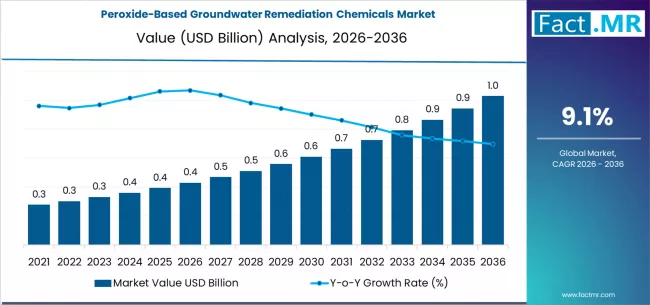
Hydrogen peroxide-based chemistries, particularly Fenton’s reagent and activated persulfate systems, lead the market with a 36% share. The primary application driving demand is the treatment of petroleum hydrocarbon contamination, accounting for 34% of the market. In-situ injection via direct push or wells remains the dominant delivery method, holding a 42% share due to its effectiveness in delivering oxidants to the contaminated plume.
Growth is propelled by stringent environmental regulations governing soil and groundwater quality, alongside an increasing prevalence of brownfield redevelopment projects. Peroxide-based in-situ chemical oxidation offers a powerful solution for destroying a wide range of organic contaminants, converting hazardous compounds into harmless byproducts like carbon dioxide and water. This technology addresses the critical need for permanent contaminant mass reduction, moving beyond mere containment or transfer.
These advanced oxidation chemistries are essential for remediating sites impacted by industrial solvents, fuels, and emerging contaminants. Their development focuses on enhanced stability, controlled reactivity, and targeted activation to improve treatment efficiency and cost-effectiveness. The market's evolution is centered on overcoming the challenges of subsurface heterogeneity and competing soil demands to achieve reliable and predictable remediation outcomes.
Metric
| Metric | Value |
|---|---|
| Market Value (2026) | USD 0.43 Billion |
| Market Forecast Value (2036) | USD 1.03 Billion |
| Forecast CAGR (2026-2036) | 9.1% |
Category
| Category | Segments |
|---|---|
| Chemistry Type | Hydrogen Peroxide, Fenton’s Reagent & Modified Fenton Systems, Activated Persulfate & Peroxydisulfate, Percarbonate & Peroxyhydrate Agents, Other Specialty Peroxide-Based Oxidants |
| Application | Petroleum Hydrocarbon Contamination (BTEX, TPH), Chlorinated Solvents (TCE, PCE, VC), Industrial Organic Chemicals & Solvents, PFAS & Emerging Organic Contaminants, Mixed & Multi-Phase Contaminants |
| Delivery Method | In-Situ Injection (Direct Push/Wells), In-Situ Recirculation Systems, Batch/Pulsed Dosing, ISCO-Integrated Treatment Systems, Other Delivery & Remediation Systems |
| Region | North America, Latin America, Western Europe, Eastern Europe, East Asia, South Asia & Pacific, MEA |
Segmental Analysis
By Chemistry Type, Which Segment Commands the Largest Market Share?
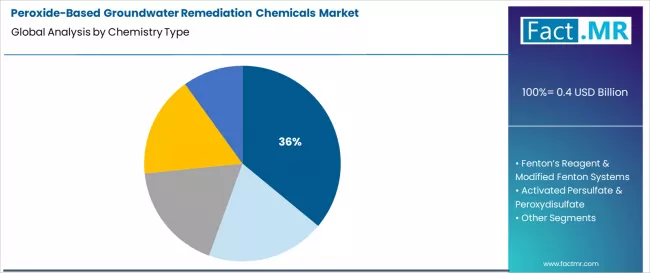
Hydrogen peroxide-based systems, including classical and modified Fenton’s reagent, lead this segment with a 36% share. Their dominance stems from a well-understood reaction mechanism, cost-effective oxidant source, and proven effectiveness against a broad spectrum of contaminants like BTEX and chlorinated ethenes.
The ability to catalyze hydrogen peroxide with iron to generate highly reactive hydroxyl radicals makes it a versatile and powerful choice for many site conditions, solidifying its position as a foundational ISCO technology.
By Application, Which Contaminant Class Generates the Most Consistent Demand?
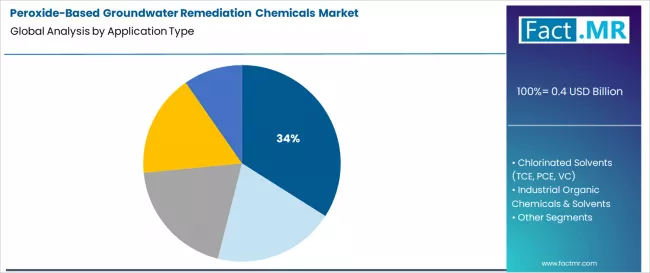
Petroleum hydrocarbon contamination represents the largest application segment with a 34% share. The widespread legacy of leaking underground storage tanks, pipeline releases, and refinery operations creates a continuous stream of remediation projects globally.
Regulations mandating the cleanup of benzene, toluene, ethylbenzene, and xylenes (BTEX) and total petroleum hydrocarbons (TPH) ensure persistent demand for effective oxidants like peroxides, which can directly degrade these compounds in the subsurface.
By Delivery Method, Where is Precision Most Critical for Treatment Success?
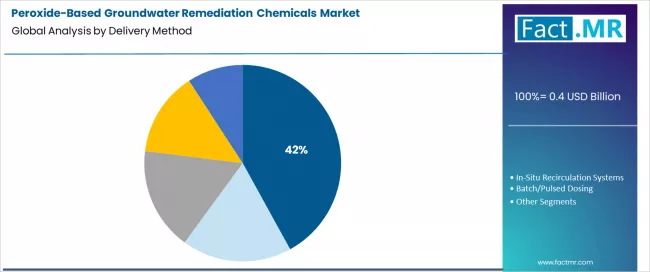
In-situ injection via direct push technology or permanent wells is the leading delivery method, holding a 42% share. The success of ISCO is highly dependent on achieving adequate contact between the oxidant and the contaminant mass within the complex subsurface environment.
Direct injection allows for targeted delivery and distribution control, enabling practitioners to tailor the application to specific plume geometries and soil characteristics. This method’s effectiveness in delivering high oxidant concentrations directly to the source zone concentrates both market demand and technical innovation.
What are the Drivers, Restraints, and Key Trends of the Peroxide-Based Groundwater Remediation Chemicals Market?
The primary market driver is the global tightening of regulations for groundwater protection and site closure standards, which mandate aggressive remediation timelines and permanent solutions. Peroxide-based ISCO offers a faster, more definitive outcome compared to long-term monitoring or pump-and-treat systems. Increased brownfield redevelopment and pressure from stakeholders for accelerated site turnover further propel demand. The growing need to address complex contaminant mixtures and dense non-aqueous phase liquids (DNAPLs) also favors powerful oxidant technologies.
A significant market restraint is the technical complexity of applying ISCO effectively. Subsurface heterogeneity, natural oxidant demand from soil organic matter, and rapid oxidant decomposition can lead to incomplete treatment and cost overruns. Health and safety risks associated with handling high-concentration peroxide and the potential for subsurface gas generation or heat release require specialized expertise. The high upfront chemical costs, despite favorable long-term economics, can also be a barrier for some projects.
Key trends include the development of activated persulfate systems, which offer greater subsurface stability and the ability to generate multiple radical species for treating a wider contaminant range, including some PFAS. There is growing innovation in chelated or stabilized peroxide formulations designed to control reaction rates and extend oxidant longevity in the subsurface. The market is also seeing a rise in combined remedies, where ISCO is strategically integrated with bioremediation or other technologies for synergistic effects and cost optimization.
Analysis of the Peroxide-Based Groundwater Remediation Chemicals Market by Key Countries
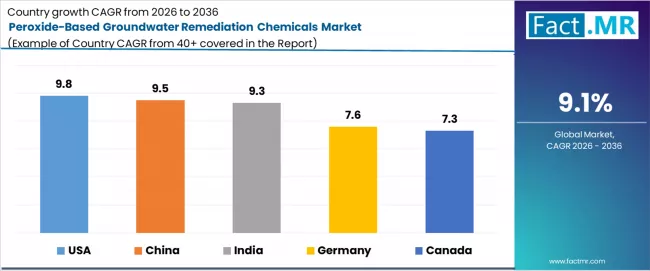
| Country | CAGR (2026-2036) |
|---|---|
| USA | 9.80% |
| China | 9.50% |
| India | 9.30% |
| Germany | 7.60% |
| Canada | 7.30% |
How do the USA’s Comprehensive Regulatory Frameworks Drive Demand for Advanced Oxidants?
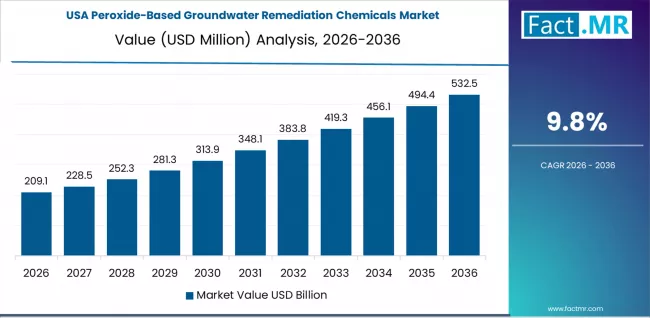
Robust federal and state-level cleanup programs like Superfund and RCRA Corrective Action fuel the USA’s leading CAGR of 9.80%. Stringent Maximum Contaminant Levels (MCLs) for groundwater, coupled with a mature environmental consulting and contracting industry, create a high-volume market for proven, effective technologies. The need to remediate vast numbers of legacy industrial and military sites efficiently drives the adoption of advanced peroxide-based oxidants for accelerated site closure.
What is the Impact of China’s Soil and Groundwater Pollution Prevention Action Plan?
China’s 9.50% growth is directly tied to the enforcement of its national soil and water pollution prevention policies. As the government mandates the investigation and remediation of contaminated industrial land, particularly from state-owned enterprises and chemical parks, large-scale projects emerge. This creates substantial demand for advanced remediation chemistries, including peroxide-based systems, to meet ambitious cleanup targets within defined timelines.
How is India’s Growing Environmental Enforcement Shaping the Market?
India’s 9.30% CAGR is supported by increasing regulatory pressure on industries to address historical contamination and prevent future groundwater pollution. The expansion of environmental impact assessment requirements and the establishment of liability for polluters are prompting more remedial actions. The cost-effectiveness and relatively rapid implementation of ISCO make peroxide-based solutions attractive for treating industrial solvent and hydrocarbon plumes in India’s developing remediation market.
Why is Germany a Key Market for Precision Remediation Technologies?
Germany’s 7.60% growth reflects its stringent adherence to EU groundwater directives and a strong technical preference for in-situ treatments that minimize surface disruption. German remediation projects often involve complex urban settings or sensitive ecosystems, demanding highly controlled and effective oxidant delivery. This fosters a sophisticated market for advanced, stabilized peroxide formulations and integrated delivery systems backed by detailed site characterization and performance monitoring.
What Role does Canada’s Resource Sector and Legacy Sites Play?
Canada’s 7.00% growth is anchored in two areas: ongoing remediation of numerous historic hydrocarbon contamination sites (e.g., gas stations, refineries) and addressing contamination associated with mining and industrial operations. The vast geography and often remote locations of contaminated sites in Canada make in-situ treatments like peroxide-based ISCO particularly valuable, as they reduce the need for extensive excavation and off-site waste disposal.
Competitive Landscape of the Peroxide-Based Groundwater Remediation Chemicals Market
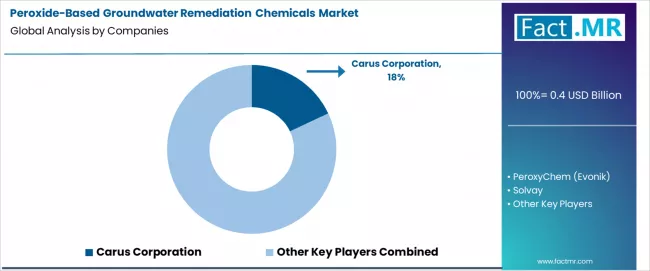
The competitive landscape features specialized chemical companies with deep expertise in environmental remediation chemistry. Leaders such as Carus Corporation and PeroxyChem compete based on their proprietary oxidant formulations, activation technologies, and extensive field application experience.
Competition centers on providing complete technical solutions, from site screening and design support to oxidant delivery equipment and performance validation. A key differentiator is the ability to offer tailored chemical recipes and activation strategies for specific contaminant suites and challenging geochemical conditions, supported by robust field data and case studies.
Key Players in the Peroxide-Based Groundwater Remediation Chemicals Market
- Carus Corporation
- PeroxyChem (Evonik)
- Solvay
- Regenesis
- EOS Remediation
Scope of Report
| Items | Values |
|---|---|
| Quantitative Units | USD Billion |
| Chemistry Type | Hydrogen Peroxide, Fenton’s & Modified Systems, Activated Persulfate, Percarbonate, Other Specialty Oxidants |
| Application | Petroleum Hydrocarbons, Chlorinated Solvents, Industrial Chemicals, PFAS & Emerging Contaminants, Mixed Contaminants |
| Delivery Method | In-Situ Injection, Recirculation Systems, Batch Dosing, Integrated Treatment Systems |
| Key Countries | USA, China, India, Germany, Canada |
| Key Companies | Carus Corporation, PeroxyChem (Evonik), Solvay, Regenesis, EOS Remediation |
| Additional Analysis | Analysis of radical generation mechanisms (hydroxyl vs. sulfate radicals); oxidant persistence and stability studies; geochemical compatibility assessment; treatment effectiveness for DNAPL sources; regulatory limits on oxidant residuals; supply chain for key precursors. |
Market by Segments
-
Chemistry Type :
- Hydrogen Peroxide
- Fenton’s Reagent & Modified Fenton Systems
- Activated Persulfate & Peroxydisulfate
- Percarbonate & Peroxyhydrate Agents
- Other Specialty Peroxide-Based Oxidants
-
Application :
- Petroleum Hydrocarbon Contamination (BTEX, TPH)
- Chlorinated Solvents (TCE, PCE, VC)
- Industrial Organic Chemicals & Solvents
- PFAS & Emerging Organic Contaminants
- Mixed & Multi-Phase Contaminants
-
Delivery Method :
- In-Situ Injection (Direct Push/Wells)
- In-Situ Recirculation Systems
- Batch/Pulsed Dosing
- ISCO-Integrated Treatment Systems
- Other Delivery & Remediation Systems
-
Region :
-
North America
- USA
- Canada
-
Latin America
- Brazil
- Mexico
- Argentina
- Rest of Latin America
-
Western Europe
- Germany
- UK
- France
- Spain
- Italy
- BENELUX
- Rest of Western Europe
-
Eastern Europe
- Russia
- Poland
- Czech Republic
- Rest of Eastern Europe
-
East Asia
- China
- Japan
- South Korea
- Rest of East Asia
-
South Asia & Pacific
- India
- ASEAN
- Australia
- Rest of South Asia & Pacific
-
MEA
- Saudi Arabia
- UAE
- Turkiye
- Rest of MEA
-
Table of Content
- Executive Summary
- Global Market Outlook
- Demand to side Trends
- Supply to side Trends
- Technology Roadmap Analysis
- Analysis and Recommendations
- Market Overview
- Market Coverage / Taxonomy
- Market Definition / Scope / Limitations
- Market Background
- Market Dynamics
- Drivers
- Restraints
- Opportunity
- Trends
- Scenario Forecast
- Demand in Optimistic Scenario
- Demand in Likely Scenario
- Demand in Conservative Scenario
- Opportunity Map Analysis
- Product Life Cycle Analysis
- Supply Chain Analysis
- Investment Feasibility Matrix
- Value Chain Analysis
- PESTLE and Porter’s Analysis
- Regulatory Landscape
- Regional Parent Market Outlook
- Production and Consumption Statistics
- Import and Export Statistics
- Market Dynamics
- Global Market Analysis 2021 to 2025 and Forecast, 2026 to 2036
- Historical Market Size Value (USD Million) Analysis, 2021 to 2025
- Current and Future Market Size Value (USD Million) Projections, 2026 to 2036
- Y to o to Y Growth Trend Analysis
- Absolute $ Opportunity Analysis
- Global Market Pricing Analysis 2021 to 2025 and Forecast 2026 to 2036
- Global Market Analysis 2021 to 2025 and Forecast 2026 to 2036, By Chemistry Type
- Introduction / Key Findings
- Historical Market Size Value (USD Million) Analysis By Chemistry Type, 2021 to 2025
- Current and Future Market Size Value (USD Million) Analysis and Forecast By Chemistry Type, 2026 to 2036
- Hydrogen Peroxide
- Fenton’s Reagent & Modified Fenton Systems
- Activated Persulfate & Peroxydisulfate
- Percarbonate & Peroxyhydrate Agents
- Other Specialty Peroxide-Based Oxidants
- Hydrogen Peroxide
- Y to o to Y Growth Trend Analysis By Chemistry Type, 2021 to 2025
- Absolute $ Opportunity Analysis By Chemistry Type, 2026 to 2036
- Global Market Analysis 2021 to 2025 and Forecast 2026 to 2036, By Application Type
- Introduction / Key Findings
- Historical Market Size Value (USD Million) Analysis By Application Type, 2021 to 2025
- Current and Future Market Size Value (USD Million) Analysis and Forecast By Application Type, 2026 to 2036
- Petroleum Hydrocarbon Contamination (BTEX, TPH)
- Chlorinated Solvents (TCE, PCE, VC)
- Industrial Organic Chemicals & Solvents
- PFAS & Emerging Organic Contaminants
- Mixed & Multi-Phase Contaminants
- Petroleum Hydrocarbon Contamination (BTEX, TPH)
- Y to o to Y Growth Trend Analysis By Application Type, 2021 to 2025
- Absolute $ Opportunity Analysis By Application Type, 2026 to 2036
- Global Market Analysis 2021 to 2025 and Forecast 2026 to 2036, By Delivery Method
- Introduction / Key Findings
- Historical Market Size Value (USD Million) Analysis By Delivery Method, 2021 to 2025
- Current and Future Market Size Value (USD Million) Analysis and Forecast By Delivery Method, 2026 to 2036
- In-Situ Injection (Direct Push/Wells)
- In-Situ Recirculation Systems
- Batch/Pulsed Dosing
- ISCO-Integrated Treatment Systems
- Other Delivery & Remediation Systems
- In-Situ Injection (Direct Push/Wells)
- Y to o to Y Growth Trend Analysis By Delivery Method, 2021 to 2025
- Absolute $ Opportunity Analysis By Delivery Method, 2026 to 2036
- Global Market Analysis 2021 to 2025 and Forecast 2026 to 2036, By Region
- Introduction
- Historical Market Size Value (USD Million) Analysis By Region, 2021 to 2025
- Current Market Size Value (USD Million) Analysis and Forecast By Region, 2026 to 2036
- North America
- Latin America
- Western Europe
- Eastern Europe
- East Asia
- South Asia and Pacific
- Middle East & Africa
- Market Attractiveness Analysis By Region
- North America Market Analysis 2021 to 2025 and Forecast 2026 to 2036, By Country
- Historical Market Size Value (USD Million) Trend Analysis By Market Taxonomy, 2021 to 2025
- Market Size Value (USD Million) Forecast By Market Taxonomy, 2026 to 2036
- By Country
- USA
- Canada
- Mexico
- By Chemistry Type
- By Application Type
- By Delivery Method
- By Country
- Market Attractiveness Analysis
- By Country
- By Chemistry Type
- By Application Type
- By Delivery Method
- Key Takeaways
- Latin America Market Analysis 2021 to 2025 and Forecast 2026 to 2036, By Country
- Historical Market Size Value (USD Million) Trend Analysis By Market Taxonomy, 2021 to 2025
- Market Size Value (USD Million) Forecast By Market Taxonomy, 2026 to 2036
- By Country
- Brazil
- Chile
- Rest of Latin America
- By Chemistry Type
- By Application Type
- By Delivery Method
- By Country
- Market Attractiveness Analysis
- By Country
- By Chemistry Type
- By Application Type
- By Delivery Method
- Key Takeaways
- Western Europe Market Analysis 2021 to 2025 and Forecast 2026 to 2036, By Country
- Historical Market Size Value (USD Million) Trend Analysis By Market Taxonomy, 2021 to 2025
- Market Size Value (USD Million) Forecast By Market Taxonomy, 2026 to 2036
- By Country
- Germany
- UK
- Italy
- Spain
- France
- Nordic
- BENELUX
- Rest of Western Europe
- By Chemistry Type
- By Application Type
- By Delivery Method
- By Country
- Market Attractiveness Analysis
- By Country
- By Chemistry Type
- By Application Type
- By Delivery Method
- Key Takeaways
- Eastern Europe Market Analysis 2021 to 2025 and Forecast 2026 to 2036, By Country
- Historical Market Size Value (USD Million) Trend Analysis By Market Taxonomy, 2021 to 2025
- Market Size Value (USD Million) Forecast By Market Taxonomy, 2026 to 2036
- By Country
- Russia
- Poland
- Hungary
- Balkan & Baltic
- Rest of Eastern Europe
- By Chemistry Type
- By Application Type
- By Delivery Method
- By Country
- Market Attractiveness Analysis
- By Country
- By Chemistry Type
- By Application Type
- By Delivery Method
- Key Takeaways
- East Asia Market Analysis 2021 to 2025 and Forecast 2026 to 2036, By Country
- Historical Market Size Value (USD Million) Trend Analysis By Market Taxonomy, 2021 to 2025
- Market Size Value (USD Million) Forecast By Market Taxonomy, 2026 to 2036
- By Country
- China
- Japan
- South Korea
- By Chemistry Type
- By Application Type
- By Delivery Method
- By Country
- Market Attractiveness Analysis
- By Country
- By Chemistry Type
- By Application Type
- By Delivery Method
- Key Takeaways
- South Asia and Pacific Market Analysis 2021 to 2025 and Forecast 2026 to 2036, By Country
- Historical Market Size Value (USD Million) Trend Analysis By Market Taxonomy, 2021 to 2025
- Market Size Value (USD Million) Forecast By Market Taxonomy, 2026 to 2036
- By Country
- India
- ASEAN
- Australia & New Zealand
- Rest of South Asia and Pacific
- By Chemistry Type
- By Application Type
- By Delivery Method
- By Country
- Market Attractiveness Analysis
- By Country
- By Chemistry Type
- By Application Type
- By Delivery Method
- Key Takeaways
- Middle East & Africa Market Analysis 2021 to 2025 and Forecast 2026 to 2036, By Country
- Historical Market Size Value (USD Million) Trend Analysis By Market Taxonomy, 2021 to 2025
- Market Size Value (USD Million) Forecast By Market Taxonomy, 2026 to 2036
- By Country
- Kingdom of Saudi Arabia
- Other GCC Countries
- Turkiye
- South Africa
- Other African Union
- Rest of Middle East & Africa
- By Chemistry Type
- By Application Type
- By Delivery Method
- By Country
- Market Attractiveness Analysis
- By Country
- By Chemistry Type
- By Application Type
- By Delivery Method
- Key Takeaways
- Key Countries Market Analysis
- USA
- Pricing Analysis
- Market Share Analysis, 2025
- By Chemistry Type
- By Application Type
- By Delivery Method
- Canada
- Pricing Analysis
- Market Share Analysis, 2025
- By Chemistry Type
- By Application Type
- By Delivery Method
- Mexico
- Pricing Analysis
- Market Share Analysis, 2025
- By Chemistry Type
- By Application Type
- By Delivery Method
- Brazil
- Pricing Analysis
- Market Share Analysis, 2025
- By Chemistry Type
- By Application Type
- By Delivery Method
- Chile
- Pricing Analysis
- Market Share Analysis, 2025
- By Chemistry Type
- By Application Type
- By Delivery Method
- Germany
- Pricing Analysis
- Market Share Analysis, 2025
- By Chemistry Type
- By Application Type
- By Delivery Method
- UK
- Pricing Analysis
- Market Share Analysis, 2025
- By Chemistry Type
- By Application Type
- By Delivery Method
- Italy
- Pricing Analysis
- Market Share Analysis, 2025
- By Chemistry Type
- By Application Type
- By Delivery Method
- Spain
- Pricing Analysis
- Market Share Analysis, 2025
- By Chemistry Type
- By Application Type
- By Delivery Method
- France
- Pricing Analysis
- Market Share Analysis, 2025
- By Chemistry Type
- By Application Type
- By Delivery Method
- India
- Pricing Analysis
- Market Share Analysis, 2025
- By Chemistry Type
- By Application Type
- By Delivery Method
- ASEAN
- Pricing Analysis
- Market Share Analysis, 2025
- By Chemistry Type
- By Application Type
- By Delivery Method
- Australia & New Zealand
- Pricing Analysis
- Market Share Analysis, 2025
- By Chemistry Type
- By Application Type
- By Delivery Method
- China
- Pricing Analysis
- Market Share Analysis, 2025
- By Chemistry Type
- By Application Type
- By Delivery Method
- Japan
- Pricing Analysis
- Market Share Analysis, 2025
- By Chemistry Type
- By Application Type
- By Delivery Method
- South Korea
- Pricing Analysis
- Market Share Analysis, 2025
- By Chemistry Type
- By Application Type
- By Delivery Method
- Russia
- Pricing Analysis
- Market Share Analysis, 2025
- By Chemistry Type
- By Application Type
- By Delivery Method
- Poland
- Pricing Analysis
- Market Share Analysis, 2025
- By Chemistry Type
- By Application Type
- By Delivery Method
- Hungary
- Pricing Analysis
- Market Share Analysis, 2025
- By Chemistry Type
- By Application Type
- By Delivery Method
- Kingdom of Saudi Arabia
- Pricing Analysis
- Market Share Analysis, 2025
- By Chemistry Type
- By Application Type
- By Delivery Method
- Turkiye
- Pricing Analysis
- Market Share Analysis, 2025
- By Chemistry Type
- By Application Type
- By Delivery Method
- South Africa
- Pricing Analysis
- Market Share Analysis, 2025
- By Chemistry Type
- By Application Type
- By Delivery Method
- USA
- Market Structure Analysis
- Competition Dashboard
- Competition Benchmarking
- Market Share Analysis of Top Players
- By Regional
- By Chemistry Type
- By Application Type
- By Delivery Method
- Competition Analysis
- Competition Deep Dive
- Carus Corporation
- Overview
- Product Portfolio
- Profitability by Market Segments (Product/Age /Sales Channel/Region)
- Sales Footprint
- Strategy Overview
- Marketing Strategy
- Product Strategy
- Channel Strategy
- PeroxyChem (Evonik)
- Solvay
- Regenesis
- EOS Remediation
- Carus Corporation
- Competition Deep Dive
- Assumptions & Acronyms Used
- Research Methodology
List Of Table
- Table 1: Global Market Value (USD Million) Forecast by Region, 2021 to 2036
- Table 2: Global Market Value (USD Million) Forecast by Chemistry Type, 2021 to 2036
- Table 3: Global Market Value (USD Million) Forecast by Application Type, 2021 to 2036
- Table 4: Global Market Value (USD Million) Forecast by Delivery Method, 2021 to 2036
- Table 5: North America Market Value (USD Million) Forecast by Country, 2021 to 2036
- Table 6: North America Market Value (USD Million) Forecast by Chemistry Type, 2021 to 2036
- Table 7: North America Market Value (USD Million) Forecast by Application Type, 2021 to 2036
- Table 8: North America Market Value (USD Million) Forecast by Delivery Method, 2021 to 2036
- Table 9: Latin America Market Value (USD Million) Forecast by Country, 2021 to 2036
- Table 10: Latin America Market Value (USD Million) Forecast by Chemistry Type, 2021 to 2036
- Table 11: Latin America Market Value (USD Million) Forecast by Application Type, 2021 to 2036
- Table 12: Latin America Market Value (USD Million) Forecast by Delivery Method, 2021 to 2036
- Table 13: Western Europe Market Value (USD Million) Forecast by Country, 2021 to 2036
- Table 14: Western Europe Market Value (USD Million) Forecast by Chemistry Type, 2021 to 2036
- Table 15: Western Europe Market Value (USD Million) Forecast by Application Type, 2021 to 2036
- Table 16: Western Europe Market Value (USD Million) Forecast by Delivery Method, 2021 to 2036
- Table 17: Eastern Europe Market Value (USD Million) Forecast by Country, 2021 to 2036
- Table 18: Eastern Europe Market Value (USD Million) Forecast by Chemistry Type, 2021 to 2036
- Table 19: Eastern Europe Market Value (USD Million) Forecast by Application Type, 2021 to 2036
- Table 20: Eastern Europe Market Value (USD Million) Forecast by Delivery Method, 2021 to 2036
- Table 21: East Asia Market Value (USD Million) Forecast by Country, 2021 to 2036
- Table 22: East Asia Market Value (USD Million) Forecast by Chemistry Type, 2021 to 2036
- Table 23: East Asia Market Value (USD Million) Forecast by Application Type, 2021 to 2036
- Table 24: East Asia Market Value (USD Million) Forecast by Delivery Method, 2021 to 2036
- Table 25: South Asia and Pacific Market Value (USD Million) Forecast by Country, 2021 to 2036
- Table 26: South Asia and Pacific Market Value (USD Million) Forecast by Chemistry Type, 2021 to 2036
- Table 27: South Asia and Pacific Market Value (USD Million) Forecast by Application Type, 2021 to 2036
- Table 28: South Asia and Pacific Market Value (USD Million) Forecast by Delivery Method, 2021 to 2036
- Table 29: Middle East & Africa Market Value (USD Million) Forecast by Country, 2021 to 2036
- Table 30: Middle East & Africa Market Value (USD Million) Forecast by Chemistry Type, 2021 to 2036
- Table 31: Middle East & Africa Market Value (USD Million) Forecast by Application Type, 2021 to 2036
- Table 32: Middle East & Africa Market Value (USD Million) Forecast by Delivery Method, 2021 to 2036
List Of Figures
- Figure 1: Global Market Pricing Analysis
- Figure 2: Global Market Value (USD Million) Forecast 2021 to 2036
- Figure 3: Global Market Value Share and BPS Analysis by Chemistry Type, 2026 and 2036
- Figure 4: Global Market Y to o to Y Growth Comparison by Chemistry Type, 2026 to 2036
- Figure 5: Global Market Attractiveness Analysis by Chemistry Type
- Figure 6: Global Market Value Share and BPS Analysis by Application Type, 2026 and 2036
- Figure 7: Global Market Y to o to Y Growth Comparison by Application Type, 2026 to 2036
- Figure 8: Global Market Attractiveness Analysis by Application Type
- Figure 9: Global Market Value Share and BPS Analysis by Delivery Method, 2026 and 2036
- Figure 10: Global Market Y to o to Y Growth Comparison by Delivery Method, 2026 to 2036
- Figure 11: Global Market Attractiveness Analysis by Delivery Method
- Figure 12: Global Market Value (USD Million) Share and BPS Analysis by Region, 2026 and 2036
- Figure 13: Global Market Y to o to Y Growth Comparison by Region, 2026 to 2036
- Figure 14: Global Market Attractiveness Analysis by Region
- Figure 15: North America Market Incremental Dollar Opportunity, 2026 to 2036
- Figure 16: Latin America Market Incremental Dollar Opportunity, 2026 to 2036
- Figure 17: Western Europe Market Incremental Dollar Opportunity, 2026 to 2036
- Figure 18: Eastern Europe Market Incremental Dollar Opportunity, 2026 to 2036
- Figure 19: East Asia Market Incremental Dollar Opportunity, 2026 to 2036
- Figure 20: South Asia and Pacific Market Incremental Dollar Opportunity, 2026 to 2036
- Figure 21: Middle East & Africa Market Incremental Dollar Opportunity, 2026 to 2036
- Figure 22: North America Market Value Share and BPS Analysis by Country, 2026 and 2036
- Figure 23: North America Market Value Share and BPS Analysis by Chemistry Type, 2026 and 2036
- Figure 24: North America Market Y to o to Y Growth Comparison by Chemistry Type, 2026 to 2036
- Figure 25: North America Market Attractiveness Analysis by Chemistry Type
- Figure 26: North America Market Value Share and BPS Analysis by Application Type, 2026 and 2036
- Figure 27: North America Market Y to o to Y Growth Comparison by Application Type, 2026 to 2036
- Figure 28: North America Market Attractiveness Analysis by Application Type
- Figure 29: North America Market Value Share and BPS Analysis by Delivery Method, 2026 and 2036
- Figure 30: North America Market Y to o to Y Growth Comparison by Delivery Method, 2026 to 2036
- Figure 31: North America Market Attractiveness Analysis by Delivery Method
- Figure 32: Latin America Market Value Share and BPS Analysis by Country, 2026 and 2036
- Figure 33: Latin America Market Value Share and BPS Analysis by Chemistry Type, 2026 and 2036
- Figure 34: Latin America Market Y to o to Y Growth Comparison by Chemistry Type, 2026 to 2036
- Figure 35: Latin America Market Attractiveness Analysis by Chemistry Type
- Figure 36: Latin America Market Value Share and BPS Analysis by Application Type, 2026 and 2036
- Figure 37: Latin America Market Y to o to Y Growth Comparison by Application Type, 2026 to 2036
- Figure 38: Latin America Market Attractiveness Analysis by Application Type
- Figure 39: Latin America Market Value Share and BPS Analysis by Delivery Method, 2026 and 2036
- Figure 40: Latin America Market Y to o to Y Growth Comparison by Delivery Method, 2026 to 2036
- Figure 41: Latin America Market Attractiveness Analysis by Delivery Method
- Figure 42: Western Europe Market Value Share and BPS Analysis by Country, 2026 and 2036
- Figure 43: Western Europe Market Value Share and BPS Analysis by Chemistry Type, 2026 and 2036
- Figure 44: Western Europe Market Y to o to Y Growth Comparison by Chemistry Type, 2026 to 2036
- Figure 45: Western Europe Market Attractiveness Analysis by Chemistry Type
- Figure 46: Western Europe Market Value Share and BPS Analysis by Application Type, 2026 and 2036
- Figure 47: Western Europe Market Y to o to Y Growth Comparison by Application Type, 2026 to 2036
- Figure 48: Western Europe Market Attractiveness Analysis by Application Type
- Figure 49: Western Europe Market Value Share and BPS Analysis by Delivery Method, 2026 and 2036
- Figure 50: Western Europe Market Y to o to Y Growth Comparison by Delivery Method, 2026 to 2036
- Figure 51: Western Europe Market Attractiveness Analysis by Delivery Method
- Figure 52: Eastern Europe Market Value Share and BPS Analysis by Country, 2026 and 2036
- Figure 53: Eastern Europe Market Value Share and BPS Analysis by Chemistry Type, 2026 and 2036
- Figure 54: Eastern Europe Market Y to o to Y Growth Comparison by Chemistry Type, 2026 to 2036
- Figure 55: Eastern Europe Market Attractiveness Analysis by Chemistry Type
- Figure 56: Eastern Europe Market Value Share and BPS Analysis by Application Type, 2026 and 2036
- Figure 57: Eastern Europe Market Y to o to Y Growth Comparison by Application Type, 2026 to 2036
- Figure 58: Eastern Europe Market Attractiveness Analysis by Application Type
- Figure 59: Eastern Europe Market Value Share and BPS Analysis by Delivery Method, 2026 and 2036
- Figure 60: Eastern Europe Market Y to o to Y Growth Comparison by Delivery Method, 2026 to 2036
- Figure 61: Eastern Europe Market Attractiveness Analysis by Delivery Method
- Figure 62: East Asia Market Value Share and BPS Analysis by Country, 2026 and 2036
- Figure 63: East Asia Market Value Share and BPS Analysis by Chemistry Type, 2026 and 2036
- Figure 64: East Asia Market Y to o to Y Growth Comparison by Chemistry Type, 2026 to 2036
- Figure 65: East Asia Market Attractiveness Analysis by Chemistry Type
- Figure 66: East Asia Market Value Share and BPS Analysis by Application Type, 2026 and 2036
- Figure 67: East Asia Market Y to o to Y Growth Comparison by Application Type, 2026 to 2036
- Figure 68: East Asia Market Attractiveness Analysis by Application Type
- Figure 69: East Asia Market Value Share and BPS Analysis by Delivery Method, 2026 and 2036
- Figure 70: East Asia Market Y to o to Y Growth Comparison by Delivery Method, 2026 to 2036
- Figure 71: East Asia Market Attractiveness Analysis by Delivery Method
- Figure 72: South Asia and Pacific Market Value Share and BPS Analysis by Country, 2026 and 2036
- Figure 73: South Asia and Pacific Market Value Share and BPS Analysis by Chemistry Type, 2026 and 2036
- Figure 74: South Asia and Pacific Market Y to o to Y Growth Comparison by Chemistry Type, 2026 to 2036
- Figure 75: South Asia and Pacific Market Attractiveness Analysis by Chemistry Type
- Figure 76: South Asia and Pacific Market Value Share and BPS Analysis by Application Type, 2026 and 2036
- Figure 77: South Asia and Pacific Market Y to o to Y Growth Comparison by Application Type, 2026 to 2036
- Figure 78: South Asia and Pacific Market Attractiveness Analysis by Application Type
- Figure 79: South Asia and Pacific Market Value Share and BPS Analysis by Delivery Method, 2026 and 2036
- Figure 80: South Asia and Pacific Market Y to o to Y Growth Comparison by Delivery Method, 2026 to 2036
- Figure 81: South Asia and Pacific Market Attractiveness Analysis by Delivery Method
- Figure 82: Middle East & Africa Market Value Share and BPS Analysis by Country, 2026 and 2036
- Figure 83: Middle East & Africa Market Value Share and BPS Analysis by Chemistry Type, 2026 and 2036
- Figure 84: Middle East & Africa Market Y to o to Y Growth Comparison by Chemistry Type, 2026 to 2036
- Figure 85: Middle East & Africa Market Attractiveness Analysis by Chemistry Type
- Figure 86: Middle East & Africa Market Value Share and BPS Analysis by Application Type, 2026 and 2036
- Figure 87: Middle East & Africa Market Y to o to Y Growth Comparison by Application Type, 2026 to 2036
- Figure 88: Middle East & Africa Market Attractiveness Analysis by Application Type
- Figure 89: Middle East & Africa Market Value Share and BPS Analysis by Delivery Method, 2026 and 2036
- Figure 90: Middle East & Africa Market Y to o to Y Growth Comparison by Delivery Method, 2026 to 2036
- Figure 91: Middle East & Africa Market Attractiveness Analysis by Delivery Method
- Figure 92: Global Market - Tier Structure Analysis
- Figure 93: Global Market - Company Share Analysis
- FAQs -
How big is the peroxide-based groundwater remediation chemicals market in 2026?
The global peroxide-based groundwater remediation chemicals market is estimated to be valued at USD 0.4 billion in 2026.
What will be the size of peroxide-based groundwater remediation chemicals market in 2036?
The market size for the peroxide-based groundwater remediation chemicals market is projected to reach USD 1.0 billion by 2036.
How much will be the peroxide-based groundwater remediation chemicals market growth between 2026 and 2036?
The peroxide-based groundwater remediation chemicals market is expected to grow at a 9.1% CAGR between 2026 and 2036.
What are the key product types in the peroxide-based groundwater remediation chemicals market?
The key product types in peroxide-based groundwater remediation chemicals market are hydrogen peroxide, fenton’s reagent & modified fenton systems, activated persulfate & peroxydisulfate, percarbonate & peroxyhydrate agents and other specialty peroxide-based oxidants.
Which application type segment to contribute significant share in the peroxide-based groundwater remediation chemicals market in 2026?
In terms of application type, petroleum hydrocarbon contamination (btex, tph) segment to command 34.0% share in the peroxide-based groundwater remediation chemicals market in 2026.