- Base Value(2025): 2.2 Bn
- Estimated Value(2026): 2.3 Bn
- Forecast Value (2036): 3.9 Bn
- CAGR (2026 - 2036): 5.3%
Normal Balloon Catheter Market Analysis and Forecast by Fact.MR
The normal balloon catheter market, valued at USD 2.2 billion in 2025, is expanding at a 5.3% CAGR to reach USD 3.883 billion by 2036. Normal balloon catheters are percutaneous transluminal angioplasty devices used to dilate stenosed coronary and peripheral blood vessels through controlled balloon inflation. Growth reflects sustained coronary and peripheral angioplasty procedure volumes, expanding intervention access in emerging markets, and ongoing replacement demand as catheter technology evolves. The USD 1.566 billion incremental opportunity between 2026 and 2036 is distributed across coronary and peripheral angioplasty applications globally.
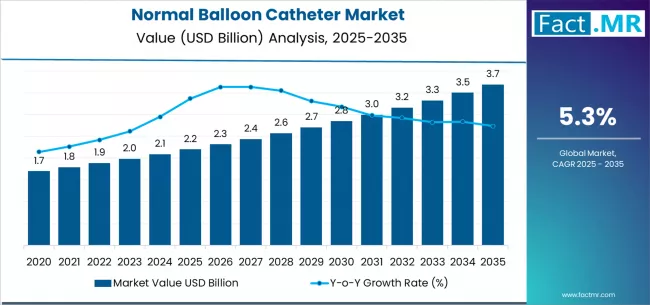
Normal Balloon Catheter Market Market Value Analysis | Source: Fact.MR
Summary of Normal Balloon Catheter Market
- Market Snapshot
- Market value in 2025: USD 2.2 billion
- Projected value in 2026: USD 2.317 billion; forecast to reach USD 3.883 billion by 2036
- CAGR from 2026 to 2036: 5.3%
- Incremental opportunity (2026 to 2036): USD 1.566 billion
- Nylon-based catheters lead material demand with 46.0% share in 2025
- USA and Mexico lead country-level growth, followed by Germany and South Korea
- Demand and Growth Drivers
- Coronary angioplasty procedure volumes remain stable and growing, sustained by aging populations and metabolic risk factors that drive coronary artery disease prevalence.
- Peripheral angioplasty is expanding as an indication, with growing clinical application in lower-limb, renal, and carotid artery interventions.
- Catheter technology refinement, including lower-profile balloons and improved crossing profiles, is enabling treatment of more complex lesions.
- Interventional cardiology infrastructure expansion in Latin America, Asia, and the Middle East is creating new procedural volume.
- Product and Segment View
- Nylon-based catheters hold 46.0% of material demand, driven by compliance characteristics, burst pressure tolerance, and cost-effectiveness.
- Coronary angioplasty accounts for 36.8% of application share, the primary procedural indication for normal balloon catheter use.
- Hospitals hold 72.0% of end-user demand, as catheterization procedures are predominantly performed in hospital settings.
- Key segmentation includes:
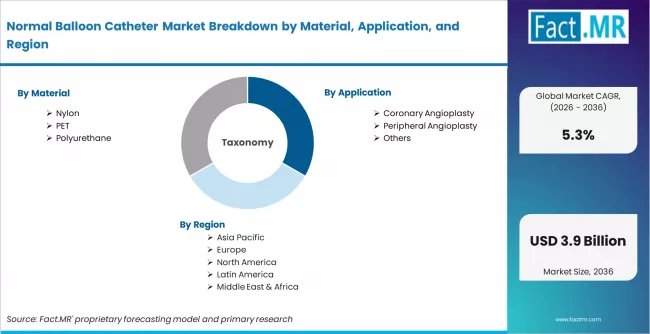
- Material: Nylon, PET, Polyurethane
- Application: Coronary Angioplasty, Peripheral Angioplasty, Others
- End User: Hospitals, ASCs, Clinics
- Distribution Channel: Direct Sales, Distributors, Online Sales
- Geography and Competitive Outlook
- North America is the largest revenue region, with the USA contributing USD 0.849 billion in 2025.
- Latin America is a growth corridor, with Mexico recording strong CAGR driven by expanding interventional cardiology access.
- Europe maintains steady growth, with Germany leading through high procedural volumes.
- Boston Scientific leads the competitive field with a 16.0% market share, followed by Medtronic, Abbott, Terumo, and B. Braun.
- Analyst Opinion
- The normal balloon catheter market is a mature, procedure-volume-driven category where growth tracks angioplasty utilization rates. Normal balloon catheters serve as both standalone angioplasty devices and pre-dilation tools used before stent deployment, ensuring sustained demand regardless of stent technology evolution. Fact.MR expects moderate but stable growth, with the fastest procedural volume expansion in peripheral angioplasty applications. Material improvements toward thinner-wall, higher-pressure balloons with improved trackability represent the primary product differentiation vector in this commodity-adjacent device category.
Key Growth Drivers, Constraints, and Opportunities
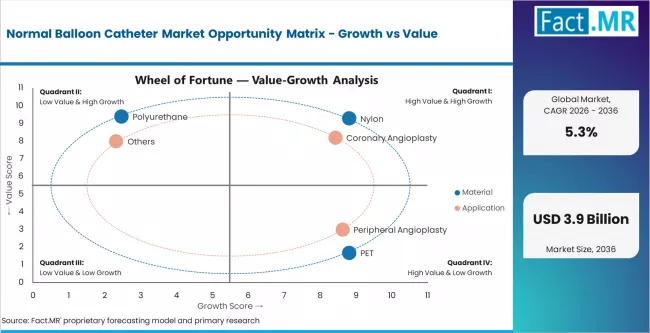
Normal Balloon Catheter Market Opportunity Matrix Growth Vs Value | Source: Fact.MR
Key Factors Driving Growth
- Coronary intervention volume stability: PCI procedure counts remain stable or growing, sustaining baseline demand for normal balloon catheters.
- Peripheral angioplasty expansion: Growing evidence and guideline endorsement for endovascular treatment of PAD expand the procedural volume base.
- Emerging market catheterization access: New catheterization laboratory construction in India, China, Brazil, and Mexico creates new procedural capacity.
Key Market Constraints
- Commodity pricing pressure: Multiple manufacturers offer functionally equivalent products, compressing unit pricing and margins.
- Drug-coated balloon substitution: DCBs are displacing normal balloons in some applications by providing pharmacological benefit alongside dilation.
- Reprocessing competition: Single-use catheter reprocessing programs reduce new catheter procurement volumes in cost-sensitive markets.
Key Opportunity Areas
- Ultra-low-profile balloon development: Sub-0.014-inch crossing profiles that navigate severely stenosed anatomy create a premium product tier.
- Peripheral intervention growth: Below-the-knee, renal, and mesenteric artery interventions expand the clinical application range.
- Catheterization laboratory expansion: Each new cath lab generates recurring demand for balloon catheters as a per-procedure consumable.
Segment-wise Analysis of the Normal Balloon Catheter Market
- Nylon-based catheters lead material demand at 46.0%, preferred for standard angioplasty applications.
- Coronary angioplasty holds 36.8% of application share.
- Hospitals account for 72.0% of end-user demand.
Which material dominates the Normal Balloon Catheter Market?
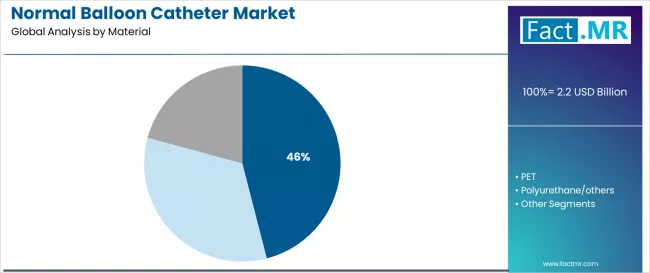
Normal Balloon Catheter Market Analysis By Material | Source: Fact.MR
Nylon-based catheters hold a 46.0% share of material demand in 2025. Nylon offers a balance of compliance, burst pressure tolerance, and cost that makes it the default for standard angioplasty. Nylon balloons are semi-compliant, expanding predictably within defined pressure ranges for controlled vessel dilation.
PET catheters represent the second-largest category, preferred for non-compliant applications where precise diameter at high pressure is required. Polyurethane serves niche applications requiring specific flexibility characteristics.
Which application dominates the Normal Balloon Catheter Market?
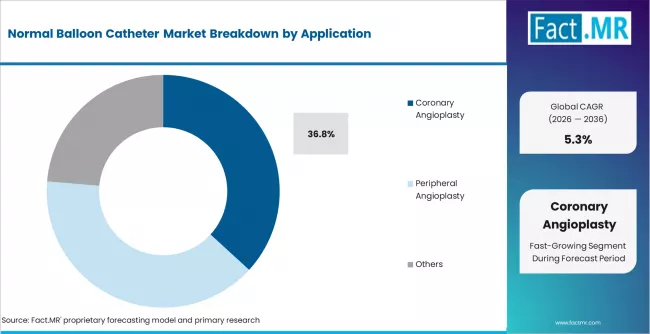
Normal Balloon Catheter Market Analysis By Application | Source: Fact.MR
Coronary angioplasty accounts for 36.8% of application demand in 2025. Normal balloon catheters are used both as standalone dilation devices and as pre-dilation tools before stent implantation. Per-case consumption creates a recurring demand stream proportional to PCI volumes.
Peripheral angioplasty is the fastest-growing application, driven by expanding evidence for endovascular treatment of PAD. Larger balloon diameters and longer lengths for peripheral applications carry higher per-unit pricing.
Which end user dominates the Normal Balloon Catheter Market?
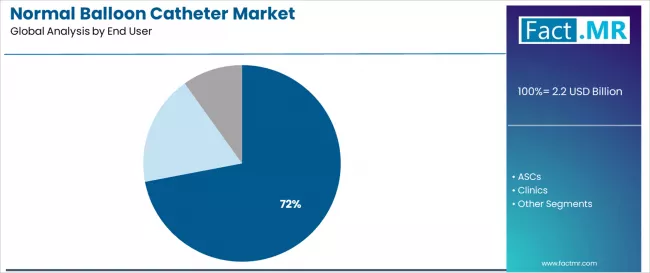
Normal Balloon Catheter Market Analysis By End User | Source: Fact.MR
Hospitals account for 72.0% of end-user demand. Catheterization laboratory-based procedures are concentrated in hospital cardiology and vascular surgery departments with required infrastructure and emergency backup.
Ambulatory surgical centers are a growing segment, capturing lower-risk peripheral and diagnostic catheterization procedures migrating from hospital settings.
Which Product Trend is Shaping the Next Phase of Growth in the Normal Balloon Catheter Market?
Ultra-low-profile and high-performance balloon catheter designs are shaping the next product generation. Manufacturers are developing catheters with reduced crossing profiles that navigate severely stenosed, calcified, or tortuous anatomy. These designs use thinner balloon wall materials, optimized shaft engineering, and specialized folding patterns that reduce the deflated profile while maintaining inflation performance. Premium pricing for ultra-low-profile balloons creates a margin improvement opportunity in a price-compressed category.
The expansion of peripheral angioplasty applications is creating demand for balloon catheters optimized for non-coronary anatomy. Below-the-knee interventions, renal artery denervation, and mesenteric artery interventions each require specific balloon characteristics that differ from standard coronary balloons. Fact.MR projects that peripheral-specific balloon development will be the primary product differentiation vector through 2036.
Regional Outlook Across Key Markets
.webp "Top Country Growth Comparison Normal Balloon Catheter Market Cagr (2026 2036)")
Top Country Growth Comparison Normal Balloon Catheter Market Cagr (2026 2036) | Source: Fact.MR
- North America is the largest revenue region, with the USA contributing USD 0.849 billion in 2025.
- Latin America is a growing corridor, with Mexico recording strong CAGR.
- Europe maintains steady growth, shaped by high procedural volumes.
- East Asia is an emerging region, with South Korea recording solid CAGR.
CAGR Table
| Country | CAGR (%) |
|---|---|
| USA | 5.7% |
| Mexico | 5.4% |
| Germany | 5.0% |
| South Korea | 4.9% |
| France | 4.9% |
| UK | 4.8% |
| Japan | 4.7% |
Source: Fact.MR analysis, based on proprietary forecasting model and primary research.
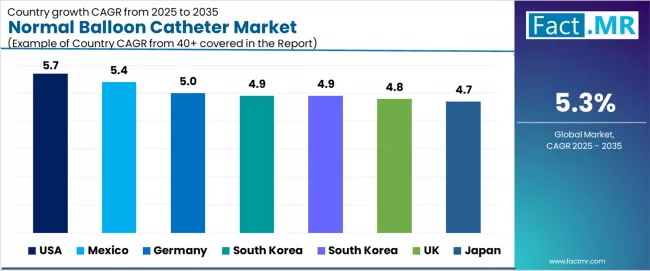
Normal Balloon Catheter Market Cagr Analysis By Country | Source: Fact.MR
USA: Procedural volume leadership and peripheral expansion
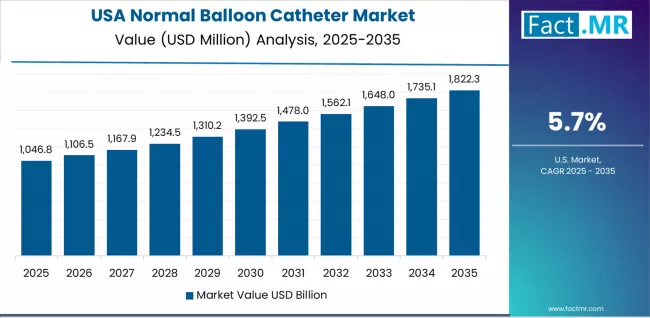
Normal Balloon Catheter Market Country Value Analysis | Source: Fact.MR
The USA contributes USD 0.849 billion in 2025. Growth reflects stable coronary PCI volumes, expanding peripheral angioplasty utilization, and catheter technology advancement. The concentration of interventional expertise drives high per-capita procedure rates. Medicare and commercial insurance coverage supports treatment access.
- Growth anchor: Peripheral angioplasty expansion and sustained coronary PCI volumes maintain stable growth.
Mexico: Interventional cardiology access expansion
Mexico records strong growth driven by expanding interventional cardiology infrastructure, cardiovascular disease burden growth, and government health program investment in catheterization laboratory capacity. Construction of new cath labs in regional hospitals creates procedural volume.
- Growth anchor: Catheterization laboratory expansion beyond major urban centers creates new procedural volume.
Germany: Procedural density and advanced intervention
Germany leads European growth supported by one of the highest per-capita coronary intervention rates in Europe and advanced cath lab infrastructure. German interventional cardiologists demonstrate high utilization of balloon pre-dilation before stent deployment. Statutory health insurance provides comprehensive coverage.
- Growth anchor: High per-capita intervention rates and systematic pre-dilation practice sustain above-average consumption.
South Korea: Advanced interventional practice
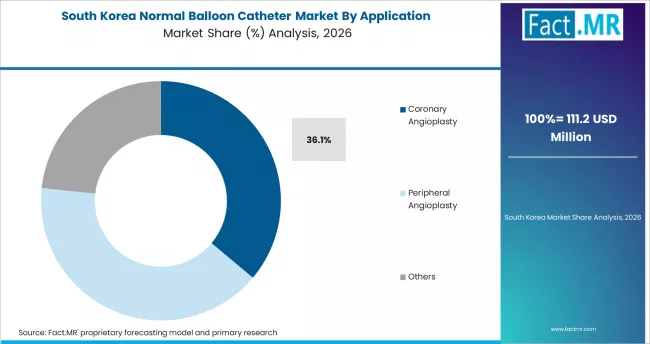
Normal Balloon Catheter Market South Korea Market Share Analysis By Application | Source: Fact.MR
South Korea records solid growth driven by advanced interventional cardiology practice, high adoption of latest-generation technologies, and comprehensive national health insurance coverage. Korean interventional cardiologists are recognized for technical expertise.
- Growth anchor: Technical expertise and early technology adoption create demand for latest-generation products.
Competitive Benchmarking and Company Positioning
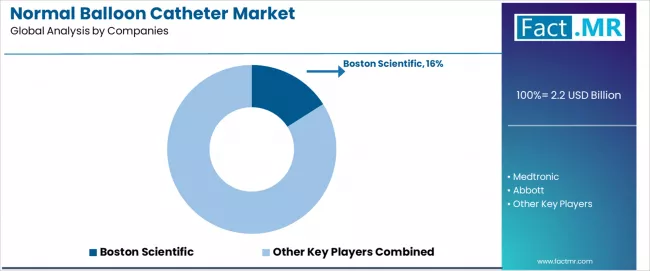
Normal Balloon Catheter Market Analysis By Company | Source: Fact.MR
Normal Balloon Catheter Market Analysis By Company
- Boston Scientific leads with 16.0% market share, anchored by its broad interventional cardiology portfolio and hospital distribution relationships.
- Medtronic and Abbott compete in the broad interventional tier, maintaining strength through coronary and peripheral product lines.
- Terumo and B. Braun maintain strong positions through catheter manufacturing expertise, competitive pricing, and established distribution networks.
The competitive field is moderately concentrated, with the top five players accounting for a combined share above 50%. Competition is primarily price-driven in the standard segment, with differentiation depending on crossing profile, trackability, and distribution reach.
Boston Scientific leads through scale advantage and ability to bundle balloon catheters with guidewires and stent systems through GPO contracts.
Terumo and Cook Medical maintain positions through manufacturing cost advantages and strong regional distribution in Asia-Pacific and North America.
Key Companies in the Normal Balloon Catheter Market
Boston Scientific, Medtronic, Abbott, Terumo, B. Braun, BD, Cordis, Cook Medical, Teleflex, and Biotronik are the principal companies operating in the global normal balloon catheter market.
Recent Industry Developments
- Boston Scientific: ultra-low-profile coronary balloon launch (2025)
- Boston Scientific launched an ultra-low-profile coronary balloon catheter in 2025 with a sub-0.017-inch crossing profile for severely stenosed and calcified coronary lesions.
- Medtronic: peripheral balloon catheter line expansion (2025)
- Medtronic expanded its peripheral balloon catheter line in 2025, adding dedicated below-the-knee balloon designs for infrapopliteal intervention.
- Terumo: high-pressure balloon platform (2025)
- Terumo introduced a high-pressure non-compliant balloon platform in 2025 designed for post-dilation of underexpanded stents and heavily calcified lesions.
- Abbott: peripheral intervention balloon system (2026)
- Abbott launched a dedicated peripheral intervention balloon catheter system in early 2026 with a rapid-exchange platform optimized for iliac and femoropopliteal interventions.
Leading Companies Shaping the Normal Balloon Catheter Market
-
Global Players
- Boston Scientific
- Medtronic
- Abbott
- Terumo
- B. Braun
- BD
-
Regional Players
- Cordis
- Cook Medical
- Teleflex
- Biotronik
-
Emerging / Start-up Players
- OrbusNeich
- Concept Medical
- iVascular
Sources and Research References
- Boston Scientific Annual Report 2024
- Medtronic Annual Report 2024
- ACC NCDR PCI Procedure Statistics
- VIVA Congress Peripheral Intervention Data
- WHO Global Health Estimates for CVD
- OECD Health Statistics, Cardiac Catheterization Rates
All numerical data in this report is derived from Fact.MR proprietary research. Source references are provided for contextual and directional validation only.
Key Questions This Report Addresses
- What is the projected size of the normal balloon catheter market by 2036?
- Which material holds the largest share?
- What CAGR is expected from 2026 to 2036?
- Which country is growing fastest?
- Who is the leading company?
- What is the incremental opportunity between 2026 and 2036?
- How is peripheral angioplasty expansion affecting growth?
- What role does material science play in differentiation?
Normal Balloon Catheter Market Definition
The normal balloon catheter market covers percutaneous transluminal angioplasty balloon catheters used to dilate stenosed blood vessels through controlled inflation. Products include nylon, PET, and polyurethane-based catheters used in coronary, peripheral, and other vascular interventions.
Normal Balloon Catheter Market Inclusions
- Standard angioplasty balloon catheters for coronary and peripheral vascular dilation
- Pre-dilation and post-dilation balloon catheters used with stent deployment
- Balloon catheters constructed from nylon, PET, and polyurethane materials
- Devices distributed through direct sales, distributors, and online channels
Normal Balloon Catheter Market Exclusions
- Drug-coated balloon catheters with pharmacological agents
- Cutting and scoring balloon catheters
- Stent delivery balloon catheters integrated with stent systems
- Non-vascular balloon catheters (urological, gastrointestinal, ENT)
Normal Balloon Catheter Market Research Methodology
- Bottom-up revenue modeling using angioplasty procedure volumes, catheter consumption rates, and average selling prices across 15+ countries
- Primary interviews with interventional cardiologists, vascular surgeons, and device procurement directors
- Cross-referencing procedure volume data from cardiovascular intervention registries
- Validation through device manufacturer product catalogues and GPO contract databases
- Forecasting calibrated against cardiovascular disease incidence and catheterization laboratory expansion
- Company-level revenue triangulation using annual reports and SEC filings
Scope of Analysis
Normal Balloon Catheter Market Breakdown By Material, Application, And Region | Source: Fact.MR
| Parameter | Details |
|---|---|
| Market size (2025) | USD 2.2 billion |
| Forecast period | 2026 to 2036 |
| CAGR | 5.3% |
| Base year | 2025 |
| Units | USD Billion |
| Segments covered | Material (Nylon, PET, Polyurethane); Application (Coronary Angioplasty, Peripheral Angioplasty, Others); End User (Hospitals, ASCs, Clinics); Distribution Channel (Direct Sales, Distributors, Online Sales) |
| Regions covered | North America, Latin America, Europe, East Asia, South Asia and Pacific, Middle East and Africa |
| Countries profiled | USA, Mexico, Germany, South Korea, France, UK, Japan |
| Companies profiled | Boston Scientific, Medtronic, Abbott, Terumo, B. Braun, Cook Medical |
| Forecasting approach | Bottom-up revenue modeling validated through primary research, procedural volume analysis, and company-level financial triangulation |
Market Segmentation Analysis
-
Normal Balloon Catheter Market Market Segmented by Material:
- Nylon
- Semi Compliant Nylon
- High Pressure Nylon
- Low Profile Nylon
- PET
- Non Compliant PET
- High Burst Pressure PET
- Thin Wall PET
- Polyurethane
- Soft Tip Polyurethane
- Flexible Shaft Polyurethane
- Hybrid Material Blends
- Nylon
-
Normal Balloon Catheter Market Market Segmented by Application:
- Coronary Angioplasty
- Pre Dilatation Procedures
- Post Dilatation Procedures
- Chronic Total Occlusion
- Peripheral Angioplasty
- Lower Limb Interventions
- Renal Artery Interventions
- Carotid Artery Procedures
- Others
- Neurovascular Procedures
- Pediatric Interventions
- Arteriovenous Access
- Coronary Angioplasty
-
Normal Balloon Catheter Market Market Segmented by End User:
- Hospitals
- Tertiary Care Hospitals
- Cardiac Specialty Hospitals
- Multi Specialty Hospitals
- ASCs
- Day Care Surgical Centers
- Cardiac Ambulatory Centers
- Minimally Invasive Centers
- Clinics
- Cardiology Clinics
- Vascular Clinics
- Specialty Care Clinics
- Hospitals
-
Normal Balloon Catheter Market Market Segmented by Distribution Channel:
- Direct Sales
- Hospitals Procurement
- Long Term Contracts
- Bulk Procurement
- Distributors
- Medical Device Distributors
- Regional Distributors
- Specialty Distributors
- Online Sales
- Digital Procurement
- Small Clinics
- Emergency Procurement
- Direct Sales
-
Normal Balloon Catheter Market Market by Region:
- North America
- USA
- Canada
- Mexico
- Latin America
- Brazil
- Chile
- Rest of Latin America
- Western Europe
- Germany
- UK
- Italy
- Spain
- France
- Nordic
- BENELUX
- Rest of Western Europe
- Eastern Europe
- Russia
- Poland
- Hungary
- Balkan & Baltic
- Rest of Eastern Europe
- East Asia
- China
- Japan
- South Korea
- South Asia and Pacific
- India
- ASEAN
- Australia & New Zealand
- Rest of South Asia and Pacific
- Middle East & Africa
- Kingdom of Saudi Arabia
- Other GCC Countries
- Turkiye
- South Africa
- Other African Union
- Rest of Middle East & Africa
- North America