- Base Value(2025): 1.6 Bn
- Estimated Value(2026): 1.7 Bn
- Forecast Value (2036): 3.1 Bn
- CAGR (2026 - 2036): 6.2%
Non-Isolated LED Drivers Market Forecast 2026 to 2036
In 2025, the non-isolated LED drivers market was valued at USD 1.6 billion. Based on Fact MR's analysis, demand for non-isolated LED drivers is estimated to grow to USD 1.7 billion in 2026 and USD 3.1 billion by 2036. FMR projects a CAGR of 6.2% during the forecast period.
The absolute dollar growth from 2026 to 2036 is USD 1.4 billion. This growth is driven by the increasing adoption of energy-efficient lighting solutions, particularly in the commercial, industrial, and residential sectors. Non-isolated LED drivers are essential for ensuring efficient power conversion and optimal performance of LED lighting systems. However, challenges such as competition from isolated LED drivers and fluctuating material costs may impact the market's growth in some regions.
As Vesa Leino, Chief Executive Officer of Enedo (formerly Efore), noted regarding demand for reliable LED lighting power solutions including LED drivers, “Electricity must be reshaped to meet the requirements of more and more sensitive and vulnerable systems and processes. With our core competency, we provide solutions for devices that demand high reliability, for example, in demanding LED lighting applications.”
China leads with a CAGR of 8.4%, driven by the rapid expansion of the LED lighting market and government initiatives promoting energy-efficient technologies. India follows with a 7.8% CAGR, supported by the growing adoption of LED technology in urban areas and the shift towards energy-saving solutions. Germany grows at 5.9%, benefiting from strong demand in the industrial and commercial sectors. Japan grows at 5.4%, driven by the need for advanced lighting technologies in residential and commercial buildings. The USA shows growth at 5.1%, reflecting steady demand in both the residential and commercial markets for energy-efficient LED lighting solutions.
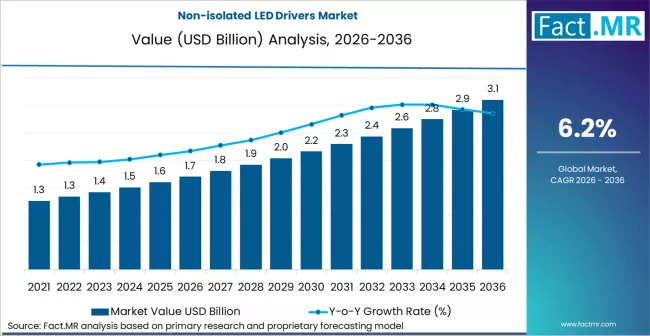
Non Isolated Led Drivers Market Market Value Analysis | Source: Fact.MR
Non-isolated LED Drivers Market
| Metric | Value |
|---|---|
| Estimated Value in (2026E) | USD 1.7 billion |
| Forecast Value in (2036F) | USD 3.1 billion |
| Forecast CAGR (2026 to 2036) | 6.2% |
Source: Fact.MR analysis. Updated Feb 26, 2026
Non‑isolated LED Drivers Market Definition
The non‑isolated LED drivers market involves the manufacture and sale of power supply units that regulate current for LEDs without galvanic isolation between input and output, typically used in low‑voltage, cost‑sensitive lighting applications.
Market Inclusions
This report covers global and regional market sizes for non‑isolated LED drivers over a defined forecast period, including product types, applications (residential, commercial, automotive), and distribution channels.
Market Exclusions
The scope excludes isolated LED drivers, unrelated power electronics, and complete lighting fixtures that incorporate drivers but are not sold as standalone driver units.
Research Methodology
- Primary Research: Interviews were conducted with power electronics designers, LED driver manufacturers, and lighting system integrators.
- Desk Research: Data was sourced from industry reports, standards publications, and trade association data.
- Market‑Sizing and Forecasting: A hybrid model combining top‑down lighting market forecasts with bottom‑up shipment and revenue data was used.
- Data Validation and Update Cycle: Findings were validated through expert review and aligned with recent production and trade figures.
Summary of the Non-Isolated LED Drivers Market
- Market Definition
- The non-isolated LED drivers market pertains to power supply units that regulate current for LEDs without galvanic isolation, typically used in low-voltage, cost-sensitive lighting applications. These drivers are essential for ensuring energy-efficient performance in LED systems across residential, commercial, and industrial sectors.
- Demand Drivers
- Energy Efficiency: As demand for energy-efficient lighting grows, non-isolated LED drivers play a key role in minimizing power loss and improving system performance.
- Cost-Effectiveness: Non-isolated LED drivers are more affordable than isolated counterparts, making them a preferred choice in applications that prioritize low upfront costs.
- Government Initiatives: Increasing government incentives for energy-efficient lighting solutions are contributing to the wider adoption of non-isolated LED drivers.
- Key Segments Analyzed
- Type: Buck-type LED drivers are expected to dominate the market, capturing 45% of the segment by 2026. Their high efficiency and cost-effectiveness make them ideal for a range of lighting applications.
- Application: Home lighting is projected to hold 35% of the market share by 2026, driven by growing consumer preference for energy-saving LED technologies in residential environments.
- End-User: Pharmaceutical and biotechnology companies are expected to account for a significant share of the market, given the strong demand for energy-efficient lighting solutions in industrial settings.
- Analyst Opinion at Fact MR
- “The non-isolated LED drivers market is set for steady growth, driven by energy efficiency and cost-effectiveness in lighting applications. As LED adoption continues to rise, non-isolated drivers will remain crucial in the widespread implementation of energy-saving technologies.” - Shambhu Nath Jha, Principal Consultant at Fact MR.
- Strategic Implications/Executive Takeaways
- Innovation in Performance: While basic LED drivers remain popular, demand for advanced drivers with improved power quality and dimming compatibility is expected to increase.
- Focus on Regional Expansion: Companies should explore markets in Asia Pacific and Latin America, where cost-sensitive lighting solutions are in high demand.
- Energy Standards: The growing emphasis on energy efficiency and sustainability will push further demand for advanced, high-performance non-isolated LED drivers.
- Methodology
- Primary Research: Interviews with LED driver manufacturers, lighting system integrators, and product engineers.
- Desk Research: Data sourced from industry reports, standards publications, and trade association insights.
Segmental Analysis
Non-Isolated LED Drivers Market Analysis by Type
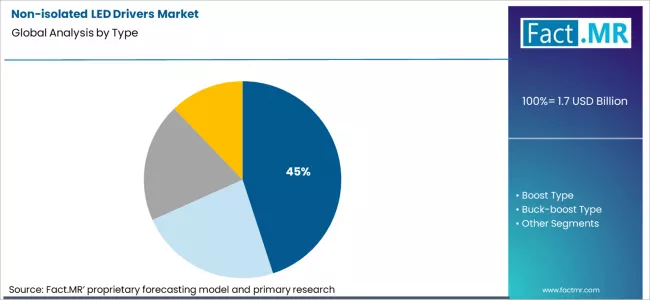
Non Isolated Led Drivers Market Analysis By Type | Source: Fact.MR
- Market Overview: Buck type LED drivers are projected to capture 45% of the market share by 2026. Buck-type LED drivers are highly efficient and commonly used in LED applications where the input voltage is higher than the required output voltage, making them ideal for applications with a stable power supply and lower energy consumption.
- Demand Drivers:
- Energy Efficiency: Buck-type drivers are known for their high energy efficiency, as they step down the voltage without excessive power loss. This makes them highly attractive for both commercial and residential lighting solutions.
- Cost-Effectiveness: Due to their simplicity and efficiency, buck-type LED drivers are often more affordable compared to other types, such as boost-type drivers. This cost-effectiveness drives their widespread adoption in home and commercial lighting systems.
- Wide Application in Low-Voltage Systems: Buck-type drivers are commonly used in systems where the power supply operates within a predictable, lower voltage range, making them ideal for a variety of residential and commercial lighting applications.
Non-Isolated LED Drivers Market Analysis by Application
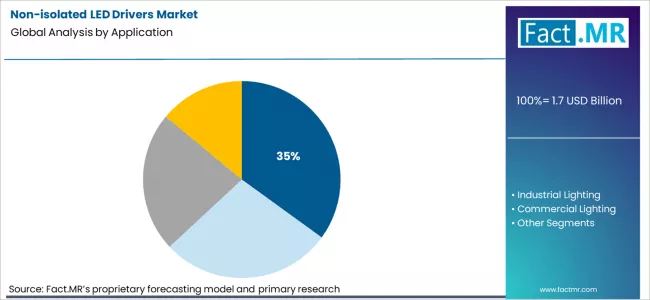
Non Isolated Led Drivers Market Analysis By Application | Source: Fact.MR
- Market Overview: Home lighting is expected to hold 35% of the market share by 2026. The demand for non-isolated LED drivers in home lighting is being driven by the increasing adoption of energy-efficient lighting solutions. LED lighting offers longer lifespans, lower power consumption, and better lighting quality, making it the preferred choice for home environments.
- Demand Drivers:
- Energy Savings and Sustainability: LED lighting is well-known for its energy efficiency, and non-isolated LED drivers are a key component in making these systems even more efficient. Homeowners are increasingly prioritizing energy-saving solutions, which boosts the adoption of LED lighting and, in turn, non-isolated LED drivers.
- Cost-Effectiveness and Long Lifespan: As LED technology continues to improve, the upfront costs of installation decrease, and the long operational life of LED lighting solutions becomes a key selling point for residential lighting applications. Non-isolated LED drivers contribute to the affordability and longevity of these systems.
- Smart Home Integration: The rise in smart home technologies, where lighting is controlled through apps or automation systems, is increasing the demand for LED-based lighting solutions, further driving the use of non-isolated LED drivers in home lighting systems.
Non isolated LED Drivers Market Drivers, Restraints, and Opportunities
FMR analysts observe that the non‑isolated LED drivers market is a mature, cost‑centric segment within solid‑state lighting, anchored in applications where low cost, high efficiency, and compact form‑factors are prioritized. Historically, non‑isolated topologies dominated low‑power LED lighting (indoor fixtures, signage, task lighting) because they eliminate galvanic isolation to reduce component count and price. The 2026 valuation reflects this structural reality: demand persists where safety risk is managed through design and certification, and where cost savings outweigh the benefits of isolated solutions.
While demand for basic non‑isolated drivers remains large in low‑power, line‑voltage lighting, growth is shifting toward higher‑performance drivers with improved power quality and broader dimming compatibility. These enhanced non‑isolated designs typically carry higher average selling prices, contributing to net market value growth even as overall unit volumes grow in line with LED fixture adoption and retrofit cycles. The market exists at its current size because cost sensitivity and efficiency remain primary selection criteria in many lighting segments that do not require isolation.
- Cost & Efficiency Demand: End‑users adopt non‑isolated LED drivers to minimize upfront costs and maximize luminous efficacy in low‑power lighting, replacing higher‑cost isolated designs where safety can be managed by system design.
- Regulatory & Safety Standards: Electrical safety standards such as IEC 61347 and UL driver requirements push specification of certified non‑isolated drivers in applications where regulatory criteria permit use without galvanic isolation, raising performance expectations.
- Regional Market Dynamics: In Asia‑Pacific and parts of Latin America, strong sensitivity to upfront lighting costs drives higher uptake of non‑isolated solutions, while in North America/Europe specification toward isolated drivers remains stronger in commercial and industrial segments.
Regional Analysis
The market analysis covers key global regions, including East Asia, South Asia, Western Europe, North America, and China. It is segmented geographically, with specific market dynamics for each region. The full report provides a detailed market attractiveness analysis.
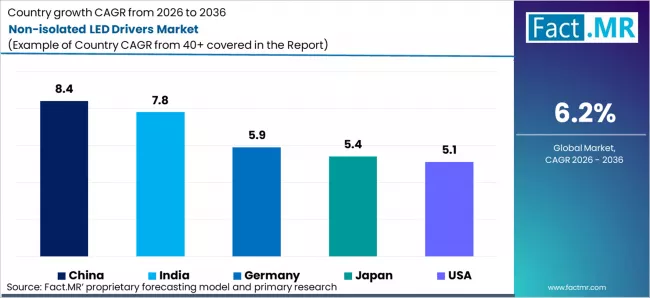
Non Isolated Led Drivers Market Cagr Analysis By Country | Source: Fact.MR
| Country | CAGR (%) |
|---|---|
| China | 8.4% |
| India | 7.8% |
| Germany | 5.9% |
| Japan | 5.4% |
| USA | 5.1% |
Source: Fact.MR analysis. Updated Feb 26, 2026
Source: Fact MR (FMR) analysis, based on proprietary forecasting model and primary research.
East Asia:
In East Asia, China and Japan are leading the demand for non-isolated LED drivers, supported by the growing demand for energy-efficient lighting solutions and technological advancements in the LED sector.
- China: Demand for non-isolated LED drivers in China is projected to rise at 8.4% CAGR through 2036. China’s rapid urbanization, increased focus on energy-efficient lighting, and strong LED manufacturing capabilities continue to drive market growth.
- Japan: Demand for non-isolated LED drivers in Japan is projected to rise at 5.4% CAGR through 2036. Japan’s technological advancements in LED technology and growing demand for energy-efficient lighting solutions support steady market growth.
South Asia:
In South Asia, India is seeing strong demand for non-isolated LED drivers, driven by the increasing adoption of energy-efficient lighting in both residential and commercial sectors.
- India: Demand for non-isolated LED drivers in India is projected to rise at 7.8% CAGR through 2036. India’s expanding infrastructure and growing focus on energy-efficient lighting solutions continue to drive the adoption of non-isolated LED drivers.
Western Europe:
In Western Europe, Germany remains a major market for non-isolated LED drivers, with the growing demand for energy-efficient lighting solutions in both commercial and residential applications.
- Germany: Demand for non-isolated LED drivers in Germany is projected to rise at 5.9% CAGR through 2036. Germany’s commitment to sustainable lighting and technological innovations in LED drivers continue to contribute to market growth.
North America:
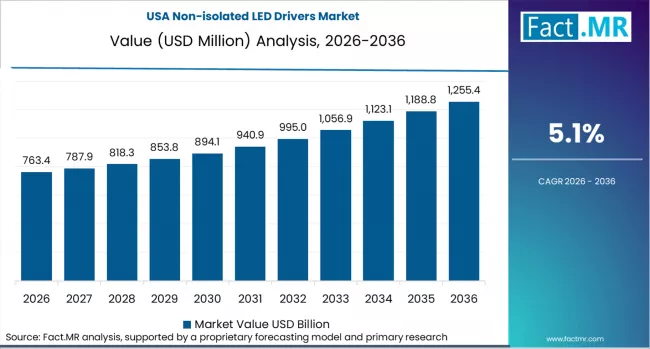
Non Isolated Led Drivers Market Country Value Analysis | Source: Fact.MR
In North America, the USA is a key market for non-isolated LED drivers, driven by demand in the commercial sector, energy-efficient lighting initiatives, and government regulations pushing for energy savings.
- USA: Demand for non-isolated LED drivers in the U.S. is projected to rise at 5.1% CAGR through 2036. The USA’s growing adoption of LED lighting and energy efficiency standards continue to drive demand for advanced LED driver solutions.
Fact MR's analysis of the Non-isolated LED Drivers Market in East Asia, South Asia, Western Europe, North America, and China consists of country-wise assessments that include China, India, Germany, Japan, and the USA. Readers can find detailed trends, regulatory updates, and company-specific investments shaping the market’s growth in these countries.
How Are Key Players Competing in the Non-Isolated LED Drivers Market?
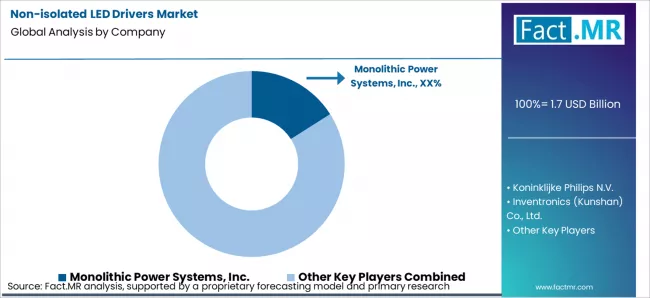
Non Isolated Led Drivers Market Analysis By Company | Source: Fact.MR
In the non-isolated LED drivers market, Monolithic Power Systems, Inc. and Inventronics (Kunshan) Co., Ltd. lead by offering high-performance, energy-efficient LED driver solutions tailored for a wide range of applications. Koninklijke Philips N.V. leverages its established brand presence to develop advanced drivers focused on superior performance and reliability. Texas Instruments Incorporated and Infineon Technologies AG emphasize customizable drivers that support energy-saving and adaptive lighting systems. NXP Semiconductors N.V. and ROHM Co., Ltd. provide cost-effective, high-quality drivers with robust features for both commercial and residential use. Silicon Laboratories, Inc., ON Semiconductor Corporation, and STMicroelectronics N.V. are enhancing their portfolios with integrated, compact LED drivers that ensure improved efficiency and support for IoT connectivity, gaining traction in smart lighting systems.
Recent Industry Developments
- BIS Mandatory Safety Revision for LED Modules (Regulatory): The Bureau of Indian Standards (BIS) announced that all LED modules and associated drivers must comply with the revised IS 16103 (Part 1):2025 / IEC 62031:2018 standard by January 21, 2026.
- Tridonic Transition to Bio-Circular Housings (Corporate): In late 2025, Tridonic transitioned its excite (EXC4) and premium (PRE4) driver series to Makrolon® RE, a bio-circular polycarbonate that reduces the housing's carbon footprint by 80% without requiring new UL certifications.
- Inventronics ESM-Series Multi-Channel Launch (Corporate): Inventronics expanded its high-efficiency non-isolated portfolio in late 2024 with the ESM series (e.g., ESM-1K2T), specifically designed for horticulture applications to allow precise light spectrum steering while maintaining 95% full-load efficiency.
Key Players of the Non-isolated LED Drivers Market
- Monolithic Power Systems, Inc.
- Koninklijke Philips N.V.
- Inventronics (Kunshan) Co., Ltd.
- Texas Instruments Incorporated
- Infineon Technologies AG
- NXP Semiconductors N.V.
- ROHM Co., Ltd.
- Silicon Laboratories, Inc.
- ON Semiconductor Corporation
- STMicroelectronics N.V.
Report Scope
| Metric | Value |
|---|---|
| Quantitative Units | USD 1.7 billion (2026) to USD 3.1 billion (2036), at a CAGR of 6.2% |
| Market Definition | The Non-isolated LED Drivers Market includes LED drivers that provide power to LEDs without isolation from the input, used across various applications in residential, commercial, and industrial lighting. |
| By Type | Buck Type, Boost Type, Buck-boost Type, Others |
| By Application | Home Lighting, Industrial Lighting, Commercial Lighting, Others |
| By End-Use Industry | Residential, Commercial, Industrial, Retail, Outdoor, Architectural |
| Regions Covered | North America, Latin America, Europe, East Asia, South Asia, Oceania, Middle East and Africa |
| Countries Covered | United States, Canada, Mexico, Brazil, Argentina, Germany, France, United Kingdom, Italy, Spain, China, India, Japan, South Korea, Indonesia, Australia, and 40+ countries |
| Key Companies Profiled | Monolithic Power Systems, Inc., Koninklijke Philips N.V., Inventronics (Kunshan) Co., Ltd., Texas Instruments Incorporated, Infineon Technologies AG, NXP Semiconductors N.V., ROHM Co., Ltd., Silicon Laboratories, Inc., ON Semiconductor Corporation, STMicroelectronics N.V. |
| Forecast Period | 2026 to 2036 |
| Approach | Hybrid top-down and bottom-up market modeling validated through primary interviews with manufacturers and supported by trade data benchmarking and market research. |
Source: Fact.MR analysis. Updated Feb 26, 2026
Bibliographies
- Infineon Technologies AG. (2024). Non-isolated LED driver IC solutions for smart and energy-efficient lighting systems. Infineon Technologies AG.
- Inventronics (Kunshan) Co., Ltd. (2024). LED driver solutions for general lighting and horticulture applications. Inventronics (Kunshan) Co., Ltd.
- Inventronics (Kunshan) Co., Ltd. (2024). Launch of ESM series multi-channel LED drivers for horticulture lighting [Product announcement]. Inventronics (Kunshan) Co., Ltd.
- Koninklijke Philips N.V. (2024). LED driver technologies for energy-efficient lighting systems. Koninklijke Philips N.V.
- Monolithic Power Systems, Inc. (2024). Non-isolated LED driver ICs for compact and cost-optimized lighting designs. Monolithic Power Systems, Inc.
- Texas Instruments Incorporated. (2024). LED driver integrated circuits for high-efficiency lighting applications. Texas Instruments Incorporated.
- Tridonic GmbH & Co KG. (2025). Transition of excite and premium LED driver series to bio-circular Makrolon® RE housing materials [Corporate sustainability update]. Tridonic GmbH & Co KG.
- Bureau of Indian Standards. (2025). Revision of IS 16103 (Part 1):2025 / IEC 62031:2018-Safety requirements for LED modules. Bureau of Indian Standards.
- International Electrotechnical Commission. (2018). IEC 62031:2018 LED modules for general lighting-Safety specifications. International Electrotechnical Commission.
- International Electrotechnical Commission. (2023). IEC 61347-2-13: Particular requirements for d.c. or a.c. supplied electronic controlgear for LED modules. International Electrotechnical Commission.
This report addresses:
- Market Intelligence enabling comprehensive assessment of leading countries and service segments across the Non-Isolated LED Drivers Market globally.
- Market Volume (Sales Units) estimates and 10-year revenue forecasts from 2026 to 2036, validated through manufacturer shipment data, channel partner surveys, and country-level demand modeling.
- Growth Opportunity Mapping across product types (Buck Type, Boost Type, Buck-boost Type, Others), application segments (Home Lighting, Industrial Lighting, Commercial Lighting, Others), end-user sectors (Residential, Commercial, Industrial, Retail, Outdoor, Architectural), and regions.
- Segment and Regional Revenue Forecasts by product type, application segment, end-user sector, and geography across 40+ countries.
- Competition Strategy Analysis covering dealer network structure, recent developments, product portfolio, unique selling propositions (USPs), and market share analysis.
- Product and Regulatory Compliance Tracking aligned with energy efficiency standards and safety guidelines for LED drivers used in various sectors such as residential, commercial, and industrial lighting.
- Regulatory Impact Analysis addressing global compliance standards for LED drivers, market access regulations, and evolving standards for energy-efficient lighting solutions in different regions.
- Report Delivery in PDF, Excel, PowerPoint, and interactive dashboard formats for executive, procurement, and operational planning use.
Segmentation
Non-isolated LED Drivers Market Key Segments
-
Type :
- Buck Type
- Boost Type
- Buck-boost Type
- Others
-
Application :
- Home Lighting
- Industrial Lighting
- Commercial Lighting
- Others
-
End-Use Industry :
- Residential
- Commercial
- Industrial
- Retail
- Outdoor
- Architectural
-
Region :
- North America
- USA
- Canada
- Mexico
- Europe
- Germany
- UK
- France
- Italy
- Spain
- Nordic Countries
- BENELUX
- Rest of Europe
- Asia Pacific
- China
- Japan
- South Korea
- India
- Australia
- Rest of Asia Pacific
- Latin America
- Brazil
- Argentina
- Rest of Latin America
- Middle East and Africa
- Kingdom of Saudi Arabia
- United Arab Emirates
- South Africa
- Rest of Middle East and Africa
- Other Regions
- Oceania
- Central Asia
- Other Markets
- North America
Frequently Asked Questions
How large is the demand for Non-isolated LED Drivers in the global market in 2026?
What will be the market size of Non-isolated LED Drivers in the global market by 2036?
What is the expected demand growth for Non-isolated LED Drivers in the global market between 2026 and 2036?
Which type of LED driver is expected to dominate the market?
Which region is expected to show the highest growth rate for Non-isolated LED Drivers?
How significant is the growth outlook for India in this market?
What is the growth outlook for Germany in the Non-isolated LED Drivers market?
What is the growth forecast for Japan in the Non-isolated LED Drivers market?
What is the growth forecast for the United States in the Non-isolated LED Drivers market?
Which company is identified as a leading player in the Non-isolated LED Drivers market?
What are Non-isolated LED Drivers used for?
What does the Non-isolated LED Drivers market include in this report?
How is the market forecast developed in this report?
What is meant by the Non-isolated LED Drivers market in this report?
Who worked on this report


Preview the report firsthand - request a free sample
Free SampleGet the brochure for pricing and purchase details
Download PDF