Non-Biocidal Slime Control Agents for Cooling Systems Market

Non-Biocidal Slime Control Agents for Cooling Systems Market Size and Share Forecast Outlook 2026 to 2036

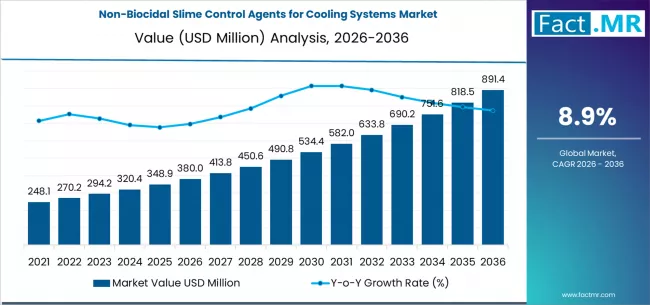
Non-biocidal slime control agents for cooling systems market is projected to grow from USD 380.0 million in 2026 to USD 891.4 million by 2036, at a CAGR of 8.9%. Polymer-Based Slime Control Agents will dominate with a 30.0% market share, while open recirculating cooling towers will lead the cooling system type segment with a 38.0% share.

Non-Biocidal Slime Control Agents for Cooling Systems Market Forecast and Outlook 2026 to 2036

The global market for non-biocidal slime control agents is experiencing significant growth, driven by the urgent need for environmentally compatible solutions in industrial water management. Projected to rise from USD 380.00 million in 2026 to USD 891.38 million by 2036, the market is set to advance at a CAGR of 8.9%.

Key Takeaways from the Non-Biocidal Slime Control Agents for Cooling Systems Market

  • Market Value for 2026: USD 380.00 Million
  • Market Value for 2036: USD 891.38 Million
  • Forecast CAGR (2026-2036): 8.9%
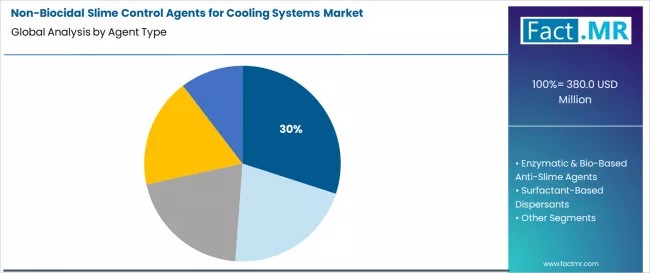
  • Leading Agent Type Share (2026): Polymer-Based Slime Control Agents (30%)
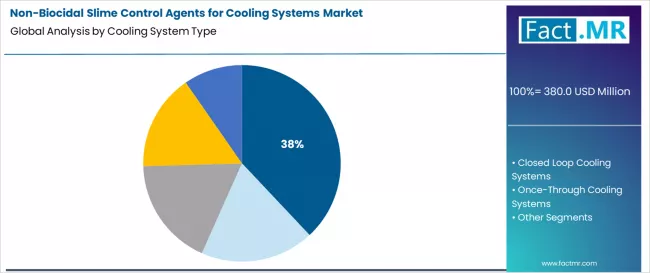
  • Leading System Type Share (2026): Open Recirculating Cooling Towers (38%)
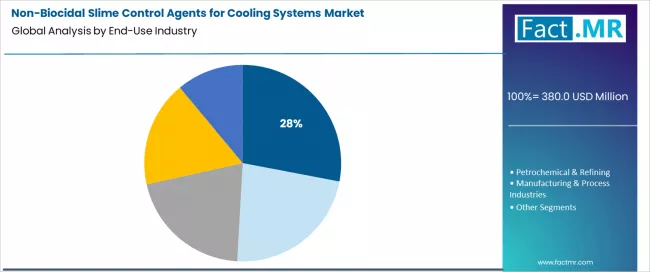
  • Leading End-Use Industry Share (2026): Power Generation & Utilities (28%)
  • Key Players in the Market: Ecolab, Solenis, Nalco Water (Ecolab), Kemira, Kurita Water Industries
Non Biocidal Slime Control Agents For Cooling Systems Market Market Value Analysis

Polymer-based slime control agents represent the dominant product type, capturing a 30% market share. Open recirculating cooling towers are the primary system type, accounting for 38% of demand. The power generation and utilities sector stands as the leading end-use industry, with a 28% share, due to its intensive cooling water requirements and regulatory scrutiny.

This expansion is propelled by stringent global regulations phasing out traditional oxidizing biocides and increasing corporate mandates for sustainable water treatment. Non-biocidal agents prevent biofilm and slime formation through physical and chemical means—such as dispersing microorganisms, modifying surface properties, or sequestering nutrients—without introducing toxic chemicals into blowdown water. Their adoption is critical for maintaining heat transfer efficiency, reducing corrosion risks, and ensuring compliance with environmental discharge permits.

Innovation focuses on enhancing the efficacy and cost-competitiveness of these agents while ensuring compatibility with other water treatment chemistries. The development of these advanced formulations is essential for enabling industries to achieve operational reliability and environmental stewardship without relying on conventional biocidal approaches.

Metric

Metric Value
Market Value (2026) USD 380.00 Million
Market Forecast Value (2036) USD 891.38 Million
Forecast CAGR (2026-2036) 8.9%

Category

Category Segments
Agent Type Polymer-Based Slime Control Agents, Enzymatic & Bio-Based Anti-Slime Agents, Surfactant-Based Dispersants, Chelating & Fouling Prevention Agents, Other Non-Biocidal Slime Control Additives
Cooling System Type Open Recirculating Cooling Towers, Closed Loop Cooling Systems, Once-Through Cooling Systems, Hybrid & Advanced Cooling Systems, Decentralized / Modular Cooling Units
End-Use Industry Power Generation & Utilities, Petrochemical & Refining, Manufacturing & Process Industries, HVAC & Commercial Buildings, Data Centers & Industrial Cooling
Region North America, Latin America, Western Europe, Eastern Europe, East Asia, South Asia & Pacific, MEA

Segmental Analysis

By Agent Type, Which Technology Offers a Broad-Spectrum Physical Barrier?
Non Biocidal Slime Control Agents For Cooling Systems Market Analysis By Agent Type

Polymer-based slime control agents lead the market with a 30% share. These agents function by forming a protective molecular layer on system surfaces or by encapsulating and dispersing microbial clusters. Their mechanism is physical rather than toxic, preventing bacteria from adhering and forming biofilm matrices.

This approach is highly effective across various water chemistries and is compatible with other treatment programs, making it a versatile and widely adopted first-line defense against slime in systems where biocide use is restricted.

By Cooling System Type, Which Configuration is Most Vulnerable to Biofouling?
Non Biocidal Slime Control Agents For Cooling Systems Market Analysis By Cooling System Type

Open recirculating cooling towers represent the largest system segment, holding a 38% share. These systems are inherently vulnerable to biological growth due to constant exposure to air, sunlight, and airborne nutrients, creating an ideal environment for biofilm formation.

The significant water and energy savings they provide are jeopardized by fouling, making continuous, effective slime control a non-negotiable operational requirement. This drives consistent, high-volume demand for non-biocidal agents that can maintain cleanliness without environmental compromise.

By End-Use Industry, Which Sector Balances Massive Scale with Strict Compliance?
Non Biocidal Slime Control Agents For Cooling Systems Market Analysis By End Use Industry

The power generation and utilities sector is the leading end-use industry, accounting for a 28% share. Power plants operate some of the largest cooling water systems globally, where even minor losses in heat transfer efficiency have major cost and carbon emission implications.

This sector faces particularly stringent regulations on discharge water quality, pushing operators toward non-biocidal alternatives to manage microbial populations responsibly while safeguarding asset performance and reliability.

What are the Drivers, Restraints, and Key Trends of the Non-Biocidal Slime Control Agents Market?

The primary market driver is the global regulatory shift restricting the use of conventional biocides like chlorine, bromine, and isothiazolinones due to their toxicity to aquatic life and formation of harmful by-products. Corporate sustainability goals and water stewardship certifications further mandate greener treatment solutions. The operational need to control Legionella and other pathogens in cooling systems also drives adoption of non-biocidal strategies that mitigate risk without creating chemical handling hazards or resistant microbial strains.

A significant market restraint is the perception that non-biocidal programs can be less immediately effective or more expensive than traditional biocide dosing, especially in heavily fouled systems. Their performance can be more sensitive to system control parameters like pH, flow, and organic loading. There is also a technical knowledge gap; designing and monitoring an effective non-biocidal program often requires more sophisticated expertise than a standard biocide regimen, potentially slowing adoption.

Key trends include the development of intelligent, sensor-driven dosing systems that apply non-biocidal agents based on real-time biofilm monitoring, optimizing chemical use and efficacy. There is increasing use of enzymatic and quorum sensing inhibitors that disrupt bacterial communication and biofilm formation at very low doses. The market is also moving toward multifunctional treatment programs where non-biocidal slime control agents are integrated with scale and corrosion inhibitors, providing a comprehensive, sustainable treatment approach from a single supplier.

Analysis of the Non-Biocidal Slime Control Agents Market by Key Countries
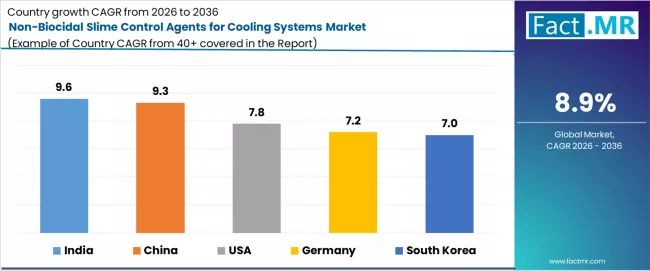
Non Biocidal Slime Control Agents For Cooling Systems Market Cagr Analysis By Country

Country CAGR (2026-2036)
India 9.60%
China 9.30%
USA 7.80%
Germany 7.20%
South Korea 7.00%

How do India’s Industrial Expansion and Water Stress Drive Market Growth?

India’s leading CAGR of 9.60% is fueled by rapid industrial growth and acute water stress, which mandates efficient cooling water management and minimal chemical discharge. New environmental regulations are pushing industries to adopt greener chemistries.

The massive installation of new cooling systems in power, refining, and manufacturing, combined with the retrofit of existing systems, creates a substantial market for advanced, non-biocidal treatment programs that conserve water and ensure compliance.

What is the Impact of China’s Ecological Protection Policies on Industrial Water Treatment?

China’s 9.30% growth is linked to its stringent "Blue Sky" and water protection campaigns, which enforce limits on toxic discharges from industrial facilities. Cooling water systems are a focal point for these regulations.

The scale of Chinese industry and its concerted push toward circular water use drives widespread adoption of sustainable treatment technologies, including non-biocidal slime control, particularly in water-scarce northern regions and industrial parks.

How does Evolving US Regulation and a Focus on Water Reuse Shape Demand?
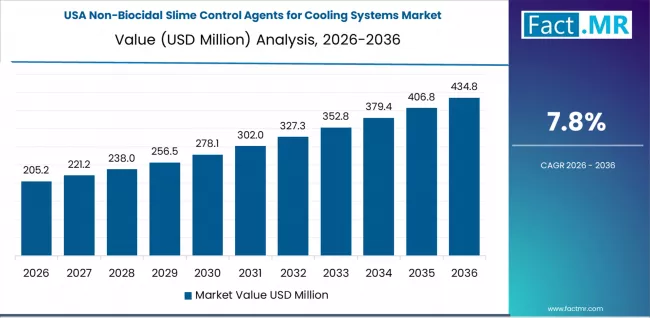
Non Biocidal Slime Control Agents For Cooling Systems Market Country Value Analysis

The USA’s 7.80% CAGR is supported by tightening regulations on biocide discharge under the Clean Water Act and growing corporate focus on water reuse and reduction. Facilities aiming for LEED certification or zero-liquid discharge (ZLD) increasingly adopt non-biocidal programs. The mature market is characterized by a shift from commodity biocides to higher-value, specialty non-biocidal treatment programs that offer operational and environmental benefits.

Why is Germany a Center for Advanced, Precision Water Treatment Solutions?

Germany’s 7.20% growth reflects its rigorous implementation of EU water framework directives and its engineering leadership. German industries and commercial building operators seek highly efficient, automated treatment solutions that minimize all chemical inputs. This drives demand for sophisticated non-biocidal programs, often integrated with advanced monitoring and control systems, to achieve perfect water balance and compliance with the country’s exacting environmental standards.

What Role does South Korea’s High-Tech Industry and Green Growth Policy Play?

South Korea’s 7.00% growth is anchored in its advanced electronics, petrochemical, and data center industries, where cooling system reliability is paramount. The national green growth strategy encourages sustainable industrial practices. This combination creates demand for high-performance, non-biocidal agents that protect sensitive equipment from biofilm-related corrosion and fouling without introducing contaminants that could interfere with high-purity process requirements.

Competitive Landscape of the Non-Biocidal Slime Control Agents Market
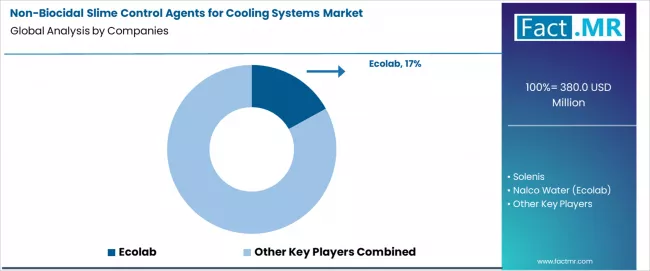
Non Biocidal Slime Control Agents For Cooling Systems Market Analysis By Company

Global water treatment specialists offering comprehensive chemical management programs dominate the competitive landscape. Leaders like Ecolab and Solenis compete based on their extensive R&D in polymer science and microbiology, proprietary monitoring technologies, and global service networks.

Competition centers on demonstrating proven return on investment through energy savings and reduced downtime, providing robust technical support for program optimization, and offering digital tools for performance tracking. A key differentiator is the ability to deliver a fully integrated water treatment management service that guarantees results while meeting sustainability KPIs.

Key Players in the Non-Biocidal Slime Control Agents for Cooling Systems Market

  • Ecolab
  • Solenis
  • Nalco Water (Ecolab)
  • Kemira Oyj.
  • Kurita Water Industries

Scope of Report

Items Values
Quantitative Units USD Million
Agent Type Polymer-Based, Enzymatic/Bio-Based, Surfactant Dispersants, Chelating Agents, Other Additives
Cooling System Type Open Recirculating Towers, Closed Loops, Once-Through, Hybrid Systems, Decentralized Units
End-Use Industry Power Generation, Petrochemical/Refining, Manufacturing, HVAC/Commercial, Data Centers
Key Countries India, China, USA, Germany, South Korea
Key Companies Ecolab, Solenis, Nalco Water (Ecolab), Kemira, Kurita Water Industries
Additional Analysis Analysis of biofilm formation mechanisms; performance validation methods (e.g., flow cells, sidestream monitors); compatibility with materials of construction; impact on water reuse and blowdown treatment; regulatory analysis of biocide restrictions and green chemistry incentives.

Market by Segments

  • Agent Type :

    • Polymer-Based Slime Control Agents
    • Enzymatic & Bio-Based Anti-Slime Agents
    • Surfactant-Based Dispersants
    • Chelating & Fouling Prevention Agents
    • Other Non-Biocidal Slime Control Additives
  • Cooling System Type :

    • Open Recirculating Cooling Towers
    • Closed Loop Cooling Systems
    • Once-Through Cooling Systems
    • Hybrid & Advanced Cooling Systems
    • Decentralized/Modular Cooling Units
  • End-Use Industry :

    • Power Generation & Utilities
    • Petrochemical & Refining
    • Manufacturing & Process Industries
    • HVAC & Commercial Buildings
    • Data Centers & Industrial Cooling
  • Region :

    • North America

      • USA
      • Canada
    • Latin America

      • Brazil
      • Mexico
      • Argentina
      • Rest of Latin America
    • Western Europe

      • Germany
      • UK
      • France
      • Spain
      • Italy
      • BENELUX
      • Rest of Western Europe
    • Eastern Europe

      • Russia
      • Poland
      • Czech Republic
      • Rest of Eastern Europe
    • East Asia

      • China
      • Japan
      • South Korea
      • Rest of East Asia
    • South Asia & Pacific

      • India
      • ASEAN
      • Australia
      • Rest of South Asia & Pacific
    • MEA

      • Saudi Arabia
      • UAE
      • Turkiye
      • Rest of MEA

Table of Content

  1. Executive Summary
    • Global Market Outlook
    • Demand to side Trends
    • Supply to side Trends
    • Technology Roadmap Analysis
    • Analysis and Recommendations
  2. Market Overview
    • Market Coverage / Taxonomy
    • Market Definition / Scope / Limitations
  3. Market Background
    • Market Dynamics
      • Drivers
      • Restraints
      • Opportunity
      • Trends
    • Scenario Forecast
      • Demand in Optimistic Scenario
      • Demand in Likely Scenario
      • Demand in Conservative Scenario
    • Opportunity Map Analysis
    • Product Life Cycle Analysis
    • Supply Chain Analysis
    • Investment Feasibility Matrix
    • Value Chain Analysis
    • PESTLE and Porter’s Analysis
    • Regulatory Landscape
    • Regional Parent Market Outlook
    • Production and Consumption Statistics
    • Import and Export Statistics
  4. Global Market Analysis 2021 to 2025 and Forecast, 2026 to 2036
    • Historical Market Size Value (USD Million) Analysis, 2021 to 2025
    • Current and Future Market Size Value (USD Million) Projections, 2026 to 2036
      • Y to o to Y Growth Trend Analysis
      • Absolute $ Opportunity Analysis
  5. Global Market Pricing Analysis 2021 to 2025 and Forecast 2026 to 2036
  6. Global Market Analysis 2021 to 2025 and Forecast 2026 to 2036, By Agent Type
    • Introduction / Key Findings
    • Historical Market Size Value (USD Million) Analysis By Agent Type, 2021 to 2025
    • Current and Future Market Size Value (USD Million) Analysis and Forecast By Agent Type, 2026 to 2036
      • Polymer-Based Slime Control Agents
      • Enzymatic & Bio-Based Anti-Slime Agents
      • Surfactant-Based Dispersants
      • Chelating & Fouling Prevention Agents
      • Other Non-Biocidal Slime Control Additives
    • Y to o to Y Growth Trend Analysis By Agent Type, 2021 to 2025
    • Absolute $ Opportunity Analysis By Agent Type, 2026 to 2036
  7. Global Market Analysis 2021 to 2025 and Forecast 2026 to 2036, By Cooling System Type
    • Introduction / Key Findings
    • Historical Market Size Value (USD Million) Analysis By Cooling System Type, 2021 to 2025
    • Current and Future Market Size Value (USD Million) Analysis and Forecast By Cooling System Type, 2026 to 2036
      • Open Recirculating Cooling Towers
      • Closed Loop Cooling Systems
      • Once-Through Cooling Systems
      • Hybrid & Advanced Cooling Systems
      • Decentralized / Modular Cooling Value (USD Million)s
    • Y to o to Y Growth Trend Analysis By Cooling System Type, 2021 to 2025
    • Absolute $ Opportunity Analysis By Cooling System Type, 2026 to 2036
  8. Global Market Analysis 2021 to 2025 and Forecast 2026 to 2036, By End-Use Industry
    • Introduction / Key Findings
    • Historical Market Size Value (USD Million) Analysis By End-Use Industry, 2021 to 2025
    • Current and Future Market Size Value (USD Million) Analysis and Forecast By End-Use Industry, 2026 to 2036
      • Power Generation & Utilities
      • Petrochemical & Refining
      • Manufacturing & Process Industries
      • HVAC & Commercial Buildings
      • Data Centers & Industrial Cooling
    • Y to o to Y Growth Trend Analysis By End-Use Industry, 2021 to 2025
    • Absolute $ Opportunity Analysis By End-Use Industry, 2026 to 2036
  9. Global Market Analysis 2021 to 2025 and Forecast 2026 to 2036, By Region
    • Introduction
    • Historical Market Size Value (USD Million) Analysis By Region, 2021 to 2025
    • Current Market Size Value (USD Million) Analysis and Forecast By Region, 2026 to 2036
      • North America
      • Latin America
      • Western Europe
      • Eastern Europe
      • East Asia
      • South Asia and Pacific
      • Middle East & Africa
    • Market Attractiveness Analysis By Region
  10. North America Market Analysis 2021 to 2025 and Forecast 2026 to 2036, By Country
    • Historical Market Size Value (USD Million) Trend Analysis By Market Taxonomy, 2021 to 2025
    • Market Size Value (USD Million) Forecast By Market Taxonomy, 2026 to 2036
      • By Country
        • USA
        • Canada
        • Mexico
      • By Agent Type
      • By Cooling System Type
      • By End-Use Industry
    • Market Attractiveness Analysis
      • By Country
      • By Agent Type
      • By Cooling System Type
      • By End-Use Industry
    • Key Takeaways
  11. Latin America Market Analysis 2021 to 2025 and Forecast 2026 to 2036, By Country
    • Historical Market Size Value (USD Million) Trend Analysis By Market Taxonomy, 2021 to 2025
    • Market Size Value (USD Million) Forecast By Market Taxonomy, 2026 to 2036
      • By Country
        • Brazil
        • Chile
        • Rest of Latin America
      • By Agent Type
      • By Cooling System Type
      • By End-Use Industry
    • Market Attractiveness Analysis
      • By Country
      • By Agent Type
      • By Cooling System Type
      • By End-Use Industry
    • Key Takeaways
  12. Western Europe Market Analysis 2021 to 2025 and Forecast 2026 to 2036, By Country
    • Historical Market Size Value (USD Million) Trend Analysis By Market Taxonomy, 2021 to 2025
    • Market Size Value (USD Million) Forecast By Market Taxonomy, 2026 to 2036
      • By Country
        • Germany
        • UK
        • Italy
        • Spain
        • France
        • Nordic
        • BENELUX
        • Rest of Western Europe
      • By Agent Type
      • By Cooling System Type
      • By End-Use Industry
    • Market Attractiveness Analysis
      • By Country
      • By Agent Type
      • By Cooling System Type
      • By End-Use Industry
    • Key Takeaways
  13. Eastern Europe Market Analysis 2021 to 2025 and Forecast 2026 to 2036, By Country
    • Historical Market Size Value (USD Million) Trend Analysis By Market Taxonomy, 2021 to 2025
    • Market Size Value (USD Million) Forecast By Market Taxonomy, 2026 to 2036
      • By Country
        • Russia
        • Poland
        • Hungary
        • Balkan & Baltic
        • Rest of Eastern Europe
      • By Agent Type
      • By Cooling System Type
      • By End-Use Industry
    • Market Attractiveness Analysis
      • By Country
      • By Agent Type
      • By Cooling System Type
      • By End-Use Industry
    • Key Takeaways
  14. East Asia Market Analysis 2021 to 2025 and Forecast 2026 to 2036, By Country
    • Historical Market Size Value (USD Million) Trend Analysis By Market Taxonomy, 2021 to 2025
    • Market Size Value (USD Million) Forecast By Market Taxonomy, 2026 to 2036
      • By Country
        • China
        • Japan
        • South Korea
      • By Agent Type
      • By Cooling System Type
      • By End-Use Industry
    • Market Attractiveness Analysis
      • By Country
      • By Agent Type
      • By Cooling System Type
      • By End-Use Industry
    • Key Takeaways
  15. South Asia and Pacific Market Analysis 2021 to 2025 and Forecast 2026 to 2036, By Country
    • Historical Market Size Value (USD Million) Trend Analysis By Market Taxonomy, 2021 to 2025
    • Market Size Value (USD Million) Forecast By Market Taxonomy, 2026 to 2036
      • By Country
        • India
        • ASEAN
        • Australia & New Zealand
        • Rest of South Asia and Pacific
      • By Agent Type
      • By Cooling System Type
      • By End-Use Industry
    • Market Attractiveness Analysis
      • By Country
      • By Agent Type
      • By Cooling System Type
      • By End-Use Industry
    • Key Takeaways
  16. Middle East & Africa Market Analysis 2021 to 2025 and Forecast 2026 to 2036, By Country
    • Historical Market Size Value (USD Million) Trend Analysis By Market Taxonomy, 2021 to 2025
    • Market Size Value (USD Million) Forecast By Market Taxonomy, 2026 to 2036
      • By Country
        • Kingdom of Saudi Arabia
        • Other GCC Countries
        • Turkiye
        • South Africa
        • Other African Union
        • Rest of Middle East & Africa
      • By Agent Type
      • By Cooling System Type
      • By End-Use Industry
    • Market Attractiveness Analysis
      • By Country
      • By Agent Type
      • By Cooling System Type
      • By End-Use Industry
    • Key Takeaways
  17. Key Countries Market Analysis
    • USA
      • Pricing Analysis
      • Market Share Analysis, 2025
        • By Agent Type
        • By Cooling System Type
        • By End-Use Industry
    • Canada
      • Pricing Analysis
      • Market Share Analysis, 2025
        • By Agent Type
        • By Cooling System Type
        • By End-Use Industry
    • Mexico
      • Pricing Analysis
      • Market Share Analysis, 2025
        • By Agent Type
        • By Cooling System Type
        • By End-Use Industry
    • Brazil
      • Pricing Analysis
      • Market Share Analysis, 2025
        • By Agent Type
        • By Cooling System Type
        • By End-Use Industry
    • Chile
      • Pricing Analysis
      • Market Share Analysis, 2025
        • By Agent Type
        • By Cooling System Type
        • By End-Use Industry
    • Germany
      • Pricing Analysis
      • Market Share Analysis, 2025
        • By Agent Type
        • By Cooling System Type
        • By End-Use Industry
    • UK
      • Pricing Analysis
      • Market Share Analysis, 2025
        • By Agent Type
        • By Cooling System Type
        • By End-Use Industry
    • Italy
      • Pricing Analysis
      • Market Share Analysis, 2025
        • By Agent Type
        • By Cooling System Type
        • By End-Use Industry
    • Spain
      • Pricing Analysis
      • Market Share Analysis, 2025
        • By Agent Type
        • By Cooling System Type
        • By End-Use Industry
    • France
      • Pricing Analysis
      • Market Share Analysis, 2025
        • By Agent Type
        • By Cooling System Type
        • By End-Use Industry
    • India
      • Pricing Analysis
      • Market Share Analysis, 2025
        • By Agent Type
        • By Cooling System Type
        • By End-Use Industry
    • ASEAN
      • Pricing Analysis
      • Market Share Analysis, 2025
        • By Agent Type
        • By Cooling System Type
        • By End-Use Industry
    • Australia & New Zealand
      • Pricing Analysis
      • Market Share Analysis, 2025
        • By Agent Type
        • By Cooling System Type
        • By End-Use Industry
    • China
      • Pricing Analysis
      • Market Share Analysis, 2025
        • By Agent Type
        • By Cooling System Type
        • By End-Use Industry
    • Japan
      • Pricing Analysis
      • Market Share Analysis, 2025
        • By Agent Type
        • By Cooling System Type
        • By End-Use Industry
    • South Korea
      • Pricing Analysis
      • Market Share Analysis, 2025
        • By Agent Type
        • By Cooling System Type
        • By End-Use Industry
    • Russia
      • Pricing Analysis
      • Market Share Analysis, 2025
        • By Agent Type
        • By Cooling System Type
        • By End-Use Industry
    • Poland
      • Pricing Analysis
      • Market Share Analysis, 2025
        • By Agent Type
        • By Cooling System Type
        • By End-Use Industry
    • Hungary
      • Pricing Analysis
      • Market Share Analysis, 2025
        • By Agent Type
        • By Cooling System Type
        • By End-Use Industry
    • Kingdom of Saudi Arabia
      • Pricing Analysis
      • Market Share Analysis, 2025
        • By Agent Type
        • By Cooling System Type
        • By End-Use Industry
    • Turkiye
      • Pricing Analysis
      • Market Share Analysis, 2025
        • By Agent Type
        • By Cooling System Type
        • By End-Use Industry
    • South Africa
      • Pricing Analysis
      • Market Share Analysis, 2025
        • By Agent Type
        • By Cooling System Type
        • By End-Use Industry
  18. Market Structure Analysis
    • Competition Dashboard
    • Competition Benchmarking
    • Market Share Analysis of Top Players
      • By Regional
      • By Agent Type
      • By Cooling System Type
      • By End-Use Industry
  19. Competition Analysis
    • Competition Deep Dive
      • Ecolab
        • Overview
        • Product Portfolio
        • Profitability by Market Segments (Product/Age /Sales Channel/Region)
        • Sales Footprint
        • Strategy Overview
          • Marketing Strategy
          • Product Strategy
          • Channel Strategy
      • Solenis
      • Nalco Water (Ecolab)
      • Kemira
      • Kurita Water Industries
  20. Assumptions & Acronyms Used
  21. Research Methodology

List Of Table

  • Table 1: Global Market Value (USD Million) Forecast by Region, 2021 to 2036
  • Table 2: Global Market Value (USD Million) Forecast by Agent Type, 2021 to 2036
  • Table 3: Global Market Value (USD Million) Forecast by Cooling System Type, 2021 to 2036
  • Table 4: Global Market Value (USD Million) Forecast by End-Use Industry, 2021 to 2036
  • Table 5: North America Market Value (USD Million) Forecast by Country, 2021 to 2036
  • Table 6: North America Market Value (USD Million) Forecast by Agent Type, 2021 to 2036
  • Table 7: North America Market Value (USD Million) Forecast by Cooling System Type, 2021 to 2036
  • Table 8: North America Market Value (USD Million) Forecast by End-Use Industry, 2021 to 2036
  • Table 9: Latin America Market Value (USD Million) Forecast by Country, 2021 to 2036
  • Table 10: Latin America Market Value (USD Million) Forecast by Agent Type, 2021 to 2036
  • Table 11: Latin America Market Value (USD Million) Forecast by Cooling System Type, 2021 to 2036
  • Table 12: Latin America Market Value (USD Million) Forecast by End-Use Industry, 2021 to 2036
  • Table 13: Western Europe Market Value (USD Million) Forecast by Country, 2021 to 2036
  • Table 14: Western Europe Market Value (USD Million) Forecast by Agent Type, 2021 to 2036
  • Table 15: Western Europe Market Value (USD Million) Forecast by Cooling System Type, 2021 to 2036
  • Table 16: Western Europe Market Value (USD Million) Forecast by End-Use Industry, 2021 to 2036
  • Table 17: Eastern Europe Market Value (USD Million) Forecast by Country, 2021 to 2036
  • Table 18: Eastern Europe Market Value (USD Million) Forecast by Agent Type, 2021 to 2036
  • Table 19: Eastern Europe Market Value (USD Million) Forecast by Cooling System Type, 2021 to 2036
  • Table 20: Eastern Europe Market Value (USD Million) Forecast by End-Use Industry, 2021 to 2036
  • Table 21: East Asia Market Value (USD Million) Forecast by Country, 2021 to 2036
  • Table 22: East Asia Market Value (USD Million) Forecast by Agent Type, 2021 to 2036
  • Table 23: East Asia Market Value (USD Million) Forecast by Cooling System Type, 2021 to 2036
  • Table 24: East Asia Market Value (USD Million) Forecast by End-Use Industry, 2021 to 2036
  • Table 25: South Asia and Pacific Market Value (USD Million) Forecast by Country, 2021 to 2036
  • Table 26: South Asia and Pacific Market Value (USD Million) Forecast by Agent Type, 2021 to 2036
  • Table 27: South Asia and Pacific Market Value (USD Million) Forecast by Cooling System Type, 2021 to 2036
  • Table 28: South Asia and Pacific Market Value (USD Million) Forecast by End-Use Industry, 2021 to 2036
  • Table 29: Middle East & Africa Market Value (USD Million) Forecast by Country, 2021 to 2036
  • Table 30: Middle East & Africa Market Value (USD Million) Forecast by Agent Type, 2021 to 2036
  • Table 31: Middle East & Africa Market Value (USD Million) Forecast by Cooling System Type, 2021 to 2036
  • Table 32: Middle East & Africa Market Value (USD Million) Forecast by End-Use Industry, 2021 to 2036

List Of Figures

  • Figure 1: Global Market Pricing Analysis
  • Figure 2: Global Market Value (USD Million) Forecast 2021 to 2036
  • Figure 3: Global Market Value Share and BPS Analysis by Agent Type, 2026 and 2036
  • Figure 4: Global Market Y to o to Y Growth Comparison by Agent Type, 2026 to 2036
  • Figure 5: Global Market Attractiveness Analysis by Agent Type
  • Figure 6: Global Market Value Share and BPS Analysis by Cooling System Type, 2026 and 2036
  • Figure 7: Global Market Y to o to Y Growth Comparison by Cooling System Type, 2026 to 2036
  • Figure 8: Global Market Attractiveness Analysis by Cooling System Type
  • Figure 9: Global Market Value Share and BPS Analysis by End-Use Industry, 2026 and 2036
  • Figure 10: Global Market Y to o to Y Growth Comparison by End-Use Industry, 2026 to 2036
  • Figure 11: Global Market Attractiveness Analysis by End-Use Industry
  • Figure 12: Global Market Value (USD Million) Share and BPS Analysis by Region, 2026 and 2036
  • Figure 13: Global Market Y to o to Y Growth Comparison by Region, 2026 to 2036
  • Figure 14: Global Market Attractiveness Analysis by Region
  • Figure 15: North America Market Incremental Dollar Opportunity, 2026 to 2036
  • Figure 16: Latin America Market Incremental Dollar Opportunity, 2026 to 2036
  • Figure 17: Western Europe Market Incremental Dollar Opportunity, 2026 to 2036
  • Figure 18: Eastern Europe Market Incremental Dollar Opportunity, 2026 to 2036
  • Figure 19: East Asia Market Incremental Dollar Opportunity, 2026 to 2036
  • Figure 20: South Asia and Pacific Market Incremental Dollar Opportunity, 2026 to 2036
  • Figure 21: Middle East & Africa Market Incremental Dollar Opportunity, 2026 to 2036
  • Figure 22: North America Market Value Share and BPS Analysis by Country, 2026 and 2036
  • Figure 23: North America Market Value Share and BPS Analysis by Agent Type, 2026 and 2036
  • Figure 24: North America Market Y to o to Y Growth Comparison by Agent Type, 2026 to 2036
  • Figure 25: North America Market Attractiveness Analysis by Agent Type
  • Figure 26: North America Market Value Share and BPS Analysis by Cooling System Type, 2026 and 2036
  • Figure 27: North America Market Y to o to Y Growth Comparison by Cooling System Type, 2026 to 2036
  • Figure 28: North America Market Attractiveness Analysis by Cooling System Type
  • Figure 29: North America Market Value Share and BPS Analysis by End-Use Industry, 2026 and 2036
  • Figure 30: North America Market Y to o to Y Growth Comparison by End-Use Industry, 2026 to 2036
  • Figure 31: North America Market Attractiveness Analysis by End-Use Industry
  • Figure 32: Latin America Market Value Share and BPS Analysis by Country, 2026 and 2036
  • Figure 33: Latin America Market Value Share and BPS Analysis by Agent Type, 2026 and 2036
  • Figure 34: Latin America Market Y to o to Y Growth Comparison by Agent Type, 2026 to 2036
  • Figure 35: Latin America Market Attractiveness Analysis by Agent Type
  • Figure 36: Latin America Market Value Share and BPS Analysis by Cooling System Type, 2026 and 2036
  • Figure 37: Latin America Market Y to o to Y Growth Comparison by Cooling System Type, 2026 to 2036
  • Figure 38: Latin America Market Attractiveness Analysis by Cooling System Type
  • Figure 39: Latin America Market Value Share and BPS Analysis by End-Use Industry, 2026 and 2036
  • Figure 40: Latin America Market Y to o to Y Growth Comparison by End-Use Industry, 2026 to 2036
  • Figure 41: Latin America Market Attractiveness Analysis by End-Use Industry
  • Figure 42: Western Europe Market Value Share and BPS Analysis by Country, 2026 and 2036
  • Figure 43: Western Europe Market Value Share and BPS Analysis by Agent Type, 2026 and 2036
  • Figure 44: Western Europe Market Y to o to Y Growth Comparison by Agent Type, 2026 to 2036
  • Figure 45: Western Europe Market Attractiveness Analysis by Agent Type
  • Figure 46: Western Europe Market Value Share and BPS Analysis by Cooling System Type, 2026 and 2036
  • Figure 47: Western Europe Market Y to o to Y Growth Comparison by Cooling System Type, 2026 to 2036
  • Figure 48: Western Europe Market Attractiveness Analysis by Cooling System Type
  • Figure 49: Western Europe Market Value Share and BPS Analysis by End-Use Industry, 2026 and 2036
  • Figure 50: Western Europe Market Y to o to Y Growth Comparison by End-Use Industry, 2026 to 2036
  • Figure 51: Western Europe Market Attractiveness Analysis by End-Use Industry
  • Figure 52: Eastern Europe Market Value Share and BPS Analysis by Country, 2026 and 2036
  • Figure 53: Eastern Europe Market Value Share and BPS Analysis by Agent Type, 2026 and 2036
  • Figure 54: Eastern Europe Market Y to o to Y Growth Comparison by Agent Type, 2026 to 2036
  • Figure 55: Eastern Europe Market Attractiveness Analysis by Agent Type
  • Figure 56: Eastern Europe Market Value Share and BPS Analysis by Cooling System Type, 2026 and 2036
  • Figure 57: Eastern Europe Market Y to o to Y Growth Comparison by Cooling System Type, 2026 to 2036
  • Figure 58: Eastern Europe Market Attractiveness Analysis by Cooling System Type
  • Figure 59: Eastern Europe Market Value Share and BPS Analysis by End-Use Industry, 2026 and 2036
  • Figure 60: Eastern Europe Market Y to o to Y Growth Comparison by End-Use Industry, 2026 to 2036
  • Figure 61: Eastern Europe Market Attractiveness Analysis by End-Use Industry
  • Figure 62: East Asia Market Value Share and BPS Analysis by Country, 2026 and 2036
  • Figure 63: East Asia Market Value Share and BPS Analysis by Agent Type, 2026 and 2036
  • Figure 64: East Asia Market Y to o to Y Growth Comparison by Agent Type, 2026 to 2036
  • Figure 65: East Asia Market Attractiveness Analysis by Agent Type
  • Figure 66: East Asia Market Value Share and BPS Analysis by Cooling System Type, 2026 and 2036
  • Figure 67: East Asia Market Y to o to Y Growth Comparison by Cooling System Type, 2026 to 2036
  • Figure 68: East Asia Market Attractiveness Analysis by Cooling System Type
  • Figure 69: East Asia Market Value Share and BPS Analysis by End-Use Industry, 2026 and 2036
  • Figure 70: East Asia Market Y to o to Y Growth Comparison by End-Use Industry, 2026 to 2036
  • Figure 71: East Asia Market Attractiveness Analysis by End-Use Industry
  • Figure 72: South Asia and Pacific Market Value Share and BPS Analysis by Country, 2026 and 2036
  • Figure 73: South Asia and Pacific Market Value Share and BPS Analysis by Agent Type, 2026 and 2036
  • Figure 74: South Asia and Pacific Market Y to o to Y Growth Comparison by Agent Type, 2026 to 2036
  • Figure 75: South Asia and Pacific Market Attractiveness Analysis by Agent Type
  • Figure 76: South Asia and Pacific Market Value Share and BPS Analysis by Cooling System Type, 2026 and 2036
  • Figure 77: South Asia and Pacific Market Y to o to Y Growth Comparison by Cooling System Type, 2026 to 2036
  • Figure 78: South Asia and Pacific Market Attractiveness Analysis by Cooling System Type
  • Figure 79: South Asia and Pacific Market Value Share and BPS Analysis by End-Use Industry, 2026 and 2036
  • Figure 80: South Asia and Pacific Market Y to o to Y Growth Comparison by End-Use Industry, 2026 to 2036
  • Figure 81: South Asia and Pacific Market Attractiveness Analysis by End-Use Industry
  • Figure 82: Middle East & Africa Market Value Share and BPS Analysis by Country, 2026 and 2036
  • Figure 83: Middle East & Africa Market Value Share and BPS Analysis by Agent Type, 2026 and 2036
  • Figure 84: Middle East & Africa Market Y to o to Y Growth Comparison by Agent Type, 2026 to 2036
  • Figure 85: Middle East & Africa Market Attractiveness Analysis by Agent Type
  • Figure 86: Middle East & Africa Market Value Share and BPS Analysis by Cooling System Type, 2026 and 2036
  • Figure 87: Middle East & Africa Market Y to o to Y Growth Comparison by Cooling System Type, 2026 to 2036
  • Figure 88: Middle East & Africa Market Attractiveness Analysis by Cooling System Type
  • Figure 89: Middle East & Africa Market Value Share and BPS Analysis by End-Use Industry, 2026 and 2036
  • Figure 90: Middle East & Africa Market Y to o to Y Growth Comparison by End-Use Industry, 2026 to 2036
  • Figure 91: Middle East & Africa Market Attractiveness Analysis by End-Use Industry
  • Figure 92: Global Market - Tier Structure Analysis
  • Figure 93: Global Market - Company Share Analysis

- FAQs -

How big is the non-biocidal slime control agents for cooling systems market in 2026?

The global non-biocidal slime control agents for cooling systems market is estimated to be valued at USD 380.0 million in 2026.

What will be the size of non-biocidal slime control agents for cooling systems market in 2036?

The market size for the non-biocidal slime control agents for cooling systems market is projected to reach USD 891.4 million by 2036.

How much will be the non-biocidal slime control agents for cooling systems market growth between 2026 and 2036?

The non-biocidal slime control agents for cooling systems market is expected to grow at a 8.9% CAGR between 2026 and 2036.

What are the key product types in the non-biocidal slime control agents for cooling systems market?

The key product types in non-biocidal slime control agents for cooling systems market are polymer-based slime control agents, enzymatic & bio-based anti-slime agents, surfactant-based dispersants, chelating & fouling prevention agents and other non-biocidal slime control additives.

Which cooling system type segment to contribute significant share in the non-biocidal slime control agents for cooling systems market in 2026?

In terms of cooling system type, open recirculating cooling towers segment to command 38.0% share in the non-biocidal slime control agents for cooling systems market in 2026.

Non-Biocidal Slime Control Agents for Cooling Systems Market