Non-Toxic Scale Inhibitors for Cooling Towers Market
Non-Toxic Scale Inhibitors for Cooling Towers Market Size and Share Forecast Outlook 2026 to 2036
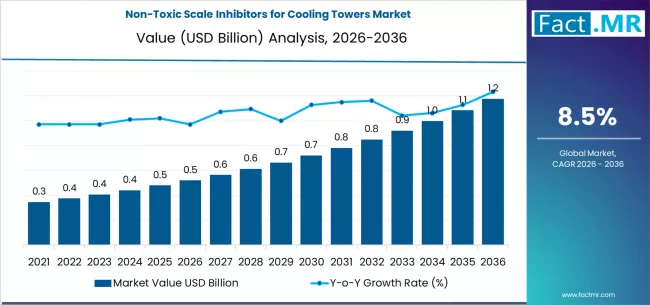
Non-toxic scale inhibitors for cooling towers market is projected to grow from USD 0.5 billion in 2026 to USD 1.2 billion by 2036, at a CAGR of 8.5%. Phosphonate-Free Organic Scale Inhibitors will dominate with a 34.0% market share, while hvac & commercial cooling systems will lead the end-use industry segment with a 30.0% share.
Non-Toxic Scale Inhibitors for Cooling Towers Market Forecast and Outlook 2026 to 2036
The global market for non-toxic scale inhibitors in cooling towers is projected to reach USD 1.18 billion by 2036. The market is valued at USD 0.52 billion in 2026 and is set to rise at a CAGR of 8.5% during the assessment period.
Key Takeaways from the Non-Toxic Scale Inhibitors for Cooling Towers Market
- Market Value for 2026: USD 0.52 Billion
- Market Value for 2036: USD 1.18 Billion
- Forecast CAGR (2026-2036): 8.5%
- Leading Inhibitor Chemistry Share (2026): Phosphonate-Free Organic Scale Inhibitors (34%)
- Leading End-Use Industry Share (2026): HVAC & Commercial Cooling Systems (30%)
- Leading Treatment Method Share (2026): Continuous Chemical Dosing (42%)
- Key Players in the Market: Ecolab Inc., Kemira Oyj., Solenis, BASF SE, Veolia Environnement S.A.
By inhibitor chemistry, phosphonate-free organic scale inhibitors hold a leading 34% share. The end-use industry for HVAC and commercial cooling systems represents the dominant application at 30%. Continuous chemical dosing is the foremost treatment method, accounting for a 42% share.
This growth is propelled by stringent environmental regulations phasing out phosphonates and other persistent scale control chemicals, alongside a strong industry push toward sustainable water treatment. Building owners and industrial operators are adopting greener chemistries to minimize environmental discharge, reduce toxicity, and meet corporate sustainability targets.
Non-toxic scale inhibitors are essential for preventing mineral deposits like calcium carbonate and sulfate scales in recirculating cooling water systems without introducing harmful residues into blowdown water. Their performance ensures operational efficiency, energy savings, and equipment longevity while aligning with modern environmental stewardship principles.
Non-Toxic Scale Inhibitors for Cooling Towers Market
| Metric | Value |
|---|---|
| Market Value (2026) | USD 0.52 Billion |
| Market Forecast Value (2036) | USD 1.18 Billion |
| Forecast CAGR (2026-2036) | 8.5% |
Category
| Category | Segments |
|---|---|
| Inhibitor Chemistry | Phosphonate-Free Organic Scale Inhibitors, Biodegradable Polymer-Based Inhibitors, Green Chelating & Sequestration Agents, Bio-Based & Natural Extract Inhibitors, Other Eco-Friendly Scale Inhibitors |
| End-Use Industry | HVAC & Commercial Cooling Systems, Power Generation & Utilities, Petrochemical & Refineries, Manufacturing & Metal Processing, Food, Pharma & Other Industries |
| Treatment Method | Continuous Chemical Dosing, Solid/Tablet-Based Inhibitor Systems, Bio-Based Chelation & Dispersant Blends, Hybrid Green Scale Control Systems, Other Delivery Methods |
| Region | North America, Latin America, Western Europe, Eastern Europe, East Asia, South Asia & Pacific, MEA |
Segmental Analysis
By Inhibitor Chemistry, Which Segment is Leading the Shift Away from Traditional Phosphonates?
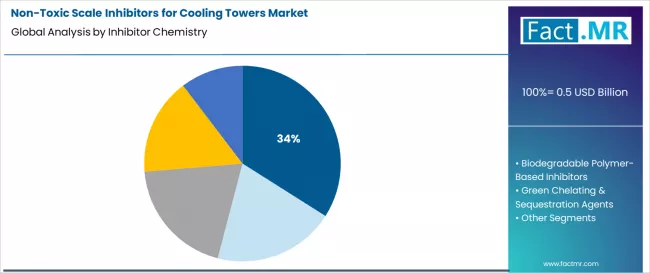
Phosphonate-free organic scale inhibitors lead the segment with a 34% share. This dominance is driven by regulatory restrictions on phosphorus discharge due to its role in eutrophication. These inhibitors utilize alternative organic polymers and carboxylic acids that effectively disrupt crystal growth and disperse scale-forming ions without environmental persistence.
They offer a direct, performance-comparable substitute for legacy phosphonate-based programs, making them the primary choice for facilities transitioning to compliant water treatment.
By End-Use Industry, Which Sector is Most Sensitive to Public and Regulatory Scrutiny?
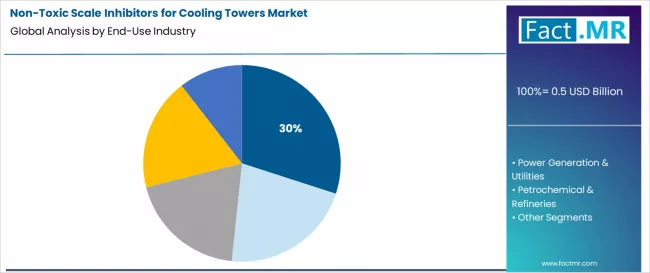
HVAC and commercial cooling systems represent the largest end-use industry with a 30% share. These systems are ubiquitous in office buildings, hospitals, data centers, and shopping malls, often located in urban areas with strict municipal sewer discharge limits.
The public visibility and environmental compliance requirements for these facilities drive early and widespread adoption of non-toxic treatment programs to avoid fines and support green building certifications like LEED.
By Treatment Method, Which Approach Ensures Precise and Consistent Control?
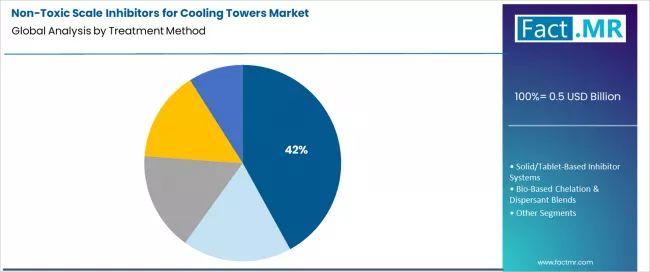
Continuous chemical dosing is the leading treatment method with a 42% share. This method involves the automated injection of liquid inhibitor into the cooling water recirculation line. It provides precise control over inhibitor concentration, allowing for optimal scale prevention while minimizing chemical usage.
Its compatibility with modern water management software and sensors makes it the preferred method for maintaining stringent control in both industrial and commercial systems.
What are the Drivers, Restraints, and Key Trends of the Non-Toxic Scale Inhibitors for Cooling Towers Market?
The primary market driver is the global implementation of stringent wastewater discharge regulations limiting nutrients like phosphorus and non-biodegradable chemicals. Regulations such as the EU Water Framework Directive and local municipal codes directly mandate the use of environmentally acceptable alternatives. Corporate net-zero water and sustainability goals further accelerate the replacement of traditional scale inhibitors with greener chemistries.
A significant market restraint is the higher cost of some advanced non-toxic inhibitors compared to conventional phosphonates. Achieving equivalent performance in very hard water or high-cycles-of-concentration systems can also require more sophisticated, and sometimes more expensive, blended formulations or increased dosing rates. Customer education on the total cost of ownership, which includes reduced environmental liability, is often necessary to overcome initial price resistance.
Key trends include the development of synergistic multi-component green formulations that combine scale inhibition with corrosion and microbiological control. There is growing use of predictive dosing technologies integrated with IoT sensors that monitor water parameters in real-time to optimize inhibitor feed. The market is also seeing a rise in solid tablet and slow-release systems for smaller cooling towers where liquid handling is impractical. Research into highly effective inhibitors derived from plant extracts continues to advance.
Analysis of the Non-Toxic Scale Inhibitors for Cooling Towers Market by Key Countries
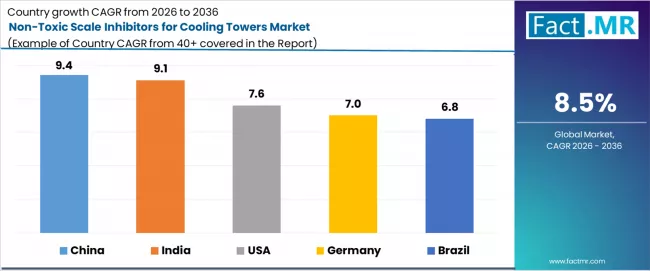
| Country | CAGR (2026-2036) |
|---|---|
| China | 9.40% |
| India | 9.10% |
| USA | 7.60% |
| Germany | 7.00% |
| Brazil | 6.80% |
How are China's Environmental Regulations and Urban Development Driving Demand?
China's leading CAGR of 9.40% is fueled by its sponge city initiatives and stringent national standards for wastewater discharge from industrial and commercial facilities. The massive expansion of urban infrastructure, including data centers and commercial complexes with large cooling systems, creates substantial demand. Regulatory enforcement pushing for phosphorus-free operations makes non-toxic scale inhibitors a compliance necessity.
What is the Impact of India's Rapid Commercial Construction and Water Stress?
India's 9.10% growth is underpinned by booming commercial real estate, IT parks, and industrial growth, all requiring extensive cooling systems. Increasing water stress drives the need for efficient cooling tower operation at high cycles of concentration, which in turn requires effective scale control. Growing environmental awareness and evolving discharge regulations are pushing the market toward greener, non-toxic inhibitor solutions.
How does the USA's Mature Regulatory and Green Building Market Influence Adoption?
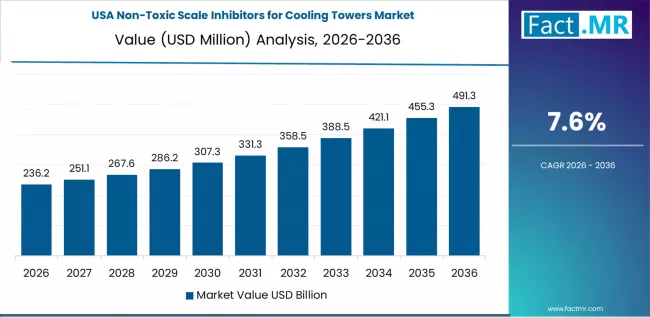
The USA's 7.60% growth is supported by well-established local sewer discharge limits and the widespread pursuit of LEED and other green building certifications. Large commercial property portfolios and data center operators proactively adopt non-toxic treatment programs to minimize regulatory risk, reduce their environmental footprint, and meet corporate ESG commitments, sustaining a steady demand for advanced products.
Why is Germany a Key Market for High-Efficiency Green Chemicals?
Germany's 7.00% CAGR reflects its strict adherence to EU chemical regulations and high engineering standards for building systems. German facility managers prioritize chemical programs that are both highly effective and environmentally benign. This demand for performance within a strict regulatory framework makes Germany a key market for innovative, high-efficiency non-toxic inhibitor technologies.
What Role does Brazil's Industrial and Commercial Growth Play?
Brazil's 6.80% growth is anchored in its expanding industrial base and commercial sector. Environmental licensing for new projects increasingly requires sustainable water management plans. The need to protect cooling systems in water-scarce regions while complying with environmental conditions fosters demand for effective, non-toxic scale control solutions.
Competitive Landscape of the Non-Toxic Scale Inhibitors for Cooling Towers Market
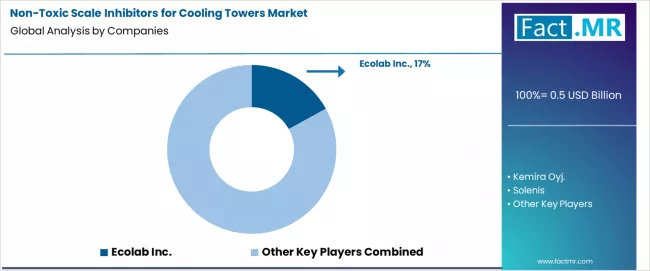
Global water treatment specialists who are reformulating their product lines to meet green chemistry demands dominate the competitive landscape. Leaders like Ecolab and Kemira compete on the strength of their R&D in biodegradable polymers and phosphonate-free chemistry.
Competition centers on providing proven performance data, achieving relevant environmental certifications (e.g., Green Seal, DfE), and offering integrated digital water management platforms that optimize the use of green inhibitors and demonstrate compliance and savings to customers.
Key Players in the Non-Toxic Scale Inhibitors for Cooling Towers Market
- Ecolab Inc.
- Kemira Oyj.
- Solenis
- BASF SE
- Veolia Environnement S.A.
Scope of Report
| Items | Values |
|---|---|
| Quantitative Units | USD Billion |
| Inhibitor Chemistry | Phosphonate-Free Organic, Biodegradable Polymers, Green Chelants, Bio-Based, Other |
| End-Use Industry | HVAC/Commercial, Power, Petrochemical, Manufacturing, Food/Pharma |
| Treatment Method | Continuous Dosing, Solid/Tablet Systems, Bio-Chelation Blends, Hybrid, Other |
| Key Countries | China, India, USA, Germany, Brazil |
| Key Companies | Ecolab Inc., Kemira Oyj., Solenis, BASF SE, Veolia Environnement S.A. |
| Additional Analysis | Analysis of scale inhibition mechanism (threshold effect, crystal distortion); environmental fate and biodegradability testing; compatibility with other green treatment chemicals (corrosion inhibitors, biocides); impact of water chemistry (hardness, alkalinity, pH) on green inhibitor performance; regulatory and certification landscape for cooling water chemicals. |
Market by Segments
-
Inhibitor Chemistry :
- Phosphonate-Free Organic Scale Inhibitors
- Biodegradable Polymer-Based Inhibitors
- Green Chelating & Sequestration Agents
- Bio-Based & Natural Extract Inhibitors
- Other Eco-Friendly Scale Inhibitors
-
End-Use Industry :
- HVAC & Commercial Cooling Systems
- Power Generation & Utilities
- Petrochemical & Refineries
- Manufacturing & Metal Processing
- Food, Pharma & Other Industries
-
Treatment Method :
- Continuous Chemical Dosing
- Solid/Tablet-Based Inhibitor Systems
- Bio-Based Chelation & Dispersant Blends
- Hybrid Green Scale Control Systems
- Other Delivery Methods
-
Region :
- North America
- USA
- Canada
- Latin America
- Brazil
- Mexico
- Argentina
- Rest of Latin America
- Western Europe
- Germany
- UK
- France
- Spain
- Italy
- BENELUX
- Rest of Western Europe
- Eastern Europe
- Russia
- Poland
- Czech Republic
- Rest of Eastern Europe
- East Asia
- China
- Japan
- South Korea
- Rest of East Asia
- South Asia & Pacific
- India
- ASEAN
- Australia
- Rest of South Asia & Pacific
- MEA
- Saudi Arabia
- UAE
- Turkiye
- Rest of MEA
- North America
Table of Content
- Executive Summary
- Global Market Outlook
- Demand to side Trends
- Supply to side Trends
- Technology Roadmap Analysis
- Analysis and Recommendations
- Market Overview
- Market Coverage / Taxonomy
- Market Definition / Scope / Limitations
- Market Background
- Market Dynamics
- Drivers
- Restraints
- Opportunity
- Trends
- Scenario Forecast
- Demand in Optimistic Scenario
- Demand in Likely Scenario
- Demand in Conservative Scenario
- Opportunity Map Analysis
- Product Life Cycle Analysis
- Supply Chain Analysis
- Investment Feasibility Matrix
- Value Chain Analysis
- PESTLE and Porter’s Analysis
- Regulatory Landscape
- Regional Parent Market Outlook
- Production and Consumption Statistics
- Import and Export Statistics
- Market Dynamics
- Global Market Analysis 2021 to 2025 and Forecast, 2026 to 2036
- Historical Market Size Value (USD Million) Analysis, 2021 to 2025
- Current and Future Market Size Value (USD Million) Projections, 2026 to 2036
- Y to o to Y Growth Trend Analysis
- Absolute $ Opportunity Analysis
- Global Market Pricing Analysis 2021 to 2025 and Forecast 2026 to 2036
- Global Market Analysis 2021 to 2025 and Forecast 2026 to 2036, By Inhibitor Chemistry
- Introduction / Key Findings
- Historical Market Size Value (USD Million) Analysis By Inhibitor Chemistry, 2021 to 2025
- Current and Future Market Size Value (USD Million) Analysis and Forecast By Inhibitor Chemistry, 2026 to 2036
- Phosphonate-Free Organic Scale Inhibitors
- Biodegradable Polymer-Based Inhibitors
- Green Chelating & Sequestration Agents
- Bio-Based & Natural Extract Inhibitors
- Other Eco-Friendly Scale Inhibitors
- Phosphonate-Free Organic Scale Inhibitors
- Y to o to Y Growth Trend Analysis By Inhibitor Chemistry, 2021 to 2025
- Absolute $ Opportunity Analysis By Inhibitor Chemistry, 2026 to 2036
- Global Market Analysis 2021 to 2025 and Forecast 2026 to 2036, By End-Use Industry
- Introduction / Key Findings
- Historical Market Size Value (USD Million) Analysis By End-Use Industry, 2021 to 2025
- Current and Future Market Size Value (USD Million) Analysis and Forecast By End-Use Industry, 2026 to 2036
- HVAC & Commercial Cooling Systems
- Power Generation & Utilities
- Petrochemical & Refineries
- Manufacturing & Metal Processing
- Food, Pharma & Other Industries
- HVAC & Commercial Cooling Systems
- Y to o to Y Growth Trend Analysis By End-Use Industry, 2021 to 2025
- Absolute $ Opportunity Analysis By End-Use Industry, 2026 to 2036
- Global Market Analysis 2021 to 2025 and Forecast 2026 to 2036, By Treatment Method
- Introduction / Key Findings
- Historical Market Size Value (USD Million) Analysis By Treatment Method, 2021 to 2025
- Current and Future Market Size Value (USD Million) Analysis and Forecast By Treatment Method, 2026 to 2036
- Continuous Chemical Dosing
- Solid/Tablet-Based Inhibitor Systems
- Bio-Based Chelation & Dispersant Blends
- Hybrid Green Scale Control Systems
- Other Delivery Methods
- Continuous Chemical Dosing
- Y to o to Y Growth Trend Analysis By Treatment Method, 2021 to 2025
- Absolute $ Opportunity Analysis By Treatment Method, 2026 to 2036
- Global Market Analysis 2021 to 2025 and Forecast 2026 to 2036, By Region
- Introduction
- Historical Market Size Value (USD Million) Analysis By Region, 2021 to 2025
- Current Market Size Value (USD Million) Analysis and Forecast By Region, 2026 to 2036
- North America
- Latin America
- Western Europe
- Eastern Europe
- East Asia
- South Asia and Pacific
- Middle East & Africa
- Market Attractiveness Analysis By Region
- North America Market Analysis 2021 to 2025 and Forecast 2026 to 2036, By Country
- Historical Market Size Value (USD Million) Trend Analysis By Market Taxonomy, 2021 to 2025
- Market Size Value (USD Million) Forecast By Market Taxonomy, 2026 to 2036
- By Country
- USA
- Canada
- Mexico
- By Inhibitor Chemistry
- By End-Use Industry
- By Treatment Method
- By Country
- Market Attractiveness Analysis
- By Country
- By Inhibitor Chemistry
- By End-Use Industry
- By Treatment Method
- Key Takeaways
- Latin America Market Analysis 2021 to 2025 and Forecast 2026 to 2036, By Country
- Historical Market Size Value (USD Million) Trend Analysis By Market Taxonomy, 2021 to 2025
- Market Size Value (USD Million) Forecast By Market Taxonomy, 2026 to 2036
- By Country
- Brazil
- Chile
- Rest of Latin America
- By Inhibitor Chemistry
- By End-Use Industry
- By Treatment Method
- By Country
- Market Attractiveness Analysis
- By Country
- By Inhibitor Chemistry
- By End-Use Industry
- By Treatment Method
- Key Takeaways
- Western Europe Market Analysis 2021 to 2025 and Forecast 2026 to 2036, By Country
- Historical Market Size Value (USD Million) Trend Analysis By Market Taxonomy, 2021 to 2025
- Market Size Value (USD Million) Forecast By Market Taxonomy, 2026 to 2036
- By Country
- Germany
- UK
- Italy
- Spain
- France
- Nordic
- BENELUX
- Rest of Western Europe
- By Inhibitor Chemistry
- By End-Use Industry
- By Treatment Method
- By Country
- Market Attractiveness Analysis
- By Country
- By Inhibitor Chemistry
- By End-Use Industry
- By Treatment Method
- Key Takeaways
- Eastern Europe Market Analysis 2021 to 2025 and Forecast 2026 to 2036, By Country
- Historical Market Size Value (USD Million) Trend Analysis By Market Taxonomy, 2021 to 2025
- Market Size Value (USD Million) Forecast By Market Taxonomy, 2026 to 2036
- By Country
- Russia
- Poland
- Hungary
- Balkan & Baltic
- Rest of Eastern Europe
- By Inhibitor Chemistry
- By End-Use Industry
- By Treatment Method
- By Country
- Market Attractiveness Analysis
- By Country
- By Inhibitor Chemistry
- By End-Use Industry
- By Treatment Method
- Key Takeaways
- East Asia Market Analysis 2021 to 2025 and Forecast 2026 to 2036, By Country
- Historical Market Size Value (USD Million) Trend Analysis By Market Taxonomy, 2021 to 2025
- Market Size Value (USD Million) Forecast By Market Taxonomy, 2026 to 2036
- By Country
- China
- Japan
- South Korea
- By Inhibitor Chemistry
- By End-Use Industry
- By Treatment Method
- By Country
- Market Attractiveness Analysis
- By Country
- By Inhibitor Chemistry
- By End-Use Industry
- By Treatment Method
- Key Takeaways
- South Asia and Pacific Market Analysis 2021 to 2025 and Forecast 2026 to 2036, By Country
- Historical Market Size Value (USD Million) Trend Analysis By Market Taxonomy, 2021 to 2025
- Market Size Value (USD Million) Forecast By Market Taxonomy, 2026 to 2036
- By Country
- India
- ASEAN
- Australia & New Zealand
- Rest of South Asia and Pacific
- By Inhibitor Chemistry
- By End-Use Industry
- By Treatment Method
- By Country
- Market Attractiveness Analysis
- By Country
- By Inhibitor Chemistry
- By End-Use Industry
- By Treatment Method
- Key Takeaways
- Middle East & Africa Market Analysis 2021 to 2025 and Forecast 2026 to 2036, By Country
- Historical Market Size Value (USD Million) Trend Analysis By Market Taxonomy, 2021 to 2025
- Market Size Value (USD Million) Forecast By Market Taxonomy, 2026 to 2036
- By Country
- Kingdom of Saudi Arabia
- Other GCC Countries
- Turkiye
- South Africa
- Other African Union
- Rest of Middle East & Africa
- By Inhibitor Chemistry
- By End-Use Industry
- By Treatment Method
- By Country
- Market Attractiveness Analysis
- By Country
- By Inhibitor Chemistry
- By End-Use Industry
- By Treatment Method
- Key Takeaways
- Key Countries Market Analysis
- USA
- Pricing Analysis
- Market Share Analysis, 2025
- By Inhibitor Chemistry
- By End-Use Industry
- By Treatment Method
- Canada
- Pricing Analysis
- Market Share Analysis, 2025
- By Inhibitor Chemistry
- By End-Use Industry
- By Treatment Method
- Mexico
- Pricing Analysis
- Market Share Analysis, 2025
- By Inhibitor Chemistry
- By End-Use Industry
- By Treatment Method
- Brazil
- Pricing Analysis
- Market Share Analysis, 2025
- By Inhibitor Chemistry
- By End-Use Industry
- By Treatment Method
- Chile
- Pricing Analysis
- Market Share Analysis, 2025
- By Inhibitor Chemistry
- By End-Use Industry
- By Treatment Method
- Germany
- Pricing Analysis
- Market Share Analysis, 2025
- By Inhibitor Chemistry
- By End-Use Industry
- By Treatment Method
- UK
- Pricing Analysis
- Market Share Analysis, 2025
- By Inhibitor Chemistry
- By End-Use Industry
- By Treatment Method
- Italy
- Pricing Analysis
- Market Share Analysis, 2025
- By Inhibitor Chemistry
- By End-Use Industry
- By Treatment Method
- Spain
- Pricing Analysis
- Market Share Analysis, 2025
- By Inhibitor Chemistry
- By End-Use Industry
- By Treatment Method
- France
- Pricing Analysis
- Market Share Analysis, 2025
- By Inhibitor Chemistry
- By End-Use Industry
- By Treatment Method
- India
- Pricing Analysis
- Market Share Analysis, 2025
- By Inhibitor Chemistry
- By End-Use Industry
- By Treatment Method
- ASEAN
- Pricing Analysis
- Market Share Analysis, 2025
- By Inhibitor Chemistry
- By End-Use Industry
- By Treatment Method
- Australia & New Zealand
- Pricing Analysis
- Market Share Analysis, 2025
- By Inhibitor Chemistry
- By End-Use Industry
- By Treatment Method
- China
- Pricing Analysis
- Market Share Analysis, 2025
- By Inhibitor Chemistry
- By End-Use Industry
- By Treatment Method
- Japan
- Pricing Analysis
- Market Share Analysis, 2025
- By Inhibitor Chemistry
- By End-Use Industry
- By Treatment Method
- South Korea
- Pricing Analysis
- Market Share Analysis, 2025
- By Inhibitor Chemistry
- By End-Use Industry
- By Treatment Method
- Russia
- Pricing Analysis
- Market Share Analysis, 2025
- By Inhibitor Chemistry
- By End-Use Industry
- By Treatment Method
- Poland
- Pricing Analysis
- Market Share Analysis, 2025
- By Inhibitor Chemistry
- By End-Use Industry
- By Treatment Method
- Hungary
- Pricing Analysis
- Market Share Analysis, 2025
- By Inhibitor Chemistry
- By End-Use Industry
- By Treatment Method
- Kingdom of Saudi Arabia
- Pricing Analysis
- Market Share Analysis, 2025
- By Inhibitor Chemistry
- By End-Use Industry
- By Treatment Method
- Turkiye
- Pricing Analysis
- Market Share Analysis, 2025
- By Inhibitor Chemistry
- By End-Use Industry
- By Treatment Method
- South Africa
- Pricing Analysis
- Market Share Analysis, 2025
- By Inhibitor Chemistry
- By End-Use Industry
- By Treatment Method
- USA
- Market Structure Analysis
- Competition Dashboard
- Competition Benchmarking
- Market Share Analysis of Top Players
- By Regional
- By Inhibitor Chemistry
- By End-Use Industry
- By Treatment Method
- Competition Analysis
- Competition Deep Dive
- Ecolab Inc.
- Overview
- Product Portfolio
- Profitability by Market Segments (Product/Age /Sales Channel/Region)
- Sales Footprint
- Strategy Overview
- Marketing Strategy
- Product Strategy
- Channel Strategy
- Kemira Oyj.
- Solenis
- BASF SE
- Veolia Environnement S.A.
- Ecolab Inc.
- Competition Deep Dive
- Assumptions & Acronyms Used
- Research Methodology
List Of Table
- Table 1: Global Market Value (USD Million) Forecast by Region, 2021 to 2036
- Table 2: Global Market Value (USD Million) Forecast by Inhibitor Chemistry, 2021 to 2036
- Table 3: Global Market Value (USD Million) Forecast by End-Use Industry, 2021 to 2036
- Table 4: Global Market Value (USD Million) Forecast by Treatment Method, 2021 to 2036
- Table 5: North America Market Value (USD Million) Forecast by Country, 2021 to 2036
- Table 6: North America Market Value (USD Million) Forecast by Inhibitor Chemistry, 2021 to 2036
- Table 7: North America Market Value (USD Million) Forecast by End-Use Industry, 2021 to 2036
- Table 8: North America Market Value (USD Million) Forecast by Treatment Method, 2021 to 2036
- Table 9: Latin America Market Value (USD Million) Forecast by Country, 2021 to 2036
- Table 10: Latin America Market Value (USD Million) Forecast by Inhibitor Chemistry, 2021 to 2036
- Table 11: Latin America Market Value (USD Million) Forecast by End-Use Industry, 2021 to 2036
- Table 12: Latin America Market Value (USD Million) Forecast by Treatment Method, 2021 to 2036
- Table 13: Western Europe Market Value (USD Million) Forecast by Country, 2021 to 2036
- Table 14: Western Europe Market Value (USD Million) Forecast by Inhibitor Chemistry, 2021 to 2036
- Table 15: Western Europe Market Value (USD Million) Forecast by End-Use Industry, 2021 to 2036
- Table 16: Western Europe Market Value (USD Million) Forecast by Treatment Method, 2021 to 2036
- Table 17: Eastern Europe Market Value (USD Million) Forecast by Country, 2021 to 2036
- Table 18: Eastern Europe Market Value (USD Million) Forecast by Inhibitor Chemistry, 2021 to 2036
- Table 19: Eastern Europe Market Value (USD Million) Forecast by End-Use Industry, 2021 to 2036
- Table 20: Eastern Europe Market Value (USD Million) Forecast by Treatment Method, 2021 to 2036
- Table 21: East Asia Market Value (USD Million) Forecast by Country, 2021 to 2036
- Table 22: East Asia Market Value (USD Million) Forecast by Inhibitor Chemistry, 2021 to 2036
- Table 23: East Asia Market Value (USD Million) Forecast by End-Use Industry, 2021 to 2036
- Table 24: East Asia Market Value (USD Million) Forecast by Treatment Method, 2021 to 2036
- Table 25: South Asia and Pacific Market Value (USD Million) Forecast by Country, 2021 to 2036
- Table 26: South Asia and Pacific Market Value (USD Million) Forecast by Inhibitor Chemistry, 2021 to 2036
- Table 27: South Asia and Pacific Market Value (USD Million) Forecast by End-Use Industry, 2021 to 2036
- Table 28: South Asia and Pacific Market Value (USD Million) Forecast by Treatment Method, 2021 to 2036
- Table 29: Middle East & Africa Market Value (USD Million) Forecast by Country, 2021 to 2036
- Table 30: Middle East & Africa Market Value (USD Million) Forecast by Inhibitor Chemistry, 2021 to 2036
- Table 31: Middle East & Africa Market Value (USD Million) Forecast by End-Use Industry, 2021 to 2036
- Table 32: Middle East & Africa Market Value (USD Million) Forecast by Treatment Method, 2021 to 2036
List Of Figures
- Figure 1: Global Market Pricing Analysis
- Figure 2: Global Market Value (USD Million) Forecast 2021 to 2036
- Figure 3: Global Market Value Share and BPS Analysis by Inhibitor Chemistry, 2026 and 2036
- Figure 4: Global Market Y to o to Y Growth Comparison by Inhibitor Chemistry, 2026 to 2036
- Figure 5: Global Market Attractiveness Analysis by Inhibitor Chemistry
- Figure 6: Global Market Value Share and BPS Analysis by End-Use Industry, 2026 and 2036
- Figure 7: Global Market Y to o to Y Growth Comparison by End-Use Industry, 2026 to 2036
- Figure 8: Global Market Attractiveness Analysis by End-Use Industry
- Figure 9: Global Market Value Share and BPS Analysis by Treatment Method, 2026 and 2036
- Figure 10: Global Market Y to o to Y Growth Comparison by Treatment Method, 2026 to 2036
- Figure 11: Global Market Attractiveness Analysis by Treatment Method
- Figure 12: Global Market Value (USD Million) Share and BPS Analysis by Region, 2026 and 2036
- Figure 13: Global Market Y to o to Y Growth Comparison by Region, 2026 to 2036
- Figure 14: Global Market Attractiveness Analysis by Region
- Figure 15: North America Market Incremental Dollar Opportunity, 2026 to 2036
- Figure 16: Latin America Market Incremental Dollar Opportunity, 2026 to 2036
- Figure 17: Western Europe Market Incremental Dollar Opportunity, 2026 to 2036
- Figure 18: Eastern Europe Market Incremental Dollar Opportunity, 2026 to 2036
- Figure 19: East Asia Market Incremental Dollar Opportunity, 2026 to 2036
- Figure 20: South Asia and Pacific Market Incremental Dollar Opportunity, 2026 to 2036
- Figure 21: Middle East & Africa Market Incremental Dollar Opportunity, 2026 to 2036
- Figure 22: North America Market Value Share and BPS Analysis by Country, 2026 and 2036
- Figure 23: North America Market Value Share and BPS Analysis by Inhibitor Chemistry, 2026 and 2036
- Figure 24: North America Market Y to o to Y Growth Comparison by Inhibitor Chemistry, 2026 to 2036
- Figure 25: North America Market Attractiveness Analysis by Inhibitor Chemistry
- Figure 26: North America Market Value Share and BPS Analysis by End-Use Industry, 2026 and 2036
- Figure 27: North America Market Y to o to Y Growth Comparison by End-Use Industry, 2026 to 2036
- Figure 28: North America Market Attractiveness Analysis by End-Use Industry
- Figure 29: North America Market Value Share and BPS Analysis by Treatment Method, 2026 and 2036
- Figure 30: North America Market Y to o to Y Growth Comparison by Treatment Method, 2026 to 2036
- Figure 31: North America Market Attractiveness Analysis by Treatment Method
- Figure 32: Latin America Market Value Share and BPS Analysis by Country, 2026 and 2036
- Figure 33: Latin America Market Value Share and BPS Analysis by Inhibitor Chemistry, 2026 and 2036
- Figure 34: Latin America Market Y to o to Y Growth Comparison by Inhibitor Chemistry, 2026 to 2036
- Figure 35: Latin America Market Attractiveness Analysis by Inhibitor Chemistry
- Figure 36: Latin America Market Value Share and BPS Analysis by End-Use Industry, 2026 and 2036
- Figure 37: Latin America Market Y to o to Y Growth Comparison by End-Use Industry, 2026 to 2036
- Figure 38: Latin America Market Attractiveness Analysis by End-Use Industry
- Figure 39: Latin America Market Value Share and BPS Analysis by Treatment Method, 2026 and 2036
- Figure 40: Latin America Market Y to o to Y Growth Comparison by Treatment Method, 2026 to 2036
- Figure 41: Latin America Market Attractiveness Analysis by Treatment Method
- Figure 42: Western Europe Market Value Share and BPS Analysis by Country, 2026 and 2036
- Figure 43: Western Europe Market Value Share and BPS Analysis by Inhibitor Chemistry, 2026 and 2036
- Figure 44: Western Europe Market Y to o to Y Growth Comparison by Inhibitor Chemistry, 2026 to 2036
- Figure 45: Western Europe Market Attractiveness Analysis by Inhibitor Chemistry
- Figure 46: Western Europe Market Value Share and BPS Analysis by End-Use Industry, 2026 and 2036
- Figure 47: Western Europe Market Y to o to Y Growth Comparison by End-Use Industry, 2026 to 2036
- Figure 48: Western Europe Market Attractiveness Analysis by End-Use Industry
- Figure 49: Western Europe Market Value Share and BPS Analysis by Treatment Method, 2026 and 2036
- Figure 50: Western Europe Market Y to o to Y Growth Comparison by Treatment Method, 2026 to 2036
- Figure 51: Western Europe Market Attractiveness Analysis by Treatment Method
- Figure 52: Eastern Europe Market Value Share and BPS Analysis by Country, 2026 and 2036
- Figure 53: Eastern Europe Market Value Share and BPS Analysis by Inhibitor Chemistry, 2026 and 2036
- Figure 54: Eastern Europe Market Y to o to Y Growth Comparison by Inhibitor Chemistry, 2026 to 2036
- Figure 55: Eastern Europe Market Attractiveness Analysis by Inhibitor Chemistry
- Figure 56: Eastern Europe Market Value Share and BPS Analysis by End-Use Industry, 2026 and 2036
- Figure 57: Eastern Europe Market Y to o to Y Growth Comparison by End-Use Industry, 2026 to 2036
- Figure 58: Eastern Europe Market Attractiveness Analysis by End-Use Industry
- Figure 59: Eastern Europe Market Value Share and BPS Analysis by Treatment Method, 2026 and 2036
- Figure 60: Eastern Europe Market Y to o to Y Growth Comparison by Treatment Method, 2026 to 2036
- Figure 61: Eastern Europe Market Attractiveness Analysis by Treatment Method
- Figure 62: East Asia Market Value Share and BPS Analysis by Country, 2026 and 2036
- Figure 63: East Asia Market Value Share and BPS Analysis by Inhibitor Chemistry, 2026 and 2036
- Figure 64: East Asia Market Y to o to Y Growth Comparison by Inhibitor Chemistry, 2026 to 2036
- Figure 65: East Asia Market Attractiveness Analysis by Inhibitor Chemistry
- Figure 66: East Asia Market Value Share and BPS Analysis by End-Use Industry, 2026 and 2036
- Figure 67: East Asia Market Y to o to Y Growth Comparison by End-Use Industry, 2026 to 2036
- Figure 68: East Asia Market Attractiveness Analysis by End-Use Industry
- Figure 69: East Asia Market Value Share and BPS Analysis by Treatment Method, 2026 and 2036
- Figure 70: East Asia Market Y to o to Y Growth Comparison by Treatment Method, 2026 to 2036
- Figure 71: East Asia Market Attractiveness Analysis by Treatment Method
- Figure 72: South Asia and Pacific Market Value Share and BPS Analysis by Country, 2026 and 2036
- Figure 73: South Asia and Pacific Market Value Share and BPS Analysis by Inhibitor Chemistry, 2026 and 2036
- Figure 74: South Asia and Pacific Market Y to o to Y Growth Comparison by Inhibitor Chemistry, 2026 to 2036
- Figure 75: South Asia and Pacific Market Attractiveness Analysis by Inhibitor Chemistry
- Figure 76: South Asia and Pacific Market Value Share and BPS Analysis by End-Use Industry, 2026 and 2036
- Figure 77: South Asia and Pacific Market Y to o to Y Growth Comparison by End-Use Industry, 2026 to 2036
- Figure 78: South Asia and Pacific Market Attractiveness Analysis by End-Use Industry
- Figure 79: South Asia and Pacific Market Value Share and BPS Analysis by Treatment Method, 2026 and 2036
- Figure 80: South Asia and Pacific Market Y to o to Y Growth Comparison by Treatment Method, 2026 to 2036
- Figure 81: South Asia and Pacific Market Attractiveness Analysis by Treatment Method
- Figure 82: Middle East & Africa Market Value Share and BPS Analysis by Country, 2026 and 2036
- Figure 83: Middle East & Africa Market Value Share and BPS Analysis by Inhibitor Chemistry, 2026 and 2036
- Figure 84: Middle East & Africa Market Y to o to Y Growth Comparison by Inhibitor Chemistry, 2026 to 2036
- Figure 85: Middle East & Africa Market Attractiveness Analysis by Inhibitor Chemistry
- Figure 86: Middle East & Africa Market Value Share and BPS Analysis by End-Use Industry, 2026 and 2036
- Figure 87: Middle East & Africa Market Y to o to Y Growth Comparison by End-Use Industry, 2026 to 2036
- Figure 88: Middle East & Africa Market Attractiveness Analysis by End-Use Industry
- Figure 89: Middle East & Africa Market Value Share and BPS Analysis by Treatment Method, 2026 and 2036
- Figure 90: Middle East & Africa Market Y to o to Y Growth Comparison by Treatment Method, 2026 to 2036
- Figure 91: Middle East & Africa Market Attractiveness Analysis by Treatment Method
- Figure 92: Global Market - Tier Structure Analysis
- Figure 93: Global Market - Company Share Analysis
- FAQs -
How big is the non-toxic scale inhibitors for cooling towers market in 2026?
The global non-toxic scale inhibitors for cooling towers market is estimated to be valued at USD 0.5 billion in 2026.
What will be the size of non-toxic scale inhibitors for cooling towers market in 2036?
The market size for the non-toxic scale inhibitors for cooling towers market is projected to reach USD 1.2 billion by 2036.
How much will be the non-toxic scale inhibitors for cooling towers market growth between 2026 and 2036?
The non-toxic scale inhibitors for cooling towers market is expected to grow at a 8.5% CAGR between 2026 and 2036.
What are the key product types in the non-toxic scale inhibitors for cooling towers market?
The key product types in non-toxic scale inhibitors for cooling towers market are phosphonate-free organic scale inhibitors, biodegradable polymer-based inhibitors, green chelating & sequestration agents, bio-based & natural extract inhibitors and other eco-friendly scale inhibitors.
Which end-use industry segment to contribute significant share in the non-toxic scale inhibitors for cooling towers market in 2026?
In terms of end-use industry, hvac & commercial cooling systems segment to command 30.0% share in the non-toxic scale inhibitors for cooling towers market in 2026.