- Base Value(2025): 1.9 Bn
- Estimated Value(2026): 2.1 Bn
- Forecast Value (2036): 5.8 Bn
- CAGR (2026 - 2036): 10.7%
Non-Phthalate Bio-Plasticizers Market Forecast and Outlook 2026 to 2036
In 2025, the non-phthalate bio-plasticizers market was valued at USD 1.9 billion. Based on Fact.MR analysis, demand for non-phthalate bio-plasticizers is estimated to grow to USD 2.1 billion in 2026 and USD 5.8 billion by 2036. Fact.MR projects a CAGR of 10.7% during the forecast period.
The absolute dollar growth from 2026 to 2036 represents an incremental gain of USD 3.7 billion, a transformational expansion driven by a mandatory product substitution cycle across PVC compounding, rubber, and adhesives manufacturing in regulated markets worldwide. Growth is sustained by the scale of the installed base of phthalate-dependent polymer processing that must convert to compliant alternatives under EU REACH authorization deadlines and equivalent U.S. and Asian chemical management programs.
The non-phthalate bio-plasticizers substitution cycle is advancing fastest in markets with active REACH authorization expiry. DEHP, DBP, BBP, and DIBP were placed on the REACH Authorization List under Annex XIV, compelling European processors to seek authorized alternatives or cease use in regulated applications. This regulatory mechanism has converted what would have been a gradual commercial transition into a time-bounded compliance obligation that benefits certified bio-based plasticizer producers across the forecast period.
Growth rates vary significantly between regulatory-advanced and emerging markets. China leads with a 14.5% CAGR, driven by domestic chemical safety reforms under the New Chemicals Regulation, rapid expansion of PVC construction materials production, and OEM export compliance requirements from European automotive buyers. The United States follows at 13.8%, anchored by EPA TSCA phthalate restrictions and consumer goods retailer sustainability procurement standards. Germany records 12.5%, driven by REACH authorization deadlines, the concentration of European PVC and polymer processing infrastructure, and advanced adoption of citrate plasticizers in medical and food-contact applications. South Korea posts 11.2%, supported by K-REACH phthalate restrictions mirroring EU frameworks and strong electronics and automotive sector demand for compliant polymer compounds. Mature European markets generate structured regulatory-conversion demand rather than volume-driven growth, with the primary constraint being the pace of re-formulation qualification approval by end-use OEMs.
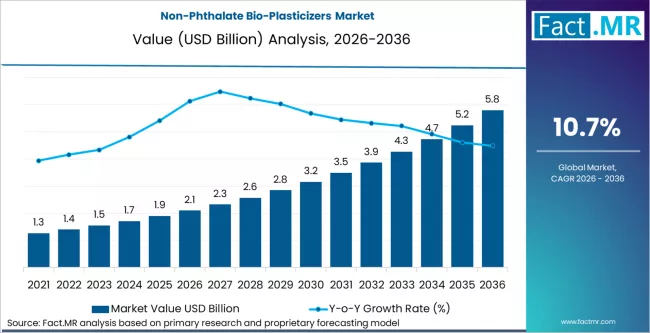
Non Phthalate Bio Plasticizers Market Market Value Analysis | Source: Fact.MR
Market Definition
The non-phthalate bio-plasticizers market covers citrate esters, epoxidized vegetable oil derivatives such as epoxidized soy oil, adipate esters, and other bio-based chemical compounds used as flexible additives in polyvinyl chloride compounds, rubber formulations, and adhesive systems. Their primary industrial function is to improve the flexibility, durability, and process ability of polymer matrices without the endocrine-disrupting properties associated with legacy phthalate plasticizers. Key end-uses include flexible PVC flooring, cables, medical devices, automotive interior components, and consumer goods requiring compliant polymer compounds.
Market Inclusions
The report covers global and regional market size forecasts from 2026 to 2036, segmented by product type, application, and end-use industry. It evaluates REACH authorization compliance timelines, bio-based content certification, pricing dynamics of citrate and epoxidized oil alternatives relative to legacy phthalates, competitive positioning of leading bio-plasticizer producers, and adoption rates across construction, automotive, and consumer goods sectors.
Market Exclusions
The scope excludes legacy phthalate plasticizers including DEHP, DBP, BBP, and DIBP unless they are part of a documented substitution or reformulation program. It also omits finished polymer products incorporating bio-plasticizers such as flexible PVC flooring panels, automotive trim components, and consumer goods, focusing strictly on the bio-plasticizer compound itself and its immediate industrial supply chain to polymer compounders and formulators.
Research Methodology
- Primary Research: Primary research involved structured interviews with plasticizer procurement directors at major PVC and rubber compounders, sustainability and compliance managers at automotive OEM tier-one suppliers, regulatory affairs specialists at European and U.S. chemical industry associations, and bio-based feedstock procurement managers at citrate and epoxidized oil producers across China, the United States, Germany, and South Korea.
- Desk Research: Desk research synthesized data from European Chemicals Agency REACH Authorisation List dossiers and restriction proposals, U.S. EPA TSCA phthalate chemical action plan publications, national environmental agency chemical registration data in China and South Korea, corporate sustainability and product compliance disclosures from Lanxess AG, Eastman Chemical Company, and Roquette Freres, and industry association bio-based plasticizer adoption reports from the European Bioplastics association.
- Market-Sizing and Forecasting: Market sizing employed a hybrid top-down and bottom-up approach, combining total addressable phthalate plasticizer volume by end-use sector and geography with conversion rate estimates driven by regulatory deadline timelines, validated against disclosed specialty chemical segment revenues from leading bio-plasticizer producers and benchmarked against European Chemicals Agency authorization expiry calendars and national chemical restriction implementation schedules.
- Data Validation and Update Cycle: Outputs were cross-validated against disclosed specialty chemicals and bio-based product revenues from Lanxess AG, Jungbunzlauer AG, and Vertellus Holdings, reconciled semi-annually with ECHA authorization decision updates and EPA TSCA regulatory action publications, and updated annually with national chemical registration agency enforcement data and automotive and construction OEM supply chain compliance announcements in key markets.
Summary
Market Definition
- The non-phthalate bio-plasticizers market encompasses citrate esters, epoxidized soy oil, adipate esters, and other bio-derived plasticizing compounds used as REACH-compliant and phthalate-free additives in flexible PVC compounds, rubber processing, and adhesive formulations across construction, automotive, and consumer goods manufacturing supply chains globally.
Demand Drivers
- The European Chemicals Agency's REACH Authorisation List has placed key phthalate plasticizers including DEHP, DBP, BBP, and DIBP under authorization obligations that require European PVC compounders and processors to demonstrate the absence of suitable alternatives or obtain formal chemical use authorization, creating a structured and time-bounded market conversion to compliant bio-based plasticizers.
- China's National Registration Centre for Chemicals has implemented the New Chemicals Environmental Management Regulation that increases restrictions on endocrine-disrupting chemicals in polymer processing, while export-oriented Chinese PVC and rubber manufacturers are proactively converting to non-phthalate alternatives to meet European and North American buyer material compliance standards.
- Major consumer goods retailers and electronics OEMs in North America and Europe are embedding phthalate-free material requirements into supplier codes of conduct and raw material compliance specifications, creating demand pull from finished goods brands that extends upstream to polymer compounders and their plasticizer suppliers well ahead of formal regulatory deadlines.
Key Segments Analyzed
- By product type, citrates hold the leading 35% share, reflecting their established performance profile in flexible PVC, medical device, and food-contact polymer applications where regulatory authorities specifically accept citrate chemistry as a demonstrated safe alternative to restricted phthalates.
- By application, PVC compounds account for the dominant 52% share, driven by the breadth of flexible PVC applications in construction, cable, flooring, and medical sectors where phthalate restrictions are most active and bio-based plasticizer conversion is most structurally mandated.
- By geography, Asia Pacific contributes the largest share of volume-driven growth, with China recording the fastest country-level CAGR at 14.5%, while Europe generates the highest regulatory-driven conversion premiums driven by REACH authorization deadlines and the concentration of PVC processing infrastructure.
Analyst Opinion at FACT.MR
- Shambhu Nath Jha, Principal Consultant at Fact.MR, opines, 'CXOs will find this report essential for understanding how REACH Authorisation List expiry deadlines for key phthalate plasticizers are creating a large, time-bounded conversion pipeline for certified bio-based citrate and epoxidized oil alternatives across the PVC compounding, rubber, and adhesives sectors, and which product platforms, application segments, and geographic markets offer the highest revenue quality and contract durability through the forecast period.'
Strategic Implications / Executive Takeaways
- Bio-based plasticizer producers should prioritize accelerating product qualification with tier-one automotive and construction OEM approved supplier lists in Germany, the United States, and China, as qualification timelines of eighteen to thirty-six months mean that producers not yet on OEM approved lists will miss the peak regulatory conversion window between 2026 and 2030.
- PVC compounders transitioning from phthalate to bio-based plasticizers should evaluate epoxidized soy oil as a blending component alongside citrates in standard flexibility applications, as the combination can reduce the cost premium of full citrate substitution while maintaining REACH compliance, improving the commercial feasibility of transition for cost-sensitive construction applications.
- Specialty chemical distributors serving Asian polymer processors should invest in technical service capabilities around bio-plasticizer application development, as Chinese and South Korean compounders transitioning under export compliance pressure require hands-on formulation support to qualify new plasticizer chemistries within existing production processes, creating service revenue opportunities that pure product distribution cannot capture.
Methodology
- Market size estimates were based on addressable phthalate plasticizer volumes by sector combined with regulatory-driven conversion rate projections, cross-checked against specialty chemical revenue disclosures from leading bio-plasticizer producers.
- Segment analysis used ECHA REACH Authorisation List dossiers, EPA TSCA phthalate restriction data, and automotive and construction OEM material compliance program disclosures by market.
- Country forecasts were validated using national chemical registration agency data, export compliance requirement timelines, and corporate investment and product launch announcements across key bio-plasticizer producing companies.
Segmental Analysis
Non-Phthalate Bio-Plasticizers Market Analysis by Product Type
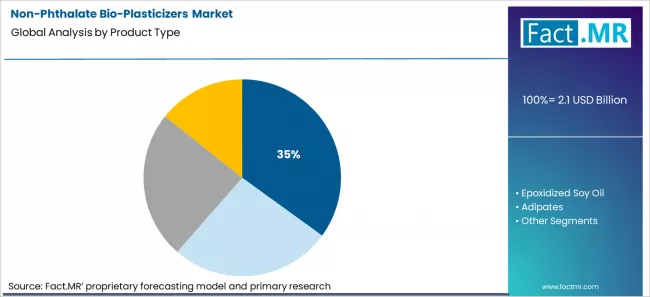
Non Phthalate Bio Plasticizers Market Analysis By Product Type | Source: Fact.MR
Citrates are projected to hold 35% share in 2026. They are widely accepted for medical-grade PVC, food-contact films, and toys, supported by EFSA and FDA approvals that reduce compliance risk.
- Jungbunzlauer Citrate Capacity Expansion: The company expanded bio-based specialty production in Austria to meet growing European demand. [5]
- Roquette Bio-Based Plasticizer Development: Roquette advanced citrate-based plasticizers derived from fermentation, targeting food and medical PVC markets. [6]
- Epoxidized Soy Oil Growth: Holding 28% share, this segment is expanding quickly due to its lower cost premium and suitability for construction-grade PVC. [1]
Non-Phthalate Bio-Plasticizers Market Analysis by Application
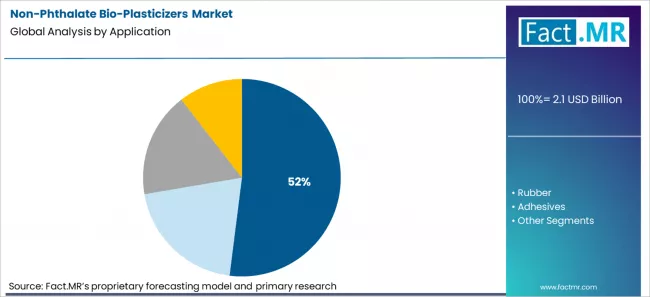
Non Phthalate Bio Plasticizers Market Analysis By Application | Source: Fact.MR
PVC compounds account for 52% share in 2026, as flexible PVC is the largest and most directly regulated plasticizer application globally. Construction, cable, healthcare, and consumer goods all rely heavily on compliant plasticizers.
- Lanxess Polymer Additives Investment: Lanxess continues investing in REACH-compliant plasticizer alternatives for PVC compounding. [7]
- Vertellus Citrate Technology: Vertellus commercialized FDA- and EU-approved citrate plasticizers for sensitive applications. [8]
- Rubber Segment Expansion: Rubber applications hold 25% share, with automotive and industrial suppliers transitioning to bio-based alternatives under OEM compliance requirements. [3]
Drivers, Restraints, and Opportunities
Fact.MR analysis shows that the non-phthalate bio-plasticizers market, valued at USD 1.9 billion, has expanded largely due to regulatory pressure in Europe and brand-led substitution in North America. Phthalates were long favored for flexible PVC and rubber because of their low cost and reliable performance. However, growing evidence linking phthalates to endocrine disruption led to restrictions under EU REACH, U.S. EPA TSCA, and other consumer safety rules, triggering a structured shift toward safer alternatives.
The main challenge is cost. Bio-based options such as citrate esters and epoxidized soy oil are 25 to 45 percent more expensive than conventional phthalates due to feedstock and scale limitations. Where regulations impose deadlines, buyers absorb the added cost. In less regulated markets, price sensitivity slows adoption. Adipates provide a middle-ground solution in performance and cost.
- REACH Authorisation Expiry Deadlines: Annex XIV listings for DEHP, DBP, BBP, and DIBP are forcing European PVC users to transition to compliant alternatives, creating a steady substitution pipeline. [2]
- China Export Compliance Cascade: Chinese manufacturers supplying Europe and North America are converting to non-phthalate formulations to meet customer requirements. [3]
- Consumer Goods Brand Procurement Standards: Global brands are embedding phthalate-free policies into supplier contracts, expanding demand beyond regulatory mandates. [4]
Regional Analysis
The non-phthalate bio-plasticizers market is analyzed across North America, Europe, Asia Pacific, Latin America, and Middle East and Africa. Regional demand patterns reflect the maturity of phthalate restriction enforcement, the concentration of flexible PVC and rubber processing infrastructure, and the depth of OEM supply chain compliance requirements by industry sector. The full report offers detailed market attractiveness analysis comparing regulatory conversion timelines, bio-based feedstock availability, and competitive intensity by region.
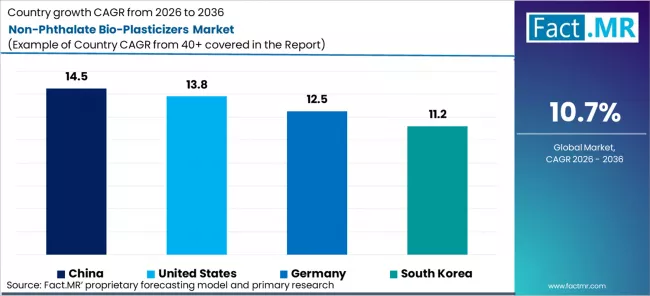
Non Phthalate Bio Plasticizers Market Cagr Analysis By Country | Source: Fact.MR
| Country | CAGR% |
|---|---|
| China | 14.5% |
| United States | 13.8% |
| Germany | 12.5% |
| South Korea | 11.2% |
Source: Fact.MR analysis. Updated Feb 23, 2026
Source: Fact.MR (FACT.MR) analysis, based on proprietary forecasting model and primary research
Asia Pacific Non-Phthalate Bio-Plasticizers Market Analysis
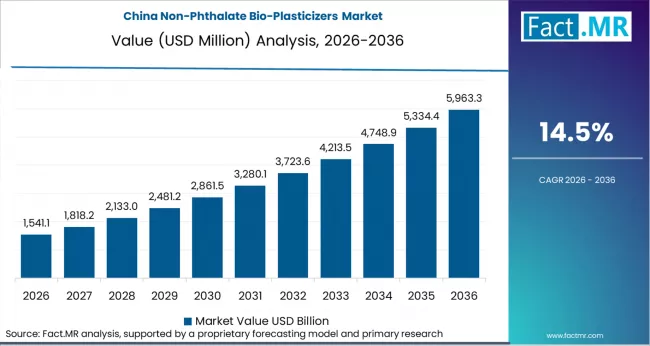
Non Phthalate Bio Plasticizers Market Country Value Analysis | Source: Fact.MR
Asia Pacific is the fastest-growing region for non-phthalate bio-plasticizers. China plays a central role as the world’s largest PVC producer and a major export manufacturing base. Many regional polymer processors must meet European and North American compliance standards, which is accelerating the shift to bio-based plasticizers. Regional producers and oleo chemical companies are expanding capacity to serve both export and domestic demand.
- China: Demand in China is projected to grow at 14.5% CAGR through 2036. Growth is driven by tighter domestic chemical management rules and export compliance pressure. Manufacturers supplying EU and U.S. markets must meet REACH SVHC requirements, prompting proactive conversion to phthalate-free formulations. Major PVC flooring and flexible polymer producers have already launched certified compliant product lines.
- South Korea: Demand is forecast to expand at 11.2% CAGR. K-REACH regulations and updated hazardous substance classifications are tightening restrictions on phthalates. Automotive and electronics supply chains led by Hyundai and Kia are enforcing phthalate-free standards across tier suppliers, creating structured demand for compliant plasticizers.
FACT.MR’s Asia Pacific analysis covers China, Japan, South Korea, India, and ASEAN, with detailed regulatory and export compliance insights.
Europe Non-Phthalate Bio-Plasticizers Market Analysis
Europe is the regulatory benchmark for bio-plasticizer adoption. REACH authorization deadlines are driving mandatory substitution across PVC, rubber, and adhesive applications. The region’s specialty chemical producers are well positioned to supply compliant alternatives.
- Germany: Demand in Germany is projected to rise at 12.5% CAGR through 2036. The country is a major PVC processing and automotive hub. Updated risk assessment guidance and active industry compliance programs are accelerating the shift to bio-based plasticizers. German chemical producers are investing in innovation to support both domestic and export markets.
FACT.MR’s Europe coverage includes Germany, the United Kingdom, France, the Netherlands, and Nordic countries, with analysis of REACH timelines and OEM adoption trends.
North America Non-Phthalate Bio-Plasticizers Market Analysis
North America is shaped by regulatory enforcement and strong retailer-driven sustainability policies. EPA TSCA restrictions and consumer safety rules form the regulatory backbone, while major retailers and brands demand phthalate-free materials in private-label products.
- United States: Demand is projected to grow at 13.8% CAGR through 2036. Federal regulations and retailer chemical policies are pushing PVC compounders and product manufacturers to transition away from DEHP and related phthalates. Strong domestic bio-based feedstock availability supports competitive citrate and adipate production.
FACT.MR’s North America analysis covers the United States and Canada, including regulatory timelines, retailer standards, and competitive positioning of key producers.
Competitive Aligners for Market Players
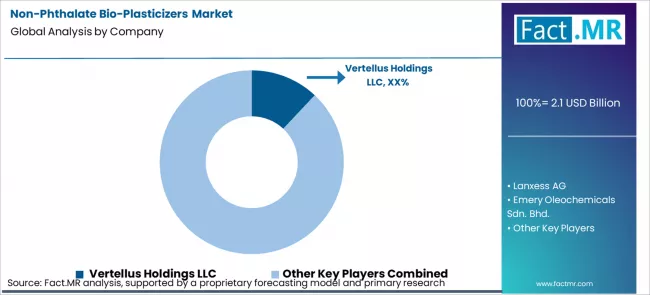
Non Phthalate Bio Plasticizers Market Analysis By Company | Source: Fact.MR
The global non-phthalate bio-plasticizers market is moderately concentrated at the top tier. Leading companies such as Vertellus Holdings, Lanxess AG, Emery Oleo chemicals, Jungbunzlauer, Roquette Freres, and Eastman Chemical account for roughly 50 to 60 percent of certified bio-based plasticizer capacity worldwide. Below them, the market includes many regional specialty chemical producers and distributors competing on pricing, niche certifications, and local feedstock advantages. At the leadership level, competition revolves around regulatory approvals across multiple regions, verified bio-based content, and strong technical support for OEM qualification.
Producers with vertically integrated bio-based feedstock supply enjoy clear structural advantages. Jungbunzlauer benefits from its in-house citric acid fermentation platform, which stabilizes input costs for citrate plasticizers. Roquette leverages its agricultural and fermentation capabilities, while Emery Oleo chemicals draws on oleo chemical feedstock integration and a strong Asian manufacturing base to remain cost competitive in fast-growing markets.
Large PVC compounders typically approve two or three suppliers per application to ensure supply security and maintain pricing leverage. Automotive and medical qualification programs are lengthy and demanding, which protects established suppliers. Technical collaboration with OEM engineering teams is becoming a key differentiator in winning long-term contracts.
Key Players
- Vertellus Holdings LLC
- Lanxess AG
- Emery Oleochemicals Sdn. Bhd.
- Jungbunzlauer AG
- Roquette Freres S.A.
Bibliography
- [1] European Chemicals Agency, REACH Candidate List of Substances of Very High Concern for Authorisation, updated January 2024.
- [2] European Chemicals Agency, Authorisation List under REACH Annex XIV, updated February 2024.
- [3] Ministry of Ecology and Environment of China, New Chemicals Environmental Management Regulation (MEE Order No. 12), January 2021.
- [4] U.S. Consumer Product Safety Commission, Phthalates in Children's Products Regulation under CPSIA, June 2018 (updated guidance 2023).
- [5] Jungbunzlauer AG, Corporate Sustainability and Product Portfolio Report 2023, March 2024.
- [6] Roquette Freres S.A., Annual and Sustainability Report 2023, April 2024.
- [7] Lanxess AG, Annual Report 2023, March 2024.
- [8] Vertellus Holdings LLC, Citroflex Citrate Plasticizers Product Compliance Documentation, 2023.
- [9] Emery Oleochemicals, Corporate Profile and Bio-Based Chemical Capacity Disclosure 2023, November 2023.
This Report Addresses
- Market intelligence for strategic planning with analysis of non-phthalate bio-plasticizer market evolution from voluntary bio-based adoption toward regulatory-mandated REACH and TSCA phthalate replacement across PVC compounding, rubber, adhesives, and construction, automotive, and consumer goods manufacturing sectors globally.
- Market size and forecast showing global valuation of USD 2.1 billion in 2026 and projected USD 5.8 billion by 2036 at a CAGR of 10.7%.
- Growth opportunity mapping across bio-based citrate ester platforms for medical and food-contact PVC applications, epoxidized soy oil secondary plasticizer demand in construction-grade flexible PVC, and adipate ester adoption in rubber and cable manufacturing undergoing REACH-driven phthalate substitution.
- Segment and regional forecasts covering all major countries with product type, application, and end-use industry breakdowns including construction, automotive, and consumer goods sector plasticizer demand analysis.
- Competition strategy assessment of leading non-phthalate bio-plasticizer producers including bio-based feedstock integration depth, multi-market regulatory certification status, OEM qualification relationships, and production capacity investment programs.
- Regulatory compliance tracking of ECHA REACH Authorisation List phthalate sunset dates, EPA TSCA chemical action plan enforcement milestones, K-REACH South Korea restriction updates, China New Chemicals Regulation implementation timelines, and consumer product safety phthalate standards in key markets.
- Technology adoption analysis covering citrate ester formulation innovations for temperature-sensitive PVC applications, epoxidized oil compatibility optimization in mixed plasticizer systems, bio-based content certification developments, and OEM approved supplier list qualification timelines for non-phthalate alternatives.
- Report delivery in Excel, PowerPoint, and PDF formats with fully validated data, primary research evidence, and verified regulatory and company source documentation.
Segmentation
Scope of Report
| Items | Values |
|---|---|
| Quantitative Units | USD 2.1 billion (2026) to USD 5.8 billion (2036), at a CAGR of 10.7% |
| Market Definition | The non-phthalate bio-plasticizers market covers citrate esters, epoxidized soy oil, adipate esters, and other bio-based plasticizer compounds used as flexible PVC, rubber, and adhesive additives across construction, automotive, and consumer goods manufacturing industries as compliant substitutes for legacy phthalate plasticizers. |
| By Product Type | Citrates, Epoxidized Soy Oil, Adipates, Others |
| By Application | PVC Compounds, Rubber, Adhesives, Others |
| By End-Use Industry | Construction, Automotive, Consumer Goods, Others |
| Regions Covered | Asia Pacific, Europe, North America, Latin America, Middle East & Africa |
| Countries Covered | China, Japan, South Korea, Australia & New Zealand, India, ASEAN, Rest of Asia Pacific, Norway, Germany, United Kingdom, France, Spain, Netherlands, Nordics, Rest of Europe, United States, Canada, Mexico, Brazil, Chile, Ecuador, Rest of Latin America, Kingdom of Saudi Arabia, United Arab Emirates, South Africa, Turkey, Rest of Middle East & Africa |
| Key Companies Profiled | Vertellus Holdings LLC, Lanxess AG, Emery Oleochemicals Sdn. Bhd., Jungbunzlauer AG, Roquette Freres S.A. |
| Forecast Period | 2026 to 2036 |
| Approach | Hybrid top-down and bottom-up market modeling validated through primary interviews with plasticizer procurement managers, PVC compounders, construction materials formulators, and regulatory affairs specialists, supported by European Chemicals Agency restriction dossiers, EPA chemical action plan data, national construction materials standards, and corporate sustainability and investment disclosures. |
Source: Fact.MR analysis. Updated Feb 23, 2026
Non-Phthalate Bio-Plasticizers Market by Segment
-
By Product Type :
- Citrates
- Epoxidized Soy Oil
- Adipates
- Others
-
By Application :
- PVC Compounds
- Rubber
- Adhesives
- Others
-
By End-Use Industry :
- Construction
- Automotive
- Consumer Goods
- Others
-
Region :
- Asia Pacific
- China
- Japan
- South Korea
- Australia & New Zealand
- India
- ASEAN
- Rest of Asia Pacific
- Europe
- Norway
- Germany
- United Kingdom
- France
- Spain
- Netherlands
- Nordics
- Rest of Europe
- North America
- United States
- Canada
- Mexico
- Latin America
- Brazil
- Chile
- Ecuador
- Rest of Latin America
- Middle East & Africa
- Kingdom of Saudi Arabia
- United Arab Emirates
- South Africa
- Turkey
- Rest of Middle East & Africa
- Asia Pacific
Frequently Asked Questions
How large is the non-phthalate bio-plasticizers market in 2025?
What will the market size be in 2026?
What is the projected market size by 2036?
What is the expected CAGR for the forecast period 2026 to 2036?
Which Product Type segment holds the largest share?
Which Application segment dominates in 2026?
Which country shows the fastest CAGR?
What is the absolute dollar growth from 2026 to 2036?
How significant is the construction end-use industry?
Who worked on this report


Preview the report firsthand - request a free sample
Free SampleGet the brochure for pricing and purchase details
Download PDF