- Base Value(2025): 1.7 Bn
- Estimated Value(2026): 1.8 Bn
- Forecast Value (2036): 3.1 Bn
- CAGR (2026 - 2036): 5.6%
Non-silver Antimicrobial Wound Dressing Market Forecast and Outlook By Fact.MR
In 2025, the non-silver antimicrobial wound dressing market was valued at USD 1.7 billion. Based on Fact.MR analysis, demand for non-silver antimicrobial wound dressings is estimated to grow to USD 1.8 billion in 2026 and USD 3.1 billion by 2036. FACT.MR projects a CAGR of 5.6% during the forecast period.
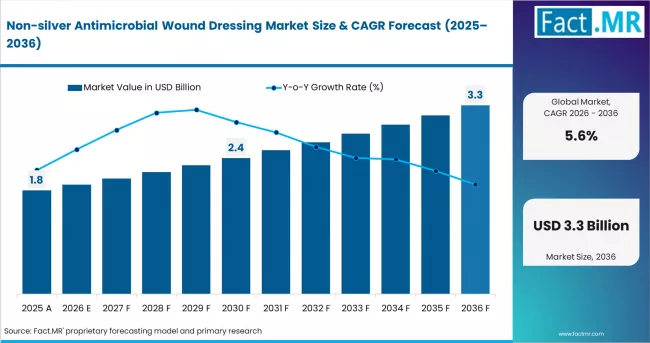
Non Silver Antimicrobial Wound Dressing Market Market Value Analysis | Source: Fact.MR
| Metric | Value |
|---|---|
| Estimated Value in 2026 | USD 1.8 billion |
| Forecast Value in 2036 | USD 3.1 billion |
| Forecast CAGR (2026 to 2036) | 5.6% |
Source: Fact.MR analysis. Updated May 6, 2026
Summary of the Non-silver Antimicrobial Wound Dressing Market
- Market Definition
- The market covers advanced wound dressings incorporating PHMB, iodine, honey, and chlorhexidine antimicrobial actives in foam, hydrocolloid, alginate, and film formats for chronic and acute wound management in hospital and community care settings globally.
- Demand Drivers
- Rising antimicrobial stewardship protocols in U.S. and European hospitals are accelerating PHMB and iodine dressing adoption as low-toxicity silver alternatives in structured wound care programmes.
- India's expanding diabetic population and growing hospital wound care infrastructure are driving procurement of advanced non-silver antimicrobial dressings through public health procurement channels.
- NHS England's updated wound care commissioning frameworks in 2024 are reinforcing evidence-based advanced dressing adoption across community nursing and district nurse-led care pathways.
- Key Segments Analyzed
- By Product Type: PHMB dressings lead with approximately 35% share in 2026, driven by broad-spectrum activity, low toxicity profile, and strong clinical preference across chronic wound management protocols.
- By Dressing Type: Foam dressings lead with approximately 40% share in 2026, driven by high exudate absorption capacity and suitability for chronic wound management in hospital and community settings.
- By Application: Chronic wounds lead with approximately 50% share in 2026, driven by high diabetic foot ulcer, pressure injury, and venous leg ulcer prevalence across ageing global populations.
- Analyst Opinion at FACT.MR
- Shambhu Nath Jha, Principal Consultant at Fact.MR, opines, 'CXOs will find that PHMB and iodine-based dressings are capturing disproportionate share as antimicrobial stewardship programmes displace silver formats. Clinical evidence and biofilm data are becoming procurement prerequisites. Brands with documented low-cytotoxicity and reimbursement alignment hold a clear structural advantage.'
- Strategic Implications
- Invest in clinical evidence for PHMB and iodine dressings. Focus on biofilm control and low cytotoxicity. This strengthens positioning in U.S. hospital programmes and NHS procurement.
- Develop home-care-friendly dressing formats with longer wear time. This supports growing use in India and China. Demand is rising with home-based wound care expansion.
- Expand reimbursement access for advanced dressings in Germany and the United Kingdom. This supports adoption in public healthcare systems.
- Methodology
- Market sizing is based on manufacturer revenues and shipment volumes by product type. Validated using 2024–2025 financials and hospital procurement data.
- Country analysis uses NHS data, U.S. Medicare records, India healthcare statistics, and disease prevalence insights.
- Forecasts consider antimicrobial resistance trends, reimbursement expansion, and wound care adoption. Supported by expert interviews with clinicians and procurement specialists.
Between 2026 and 2036, the market is projected to generate USD 1.3 billion in absolute opportunity. Growth is driven by rising chronic wound prevalence, expanding hospital and home care wound management programmes, and clinician-led substitution of silver dressings with PHMB and iodine formats. Expansion is moderated by reimbursement variability across emerging markets and higher unit costs of advanced dressing formats relative to standard gauze.
Wound dressing procurement in hospital and long-term care settings is increasingly guided by antimicrobial stewardship protocols. Major hospital networks and national health systems are consolidating preferred supplier lists, favouring brands with clinical evidence of biofilm disruption, documented low cytotoxicity profiles, and regulatory clearance for chronic and acute wound indications over undifferentiated lower-cost alternatives.
India leads country-level growth at 7.5% CAGR through 2036, driven by rapid healthcare infrastructure expansion, rising diabetic wound burden, and growing awareness of advanced wound care among clinical procurement teams. China follows at 7.1%, supported by government hospital capacity expansion and increasing chronic disease management budgets. The United States records 6.2%, anchored by strong hospital demand, antimicrobial stewardship programme adoption, and structured Medicare reimbursement for advanced wound dressings. Germany records 5.5%, supported by statutory health insurance reimbursement and an ageing population driving chronic wound prevalence. The United Kingdom records approximately 5.0%, underpinned by high NHS adoption of evidence-based advanced dressings in community and acute care settings.
Segmental Analysis
Non-silver Antimicrobial Wound Dressing Market Analysis by Product Type
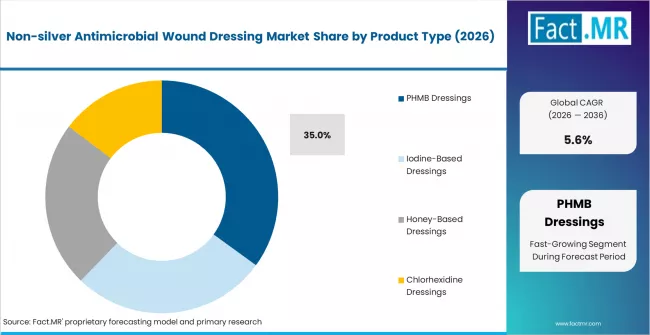
Non Silver Antimicrobial Wound Dressing Market Analysis By Product Type | Source: Fact.MR
Based on FACT.MR's non-silver antimicrobial wound dressing market report, PHMB dressings are estimated to hold 35% share in 2026. This segment leads due to broad-spectrum antimicrobial activity, clinically validated low cytotoxicity, and established formulary inclusion across hospital wound care protocols. PHMB's compatibility with chronic wound management and absence of resistance development concerns gives it a structural procurement advantage.
- Smith & Nephew Clinical Expansion: Smith & Nephew expanded its PHMB-based ALLEVYN dressing portfolio across European hospital accounts in 2024. The expansion included new foam format variants with enhanced exudate management. This supports chronic wound care formulary positioning. [4]
- Mölnlycke Iodine Dressing Launch: Mölnlycke Health Care introduced an updated iodine-cadexomer dressing range for chronic wound management in 2025. These target diabetic foot ulcer and venous leg ulcer indications. This supports iodine segment growth within structured hospital procurement. [5]
- Honey Dressing Adoption Trend: The Wounds International 2024 consensus report documented growing clinical evidence for medical-grade honey dressings in biofilm-infected wounds. Demand is driven by non-antibiotic infection management protocols. ConvaTec and B. Braun expanded honey dressing distribution across community care channels. [6]
Non-silver Antimicrobial Wound Dressing Market Analysis by Dressing Type
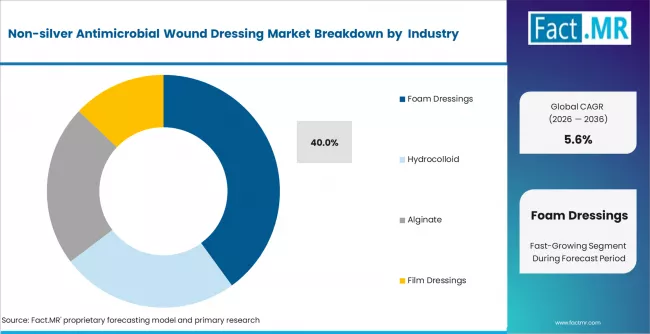
Non Silver Antimicrobial Wound Dressing Market Analysis By Dressing Type | Source: Fact.MR
Based on FACT.MR's non-silver antimicrobial wound dressing market report, foam dressings are estimated to hold 40% share in 2026. This segment leads due to high exudate absorption capacity, patient comfort, and clinical suitability for chronic wounds including diabetic foot ulcers and pressure injuries. Foam formats accommodate antimicrobial actives across PHMB, iodine, and honey, enabling broad product coverage.
- ConvaTec Foam Portfolio Investment: ConvaTec Group expanded its AQUACEL Foam antimicrobial dressing line with new PHMB-impregnated variants in 2024. These are positioned for hospital and community chronic wound care. This supports foam segment dominance in the non-silver category. [7]
- Alginate Dressing Development: Coloplast launched an updated iodine-impregnated alginate dressing for heavily exuding wounds in 2025. These target surgical and venous leg ulcer applications across community nursing channels. This expands non-silver options within the alginate format. [8]
- Film Dressing Adoption Trend: 3M Company reported increased hospital procurement of antimicrobial film dressings for post-surgical wound protection in 2024. Growth is driven by infection prevention protocols in elective surgery settings. This drives non-silver active adoption into film format segments. [9]
Drivers, Restraints, and Opportunities
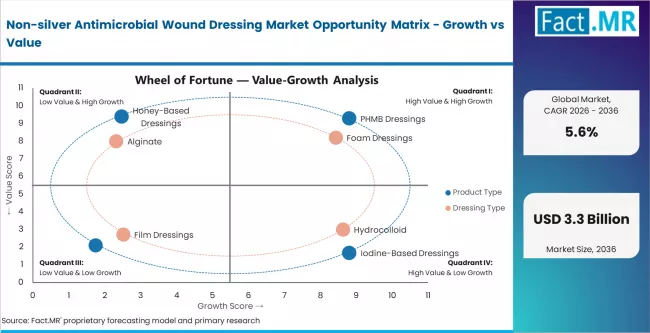
Non Silver Antimicrobial Wound Dressing Market Opportunity Matrix Growth Vs Value | Source: Fact.MR
FACT.MR notes the non-silver antimicrobial wound dressing market is a compliance- and evidence-driven segment, valued at USD 1.7 billion in 2025. Demand is anchored in chronic wound management and antimicrobial stewardship protocols. These applications are structured procurement priorities in hospital and community care systems. Clinical guideline alignment ensures stable demand across healthcare expenditure cycles.
The market reflects a clear clinical preference shift. Standard silver dressings face formulary pressure from antimicrobial stewardship committees citing cytotoxicity risks. PHMB, iodine, and honey-based formats are gaining formulary inclusion. Advanced foam and alginate constructs with embedded antimicrobials command 25 to 40% price premiums over basic dressings, supporting value growth alongside modest volume increases.
- Antimicrobial Stewardship Policy Driver: The U.S. Centers for Disease Control and Prevention and NHS England both updated antimicrobial stewardship frameworks in 2024, reinforcing clinician guidance to prioritise low-toxicity non-silver wound actives. This creates structured formulary inclusion pathways for PHMB and iodine dressings. [1]
- Chronic Wound Prevalence Growth: The International Diabetes Federation reported 537 million adults living with diabetes globally in 2024, with diabetic foot ulcers representing a primary driver of advanced wound dressing demand. India and China account for the highest absolute volumes. [2]
- Asia Pacific Healthcare Infrastructure Expansion: India's Ayushman Bharat PM-JAY programme extended hospital coverage to over 550 million beneficiaries by 2024, expanding institutional wound care procurement volumes. China's 14th Five-Year Plan committed to hospital capacity additions, increasing clinical wound management infrastructure. [3]
Regional Analysis
The non-silver antimicrobial wound dressing market is assessed across North America, Europe, Asia Pacific, Latin America, and Middle East and Africa, covering 40+ key countries with distinct demand profiles shaped by reimbursement frameworks, antimicrobial stewardship policy intensity, chronic disease prevalence, and healthcare infrastructure maturity. The full report offers market attractiveness analysis by region and country.
.webp "Top Country Growth Comparison Non Silver Antimicrobial Wound Dressing Market Cagr (2026 2036)")
Top Country Growth Comparison Non Silver Antimicrobial Wound Dressing Market Cagr (2026 2036) | Source: Fact.MR
| Country | CAGR (2026 to 2036) |
|---|---|
| India | 7.5% |
| China | 7.1% |
| United States | 6.2% |
| Germany | 5.5% |
| United Kingdom | ~5.0% |
Source: Fact.MR analysis. Updated May 6, 2026
Source: Fact.MR (FACT.MR) analysis, based on proprietary forecasting model and primary research
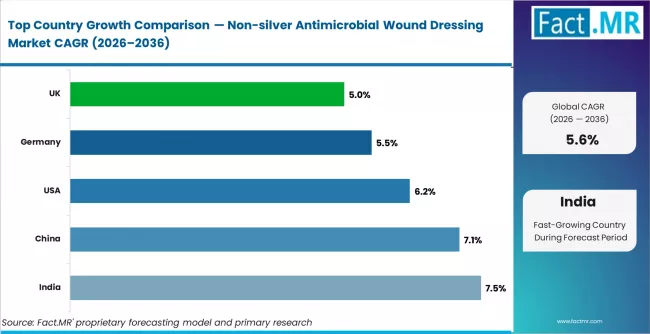
Non Silver Antimicrobial Wound Dressing Market Cagr Analysis By Country | Source: Fact.MR
Asia Pacific Non-Silver Antimicrobial Wound Dressing Market Analysis
Asia Pacific is the fastest-growing region. Growth is structured around public procurement expansion and hospital supply integration. Smith & Nephew and Mölnlycke Health Care lead with dedicated wound care portfolios. The region reflects dual demand models across institutional and community care settings.
- India: Government-led expansion drives growth at 7.5% CAGR through 2036. Ayushman Bharat coverage is scaling hospital procurement volumes. Reimbursement updates in 2024 improved access to advanced dressings. Diabetic foot ulcer incidence remains structurally high. PHMB foam and alginate formats are gaining traction across public and private care networks.
- China: Centralised procurement underpins growth at 7.1% CAGR through 2036. Volume-based tender systems are expanding hospital supply contracts. Infrastructure investment under the Five-Year Plan is increasing bed capacity. Updated 2024 clinical guidelines formalised PHMB and iodine usage. Adoption is strengthening across chronic wound management pathways.
Fact.MR covers India, China, Japan, South Korea, ASEAN, and Australia & New Zealand. It includes reimbursement data, procurement trends, and disease prevalence analysis.
North America Non-Silver Antimicrobial Wound Dressing Market Analysis
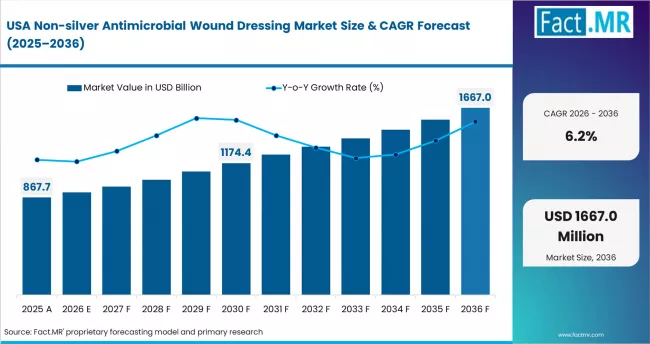
Non Silver Antimicrobial Wound Dressing Market Country Value Analysis | Source: Fact.MR
North America is the largest advanced wound care market. Growth is supported by reimbursement frameworks and hospital formulary systems. Smith & Nephew, 3M, and ConvaTec Group lead supply across institutional and home care channels.
- United States: Reimbursement-led expansion supports growth at 6.2% CAGR through 2036. Medicare Part B incentivises advanced dressing procurement. Updated stewardship frameworks in 2024 favour low-toxicity antimicrobial use. Smith & Nephew expanded its commercial footprint in 2025. Adoption is increasing across hospital and ambulatory care settings.
Fact.MR covers the United States, Canada, and Mexico. It includes reimbursement data, policy trends, and procurement benchmarks.
Europe Non-Silver Antimicrobial Wound Dressing Market Analysis
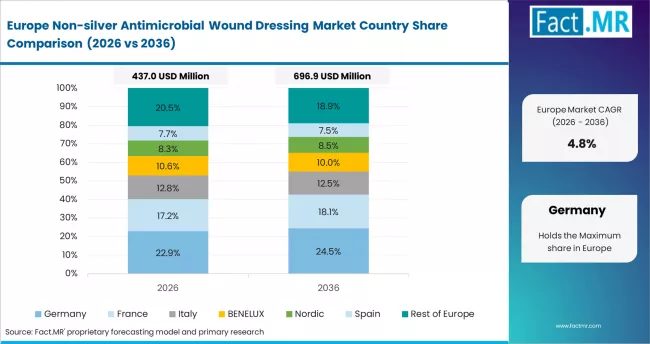
Non Silver Antimicrobial Wound Dressing Market Europe Country Market Share Analysis, 2026 & 2036 | Source: Fact.MR
Europe is a guideline-driven market shaped by reimbursement systems. Adoption is defined by national health frameworks and clinical protocols. Mölnlycke Health Care, B. Braun Melsungen, and Coloplast maintain strong distribution across hospital and community care networks.
- Germany: Reimbursement-backed procurement supports growth at 5.5% CAGR through 2036. Statutory insurance enables access through medical aid catalogues. Updated 2024 guidelines include PHMB and iodine formats. B. Braun Melsungen expanded its antimicrobial dressing portfolio. Adoption is increasing across outpatient wound centres.
- United Kingdom: Framework-driven adoption supports growth at ~5.0% CAGR through 2036. NHS commissioning models prioritise advanced dressings in community care. Updated guidance favours PHMB and honey-based products. Smith & Nephew and Mölnlycke Health Care retain strong NHS procurement positions. Utilisation is expanding across district nursing and care settings.
Fact.MR covers Germany, France, the United Kingdom, Italy, Spain, and Rest of Europe. It includes reimbursement systems, clinical guidelines, and procurement trends.
Competitive Aligners for Market Players
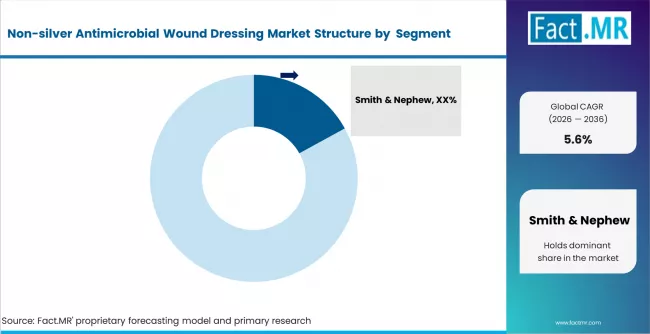
Non Silver Antimicrobial Wound Dressing Market Analysis By Company | Source: Fact.MR
The non-silver antimicrobial wound dressing market feels increasingly competitive, but not in a chaotic way. It is dominated by a handful of strong, well-established medical players, while smaller companies try to carve out niche positions. Companies like Smith & Nephew, Mölnlycke Health Care, 3M, ConvaTec Group, and Coloplast continue to lead the space, largely because of their strong hospital relationships and wide product portfolios.
What really sets companies apart now is not just product availability, but clinical credibility and technology. Hospitals are becoming more selective, preferring dressings backed by evidence, especially for PHMB, iodine, and other non-silver formulations. This gives larger players an edge since they can invest more in clinical trials and regulatory approvals.
Another important shift is how contracts are being awarded. Instead of buying products in isolation, hospitals and healthcare systems are forming long-term supplier partnerships. Companies that can offer a full wound care portfolio, along with training and support, are winning these contracts more consistently. Mid-sized and regional players are still active, particularly in cost-sensitive markets. However, they face pressure from larger firms that benefit from scale, stronger distribution, and established trust with clinicians. Thus, the market is moving toward consolidation. As clinical standards tighten and procurement becomes more structured, companies with proven outcomes, strong compliance, and broad product capabilities are likely to dominate future growth.
Key Players
- Smith & Nephew
- 3M Company
- Mölnlycke Health Care
- ConvaTec Group
- Coloplast
- B. Braun Melsungen
Bibliography
- [1] U.S. Centers for Disease Control and Prevention. Core Elements of Hospital Antibiotic Stewardship Programs: 2024 Update Including Wound Care Antimicrobial Prescribing Guidance. 2024. cdc.gov/antibiotic-use/core-elements
- [2] International Diabetes Federation. IDF Diabetes Atlas 11th Edition 2025: Global Diabetic Foot Ulcer Prevalence Data and Advanced Wound Dressing Demand Projections. 2025. diabetesatlas.org
- [3] Ministry of Health and Family Welfare, India. Ayushman Bharat PM-JAY Programme Beneficiary Coverage and Hospital Procurement Expansion Report 2024. 2024. pmjay.gov.in
- [4] Smith & Nephew plc. Annual Report 2024: Advanced Wound Management Portfolio Expansion Including PHMB Foam Dressing Range Growth Across European Hospital Accounts. 2024. smith-nephew.com/investor-relations
- [5] Mölnlycke Health Care. Product Launch Announcement: Mepilex Border Iodine-Cadexomer Dressing Range for Chronic Wound Management in Hospital and Community Care Settings. January 2025. molnlycke.com/news
- [6] Wounds International. International Consensus Document 2024: Medical-Grade Honey Dressing Evidence Review for Biofilm-Infected Chronic Wound Management. 2024. woundsinternational.com
- [7] ConvaTec Group plc. Annual Report 2024: AQUACEL Foam PHMB Antimicrobial Dressing Portfolio Expansion and U.S. and European Distribution Channel Growth. 2024. convatecgroup.com/investors
- [8] Coloplast A/S. Product Development Announcement: Iodine-Impregnated Alginate Dressing for Heavily Exuding Wounds in Community Nursing Channels. 2025. coloplast.com
This Report Addresses
- Strategic intelligence on non-silver antimicrobial wound dressing demand across PHMB, iodine, honey, and chlorhexidine product formats in hospital and community care channels globally.
- Market forecast from USD 1.8 billion in 2026 to USD 3.1 billion by 2036 at a CAGR of 5.6%.
- Growth opportunity mapping across India hospital procurement expansion, China centralised purchasing programme growth, U.S. antimicrobial stewardship adoption, Germany reimbursement-driven chronic wound care, and UK NHS evidence-based formulary expansion.
- Segment analysis by product type (PHMB, iodine, honey, chlorhexidine), dressing type (foam, hydrocolloid, alginate, film), and application (chronic wounds, acute wounds).
- Regional outlook covering Asia Pacific infrastructure-driven growth, North America stewardship-led demand, and Europe reimbursement-structured advanced dressing adoption.
- Competitive landscape of Smith & Nephew, 3M Company, Mölnlycke Health Care, ConvaTec Group, Coloplast, and B. Braun Melsungen, focused on clinical evidence, formulary access, and reimbursement positioning.
- Regulatory analysis covering U.S. CDC antimicrobial stewardship frameworks, NHS England wound care commissioning guidelines, Germany GKV reimbursement standards, and India NPPA wound care pricing updates.
- Report delivered in PDF, Excel, and presentation formats, supported by primary interviews, manufacturer data, reimbursement records, and clinical procurement benchmarks.
Non-silver Antimicrobial Wound Dressing Market Definition
The non-silver antimicrobial wound dressing market covers advanced wound care products incorporating PHMB, iodine, honey, and chlorhexidine actives as primary antimicrobial agents. Key formats include foam dressings, hydrocolloid, alginate, and film dressings.
Non-silver Antimicrobial Wound Dressing Market Inclusions
Covers global and regional forecasts from 2026 to 2036 by product type, dressing type, and application. Includes PHMB, iodine-based, honey-based, and chlorhexidine dressings across foam, hydrocolloid, alginate, and film formats. Includes reimbursement analysis, clinical guideline alignment, and advanced wound care channel benchmarks.
Non-silver Antimicrobial Wound Dressing Market Exclusions
Excludes silver-based antimicrobial dressings and standard non-antimicrobial wound care products. Finished wound closure devices, surgical sutures, and wound irrigation solutions are not included. Basic gauze and non-impregnated dressings without antimicrobial actives are excluded. Focus remains on value-added non-silver antimicrobial dressing formats supplied to clinical and home care channels.
Non-silver Antimicrobial Wound Dressing Market Research Methodology
- Primary Research: Interviews with wound care specialists, hospital procurement officers, community nursing teams, and wound dressing distributors across key markets.
- Desk Research: Uses data from Smith & Nephew, Mölnlycke Health Care, and ConvaTec Group annual reports, NHS England wound care commissioning guidelines, U.S. Medicare wound dressing reimbursement updates, and advanced wound care trade statistics from 2024 to 2025.
- Market-Sizing and Forecasting: Applies a hybrid model using wound dressing manufacturer revenues, unit volume estimates by product type and application, and average selling price benchmarks by dressing format and clinical indication.
- Data Validation and Update Cycle: Validated using manufacturer revenue data, hospital procurement sell-through volumes, and national wound care guideline adoption benchmarks. Supported by expert interviews with clinical wound specialists.
Segmentation
Scope of Report
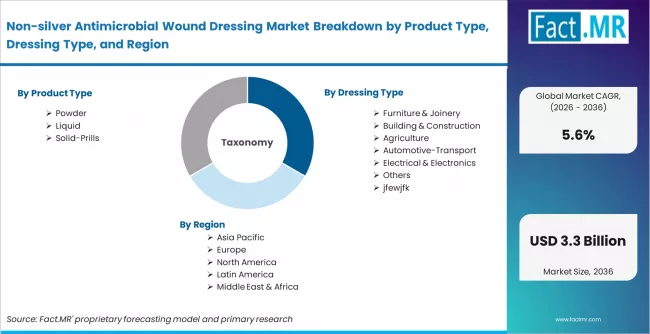
Non Silver Antimicrobial Wound Dressing Market Breakdown By Product Type, Dressing Type, And Region | Source: Fact.MR
| Attribute | Details |
|---|---|
| Quantitative Units | USD 1.8 billion (2026) to USD 3.1 billion (2036), at a CAGR of 5.6% |
| Market Definition | Advanced wound dressings incorporating PHMB, iodine, honey, and chlorhexidine antimicrobial actives in foam, hydrocolloid, alginate, and film formats for chronic and acute wound management in hospital and community care channels globally. |
| Product Type Segmentation | PHMB Dressings, Iodine-Based Dressings, Honey-Based Dressings, Chlorhexidine Dressings |
| Dressing Type Segmentation | Foam Dressings, Hydrocolloid, Alginate, Film Dressings |
| Application Segmentation | Chronic Wounds, Acute Wounds |
| Application Coverage | Chronic wound antimicrobial management for diabetic foot ulcers, pressure injuries, and venous leg ulcers; acute wound infection prevention for surgical, burn, and trauma wound care in hospital and community settings. |
| Regions Covered | North America, Europe, Asia Pacific, Latin America, Middle East and Africa |
| Countries Covered | USA, Canada, Mexico, Germany, UK, France, Italy, Spain, Nordic, BENELUX, China, Japan, South Korea, India, ASEAN, Australia and New Zealand, Brazil, Argentina, Chile, Saudi Arabia, GCC, Turkey, South Africa, Rest of MEA |
| Key Companies Profiled | Smith & Nephew, 3M Company, Mölnlycke Health Care, ConvaTec Group, Coloplast, B. Braun Melsungen |
| Forecast Period | 2026 to 2036 |
| Approach | Hybrid top-down and bottom-up model using wound dressing manufacturer revenues, unit volume estimates by product type and dressing format, average selling prices by application and clinical indication, hospital formulary and reimbursement channel benchmarks, and primary interviews with wound care procurement specialists and clinical wound care teams. |
Source: Fact.MR analysis. Updated May 6, 2026
Non-silver Antimicrobial Wound Dressing Market by Segments
-
By Product Type:
- PHMB Dressings
- Iodine-Based Dressings
- Honey-Based Dressings
- Chlorhexidine Dressings
-
By Dressing Type:
- Foam Dressings
- Hydrocolloid
- Alginate
- Film Dressings
-
By Application:
- Chronic Wounds
- Acute Wounds
-
By Region:
- North America
- United States
- Canada
- Mexico
- Latin America
- Brazil
- Mexico
- Argentina
- Chile
- Rest of Latin America
- Western Europe
- Germany
- United Kingdom
- France
- Italy
- Spain
- Nordic Countries
- BENELUX
- Rest of Western Europe
- Eastern Europe
- Russia
- Poland
- Hungary
- Balkan and Baltic
- Rest of Eastern Europe
- East Asia
- China
- Japan
- South Korea
- South Asia and Pacific
- India
- ASEAN
- Australia and New Zealand
- Rest of South Asia and Pacific
- Middle East and Africa
- Kingdom of Saudi Arabia
- Other GCC Countries
- Turkey
- South Africa
- Rest of Middle East and Africa
- North America
Frequently Asked Questions
How large is the global non-silver antimicrobial wound dressing market in 2025?
What will the market size be in 2026?
What is the projected market size by 2036?
What is the expected CAGR from 2026 to 2036?
Which product type is poised to lead the non-silver antimicrobial wound dressing market?
Which dressing type holds the largest share?
Which country shows the fastest growth in the market?
What are non-silver antimicrobial wound dressings used for?
What drives demand in this market?
Who are the key players in the market?
What are the major restraints?
Who worked on this report


Preview the report firsthand - request a free sample
Free SampleGet the brochure for pricing and purchase details
Download PDF