- Market Value (2025): USD 872.5 Mn
- Estimated Value (2026): USD 966.2 Mn
- Forecast Value (2036): USD 2679.0 Mn
- CAGR (2026-2036): 10.7%
What is the Online Fashion Retail Market forecast to be worth by 2036?
USD 966.2 billion in 2026 to USD 2,679.0 billion by 2036 at a 10.7% CAGR.
- At USD 872.5 billion in 2025, the online fashion retail market already drew most of its value from apparel bought by women on brand sites and mobile apps.
- Sales will grow from USD 966.2 billion in 2026 to USD 2,679.0 billion by 2036 as internet access spreads and shoppers trust digital checkout for higher-priced items.
- Fashion e-commerce will expand at a 10.7% CAGR through 2036, with app-led discovery and flexible payment options drawing in first-time buyers.
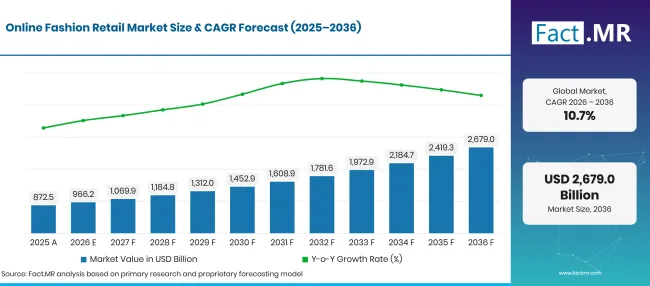
Online Fashion Retail Market Forecast Global | Source: Fact.MR
| Year | Basis | Market Value (USD billion) |
|---|---|---|
| 2025 | Actual | 872.5 |
| 2026 | Estimate | 966.2 |
| 2036 | Forecast | 2,679.0 |
| CAGR 2026 to 2036 | Forecast period | 10.7% |
Source: Fact.MR analysis. Updated Oct 26, 2026
What are the defining numbers behind Online Fashion Retail Market growth?
The 2026 to 2036 window opens USD 1,712.8 billion in fresh online fashion revenue, led by apparel and women’s orders.
- Demand Drivers in the Market
- Internet access sets the ceiling for online clothing sales. The International Telecommunication Union reported that about 6 billion people, close to three quarters of the world population, used the internet in 2025 [1]. Another 2.2 billion people stayed offline that year, which leaves room for new buyers [1].
- Buying clothes online is now a mainstream habit in Europe. Eurostat reported that 77% of internet users in the EU bought goods or services online for personal use in 2024, up from 59% in 2014 [2]. Fashion apps turn that habit into repeat orders through saved sizes, wish lists and alerts on price drops.
- Mobile shopping apps shorten the path from inspiration to checkout. Shoppers see an outfit on social media, tap through to a product page and pay with a stored card or wallet. Live video, styling tools and AI search are now built into the apps of many large platforms.
- Unsold stock rules push retailers to plan inventory with more care. The European Commission said the ban on destroying unsold clothes, clothing accessories and footwear applied to large companies from 19 July 2026, with medium-sized firms covered from 2030 [3]. The Commission cited a European Environment Agency estimate that 4% to 9% of textile products placed on the EU market are destroyed before use [3].
- Cross-border delivery lets small and mid-sized labels sell far beyond their home market. Marketplaces handle payment, translation and returns, so a designer in one country can reach buyers in many others.
- Key Segments Analyzed
- By Product Type: Apparel will account for 52.4% share in 2026, since tops, dresses and denim are bought often and replaced each season.
- By End-User: Women will represent 57.3% share in 2026, reflecting wider ranges, more frequent purchases and strong use of fashion apps.
- By Business Model: Business to Consumer will capture 40.9% share in 2026 as brand sites and retailer apps control pricing, stock and returns.
- By Payment Mode: Cash on Delivery will hold 25.9% share in 2026, given that many buyers in emerging markets still want to inspect a parcel before paying.
- Analyst Opinion at Fact.MR
- Shambhu Nath Jha, Principal Consultant at Fact.MR, states, “Online fashion buyers judge a retailer on fit, delivery speed and how easy it is to send something back. Platforms that cut return rates with better size data will protect margins as order volumes grow. The next wave of demand will come from mobile-first shoppers in markets where card use is still low, so payment choice deserves as much attention as the product range.”
- Strategic Implications
- Fashion brands should invest in size and fit data on every product page, because fit problems drive most returns.
- Marketplace operators should offer cash on delivery, instant bank payments and wallets side by side in markets with low card ownership.
- Logistics partners should build local return hubs near large cities, which shortens refund times and puts stock back on sale sooner.
- Retail investors should favor platforms with a high share of repeat buyers and app traffic, as these lower the cost of each new order.
Germany will lead at 12.3% CAGR, where online and mail-order sellers keep gaining ground on clothing stores. Brazil follows at 11.2% as instant payments make small online orders easy. Growth of 10.2% in the United States reflects steady gains in e-commerce’s share of retail. The United Kingdom will advance at 9.1% with online spending already a large part of total retail. Japan will register 8.0%, helped by a high e-commerce rate for clothing and wider cashless payment.
How does the Online Fashion Retail Market break down by segment?
Apparel will lead Product Type at 52.4%; Women will top End-User at 57.3%; Business to Consumer will head Business Model at 40.9%; Cash on Delivery will lead Payment Mode at 25.9%.
Which Product Type dominates?
Apparel makes up 52.4% of 2026 revenue.
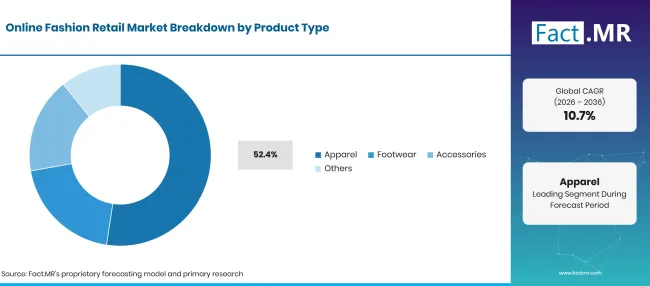
Factmr Online Fashion Retail Market Breakdown Product Type | Source: Fact.MR
| Product Type | Share (2026) |
|---|---|
| Apparel (Leading segment) | 52.4% |
| Other segments combined | 47.6%* |
| Total | 100.0% |
Source: Fact.MR analysis. Updated Oct 26, 2026
Clothing bought online turns over faster than any other fashion category, since shoppers refresh tops, knitwear and denim several times a year. Size charts, model photos and free returns have lowered the risk of buying without trying on. Brand sites and multi-brand platforms also sell branded apparel with exclusive online drops that pull customers back each week. Clothes, shoes and accessories were the goods EU shoppers bought online most often in 2024, with 45% of people making such purchases in the previous three months [2]. Footwear follows apparel, helped by sneaker launches and easy exchange of sizes. Online footwear sales also benefit from detailed product videos. Accessories such as bags, jewelry and luxury watches carry higher order values and fewer fit issues.
What leads the End-User segment?
Women generate 57.3% of 2026 sales.
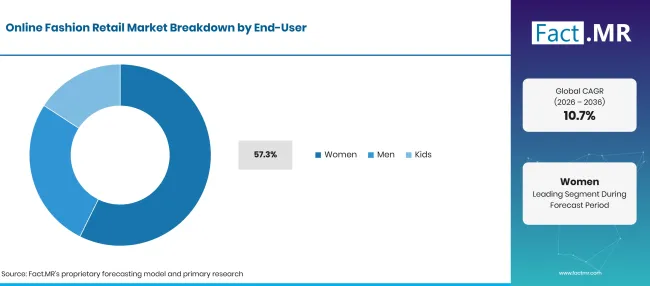
Factmr Online Fashion Retail Market Breakdown End User | Source: Fact.MR
| End-User | Share (2026) |
|---|---|
| Women (Leading segment) | 57.3% |
| Other segments combined | 42.7%* |
| Total | 100.0% |
Source: Fact.MR analysis. Updated Oct 26, 2026
Womenswear ranges online are deeper and change faster than menswear, which gives shoppers more reasons to visit. Women also buy across categories in one order, mixing clothing with shoes, bags and beauty. Platforms target them with styling content, creator collections and personalized feeds. Menswear online grows as more men buy basics, sportswear and sneakers through apps. Kids’ clothing is a steady repeat purchase, because children outgrow sizes within months. Parents often add baby fashion accessories to the same basket, and school-season sales bring sharp peaks in orders.
How does Business Model shape demand?
Business to Consumer takes 40.9% of 2026 value.
| Business Model | Share (2026) |
|---|---|
| Business to Consumer (Leading segment) | 40.9% |
| Other segments combined | 59.1%* |
| Total | 100.0% |
Source: Fact.MR analysis. Updated Oct 26, 2026
Direct selling from brands and retailers to shoppers gives the seller control over price, stock and customer data. Retail chains run their own sites and apps alongside stores, and they link the two with click-and-collect and in-store returns. Premium labels in the high fashion space use their own sites to protect pricing. Business to business platforms supply boutiques and smaller retailers with wholesale stock ordered online. Consumer to consumer resale sites let people sell used clothing and bags to each other. Resale appeals to shoppers on a budget and to those who want to keep clothes in use for longer.
What supports Cash on Delivery within Payment Mode?
Cash on Delivery covers 25.9% of 2026 orders by value.
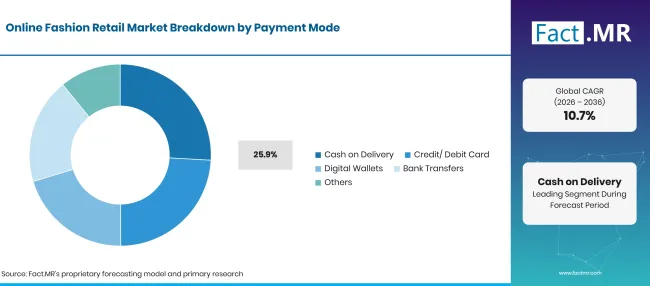
Online Fashion Retail Market Breakdown Payment Mode | Source: Fact.MR
| Payment Mode | Share (2026) |
|---|---|
| Cash on Delivery (Leading segment) | 25.9% |
| Other segments combined | 74.1%* |
| Total | 100.0% |
Source: Fact.MR analysis. Updated Oct 26, 2026
Shoppers in India, Southeast Asia, the Middle East and parts of Latin America often pay the courier at the door. Paying on arrival builds trust with first-time online buyers and with those who do not hold a credit card. Sellers accept higher return risk in exchange for a larger pool of customers. Credit and debit cards stay common in North America, Europe and Japan. Instant bank payments are gaining fast in Brazil, where the Banco Central do Brasil reported that Pix rose from 22.1% of payment value across Pix, boletos, bank transfers and cheques in January 2023 to 41.2% in September 2025 [4]. Retailers now apply AI in retail tools to spot fraud and pick the best payment option for each buyer.
What is accelerating Online Fashion Retail Market adoption, and what is holding it back?
Wider internet access, mobile apps and easy payments will keep adding online fashion buyers in every region. High return rates, delivery costs and stricter rules on unsold stock will hold margins back.
Drivers Impact Analysis
| DRIVER | (~) % IMPACT ON CAGR | GEOGRAPHIC RELEVANCE | IMPACT TIMELINE |
|---|---|---|---|
| Wider internet and smartphone access in emerging markets | +2.4% | South Asia & Pacific, Latin America, Middle East & Africa | Short term (<= 2 years) |
| Mobile apps with social and video shopping features | +2.0% | Global | Short term (<= 2 years) |
| Free and fast delivery with easy returns | +1.7% | North America, Western Europe, East Asia | Medium term (2-4 years) |
| Instant payments and digital wallets at checkout | +1.4% | Latin America, South Asia & Pacific | Medium term (2-4 years) |
| Cross-border marketplaces for smaller labels | +1.0% | Global | Long term (>= 4 years) |
Source: Fact.MR analysis. Updated Oct 26, 2026
Opportunity Impact Analysis
| OPPORTUNITY | (~) % IMPACT ON CAGR | GEOGRAPHIC RELEVANCE | IMPACT TIMELINE |
|---|---|---|---|
| AI sizing and virtual try-on that lower returns | +1.2% | North America, Western Europe | Medium term (2-4 years) |
| Online resale and rental of clothing and bags | +0.9% | Western Europe, North America | Long term (>= 4 years) |
| Menswear and kidswear growth on mobile apps | +0.7% | East Asia, South Asia & Pacific | Short term (<= 2 years) |
Source: Fact.MR analysis. Updated Oct 26, 2026
Restraints Impact Analysis
| RESTRAINT | (~) % IMPACT ON CAGR | GEOGRAPHIC RELEVANCE | IMPACT TIMELINE |
|---|---|---|---|
| High return rates and reverse logistics costs | -1.1% | Global | Short term (<= 2 years) |
| Rules on unsold stock and textile waste | -0.6% | Western Europe | Long term (>= 4 years) |
| Payment fraud and cash on delivery refusals | -0.5% | South Asia & Pacific, Middle East & Africa | Medium term (2-4 years) |
Source: Fact.MR analysis. Updated Oct 26, 2026
Which countries are scaling the Online Fashion Retail Market through 2036?
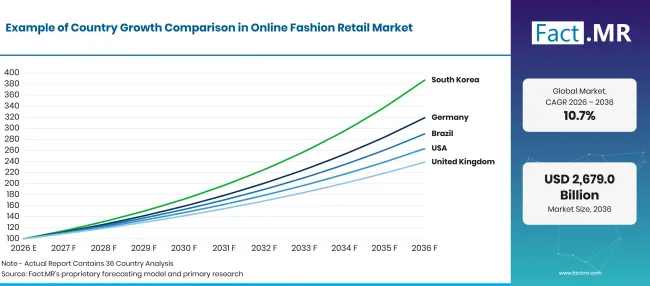
Online Fashion Retail Market Growth Index 1 | Source: Fact.MR
| Country | CAGR (2026 to 2036) |
|---|---|
| Germany | 12.3% |
| Brazil | 11.2% |
| United States | 10.2% |
| United Kingdom | 9.1% |
| Japan | 8.0% |
Source: Fact.MR analysis. Updated Oct 26, 2026
What supports Germany’s adoption?
12.3% CAGR, driven by a shift of clothing spend from stores to online and mail-order sellers.
Online clothing demand in Germany grows while store sales lag. Destatis reported that internet and mail-order retail sales rose 5.0% in real terms in 2024, while stores selling textiles, clothing, shoes and leather goods saw real sales fall 3.2% [5]. German shoppers favor paying by invoice and returning items with ease, and platforms built around those habits keep winning repeat orders.
How is Brazil scaling demand?
11.2% CAGR, backed by instant payments that make small fashion orders easy to complete.
Fashion e-commerce in Brazil depends on payments that work without a credit card. The Ministry of Finance reported that Pix handled nearly 80 billion transactions worth more than R$35 trillion in 2025 [6]. By the end of that period, 148 million individuals had made or received a Pix payment [6]. Instalment plans on cards remain popular for larger fashion baskets.
What supports United States growth?
10.2% CAGR, reflecting a steady rise in e-commerce’s share of total retail.
American shoppers keep moving routine clothing purchases online. The U.S. Census Bureau reported that e-commerce sales came to $340.2 billion in the second quarter of 2026, or 17.1% of total retail sales [7]. That figure was 12.2% higher than in the same quarter of 2025 [7]. Department stores, off-price chains and brand sites all compete through apps and loyalty programs.
How is the United Kingdom developing demand?
9.1% CAGR, as online spending holds a high share of total retail.
Online clothes shopping in the UK is already a large part of how people buy. The Office for National Statistics reported that online sales accounted for 28.8% of total retail spending in August 2026, up from 28.4% in July [8]. Online spending values for the three months to August were 10.1% higher than a year earlier [8].
How does Japan perform?
8.0% CAGR, helped by wide cashless payment use and a high online rate for clothing.
Clothing is one of the most digital retail categories in Japan. The Ministry of Economy, Trade and Industry reported that the B2C e-commerce market for clothing and accessories reached 2.798 trillion yen in 2024, with an e-commerce rate of 23.38% [9]. METI also put the cashless share of consumer payments at 58.0% in 2025, with credit cards making up 82.7% of cashless value [10].
Who leads the Online Fashion Retail Market?
The online fashion field splits into three groups, and each wins buyers in a different way. Fast-fashion chains such as Zara and H&M run their own sites and apps beside large store networks, so online orders and store visits feed each other. Online-only players compete on range and speed. ASOS launched its first adaptive collection of 51 options in September 2026, sold only on ASOS.com [11]. In August 2026, ASOS added premium handbag and footwear brands, including Michael Kors and Vagabond [12].
Debenhams Group sells fashion for younger shoppers through its own websites, while Shein sells low-priced clothing through apps in many countries. Myntra serves Indian shoppers and offers cash on delivery. A third group focuses on luxury. Net-a-Porter and Farfetch sell designer labels online, and Nordstrom added AI outfit suggestions and stylist access to its app in October 2026 [13]. Fit accuracy, delivery speed and return costs will decide who gains share.
Which companies are the key providers?
Key companies include Zara; H&M; ASOS; Debenhams Group; Shein; Myntra; Net-a-Porter; Farfetch; and Nordstrom.
- Zara
- H&M
- ASOS
- Debenhams Group
- Shein
- Myntra
- Net-a-Porter
- Farfetch
- Nordstrom
Bibliography
- [1] International Telecommunication Union. (2025, November 17). Global number of Internet users increases, but disparities deepen key digital divides.
- [2] Eurostat. (2025, February 20). Online shopping in the EU keeps growing.
- [3] European Commission. (2026, July 17). Ban on destruction of unsold clothes and shoes enters into application.
- [4] Banco Central do Brasil. (2025, December). Estatísticas de pagamentos por atividade econômica (EPAE) [Payment statistics by economic activity].
- [5] Statistisches Bundesamt (Destatis). (2025, January 31). Einzelhandelsumsatz im Jahr 2024 real um 1,1 % höher als 2023 [Retail sales in 2024 up 1.1% in real terms on 2023].
- [6] Ministério da Fazenda. (2026, August 19). Pix consolida liderança nos pagamentos digitais e projeta novas evoluções até 2030 [Pix consolidates its lead in digital payments and plans new upgrades to 2030].
- [7] U.S. Census Bureau. (2026, August 18). Quarterly Retail E-Commerce Sales: 2nd Quarter 2026.
- [8] Office for National Statistics. (2026, September 18). Retail sales, Great Britain: August 2026.
- [9] Ministry of Economy, Trade and Industry, Japan. (2025, August 26).[Results of the FY2024 e-commerce market survey].
- [10] Ministry of Economy, Trade and Industry, Japan. (2026, March 31). 2025 Ratio of Cashless Payment Among the Total Amount Paid by Consumers Calculated.
- [11] ASOS. (2026, September 24). ASOS launches Adaptive collection, putting style at the heart of accessible fashion, co-created with Disabled customers and Tilting the Lens.
- [12] ASOS. (2026, August 26). ASOS steps up its premium accessories game with cult handbag brands and elevated footwear.
- [13] Nordstrom. (2026, October 12). Gifting Made Easier, More Personal, and More Fun at Nordstrom This Holiday Season
This Report Answers
- How large will online fashion retail be in 2026 and 2036, and at what yearly pace will it grow?
- Why do apparel, women shoppers, direct brand selling and cash on delivery lead their segments?
- What role do internet access, mobile apps and payment choice play in online clothing orders?
- Where do Germany, Brazil, the United States, the United Kingdom and Japan differ in online fashion demand?
- Which fashion retailers and platforms sell online today, and what will help them gain share?
What does the Online Fashion Retail Market cover?
Fashion goods bought online form the base of this market. Apparel, footwear and accessories ordered through websites, apps and marketplaces are all counted.
Orders from women, men and kids are tracked across direct brand selling, wholesale platforms and resale sites. Every major payment route is covered, from cash paid to the courier to cards, wallets and bank transfers.
What is included in the scope?
Brand websites, retailer apps, multi-brand marketplaces and luxury e-boutiques fall inside the boundary. Online orders collected in store are counted, as are social commerce sales completed inside an app.
Cross-border orders shipped to the buyer’s country count in the destination market. Online resale of used clothing, shoes and bags between consumers is part of the total, along with wholesale fashion orders placed online by boutiques.
What is excluded from the scope?
Fashion sold in physical stores without an online order is excluded. Beauty, fragrance and home textiles fall outside this market, even when sold on fashion platforms.
Clothing rental subscriptions, uniforms bought through business contracts and custom tailoring ordered in person are left out. Shipping fees and taxes are not counted in sales value.
How Was the Analysis Built?
The analysis draws on 120+ sources, 35+ company portfolios, 25+ countries, and more than 20 industry interviews.
- Primary Research: Primary research includes discussions with manufacturers, service providers, technology developers, distributors, end users, and subject-matter experts. These conversations examine purchasing priorities, product adoption, operational challenges, approval requirements, competitive positioning, and the factors that influence wider market acceptance.
- Desk Research: Desk research covers government statistics, regulatory publications, company filings, trade data, technical studies, industry associations, standards, public policy, and other authoritative sources. Every source used in the analysis is documented in the bibliography.
- Market Sizing and Forecasting: Market estimates combine historical performance, demand indicators, pricing and volume trends, segment shares, company participation, country-level growth, adoption patterns, investment activity, and barriers to market expansion.
- Data Validation and Update Cycle: Findings are validated by comparing primary interviews with public data, company activity, regulatory changes, trade patterns, and industry developments. Regular updates review new product launches, capacity changes, partnerships, approvals, and shifts in commercial adoption.
Segmentation
What is the report’s scope and coverage?
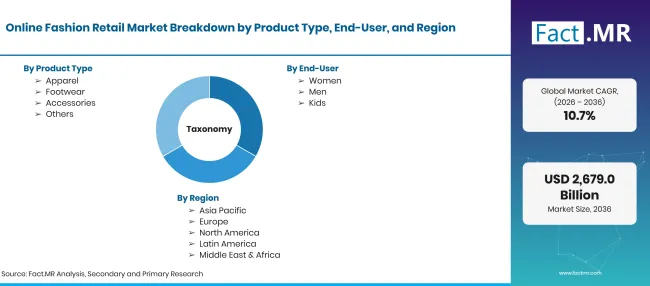
Online Fashion Retail Market Taxonomy | Source: Fact.MR
| Attribute | Details |
|---|---|
| Quantitative Units | USD billion |
| Market Definition | Sales of apparel, footwear and fashion accessories ordered through websites, mobile apps and online marketplaces and delivered to the buyer or collected in store. Value is counted at the online transaction price, net of returns. |
| Product Type | Apparel; Footwear; Accessories; Others |
| End-User | Women; Men; Kids |
| Business Model | Business to Consumer; Business to Business; Consumer to Consumer |
| Payment Mode | Cash on Delivery; Credit/Debit Card; Digital Wallets; Bank Transfers; Others |
| Regions Covered | North America; Latin America; Western Europe; Eastern Europe; East Asia; South Asia & Pacific; Middle East & Africa |
| Countries Covered | Germany; Brazil; United States; United Kingdom; Japan |
| Companies Profiled | Zara; H&M; ASOS; Debenhams Group; Shein; Myntra; Net-a-Porter; Farfetch; Nordstrom |
| Forecast Period | 2026 to 2036 |
| Approach | Hybrid top-down and bottom-up approach using internet user counts, online shopper rates, e-commerce shares of clothing retail, average order values by category and payment mix by country. |
Source: Fact.MR analysis. Updated Oct 26, 2026
How is the market segmented?
-
By Product Type
- Apparel
- Footwear
- Accessories
- Others
-
By End-User
- Women
- Men
- Kids
-
By Business Model
- Business to Consumer
- Business to Business
- Consumer to Consumer
-
By Payment Mode
- Cash on Delivery
- Credit/Debit Card
- Digital Wallets
- Bank Transfers
- Others
-
By Region
- North America
- Latin America
- Western Europe
- Eastern Europe
- East Asia
- South Asia & Pacific
- Middle East & Africa
Frequently Asked Questions
How big is the online fashion retail market in 2026?
What is the CAGR of the online fashion retail market from 2026 to 2036?
Which product type leads the online fashion retail market?
Which end-user leads the online fashion retail market?
Which business model leads the online fashion retail market?
Which payment mode leads the online fashion retail market?
Which country will grow the most in the online fashion retail market?
Who are the main companies in the online fashion retail market?
Who worked on this report


Preview the report firsthand - request a free sample
Free SampleGet the brochure for pricing and purchase details
Download PDF