- Base Value(2025): 920.0 Mn
- Estimated Value(2026): 957.7 Mn
- Forecast Value (2036): 1431.4 Mn
- CAGR (2026 - 2036): 4.1%
Optical Lens Cutter and Edger Market Analysis and Forecast by Fact.MR
- The global optical lens cutter and edger market is estimated at USD 957.72 million in 2026 and is forecast to expand at a CAGR of 4.1% to reach USD 1431.35 million by 2036.
- Optical lens edgers are precision machines that cut, grind, and finish prescription lenses to fit specific eyeglass frames.
- Product types range from manual edgers to CNC-controlled fully automatic systems with integrated tracing, drilling, and polishing capability.
- Fully automatic systems dominate new procurement, driven by optical retail chain demand for same-day lens delivery and consistent finishing quality.
- Growth is supported by rising global myopia prevalence, aging population vision correction needs, and expanding optical retail infrastructure in emerging markets.
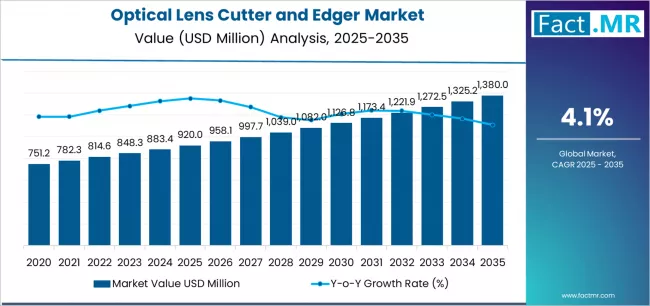
Optical Lens Cutter And Edger Market Value Analysis | Source: Fact.MR
Summary of the Optical Lens Cutter and Edger Market
- Market Snapshot
- In 2025, the global Optical Lens Cutter and Edger Market was valued at approximately USD 920.0 million.
- The market is estimated to reach USD 957.72 million in 2026 and is projected to attain USD 1431.35 million by 2036.
- The optical lens cutter and edger market is likely to expand at a CAGR of 4.1% during the forecast period.
- The market is anticipated to create an absolute dollar opportunity of USD 473.63 million between 2026 and 2036.
- Retail Optical Businesses accounts for 39.7% of the end use segment share in 2026.
- USA (4.7%) and Mexico (4.4%) are the key growth markets during the forecast period.
- Demand and Growth Drivers
- Rising global myopia prevalence, particularly among younger populations in East Asia, is increasing prescription eyewear demand and correspondingly expanding the volume of lenses requiring edging and finishing at optical laboratories and retail stores.
- Same-day lens delivery expectations from consumers are compelling optical retail chains to invest in in-store automatic edging systems that enable rapid on-premises lens finishing without sending prescriptions to external laboratories.
- Aging population demographics across developed markets are increasing demand for progressive and multifocal lenses that require more precise edging and centering, favoring automated systems with digital pattern recognition.
- Optical retail chain expansion in emerging markets across India, China, and Southeast Asia is creating procurement for edging equipment as new stores are fitted with finishing capabilities.
- Specialty lens processing for high-index, rimless, and sport wrap frames requires advanced drilling, grooving, and beveling capability, pushing procurement toward fully automatic systems with multi-function processing.
- Product and Segment View
- Automated lens edger machines account for 41.5% of the product segment in 2026, with CNC-controlled systems providing consistent precision across high-volume optical laboratory and retail store operations.
- Retail optical businesses represent 39.7% of end-use demand, with local opticians and franchise optical chains investing in finishing equipment for same-day lens delivery capability.
- CNC-based technology holds 38.9% of the technology segment, reflecting the shift toward computer-controlled edging for improved accuracy and reduced operator dependency.
- Key segmentation includes:
- Product: Automated Edgers, Fully Automatic, Computer Controlled, Manual Edgers
- Technology: CNC-Based, Digital Pattern Recognition, Conventional Edging
- Automation: Fully Automatic, Semi Automatic, Manual, Smart Automated
- Application: Optical Retail Stores, Optical Laboratories, Healthcare Institutions
- These systems enable:
- CNC-controlled lens cutting and edging with integrated tracing, beveling, drilling, and polishing for precise frame fitting across all lens types
- Same-day in-store lens finishing enabling optical retailers to deliver fitted prescription eyewear within hours rather than days
- Multi-material processing capability handling high-index plastic, polycarbonate, glass, and trivex lenses with automated tool selection and pressure adjustment
- Geography and Competitive Outlook
- North America holds significant value, with the U.S. at USD 325.912 million in 2026, supported by optical retail chain investment, same-day delivery expectations, and progressive lens processing demand from aging demographics.
- Europe shows growth led by Germany (4.1%) and France (3.9%), supported by optical retail modernization, premium eyewear demand, and independent optician equipment upgrade cycles.
- Mexico (4.4%) is the second-fastest-growing market, driven by expanding optical retail infrastructure and growing vision correction access across the population.
- Key companies include EssilorLuxottica Instruments, NIDEK Co., Ltd., Luneau Technology Visionix, Topcon Corporation, Briot SA.
- Analyst Opinion
- Shambhu Nath Jha, Principal Consultant at Fact.MR, says 'The optical lens edger market is a specification-driven equipment segment where technology precision directly determines lens quality and customer satisfaction. The shift toward fully automatic systems reflects optical retail's requirement for consistent finishing quality with minimal operator skill dependency. EssilorLuxottica's vertically integrated position as both lens manufacturer and edging equipment supplier creates a unique competitive dynamic where equipment specification influences lens attachment rates across retail networks.'
Key Growth Drivers, Constraints, and Opportunities
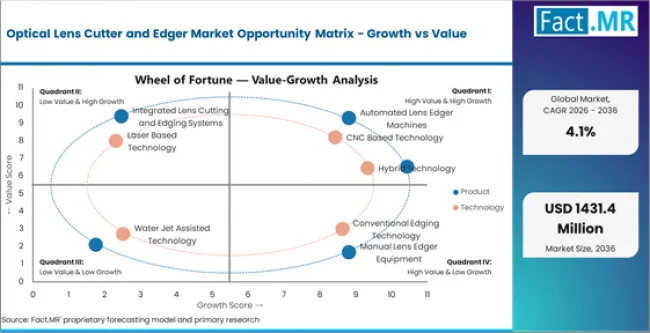
Optical Lens Cutter And Edger Market Opportunity Matrix Growth Vs Value | Source: Fact.MR
Key Factors Driving Growth
- Rising myopia prevalence is expanding prescription eyewear volumes globally, with the WHO projecting half the world's population will be myopic by 2050, driving proportional demand for lens cutting and edging capacity.
- Same-day lens delivery expectations from consumers are creating a structural shift from centralized laboratory processing to in-store edging capability, generating equipment procurement at optical retail locations previously without finishing equipment.
- Progressive and multifocal lens adoption among aging populations requires precise centering, beveling, and edge finishing that favors fully automatic CNC edgers over manual systems where operator variability affects fitting quality.
Key Market Constraints
- High capital cost of fully automatic lens edgers, ranging from USD 20,000 to USD 60,000, creates procurement barriers for independent opticians and small optical practices competing with chain retailers that amortize equipment across multiple locations.
- Skilled operator requirements for semi-automatic and manual systems create staffing challenges in markets with limited optical technician training infrastructure, pushing procurement toward automatic systems with reduced skill dependency.
- Equipment replacement cycles of 8 to 12 years for quality lens edgers limit annual procurement volumes to new store openings and technology upgrade cycles at existing locations.
Key Opportunity Areas
- Optical retail chain expansion in emerging markets across India, China, and Southeast Asia is creating high-volume procurement pipelines as new stores are equipped with in-store finishing capability.
- Rimless and drilled lens fashion trends require edging equipment with integrated drilling and grooving capability, creating upgrade demand at locations with older equipment lacking multi-function processing.
- Cloud-connected edging systems with remote diagnostics, software updates, and lens design integration are creating service differentiation and recurring revenue for manufacturers.
Segment-wise Analysis of the Optical Lens Cutter and Edger Market
- Automated edgers hold 41.5% of the product segment, with fully automatic CNC systems dominating new procurement.
- Retail optical businesses account for 39.7% of end-use demand, with same-day delivery capability driving in-store equipment investment.
- Fully automatic systems represent 43.2% of the automation level segment, reflecting the shift from manual to CNC-controlled edging.
The optical lens cutter and edger market is segmented by product type, technology, automation level, application, end use, and region. Fully automatic edgers lead new procurement. Semi-automatic systems serve mid-volume laboratories. Manual edgers retain niche presence in low-volume independent practices.
Which Product Segment Dominates the Optical Lens Cutter and Edger Market?
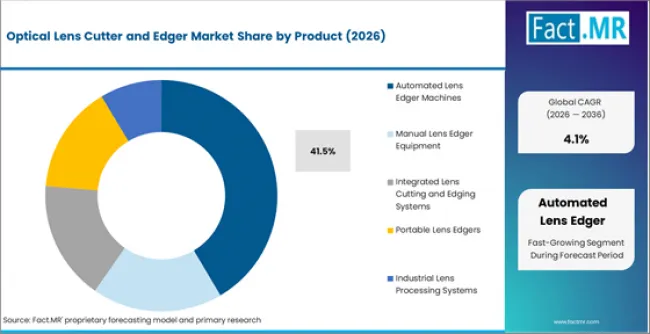
Optical Lens Cutter And Edger Market Analysis By Product | Source: Fact.MR
Automated lens edger machines account for 41.5% in 2026. Fully automatic CNC-controlled systems with integrated tracing, beveling, drilling, and polishing provide consistent precision with minimal operator intervention, making them the standard for optical retail chains and high-throughput laboratories.
Manual and semi-automatic edgers retain presence in independent optical practices and emerging markets where lower equipment cost and simpler maintenance requirements outweigh throughput advantages of fully automatic systems.
Which End-Use Segment Dominates the Optical Lens Cutter and Edger Market?
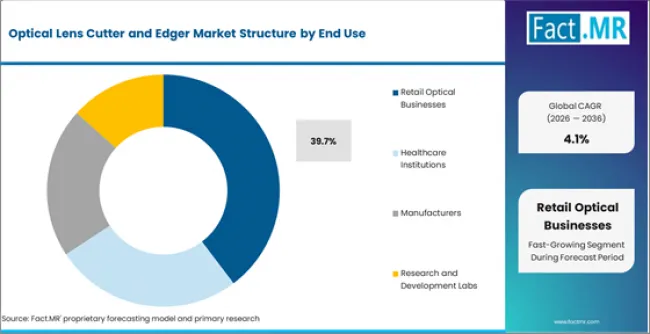
Optical Lens Cutter And Edger Market Analysis By End Use | Source: Fact.MR
Retail optical businesses lead with 39.7% share in 2026, with franchise optical chains, independent opticians, and eyewear shops investing in in-store edging for same-day lens delivery and improved customer experience.
Optical laboratories represent the second-largest segment, processing higher volumes across multiple lens types and prescriptions with fully automatic multi-station edging lines that maximize throughput and minimize per-lens processing time.
Which Product Trend is Shaping the Next Phase of Growth in the Optical Lens Cutter and Edger Market?
AI-assisted lens alignment and edge optimization are the technology trends reshaping automatic edger specifications. Next-generation edgers use machine vision and AI algorithms to automatically detect lens axis, optimize bevel placement, and adjust cutting parameters for different lens materials and frame types. These capabilities reduce finishing errors, minimize lens waste, and enable less-skilled operators to achieve expert-level results.
This AI integration also supports cloud-connected lens design workflows where prescription data flows digitally from refraction instrument to edger with minimal manual input. Optical chains deploying connected edging systems achieve faster turnaround, consistent quality across locations, and centralized quality monitoring that identifies equipment requiring calibration or maintenance.
Regional Outlook Across Key Markets
.webp "Top Country Growth Comparison Optical Lens Cutter And Edger Market Cagr (2026 2036)")
Top Country Growth Comparison Optical Lens Cutter And Edger Market Cagr (2026 2036) | Source: Fact.MR
- The U.S. leads at 4.7%, supported by optical retail chain investment, same-day delivery capability expansion, and progressive lens processing demand from aging demographics.
- Mexico (4.4%) reflects expanding optical retail infrastructure and growing vision correction access, with new optical store openings creating equipment procurement across the country.
- Germany (4.1%) grows on premium eyewear demand, independent optician equipment upgrades, and advanced lens processing requirements for progressive and specialty designs.
CAGR Table
| Country | CAGR (%) |
|---|---|
| USA | 4.7% |
| Mexico | 4.4% |
| Germany | 4.1% |
| France | 3.9% |
| UK | 3.6% |
| South Korea | 3.4% |
| Japan | 3.2% |
Source: Fact.MR analysis. Updated Jun 1, 2026
Source: Fact MR (FMR) analysis, based on proprietary forecasting model and primary research.
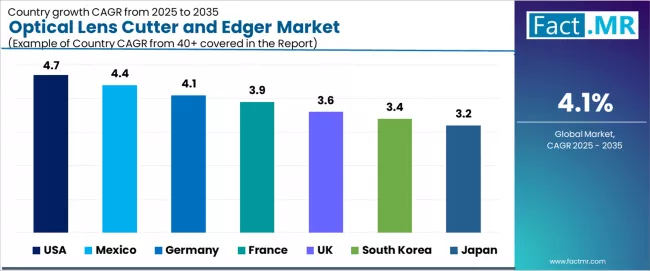
Optical Lens Cutter And Edger Market Cagr Analysis By Country | Source: Fact.MR
Market Outlook for Optical Lens Edgers in the United States
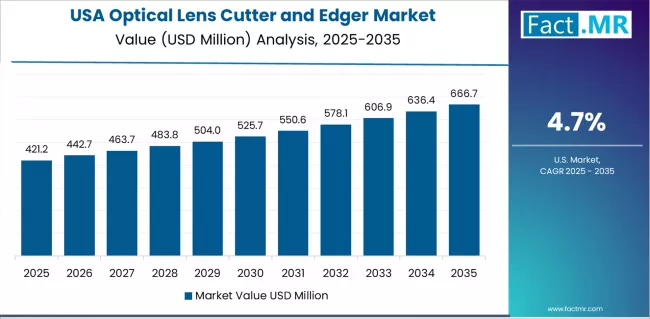
Optical Lens Cutter And Edger Market Country Value Analysis | Source: Fact.MR
Optical retail chain investment in same-day delivery capability is the primary demand driver at 4.7% CAGR. Chains including LensCrafters, Warby Parker, and regional optical retailers are expanding in-store finishing equipment to reduce turnaround time from days to hours.
- Same-day delivery expectations drive in-store automatic edger investment at optical retail chain locations.
- Progressive lens adoption among aging baby boomers increases demand for precision CNC edging with accurate centering and bevel placement.
Optical Lens Edger Demand Trends in Mexico
Expanding optical retail infrastructure and growing vision correction access drive demand at 4.4% CAGR. International and domestic optical chains opening locations across metropolitan and secondary cities create equipment procurement at each new store.
- Optical retail chain expansion across Mexican metropolitan areas generates in-store edger procurement at each new location.
- Growing population access to vision correction increases prescription volume requiring lens cutting and finishing capacity.
Germany Optical Lens Edger Market Demand Analysis
Premium eyewear demand and independent optician technology investment shape demand at 4.1% CAGR. Germany's strong independent optician tradition generates equipment procurement as established practices upgrade to CNC-controlled systems for improved finishing quality.
- Independent optician equipment upgrades from semi-automatic to fully automatic CNC edgers improve finishing quality and reduce processing time.
- Premium progressive and sport lens demand requires advanced drilling, grooving, and edge polishing capability.
France Optical Lens Edger Growth Outlook
Optical retail modernization and progressive lens processing support demand at 3.9% CAGR. French optical chains and independent opticians invest in same-day capability as consumer expectations for rapid service increase.
- Same-day lens delivery investment by French optical retailers generates in-store edger procurement.
- High progressive lens adoption rates in France support demand for precision CNC edging with accurate optical centering.
South Korea Optical Lens Edger Opportunity
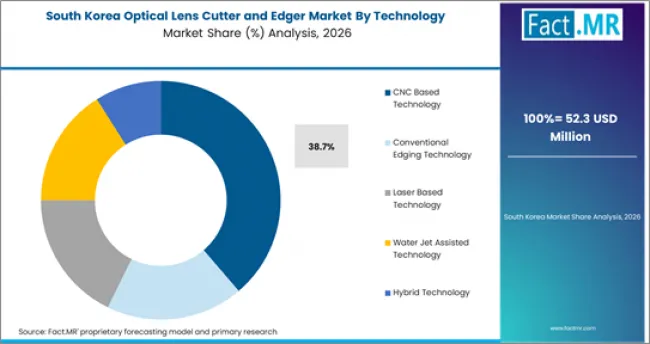
Optical Lens Cutter And Edger Market South Korea Market Share Analysis By Technology | Source: Fact.MR
High myopia prevalence among younger populations and advanced optical retail infrastructure support demand at 3.4% CAGR. Korean consumers' high eyewear fashion awareness creates demand for precision finishing of trendy frame styles.
- High youth myopia rates generate prescription volume supporting lens edging equipment utilization.
- Fashion-forward eyewear demand requires advanced drilling and rimless finishing capability.
Competitive Benchmarking and Company Positioning
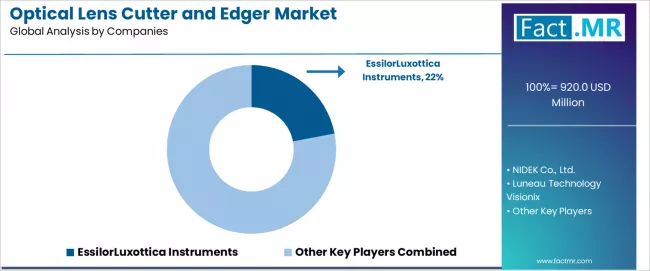
Optical Lens Cutter And Edger Market Analysis By Company | Source: Fact.MR
Optical Lens Cutter and Edger Market Analysis By Company
- EssilorLuxottica Instruments holds the dominant position with approximately 22.0% share, benefiting from vertically integrated lens-to-equipment supply and specification influence across the world's largest optical retail network.
- NIDEK and Luneau Technology (Visionix/Briot) compete through dedicated ophthalmic instrument portfolios with strong relationships among independent opticians and optical laboratories.
- Topcon, Huvitz, and Coburn Technologies maintain positions in specific regional markets and equipment tiers, with Huvitz holding particular strength in Asian optical retail markets.
EssilorLuxottica leads through its instrument division supplying edging equipment to its own Luxottica retail network (LensCrafters, Sunglass Hut, GrandVision) and to independent opticians buying Essilor lenses, creating bundled specification opportunities.
NIDEK competes through ME-1500 and LEXCE Trend platforms with AI alignment and fast cycle times. Briot (Luneau) serves mid-volume laboratories and independent opticians with practical, compact designs.
Strategic priorities include AI-assisted lens alignment, cloud-connected digital workflow integration, expanding multi-function capability for rimless and specialty lenses, and strengthening service networks for rapid equipment support.
Key Companies in the Optical Lens Cutter and Edger Market
- EssilorLuxottica Instruments, NIDEK Co., Ltd., Luneau Technology Visionix, Topcon Corporation are among the leading players in the optical lens cutter and edger market globally, supported by strong brand visibility, broad service portfolios, and growing positions in managed energy solutions.
- Briot SA, MEI (Measurement Engineering, Inc.), Huvitz Co., Ltd., Santinelli International hold established positions across specific service segments, end-use categories, and regional markets, supported by specialized capabilities and established commercial relationships.
- Coburn Technologies, Inc., Shanghai Yanke Optical Co., Ltd. continue to compete through focused offerings, technology partnerships, and regional service networks.
Recent Industry Developments
- EssilorLuxottica, Equipment Enhancement, Mr. Blue 2.0 Edger Platform (2025)
- EssilorLuxottica continued enhancement of its Mr. Blue 2.0 hybrid edging platform, improving precision centering and adding sport wrap frame processing capability. The platform strengthens Essilor Instruments' position in optical retail chain equipment supply.
- NIDEK, Product Development, AI-Assisted Lens Edging (2025)
- NIDEK advanced AI-assisted alignment and edge optimization in its automatic lens edger platforms, reducing finishing errors and enabling less-skilled operators to achieve expert-level results. The technology targets optical retail chains seeking consistent quality across distributed store locations.
- Luneau Technology, Market Expansion, Visionix Edging Solutions (2025)
- Luneau Technology expanded its Visionix/Briot edging solutions portfolio for independent opticians and mid-volume optical laboratories, targeting the growing demand for affordable automatic edging capability in practices transitioning from manual processing.
Leading Companies Shaping the Optical Lens Cutter and Edger Market
- EssilorLuxottica Instruments
- NIDEK Co., Ltd.
- Luneau Technology Visionix
- Topcon Corporation
- Briot SA
- MEI (Measurement Engineering, Inc.)
- Huvitz Co., Ltd.
- Santinelli International
- Coburn Technologies, Inc.
- Shanghai Yanke Optical Co., Ltd.
Sources and Research References
- EssilorLuxottica Instruments. Mr. Blue 2.0 platform and retail equipment supply.
- NIDEK. AI-assisted lens edging technology.
- Luneau Technology. Visionix/Briot edging portfolio.
- WHO. Global myopia prevalence projections.
- Vision Council. Optical retail and prescription eyewear market data.
- Primary interviews across manufacturers, optical laboratories, retail chains, and independent opticians.
- This bibliography is provided for reader reference and is not exhaustive.
Key Questions This Report Addresses
- What is the current and future size of the Optical Lens Cutter and Edger Market?
- How fast is the Optical Lens Cutter and Edger Market expected to grow between 2026 and 2036?
- Which product type leads by 2026?
- Which end-use accounts for the highest demand?
- What drives demand for lens edging equipment?
- How is AI-assisted alignment influencing the market?
- Why is the USA the leading growth market?
- How are same-day delivery expectations shaping procurement?
- Which countries show fastest growth?
- Who are key companies in the Optical Lens Cutter and Edger Market?
- How does Fact.MR validate the forecast?
Optical Lens Cutter and Edger Market Definition
The optical lens cutter and edger market covers precision machines for cutting, grinding, and finishing prescription optical lenses to fit eyeglass frames, including manual, semi-automatic, and fully automatic CNC-controlled edging systems.
Optical Lens Cutter and Edger Market Inclusions
- The scope covers global and regional forecasts for 2026 to 2036 across product type, technology, automation level, application, end use, and region.
- It includes regional analysis based on eyewear prescription volumes, optical retail store counts, laboratory processing capacity, and vision correction demographics.
- The report includes pricing across manual, semi-automatic, and fully automatic edger categories.
- It covers technology trends, competitive landscape, and product portfolios of leading manufacturers.
Optical Lens Cutter and Edger Market Exclusions
- The scope excludes contact lens manufacturing equipment, ophthalmic diagnostic instruments, and lens coating machines.
- It excludes frame manufacturing and adjustment tools.
- The report excludes industrial optics fabrication equipment for non-eyewear applications such as camera and scientific instrument lenses.
Optical Lens Cutter and Edger Market Research Methodology
- The methodology combines secondary research, primary interviews, and forecast modelling.
- It draws on 90+ secondary sources and benchmarks 30+ company product portfolios.
- Market sizing covers 30+ countries through a demand-side model.
- Key inputs include eyewear prescription volumes, optical retail store counts, laboratory throughput, and equipment replacement cycles.
- The model cross-checks with manufacturer shipments and optical retail equipment purchasing data.
- Primary validation includes 20+ interviews across manufacturers, optical laboratories, retail chain procurement, and independent opticians.
- Final estimates go through store-count reconciliation and sensitivity testing.
Segmentation
Scope of Analysis
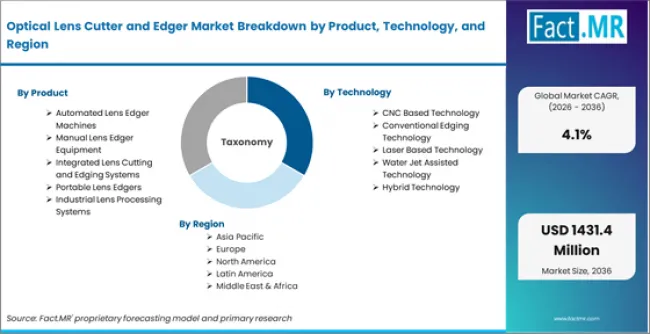
Optical Lens Cutter And Edger Market Breakdown By Product, Technology, And Region | Source: Fact.MR
| Parameter | Details |
|---|---|
| Quantitative Units | USD 957.72 million to USD 1431.35 million, at a CAGR of 4.1% |
| Market Definition | The optical lens cutter and edger market covers precision machines for cutting, grinding, and finishing prescription optical lenses to fit eyeglass frames across manual, semi-automatic, and fully automatic configurations. |
| Regions Covered | North America, Latin America, Europe, East Asia, South Asia and Pacific, Middle East and Africa |
| Countries Covered | USA, Mexico, Germany, France, UK, South Korea, Japan, 30 plus countries |
| Key Companies | EssilorLuxottica Instruments, NIDEK Co., Ltd., Luneau Technology Visionix, Topcon Corporation, Briot SA, MEI (Measurement Engineering, Inc.), Huvitz Co., Ltd., Santinelli International, Coburn Technologies, Inc., Shanghai Yanke Optical Co., Ltd. |
| Forecast Period | 2026 to 2036 |
| Approach | Hybrid demand-side methodology built on eyewear prescription volumes, optical retail store counts, laboratory throughput, equipment replacement cycles, and primary interviews across manufacturers, optical chains, and independent opticians |
Source: Fact.MR analysis. Updated Jun 1, 2026
Optical Lens Cutter and Edger Market Segmentation
-
Optical Lens Cutter and Edger Market Segmented by Product:
- Automated Lens Edger Machines
- Fully Automatic Lens Edgers
- Computer Controlled Edging Systems
- Manual Lens Edger Equipment
- Bench Top Manual Edgers
- Semi Manual Lens Cutting Tools
- Integrated Lens Cutting and Edging Systems
- All in One Lens Processing Machines
- Digital Surfacing Edger Units
- Portable Lens Edgers
- Compact Optical Edging Devices
- Handheld Lens Trimming Devices
- Industrial Lens Processing Systems
- High Volume Optical Manufacturing Systems
- Precision Lab Grade Systems
- Automated Lens Edger Machines
-
Optical Lens Cutter and Edger Market Segmented by Technology:
- CNC Based Technology
- Computer Numerical Control Edging
- Digital Pattern Recognition Systems
- Conventional Edging Technology
- Metal Wheel Cutting Systems
- Abrasive Grinding Technology
- Laser Based Technology
- Laser Lens Cutting Systems
- High Precision Laser Trimming
- Water Jet Assisted Technology
- Hybrid Technology
- Laser and Mechanical Combination Systems
- AI Assisted Lens Shaping Systems
- CNC Based Technology
-
Optical Lens Cutter and Edger Market Segmented by Automation Level:
- Fully Automatic Systems
- Semi Automatic Systems
- Manual Systems
- Smart Automated Systems
- AI Driven Lens Shaping Equipment
- IoT Enabled Optical Machines
-
Optical Lens Cutter and Edger Market Segmented by Application:
- Optical Retail Stores
- Eyewear Shops
- Optical Chain Stores
- Optical Laboratories
- Lens Manufacturing Labs
- Custom Prescription Labs
- Hospitals and Eye Clinics
- Ophthalmology Centers
- Hospital Optical Units
- Manufacturing Facilities
- Mass Lens Production Units
- Industrial Optical Plants
- Optical Retail Stores
-
Optical Lens Cutter and Edger Market Segmented by End Use:
- Retail Optical Businesses
- Local Opticians
- Franchise Optical Chains
- Healthcare Institutions
- Eye Hospitals
- Clinic Based Optical Services
- Manufacturers
- Optical Lens Manufacturers
- OEM Optical Equipment Users
- Research and Development Labs
- Optical Research Centers
- Lens Design Facilities
- Retail Optical Businesses
-
Optical Lens Cutter and Edger Market by Region:
- North America
- USA
- Canada
- Mexico
- Latin America
- Brazil
- Chile
- Rest of Latin America
- Western Europe
- Germany
- UK
- Italy
- Spain
- France
- Nordic
- BENELUX
- Rest of Western Europe
- Eastern Europe
- Russia
- Poland
- Hungary
- Balkan & Baltic
- Rest of Eastern Europe
- East Asia
- China
- Japan
- South Korea
- South Asia and Pacific
- India
- ASEAN
- Australia & New Zealand
- Rest of South Asia and Pacific
- Middle East & Africa
- Kingdom of Saudi Arabia
- Other GCC Countries
- Turkiye
- South Africa
- Other African Union
- Rest of Middle East & Africa
- North America
Frequently Asked Questions
How big is the optical lens cutter and edger market in 2026?
What will be the size of optical lens cutter and edger market in 2036?
How much will be the optical lens cutter and edger market growth between 2026 and 2036?
What are the key product types in the optical lens cutter and edger market?
Which technology segment is expected to contribute significant share in the optical lens cutter and edger market in 2026?
Who worked on this report


Preview the report firsthand - request a free sample
Free SampleGet the brochure for pricing and purchase details
Download PDF