The Organic Textile Cotton Seeds Market is analyzed across its key product, application and end-use segments, with the study covering market dynamics, regional trends and demand outlook, forecast 2026 to 2036.
By Fact.MR Chemical & Materials DeskLead analyst:
S.N. JhaPublished :
Updated :
11 min read
Fact-checked under the Fact.MR editorial process
Organic Textile Cotton Seeds Market Forecast and Outlook 2026 to 2036
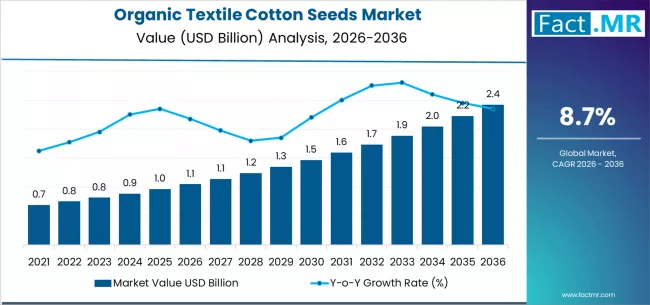
The global market for organic textile cotton seeds is experiencing a transformative phase driven by the convergence of ethical consumerism and regenerative agriculture, projected to expand from USD 1.05 billion in 2026 to USD 2.42 billion by 2036, advancing at an 8.7% CAGR. This growth trajectory is fundamentally linked to the apparel industry's structural shift toward transparent, sustainable supply chains and the corresponding need for identity-preserved, non-GMO seed systems.
Global organic textile cotton seeds market revenue stood at USD 1.05 billion in 2026 and is forecast to reach USD 2.42 billion by 2036.
At aCAGRof 8.7% from 2026 to 2036, this market adds USD 1.37 billion in absolute opportunity, growing ~2.30x in value.
Growth is driven by the apparel industry's structural shift toward transparent, sustainable supply chains requiring identity-preserved, non-GMO seed systems.
The market's evolution is characterized by dedicated breeding programs for organic-specific cultivars,blockchain-based traceability, and integration of seed sourcing with organic certification protocols.
Demand and Growth Drivers
Binding commitments from major apparel and home textile brands to source 100% sustainable or organic cotton within ambitious timelines are creating guaranteed premium-paying markets for farmers.
Governmental and NGO support for regenerative agriculture provides technical and financialassistancefor the transition to organic systems, including seed procurement.
Consumer demand for fully traceable, ethically produced textiles is reinforcing farm-level investment in certified organic seeds.
Regulatory pressure to reduce nutrient runoff and manage livestock wastefavorscertified organic inputs over conventional alternatives.
Revival and commercialization of regionally adapted heirloom and open-pollinated varieties, enabling farmer-saved seed options, are broadening accessibility.
Product and Segment View
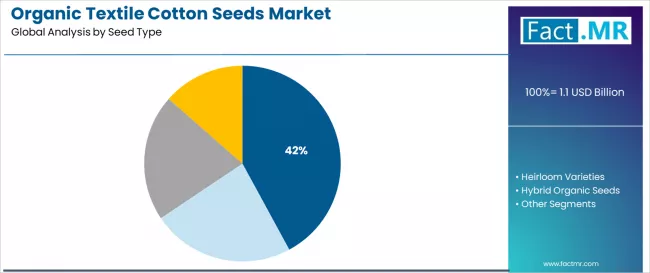
Open-pollinated varieties lead the seed type segment with 42% market share in 2026,cornerstoningtraditional and cost-accessible organic farming by enabling farmer-saved seed practices.
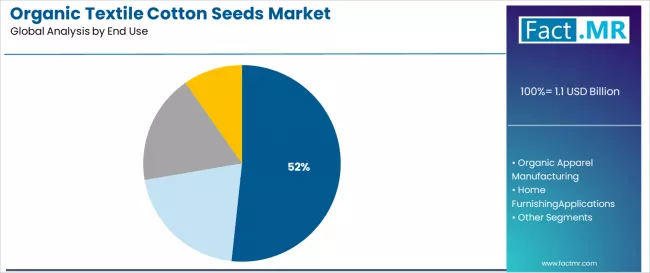
Textile cotton production dominates the end-use segment with 51.7% share in 2026, encompassing the entire agricultural phase where seed choicedeterminescertification integrity of raw organic lint.
Additionalseed type segments include Heirloom Varieties and Hybrid Organic Seeds.
End-use segments also include Organic Apparel Manufacturing and Home Furnishing Applications.
Geography and Competitive Outlook
Key growth regions include North America, Latin America, Western Europe, Eastern Europe, East Asia, South Asia & Pacific, and Middle East & Africa.
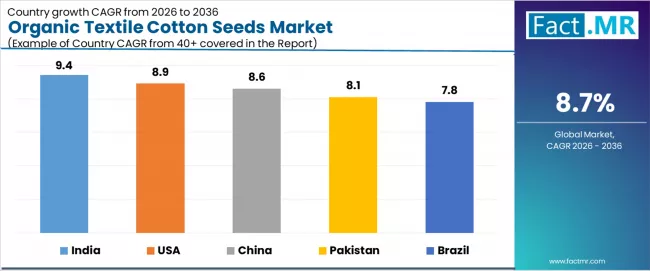
India leads country-level growth at 9.4%CAGR,fueledby its position as the world's largest organic cotton producer, supported by vast smallholder networks and brand partnerships.
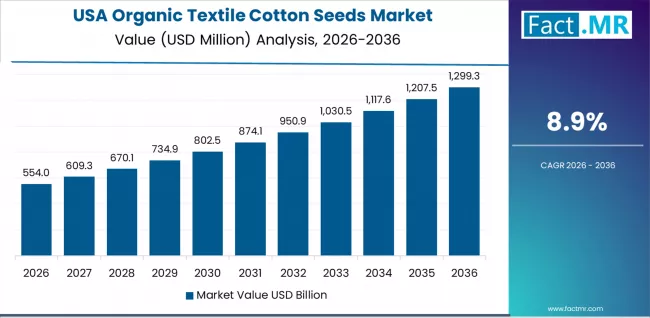
USA (8.9%CAGR) driven by domestic brand commitments, large-scale mechanized organic farms, and premium denim and apparel manufacturer specifications.
China (8.6%CAGR) linked to its dual role as major textile manufacturer and growing organic cotton producer seeking supply chain control and quality.
Brazil (7.8%CAGR) driven by large-scale agricultural sectorchannelingland toward certified organic production for export markets.
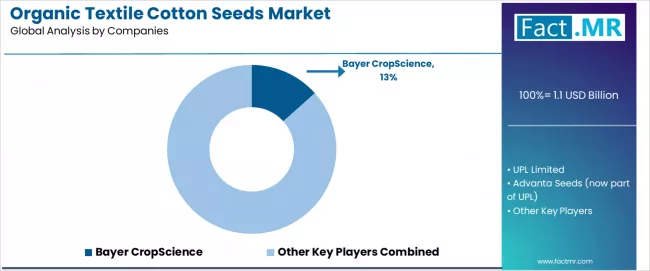
Key companies active in this market include BayerCropScience,UPLLimited,AdvantaSeeds (now part ofUPL), andNuseed(Tamar Seeds).
Organic Textile Cotton Seeds Market — At a Glance
Attribute
Details
Market Value 2026
USD 1.05 Billion
Market Value 2036
USD 2.42 Billion
Absolute DollarOpportunity 2026-2036
USD 1.37 Billion
Total Growth 2026-2036
130.48%
CAGR2026-2036
8.7%
Growth Multiple
~2.30x
Key Demand Theme
Structural apparel industry shift toward identity-preserved, non-GMO organic cotton seed systems with full supply chain traceability and certification integrity
Leading Segment by Seed Type (2026)
Open-Pollinated Varieties
Seed Type Segment Share (2026)
42%
Leading Segment by End Use (2026)
Textile Cotton Production
End Use Segment Share (2026)
51.7%
Key Growth Regions
North America, Latin America, Western Europe, Eastern Europe, East Asia, South Asia & Pacific, Middle East & Africa
CountryCAGRs
India 9.4%, USA 8.9%, China 8.6%, Brazil 7.8%
Top Companies
BayerCropScience,UPLLimited,AdvantaSeeds (now part ofUPL),Nuseed(Tamar Seeds)
Textile Cotton Production, Organic Apparel Manufacturing, Home Furnishing Applications, Others
Segmentation by Region
North America, Latin America, Western Europe, Eastern Europe, East Asia, South Asia & Pacific, Middle East & Africa
Source: Fact.MR analysis. Updated Apr 10, 2026
The market's evolution is characterized by the critical development of seed varieties specifically bred for organic systems, prioritizing traits like vigorous early growth for weed competition, natural resistance to sucking pests, and enhanced nutrient-use efficiency under lower-input conditions. Key trends include the strategic revival and commercialization of regionally adapted heirloom and open-pollinated varieties that offer genetic diversity and farmer-saved seed options, countering the reliance on hybrid annual purchases. Concurrently, dedicated breeding programs are producing proprietary organic hybrids that deliver improved fiber strength and yield stability without genetic modification. The market is further defined by the integration of seed sourcing with organic certification protocols, where traceability from seed to bale becomes a mandatory component of brand assurance. This specialization transforms cotton seed from a generic input into a branded, value-capturing asset at the very origin of the sustainable textile value chain.
Textile Cotton Production, Organic Apparel Manufacturing, Home Furnishing Applications, Others
Region
North America, Latin America, Western Europe, Eastern Europe, East Asia, South Asia & Pacific, MEA
Source: Fact.MR analysis. Updated Apr 10, 2026
Segmental Analysis
By Seed Type, Which Segment Forms the Genetic Backbone of Organic Systems?
Organic Textile Cotton Seeds Market Analysis By Seed Type | Source: Fact.MR
Open-pollinated varieties hold a leading 42% market share, representing the cornerstone of traditional and cost-accessible organic farming. Their dominance is rooted in the right of farmers to save and replant seeds, reducing annual input costs and fostering on-farm adaptation through selection.
These varieties often possess inherent resilience and are critical for maintaining genetic diversity within organic cotton production, particularly among smallholder farmers and in regions where the organic premium must offset potentially lower yields compared to conventional hybrids.
By End Use, Which Segment is the Primary Market Driver?
Organic Textile Cotton Seeds Market Analysis By End Use | Source: Fact.MR
Textile cotton production is the dominant end-use segment, accounting for 51.7% of the market. This segment encompasses the entire agricultural production phase, where the choice of seed directly determines the quality, volume, and certification integrity of the raw organic lint.
Demand here is driven by the contractual requirements of brands and spinners who mandate the use of certified organic seeds as the non-negotiable first link in a compliant supply chain, making seed selection the foundational decision for organic cotton cultivation.
What are the Drivers, Restraints, and Key Trends of the Organic Textile Cotton Seeds Market?
The primary market driver is the binding commitment from major apparel and home textile brands to source 100% sustainable or organic cotton within ambitious timelines. This corporate demand creates guaranteed, often premium-paying, markets for farmers, incentivizing investment in certified organic seeds. Simultaneously, governmental and NGO support for regenerative agriculture practices provides technical and financial assistance for the transition to organic systems, which includes seed procurement. Consumer awareness and demand for fully traceable, ethically produced textiles further solidify market growth.
A significant market restraint is the substantial yield gap that can exist between organic and conventional cotton systems, especially during a multi-year transition period, posing economic risk to farmers. The limited availability of high-performing, regionally optimized organic seed varieties compared to the conventional portfolio constrains productivity. Stringent and costly certification processes for both seed production and organic farming act as a barrier to entry. Contamination risk from genetically modified cotton pollen remains a persistent threat to the purity and marketability of the organic crop.
Key trends include the dedicated breeding of organic-specific cultivars with enhanced biotic and abiotic stress tolerance. Blockchain and DNA fingerprinting technologies are being deployed for seed traceability and variety verification. There is growing interest in participatory plant breeding models that involve organic farmers directly in the selection process. Furthermore, seed companies are increasingly offering integrated agronomic support packages alongside seed sales, providing organic pest and soil management guidance to ensure crop success and strengthen customer loyalty.
Analysis of the Organic Textile Cotton Seeds Market by Key Countries
Organic Textile Cotton Seeds Market Cagr Analysis By Country | Source: Fact.MR
Country
CAGR (2026-2036)
India
9.4%
USA
8.9%
China
8.6%
Pakistan
8.1%
Brazil
7.8%
Source: Fact.MR analysis. Updated Apr 10, 2026
How is India's Established Organic Cotton Leadership and Smallholder Base Shaping the Market?
India's leading CAGR of 9.4% is fueled by its position as the world's largest producer of organic cotton, supported by a vast network of smallholder farmers organized under contract farming or fair-trade initiatives. The market is driven by strong NGO and brand partnerships that facilitate access to certified non-GMO seeds.
Demand is particularly high for reliable open-pollinated and hybrid organic varieties suited to diverse agro-climatic zones, with a focus on reducing the cost of cultivation and securing fair premiums for farmers.
What is the Impact of the USA's Brand-Driven Demand and Large-Scale Organic Farming?
Organic Textile Cotton Seeds Market Country Value Analysis | Source: Fact.MR
The USA's 8.9% growth is driven by domestic brand commitments and the presence of large-scale, mechanized organic farms, particularly in Texas. The market demands high-yielding, mechanization-compatible organic seed varieties with excellent fiber quality metrics to meet the specifications of premium denim and apparel manufacturers. US growers prioritize genetic purity and seed treatments approved for organic use, with a strong emphasis on supply chain traceability from field to gin.
Why is China's Focus on Supply Chain Control and Quality Influencing Adoption?
China's 8.6% CAGR is linked to its dual role as a major textile manufacturer and a growing producer of organic cotton for both export and its domestic eco-conscious market. Chinese authorities and large vertically integrated textile companies seek greater control over raw material quality, driving investment in dedicated organic seed production and breeding programs. The focus is on developing varieties with high fiber strength and length suitable for advanced spinning, ensuring the competitive quality of finished organic textiles.
How is Pakistan's Textile-Centric Economy and Water Challenges Driving Seed Selection?
Pakistan's 8.1% growth is propelled by its export-oriented textile industry's need to meet international sustainability standards. Water scarcity makes drought-tolerant characteristics a critical breeding target for organic seeds.
The market is evolving from informal seed saving to more structured systems providing certified organic seeds that ensure yield stability and fiber consistency, which are crucial for maintaining the reputation and compliance of Pakistan's textile exports in key Western markets.
What Role Does Brazil's Large-Scale Agriculture and Export Focus Play?
Brazil's 7.8% growth occurs within its large-scale, technologically advanced agricultural sector, which is increasingly channeling land toward certified organic production for export markets. Brazilian growers require organic seeds that deliver performance in tropical conditions and align with integrated pest management strategies.
The market favors seeds from companies that can provide agronomic support for organic systems at scale and guarantee the documentation required for international organic certification audits.
Competitive Landscape of the Organic Textile Cotton Seeds Market
Organic Textile Cotton Seeds Market Analysis By Company | Source: Fact.MR
The competitive landscape features a mix of global agricultural giants with dedicated organic seed divisions and regional specialists focused on non-GMO and organic breeding. Competition centers on germplasm specifically adapted to organic growing conditions, the robustness of identity preservation systems to ensure non-GMO purity, and the strength of partnerships with brands and farmer collectives.
Success depends on providing a compelling value proposition that includes not just the seed, but also the technical support and market linkages that reduce risk for organic farmers and ensure reliable supply for brands.
Key Players in the Organic Textile Cotton Seeds Market
Textile Cotton Production, Organic Apparel Manufacturing, Home Furnishing Applications, Others
Key Countries
India, USA, China, Pakistan, Brazil
Key Companies
Bayer CropScience, UPL Limited, Advanta Seeds (now part of UPL), Nuseed (Tamar Seeds)
Additional Analysis
Agronomic performance trials of organic vs. conventional seed varieties; economic analysis of farmer profitability in organic seed systems; supply chain models for identity-preserved seed production; impact of organic seed on fiber quality and processing efficiency; policy and subsidy frameworks supporting organic seed adoption.
Source: Fact.MR analysis. Updated Apr 10, 2026
Market by Segments
Seed Type :
Open-Pollinated Varieties
Heirloom Varieties
Hybrid Organic Seeds
Others
End Use :
Textile Cotton Production
Organic Apparel Manufacturing
Home Furnishing Applications
Others
Region :
North America
USA
Canada
Latin America
Brazil
Mexico
Argentina
Rest of Latin America
Western Europe
Germany
UK
France
Spain
Italy
BENELUX
Rest of Western Europe
Eastern Europe
Russia
Poland
Czech Republic
Rest of Eastern Europe
East Asia
China
Japan
South Korea
Rest of East Asia
South Asia & Pacific
India
Pakistan
ASEAN
Australia
Rest of South Asia & Pacific
MEA
Saudi Arabia
UAE
Turkiye
Rest of MEA
References
Eyhorn, F., & Mahendran, P. (2024). Organic cotton production: Agronomic performance and economic viability in smallholder systems. Agricultural Systems, 215, 103855.
Forster, D., & Andres, C. (2023). Seed systems in organic agriculture: Challenges and innovations for genetic diversity. Renewable Agriculture and Food Systems, 38(2), 145-158.
Hubbard, K., & Zystro, J. (2024). The role of heirloom and open-pollinated seeds in resilient farming systems. Elementa: Science of the Anthropocene, 12(1), 00123.
Khan, M. M., & Azam, F. (2023). Fiber quality traits of organically grown cotton genotypes: A comparative study. Journal of Natural Fibers, 20(1), 2157823.
Loker, A., & Levi, A. (2024). Breeding cotton for organic systems: Prioritizing plant vigor and natural resistance. Crop Science, 64(3), 1124-1136.
Mendoza, T. C., & Samian, M. F. (2023). The economics of non-GMO and organic seed in the global cotton value chain. Journal of New Seeds, 24(3-4), 189-207.
Parrott, N., & Marsden, T. (2024). Re-localizing seed systems: The case of organic cotton in India. Sociologia Ruralis, 64(1), 45-67.
Rasmussen, I. A., & Sønderskov, M. (2023). Managing weeds and pests in organic cotton: The critical role of variety choice. Weed Research, 63(2), 89-102.
Ton, P., & van der Zee, J. (2024). Traceability and transparency in the organic textile chain: The seed-to-garment model. Business Strategy and the Environment, 33(4), 2345-2360.
Willer, H., & Lernoud, J. (2023). The world of organic agriculture: Statistics and emerging trends 2023. Research Institute of Organic Agriculture (FiBL), Frick.
Questions Answered
Frequently Asked Questions
How big is the organic textile cotton seeds market in 2026?
The global organic textile cotton seeds market is estimated to be valued at USD 1.1 billion in 2026.
What will be the size of organic textile cotton seeds market in 2036?
The market size for the organic textile cotton seeds market is projected to reach USD 2.4 billion by 2036.
How much will be the organic textile cotton seeds market growth between 2026 and 2036?
The organic textile cotton seeds market is expected to grow at a 8.7% CAGR between 2026 and 2036.
What are the key product types in the organic textile cotton seeds market?
The key product types in organic textile cotton seeds market are open-pollinated varieties, heirloom varieties, hybrid organic seeds and others.
Which end use segment to contribute significant share in the organic textile cotton seeds market in 2026?
In terms of end use, textile cottonproduction segment to command 51.7% share in the organic textile cotton seeds market in 2026.