- Market Value (2025): USD 1.7 Bn
- Estimated Value (2026): USD 1.9 Bn
- Forecast Value (2036): USD 5.9 Bn
- CAGR (2026-2036): 12.0%
What is the Paper Straw Market forecast to be worth by 2036?
The Paper Straw Market is valued at USD 1.9 billion in 2026 and is projected to reach USD 5.9 billion by 2036, expanding at a 12.0% CAGR during the forecast period.
- The market was valued at USD 1.7 billion in 2025.
- Demand is projected to increase from USD 1.9 billion in 2026 to USD 5.9 billion by 2036.
- The market is forecast to expand at a 12.0% CAGR from 2026 to 2036.
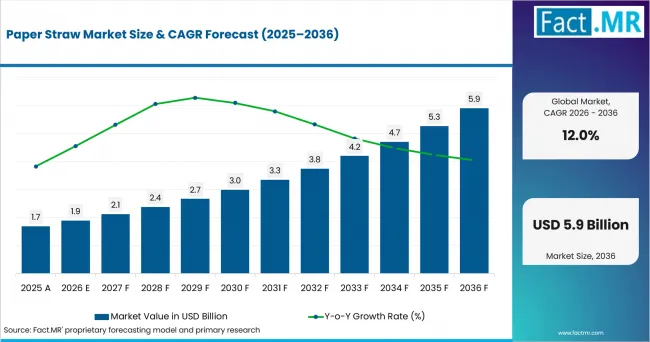
Paper Straw Market Value Analysis | Source: Fact.MR
What are the defining numbers behind Paper Straw Market growth?
The market is expected to add USD 4.0 billion in absolute opportunity between 2026 and 2036.
- Demand Drivers in the Market
- Restrictions on single-use plastic straws are pushing foodservice operators toward paper and other non-plastic options. In the EU, plastic straws are covered by restrictions on placing certain single-use plastic products on the market, while England also restricts their supply except in defined cases. This makes straw selection part of broader sustainable packaging decisions.
- Restaurants, cafés and hospitality venues replenish straws continuously as drinks are served. Once a chain approves a particular specification, the same format can be ordered across many outlets and becomes part of its wider foodservice packaging program.
- Paper straw performance is improving as manufacturers refine paper layers, winding and adhesive systems. Better rigidity during the normal drinking period helps address one of the main practical objections to paper formats: softening too quickly in the beverage.
- Printed paper straws also give beverage brands a simple way to match serving presentation with brand colors, events or seasonal campaigns. Food-safe printing systems make this possible without turning the straw into a separate promotional item.
- Large buyers also need confidence that the paper and other materials used in the straw are suitable for direct food contact. Traceable fibre, documented food-safe inputs and consistent conversion quality make suppliers easier to approve across multi-site foodservice operations.
- Key Segments Analyzed
- Product: Printed Paper Straws account for 72.6% of the market in 2026. Their lead reflects the value of customization, branding and visual coordination for foodservice and beverage programs without changing the basic disposable-straw workflow.
- Material: Virgin Paper accounts for 59.7% of the market in 2026. Converters favor its consistent fibre furnish, predictable winding behavior and controlled contamination history when producing food-contact straws at scale.
- Application: Foodservice accounts for 42.3% of the market in 2026. Restaurants, cafés, beverage outlets and hospitality venues generate repeated straw use and are directly exposed to plastic-reduction policies and corporate packaging specifications.
- Analyst Opinion at Fact.MR
- Shambhu Nath Jha, Principal Consultant, Fact.MR, states, “Paper-straw procurement is moving from a simple plastic-replacement decision to a performance and specification decision. Foodservice buyers need a straw that keeps rigidity through the beverage-use window, meets food-contact requirements and can be supplied at chain scale. Suppliers that combine stable multilayer converting, certified fibre and reliable custom printing are positioned to win repeat contracts as plastic restrictions broaden.”
- Strategic Implications
- Converters should optimize ply count, paper basis weight and adhesive application around drink dwell time rather than using one construction for every beverage format.
- Foodservice chains should qualify paper straws by beverage viscosity, straw diameter, serving temperature and expected consumption time so that performance failures do not trigger a return to alternative materials.
- Printed programs need controlled ink systems and repeatable prepress quality because brand colors and graphics sit on an item that is used in direct proximity to food and drink.
- Fibre traceability, certification and supply redundancy are becoming procurement controls alongside unit price as multi-site buyers seek consistent specifications across regions.
How does the Paper Straw Market break down by segment?
The market is analyzed by Product, Material and Application.
Why do Printed Paper Straws lead Product?
Printed Paper Straws account for 72.6% of the Product segment in 2026.
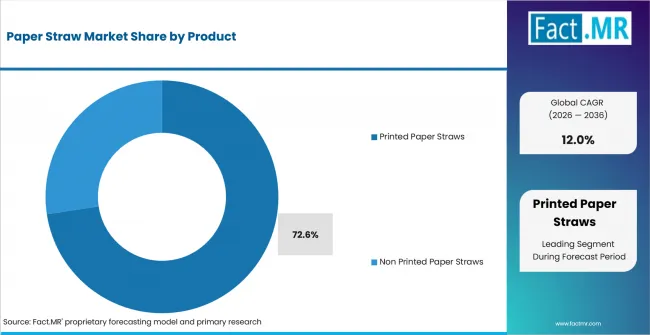
Paper Straw Market Analysis By Product | Source: Fact.MR
Printing also gives buyers a way to coordinate a small serving accessory with cups, sleeves and other paper cutlery or disposable service items. BioPak UK, for example, describes printed paper straw products made with flexographic printing and food-contact-safe inks, showing that branding can be built into a direct-contact serving format.
Why does Virgin Paper lead Material?
Virgin Paper accounts for 59.7% of the Material segment in 2026.
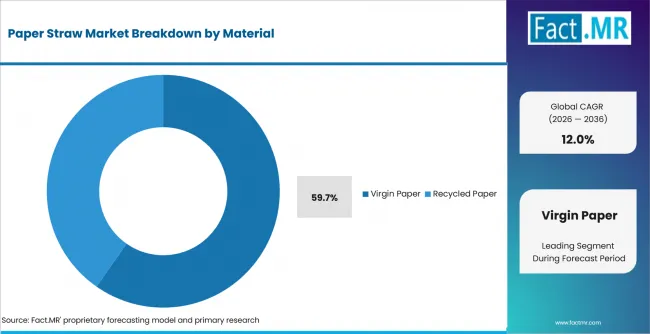
Paper Straw Market Analysis By Material | Source: Fact.MR
For procurement teams, predictable raw paper reduces variation in wall integrity, printing response and adhesive performance. The same quality logic is important across paper packaging where fibre consistency affects converting efficiency and finished-product performance.
Why does Foodservice lead Application?
Foodservice accounts for 42.3% of the Application segment in 2026.
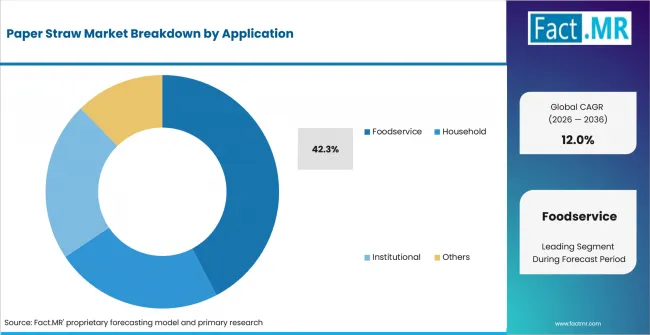
Paper Straw Market Analysis By Application | Source: Fact.MR
The regulatory mechanism is also concentrated in this channel. Germany prohibits placing specified single-use plastic products including drinking straws on the market, England restricts the supply of single-use plastic straws subject to exemptions, and São Paulo prohibits plastic straws across hotels, restaurants, bars, bakeries and other commercial establishments while explicitly permitting recyclable paper alternatives. These rules push operators to qualify replacement formats that can be ordered reliably at outlet scale.
What is accelerating Paper Straw Market adoption, and what is holding it back?
Adoption is being accelerated by plastic-straw restrictions, chain-level material substitution, custom-print demand and better paper-straw performance. The opportunity expands when converters can serve premium beverage formats, institutional buyers and biodegradable packaging programs with documented fibre and food-contact specifications. The main constraints are rapid softening in prolonged use, a unit-cost premium versus conventional plastic in price-sensitive settings, compliance complexity around inks and bonding systems, and the growth of strawless lids or reusable formats in some beverage-service occasions.
Drivers Impact Analysis
| Factor | (~) % Impact on CAGR | Geographic Relevance | Impact Timeline |
|---|---|---|---|
| Plastic-straw restrictions and formal reduction rules | +1.7% | Europe, U.K., Japan and selected U.S./Brazil markets | Short term (≤2 years) |
| Foodservice substitution across restaurants, cafés and hospitality | +1.4% | Global | Short term (≤2 years) |
| Custom-printed straw procurement by beverage and foodservice brands | +1.0% | North America, Europe and Asia | Medium term (2–4 years) |
| Higher wet-strength multi-ply paper performance | +0.8% | Global | Medium term (2–4 years) |
| Certified fibre and food-contact qualification | +0.6% | Europe, North America and Japan | Long term (≥4 years) |
Opportunity Impact Analysis
| Factor | (~) % Impact on CAGR | Geographic Relevance | Impact Timeline |
|---|---|---|---|
| Custom printing and private-label programs | +0.9% | Global | Medium term (2–4 years) |
| High-durability formats for smoothies, specialty drinks and cocktails | +0.7% | North America, Europe and East Asia | Medium term (2–4 years) |
| Institutional procurement in schools, healthcare and offices | +0.6% | Europe, USA and Japan | Long term (≥4 years) |
| Recycled-paper designs that meet food-contact and performance requirements | +0.4% | Europe, Brazil and USA | Long term (≥4 years) |
Restraints Impact Analysis
| Factor | (~) % Impact on CAGR | Geographic Relevance | Impact Timeline |
|---|---|---|---|
| Softening, sogginess and mouthfeel concerns during prolonged use | -1.0% | Global | Short term (≤2 years) |
| Unit-cost premium versus conventional bulk alternatives | -0.8% | Price-sensitive markets | Short term (≤2 years) |
| Food-contact, ink, adhesive and coating compliance complexity | -0.6% | Europe, USA and Japan | Medium term (2–4 years) |
| Strawless lids and reusable formats reducing straw occasions | -0.5% | Developed foodservice markets | Long term (≥4 years) |
Which countries are scaling the Paper Straw Market through 2036?
- Germany: National restrictions on placing single-use plastic drinking straws on the market make material replacement structural in beverage service. Buyers increasingly focus on food-contact documentation, certified paper and predictable wet strength when qualifying paper alternatives.
- Brazil: São Paulo’s municipal law prohibits plastic straws in hotels, restaurants, bars, bakeries and related venues and explicitly permits recyclable paper straws. Dense urban foodservice and event channels therefore provide a direct substitution pathway for paper formats.
- USA: There is no single nationwide plastic-straw ban, but state and local rules influence foodservice behavior. California’s rules requiring single-use foodware accessories to be supplied on request reduce default distribution and encourage chain operators to standardize alternative serving formats across multiple jurisdictions.
- U.K.: England has restricted the supply of single-use plastic straws since October 2020, with defined exemptions. Foodservice buyers need paper formats that can function reliably in high-throughput takeaway, café, pub and hospitality settings.
- Japan: The Plastic Resource Circulation framework includes drinking straws among specified plastic-use products and applies to service sectors such as restaurants, lodging and retail. Official guidance identifies paper straws as an example of a measure that can reduce specified plastic use.
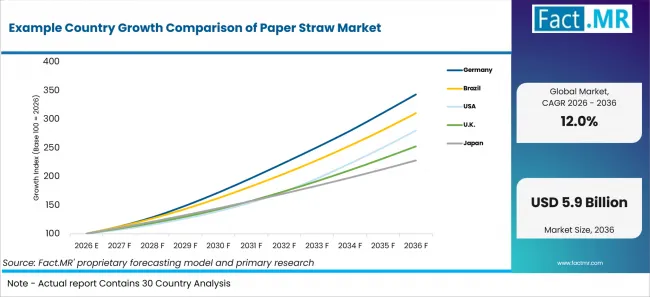
Example Country Growth Comparison Of Paper Straw Market | Source: Fact.MR
| Country | CAGR, 2026-2036 |
|---|---|
| Germany | 13.1% |
| Brazil | 12.0% |
| USA | 10.9% |
| U.K. | 9.7% |
| Japan | 8.6% |
What is driving Germany's growth through 2036?
Germany is projected to expand at a 13.1% CAGR from 2026 to 2036.
The country’s Einwegkunststoffverbotsverordnung has prohibited the placing on the market of specified single-use plastic products including drinking straws since 3 July 2021, translating EU single-use-plastic policy into a direct commercial constraint on conventional plastic formats.
For paper-straw suppliers, the demand mechanism is qualification and replenishment rather than a one-time regulatory switch. Restaurants, cafés, catering operators and distributors need alternatives with stable wet strength, food-contact suitability and dependable case supply. German buyers also operate within a packaging environment that places strong attention on fibre sourcing and compliance documentation, making consistent paper specifications important for repeat contracts.
What is driving Brazil's growth through 2036?
Brazil is projected to expand at a 12.0% CAGR from 2026 to 2036.
São Paulo’s Law No. 17.123 prohibits the provision of plastic straws to customers in hotels, restaurants, bars, bakeries and other commercial establishments, and its scope also extends to nightlife and musical events. The law explicitly allows recyclable paper, edible or biodegradable straw alternatives.
This creates a practical opening for paper straws in urban foodservice, entertainment and hospitality. Suppliers that can provide individually wrapped products, high-throughput restaurant packs and durable larger-diameter formats can address different serving occasions. The main commercial challenge is balancing price with rigidity in a market where foodservice operators remain sensitive to consumable costs.
What is driving USA's growth through 2036?
The USA is projected to expand at a 10.9% CAGR from 2026 to 2036.
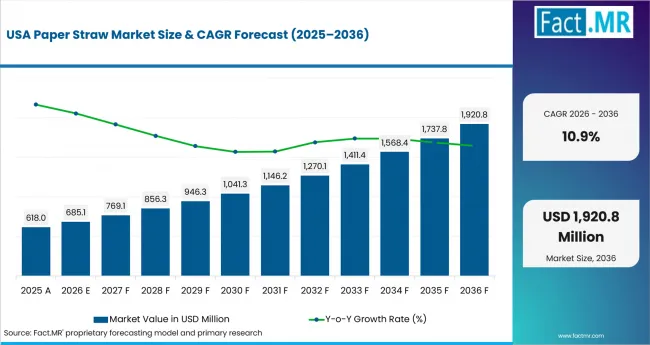
Paper Straw Market Country Value Analysis | Source: Fact.MR
Demand is shaped by a patchwork of state, municipal and corporate foodservice policies rather than one federal straw rule. California’s AB 1276 expanded the requirement that plastic straws be distributed only on request to cover single-use foodware accessories and standard condiments supplied by food facilities and delivery platforms.
For national restaurant and beverage chains, fragmented rules can still support broad paper-straw specifications because using a common approved alternative across locations simplifies procurement, staff training and packaging inventories. The U.S. market also rewards format breadth, including wrapped straws for hygiene-sensitive locations, larger diameters for specialty drinks and custom printing for branded service programs.
What is driving U.K.'s growth through 2036?
The U.K. is projected to expand at a 9.7% CAGR from 2026 to 2036.
Paper-straw demand is therefore tied to daily operating reliability in cafés, pubs, quick-service restaurants, takeaway counters and hospitality venues. Printed formats can support brand presentation, but buyers still need the straw to retain structure for the expected drink-consumption window. Suppliers that pair consistent converting with food-contact-safe printing and dependable distribution are better aligned with multi-site operator requirements.
What is driving Japan's growth through 2036?
Japan is projected to expand at an 8.6% CAGR from 2026 to 2036.
Under the Plastic Resource Circulation framework, drinking straws are included among 12 specified plastic-use products provided with goods or services. The framework covers sectors including retail, lodging, restaurants, takeout and delivery, and government guidance cites the provision of paper straws as one option for reducing specified plastic use.
This encourages operator-led substitution without requiring every outlet to follow an identical material specification. Paper-straw suppliers can compete through precise dimensions, individual wrapping, clean appearance and reliable performance suited to convenience, café and hospitality channels. Consistency is especially important where service standards and packaging presentation are tightly controlled.
Who Leads the Paper Straw Market?
Key players in the Paper Straw Market include Huhtamäki, Bygreen, Charta Global, Inc., OkStraw Paper Straws, Footprint LLC, BioPak UK, UFlex Limited, Hoffmaster Group Inc., The Paper Straw Co, Transcend Packaging Ltd. and Canada Brown Eco Products Ltd.
Competition is increasingly about whether a paper straw performs consistently in the drink and can be supplied at foodservice scale. Buyers compare wet strength and diameter options, but they also look at wrapping formats, food-contact compliance and fibre sourcing because a weak or rapidly softening straw can affect the consumer experience immediately.
Huhtamaki competes through certified fibre and food-safety documentation. Its current paper straws use 100% PEFC-certified paper, while the company states that its unprinted products have been tested for food safety in Europe, China and the USA. This matters for restaurant chains and beverage companies that need the same specification to work across several markets.
BioPak takes a more specification-led approach. Its UK range includes 3-ply FSC Mix paper straws with different diameters for standard drinks and thicker beverages. The company also lists flexographic printing with food-contact-safe inks, allowing foodservice buyers to combine functional requirements with branded presentation.
Transcend Packaging shows how competition is moving beyond the basic straight paper straw. Its range spans diameters from 3.5 mm to 12 mm and includes bendable formats, piercing straws and products developed for foil-sealed cups. The company has also developed a 4.2 mm straw intended as a direct replacement for plastic formats without requiring bottlers or co-packers to change existing equipment. This makes machinery compatibility a practical competitive advantage, especially for high-volume beverage packaging.
Material engineering remains another area of differentiation. Transcend has developed coated paper straws intended to improve rigidity and moisture resistance while retaining compatibility with paper recycling streams. Such developments address the consumer complaint that paper straws can soften or split before the drink is finished.
Which companies are the key providers?
The market assessment includes Huhtamäki, Bygreen, Charta Global, Inc., OkStraw Paper Straws, Footprint LLC, BioPak UK, UFlex Limited, Hoffmaster Group Inc., The Paper Straw Co, Transcend Packaging Ltd. and Canada Brown Eco Products Ltd.
- Huhtamäki
- Bygreen
- Charta Global, Inc.
- OkStraw Paper Straws
- Footprint LLC
- BioPak UK
- UFlex Limited
- Hoffmaster Group Inc.
- The Paper Straw Co
- Transcend Packaging Ltd.
- Canada Brown Eco Products Ltd.
Bibliography
- European Parliament and Council of the European Union. (2019). Directive (EU) 2019/904 on the reduction of the impact of certain plastic products on the environment. Official Journal of the European Union.
- Federal Ministry of Justice, Germany. (2021; amended 2026). Einwegkunststoffverbotsverordnung (EWKVerbotsV), including restrictions on single-use plastic drinking straws.
- Department for Environment, Food & Rural Affairs, GOV.UK. (2020). Start of ban on plastic straws, stirrers and cotton buds.
- Department for Environment, Food & Rural Affairs, GOV.UK. (2024). Single-use plastics bans and restrictions.
- Ministry of the Environment, Government of Japan. Plastic Resource Circulation Act portal: Rational Use of Specified Plastic Products.
- Prefeitura de São Paulo. (2019). Lei No. 17.123, de 25 de Junho de 2019, prohibiting the provision of plastic straws in specified commercial establishments.
- California Department of Resources Recycling and Recovery (CalRecycle). History of California Solid Waste Law: AB 1276, Single-Use Foodware Accessories and Standard Condiments.
- Huhtamaki. Sustainable paper straws: product materials and food-safety information.
- BioPak UK. Paper BioStraws: printed paper-straw construction and food-contact ink specifications.
- Billerud. (2019). BillerudKorsnäs and The Paper Straw Co to launch the first U-Bend paper straw.
This Report Answers
- Which paper-straw product formats carry the strongest commercial demand, and why does customization matter?
- Why does Virgin Paper remain central to paper-straw converting even as recycled content gains attention?
- How do foodservice purchasing cycles translate plastic-straw substitution into recurring paper-straw demand?
- How are country-level plastic-reduction rules shaping paper-straw adoption across Germany, Brazil, USA, U.K. and Japan?
- Which technical and procurement capabilities differentiate paper-straw suppliers in repeat foodservice contracts?
What does the Paper Straw Market cover?
The Paper Straw Market covers complete, ready-to-use drinking straws manufactured predominantly from paper and sold for beverage consumption. Revenue is counted when the finished straw is supplied to a foodservice operator, household channel, institution, retailer, distributor or other end user.
The assessment covers Product, Material and Application across the specified country markets. It includes both printed and non printed paper straws and recognizes differences in fibre source, straw construction, food-contact requirements and end-use setting.
What is included in the scope?
The scope includes standard and custom printed paper straws, non printed standard and premium paper straws, virgin-paper and recycled-paper constructions, and ready-to-use straws supplied in wrapped or unwrapped formats. Different lengths, diameters and ply constructions are included when paper remains the predominant structural material.
Applications include restaurants, cafés and beverage outlets, hospitality, household daily use, parties and events, educational institutions, healthcare facilities, corporate offices, entertainment venues, retail and convenience stores.
What is excluded from the scope?
The scope excludes conventional plastic straws and straws predominantly made from PLA or other polymer systems. Reusable metal, glass and silicone straws, as well as drinking straws made primarily from bamboo, wood, pasta or other non-paper materials, are outside the market definition.
Cups, lids, cutlery, stirrers and other foodservice accessories are excluded unless they are sold together only as packaging around the paper straw and the revenue can be attributed to the straw. Standalone printing, ink, adhesive, coating and converting-machine sales are also excluded.
How Was the Analysis Built?
The analysis combines public policy, foodservice demand mechanisms, supplier product portfolios and primary industry input across key consuming regions. Quantitative values, segment structure aand country growth rates are reconciled to a single market model so that the narrative and forecast remain consistent across sections.
- Primary Research: Interviews and commercial checks with paper converters, packaging suppliers, distributors, foodservice procurement teams and institutional buyers examine straw specifications, acceptable dwell time, printing requirements, certification needs, case-pack economics and switching barriers.
- Desk Research: The review covers government plastic-reduction rules, municipal regulations, foodservice packaging policy, supplier product specifications, fibre certification information and company disclosures. External sources used in the article are recorded in the bibliography.
- Market Sizing and Forecasting: Estimates combine beverage-service usage, straw replacement frequency, material substitution from plastic, product and material mix, application demand, unit pricing and country-level adoption conditions. The model separates recurring consumption from one-time switching effects.
- Data Validation and Update Cycle: Findings are cross-checked against regulatory status, supplier activity, product availability and buyer requirements. Updates account for changes in plastic restrictions, paper and converting costs, product performance, food-contact rules and the adoption of strawless or reusable formats.
Segmentation
What is the report's scope and coverage?
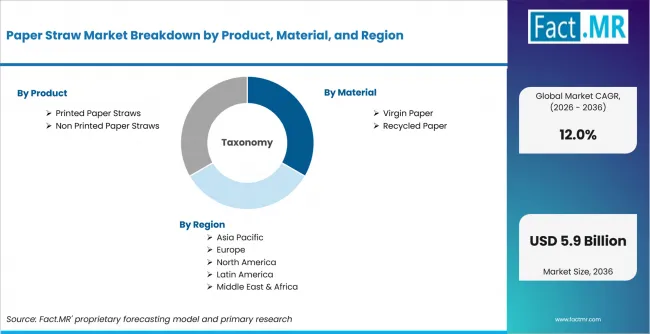
Paper Straw Market Breakdown By Product, Material, And Region | Source: Fact.MR
| Attribute | Details |
|---|---|
| Quantitative Units | USD billion |
| Market Definition | Disposable drinking straws manufactured predominantly from paper and supplied as finished beverage-serving products |
| Segments Covered | Product; Material; Application |
| Regions Covered | North America; Latin America; Europe; East Asia; South Asia and Pacific; Middle East and Africa |
| Countries Covered | Germany; Brazil; USA; U.K.; Japan |
| Key Companies Profiled | Huhtamäki; Bygreen; Charta Global, Inc.; OkStraw Paper Straws; Footprint LLC; BioPak UK; UFlex Limited; Hoffmaster Group Inc.; The Paper Straw Co; Transcend Packaging Ltd.; Canada Brown Eco Products Ltd. |
| Forecast Period | 2026 to 2036 |
| Base Year | 2025 |
| Market Value, 2026 | USD 1.9 billion |
| Market Value, 2036 | USD 5.9 billion |
| CAGR, 2026-2036 | 12.0% |
| Absolute Opportunity | USD 4.0 billion |
| Approach | Hybrid top-down and bottom-up model using beverage-service straw consumption, substitution from plastic, material and product mix, unit pricing, and country-level regulation and adoption |
How is the market segmented?
-
By Product:
- Printed Paper Straws
- Standard Printed Straws
- Custom Printed Straws
- Non Printed Paper Straws
- Standard Paper Straws
- Premium Paper Straws
- Printed Paper Straws
-
By Material:
- Virgin Paper
- Food Grade Virgin Paper
- FSC Certified Virgin Paper
- Recycled Paper
- Post Consumer Recycled Paper
- Pre Consumer Recycled Paper
- Virgin Paper
-
By Application:
- Foodservice
- Restaurants
- Cafes And Beverage Outlets
- Hospitality
- Household
- Daily Use
- Party And Events
- Institutional
- Educational Institutions
- Healthcare Facilities
- Corporate Offices
- Others
- Entertainment Venues
- Retail And Convenience Stores
- Foodservice
Frequently Asked Questions
What is the Paper Straw Market value in 2026?
At what CAGR is the market projected to grow?
What is the projected market value by 2036?
Which Product segment leads the market?
Which Material segment leads the market?
Which Application segment leads the market?
What CAGR is projected for Germany?
Which companies are included in the market assessment?
Who worked on this report


Preview the report firsthand - request a free sample
Free SampleGet the brochure for pricing and purchase details
Download PDF