- Market Value (2025): USD 13.5 Bn
- Estimated Value (2026): USD 14.2 Bn
- Forecast Value (2036): USD 22.9 Bn
- CAGR (2026-2036): 4.9%
What is the Specialty Uncoated Paper Label Market forecast to be worth by 2036?
USD 14.2 billion in 2026 to USD 22.9 billion by 2036, at a 4.9% CAGR.
- The specialty uncoated paper label market reached USD 13.5 billion in 2025.
- Demand is projected to increase from USD 14.2 billion in 2026 to USD 22.9 billion by 2036.
- The market is forecast to record 4.9% CAGR from 2026 to 2036 as food, beverage and logistics accounts standardize printable paper label formats.
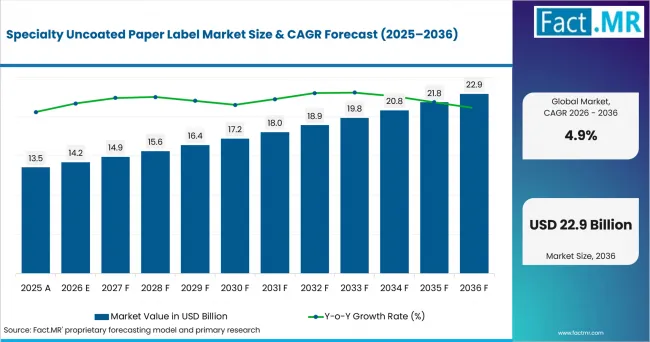
Specialty Uncoated Paper Label Market Value Analysis | Source: Fact.MR
What are the defining numbers behind Specialty Uncoated Paper Label Market growth?
An absolute opportunity of USD 8.7 billion is expected between 2026 and 2036.
- Demand Drivers in the Market
- Food manufacturers need labels that print cleanly on fast lines. USDA ERS reported on June 1, 2026 that U.S. food spending reached USD 2.51 trillion in 2025.
- Beverage producers use uncoated labels where texture supports premium packs. Destatis reported in February 2026 that German beer sales were roughly 7.8 billion litres in 2025.
- E-commerce shippers require clear barcodes. The U.S. Census Bureau reported in May 2026 that Q1 2026 retail e-commerce sales reached USD 326.7 billion.
- Packaging buyers are comparing uncoated labels with adjacent paper packaging materials where paper recovery, print quality and pack feel influence approval decisions.
- Key Segments Analyzed
- By Product: Pressure sensitive uncoated labels are expected to account for 43.8% share in 2026 due to roll-fed food and warehouse use.
- By Application: Food & beverage labeling is projected to represent 77.2% share in 2026 because packaged goods carry recurring label needs.
- By End Use: Food & beverage manufacturers are anticipated to capture 58.6% share in 2026 through repeat artwork and batch-identification programs.
- By Technology: Flexographic printing technology is estimated to hold 34.5% share in 2026 owing to press familiarity and run economics.
- By Formulation: Virgin fiber paper labels are forecast to lead with 69.4% share in 2026 due to print-surface consistency.
- By Distribution Channel: Direct manufacturer sales are expected to represent 51.7% share in 2026 through contract programs and artwork control.
- Analyst Opinion at Fact.MR
- Shambhu Nath Jha, Principal Consultant at Fact.MR, states, "Uncoated paper label demand is shaped by a practical packaging choice. Converters need material that prints reliably, while brands need a paper feel that matches fiber-based packs. The market is expected to reward suppliers that pair facestock quality with adhesive guidance and barcode support."
- Strategic Implications
- Paper mills should document fiber source, caliper and moisture behavior so converters can approve uncoated grades without repeated press trials.
- Label converters should offer artwork and press-setting guidance for industrial labels where compliance text and product identification require durable print.
- Adhesive suppliers should connect facestock choice with label adhesive and ink systems that support recyclability claims and cleaner pack recovery.
- Brand procurement teams should lock direct supply agreements for food and beverage lines where recurring SKU changes increase service needs.
Germany is projected to record 5.6% CAGR through 2036 on the back of packaging recycling discipline. Brazil is forecast at 5.1% CAGR as supermarket scale lifts label counts. USA is anticipated to post 4.7% CAGR due to grocery and e-commerce activity. UK is expected to reach 4.2% CAGR through food manufacturing. Japan is estimated at 3.7% CAGR as convenience retail supports barcode label use.
How does the Specialty Uncoated Paper Label Market break down by segment?
Food & beverage labeling leads Application at 77.2%; Virgin fiber paper labels lead Formulation at 69.4%.
Which Product dominates?
Pressure sensitive uncoated labels are expected to hold 43.8% share in 2026.
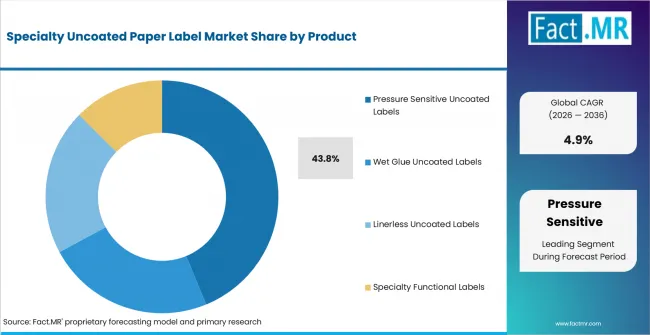
Specialty Uncoated Paper Label Market Analysis By Product | Source: Fact.MR
Pressure sensitive uncoated labels lead because they fit roll-fed converting and avoid wet-glue handling. Permanent and removable variants help brands match food, warehouse and retail labeling needs. Their straightforward application supports recurring packaging runs, while converters benefit from familiar paper handling, flexible adhesive choices and efficient changeovers across label programs.
What leads the Application segment?
Food & beverage labeling is projected to account for 77.2% share in 2026.
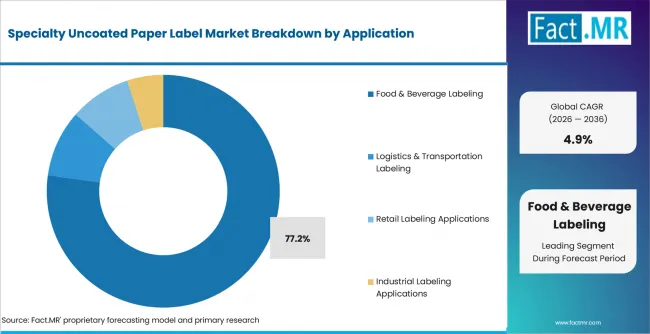
Specialty Uncoated Paper Label Market Analysis By Application | Source: Fact.MR
Food and beverage labeling leads because packaged products need identity, ingredient information and batch data. Uncoated paper gives converters a familiar print surface for recurring artwork changes. Defra reported that U.K. consumer expenditure on food and alcoholic drinks reached GBP 303.3 billion in 2025, highlighting the substantial scale of consumer spending across the U.K. food and drink market.
How does End Use shape demand?
Food & beverage manufacturers are anticipated to capture 58.6% share in 2026.
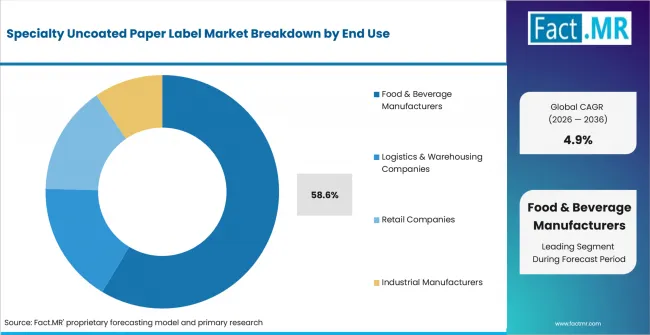
Specialty Uncoated Paper Label Market Analysis By End Use | Source: Fact.MR
Food and beverage manufacturers lead because they purchase labels through repeat packaging programs and prioritize caliper, registration and adhesive behavior. UPM Adhesive Materials introduced a removable label-material solution in September 2025, highlighting continued innovation in application-specific materials. Reliable specifications help manufacturers reduce relabeling costs and maintain packaging-line consistency.
What supports flexographic printing within Technology?
Flexographic printing technology is estimated to hold 34.5% share in 2026.
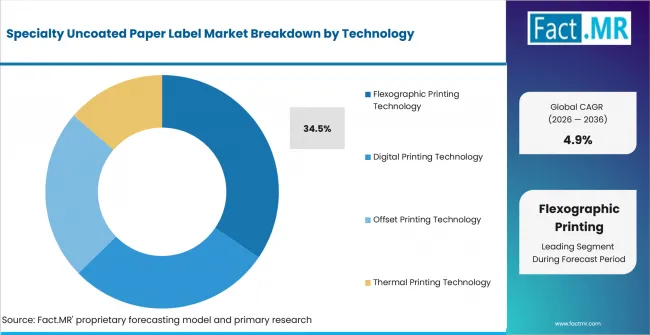
Specialty Uncoated Paper Label Market Analysis By Technology | Source: Fact.MR
Flexographic printing leads because it balances production speed, color control and cost across recurring label runs. Uncoated papers require predictable ink holdout and drying behavior to maintain print quality. Related coding and marking systems remain important where variable batch codes and production information must stay legible throughout distribution.
What leads Formulation?
Virgin fiber paper labels are forecast to hold 69.4% share in 2026.
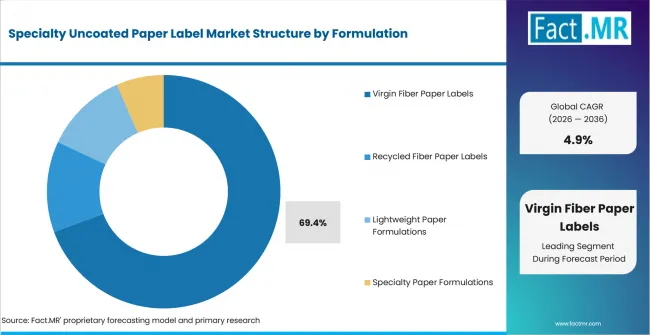
Specialty Uncoated Paper Label Market Analysis By Formulation | Source: Fact.MR
Virgin fiber paper labels lead because brightness, strength and surface uniformity remain important for packaged food and retail presentation. Recycled papers still serve applications where texture and sustainability positioning matter more than premium print quality. Converters are also reviewing deinkable label adhesives as paper-recovery requirements become more relevant during approvals.
How does Distribution Channel affect buying?
Direct manufacturer sales are expected to represent 51.7% share in 2026.
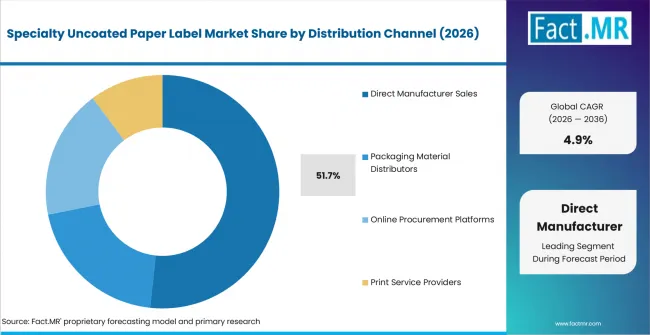
Specialty Uncoated Paper Label Market Analysis By Distribution Channel | Source: Fact.MR
Direct manufacturer sales lead because large accounts need artwork control, reliable stock allocation and tested specifications across recurring label programs. Contract supply reduces delays during seasonal, flavor and warehouse changes. Online portals suit standardized jobs such as linerless labels, while direct relationships remain preferred for customized materials and service requirements.
What is accelerating Specialty Uncoated Paper Label Market adoption, and what is holding it back?
Demand is expected to rise through food labeling, paper conversion and logistics identification. Growth is constrained by substrate costs and wet-pack performance.
| DRIVER | (~) % IMPACT ON CAGR | GEOGRAPHIC RELEVANCE | IMPACT TIMELINE |
|---|---|---|---|
| Packaged food and beverage label volume | +1.1% | North America, Europe, East Asia | Short term (<= 2 years) |
| Paper-based packaging conversion | +0.9% | Europe, North America | Medium term (2-4 years) |
| Direct thermal and barcode use in logistics | +0.7% | Global | Medium term (2-4 years) |
| Private-label and seasonal SKU refresh cycles | +0.5% | North America, Western Europe | Long term (= 4 years) |
Source: Fact.MR analysis. Updated Aug 20, 2026
- Packaged food and beverage label volume: Food processors need labels for ingredients, nutrition panels and product identification. Large retail spending pools keep order volume recurring.
- Paper-based packaging conversion: Sustainable food packaging programs are expected to lift interest in fiber-based label systems.
- Direct thermal and barcode use in logistics: Warehouses need readable carton and return labels because scan quality affects shipping accuracy.
| OPPORTUNITY | (~) % IMPACT ON CAGR | GEOGRAPHIC RELEVANCE | IMPACT TIMELINE |
|---|---|---|---|
| Recycling-ready label constructions | +0.8% | Europe, North America | Medium term (2-4 years) |
| Security and compliance labels on paper facestocks | +0.6% | Global | Long term (= 4 years) |
| Digital procurement for standard label runs | +0.4% | North America, East Asia | Short term (<= 2 years) |
Source: Fact.MR analysis. Updated Aug 20, 2026
- Recycling-ready label constructions: Suppliers can win approvals by pairing uncoated paper with adhesives that support paper and board recovery.
- Security and compliance labels: Security labels can support visible and variable product information on paper facestocks.
- Digital procurement: Standard label SKUs can move through online portals when artwork, roll size and adhesive specifications are already approved.
| RESTRAINT | (~) % IMPACT ON CAGR | GEOGRAPHIC RELEVANCE | IMPACT TIMELINE |
|---|---|---|---|
| Paper and adhesive cost volatility | -0.5% | Global | Short term (<= 2 years) |
| Wet and chilled pack performance limits | -0.4% | Food and beverage markets | Medium term (2-4 years) |
| Testing burden for recyclability claims | -0.3% | Europe, North America | Long term (= 4 years) |
Source: Fact.MR analysis. Updated Aug 20, 2026
- Paper and adhesive cost volatility: Input prices can narrow converter margins. BLS reported on July 15, 2026 that prices for processed goods for intermediate demand fell 1.2% in June 2026 and were 11.1% higher over the 12 months ended June 2026. This is broad manufacturing-input context rather than a paper-label-specific price measure.
- Wet and chilled pack performance limits: Condensation and abrasion can push some beverage and frozen-food applications toward wet-strength paper or coated alternatives.
- Testing burden for recyclability claims: Zero waste packaging claims raise the value of label recovery test data.
Which countries are scaling the Specialty Uncoated Paper Label Market through 2036?
- The country comparison spans 1.9 percentage points across the forecast period.
- Germany remains 0.5 percentage point above Brazil through recycling discipline and food-grade paper conversion.
- Brazil remains 0.4 percentage point above the USA through supermarket and food-processing label volume.
- The USA remains 0.5 percentage point above the UK through grocery scale and e-commerce shipments.
- The UK remains 0.5 percentage point above Japan through food manufacturing and packaging accountability.
- Japan closes the range as convenience retail and online food channels support direct thermal labels.
Comparable CAGRs create different entry conditions due to regulation and converter channels. Coverage includes North America, Latin America, Western Europe, Eastern Europe, East Asia, South Asia & Pacific, Middle East & Africa.
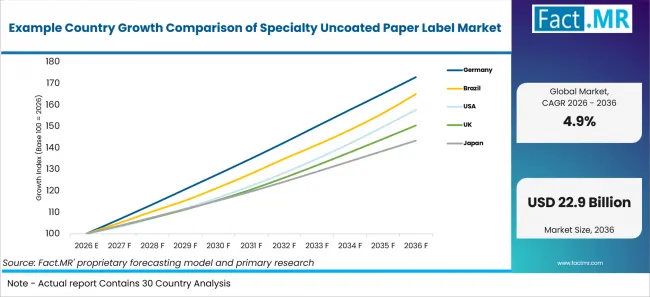
Example Country Growth Comparison Of Specialty Uncoated Paper Label Market | Source: Fact.MR
| Country | CAGR (2026-2036) |
|---|---|
| Germany | 5.6% |
| Brazil | 5.1% |
| USA | 4.7% |
| UK | 4.2% |
| Japan | 3.7% |
Source: Fact.MR analysis. Updated Aug 20, 2026
What supports Germany adoption?
5.6% CAGR, supported by packaging recycling discipline and food-grade paper conversion.
Germany’s growth reflects strong paper-packaging use, established food and beverage production, and disciplined recycling requirements. Paper, paperboard and carton packaging volume reached 7,850.8 kt in Germany in 2023, while beer sales were about 7.8 billion litres in 2025. Uncoated labels benefit from familiar converting performance, although wet-strength needs, food-sector cost pressure and competition from coated alternatives may limit broader use.
How is Brazil scaling demand?
5.1% CAGR, driven by supermarket scale and food processing label volume.
Brazil’s growth is supported by a large retail network and continued demand from food-processing accounts. Brazil’s food self-service retail sector had 424,120 stores in 2024, while retail sales volume increased 0.6% in February 2026 from January on a seasonally adjusted basis. Uncoated labels support ingredient panels and product identification, although currency exposure, humid distribution and imported facestock costs may pressure converters serving price-sensitive customers.
What supports USA adoption?
4.7% CAGR, supported by food spending, grocery scale and e-commerce shipments.
The USA’s growth reflects substantial food spending, high-volume grocery activity and expanding e-commerce shipments. Food spending reached USD 2.51 trillion in 2025, while first-quarter 2026 retail e-commerce sales totaled USD 326.7 billion. Pressure-sensitive uncoated labels support frequent SKU and artwork changes, although wet-resistance requirements, manufacturing-input costs and retailer pricing pressure may shift some applications toward coated or film constructions.
What supports the UK growth?
4.2% CAGR, backed by food retail scale and packaging accountability rules.
The UK’s growth is supported by large food spending and a sizable domestic food-manufacturing base. Consumer expenditure on food and alcoholic drinks reached GBP 303.3 billion in 2025, while food manufacturing represented 22.9% of manufacturers’ product sales. Uncoated labels benefit from documentation-focused packaging programs, although rising paper-sector prices, artwork checks and wet grocery conditions may extend qualification and conversion cycles.
How does Japan perform?
3.7% CAGR, led by convenience retail, packaged food sales and online food channels.
Japan’s growth reflects a large convenience-store network, packaged food demand and growing digital commerce. Convenience-store food and beverage sales reached USD 54.9 billion in 2024, while B2C e-commerce totaled JPY 26.1 trillion. Direct thermal and precisely printed labels support compact retail formats, although modest food e-commerce penetration, chilled distribution requirements and tight pack dimensions may constrain wider adoption.
Who leads the Specialty Uncoated Paper Label Market?
Avery Dennison Corporation is active in pressure-sensitive paper label materials, recycling solutions and variable information labels. At Labelexpo Europe 2025, the company showcased innovations addressing paper-label recyclability, material performance and packaging connectivity.
Mativ includes the Neenah Paper brand within its family of specialty-materials brands. Neenah Paper remains relevant to specialty paper applications; market inclusion here does not imply independently verified leadership in uncoated labels.
Wausau Coated Products Inc., Monadnock Paper Mills Inc., Green Bay Packaging Inc., Trysk Print Solutions, AWT Labels & Packaging (Labeltronix) and Technicote Inc. serve specialty label programs through facestocks, converting services or custom supply.
Which companies are the key providers?
Key companies include Avery Dennison Corporation; Mativ Holdings, Inc. (Neenah Label Papers); UPM Adhesive Materials; Wausau Coated Products Inc.; Monadnock Paper Mills Inc.; Green Bay Packaging Inc.; Trysk Print Solutions; AWT Labels & Packaging (Labeltronix); and Technicote Inc.
- Avery Dennison Corporation
- Mativ Holdings, Inc. (Neenah Label Papers)
- UPM Adhesive Materials
- Wausau Coated Products Inc.
- Monadnock Paper Mills Inc.
- Green Bay Packaging Inc.
- Trysk Print Solutions
- AWT Labels & Packaging (Labeltronix)
- Technicote Inc.
Bibliography
- Avery Dennison Corporation. (2025, September 4). Avery Dennison launches new labeling solutions advancing recycling, connectivity and safety at Labelexpo Europe 2025.
- Banco Central do Brasil. (2025, December 18). Monetary policy report: December 2025.
- Bundesministerium für Umwelt, Klimaschutz, Naturschutz und nukleare Sicherheit. (2025, December 19). Aufkommen und Recyclingquoten von Verpackungen [Packaging generation and recycling rates].
- Department for Environment, Food & Rural Affairs. (2026, July 29). Food statistics in your pocket.
- Federal Statistical Office (Destatis). (2025, November 12). Wholesale prices in October 2025: +1.1% on October 2024.
- Federal Statistical Office (Destatis). (2026, February 2). Beer sales down in 2025.
- Brazilian Institute of Geography and Statistics. (2026, April 15). In February, retail sales grow 0.6%.
- Ministry of Economy, Trade and Industry. (2025, August 26). Results of FY2024 E-Commerce Market Survey compiled.
- Office for National Statistics. (2026, July 22). Producer price inflation, UK: June 2026, including services, April to June 2026.
- Office for National Statistics. (2026, July 24). UK manufacturers' sales by product: 2025.
- UPM Adhesive Materials. (2025, September 15). UPM Adhesive Materials showcases its solutions for leading label material performance at Labelexpo Europe 2025.
- U.S. Bureau of Labor Statistics. (2026, July 15). Producer Price Indexes—June 2026.
- U.S. Census Bureau. (2026, May 18). Quarterly retail e-commerce sales: 1st quarter 2026.
- U.S. Department of Agriculture, Foreign Agricultural Service. (2025, June 25). Brazil: Exporter guide annual (GAIN Report No. BR2025-0020).
- U.S. Department of Agriculture, Foreign Agricultural Service. (2025, November 19). Japan: Retail foods annual (GAIN Report No. JA2025-0048).
This Report Answers
- The report explains where specialty uncoated paper labels are used across product, application, end use and technology.
- Segment analysis identifies the leading subsegments and the operational reasons converters prioritize them.
- Country analysis examines Germany, Brazil, USA, UK and Japan through packaging regulation, retail scale and paper-cost conditions.
- Competitive analysis reviews current providers across facestocks, adhesive materials, custom printing and label conversion.
- Application analysis assesses how print quality, barcode readability and wet resistance influence purchase decisions.
What does the Specialty Uncoated Paper Label Market cover?
The Specialty Uncoated Paper Label Market covers paper labels without coated decorative surfaces. It includes pressure-sensitive, wet glue, linerless and functional formats made from virgin or recycled paper.
The assessment covers food and beverage, logistics, retail and industrial applications across product type, application, end use, printing technology, formulation and channel.
What is included in the scope?
The scope includes uncoated paper facestocks and converted labels used for packaging, warehouse, retail and product-identification work. It covers direct programs, distributors, online platforms and print providers.
It includes pressure-sensitive, wet-glue, linerless and functional uncoated paper label types used by food and beverage manufacturers, logistics companies, retailers and industrial manufacturers.
What is excluded from the scope?
The scope excludes coated paper labels, plastic film labels, shrink sleeves, metallic labels and primary packaging materials without a label function. Printing equipment is excluded unless bundled with label supply.
General office paper, commercial stationery, release liners sold separately and unsupported adhesive chemistry are excluded.
How Was the Analysis Built?
The analysis draws on 120+ sources, 35+ company portfolios, 25+ countries, and more than 20 industry interviews.
- Primary Research: Primary research includes discussions with manufacturers, service providers, technology developers, distributors, end users, procurement teams, and subject-matter experts. These conversations examine purchasing priorities, product adoption, operational challenges, approval requirements, competitive positioning, and the factors that influence wider market acceptance.
- Desk Research: Desk research covers government statistics, regulatory publications, company filings, trade data, technical studies, industry associations, standards, public policy, and other authoritative sources. Every source used in the analysis is documented in the bibliography.
- Market Sizing and Forecasting: Market estimates combine historical performance, demand indicators, pricing and volume trends, segment shares, company participation, country-level growth, adoption patterns, investment activity, and barriers to market expansion.
- Data Validation and Update Cycle: Findings are validated by comparing primary interviews with public data, company activity, regulatory changes, trade patterns, and industry developments. Regular updates review new product launches, capacity changes, partnerships, approvals, procurement trends, and shifts in commercial adoption.
Segmentation
What is the report’s scope and coverage?
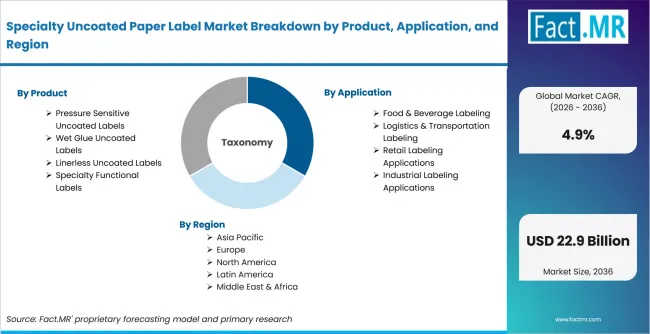
Specialty Uncoated Paper Label Market Breakdown By Product, Application, And Region | Source: Fact.MR
| Attribute | Details |
|---|---|
| Quantitative Units | USD billion |
| Market Definition | Uncoated paper labels used for packaging, product identification, logistics, retail and industrial applications. |
| Product | Pressure sensitive; Wet glue; Linerless; Specialty functional labels |
| Application | Food & beverage; Logistics & transportation; Retail; Industrial labeling |
| End Use | Food & beverage manufacturers; Logistics & warehousing companies; Retail companies; Industrial manufacturers |
| Technology | Flexographic; Digital; Offset; Thermal printing technology |
| Formulation | Virgin fiber; Recycled fiber; Lightweight; Specialty paper formulations |
| Distribution Channel | Direct manufacturer sales; Distributors; Online procurement platforms; Print service providers |
| Regions Covered | North America; Latin America; Western Europe; Eastern Europe; East Asia; South Asia & Pacific; Middle East & Africa |
| Countries Covered | Germany; Brazil; USA; UK; Japan |
| Key Companies Profiled | Avery Dennison; Neenah; UPM Adhesive Materials; Wausau Coated Products; Monadnock; Green Bay Packaging; Trysk; AWT Labels & Packaging (Labeltronix); Technicote |
| Forecast Period | 2026 to 2036 |
| Approach | Hybrid top-down and bottom-up approach using label demand, country retail indicators, paper costs and provider portfolios. |
Source: Fact.MR analysis. Updated Aug 20, 2026
How is the market segmented?
-
By Product
- Pressure Sensitive Uncoated Labels
- Permanent Adhesive Labels
- Removable Adhesive Labels
- Wet Glue Uncoated Labels
- Cut and Stack Labels
- Roll Fed Labels
- Linerless Uncoated Labels
- Direct Thermal Linerless Labels
- Adhesive Activated Linerless Labels
- Specialty Functional Labels
- Security Uncoated Labels
- Eco Friendly Labels
- Pressure Sensitive Uncoated Labels
-
By Application
- Food & Beverage Labeling
- Packaged Food Labeling
- Beverage Labeling
- Logistics & Transportation Labeling
- Shipping Labeling
- Warehouse Labeling
- Retail Labeling Applications
- Price Marking Labels
- Product Identification Labels
- Industrial Labeling Applications
- Manufacturing Labels
- Compliance Labeling
- Food & Beverage Labeling
-
By End Use
- Food & Beverage Manufacturers
- Food Processing Companies
- Beverage Producers
- Logistics & Warehousing Companies
- Third Party Logistics Providers
- Warehouse Operators
- Retail Companies
- Large Retail Chains
- Specialty Retailers
- Industrial Manufacturers
- Automotive Manufacturers
- General Manufacturing Companies
- Food & Beverage Manufacturers
-
By Technology
- Flexographic Printing Technology
- Water Based Flexographic Systems
- UV Flexographic Systems
- Digital Printing Technology
- Inkjet Printing Systems
- Electrophotographic Systems
- Offset Printing Technology
- Sheet Fed Offset Systems
- Web Offset Systems
- Thermal Printing Technology
- Direct Thermal Systems
- Thermal Transfer Systems
- Flexographic Printing Technology
-
By Formulation
- Virgin Fiber Paper Labels
- Wood Pulp Based Papers
- Fine Paper Constructions
- Recycled Fiber Paper Labels
- Post Consumer Recycled Papers
- Post Industrial Recycled Papers
- Lightweight Paper Formulations
- Low Basis Weight Papers
- Machine Optimized Papers
- Specialty Paper Formulations
- Textured Paper Labels
- High Strength Paper Labels
- Virgin Fiber Paper Labels
-
By Distribution Channel
- Direct Manufacturer Sales
- Contract Supply Agreements
- Strategic Customer Programs
- Packaging Material Distributors
- Regional Packaging Distributors
- Specialty Distribution Networks
- Online Procurement Platforms
- B2B E Commerce Platforms
- Manufacturer Digital Portals
- Print Service Providers
- Commercial Print Providers
- Managed Print Services
- Direct Manufacturer Sales
-
By Region
- North America
- Latin America
- Western Europe
- Eastern Europe
- East Asia
- South Asia and Pacific
- Middle East & Africa
Frequently Asked Questions
How big is the specialty uncoated paper label market in 2026?
What is the CAGR of the specialty uncoated paper label market from 2026 to 2036?
Which product leads the specialty uncoated paper label market?
Which application leads the specialty uncoated paper label market?
Who are the leading companies in the specialty uncoated paper label market?
Who worked on this report


Preview the report firsthand - request a free sample
Free SampleGet the brochure for pricing and purchase details
Download PDF