- Market Value (2025): USD 15.0 Bn
- Estimated Value (2026): USD 15.7 Bn
- Forecast Value (2036): USD 25.9 Bn
- CAGR (2026-2036): 5.1%
What is the Passenger Vehicle Paint & Coating Market forecast to be worth by 2036?
USD 15.7 billion in 2026 to USD 26.0 billion by 2036 at a 5.1% CAGR.
- Fact.MR calculates that the passenger vehicle paint and coating market reached USD 15.0 billion in 2025, with collision repair accounting for most of that spend.
- By 2036, revenue will climb from USD 15.7 billion in 2026 to USD 25.9 billion as the global car parc keeps growing and ageing.
- Annual growth is set to average 5.1% CAGR from 2026 to 2036, helped by refinish volumes and steady SUV production.
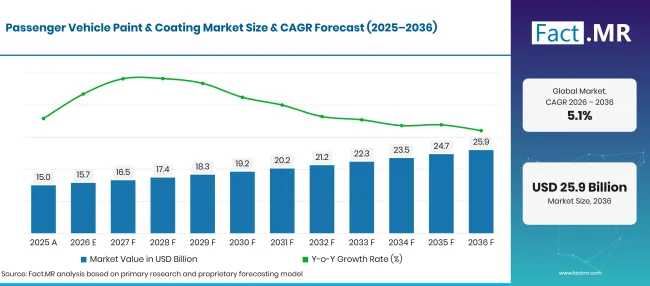
Factmr Passenger Vehicle Paint And Coating Market Forecast Global | Source: Fact.MR
| Year | Basis | Market Value (USD billion) |
|---|---|---|
| 2025 | Actual | 15.0 |
| 2026 | Estimate | 15.7 |
| 2036 | Forecast | 25.9 |
| CAGR 2026 to 2036 | Forecast period | 5.1% |
Source: Fact.MR analysis. Updated Oct 21, 2026
What are the defining numbers behind Passenger Vehicle Paint & Coating Market growth?
The decade to 2036 adds USD 10.3 billion in new value, most of it in body shop refinish and SUV body coating.
- Demand Drivers in the Market
- New car output keeps factory paint lines running across electrocoat, primer, basecoat and clearcoat. The International Energy Agency reported that electric car sales grew 20% in 2025 to exceed 20 million units, reaching 25% of all car sales [1]. Each of those vehicles still needs a full paint system, often on new aluminum or mixed-material bodies.
- A large stock of cars in use creates steady repair work for body shops. Eurostat reported that registered passenger cars in the EU exceeded 260 million in 2025, an average of 584 cars per 1,000 inhabitants [2]. More cars on the road mean more dents, scratches and panel replacements that need refinishing.
- Emission limits on solvents shape what paint shops and body shops can buy. Regulators in Europe and North America cap the solvent content of basecoats and refinish products. Coating suppliers respond with water-based basecoats and low-solvent clearcoats.
- Color and finish choices are getting more complex. Pearl, metallic and matte effects on SUVs and premium models raise the value of each repaint.
- Key Segments Analyzed
- By Product Type: Waterborne Coatings will hold 38.5% share in 2026, as solvent caps in factory lines and body shops favor water as the paint carrier.
- By Sales Channel: Aftermarket will account for 62.8% share in 2026, driven by collision repair, panel replacement and full resprays across an ageing car parc.
- By Vehicle Type: SUVs will capture 38.6% share in 2026, given that their larger body panels take more paint per unit than sedans or hatchbacks.
- By Technology: Conventional will command 72.4% share in 2026 through spray and oven-cure equipment already installed in plants and body shops worldwide.
- Analyst Opinion at Fact.MR
- Shambhu Nath Jha, Principal Consultant at Fact.MR, states, “Body shops buy most of the paint in this market, and every collision repair needs an exact color match. Suppliers that pair water-based refinish systems with fast mixing and color tools will win more shop contracts. On the factory side, SUV output and new body materials will keep OEM paint lines busy through 2036.”
- Strategic Implications
- Refinish coating suppliers should invest in color-matching software and automated mixing, since body shops are paid per repair and lose margin on rework.
- Body shop groups should standardize on low-energy clearcoats and water-based basecoats to cut booth time and stay within solvent limits.
- OEM coating suppliers should co-develop pretreatment and primer systems with vehicle makers that switch to aluminum and mixed-material bodies.
- Distributors in Latin America and South Asia should build refinish training programs, given that many independent shops still spray solvent-borne paint by hand.
At 6.4% CAGR, the United Kingdom heads the five countries as an older licensed fleet keeps body shops busy and new zero emission cars arrive in volume. The United States follows at 6.0% with a vast registered fleet and millions of police-reported crashes each year. Japan reaches 4.9% on the strength of export-focused car plants with tight finish standards. Brazil grows at 4.6% while local assembly and a large used-car fleet support both channels. Germany completes the group at 3.9%, where premium OEM programs set high finish specifications in a mature market.
How does the Passenger Vehicle Paint & Coating Market break down by segment?
Waterborne Coatings will lead Product Type at 38.5%; Aftermarket will top Sales Channel at 62.8%; SUVs will head Vehicle Type at 38.6%; Conventional will hold first place in Technology at 72.4%.
Which Product Type leads?
Waterborne Coatings take 38.5% of 2026 revenue.
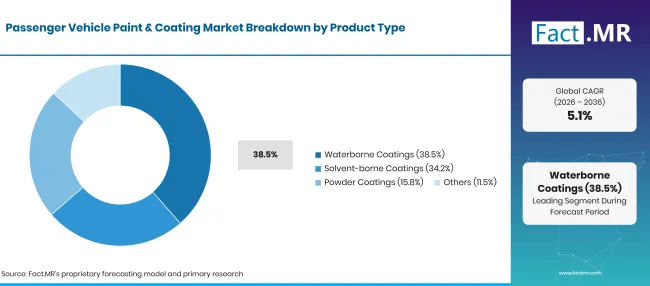
Factmr Passenger Vehicle Paint And Coating Market Breakdown Product Type | Source: Fact.MR
| Product Type | Share (2026) |
|---|---|
| Waterborne Coatings (Leading segment) | 38.5% |
| Other segments combined | 61.5%* |
| Total | 100.0% |
Source: Fact.MR analysis. Updated Oct 21, 2026
Plant managers and body shop owners in Europe and North America work under caps on solvent emissions, so basecoat lines have moved to water as the carrier. Waterborne basecoats now go on most new bodies in those regions. Large refinish networks have switched too. In the United Kingdom, a 2025 review of the rules on solvents in vehicle refinishing products credited the regulations with 364 kilotonnes of VOC reductions from paints between 2007 and 2021 [3]. The same review kept current limits, citing industry feedback that products were at their technical limits [3]. Solvent-borne coatings remain common in clearcoats and in markets with looser limits. Powder coatings serve wheels and some underbody parts, which links this segment to the wider powder coatings category.
What supports Aftermarket within Sales Channel?
Aftermarket sales make up 62.8% of 2026 revenue.
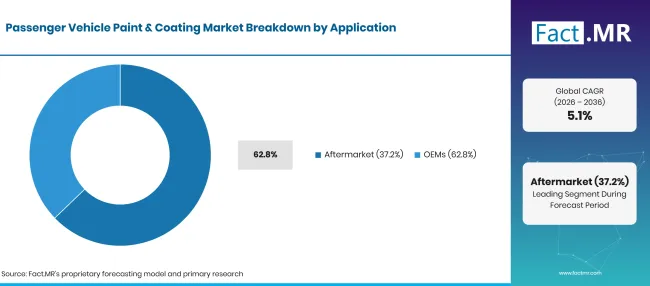
Factmr Passenger Vehicle Paint And Coating Market Breakdown Application | Source: Fact.MR
| Sales Channel | Share (2026) |
|---|---|
| Aftermarket (Leading segment) | 62.8% |
| Other segments combined | 37.2%* |
| Total | 100.0% |
Source: Fact.MR analysis. Updated Oct 21, 2026
Collision repair turns the existing car fleet into a recurring paint buyer. A damaged panel needs filler, primer, a color-matched basecoat and clearcoat. Each job uses premium products at retail prices. Refinish lines sold through distributors and paint jobbers make up the bulk of refinish paints demand. The U.S. National Highway Traffic Safety Administration counted 6,180,241 police-reported crashes in 2024, of which 4,467,244 caused property damage only [4]. Many such vehicles go to body shops for panel repair and repainting. OEM factory application forms the other channel, where vehicle makers buy full paint systems under multi-year contracts covered by automotive OEM coatings programs.
What leads the Vehicle Type segment?
SUVs represent 38.6% of 2026 sales.
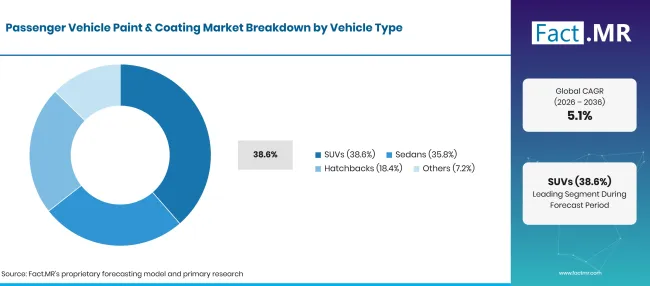
Factmr Passenger Vehicle Paint And Coating Market Breakdown Vehicle Type | Source: Fact.MR
| Vehicle Type | Share (2026) |
|---|---|
| SUVs (Leading segment) | 38.6% |
| Other segments combined | 61.4%* |
| Total | 100.0% |
Source: Fact.MR analysis. Updated Oct 21, 2026
Shoppers in the United States, Europe and China keep moving from sedans to SUVs, and a taller body means more square meters of paint per vehicle. Premium SUV trims also use multi-layer effect colors that cost more to apply and repair. The U.S. Environmental Protection Agency reported that truck SUVs reached 49.6% and car SUVs 10.6% of model year 2024 vehicle production, while sedans and wagons fell to 23.7% [5]. Sedans keep strong demand in China and parts of Asia. Hatchbacks serve compact buyers in Europe and emerging markets, where smaller panels mean lower paint use per car.
How does Technology shape demand?
Conventional systems claim 72.4% of 2026 sales.
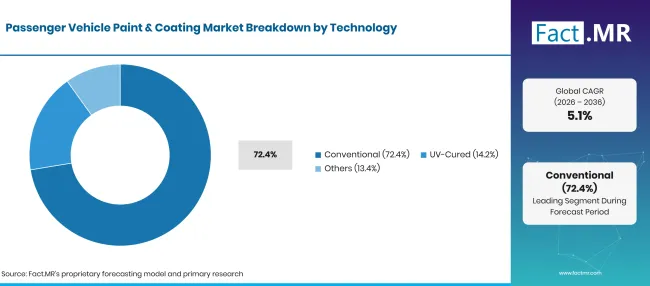
Factmr Passenger Vehicle Paint And Coating Market Breakdown Technology | Source: Fact.MR
| Technology | Share (2026) |
|---|---|
| Conventional (Leading segment) | 72.4% |
| Other segments combined | 27.6%* |
| Total | 100.0% |
Source: Fact.MR analysis. Updated Oct 21, 2026
Vehicle makers have spent heavily on spray robots, booths and curing ovens that run on thermal cure. Replacing a paint shop costs more than most plants can justify within a model cycle, so new coatings must fit existing lines. UV-cured coatings harden in seconds under ultraviolet light and use less energy than oven cure. Body shops use them mainly for primers and small spot repairs today. Pigment choices such as titanium dioxide and effect flakes still need to be adapted before UV-cured basecoats can reach full-panel use.
What is accelerating Passenger Vehicle Paint & Coating Market adoption, and what is holding it back?
Collision repair across a large car parc, solvent limits and SUV-heavy production will lift demand for primers, basecoats and clearcoats. Paint shop conversion costs, raw material price swings and slow uptake of new cure methods will hold growth back in some regions.
Drivers Impact Analysis
| DRIVER | (~) % IMPACT ON CAGR | GEOGRAPHIC RELEVANCE | IMPACT TIMELINE |
|---|---|---|---|
| Collision repair and refinish volumes across a large and ageing car parc | +1.4% | North America, Western Europe, Latin America | Short term (<= 2 years) |
| Solvent emission limits moving OEM lines and body shops to waterborne basecoats | +1.2% | Western Europe, North America | Medium term (2-4 years) |
| Passenger vehicle output with a rising SUV share in factory paint shops | +1.0% | East Asia, North America, South Asia & Pacific | Medium term (2-4 years) |
| Electric vehicle platforms with aluminum and mixed-material bodies | +0.8% | Western Europe, East Asia, North America | Long term (>= 4 years) |
Source: Fact.MR analysis. Updated Oct 21, 2026
Opportunity Impact Analysis
| OPPORTUNITY | (~) % IMPACT ON CAGR | GEOGRAPHIC RELEVANCE | IMPACT TIMELINE |
|---|---|---|---|
| Low-energy clearcoats and UV-cured primers for faster body shop cycles | +0.8% | Global | Medium term (2-4 years) |
| Waterborne refinish systems for independent shops in emerging markets | +0.7% | Latin America, South Asia & Pacific | Long term (>= 4 years) |
| Effect and premium colors for SUV and electric vehicle trims | +0.5% | Global | Short term (<= 2 years) |
| Automated paint mixing and digital color matching in body shops | +0.4% | North America, Western Europe | Short term (<= 2 years) |
Source: Fact.MR analysis. Updated Oct 21, 2026
Restraints Impact Analysis
| RESTRAINT | (~) % IMPACT ON CAGR | GEOGRAPHIC RELEVANCE | IMPACT TIMELINE |
|---|---|---|---|
| High capital cost of converting OEM paint shops to new coating systems | -0.6% | Latin America, South Asia & Pacific | Medium term (2-4 years) |
| Price swings in titanium dioxide, resins and specialty solvents | -0.5% | Global | Short term (<= 2 years) |
| Price competition from regional low-cost coating producers | -0.3% | East Asia, South Asia & Pacific | Long term (>= 4 years) |
Source: Fact.MR analysis. Updated Oct 21, 2026
Which countries are scaling the Passenger Vehicle Paint & Coating Market through 2036?
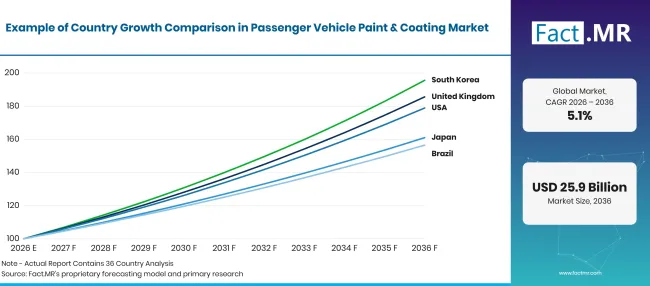
Factmr Passenger Vehicle Paint And Coating Market Growth Index | Source: Fact.MR
| Country | CAGR (2026–2036) |
|---|---|
| United Kingdom | 6.4% |
| United States | 6.0% |
| Japan | 4.9% |
| Brazil | 4.6% |
| Germany | 3.9% |
Source: Fact.MR analysis. Updated Oct 21, 2026
What supports United Kingdom adoption?
6.4% CAGR, driven by an older licensed fleet and rising zero emission car registrations.
The Department for Transport reported that 2,071,000 cars were registered for the first time in 2025, with zero emission cars at 23% of new registrations against 19% in 2024 [6]. The average licensed car in the UK was 10 years old at the end of 2025 [6]. Older cars need more paint repair, and UK body shops already use waterborne basecoats under national solvent rules.
How is the United States scaling demand?
6.0% CAGR, backed by a vast registered fleet and high collision repair volume.
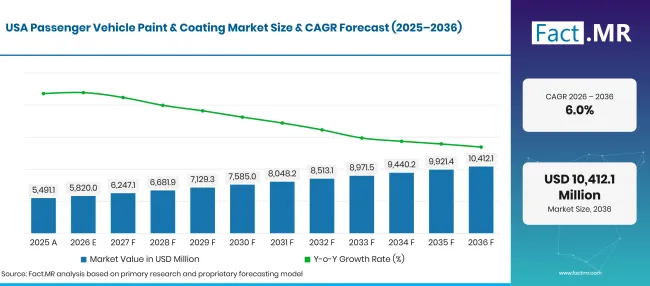
Factmr Passenger Vehicle Paint And Coating Market Forecast Usa | Source: Fact.MR
The Federal Highway Administration counted 297.5 million registered motor vehicles in the United States in 2024 [7]. Insurers route most crash repairs to large body shop networks that buy refinish paint under supply agreements. Pickup and SUV plants in the Midwest and South keep OEM paint lines running at high volume.
What is supporting Japan’s adoption?
4.9% CAGR, helped by export-focused car plants with strict finish standards.
Japan’s Ministry of Finance reported car exports of 5,148,817 units in 2025, worth JPY 15.76 trillion [8]. Every exported car leaves the plant with a full factory paint system built to meet overseas quality checks. Electric cars made up less than 3% of Japanese car sales in 2025, so hybrid and petrol models still drive paint line volume [1].
How is Brazil developing demand?
4.6% CAGR, on the back of local assembly and a large used-car fleet.
Brazilian buyers are adding electric cars to a fleet built mostly on flex-fuel models. The IEA reported that electric car sales in Brazil reached 180,000 in 2025, or 9% of new car sales, up from 6.5% in 2024 [1]. New assembly lines for these models need OEM paint systems, while independent body shops serve an older fleet with refinish products.
How does Germany perform?
3.9% CAGR, reflecting premium OEM finish programs in a mature market.
The Kraftfahrt-Bundesamt reported 545,142 new battery electric car registrations in 2025, a 19.1% share of the market [9]. Destatis reported that Germany had about 49.5 million passenger cars on January 1, 2026, or 593 per 1,000 inhabitants [10]. Premium makers specify deep metallic and effect colors, which raises paint value per car even as volumes stay flat.
Who leads the Passenger Vehicle Paint & Coating Market?
Competition splits into three tiers.
Global full-line suppliers such as Surventis, PPG, Axalta and AkzoNobel sell both OEM paint systems and refinish brands. That lets them follow a color from the factory to the body shop. Their contest in refinish turns on shop productivity. Axalta installed its first fully automated Irus Mix machines in the Middle East in March 2025 [11]. PPG launched MIX’N’SHAKE automated paint stirring in October 2025 [12], then added a Deltron clearcoat in March 2026 that it says uses up to 60% less energy than a standard bake [13]. Sherwin-Williams competes mainly through refinish distribution in the Americas. Nippon Paint and Kansai Paint hold strong OEM ties with Asian vehicle makers. Mankiewicz serves a narrower niche in coatings for exterior plastic parts and interior trim. Color data, mixing speed and energy savings in the booth will separate winners in body shop contracts.
Which companies are the key providers?
Key companies include Surventis GmbH; PPG Industries, Inc.; Axalta Coating Systems Ltd.; Akzo Nobel N.V.; The Sherwin-Williams Company; Nippon Paint Holdings Co., Ltd.; Kansai Paint Co., Ltd.; and Mankiewicz Gebr. & Co.
- Surventis GmbH
- PPG Industries, Inc.
- Axalta Coating Systems Ltd.
- Akzo Nobel N.V.
- The Sherwin-Williams Company
- Nippon Paint Holdings Co., Ltd.
- Kansai Paint Co., Ltd.
- Mankiewicz Gebr. & Co.
Bibliography
- [1] International Energy Agency. (2026, May 20). Global EV Outlook 2026: Trends in electric cars.
- [2] Eurostat. (2026, July). Passenger cars in the EU.
- [3] Regulatory Policy Committee. (2025, March 4). The Volatile Organic Compounds in Paints, Varnishes and Vehicle Refinishing Products Regulations 2012: post-implementation review opinion.
- [4] National Highway Traffic Safety Administration. (2026, April). Overview of Motor Vehicle Traffic Crashes in 2024.
- [5] U.S. Environmental Protection Agency. (2026, February). The EPA Automotive Trends Report 2025: Fuel Economy and Technology since 1975.
- [6] Department for Transport. (2026, April 29). Vehicle licensing statistics, United Kingdom: 2025.
- [7] Federal Highway Administration. (2026, January). Table MV-1: Highway Statistics 2024.
- [8] Ministry of Finance, Japan. (2026, March 12). Trade Statistics: Value of Exports and Imports 2025 (Calendar Year) (January-December) (Revised Data).
- [9] Kraftfahrt-Bundesamt. (2026, January 6). Fahrzeugzulassungen im Dezember 2025: Jahresbilanz [Vehicle registrations in December 2025: annual review].
- [10] Statistisches Bundesamt (Destatis). (2026, July 22). Pkw-Dichte 2026 erneut gestiegen [Car density rose again in 2026].
- [11] Axalta Coating Systems. (2025, March 19). Axalta Refinish installs first Axalta Irus Mix Machines in the Middle East at Wallan Group in Saudi Arabia.
- [12] PPG Industries. (2025, October 14). PPG introduces PPG MIX’N’SHAKE automated stirring technology for body shops.
- [13] PPG Industries. (2026, March 2). PPG introduces fast-drying clearcoat to PPG DELTRON automotive refinish line.
This Report Answers
- Revenue for 2025, 2026 and 2036 is set out with the growth path across the forecast decade.
- Each segment section names the subsegment with the top 2026 share and the buying reasons behind it.
- Collision repair, solvent rules and fleet age explain the gap between the five profiled countries.
- Coating suppliers are grouped by whether they serve factory paint lines, body shops or both.
- Readers can trace how body shop tools such as automated mixing and low-energy clearcoats change buying decisions.
What does the Passenger Vehicle Paint & Coating Market cover?
Passenger car paint works as a layered system. Electrocoat protects bare metal from corrosion, primer builds adhesion and chip resistance, basecoat carries the color and clearcoat adds gloss and UV protection.
Each layer is counted whether it is sprayed in a vehicle plant or in a body shop. Waterborne, solvent-borne and powder products are tracked across SUVs, sedans and hatchbacks. Conventional and UV-cured technologies are tracked as well.
What is included in the scope?
Coatings for exterior panels, bumpers, mirror housings and other painted parts of passenger cars are in scope. Factory paint systems bought by vehicle makers and refinish products sold through distributors to body shops both count toward revenue.
Primers, fillers that are sprayed as part of the paint system and clearcoats sold under refinish brands are included. Color tints used in body shop mixing systems, often made with pigment dispersions, are counted at the value of the finished coating.
What is excluded from the scope?
Paint for commercial vehicles, heavy trucks, buses, motorcycles and off-road equipment is not counted. Coatings for marine, aerospace, industrial and building uses are left out. The same applies to automotive coatings sold for those vehicle classes.
Spray guns, booths, abrasives and paint protection films are outside the revenue count. Raw pigments and resins sold to coating makers are also excluded, so value is counted only once.
How Was the Analysis Built?
The analysis draws on 120+ sources, 35+ company portfolios, 25+ countries, and more than 20 industry interviews.
- Primary Research: Primary research includes discussions with manufacturers, service providers, technology developers, distributors, end users, and subject-matter experts. These conversations examine purchasing priorities, product adoption, operational challenges, approval requirements, competitive positioning, and the factors that influence wider market acceptance.
- Desk Research: Desk research covers government statistics, regulatory publications, company filings, trade data, technical studies, industry associations, standards, public policy, and other authoritative sources. Every source used in the analysis is documented in the bibliography.
- Market Sizing and Forecasting: Market estimates combine historical performance, demand indicators, pricing and volume trends, segment shares, company participation, country-level growth, adoption patterns, investment activity, and barriers to market expansion.
- Data Validation and Update Cycle: Findings are validated by comparing primary interviews with public data, company activity, regulatory changes, trade patterns, and industry developments. Regular updates review new product launches, capacity changes, partnerships, approvals, and shifts in commercial adoption.
Segmentation
What is the report’s scope and coverage?
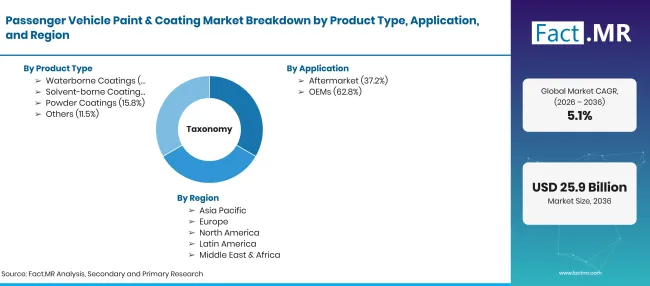
Factmr Passenger Vehicle Paint And Coating Market Taxonomy | Source: Fact.MR
| Attribute | Details |
|---|---|
| Quantitative Units | USD billion in 2026 to USD billion by 2036 at CAGR |
| Market Definition | Paints and coatings applied to passenger car bodies and visible parts, from electrocoat and primer to basecoat and clearcoat. Revenue covers factory application at vehicle makers and refinish products sold to body shops. |
| Product Type | Waterborne Coatings; Solvent-borne Coatings; Powder Coatings |
| Sales Channel | Aftermarket; OEMs |
| Vehicle Type | SUVs; Sedans; Hatchbacks |
| Technology | Conventional; UV-Cured |
| Regions Covered | North America; Latin America; Western Europe; Eastern Europe; East Asia; South Asia & Pacific; Middle East & Africa |
| Countries Covered | United Kingdom; United States; Japan; Brazil; Germany |
| Companies Profiled | Surventis GmbH; PPG Industries, Inc.; Axalta Coating Systems Ltd.; Akzo Nobel N.V.; The Sherwin-Williams Company; Nippon Paint Holdings Co., Ltd.; Kansai Paint Co., Ltd.; Mankiewicz Gebr. & Co. |
| Forecast Period | 2026 to 2036 |
| Approach | Hybrid top-down and bottom-up approach using vehicle production and car parc data; paint use per vehicle and per repair; collision repair volumes; solvent rules by country; and supplier portfolio review. |
Source: Fact.MR analysis. Updated Oct 21, 2026
How is the market segmented?
-
By Product Type
- Waterborne Coatings
- Solvent-borne Coatings
- Powder Coatings
-
By Sales Channel
- Aftermarket
- OEMs
-
By Vehicle Type
- SUVs
- Sedans
- Hatchbacks
-
By Technology
- Conventional
- UV-Cured
-
By Region
- North America
- Latin America
- Western Europe
- Eastern Europe
- East Asia
- South Asia & Pacific
- Middle East & Africa
Frequently Asked Questions
How big is the passenger vehicle paint and coating market in 2026?
What is the CAGR of the passenger vehicle paint and coating market from 2026 to 2036?
Which product type leads the passenger vehicle paint and coating market?
Which sales channel leads the passenger vehicle paint and coating market?
Which vehicle type leads the passenger vehicle paint and coating market?
Which technology leads the passenger vehicle paint and coating market?
Which country will grow the most in the passenger vehicle paint and coating market?
Who are the main companies in the passenger vehicle paint and coating market?
Who worked on this report


Preview the report firsthand - request a free sample
Free SampleGet the brochure for pricing and purchase details
Download PDF