- Base Value(2025): 12.8 Bn
- Estimated Value(2026): 13.3 Bn
- Forecast Value (2036): 18.5 Bn
- CAGR (2026 - 2036): 4.4%
Patient Handling Equipment Market Forecast 2026 to 2036
In 2025, the patient handling equipment market was valued at USD 12.8 billion. Based on Fact MR's analysis, demand for patient handling equipment is estimated to grow to USD 13.3 billion in 2026 and USD 18.5 billion by 2036. FMR projects a CAGR of 4.4% during the forecast period.
The absolute dollar growth from 2026 to 2036 is USD 5.2 billion. This growth is driven by the rising demand for healthcare services, an aging population, and increasing awareness of patient safety and comfort. The market is further supported by advancements in medical technology and a growing emphasis on improving hospital workflows. However, challenges such as high initial costs and the need for specialized training could affect the rate of adoption in some regions.
As Kevin A. Lobo, Chairman and CEO of Stryker Corporation, noted regarding the company’s growth outlook in the medical equipment sector, ‘Having surpassed $25 billion in (annual) revenue, we enter 2026 with significant momentum and are poised to continue delivering growth at the high end of MedTech.’
China leads with a CAGR of 5.2%, driven by its large and aging population along with expanding healthcare infrastructure. India follows with a 4.9% CAGR, fueled by increasing healthcare needs and a growing elderly population. The UK shows a 3.9% growth rate, supported by the aging population and demand for patient care solutions. Germany grows at 3.8%, driven by a strong healthcare system and increasing focus on patient safety. Japan grows at 3.6%, with rising demand for healthcare equipment to support its aging demographic. The USA shows slower growth at 3.4%, due to a mature healthcare market, but continues to lead in terms of advanced patient care technology.
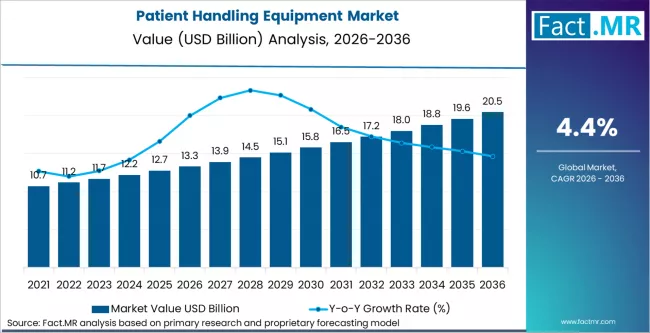
Patient Handling Equipment Market Market Value Analysis | Source: Fact.MR
Patient Handling Equipment Market Definition
The patient handling equipment market involves the manufacture and sale of devices that assist in the safe movement, transfer, and positioning of patients in healthcare settings to reduce injury risk for patients and caregivers.
Market Inclusions
This report covers global and regional market sizes for patient handling equipment, including product types (lifts, transfer aids, hoists), care settings, and end users over a defined forecast period.
Market Exclusions
The scope excludes general medical furniture, unrelated rehabilitation devices, and non‑mobility patient care products not part of handling and transfer.
Research Methodology
- Primary Research: Interviews were conducted with healthcare professionals, facility managers, and equipment suppliers.
- Desk Research: Data was sourced from industry reports, healthcare statistics, and trade associations.
- Market‑Sizing and Forecasting: A hybrid model combining top‑down healthcare demand with bottom‑up shipment data was used.
- Data Validation and Update Cycle: Findings were validated through expert review and aligned with recent healthcare equipment production and use data.
Summary of the Patient Handling Equipment Market
- Market Definition
- The Patient Handling Equipment Market focuses on the devices and equipment used for safe movement, transfer, and positioning of patients in healthcare settings. These solutions reduce the risk of injury for both patients and caregivers, facilitating patient mobility and comfort.
- Demand Drivers
- Aging Population: The growing elderly population, particularly in developed countries, increases the need for patient handling equipment to ensure mobility and comfort in both institutional and home care settings.
- Healthcare Expansion: The rising demand for healthcare services globally, along with advancements in medical technology, drives the need for patient handling solutions to improve hospital workflows and patient care efficiency.
- Patient Safety: With greater emphasis on patient safety and comfort, healthcare facilities are increasingly adopting equipment like medical beds and lifts to reduce the risk of injury from improper handling.
- Technological Advancements: Continuous innovations, such as smart beds and automated lifting systems, enhance patient care while minimizing caregiver strain.
- Key Segments Analyzed
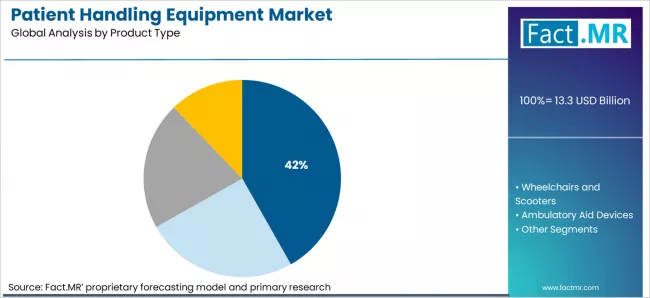
- Product Type: Medical beds are anticipated to dominate the market, accounting for 41.8% of the share by 2026. These beds are essential for ensuring patient comfort and safety in various medical conditions.
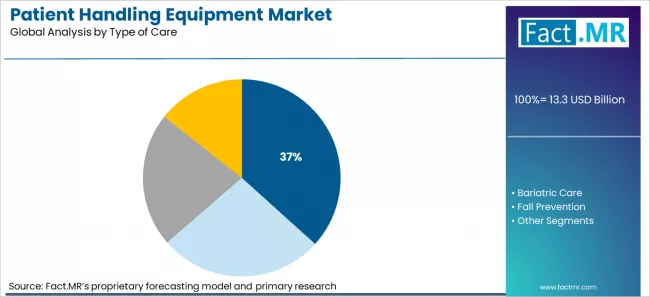
- Type of Care: Critical care is expected to hold the largest share, driven by the increasing number of patients requiring intensive care and specialized equipment.
- End-User: Hospitals are the largest end-user of patient handling equipment, given the constant need for such solutions to support patient mobility, particularly in critical and long-term care settings.
- Analyst Opinion at Fact MR
- "The patient handling equipment market is seeing steady growth driven by the aging population and the rising demand for healthcare services. The segment remains mature, but technological innovations continue to contribute to the market's expansion, especially in developed regions." - Shambhu Nath Jha, Principal Consultant at Fact MR.
- Strategic Implications/Executive Takeaways
- Focus on providing technologically advanced solutions, such as automated and smart medical beds, to enhance patient care and improve operational efficiency.
- Expand product offerings to cater to a wide range of care types, especially critical and bariatric care, where specialized equipment is in high demand.
- Explore emerging markets, particularly in Asia-Pacific, where growing healthcare infrastructure and aging populations are driving demand for patient handling equipment.
- Methodology
- Sourced from primary research with healthcare professionals, facility managers, and equipment suppliers.
- Benchmarked against healthcare trends and patient safety data.
- Hybrid model combining top-down healthcare demand forecasts with bottom-up shipment data.
Segmental Analysis
Patient Handling Equipment Market Analysis by Product Type
Patient Handling Equipment Market Analysis By Product Type | Source: Fact.MR
- Market Overview: Medical beds are expected to capture 41.8% of the market share by 2026. Medical beds are crucial for patient comfort and safety in healthcare settings, offering features such as height adjustment, repositioning capabilities, and stability to support patients with varying medical conditions. The growing demand for healthcare services is driving the need for advanced medical beds in hospitals, long-term care facilities, and home healthcare.
- Demand Drivers:
- Aging Population and Increased Healthcare Needs: The aging global population is increasing the demand for patient handling equipment, particularly medical beds, which are essential for elderly care in both institutional and home settings.
- Enhanced Comfort and Safety: Medical beds with advanced features improve patient comfort and reduce the risk of falls and bedsores, which is especially important for patients in critical or long-term care. This drives their adoption across hospitals and other healthcare facilities.
- Technological Advancements: Innovations in medical beds, such as automatic positioning, pressure relief, and integrated monitoring systems, are making them more attractive to healthcare providers seeking to enhance care quality and efficiency.
Patient Handling Equipment Market Analysis by Type of Care
Patient Handling Equipment Market Analysis By Type Of Care | Source: Fact.MR
- Market Overview: Critical care is projected to capture 36.7% of the market share by 2026. Critical care involves patients who are severely ill and require continuous monitoring and specialized equipment. The need for patient handling equipment in critical care is rising due to the increasing number of patients with chronic illnesses and complex medical conditions.
- Demand Drivers:
- Rise in Chronic Diseases and Critical Illnesses: The increasing prevalence of chronic diseases, such as cardiovascular conditions, respiratory disorders, and cancer, is driving the demand for patient handling equipment in critical care. These patients often require specialized equipment for safe and effective handling during their hospital stays.
- Growth of Intensive Care Units (ICUs): The expansion of ICU facilities and the need for more advanced patient care equipment in hospitals to address critical patients' needs is a major driver of demand in the critical care segment.
- Technological Integration in Critical Care: As healthcare providers focus on improving outcomes and patient safety, the integration of patient handling equipment with monitoring and diagnostic systems in critical care settings is gaining traction, further boosting the demand for specialized equipment.
Patient Handling Equipment Market Drivers, Restraints, and Opportunities
FMR analysts observe that the patient handling equipment market is a mature, demand‑anchored segment within healthcare infrastructure, driven by ongoing needs to improve mobility support, reduce caregiver strain, and enhance safety across hospitals, long‑term care, and home care settings. Historically, basic manual transfer aids met modest mobility needs; as aging populations and care quality expectations grew, structural demand emerged for mechanized lifts, transfer devices, and power‑assisted equipment that reduce injury risk for both patients and caregivers. The 2026 valuation reflects this baseline demand tied to demographic shifts, healthcare service expansion, and growing emphasis on safe patient handling protocols.
While basic manual aids remain prevalent in cost‑sensitive environments, advanced mechanized and power‑assisted patient handling systems are gaining share because they improve safety outcomes and operational efficiency. These higher‑value solutions command elevated per‑unit pricing, contributing to net market value growth even as overall unit volumes grow in line with healthcare infrastructure and staffing trends. The market exists at its current size because patient mobility and fall prevention remain central priorities for care facilities, and regulatory/safety guidelines increasingly reinforce equipment standards.
- Aging Population Demand: Growing elderly populations and higher incidence of limited mobility conditions drive adoption of powered lifts and advanced transfer systems to replace basic manual aids.
- Regulatory Safety Standards: Guidelines such as OSHA safe patient handling recommendations and Joint Commission care quality standards push facilities toward certified ergonomic and mechanized handling equipment, raising specification levels.
- Regional Healthcare Infrastructure: In North America and Europe, stringent care quality expectations and well‑funded facility upgrades accelerate uptake of advanced handling systems, while basic devices remain common in parts of Asia‑Pacific with constrained healthcare budgets.
Regional Analysis
The market analysis covers key global regions, including Asia Pacific, Europe, North America, and South Asia. It is segmented geographically, with specific market dynamics for each region. The full report provides a detailed market attractiveness analysis.
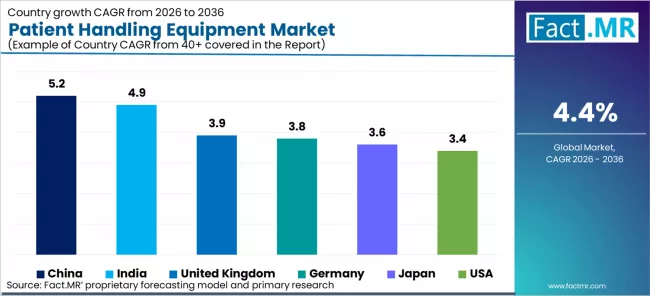
Patient Handling Equipment Market Cagr Analysis By Country | Source: Fact.MR
| Country | CAGR (%) |
|---|---|
| China | 5.2% |
| India | 4.9% |
| United Kingdom | 3.9% |
| Germany | 3.8% |
| Japan | 3.6% |
| USA | 3.4% |
Source: Fact.MR analysis. Updated Feb 25, 2026
Source: Fact MR (FMR) analysis, based on proprietary forecasting model and primary research.
Asia Pacific:
In Asia Pacific, China and India are leading the demand for patient handling equipment, driven by their large aging populations, increasing healthcare needs, and expanding healthcare infrastructure.
- China: Demand for patient handling equipment in China is projected to rise at 5.2% CAGR through 2036. China’s large and aging population and growing healthcare sector continue to drive market growth for patient handling equipment.
- India: Demand for patient handling equipment in India is projected to rise at 4.9% CAGR through 2036. India’s rapidly growing healthcare sector and increasing elderly population contribute to the rising demand for equipment that aids in patient mobility and care.
Europe:
In Europe, the United Kingdom and Germany are key markets for patient handling equipment, driven by an aging population and the need for efficient, safe, and cost-effective patient care solutions.
- United Kingdom: Demand for patient handling equipment in the UK is projected to rise at 3.9% CAGR through 2036. The UK’s aging population and focus on improving healthcare services continue to contribute to steady market growth.
- Germany: Demand for patient handling equipment in Germany is projected to rise at 3.8% CAGR through 2036. Germany’s well-established healthcare infrastructure and increasing demand for safe patient handling solutions continue to support market expansion.
East Asia:
In East Asia, Japan remains a significant market for patient handling equipment, driven by its aging population and increasing demand for healthcare services.
- Japan: Demand for patient handling equipment in Japan is projected to rise at 3.6% CAGR through 2036. Japan’s aging population and focus on elderly care contribute to steady growth in the demand for patient handling equipment.
North America:
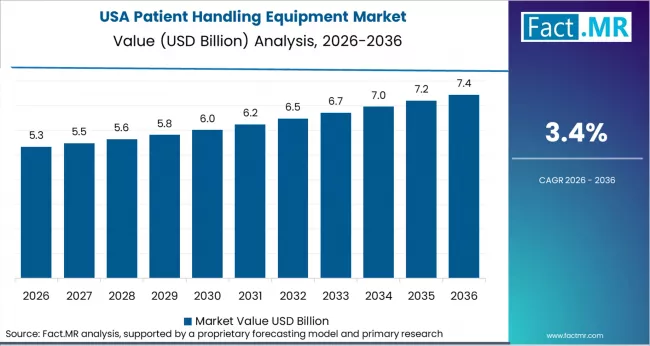
Patient Handling Equipment Market Country Value Analysis | Source: Fact.MR
In North America, the USA remains a major market for patient handling equipment, driven by the need to improve patient care and reduce the risk of injury in healthcare settings.
- USA: Demand for patient handling equipment in the U.S. is projected to rise at 3.4% CAGR through 2036. The USA’s growing healthcare needs and focus on patient safety and mobility contribute to consistent demand for patient handling solutions.
Fact MR's analysis of the Patient Handling Equipment Market in Asia Pacific, Europe, North America, and South Asia consists of country-wise assessments that include China, India, the United Kingdom, Germany, Japan, and the USA. Readers can find detailed trends, regulatory updates, and company-specific investments shaping the market’s growth in these countries.
How Are Key Players Competing in the Patient Handling Equipment Market?
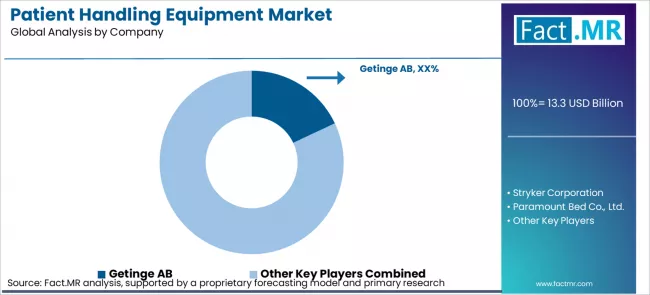
Patient Handling Equipment Market Analysis By Company | Source: Fact.MR
In the patient handling equipment market, companies such as Getinge AB and Stryker Corporation lead by offering innovative products that enhance patient safety and caregiver efficiency. Paramount Bed Co., Ltd. and Invacare Corporation focus on developing ergonomic, high-quality beds and lifting solutions, addressing the growing need for comfort and ease of use in hospitals and home care settings. Hill-Rom Services, Inc. and Guldmann A/S excel in integrating technology with their patient handling solutions, improving mobility and reducing manual handling risks. Stiegelmeyer GmbH & Co. KG and Linet Group SE focus on expanding their product portfolios to meet diverse patient care needs, while Joerns Healthcare, LLC and HoverTech International, Inc. specialize in advanced transfer systems and air-powered lifting equipment. Handicare Group AB and Benmor Medical Ltd. stand out by prioritizing personalized, efficient solutions for both healthcare institutions and home care providers. These players continually innovate to address the increasing demand for more advanced, safe, and efficient patient handling solutions.
Recent Industry Developments
- FDA Transition to QMSR (Regulatory): Effective February 2, 2026, the U.S. FDA officially replaced its decades-old Quality System Regulation (QSR) with the Quality Management System Regulation (QMSR); this new rule aligns U.S. medical device manufacturing (including patient lifts and medical beds) with the international ISO 13485:2016 standard to harmonize global inspections and safety documentation.
- Invacare and Direct Healthcare Group Merger (Corporate): On February 4, 2026, Invacare Holdings Corporation announced the sale of its EMEA and APAC businesses to a joint venture that combined these international operations with Direct Healthcare Group (DHG) to form a new entity, DHCare; the merger aims to accelerate R&D and scale production for pressure care and patient handling solutions across Europe and Asia.
- EU Harmonization of Ambulance Equipment Standards (Regulatory): In April 2025, the European Commission published Implementing Decision (EU) 2025/681, which officially harmonized new standards (EN 1865-2:2024 and EN 1865-6:2024) for patient handling equipment used specifically in road ambulances; this mandate ensures that all stretchers and power-assisted loading systems meet unified safety requirements across the EU member states.
Key Players of the Patient Handling Equipment Market
- Getinge AB
- Stryker Corporation
- Paramount Bed Co., Ltd.
- Invacare Corporation
- Hill-Rom Services, Inc.
- Guldmann A/S
- Stiegelmeyer GmbH & Co. KG
- Linet Group SE
- Joerns Healthcare, LLC
- HoverTech International, Inc.
- Handicare Group AB
- Benmor Medical Ltd.
Report Scope
| Metric | Value |
|---|---|
| Quantitative Units | USD 13.3 billion (2026) to USD 18.5 billion (2036), at a CAGR of 4.4% |
| Market Definition | The patient handling equipment market includes devices and equipment used for patient movement, support, and safety, aiding in mobility, transfer, and care in various settings such as hospitals and home care. |
| By Product Type | Medical Beds, Wheelchairs and Scooters, Ambulatory Aid Devices, Bathroom Safety Equipment, Others |
| By Type of Care | Critical Care, Bariatric Care, Fall Prevention, Wound Care, Others |
| By Accessories | Hospital Bed Accessories, Stretcher Accessories, Lifting Accessories, Transfer Accessories, Evacuation Accessories |
| By End User | Hospitals, Home Care Settings, Elderly Care Facilities, Orthopaedic Care, Others |
| Regions Covered | North America, Latin America, Europe, East Asia, South Asia, Oceania, Middle East and Africa |
| Countries Covered | United States, Canada, Mexico, Brazil, Argentina, Germany, France, United Kingdom, Italy, Spain, China, India, Japan, South Korea, Indonesia, Australia, and 40+ countries |
| Key Companies Profiled | Getinge AB, Stryker Corporation, Paramount Bed Co., Ltd., Invacare Corporation, Hill-Rom Services, Inc., Guldmann A/S, Stiegelmeyer GmbH & Co. KG, Linet Group SE, Joerns Healthcare, LLC, HoverTech International, Inc., Handicare Group AB, Benmor Medical Ltd. |
| Forecast Period | 2026 to 2036 |
| Approach | Hybrid top-down and bottom-up market modeling validated through primary interviews with manufacturers and supported by trade data benchmarking and market research. |
Source: Fact.MR analysis. Updated Feb 25, 2026
Bibliographies
- Occupational Safety and Health Administration. Healthcare: Safe patient handling. U.S. Department of Labor.
- Occupational Safety and Health Administration. Worker safety in hospitals: Patient handling equipment. U.S. Department of Labor.
- U.S. Food and Drug Administration. (2026, February 2). Quality Management System Regulation (QMSR): Final rule replacing the Quality System Regulation (21 CFR Part 820). U.S. Food and Drug Administration.
- European Commission. (2025, April). Commission Implementing Decision (EU) 2025/681 on harmonized standards for ambulance and emergency medical equipment. Official Journal of the European Union.
- Invacare International. (2026, February 4). Invacare announces merger with Direct Healthcare Group to form DHCare [Press release]. Invacare International.
This report addresses:
- Market intelligence enabling comprehensive assessment of leading countries and product segments across the Patient Handling Equipment Market globally.
- Market volume (sales units) estimates and 10-year revenue forecasts from 2026 to 2036, validated through manufacturer shipment data, channel partner surveys, and country-level demand modeling.
- Growth opportunity mapping across product types (Medical Beds, Wheelchairs and Scooters, Ambulatory Aid Devices, Bathroom Safety Equipment, and Others), types of care (Critical Care, Bariatric Care, Fall Prevention, Wound Care, and Others), accessories (Hospital Bed Accessories, Stretcher Accessories, Lifting Accessories, Transfer Accessories, Evacuation Accessories), end users (Hospitals, Home Care Settings, Elderly Care Facilities, Orthopaedic Care, and Others).
- Segment and regional revenue forecasts by product type, type of care, accessories, end-user industry, and geography across 40+ countries.
- Competition strategy analysis covering dealer network structure, recent developments, product portfolio, USPs, and market share analysis.
- Product and regulatory compliance tracking aligned with patient safety standards, healthcare facility requirements, and medical equipment certifications.
- Regulatory impact analysis addressing safety standards, ergonomic guidelines, and healthcare infrastructure regulations across key markets.
- Report delivery in PDF, Excel, PowerPoint, and interactive dashboard formats for executive, procurement, and operational planning use.
Segmentation
Patient Handling Equipment Market Key Segments
-
Product Type :
- Medical Beds
- Wheelchairs and Scooters
- Ambulatory Aid Devices
- Bathroom Safety Equipment
- Others
-
Type of Care :
- Critical Care
- Bariatric Care
- Fall Prevention
- Wound Care
- Others
-
Accessories :
- Hospital Bed Accessories
- Stretcher Accessories
- Lifting Accessories
- Transfer Accessories
- Evacuation Accessories
-
End-Use Industry :
- Hospitals
- Home Care Settings
- Elderly Care Facilities
- Orthopaedic Care
- Others
-
Region :
- North America
- USA
- Canada
- Mexico
- Europe
- Germany
- UK
- France
- Italy
- Spain
- Nordic Countries
- BENELUX
- Rest of Europe
- Asia Pacific
- China
- Japan
- South Korea
- India
- Australia
- Rest of Asia Pacific
- Latin America
- Brazil
- Argentina
- Rest of Latin America
- Middle East and Africa
- Kingdom of Saudi Arabia
- United Arab Emirates
- South Africa
- Rest of Middle East and Africa
- Other Regions
- Oceania
- Central Asia
- Other Markets
- North America
Frequently Asked Questions
How large is the demand for Patient Handling Equipment in the global market in 2026?
What will be the market size of Patient Handling Equipment in the global market by 2036?
What is the expected demand growth for Patient Handling Equipment in the global market between 2026 and 2036?
Which product type is expected to dominate the market?
Which region is expected to show the highest growth rate for Patient Handling Equipment?
How significant is the growth outlook for India in this market?
What is the growth outlook for the United Kingdom in this report?
What is the growth forecast for Germany in the Patient Handling Equipment market?
What is the growth forecast for Japan in the Patient Handling Equipment market?
What is the growth forecast for the United States in the Patient Handling Equipment market?
Which company is identified as a leading player in the Patient Handling Equipment market?
What are Patient Handling Equipment used for?
What does the Patient Handling Equipment market include in this report?
How is the market forecast developed in this report?
What is meant by the Patient Handling Equipment market in this report?
Who worked on this report


Preview the report firsthand - request a free sample
Free SampleGet the brochure for pricing and purchase details
Download PDF