- Forecast Value (2036): 11.5 Bn
- CAGR (2036): 34.4%
What is the personal data removal services market forecast to be worth by 2036?
USD 0.6 billion in 2026 to USD 11.5 billion by 2036, at 34.4% CAGR.
- The personal data removal services market crossed a valuation of USD 0.45 billion in 2025.
- Demand is expected to increase from USD 0.6 billion in 2026 to USD 11.5 billion by 2036.
- The market is forecast to record 34.4% CAGR during 2026 to 2036 as consumer subscriptions, security-suite bundles and employee privacy benefits expand.
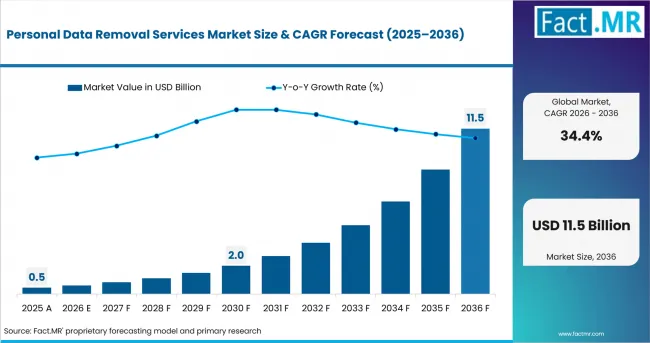
Personal Data Removal Services Market Value Analysis | Source: Fact.MR
What are the defining numbers behind personal data removal services growth?
USD 10.9 billion absolute opportunity by 2036, led by the United States and Canada.
- Demand Drivers in the Market
- Consumers need help because manual opt-outs across people-search sites take time and repeat work.
- Employers need privacy benefits that reduce doxxing risk for executives and public-facing staff.
- Banks and insurers need security bundles that reduce fraud, scam and identity exposure risk.
- Security suites need privacy add-ons as VPN and breach-monitoring bundles become more crowded.
- Key Segments Analyzed
- By Service Type: Automated Data Broker Opt-Out Requests are expected to hold 37.0% share in 2026 because repeat removal requests create the core subscription value.
- By Data Source: People-Search Sites lead because home addresses, phone numbers and family details are easy to find. The share is projected at 40.0% in 2026.
- By Customer Type: Individual Consumers and Families lead because direct-to-consumer subscriptions are the first adoption route. This customer group is likely to account for 46.0% share in 2026.
- By Delivery Model: Consumer Subscription Plans lead as users need recurring scans and removals. The model is projected to hold 44.0% share in 2026.
- By End Use: Doxxing and Identity Exposure Reduction is expected to hold 36.0% share in 2026 because public personal data can enable harassment, scams and impersonation.
- By Geography: The United States is projected to record 38.4% CAGR through 2036 as DROP, people-search exposure and employer privacy benefits expand.
- Analyst Opinion at Fact.MR
- Shambhu Nath Jha, Senior Analyst at Fact.MR, states, “Personal data removal is becoming a security service. We see consumers and employers asking who can keep addresses, phone numbers and family details away from data brokers. Providers that combine automated opt-outs, recurring monitoring and employee privacy support will gain stronger access to digital trust budgets.”
- Strategic Implications
- Consumer privacy providers should make removal status and evidence clear for subscribers.
- Employers can add data removal as a safety benefit for executives and frontline employees.
- Banks and insurers can bundle removal services with identity protection.
- Security suites should connect breach alerts with broker removal and ongoing exposure scans.
Subscription services that delete consumers' personal information from data brokers and people-search sites, increasingly bundled by banks and security suites. California’s Delete Request and Opt-out Platform lets residents submit a single request to over 500 registered data brokers. [1] This creates public awareness around data deletion and strengthens demand for commercial services outside California.
The United States is projected to record 38.4% CAGR through 2036 as DROP, people-search exposure and employer privacy benefits expand. Canada will gain from identity protection bundles and consumer privacy demand. The country is expected to post 35.8% CAGR through 2036. The United Kingdom is likely to record 34.6% CAGR as GDPR rights and executive protection services support adoption. Australia is forecast to advance at 33.1% CAGR as consumers and employers respond to scam and doxxing risk. Germany is set to record 32.2% CAGR as privacy awareness and data protection rights support recurring removal demand.
How does the personal data removal services market break down by segment?
Automated Data Broker Opt-Out Requests lead at 37.0%; People-Search Sites lead at 40.0%.
Which service type dominates?
Automated Data Broker Opt-Out Requests hold 37.0% share in 2026.
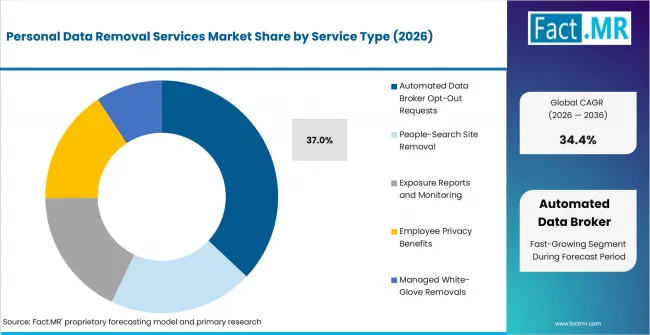
Personal Data Removal Services Market Analysis By Service Type | Source: Fact.MR
Automated Data Broker Opt-Out Requests are expected to hold 37.0% share in 2026 because repeat removal requests create the core subscription value. The service sends requests, tracks responses and repeats removal as records reappear. Incogni states that it sends automated removal requests to covered data brokers that may hold a user’s personal information. [2] Automation leads because consumers cannot easily contact hundreds of brokers on their own.
Which data source dominates?
People-Search Sites lead because home addresses and phone numbers create direct exposure.
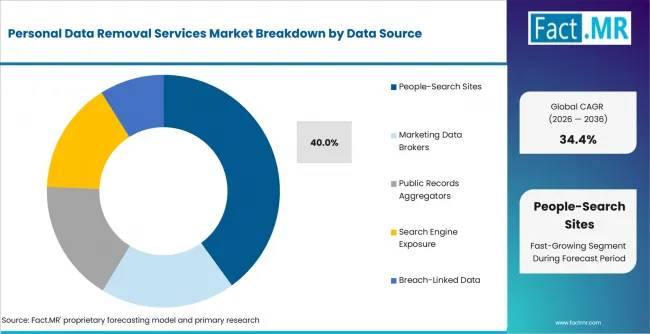
Personal Data Removal Services Market Analysis By Data Source | Source: Fact.MR
People-Search Sites lead because they often display home addresses, phone numbers, relatives and aliases in easily searchable pages. These records create risk for doxxing, stalking, scams and impersonation. The data source is projected to capture 40.0% share in 2026. Optery positions its service around removing home address, phone and private information from Google and data broker sites. [3]
Which customer type dominates?
Individual Consumers and Families lead because direct subscriptions are the first adoption route.
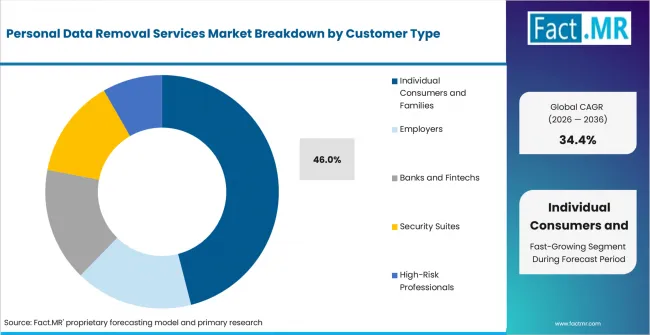
Personal Data Removal Services Market Analysis By Customer Type | Source: Fact.MR
Individual Consumers and Families lead because consumers first see the problem through search results, spam, scams or unwanted exposure. Family plans also expand demand because relatives can appear together on people-search pages. This customer group is likely to account for 46.0% share in 2026. DeleteMe states that it removes personal and business data from search engines, people-search sites, public databases and dark web sources. [4]
Which delivery model dominates?
Consumer Subscription Plans lead because removal must be repeated.
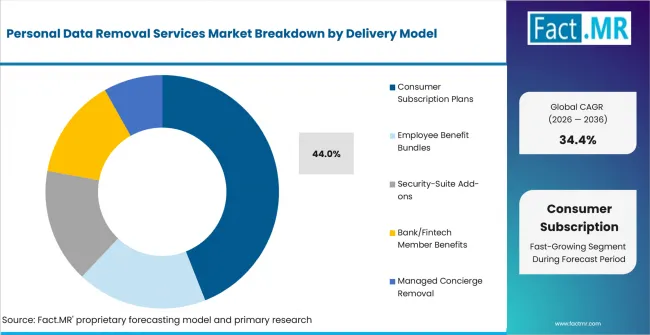
Personal Data Removal Services Market Analysis By Delivery Model | Source: Fact.MR
Consumer Subscription Plans lead because personal data can reappear after brokers refresh records or receive new feeds. Users need recurring scans, follow-up requests and progress reporting. The model is projected to hold 44.0% share in 2026. Mozilla’s former Monitor Plus model also used recurring monthly scans and ongoing removal requests before the paid removal service shut down. [6]
Which end use dominates?
Doxxing and Identity Exposure Reduction holds 36.0% share in 2026.
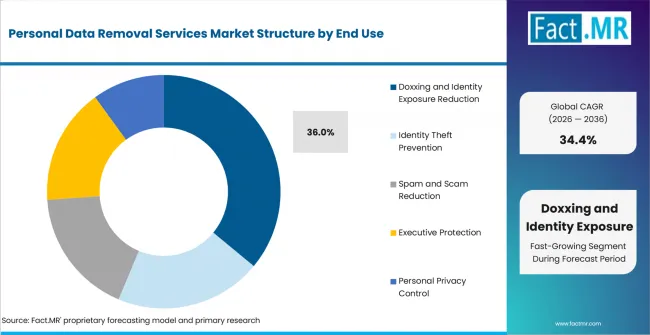
Personal Data Removal Services Market Analysis By End Use | Source: Fact.MR
Doxxing and Identity Exposure Reduction leads because exposed personal details can enable harassment, fraud and targeted scams. Kanary states that it finds, removes and monitors information across search engines, social platforms and data brokers, focusing on the riskiest data leaks. [5] The end use is expected to hold 36.0% share in 2026. Demand is strongest among executives, creators, public officials and households exposed through people-search pages.
What is accelerating personal data removal services demand, and what is holding it back?
DROP rollout, broker-site exposure and security-suite bundling drive demand; incomplete removal and reappearance restrain adoption.
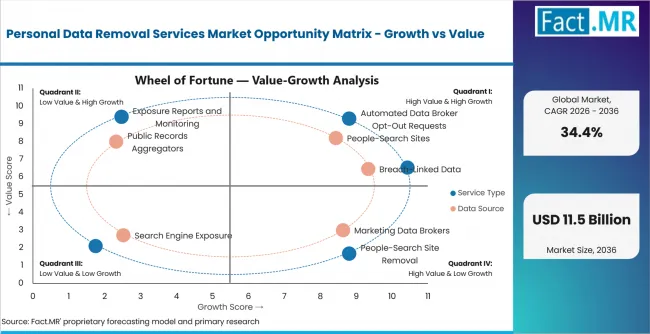
Personal Data Removal Services Market Opportunity Matrix Growth Vs Value | Source: Fact.MR
California’s DROP rollout is the main driver. The California Privacy Protection Agency states that the Delete Request and Opt-out Platform allows consumers to request deletion of their personal information from more than 500 data brokers through one request [7]. This public tool raises consumer awareness even in states and countries without a similar mechanism.
The main restraint is incomplete removal. Some sites may require identity verification, delay responses or republish records from new sources. Providers must show proof of removals and explain limits clearly before the market can scale with lower churn.
Where do the biggest personal data removal service opportunities sit?
Consumer subscriptions, employee privacy benefits and bank security bundles.
- Consumer Subscriptions: Providers can offer recurring scans and opt-outs for individuals and families.
- Employee Privacy Benefits: Employers can protect executives, customer-facing staff and public-sector employees.
- Bank Security Bundles: Financial firms can add removal services to identity theft and fraud-prevention packages.
Which countries are scaling personal data removal services fastest?
United States 38.4%, Canada 35.8%, United Kingdom 34.6%, Australia 33.1%, Germany 32.2%.
Based on regional analysis, the personal data removal services market is segmented into North America, Western Europe, Asia Pacific, Latin America, and Middle East and Africa.
.webp "Top Country Growth Comparison Personal Data Removal Services Market Cagr (2026 2036)")
Top Country Growth Comparison Personal Data Removal Services Market Cagr (2026 2036) | Source: Fact.MR
| Country | CAGR |
|---|---|
| United States | 38.4% |
| Canada | 35.8% |
| United Kingdom | 34.6% |
| Australia | 33.1% |
| Germany | 32.2% |
Source: Fact.MR analysis. Updated Jun 22, 2026
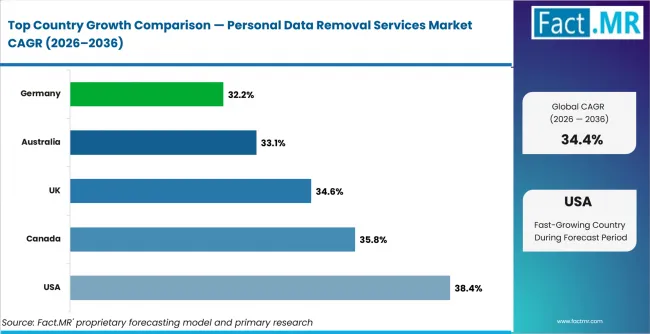
Personal Data Removal Services Market Cagr Analysis By Country | Source: Fact.MR
What is powering the United States lead?
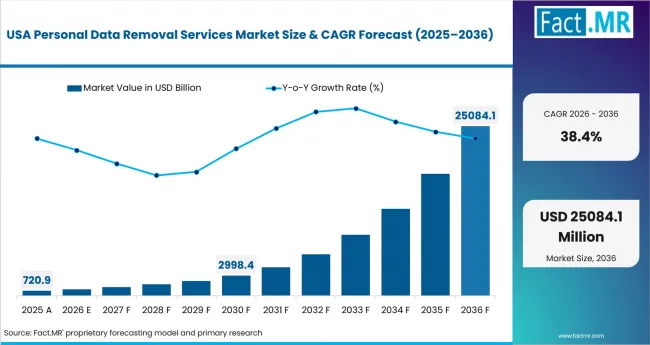
Personal Data Removal Services Market Country Value Analysis | Source: Fact.MR
The United States is projected to record 38.4% CAGR through 2036 as DROP, people-search exposure and employer privacy benefits expand. The country has a large people-search ecosystem and strong direct-to-consumer subscription adoption. Employers are also adding privacy support for executives, security teams and public-facing staff. Demand will focus on recurring scans, proof of removal and family-plan coverage. Providers with broad broker-site coverage and benefit partnerships will gain early scale.
How is Canada scaling personal data removal demand?
Canada will gain from identity protection bundles and consumer privacy demand. Banks, insurers and employers are likely to add removal services as part of fraud and digital safety support. The country is expected to post 35.8% CAGR through 2036. Demand will focus on family privacy, executive protection and scam-risk reduction. Growth will favor providers that can manage cross-border broker exposure and offer clear reporting.
What supports the United Kingdom outlook?
The United Kingdom is likely to record 34.6% CAGR through 2036 as GDPR rights and executive protection services support adoption. Consumers already have legal rights to access and erase personal data, but manual requests can be difficult. Data removal providers can help users identify exposure and manage repeat opt-outs. Employers will add services for senior leaders, journalists and public-facing teams. Growth will favor providers that combine legal-rights workflows with search and broker monitoring.
How is Australia scaling personal data removal services?
Australia is forecast to advance at 33.1% CAGR through 2036 as consumers and employers respond to scam and doxxing risk. Public attention around cyber incidents and identity theft supports demand for privacy tools. Consumer subscriptions will grow through security suites and identity protection products. Employers may add removal support for workers exposed to harassment or fraud targeting. Providers with strong education and simple reporting will gain faster adoption.
Why is Germany an important personal data removal market?
Germany is set to record 32.2% CAGR through 2036 as privacy awareness and data protection rights support recurring removal demand. Consumers are highly sensitive to personal data use, and firms must respect strong privacy norms. Demand will focus on broker opt-outs, search exposure and proof of action. Employers can use removal services for executives and employees exposed to targeted harassment. Growth will favor providers with German-language support and strong compliance processes.
Who leads the personal data removal services landscape?
DeleteMe, Incogni and Optery lead through consumer data removal, automated opt-outs and broad broker-site coverage.
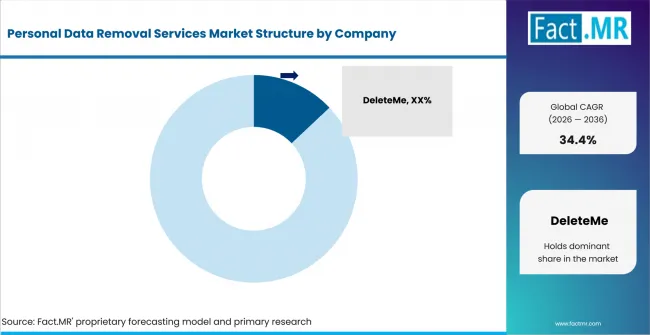
Personal Data Removal Services Market Analysis By Company | Source: Fact.MR
Personal data removal services are used by consumers, families, employers and security-suite providers seeking to reduce online personal exposure. DeleteMe provides personal data removal across search engines, people-search sites, public databases and dark web sources. Incogni, a Surfshark-backed service, automates removal requests to covered data brokers and tracks progress.
Optery provides exposure reports and automated removals across hundreds of broker and people-search sites. Kanary focuses on risky personal data leaks across search engines, social platforms and data brokers. OneRep is treated as a legacy data-removal entrant because Monitor Plus shut down, while breach monitoring continues. Competition through 2036 will depend on coverage, verification evidence and bundle distribution.
Providers that combine automation with human review will be better placed. Direct-to-consumer brands can win subscription demand. Security suites can win bundled privacy adoption. Employer benefit providers can win through executive protection and employee safety programs.
Which companies are the key players?
DeleteMe, Incogni, Optery, Kanary and OneRep.
- DeleteMe
- Incogni (Surfshark)
- Optery
- Kanary
- OneRep
Bibliography
- [1] California Privacy Protection Agency. (2026, January 1). Delete Request and Opt-out Platform (DROP). State of California.
- [2] Incogni. (n.d.). Data Broker Removal Service.
- [3] Optery. (n.d.). Remove your home address, phone and other private info from Google, and 945+ sites.
- [4] DeleteMe. (n.d.). Remove Personal Data from Internet & Data Brokers.
- [5] Kanary. (n.d.). Kanary.
- [6] Mozilla Support. (2026, March 17). Monitor Plus has shut down – what you need to know.
This Report Address
- Strategic intelligence on personal data removal services across service type, data source and customer type.
- Segment analysis covering Automated Data Broker Opt-Out Requests, People-Search Sites, Individual Consumers and Families, Consumer Subscription Plans and Doxxing Risk Reduction.
- Regional outlook covering the United States, Canada, United Kingdom, Australia and Germany.
- Competitive analysis of DeleteMe, Incogni, Optery, Kanary and OneRep.
- Service assessment covering data broker opt-outs, people-search removals, exposure reporting and employee privacy benefits.
- Data-source assessment covering people-search sites, marketing data brokers, public records aggregators and search exposure.
- Primary interviews, provider checks, official source review and privacy-service validation support the forecast.
What does the personal data removal services market cover?
Subscription and managed services that remove personal information from data brokers and people-search sites.
The personal data removal services market covers consumer and enterprise services that find personal information online and submit removal requests to data brokers, people-search sites and related sources. It includes exposure reports, recurring scans, opt-out request management and employee privacy benefits. The market differs from general identity protection because the focus is proactive personal data removal from broker-controlled sources.
What is included in the scope?
Data broker opt-outs, people-search removals and recurring exposure monitoring.
The scope includes automated removal requests, recurring scans and status reporting. It covers people-search site removals, data broker opt-outs, search exposure review and executive privacy support. It includes family plans, employee benefit programs and security-suite add-ons. It also includes managed removals for high-risk individuals such as executives, journalists and public-facing professionals.
What is excluded from the scope?
General cybersecurity tools with no personal data removal workflow.
The scope excludes password managers, VPNs and antivirus tools unless data removal is included. It excludes manual privacy advice with no opt-out execution. It excludes legal takedown services for defamation or copyright issues. It also excludes breach monitoring alone unless combined with data broker or people-search removal.
How was the analysis built?
100+ sources, 40+ company portfolios, 25+ countries, 20+ interviews.
- Primary Research: Primary research includes interviews with privacy service providers and identity protection teams. It includes input from employer benefits advisers, security-suite product leaders and consumer privacy specialists.
- Desk Research: Desk research reviews California DROP rules and official provider service pages. It covers data broker removal coverage, subscription models and employee privacy benefit positioning.
- Market-Sizing and Forecasting: Forecasting uses adult internet populations, data broker exposure rates and subscription conversion. Employer benefits adoption and bundled security-suite distribution support the market assessment.
- Data Validation and Update Cycle: Forecasts are validated through provider checks and privacy product review. Regulatory changes, broker coverage updates and consumer security demand help confirm market direction.
Segmentation
What is the report’s scope and coverage?
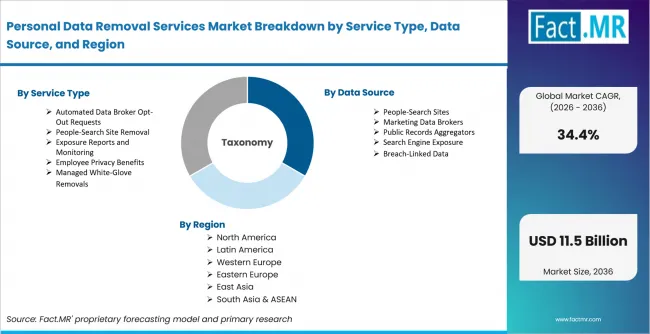
Personal Data Removal Services Market Breakdown By Service Type, Data Source, And Region | Source: Fact.MR
| Attribute | Details |
|---|---|
| Quantitative Units | USD Billion in services in 2026 to USD Billion by 2036 |
| Market Definition | Subscription services that delete consumers’ personal information from data brokers and people-search sites |
| Service Type | Automated Data Broker Opt-Out Requests, People-Search Site Removal, Exposure Reports and Monitoring, Employee Privacy Benefits, Managed White-Glove Removals |
| Data Source | People-Search Sites, Marketing Data Brokers, Public Records Aggregators, Search Engine Exposure, Breach-Linked Data |
| Customer Type | Individual Consumers and Families, Employers, Banks and Fintechs, Security Suites, High-Risk Professionals |
| Delivery Model | Consumer Subscription Plans, Employee Benefit Bundles, Security-Suite Add-ons, Bank/Fintech Member Benefits, Managed Concierge Removal |
| End Use | Doxxing and Identity Exposure Reduction, Identity Theft Prevention, Spam and Scam Reduction, Executive Protection, Personal Privacy Control |
| Regions Covered | North America, Western Europe, Asia Pacific, Latin America, Middle East and Africa |
| Countries Covered | United States, Canada, United Kingdom, Australia, Germany |
| Key Companies Profiled | DeleteMe, Incogni, Optery, Kanary and OneRep |
| Forecast Period | 2026 to 2036 |
| Approach | Hybrid top-down and bottom-up approach using adult internet populations, broker exposure, subscription adoption, bundle penetration and provider validation |
Source: Fact.MR analysis. Updated Jun 22, 2026
How is the market segmented?
-
By Service Type:
- Automated Data Broker Opt-Out Requests
- People-Search Site Removal
- Exposure Reports and Monitoring
- Employee Privacy Benefits
- Managed White-Glove Removals
-
By Data Source:
- People-Search Sites
- Marketing Data Brokers
- Public Records Aggregators
- Search Engine Exposure
- Breach-Linked Data
-
By Customer Type:
- Individual Consumers and Families
- Employers
- Banks and Fintechs
- Security Suites
- High-Risk Professionals
-
By Delivery Model:
- Consumer Subscription Plans
- Employee Benefit Bundles
- Security-Suite Add-ons
- Bank/Fintech Member Benefits
- Managed Concierge Removal
-
By End Use:
- Doxxing and Identity Exposure Reduction
- Identity Theft Prevention
- Spam and Scam Reduction
- Executive Protection
- Personal Privacy Control
-
By Region:
- North America
- United States
- Canada
- Europe
- United Kingdom
- Germany
- France
- Netherlands
- Spain
- Asia Pacific
- Australia
- Japan
- Singapore
- South Korea
- India
- Latin America
- Brazil
- Mexico
- Chile
- Middle East & Africa
- GCC Countries
- South Africa
- Israel
- North America
Frequently Asked Questions
Which service type leads the Personal Data Removal Services Market?
Which country expands faster in the Personal Data Removal Services Market?
How does Canada perform in the Personal Data Removal Services Market?
How does the United Kingdom perform in the Personal Data Removal Services Market?
How does Australia perform in the Personal Data Removal Services Market?
How does Germany perform in the Personal Data Removal Services Market?
What is the primary driver in the Personal Data Removal Services Market?
What is the main restraint in the Personal Data Removal Services Market?
Why are people-search sites important in this market?
Who worked on this report


Preview the report firsthand - request a free sample
Free SampleGet the brochure for pricing and purchase details
Download PDF