Pharmaceuticals and Personal Care Products Removal Chemicals Market
Pharmaceuticals and Personal Care Products Removal Chemicals Market Size and Share Forecast Outlook 2026 to 2036
Pharmaceuticals and personal care products removal chemicals market is projected to grow from USD 0.6 billion in 2026 to USD 1.4 billion by 2036, at a CAGR of 9.7%. Advanced Oxidation Chemicals will dominate with a 30.0% market share, while municipal wastewater treatment plants will lead the application area segment with a 34.0% share.
Pharmaceuticals and Personal Care Products Removal Chemicals Market Forecast and Outlook 2026 to 2036
The global market for chemicals targeting the removal of pharmaceuticals and personal care products (PPCPs) from water is experiencing accelerated growth, driven by heightened scientific and regulatory focus on these pervasive micropollutants. Valued at USD 0.56 billion in 2026, the market is projected to reach USD 1.41 billion by 2036, advancing at a 9.7% CAGR.
Key Takeaways from the Pharmaceuticals and Personal Care Products Removal Chemicals Market
- Market Value for 2026: USD 0.56 Billion
- Market Value for 2036: USD 1.41 Billion
- Forecast CAGR (2026-2036): 9.7%
- Leading Chemical Treatment Type Share (2026): Advanced Oxidation Chemicals (30%)
- Leading Application Area Share (2026): Municipal Wastewater Treatment Plants (34%)
- Leading Removal Mechanism Share (2026): Adsorption-Based Removal (32%)
- Key Players in the Market: Veolia Water Technologies, Ecolab, Kemira, SUEZ Water Technologies, Solenis

Advanced oxidation chemicals represent the leading treatment type, securing a 30% market share. Municipal wastewater treatment plants constitute the primary application area, accounting for 34% of demand. Adsorption-based removal is the foremost operational mechanism, holding a 32% share, due to its effectiveness in concentrating a wide range of PPCP compounds from water streams.
Expansion is propelled by the increasing detection of PPCPs, including antibiotics, analgesics, hormones, and antimicrobials, in aquatic environments worldwide. These substances, often designed to be biologically active, can disrupt ecosystems and pose potential risks to human health, even at trace concentrations. Conventional wastewater treatment provides limited removal, creating a critical need for specialized chemical solutions that can intercept, degrade, or transform these complex molecules before they enter waterways or drinking water sources.
The market's progression is characterized by the development of targeted chemistries that address the diverse chemical structures and polarities of PPCPs. Innovations aim to enhance removal efficiency, minimize energy and chemical consumption, and ensure the safe handling of concentrated waste streams. These advancements are essential for water utilities and industries to mitigate an emerging environmental challenge and safeguard water quality for future reuse.
Metric
| Metric | Value |
|---|---|
| Market Value (2026) | USD 0.56 Billion |
| Market Forecast Value (2036) | USD 1.41 Billion |
| Forecast CAGR (2026-2036) | 9.7% |
Category
| Category | Segments |
|---|---|
| Chemical Treatment Type | Advanced Oxidation Chemicals, Activated Carbon & Adsorbent Media, Ion Exchange & Resin-Based Chemicals, Bio-Based & Enzymatic Treatment Agents, Other Specialty PPCP Removal Chemicals |
| Application Area | Municipal Wastewater Treatment Plants, Industrial & Pharmaceutical Effluent, Drinking Water Filtration Systems, Hospital & Healthcare Wastewater, Specialized Pilot & Research Systems |
| Removal Mechanism | Adsorption-Based Removal, Chemical Oxidation & Degradation, Precipitation & Coagulation, Biochemical & Enzymatic Breakdown, Hybrid & Novel Removal Methods |
| Region | North America, Latin America, Western Europe, Eastern Europe, East Asia, South Asia & Pacific, MEA |
Segmental Analysis
By Chemical Treatment Type, Which Technology Addresses the Broadest Spectrum of PPCPs?

Advanced oxidation chemicals lead the market with a 30% share. Their prominence is due to their ability to fundamentally degrade and mineralize a wide array of organic PPCP molecules, breaking them down into simpler, less harmful compounds. Processes utilizing ozone, hydrogen peroxide, or UV-activated oxidants generate highly reactive hydroxyl radicals that non-selectively attack pollutant structures.
This capability is crucial for dealing with the complex and variable mixture of PPCPs found in wastewater, offering a destructive rather than a separation-based solution for persistent compounds.
By Application Area, Which Sector is the First Line of Defense?
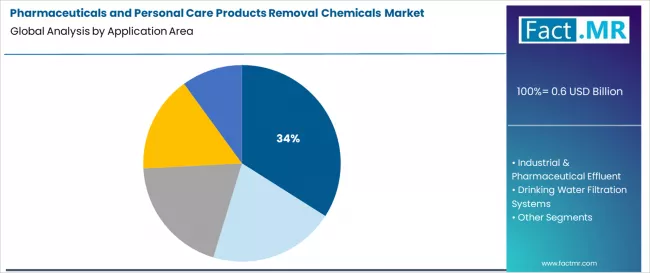
Municipal wastewater treatment plants represent the largest application area, holding a 34% share. WWTPs receive the cumulative discharge from households, hospitals, and some industries, making them the primary collection point for PPCPs entering the environment.
Upgrading these facilities with tertiary treatment chemicals is seen as the most impactful strategy for large-scale reduction of PPCP loads to rivers and lakes. Regulatory pressure and public expectation are driving municipalities to pilot and implement advanced chemical treatment stages specifically designed for micropollutant removal.
By Removal Mechanism, Which Process is Most Readily Integrated into Existing Infrastructure?

Adsorption-based removal is the leading mechanism, commanding a 32% share. This method, primarily using powdered or granular activated carbon (PAC/GAC), works by attracting and retaining PPCP molecules on the surface of the adsorbent material. Its advantage lies in the relative ease of retrofitting existing treatment trains; PAC can be dosed into existing contact tanks, and GAC can replace standard media in filters. This plug-and-play capability, combined with proven efficacy for many common PPCPs, makes adsorption a widely adopted first step for utilities addressing new regulatory guidelines.
What are the Drivers, Restraints, and Key Trends of the PPCP Removal Chemicals Market?
The primary market driver is the implementation of regulatory frameworks in Europe, North America, and parts of Asia that mandate monitoring and set limits for specific PPCPs in effluent. The EU’s Water Framework Directive and its watch list mechanism exemplify this trend. Growing public awareness of contaminants of emerging concern and scientific evidence of their effects on aquatic life create additional pressure for action. The push for potable and non-potable water reuse also demands advanced treatment barriers to ensure the safety of recycled water concerning trace organic chemicals.
A significant market restraint is the high cost of advanced treatment technologies, including the chemicals and energy required for processes like advanced oxidation. The sheer diversity of PPCPs—numbering in the thousands—means no single chemical treatment is universally effective, often necessitating combined approaches that increase complexity and cost. Furthermore, the concentrated waste streams generated by adsorption or ion exchange (e.g., spent carbon, brine) require careful management to avoid secondary pollution, adding to operational expenses.
Key trends include the development of tailored adsorbent materials such as biochars, molecularly imprinted polymers, and carbon nanotubes designed for higher affinity towards specific problematic PPCP classes like antibiotics. There is growing research into enzymatic and bio-augmentation approaches that use specific microbes or enzymes to biodegrade PPCPs in a more targeted, energy-efficient manner. The market is also moving toward smart, modular treatment systems that combine chemical units and are deployed at critical points, such as hospital wastewater outfalls, for targeted source control.
Analysis of the PPCP Removal Chemicals Market by Key Countries

| Country | CAGR (2026-2036) |
|---|---|
| India | 10.50% |
| China | 10.20% |
| USA | 8.40% |
| Germany | 7.90% |
| South Korea | 7.60% |
How do India’s Healthcare Expansion and Water Quality Priorities Interact?
India’s leading CAGR of 10.50% is driven by its rapidly growing pharmaceutical manufacturing sector and expanding healthcare infrastructure, coupled with severe surface water pollution. National programs to clean major rivers and new standards for industrial and hospital effluent are creating immediate demand for treatment solutions.
The scale of the challenge, with numerous pharmaceutical clusters and densely populated cities, positions India as a major market for adsorption media and advanced oxidation chemicals to intercept PPCPs at source and in municipal treatment.
What is the Impact of China’s Environmental Regulations on Pharmaceutical and Municipal Sectors?
China’s 10.20% growth is linked to its stringent enforcement of pollution control standards for the pharmaceutical industry and its ongoing upgrades to urban wastewater treatment. The government’s focus on reducing the environmental impact of key sectors is pushing for the adoption of advanced tertiary treatment.
Large-scale investments in new WWTPs and industrial park centralized treatment facilities incorporate design provisions for micropollutant removal, driving procurement of specialized chemicals and adsorbents.
How does the USA’s Regulatory Approach and Research Focus Shape Demand?
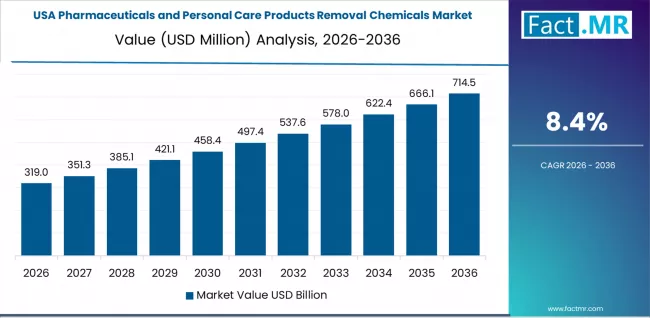
The USA’s 8.40% CAGR is supported by an evolving regulatory landscape at the state level (e.g., California’s monitoring requirements) and significant federal research into PPCP treatment through agencies like the EPA and NSF.
While nationwide mandates are still developing, proactive utilities, especially those pursuing water reuse, are early adopters. The market is characterized by demand for proven, cost-effective solutions like GAC and emerging advanced oxidation processes, backed by robust performance data.
Why is Germany a Key Market for Advanced Engineering and Precautionary Action?
Germany’s 7.90% growth reflects its precautionary environmental principle and leadership in implementing the EU Water Framework Directive. German utilities and engineering firms are at the forefront of installing full-scale ozonation and activated carbon filtration for PPCP removal.
The market demands highly reliable, engineered chemical treatment systems and focuses on optimizing the entire process chain, from chemical dosing to residual management, to achieve the highest removal efficiencies.
What Role does South Korea’s Technological Advancement and Water Reuse Focus Play?
South Korea’s 7.60% growth is anchored in its national commitment to high-tech solutions and advanced water management. With limited water resources, the country heavily invests in water reuse, necessitating advanced barriers against micropollutants.
South Korean technology developers are active in creating innovative adsorption materials and compact AOP systems. This environment fosters a sophisticated market for next-generation PPCP removal chemicals and integrated treatment units.
Competitive Landscape of the PPCP Removal Chemicals Market

The competitive landscape features global water technology leaders and specialty chemical providers offering integrated solutions. Companies like Veolia and SUEZ compete by providing not only chemicals (oxidants, adsorbents) but also the complete process design, engineering, and operation of advanced treatment lines.
Competition centers on demonstrating full-scale removal efficiencies for a broad suite of PPCPs, providing lifecycle cost analyses that include waste handling, and offering digital optimization tools for chemical dosing. A key differentiator is the ability to deliver a guaranteed performance outcome for specific regulatory compliance goals or water quality targets.
Key Players in the Pharmaceuticals and Personal Care Products Removal Chemicals Market
- Veolia Water Technologies
- Ecolab
- Kemira Oyj.
- SUEZ Water Technologies
- Solenis
Scope of Report
| Items | Values |
|---|---|
| Quantitative Units | USD Billion |
| Chemical Treatment Type | Advanced Oxidation, Adsorbent Media, Ion Exchange Resins, Bio-Based/Enzymatic Agents, Specialty Chemicals |
| Application Area | Municipal WWTPs, Industrial/Pharma Effluent, Drinking Water Systems, Hospital Wastewater, Pilot Systems |
| Removal Mechanism | Adsorption, Chemical Oxidation, Precipitation/Coagulation, Biochemical Breakdown, Hybrid Methods |
| Key Countries | India, China, USA, Germany, South Korea |
| Key Companies | Veolia Water Technologies, Ecolab, Kemira, SUEZ Water Technologies, Solenis |
| Additional Analysis | Analysis of PPCP physicochemical properties influencing treatability; competitive adsorption in complex matrices; identification of transformation products from oxidation; fate of spent adsorbents and regeneration strategies; regulatory and analytical method development for PPCP monitoring. |
Market by Segments
-
Chemical Treatment Type :
- Advanced Oxidation Chemicals
- Activated Carbon & Adsorbent Media
- Ion Exchange & Resin-Based Chemicals
- Bio-Based & Enzymatic Treatment Agents
- Other Specialty PPCP Removal Chemicals
-
Application Area :
- Municipal Wastewater Treatment Plants
- Industrial & Pharmaceutical Effluent
- Drinking Water Filtration Systems
- Hospital & Healthcare Wastewater
- Specialized Pilot & Research Systems
-
Removal Mechanism :
- Adsorption-Based Removal
- Chemical Oxidation & Degradation
- Precipitation & Coagulation
- Biochemical & Enzymatic Breakdown
- Hybrid & Novel Removal Methods
-
Region :
-
North America
- USA
- Canada
-
Latin America
- Brazil
- Mexico
- Argentina
- Rest of Latin America
-
Western Europe
- Germany
- UK
- France
- Spain
- Italy
- BENELUX
- Rest of Western Europe
-
Eastern Europe
- Russia
- Poland
- Czech Republic
- Rest of Eastern Europe
-
East Asia
- China
- Japan
- South Korea
- Rest of East Asia
-
South Asia & Pacific
- India
- ASEAN
- Australia
- Rest of South Asia & Pacific
-
MEA
- Saudi Arabia
- UAE
- Turkiye
- Rest of MEA
-
Table of Content
- Executive Summary
- Global Market Outlook
- Demand to side Trends
- Supply to side Trends
- Technology Roadmap Analysis
- Analysis and Recommendations
- Market Overview
- Market Coverage / Taxonomy
- Market Definition / Scope / Limitations
- Market Background
- Market Dynamics
- Drivers
- Restraints
- Opportunity
- Trends
- Scenario Forecast
- Demand in Optimistic Scenario
- Demand in Likely Scenario
- Demand in Conservative Scenario
- Opportunity Map Analysis
- Product Life Cycle Analysis
- Supply Chain Analysis
- Investment Feasibility Matrix
- Value Chain Analysis
- PESTLE and Porter’s Analysis
- Regulatory Landscape
- Regional Parent Market Outlook
- Production and Consumption Statistics
- Import and Export Statistics
- Market Dynamics
- Global Market Analysis 2021 to 2025 and Forecast, 2026 to 2036
- Historical Market Size Value (USD Million) Analysis, 2021 to 2025
- Current and Future Market Size Value (USD Million) Projections, 2026 to 2036
- Y to o to Y Growth Trend Analysis
- Absolute $ Opportunity Analysis
- Global Market Pricing Analysis 2021 to 2025 and Forecast 2026 to 2036
- Global Market Analysis 2021 to 2025 and Forecast 2026 to 2036, By Chemical Treatment Type
- Introduction / Key Findings
- Historical Market Size Value (USD Million) Analysis By Chemical Treatment Type, 2021 to 2025
- Current and Future Market Size Value (USD Million) Analysis and Forecast By Chemical Treatment Type, 2026 to 2036
- Advanced Oxidation Chemicals
- Activated Carbon & Adsorbent Media
- Ion Exchange & Resin-Based Chemicals
- Bio-Based & Enzymatic Treatment Agents
- Other Specialty PPCP Removal Chemicals
- Advanced Oxidation Chemicals
- Y to o to Y Growth Trend Analysis By Chemical Treatment Type, 2021 to 2025
- Absolute $ Opportunity Analysis By Chemical Treatment Type, 2026 to 2036
- Global Market Analysis 2021 to 2025 and Forecast 2026 to 2036, By Application Area
- Introduction / Key Findings
- Historical Market Size Value (USD Million) Analysis By Application Area, 2021 to 2025
- Current and Future Market Size Value (USD Million) Analysis and Forecast By Application Area, 2026 to 2036
- Municipal Wastewater Treatment Plants
- Industrial & Pharmaceutical Effluent
- Drinking Water Filtration Systems
- Hospital & Healthcare Wastewater
- Specialized Pilot & Research Systems
- Municipal Wastewater Treatment Plants
- Y to o to Y Growth Trend Analysis By Application Area, 2021 to 2025
- Absolute $ Opportunity Analysis By Application Area, 2026 to 2036
- Global Market Analysis 2021 to 2025 and Forecast 2026 to 2036, By Removal Mechanism
- Introduction / Key Findings
- Historical Market Size Value (USD Million) Analysis By Removal Mechanism, 2021 to 2025
- Current and Future Market Size Value (USD Million) Analysis and Forecast By Removal Mechanism, 2026 to 2036
- Adsorption-Based Removal
- Chemical Oxidation & Degradation
- Precipitation & Coagulation
- Biochemical & Enzymatic Breakdown
- Hybrid & Novel Removal Methods
- Adsorption-Based Removal
- Y to o to Y Growth Trend Analysis By Removal Mechanism, 2021 to 2025
- Absolute $ Opportunity Analysis By Removal Mechanism, 2026 to 2036
- Global Market Analysis 2021 to 2025 and Forecast 2026 to 2036, By Region
- Introduction
- Historical Market Size Value (USD Million) Analysis By Region, 2021 to 2025
- Current Market Size Value (USD Million) Analysis and Forecast By Region, 2026 to 2036
- North America
- Latin America
- Western Europe
- Eastern Europe
- East Asia
- South Asia and Pacific
- Middle East & Africa
- Market Attractiveness Analysis By Region
- North America Market Analysis 2021 to 2025 and Forecast 2026 to 2036, By Country
- Historical Market Size Value (USD Million) Trend Analysis By Market Taxonomy, 2021 to 2025
- Market Size Value (USD Million) Forecast By Market Taxonomy, 2026 to 2036
- By Country
- USA
- Canada
- Mexico
- By Chemical Treatment Type
- By Application Area
- By Removal Mechanism
- By Country
- Market Attractiveness Analysis
- By Country
- By Chemical Treatment Type
- By Application Area
- By Removal Mechanism
- Key Takeaways
- Latin America Market Analysis 2021 to 2025 and Forecast 2026 to 2036, By Country
- Historical Market Size Value (USD Million) Trend Analysis By Market Taxonomy, 2021 to 2025
- Market Size Value (USD Million) Forecast By Market Taxonomy, 2026 to 2036
- By Country
- Brazil
- Chile
- Rest of Latin America
- By Chemical Treatment Type
- By Application Area
- By Removal Mechanism
- By Country
- Market Attractiveness Analysis
- By Country
- By Chemical Treatment Type
- By Application Area
- By Removal Mechanism
- Key Takeaways
- Western Europe Market Analysis 2021 to 2025 and Forecast 2026 to 2036, By Country
- Historical Market Size Value (USD Million) Trend Analysis By Market Taxonomy, 2021 to 2025
- Market Size Value (USD Million) Forecast By Market Taxonomy, 2026 to 2036
- By Country
- Germany
- UK
- Italy
- Spain
- France
- Nordic
- BENELUX
- Rest of Western Europe
- By Chemical Treatment Type
- By Application Area
- By Removal Mechanism
- By Country
- Market Attractiveness Analysis
- By Country
- By Chemical Treatment Type
- By Application Area
- By Removal Mechanism
- Key Takeaways
- Eastern Europe Market Analysis 2021 to 2025 and Forecast 2026 to 2036, By Country
- Historical Market Size Value (USD Million) Trend Analysis By Market Taxonomy, 2021 to 2025
- Market Size Value (USD Million) Forecast By Market Taxonomy, 2026 to 2036
- By Country
- Russia
- Poland
- Hungary
- Balkan & Baltic
- Rest of Eastern Europe
- By Chemical Treatment Type
- By Application Area
- By Removal Mechanism
- By Country
- Market Attractiveness Analysis
- By Country
- By Chemical Treatment Type
- By Application Area
- By Removal Mechanism
- Key Takeaways
- East Asia Market Analysis 2021 to 2025 and Forecast 2026 to 2036, By Country
- Historical Market Size Value (USD Million) Trend Analysis By Market Taxonomy, 2021 to 2025
- Market Size Value (USD Million) Forecast By Market Taxonomy, 2026 to 2036
- By Country
- China
- Japan
- South Korea
- By Chemical Treatment Type
- By Application Area
- By Removal Mechanism
- By Country
- Market Attractiveness Analysis
- By Country
- By Chemical Treatment Type
- By Application Area
- By Removal Mechanism
- Key Takeaways
- South Asia and Pacific Market Analysis 2021 to 2025 and Forecast 2026 to 2036, By Country
- Historical Market Size Value (USD Million) Trend Analysis By Market Taxonomy, 2021 to 2025
- Market Size Value (USD Million) Forecast By Market Taxonomy, 2026 to 2036
- By Country
- India
- ASEAN
- Australia & New Zealand
- Rest of South Asia and Pacific
- By Chemical Treatment Type
- By Application Area
- By Removal Mechanism
- By Country
- Market Attractiveness Analysis
- By Country
- By Chemical Treatment Type
- By Application Area
- By Removal Mechanism
- Key Takeaways
- Middle East & Africa Market Analysis 2021 to 2025 and Forecast 2026 to 2036, By Country
- Historical Market Size Value (USD Million) Trend Analysis By Market Taxonomy, 2021 to 2025
- Market Size Value (USD Million) Forecast By Market Taxonomy, 2026 to 2036
- By Country
- Kingdom of Saudi Arabia
- Other GCC Countries
- Turkiye
- South Africa
- Other African Union
- Rest of Middle East & Africa
- By Chemical Treatment Type
- By Application Area
- By Removal Mechanism
- By Country
- Market Attractiveness Analysis
- By Country
- By Chemical Treatment Type
- By Application Area
- By Removal Mechanism
- Key Takeaways
- Key Countries Market Analysis
- USA
- Pricing Analysis
- Market Share Analysis, 2025
- By Chemical Treatment Type
- By Application Area
- By Removal Mechanism
- Canada
- Pricing Analysis
- Market Share Analysis, 2025
- By Chemical Treatment Type
- By Application Area
- By Removal Mechanism
- Mexico
- Pricing Analysis
- Market Share Analysis, 2025
- By Chemical Treatment Type
- By Application Area
- By Removal Mechanism
- Brazil
- Pricing Analysis
- Market Share Analysis, 2025
- By Chemical Treatment Type
- By Application Area
- By Removal Mechanism
- Chile
- Pricing Analysis
- Market Share Analysis, 2025
- By Chemical Treatment Type
- By Application Area
- By Removal Mechanism
- Germany
- Pricing Analysis
- Market Share Analysis, 2025
- By Chemical Treatment Type
- By Application Area
- By Removal Mechanism
- UK
- Pricing Analysis
- Market Share Analysis, 2025
- By Chemical Treatment Type
- By Application Area
- By Removal Mechanism
- Italy
- Pricing Analysis
- Market Share Analysis, 2025
- By Chemical Treatment Type
- By Application Area
- By Removal Mechanism
- Spain
- Pricing Analysis
- Market Share Analysis, 2025
- By Chemical Treatment Type
- By Application Area
- By Removal Mechanism
- France
- Pricing Analysis
- Market Share Analysis, 2025
- By Chemical Treatment Type
- By Application Area
- By Removal Mechanism
- India
- Pricing Analysis
- Market Share Analysis, 2025
- By Chemical Treatment Type
- By Application Area
- By Removal Mechanism
- ASEAN
- Pricing Analysis
- Market Share Analysis, 2025
- By Chemical Treatment Type
- By Application Area
- By Removal Mechanism
- Australia & New Zealand
- Pricing Analysis
- Market Share Analysis, 2025
- By Chemical Treatment Type
- By Application Area
- By Removal Mechanism
- China
- Pricing Analysis
- Market Share Analysis, 2025
- By Chemical Treatment Type
- By Application Area
- By Removal Mechanism
- Japan
- Pricing Analysis
- Market Share Analysis, 2025
- By Chemical Treatment Type
- By Application Area
- By Removal Mechanism
- South Korea
- Pricing Analysis
- Market Share Analysis, 2025
- By Chemical Treatment Type
- By Application Area
- By Removal Mechanism
- Russia
- Pricing Analysis
- Market Share Analysis, 2025
- By Chemical Treatment Type
- By Application Area
- By Removal Mechanism
- Poland
- Pricing Analysis
- Market Share Analysis, 2025
- By Chemical Treatment Type
- By Application Area
- By Removal Mechanism
- Hungary
- Pricing Analysis
- Market Share Analysis, 2025
- By Chemical Treatment Type
- By Application Area
- By Removal Mechanism
- Kingdom of Saudi Arabia
- Pricing Analysis
- Market Share Analysis, 2025
- By Chemical Treatment Type
- By Application Area
- By Removal Mechanism
- Turkiye
- Pricing Analysis
- Market Share Analysis, 2025
- By Chemical Treatment Type
- By Application Area
- By Removal Mechanism
- South Africa
- Pricing Analysis
- Market Share Analysis, 2025
- By Chemical Treatment Type
- By Application Area
- By Removal Mechanism
- USA
- Market Structure Analysis
- Competition Dashboard
- Competition Benchmarking
- Market Share Analysis of Top Players
- By Regional
- By Chemical Treatment Type
- By Application Area
- By Removal Mechanism
- Competition Analysis
- Competition Deep Dive
- Veolia Water Technologies
- Overview
- Product Portfolio
- Profitability by Market Segments (Product/Age /Sales Channel/Region)
- Sales Footprint
- Strategy Overview
- Marketing Strategy
- Product Strategy
- Channel Strategy
- Ecolab
- Kemira Oyj.
- SUEZ Water Technologies
- Solenis
- Veolia Water Technologies
- Competition Deep Dive
- Assumptions & Acronyms Used
- Research Methodology
List Of Table
- Table 1: Global Market Value (USD Million) Forecast by Region, 2021 to 2036
- Table 2: Global Market Value (USD Million) Forecast by Chemical Treatment Type, 2021 to 2036
- Table 3: Global Market Value (USD Million) Forecast by Application Area, 2021 to 2036
- Table 4: Global Market Value (USD Million) Forecast by Removal Mechanism, 2021 to 2036
- Table 5: North America Market Value (USD Million) Forecast by Country, 2021 to 2036
- Table 6: North America Market Value (USD Million) Forecast by Chemical Treatment Type, 2021 to 2036
- Table 7: North America Market Value (USD Million) Forecast by Application Area, 2021 to 2036
- Table 8: North America Market Value (USD Million) Forecast by Removal Mechanism, 2021 to 2036
- Table 9: Latin America Market Value (USD Million) Forecast by Country, 2021 to 2036
- Table 10: Latin America Market Value (USD Million) Forecast by Chemical Treatment Type, 2021 to 2036
- Table 11: Latin America Market Value (USD Million) Forecast by Application Area, 2021 to 2036
- Table 12: Latin America Market Value (USD Million) Forecast by Removal Mechanism, 2021 to 2036
- Table 13: Western Europe Market Value (USD Million) Forecast by Country, 2021 to 2036
- Table 14: Western Europe Market Value (USD Million) Forecast by Chemical Treatment Type, 2021 to 2036
- Table 15: Western Europe Market Value (USD Million) Forecast by Application Area, 2021 to 2036
- Table 16: Western Europe Market Value (USD Million) Forecast by Removal Mechanism, 2021 to 2036
- Table 17: Eastern Europe Market Value (USD Million) Forecast by Country, 2021 to 2036
- Table 18: Eastern Europe Market Value (USD Million) Forecast by Chemical Treatment Type, 2021 to 2036
- Table 19: Eastern Europe Market Value (USD Million) Forecast by Application Area, 2021 to 2036
- Table 20: Eastern Europe Market Value (USD Million) Forecast by Removal Mechanism, 2021 to 2036
- Table 21: East Asia Market Value (USD Million) Forecast by Country, 2021 to 2036
- Table 22: East Asia Market Value (USD Million) Forecast by Chemical Treatment Type, 2021 to 2036
- Table 23: East Asia Market Value (USD Million) Forecast by Application Area, 2021 to 2036
- Table 24: East Asia Market Value (USD Million) Forecast by Removal Mechanism, 2021 to 2036
- Table 25: South Asia and Pacific Market Value (USD Million) Forecast by Country, 2021 to 2036
- Table 26: South Asia and Pacific Market Value (USD Million) Forecast by Chemical Treatment Type, 2021 to 2036
- Table 27: South Asia and Pacific Market Value (USD Million) Forecast by Application Area, 2021 to 2036
- Table 28: South Asia and Pacific Market Value (USD Million) Forecast by Removal Mechanism, 2021 to 2036
- Table 29: Middle East & Africa Market Value (USD Million) Forecast by Country, 2021 to 2036
- Table 30: Middle East & Africa Market Value (USD Million) Forecast by Chemical Treatment Type, 2021 to 2036
- Table 31: Middle East & Africa Market Value (USD Million) Forecast by Application Area, 2021 to 2036
- Table 32: Middle East & Africa Market Value (USD Million) Forecast by Removal Mechanism, 2021 to 2036
List Of Figures
- Figure 1: Global Market Pricing Analysis
- Figure 2: Global Market Value (USD Million) Forecast 2021 to 2036
- Figure 3: Global Market Value Share and BPS Analysis by Chemical Treatment Type, 2026 and 2036
- Figure 4: Global Market Y to o to Y Growth Comparison by Chemical Treatment Type, 2026 to 2036
- Figure 5: Global Market Attractiveness Analysis by Chemical Treatment Type
- Figure 6: Global Market Value Share and BPS Analysis by Application Area, 2026 and 2036
- Figure 7: Global Market Y to o to Y Growth Comparison by Application Area, 2026 to 2036
- Figure 8: Global Market Attractiveness Analysis by Application Area
- Figure 9: Global Market Value Share and BPS Analysis by Removal Mechanism, 2026 and 2036
- Figure 10: Global Market Y to o to Y Growth Comparison by Removal Mechanism, 2026 to 2036
- Figure 11: Global Market Attractiveness Analysis by Removal Mechanism
- Figure 12: Global Market Value (USD Million) Share and BPS Analysis by Region, 2026 and 2036
- Figure 13: Global Market Y to o to Y Growth Comparison by Region, 2026 to 2036
- Figure 14: Global Market Attractiveness Analysis by Region
- Figure 15: North America Market Incremental Dollar Opportunity, 2026 to 2036
- Figure 16: Latin America Market Incremental Dollar Opportunity, 2026 to 2036
- Figure 17: Western Europe Market Incremental Dollar Opportunity, 2026 to 2036
- Figure 18: Eastern Europe Market Incremental Dollar Opportunity, 2026 to 2036
- Figure 19: East Asia Market Incremental Dollar Opportunity, 2026 to 2036
- Figure 20: South Asia and Pacific Market Incremental Dollar Opportunity, 2026 to 2036
- Figure 21: Middle East & Africa Market Incremental Dollar Opportunity, 2026 to 2036
- Figure 22: North America Market Value Share and BPS Analysis by Country, 2026 and 2036
- Figure 23: North America Market Value Share and BPS Analysis by Chemical Treatment Type, 2026 and 2036
- Figure 24: North America Market Y to o to Y Growth Comparison by Chemical Treatment Type, 2026 to 2036
- Figure 25: North America Market Attractiveness Analysis by Chemical Treatment Type
- Figure 26: North America Market Value Share and BPS Analysis by Application Area, 2026 and 2036
- Figure 27: North America Market Y to o to Y Growth Comparison by Application Area, 2026 to 2036
- Figure 28: North America Market Attractiveness Analysis by Application Area
- Figure 29: North America Market Value Share and BPS Analysis by Removal Mechanism, 2026 and 2036
- Figure 30: North America Market Y to o to Y Growth Comparison by Removal Mechanism, 2026 to 2036
- Figure 31: North America Market Attractiveness Analysis by Removal Mechanism
- Figure 32: Latin America Market Value Share and BPS Analysis by Country, 2026 and 2036
- Figure 33: Latin America Market Value Share and BPS Analysis by Chemical Treatment Type, 2026 and 2036
- Figure 34: Latin America Market Y to o to Y Growth Comparison by Chemical Treatment Type, 2026 to 2036
- Figure 35: Latin America Market Attractiveness Analysis by Chemical Treatment Type
- Figure 36: Latin America Market Value Share and BPS Analysis by Application Area, 2026 and 2036
- Figure 37: Latin America Market Y to o to Y Growth Comparison by Application Area, 2026 to 2036
- Figure 38: Latin America Market Attractiveness Analysis by Application Area
- Figure 39: Latin America Market Value Share and BPS Analysis by Removal Mechanism, 2026 and 2036
- Figure 40: Latin America Market Y to o to Y Growth Comparison by Removal Mechanism, 2026 to 2036
- Figure 41: Latin America Market Attractiveness Analysis by Removal Mechanism
- Figure 42: Western Europe Market Value Share and BPS Analysis by Country, 2026 and 2036
- Figure 43: Western Europe Market Value Share and BPS Analysis by Chemical Treatment Type, 2026 and 2036
- Figure 44: Western Europe Market Y to o to Y Growth Comparison by Chemical Treatment Type, 2026 to 2036
- Figure 45: Western Europe Market Attractiveness Analysis by Chemical Treatment Type
- Figure 46: Western Europe Market Value Share and BPS Analysis by Application Area, 2026 and 2036
- Figure 47: Western Europe Market Y to o to Y Growth Comparison by Application Area, 2026 to 2036
- Figure 48: Western Europe Market Attractiveness Analysis by Application Area
- Figure 49: Western Europe Market Value Share and BPS Analysis by Removal Mechanism, 2026 and 2036
- Figure 50: Western Europe Market Y to o to Y Growth Comparison by Removal Mechanism, 2026 to 2036
- Figure 51: Western Europe Market Attractiveness Analysis by Removal Mechanism
- Figure 52: Eastern Europe Market Value Share and BPS Analysis by Country, 2026 and 2036
- Figure 53: Eastern Europe Market Value Share and BPS Analysis by Chemical Treatment Type, 2026 and 2036
- Figure 54: Eastern Europe Market Y to o to Y Growth Comparison by Chemical Treatment Type, 2026 to 2036
- Figure 55: Eastern Europe Market Attractiveness Analysis by Chemical Treatment Type
- Figure 56: Eastern Europe Market Value Share and BPS Analysis by Application Area, 2026 and 2036
- Figure 57: Eastern Europe Market Y to o to Y Growth Comparison by Application Area, 2026 to 2036
- Figure 58: Eastern Europe Market Attractiveness Analysis by Application Area
- Figure 59: Eastern Europe Market Value Share and BPS Analysis by Removal Mechanism, 2026 and 2036
- Figure 60: Eastern Europe Market Y to o to Y Growth Comparison by Removal Mechanism, 2026 to 2036
- Figure 61: Eastern Europe Market Attractiveness Analysis by Removal Mechanism
- Figure 62: East Asia Market Value Share and BPS Analysis by Country, 2026 and 2036
- Figure 63: East Asia Market Value Share and BPS Analysis by Chemical Treatment Type, 2026 and 2036
- Figure 64: East Asia Market Y to o to Y Growth Comparison by Chemical Treatment Type, 2026 to 2036
- Figure 65: East Asia Market Attractiveness Analysis by Chemical Treatment Type
- Figure 66: East Asia Market Value Share and BPS Analysis by Application Area, 2026 and 2036
- Figure 67: East Asia Market Y to o to Y Growth Comparison by Application Area, 2026 to 2036
- Figure 68: East Asia Market Attractiveness Analysis by Application Area
- Figure 69: East Asia Market Value Share and BPS Analysis by Removal Mechanism, 2026 and 2036
- Figure 70: East Asia Market Y to o to Y Growth Comparison by Removal Mechanism, 2026 to 2036
- Figure 71: East Asia Market Attractiveness Analysis by Removal Mechanism
- Figure 72: South Asia and Pacific Market Value Share and BPS Analysis by Country, 2026 and 2036
- Figure 73: South Asia and Pacific Market Value Share and BPS Analysis by Chemical Treatment Type, 2026 and 2036
- Figure 74: South Asia and Pacific Market Y to o to Y Growth Comparison by Chemical Treatment Type, 2026 to 2036
- Figure 75: South Asia and Pacific Market Attractiveness Analysis by Chemical Treatment Type
- Figure 76: South Asia and Pacific Market Value Share and BPS Analysis by Application Area, 2026 and 2036
- Figure 77: South Asia and Pacific Market Y to o to Y Growth Comparison by Application Area, 2026 to 2036
- Figure 78: South Asia and Pacific Market Attractiveness Analysis by Application Area
- Figure 79: South Asia and Pacific Market Value Share and BPS Analysis by Removal Mechanism, 2026 and 2036
- Figure 80: South Asia and Pacific Market Y to o to Y Growth Comparison by Removal Mechanism, 2026 to 2036
- Figure 81: South Asia and Pacific Market Attractiveness Analysis by Removal Mechanism
- Figure 82: Middle East & Africa Market Value Share and BPS Analysis by Country, 2026 and 2036
- Figure 83: Middle East & Africa Market Value Share and BPS Analysis by Chemical Treatment Type, 2026 and 2036
- Figure 84: Middle East & Africa Market Y to o to Y Growth Comparison by Chemical Treatment Type, 2026 to 2036
- Figure 85: Middle East & Africa Market Attractiveness Analysis by Chemical Treatment Type
- Figure 86: Middle East & Africa Market Value Share and BPS Analysis by Application Area, 2026 and 2036
- Figure 87: Middle East & Africa Market Y to o to Y Growth Comparison by Application Area, 2026 to 2036
- Figure 88: Middle East & Africa Market Attractiveness Analysis by Application Area
- Figure 89: Middle East & Africa Market Value Share and BPS Analysis by Removal Mechanism, 2026 and 2036
- Figure 90: Middle East & Africa Market Y to o to Y Growth Comparison by Removal Mechanism, 2026 to 2036
- Figure 91: Middle East & Africa Market Attractiveness Analysis by Removal Mechanism
- Figure 92: Global Market - Tier Structure Analysis
- Figure 93: Global Market - Company Share Analysis
- FAQs -
How big is the pharmaceuticals and personal care products removal chemicals market in 2026?
The global pharmaceuticals and personal care products removal chemicals market is estimated to be valued at USD 0.6 billion in 2026.
What will be the size of pharmaceuticals and personal care products removal chemicals market in 2036?
The market size for the pharmaceuticals and personal care products removal chemicals market is projected to reach USD 1.4 billion by 2036.
How much will be the pharmaceuticals and personal care products removal chemicals market growth between 2026 and 2036?
The pharmaceuticals and personal care products removal chemicals market is expected to grow at a 9.7% CAGR between 2026 and 2036.
What are the key product types in the pharmaceuticals and personal care products removal chemicals market?
The key product types in pharmaceuticals and personal care products removal chemicals market are advanced oxidation chemicals, activated carbon & adsorbent media, ion exchange & resin-based chemicals, bio-based & enzymatic treatment agents and other specialty ppcp removal chemicals.
Which application area segment to contribute significant share in the pharmaceuticals and personal care products removal chemicals market in 2026?
In terms of application area, municipal wastewater treatment plants segment to command 34.0% share in the pharmaceuticals and personal care products removal chemicals market in 2026.