- Market Value (2025): USD 793.8 Mn
- Estimated Value (2026): USD 842.2 Mn
- Forecast Value (2036): USD 1521.0 Mn
- CAGR (2026-2036): 6.1%
What is the Point-to-Multipoint Microwave Antenna Market forecast to be worth by 2036?
USD 842.2 Million in 2026 to USD 1521.0 Million by 2036, at a 6.1% CAGR.
- As per Fact.MR analysis, the point-to-multipoint microwave antenna market reached USD 793.8 Million in 2025.
- Demand will increase from USD 842.2 Million in 2026 to USD 1521.0 Million in 2036.
- The market is forecast to record a 6.1% CAGR during 2026 to 2036 driven by expanding rural broadband subsidies for Fixed Wireless Access (FWA), rapid backhaul densification for small cell 5G networks, industrial IoT automation across smart energy utilities, and municipal public safety video surveillance expansions.
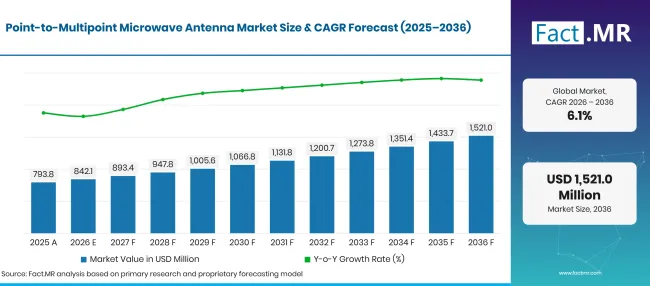
Point To Multipoint Microwave Antenna Market Forecast Global 1 | Source: Fact.MR
| Year | Basis | Market Value (USD Million) |
|---|---|---|
| 2025 | Actual | 793.8 |
| 2026 | Estimate | 842.2 |
| 2036 | Forecast | 1521.0 |
| CAGR 2026 to 2036 | Forecast period | 6.1% |
Source: Fact.MR analysis. Updated Oct 24, 2026
What are the defining numbers behind Point-to-Multipoint Microwave Antenna Market growth?
USD 678.8 Million absolute chance between 2026 and 2036, with flat panel antennas, telecommunications applications, and telecom operators generating the largest deployment volume.
- Demand Drivers in the Market
- FCC broadband reporting requirements show that fixed-wireless providers must submit propagation-model details, base-station locations and heights, carrier information, link-budget parameters, and clutter data; receiver-height inputs must be between 4 and 7 metres, while model and terrain resolution may not exceed 100 metres [1]. These engineering disclosures reinforce demand for accurately characterized sector and subscriber antennas in point-to-multipoint network planning.
- The FCC’s June 2025 Broadband Data Collection window continued location-level reporting for fixed and mobile broadband, giving regulators and network planners a current basis for identifying unserved and underserved areas [2]. More precise availability data supports targeted fixed-wireless deployments where directional point-to-multipoint links can close coverage gaps.
- NTIA’s BEAD framework covers all 56 states and territories, and by October 2026 all 56 had approved Final Proposals; 55 had signed and returned award agreements [3]. The move from planning to implementation expands the addressable pipeline for fixed-wireless equipment where approved project designs use wireless links.
- ITU estimated that 73.6% of the world’s population used the Internet in 2025, while 2.2 billion people remained offline; 5G covered 55.1% of the global population [4]. The remaining access gap, concentrated in lower-income and rural areas, sustains demand for rapidly deployable fixed-wireless and point-to-multipoint infrastructure.
- Key Segments Analyzed
- By Product Type: Flat Panel Antennas holds 38.5% share in 2026, preferred across subscriber premises, urban small cell attachments, and smart utility poles for its unobtrusive aesthetic profile and directional gain.
- By Frequency Range: C Band holds 36.4% share in 2026, dominating commercial carrier allocations due to its optimal balance between long-distance propagation range and high rain-fade resistance.
- By Application: Telecommunications accounts for 52.3% share in 2026, driven by mobile network operators deploying fixed wireless access broadband and cellular base station backhaul links.
- By End-User: Telecom Operators holds 44.6% share in 2026, supported by Tier-1 and Tier-2 mobile network carriers modernizing network infrastructure and rural coverage networks.
- Analyst Opinion at Fact.MR
- Shambhu Nath Jha, Lead Consultant at Fact.MR, states, “The point-to-multipoint microwave antenna market is experiencing a profound architectural evolution driven by the convergence of 5G fixed wireless access, automated frequency coordination (AFC) in the 6 GHz band, and multi-beam horn technologies. As mobile operators face escalating fiber trenching costs in suburban and rural areas, high-capacity point-to-multipoint microwave links have become the primary mechanism to deliver gigabit broadband. Antenna manufacturers who develop high-isolation dual-slant polarized antennas with integrated GPS timing and aerodynamically optimized radomes will capture preferred vendor status across global telecom operators.”
- Strategic Implications
- ETSI’s 2026 harmonised standard EN 302 326-2 directly covers fixed-radio multipoint equipment and antennas and specifies requirements for access to radio spectrum [5]. This current standards baseline raises the importance of compliant antenna radiation characteristics, spectrum efficiency, and interference control in new point-to-multipoint product designs.
- Tower infrastructure providers are standardizing universal quick-mount clamping brackets and integrated alignment sights. Providing tool-less elevation and azimuth adjustment mechanisms cuts technician installation time at tower heights by over 40.0%, significantly reducing hazardous climbing hours and contractor labor expenses.
- Wireless equipment manufacturers are expanding backward-compatible antenna portfolios capable of covering wide continuous frequency bands from 4.9 GHz to 6.4 GHz within a single physical housing. Sourcing directors negotiate multi-year supply agreements for UV-stabilized polycarbonate radome plastics and precision aluminum casting alloys, insulating production lines from global commodity fluctuations.
- Smart grid utilities are deploying private point-to-multipoint microwave networks to connect substations, automated reclosers, and renewable solar arrays. Private microwave communications eliminate reliance on commercial cellular networks, guaranteeing ultra-reliable low-latency telemetry during severe weather power outage events.
The United States is projected to record an industry-leading 7.7% CAGR, driven by massive federal broadband equity subsidies (BEAD), aggressive fixed wireless competition, and smart grid automation. Germany advances at a 6.9% CAGR, supported by industrial private 5G campus networks, rural digital connectivity funding, and railway wireless modernization. Brazil records a 6.5% CAGR, propelled by expanding regional internet service providers (ISPs), agricultural smart-farming connectivity, and municipal public safety camera networks. Japan registers a 6.1% CAGR, anchored by disaster-resilient communications infrastructure, urban small cell densification, and high-frequency microwave relay networks. The United Kingdom expands at a 5.4% CAGR, underpinned by Project Gigabit rural wireless rollouts, transport corridor connectivity, and coastal defense microwave links.
How does the Point-to-Multipoint Microwave Antenna Market break down by segment?
Flat Panel Antennas 38.5%; Telecommunications 52.3%; Telecom Operators 44.6%; C Band 36.4% in 2026.
Which Product Type dominates?
Flat Panel Antennas holds 38.5% share in 2026.
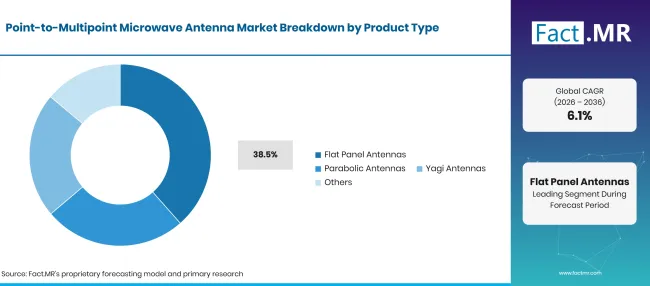
Point To Multipoint Microwave Antenna Market Breakdown Product Type | Source: Fact.MR
| Product Type | Share (2026) |
|---|---|
| Flat Panel Antennas (Leading segment) | 38.5% |
| Other segments combined (Parabolic, Yagi, Others) | 61.5%* |
| Total | 100.0% |
Source: Fact.MR analysis. Updated Oct 24, 2026
Flat panel antennas command the largest market share, generating nearly four-tenths of total market revenues. The aesthetic, compact form factor of flat panel antennas makes them highly attractive for customer-premises equipment (CPE) installations on residential rooftops, commercial building exteriors, and municipal utility poles where bulky parabolic dishes face zoning objections. Modern flat panels integrate microstrip patch arrays behind weatherproof radomes, providing directional gains ranging from 16 dBi to 24 dBi with dual-linear or dual-slant polarization. Parabolic antennas follow closely, dominating long-range subscriber links and high-capacity backhaul connections exceeding 10 kilometers due to their superior focused pencil-beam gain. Yagi and corner-reflector antennas account for the remaining share, utilized in lower-frequency telemetry and SCADA links. Network operators integrate these antenna systems with fixed wireless broadband links to deliver gigabit residential internet. Field engineers install sector antennas across cellular macro base stations to distribute high-capacity wireless backhaul. Telecom providers also bundle hub sites with multi-beam massive MIMO panels to maximize spectral reuse. Municipal networks deploy dense urban small cell arrays for public Wi-Fi and camera backhaul.
What leads the Application segment?
Telecommunications accounts for 52.3% share in 2026.
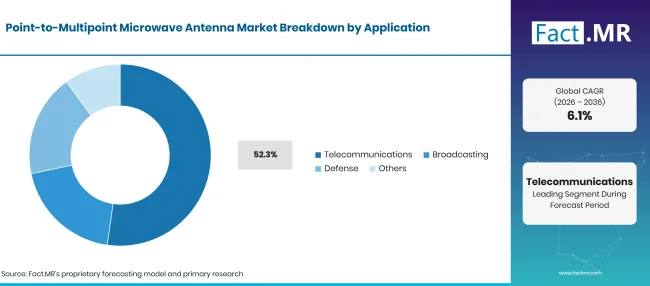
Point To Multipoint Microwave Antenna Market Breakdown Application | Source: Fact.MR
| Application | Share (2026) |
|---|---|
| Telecommunications (Leading segment) | 52.3% |
| Other segments combined | 47.7%* |
| Total | 100.0% |
Source: Fact.MR analysis. Updated Oct 24, 2026
Telecommunications represents the dominant application segment, commanding more than half of global industry spending. Mobile network operators and commercial internet service providers utilize point-to-multipoint microwave antenna architectures to deliver last-mile Fixed Wireless Access broadband, interconnect cellular microcells with centralized fiber points of presence (PoPs), and establish redundant backup transmission paths. Broadcasting follows as an important secondary vertical, utilizing microwave antennas for electronic news gathering (ENG) and remote outside broadcast links. Defense agencies, maritime port authorities, and railway operators comprise the remainder, deploying secure microwave networks for video surveillance and tactical battlefield telemetry. Infrastructure managers deploy steerable active antenna arrays to track moving maritime vessels. Network builders deploy complete carrier-grade wireless infrastructure across metropolitan corridors. Tower riggers utilize heavy-duty telecom tower mounting brackets to secure multi-sector arrays against high wind loads. Field teams also deploy microwave wireless backhaul links to bridge remote island communities. Sourcing executives specify weatherproof fluoropolymer radome materials to prevent ice accumulation. Substation operators utilize remote antenna feed optical links to connect tower-top radios to central control rooms.
Which Frequency Range captures the largest market share?
C Band holds 36.4% share in 2026.
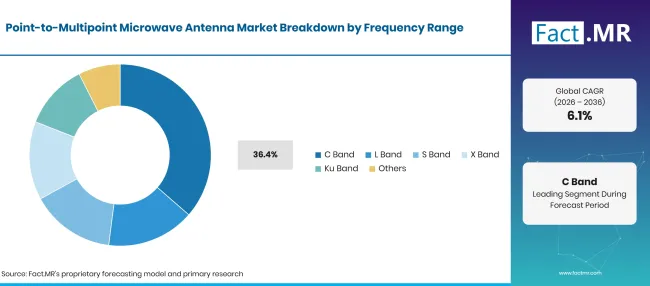
Point To Multipoint Microwave Antenna Market Breakdown Frequency Range | Source: Fact.MR
| Frequency Range | Share (2026) |
|---|---|
| C Band (Leading segment) | 36.4% |
| Other segments combined (L, S, X, Ku Bands, Others) | 63.6%* |
| Total | 100.0% |
Source: Fact.MR analysis. Updated Oct 24, 2026
C-band frequencies (nominally 4.0 GHz to 8.0 GHz, including 5 GHz and 6 GHz unlicensed bands) represent the largest frequency segment, accounting for 36.4% of total market value. Wireless service providers heavily favor C-band microwave spectrum because it provides the optimal engineering balance between long-distance non-line-of-sight propagation, minimal atmospheric rain attenuation, and multi-hundred-megahertz channel bandwidths. L-band and S-band antennas serve long-range utility SCADA and telemetry networks requiring superior foliage penetration. Ku-band (12 GHz to 18 GHz) and millimetric bands (24 GHz to 60 GHz) serve dense urban microcell backhaul links where ultra-wide transmission bandwidths are required over short line-of-sight distances.
What is accelerating Point-to-Multipoint Microwave Antenna Market adoption, and what is holding it back?
Global rural broadband equity funding, Fixed Wireless Access subscriber growth, and 5G small cell backhaul densification accelerate market expansion. Line-of-sight foliage blockage, high-frequency rain-fade attenuation, and increasing urban optical fiber competition restrict frictionless market penetration.
Drivers Impact Analysis
| DRIVER | (~) % IMPACT ON CAGR | GEOGRAPHIC RELEVANCE | IMPACT TIMELINE |
|---|---|---|---|
| Multi-billion-dollar government broadband equity subsidies for rural wireless access | +1.8% | North America, Europe | Short term (<= 2 years) |
| Rapid commercial adoption of 5G Fixed Wireless Access as a cost-effective fiber substitute | +1.5% | Global | Short term (<= 2 years) |
| Densification of cellular small cell networks requiring flexible wireless backhaul | +1.2% | East Asia, North America | Medium term (2–4 years) |
| Deployment of private wireless networks across smart utility grids and oil/gas pipelines | +0.9% | North America, Latin America | Medium term (2–4 years) |
| Opening of 6 GHz unlicensed and lightly licensed spectrum for wideband point-to-multipoint | +0.7% | North America, Europe | Long term (>= 4 years) |
Source: Fact.MR analysis. Updated Oct 24, 2026
Opportunity Impact Analysis
| OPPORTUNITY | (~) % IMPACT ON CAGR | GEOGRAPHIC RELEVANCE | IMPACT TIMELINE |
|---|---|---|---|
| Symmetrical horn antennas delivering zero side-lobe co-location on crowded cell masts | +1.6% | Global | Short term (<= 2 years) |
| Automated Frequency Coordination (AFC) enabling high-power outdoor 6 GHz standard power links | +1.3% | USA, Western Europe | Short term (<= 2 years) |
| Integrated active beamforming phased arrays dynamically steering sectors toward busy terminals | +1.1% | East Asia, North America | Medium term (2–4 years) |
| Aerodynamic low-drag flat panel radomes reducing tower structural reinforcement costs | +0.8% | Global | Long term (>= 4 years) |
Source: Fact.MR analysis. Updated Oct 24, 2026
Restraints Impact Analysis
| RESTRAINT | (~) % IMPACT ON CAGR | GEOGRAPHIC RELEVANCE | IMPACT TIMELINE |
|---|---|---|---|
| Rapid expansion of subsidized fiber-to-the-home (FTTH) networks displacing wireless links | -1.4% | Western Europe, East Asia | Short term (<= 2 years) |
| Severe signal attenuation caused by heavy rainfall and foliage obstruction at high frequencies | -1.1% | Latin America, South Asia | Short term (<= 2 years) |
| Stringent municipal zoning aesthetic restrictions on visible outdoor antenna installations | -0.8% | Europe, North America | Medium term (2–4 years) |
| Spectrum congestion and radio interference in shared unlicensed 5 GHz frequency bands | -0.6% | Global | Long term (>= 4 years) |
Source: Fact.MR analysis. Updated Oct 24, 2026
Which countries are scaling the Point-to-Multipoint Microwave Antenna Market through 2036?
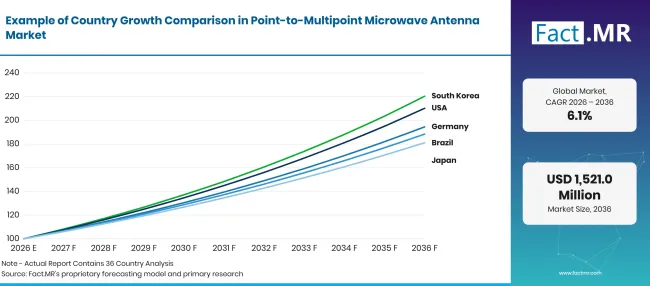
Point To Multipoint Microwave Antenna Market Growth Index | Source: Fact.MR
| Country | CAGR (2026–2036) |
|---|---|
| USA | 7.7% |
| Germany | 6.9% |
| Brazil | 6.5% |
| Japan | 6.1% |
| UK | 5.4% |
Source: Fact.MR analysis. Updated Oct 24, 2026
What sustains engineering leadership in Germany?
6.9% CAGR, supported by industrial private 5G campus networks, rural digital connectivity funding, and railway wireless modernization.
Germany’s 2025 telecommunications data show that active fibre connections increased from 5.3 million to 6.4 million, while connections offering at least 100 Mbps rose from 21.5 million to 23.6 million [6]. This rapid fixed-network modernization increases backhaul density and creates complementary demand for microwave links at mobile sites, industrial campuses, and locations where fibre extension remains operationally difficult.
What opportunities are unfolding across Brazil?
6.5% CAGR, backed by expanding regional internet service providers (ISPs), agricultural smart-farming connectivity, and municipal public safety camera networks.
Anatel’s 2025–2029 structural plan maps Brazil’s connectivity gaps across fibre backhaul, broadband penetration, provider presence, 4G coverage, rural versus urban service, and locations without coverage commitments [7]. The breadth of these documented gaps supports continued use of point-to-multipoint systems by regional providers and rural networks that need flexible distribution beyond existing fibre routes.
Why does the United States lead global market growth?
7.7% CAGR, propelled by massive federal broadband equity subsidies (BEAD), aggressive fixed wireless competition, and smart grid automation.
The FCC’s Internet Access Services report for June 2025 consolidates fixed-connection data from Form 477 and the Broadband Data Collection, providing a current official measure of U.S. broadband deployment and adoption [8]. The reporting framework distinguishes the location-level availability needed to identify where fixed-wireless networks can add coverage or capacity.
How is the United Kingdom modernizing rural connectivity?
5.4% CAGR, supported by Project Gigabit rural wireless rollouts, transport corridor connectivity, and coastal defense microwave links.
Ofcom reported that, by July 2025, gigabit-capable networks reached 87% of UK residential premises and full fibre reached 78%; its dataset included submissions from 52 fixed-network and 18 fixed-wireless-access providers [9]. The remaining hard-to-reach premises and the established FWA provider base support continued deployment of point-to-multipoint access and backhaul systems.
Why does Japan maintain steady market consumption?
6.1% CAGR, anchored by disaster-resilient communications infrastructure, urban small cell densification, and high-frequency microwave relay networks.
Japan’s 2025 Information and Communications White Paper records that the January 2024 Noto earthquake disrupted terrestrial television, radio, and cable television through power outages, relay-station damage, and cable breaks; MIC consequently planned a FY2025 project to strengthen mobile-phone base stations during disasters [10]. This verified resilience requirement supports redundant microwave and rapidly deployable wireless links for emergency restoration.
Who leads the Point-to-Multipoint Microwave Antenna Market?
Huawei Technologies Co., Ltd. commands the leading global market share at 20.3% in 2026, manufacturing an expansive portfolio of multi-band sector antennas, flat-panel subscriber terminals, and integrated microwave backhaul systems deployed across Asia, Africa, and Latin America. Ericsson AB and Nokia Corporation represent formidable European telecommunications titans, supplying carrier-grade microwave antennas, integrated active antenna units, and high-reliability wireless backhaul systems to Tier-1 mobile network operators globally. ZTE Corporation maintains a massive international manufacturing footprint, delivering cost-competitive flat-panel and parabolic microwave antennas for large-scale wireless infrastructure projects.
Cambium Networks, Ltd. and Ubiquiti Networks, Inc. stand as premier global pioneers in the fixed wireless access and WISP ecosystem, supplying millions of high-performance sector horns, flat-panel subscriber antennas, and beamforming arrays to regional broadband providers worldwide. Siklu Communication Ltd. (a division of Ceragon Networks) and Mimosa Networks, Inc. (Radisys) specialize in multi-gigabit millimeter-wave and unlicensed-band point-to-multipoint antennas tailored for dense urban small cell backhaul. Proxim Wireless Corporation and Intracom Telecom provide elite carrier-grade wireless systems, delivering ultra-wideband point-to-multipoint microwave radios, advanced antenna arrays, and private networking infrastructure to government defense agencies and telecommunications operators globally.
Which companies are the key providers?
Key companies include Huawei Technologies Co., Ltd.; Ericsson AB; Nokia Corporation; ZTE Corporation; Cambium Networks, Ltd.; Ubiquiti Networks, Inc.; Siklu Communication Ltd.; Mimosa Networks, Inc.; Proxim Wireless Corporation; and Intracom Telecom.
- Huawei Technologies Co., Ltd.
- Ericsson AB
- Nokia Corporation
- ZTE Corporation
- Cambium Networks, Ltd.
- Ubiquiti Networks, Inc.
- Siklu Communication Ltd.
- Mimosa Networks, Inc.
- Proxim Wireless Corporation
- Intracom Telecom
Bibliography
- [1] Federal Communications Commission. (2025, June 30). Fixed wireless broadband supporting data. Broadband Data Collection Help Center.
- [2] Federal Communications Commission. (2025). Broadband Data Collection.
- [3] National Telecommunications and Information Administration. (2026, October 20). BEAD Progress Dashboard.
- [4] International Telecommunication Union. (2025). Measuring digital development: Facts and Figures 2025.
- [5] European Telecommunications Standards Institute. (2026). Fixed Radio Systems; Multipoint Equipment and Antennas; Part 2: Harmonised Standard for access to radio spectrum (ETSI EN 302 326-2 V2.2.1).
- [6] Bundesnetzagentur. (2026, June 5). Telecoms Annual Report 2025.
- [7] Agência Nacional de Telecomunicações. (2025). Telecommunications Networks Structural Plan—PERT 2025–2029.
- [8] Federal Communications Commission. (2026, May 8). Internet Access Services: Status as of June 30, 2025.
- [9] Office of Communications. (2025, November 19). Connected Nations UK Report 2025.
- [10] Ministry of Internal Affairs and Communications. (2025). Responding to increasingly severe disasters. In Information and Communications in Japan 2025 (Part I, Chapter 3, Section 3).
This Report Answers
- How does the global point-to-multipoint microwave antenna market expand from USD 842.2 Million in 2026 to USD 1521.0 Million by 2036?
- What electromagnetic design innovations in substrate-integrated waveguide (SIW) cavity arrays minimize side-lobe radiation?
- Why do flat panel antennas command 38.5% of total market revenue in 2026?
- How are Wireless Internet Service Providers (WISPs) utilizing Automated Frequency Coordination (AFC) to deploy high-capacity 6 GHz links?
- What factors support the United States achieving an industry-leading 7.7% CAGR through 2036?
- How are mobile network operators deploying point-to-multipoint microwave backhaul to densify 5G urban small cells?
- What role do symmetrical horn antennas play in eliminating self-interference on crowded co-located cell tower masts?
What does the Point-to-Multipoint Microwave Antenna Market cover?
Directional and sectorized antennas that connect one hub site to multiple remote terminals form the core of this market. Coverage includes flat-panel, parabolic, Yagi, sector, and horn antenna formats used in fixed wireless broadband, cellular backhaul, broadcasting, defense, and private enterprise networks.
Demand is tracked across telecom operators, internet service providers, government and defense users, and other commercial or institutional networks. Market value is measured at the first sale of antenna hardware through manufacturers, distributors, and authorized channel partners.
What is included in the scope?
Passive point-to-multipoint microwave antennas, integrated antenna assemblies sold with dedicated radio units, mounting hardware supplied as part of the antenna package, and outdoor radomes are included when sold for fixed wireless access, backhaul, telemetry, surveillance, or private-network deployment.
Products operating across C, L, S, X, Ku, and adjacent commercial microwave bands are covered where the antenna is designed to serve multiple subscriber or remote endpoints from a central site.
What is excluded from the scope?
Point-to-point-only microwave antennas, satellite user terminals, consumer Wi-Fi routers, indoor access points, handheld-device antennas, and broadcast receiving dishes sold solely for television reception are excluded.
Spectrum licences, tower leases, civil works, fibre backhaul, installation labor, managed connectivity services, and standalone microwave radios sold without an antenna are outside the revenue boundary.
Segmentation
What is the report’s scope and coverage?
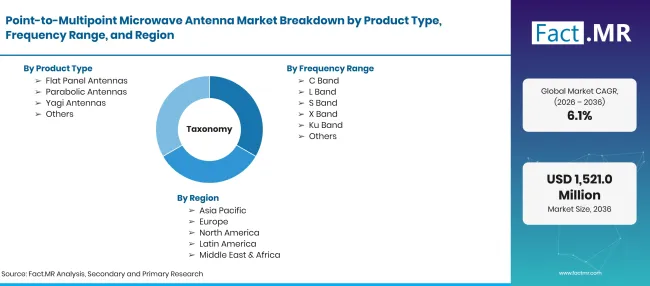
Point To Multipoint Microwave Antenna Market Taxonomy | Source: Fact.MR
| Attribute | Details |
|---|---|
| Quantitative Units | USD Million |
| Market Definition | Commercial shipments of directional and sectorized point-to-multipoint microwave antennas (flat panel, parabolic, sector, horn) utilized for fixed wireless broadband access, small cell backhaul, and private enterprise networks. |
| Product Type | Flat Panel Antennas; Parabolic Antennas; Yagi Antennas; Others |
| Frequency Range | C Band; L Band; S Band; X Band; Ku Band; Others |
| Application | Telecommunications; Broadcasting; Defense; Others |
| End-User | Telecom Operators; Internet Service Providers; Government and Defense; Others |
| Regions Covered | North America; Latin America; Western Europe; Eastern Europe; East Asia; South Asia & Pacific; Middle East & Africa |
| Countries Covered | Germany; Brazil; USA; UK; Japan |
| Companies Profiled | Huawei Technologies Co., Ltd.; Ericsson AB; Nokia Corporation; ZTE Corporation; Cambium Networks, Ltd.; Ubiquiti Networks, Inc.; Siklu Communication Ltd.; Mimosa Networks, Inc.; Proxim Wireless Corporation; Intracom Telecom |
| Forecast Period | 2026 to 2036 |
| Approach | Primary interviews with wireless internet service provider network architects, cellular backhaul planning engineers, and microwave antenna radome material specialists combined with spectrum licensing database audits. |
Source: Fact.MR analysis. Updated Oct 24, 2026
How is the market segmented?
-
By Product Type
- Flat Panel Antennas
- Parabolic Antennas
- Yagi Antennas
- Others
-
By Frequency Range
- C Band
- L Band
- S Band
- X Band
- Ku Band
- Others
-
By Application
- Telecommunications
- Broadcasting
- Defense
- Others
-
By End-User
- Telecom Operators
- Internet Service Providers
- Government and Defense
- Others
-
By Region
- North America
- Latin America
- Western Europe
- Eastern Europe
- East Asia
- South Asia & Pacific
- Middle East & Africa
Frequently Asked Questions
What is the projected value of the Point-to-Multipoint Microwave Antenna Market by 2036?
Which product type dominates the market?
What is the primary application driving point-to-multipoint antenna sales?
Which country is projected to record the highest growth rate during the forecast period?
Who is the leading global provider of point-to-multipoint microwave antennas?
Who worked on this report


Preview the report firsthand - request a free sample
Free SampleGet the brochure for pricing and purchase details
Download PDF